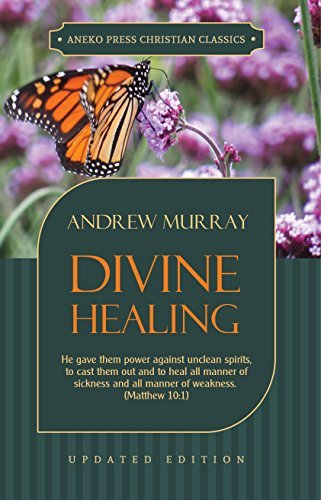
Divine Healing (Updated and Annotated): He gave them power against unclean spirits, to cast them out and to heal all manner of sickness and all manner ... 10:1
Jesus is still He who heals both soul and body. Salvation offers holiness and healing, and the Holy Spirit is willing to give us a manifestation of His power. When we ask why this divine power is not more often seen, the only biblical answer to be found is: “Because of your unbelief.”
Health as well as salvation is to be obtained by faith. The natural tendency of man is to bring about his salvation by his works, and it is only with difficulty that he comes to receive it by faith. But when it is a question of healing the body, he has still more difficulty grasping that truth. As to salvation, he finally accepts it because there is no other way to open the door of heaven. But for the body, he makes use of many other treatments. But happy is he who understands that it is the will of God to show the power of Jesus and to reveal to us His Fatherly love by healing physically as well as spiritually. By doing so, He increases and confirms our faith and teaches us that He demonstrates the power of redemption in the body as well as in the soul.
This book provides biblical clarity concerning divine healing, and supplies basic and applicable principles necessary to having faith concerning healing. The author makes it very clear that we are not healed based on who we are, but based on who Christ is.
About the Author Andrew Murray (1828-1917) was a well-known South African writer, teacher, and pastor. More than 2 million copies of his books have been sold, and his name is mentioned among the other great leaders of the past such as Charles Spurgeon, T. Austin-Sparks, George Muller, D.L. Moody, and more.
Librarian Note: There is more than one author in the GoodReads database with this name.
Murray was Born in Cape Town, South Africa, Murray became a noted missionary leader. His father was a Scottish Presbyterian serving the Dutch Reformed Church of South Africa, and his mother had connections with both French Huguenots and German Lutherans. This background to some extent explains his ecumenical spirit. He was educated at Aberdeen University, Scotland, and at Utrecht University in the Netherlands. After ordination in 1848 he served pastorates at Bloemfontein, Worcester, Cape Town, and Wellington. He helped to found what are now the University College of the Orange Free State and the Stellenbosch Seminary. He served as Moderator of the Cape Synod of the Dutch Reformed Church and was president of both the YMCA (1865) and the South Africa General Mission (1888-1917), now the Africa Evangelical Fellowship.
He was one of the chief promoters of the call to missions in South Africa. This led to the Dutch Reformed Church missions to blacks in the Transvaal and Malawi. Apart from his evangelistic tours in South Africa, he spoke at the Keswick and Northfield Conventions in 1895, making a great impression. upon his British and American audiences. For his contribution to world missions he was given an honorary doctorate by the universities of Aberdeen (1898) and Cape of Good Hope(1907).
Murray is best known today for his devotional writings, which place great emphasis on the need for a rich, personal devotional life. Many of his 240 publications explain in how he saw this devotion and its outworking in the life of the Christian. Several of his books have become devotional classics. Among these are Abide in Christ, Absolute Surrender, With Christ in the School of Prayer, The Spirit of Christ and Waiting on God.
Yet again Andrew Murray did not fail in presenting the truth of God's Word, I just love his deep writing , if us christians will believe more in the Bible then other non biblical words from different people we will have an enormous impact in our lives and the others too.
I don’t agree with this book, and maybe Andrew Murray himself began to disagree somewhat with his own writing year’s later, but it has served to convict me greatly in my lack of faith in God’s willingness to use divine healing in today’s day and age. Not through people with the gift of healing, like in the early church (certainly not through Benny Hinn) but through prayer and God’s power, which is the same yesterday, today and forever. Having some continuationist friends, I decided to read this to see where they are coming from and to challenge my own views. Coming from a cessationist, reformed Baptist church, I think most of us are afraid of associating with anything charismatic, and therefore are cautious to believe in healing without the means of medical intervention. This little book has caused me to examine my heart and my reliance on my own wisdom, supplements, medications, etc to heal illness, rather than to question why the sickness has occurred, if their is sin in my life I need to repent of. That is not to say I believe sickness is a result of sin, like Murray thinks. I think it is a result of the fall. But I do believe God is sovereign over the affairs of men and disciplines us in ways that may include illness. My first instinct is to be logical and take an ibuprofen or something before repenting and asking the Lord to heal. And if I get relief through meds, meds share the glory with God, but if I am healed by the prayer of faith, God alone is glorified. I am not saying there isn’t a place for medical intervention and I’m not saying all can be healed, like Murray seems to believe, but it has certainly caused me to search the scriptures about it. Yet I see sickness and death afflicting godly men and women and so believe, against Murray’s book, that illness must serve another purpose and that their may be good and loving reasons why we may remain sick and die in illness. I mean, a man of faith who did miracles from God, Elisha, became ill and died? Timothy had stomach problems. Epaphroditus was sick to the point of death but recovered by God’s grace…no talk of unrepentance there, just God’s grace. Also Trophimus who had accompanied the apostle Paul was sick and Paul had to leave him. The question is, if healing was for all believers at all times, why didn’t Paul heal him? Also sickness can also be judgement on a whole nation or group of people because of their sin, right? God is sovereign and knows perfectly how we may be sanctified and this “light momentary affliction is preparing for us and eternal weight of glory beyond all comparison.” Whether His will is for us to be healed now or to remain in sickness, praying with all perseverance to be healed, or to die and be in glory, I am grateful that he bore our greatest disease, sin and that we have an eternal home without sin, illness or pain.
This book composed as a devotional how we pray and waiting for a healing. This is not a complicated theology book and perhaps means for the author to share his experience in divine healing.
My mind went on high alert almost immediately once I began reading this book. In the very first chapter Murray advocates that, “He is always the same Savior both of the soul and of the body, equally ready to grant pardon and healing.” Murray continues throughout the entire book to link physical healing to what he dubs “full salvation.”
In addition to making it clear that a sick person cannot glorify God as well as one who has been healed, Murray also disparages seeking out any kind of earthly remedies, using instances of God’s healing to support his dangerous conclusion, “Does not all this clearly show that the believer is to look for healing in response to the prayer of faith alone, and without the addition of remedies?” He never addresses the Apostle Paul’s admonition to Timothy to “No longer drink only water, but use a little wine for the sake of your stomach and your frequent ailments” (1 Timothy 5:23).
Murray’s constant association of prolonged sickness with unconfessed sin also flies in the face of Paul’s experience with his “thorn in the flesh,” which Paul pleaded with God to remove, but received instead the response, “My grace is sufficient for you” (2 Corinthians 12:7-9). In stark contrast, Murray says, “Sick Christian, open your Bible, study it, and see in its pages that sickness is a warning to renounce sin, but that whoever acknowledges and forsakes his sin finds in Jesus pardon and healing.”
There is chapter after chapter of such false teaching that offers only condemnation and no comfort for the many Christians who suffer much like Job did, not because of personal sin, but because the purpose and ways of God are past understanding and explanation. Unfortunately, in this book Andrew Murray places himself squarely in the company of Job’s friends and misses the opportunity to proclaim the hope of the true gospel - that Jesus saves and heals because of His great mercy and not because of our own works of righteousness or the strength of our faith (Titus 3:5-6). And even in our darkest valleys, we need fear no evil, not because of guaranteed healing, but because He is with us (Psalm 23).
Great book that is absolutely Biblical and goes through all aspects of healing from a Biblical perspective. Andrew Murray has written some classic Christian books and this should be with them. A must for Christians to read!
I have been reading books on divine healing, trying to wrap my mind around something that is supposed to be commonplace in the church (see Mark 16:17-18). This one contains some of the same verses as other books I have read, but not so much faith-building encouragement. If you really want to have your faith built up to receive or administer divine healing, I recommend Christ the Healer by F.F. Bosworth instead.
This is a short book with very short chapters with each chapter looking at a particular aspect of divine healing. I read this book to strengthen my faith in God's work of healing--and I was not disappointed. If you have read Andrew Murray you are aware of his style of writing. Murray systematically will peruse the entire Bible on the given subject of his book! Unlike other authors, however, he does so in a succinct manner. Thus, this is a short Biblical treatise on healing.
My main take-away from Divine Healing is this: if Jesus truly (and accurately) represents God then God must care for the body, that is, our physical well-being matters to God. This then becomes the basis for divine healing.
This is underscored by a second point that Murray makes: Our bodies-not our souls or spirit- is the temple of the Holy Spirit. This last point gave me a new appreciation for the importance the body has in God's design. The body is not simply a piece of clothing that needs to be tidied up occassionally but a sacred treasure valued by God. In this way, Murray reverses the importance of the body from a human-centric emphasis to a God-centered one.
Lastly, Murray's writing style is devotional and similar to other religious authors of his period (late 19th century). If you can get past some of these stylistic bumps I believe Murray gives some keen insight on divine healing.
This is yet another great read and study by Murray. If you are looking for a book on healing with Scriptural Truth then you don’t have to look no further. Murray expounds on the subject of healing that builds the faith of those that read and study out God’s word for themselves.
Everything I’ve read by author & preacher Andrew Murray has been top-notch. This particular book and topic, however, are a different bag. Murray begins with the same piety and eloquence we expect from him. But soon, he launches out on a wobbly tightrope, with a handful of iffy postulations on sickness and healing:
• All illness derives from sin. • So naturally, Jesus never got sick. • And naturally, if you address your sin, and pray in faith, it will lead to healing. • And naturally, if you are living a sanctified life, even your death will only come through old age (or some accident or violent means).
Murray goes on to describe an idealistic life where the trajectory of a dedicated Christian is ever upward. He urges believers on to something he calls “full salvation,” marked by victorious Christian living that sails blissfully above the daily struggles with brokenness experienced by those he terms “low level Christians.” (I am not making this up.)
I’ve found it particularly fascinating (and encouraging) to be simultaneously reading author Barbara Duguid’s book “Extravagant Grace” this year. There could not be a more stark contrast to Murray!
Duguid fleshes out puritan minister John Owen’s views on sanctification and mortifying sin. In a memorable scene where she wrestles with chronic migraines, as well as another where she chronicles her battle with clinical obesity, Duguid’s personal acknowledgment of human frailty resonates deeply with me. Does that make me a “low level Christian”? 😬
Also, so many practical questions were raised from “Divine Healing” that Murray didn’t begin to answer. For starters, his examples of praying for healing were in cases of adult believers seeking healing for themselves. For me as a parent with a household of kids passing germs around to each other, this seems unhelpful.
• Never was the question of illness spreading in a broader household or community addressed. • Nor an acknowledgement of a parent's responsibility to seek physical remedies for their children. • Nor the question of birth defects. • Nor the question of how Christian medical professionals ought to view their position. • Nor an acknowledgement of the possible role of spiritual warfare in stirring up hardships such as illness.
I will reaffirm though, that Murray’s other writings have been spot-on, and I look forward to reading more by him. Posting this as a timely reminder not to write others off, just because we don’t agree with them on a single issue. Modern arrogance so easily dismisses our heroes for not being correct enough to suit our “enlightened” understanding.
This book was written in the 1800’s; however, this edition has updated English, and it is easy to read. The truths within its pages are issues that we in our current period of time have neglected and in some cases have thought do not pertain to us today, but Andrew Murray points out to us that these truths definitely apply to our times. Healing is available, but we need to consider and apply some preparation and awareness prior to availing ourselves and others to God’s gifts.
I recommend this book to those in leadership in the Church, those who are going into ministry and those who have been involved in ministry for many years, but are unaware that they have become hardened by what they think God can do today and can’t do today.
We tend to think the prodigal son was the wandering person; however, the elder son who remained at home with the father also needed to repent. Andrew Murray got me to look at my own life and evaluate where I need to change.
I chose this five star rating because sometimes those in ministry forget that we too need to change, and we need to remain connected to the vine; otherwise, the healing and fruit will not become evident.
In the chapter entitled “is sickness a chastisement?” Murray postulates that there is a close relationship between sin and sickness; while he does recognise sinfulness and illness do not always go together, it does - according to him - tend to be the case that being sinful leads to being ill. Therefore, if one is ill you should immediately repent because the removal of ones sin can lead to the Holy Spirit healing you.
In an age of modern scientific knowledge I am extremely alarmed that people think that this book can provide one with knowledge and wisdom on sickness - it is clear that this man is just a religious fanatic and that he has zero understanding on the topic that he is talking about. This means that the only value one can derive from this work (and, I would say, all of Murray’s) is it can help us to understand how batshit insane and dumb this species was in the past - and currently are.
This is my first Andrew Murray book. It was very challenging, because it discusses mastering and controlling your body before we can receive "divine healing." Over the past year, I've read several books mentioning that we as believers were supposed to do and experience the same things - and even more - than Jesus's disciples. The church seems to have forgotten that. So this year, I'm on a mission to master my body, to discipline my body and mind, and fully surrender to God and the Holy Spirit. We are missing out on so many of God's blessings because we have too little faith and are content to have lukewarm relationships with God.
I felt the author cherry-picked Bible verses. His arguments boil down to the church's failure in not teaching correctly, the person not praying earnestly, the person not repenting, the person not praying the correct prayer, the person not trusting, etc.
I read teachers' books to be inspired; unfortunately, this book did not. I have read other Murray books that were inspiring, but I will shelve this book.
Really enjoyed this book. The author takes the word of God seriously and takes a methodical but inspired approach to taking the reader through scripture in well organized orderly progression of topics. I found the book insightful and inspiring. I disciple in Africa and plan on building a training around these topics. I appreciate the organization of the materials and the straight forward interpretation, that take Jesus at His word.
I have really appreciated other books by Murray, but this was too close to prosperity gospel for me. I don't think that it is always God's will to heal in this lifetime, and I just couldn't get on board with him that it is completely dependent on our faith for whether we receive healing or not. Stopped in chapter 13, when he was just strengthening his argument and not pulling back as I thought he might.
I so have enjoyed many of the Andrew Murray books.his writings are beautiful as well as timely.this one is a anointed teaching tool.teaching both who we are in Christ and what he has wrought at the cross.another treasure added to my Murray collection.good narration I highly recommend,
Encouraging and practical. A must read....... For all devotees of Jesus Messiah
Mr Murray exhorts to every believer to not live below our privileges as followers of Jesus Christ. To take hold of what is our inheritance and live out our faith, daily. This book is for the devote disciple, who will hear and obey and carry the mandate set forth by Christ.
Christians who want to live a sactified life would benefot from this book. Each chapter is a divine healing "sermonette" with scriptural references always pointing back to Jesus as our example and the Vine. The last chapter sums it up nicely. Well done!
There are many books on healing, however this one brought out a few good points about repentance, followed by healing, and more. It read a little slower for me, hence the four stars.
A heavy emphasis on sin as the root cause of sickness. It is a collection of essays, so there is lots of overlap, and the book feels somewhat disjointed. The last 2 chapters, which only loosely deal with healing, were by far my favorite.
Filled with spiritual insights that took me by surprise. I would like to know more about his subject and grow in my experience of living in the true Spirit of God.
I do not know when I read the book but it was quite a few years ago.
I could not finish it. Church dogma, from cover to cover. The author asserts spiritual healing does not happen with the frequency that it did when Jesus lived, because of our unbelief. He further insists that conversion is required to receive such a gift. Blah blah blah
I would recommend this book to anyone searching for a closer relationship with Christ. It challenges a lot of preconceived ideas about God's willingness to work in the lives of His children.
Audiobook. Not bad. Not for everyone to understand, parts written in old English. Definitely a book to sit down and study in detail. I would own this book just to study a bit More Prefer books from Joel Osteen, Joyce Meyer and sometimes TD JAKES.
If you're interested in a Biblical look at healing, then this may be a good choice for you. My husband and I enjoyed learning more on the topic. I think it would also be interesting as a group study/discussion.
The way he breaks everything down and give examples of what some believe is great. Totally details out misunderstandings and brings healing back into the light. Also, so encouraging and strengthening are his words to every believer!
Excellent read full of truth for the believer sincerely seeking the deeper life
Essential Andrew Murray teaching not only on Devine Healing but on the life abiding in Christ. Not for the nominal Christian but for those whose hearts are yearning for all that God has for the.
If you want to have total blessing, you must have total surrender. Aside from physical healing, Andrew Murray presents the whole package of joyous living in Christ. A "Must Read" for any serious Christian.