Jump to ratings and reviews
Rate this book

The Stone Art Theory Institutes

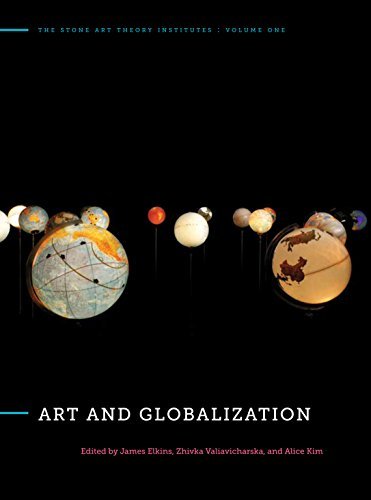
Art and Globalization

Rate this book

The “biennale culture” now determines much of the art world. Literature on the worldwide dissemination of art assumes nationalism and ethnic identity, but rarely analyzes it. At the same time there is extensive theorizing about globalization in political theory, cultural studies, postcolonial theory, political economy, sociology, and anthropology. Art and Globalization brings political and cultural theorists together with writers and historians concerned specifically with the visual arts in order to test the limits of the conceptualization of the global in art.

Among the major writers on contemporary international art represented in this book are Rasheed Araeen, Joaquín Barriendos, Susan Buck-Morss, John Clark, Iftikhar Dadi, T. J. Demos, Néstor García Canclini, Charles Green, Suman Gupta, Harry Harootunian, Michael Ann Holly, Shigemi Inaga, Fredric Jameson, Caroline Jones, Thomas DaCosta Kaufmann, Anthony D. King, Partha Mitter, Keith Moxey, Saskia Sassen, Ming Tiampo, and C. J. W.-L. Wee.

Art and Globalization is the first book in the Stone Art Theory Institutes Series. The five volumes, each on a different theoretical issue in contemporary art, build on conversations held in intensive, weeklong closed meetings. Each volume begins with edited and annotated transcripts of those meetings, followed by assessments written by a wide community of artists, scholars, historians, theorists, and critics. The result is a series of well-informed, contentious, open-ended dialogues about the most difficult theoretical and philosophical problems we face in rethinking the arts today.

306 pages, Kindle Edition

First published September 2, 2010

1 person is currently reading
29 people want to read

About the author

James Elkins

101 books210 followers
James Elkins (1955 – present) is an art historian and art critic. He is E.C. Chadbourne Chair of art history, theory, and criticism at the School of the Art Institute of Chicago. He also coordinates the Stone Summer Theory Institute, a short term school on contemporary art history based at the School of the Art Institute of Chicago.

Ratings & Reviews

What do you think?
Rate this book

Friends & Following

Create a free account to discover what your friends think of this book!

Community Reviews

5 stars
1 (10%)
4 stars
3 (30%)
3 stars
1 (10%)
2 stars
4 (40%)
1 star
1 (10%)
Displaying 1 - 2 of 2 reviews
Profile Image for Iulia.
797 reviews18 followers
April 20, 2024
What a terrible, frustrating reading experience - I have no idea who this book is for.
Half of it consisted of transcripts of various roundtable discussions during a week-long art historical seminar, while the other half was dedicated to a series of "responses" to these transcripts commissioned from other non-participating theorists, artists, art critics or art historians. The result - as in this book - was a mess.
I have many issues with this format, some of them related to the content / topic of discussion, some pertaining to the editorial decisions. First, each discussion had set texts that it revolved around, and the editors assumed - I would actually say demanded - the reader to also come fully prepared. I was however unfamiliar with many of the essays, books and other sources at the centre of the conversations, which means that - while I had no issues following along - many nuances escaped me.
Secondly, most of these conversations were entirely futile, inconclusive and phatic. Genuinely interesting questions and ideas got lost in the general noise of a roundtable, where important strands are either casually dismissed or not pursued, assumptions and terms are allowed to go unchallenged, conversations veer off track, etc. It baffled me how much of the conversation wasn't actually about art at all, rather it was this academic speak, uber abstract, entirely removed from the realities of artistic practices and experience as it could possibly be.
Thirdly, when reading the transcript of a roundtable, I am completely and vehemently uninterested in chit chat such as "oh Paul, remember the conversation we had last night at dinner about such and such topic" or "remember the email you sent me in which you said x and y". I don't care. Don't waste my time.

This book is in no way useful, despite touching on many relevant, topical, important issues. Academic navel-gazing at its peak.
Displaying 1 - 2 of 2 reviews

Can't find what you're looking for?

Get help and learn more about the design.