Completed February 1932. First published in Weird Tales, July 1933.
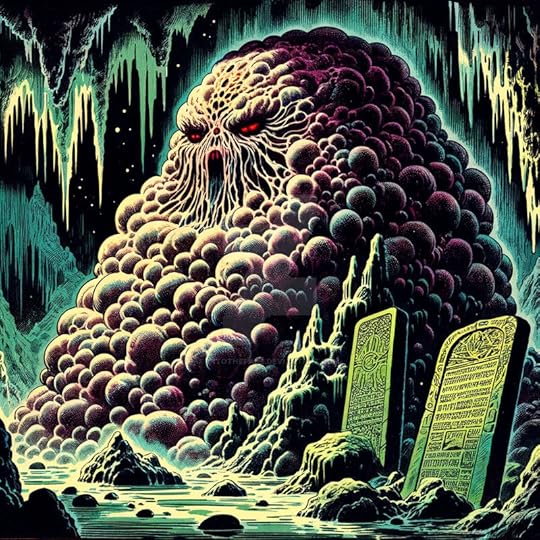
"There, in the grey beginning of Earth, the formless mass that was Ubbo-Sathla reposed amid the slime and the vapors. Headless, without organs or members, it sloughed from its oozy sides, in a slow, ceaseless wave, the amoebic forms that were the archetypes of earthly life. Horrible it was, if there had been aught to apprehend the horror; and loathsome, if there had been any to feel loathing. About it, prone or tilted in the mire, there lay the mighty tablets of star-quarried stone that were writ with the inconceivable wisdom of the pre-mundane gods"
Clark Ashton Smith was a poet, sculptor, painter and author of fantasy, horror and science fiction short stories. It is for these stories, and his literary friendship with H. P. Lovecraft from 1922 until Lovecraft's death in 1937, that he is mainly remembered today. With Lovecraft and Robert E. Howard, also a friend and correspondent, Smith remains one of the most famous contributors to the pulp magazine Weird Tales.
UBBO-SATHLA “For Ubbo-Sathla is the source and the end. Before the coming of Zhothaqquah or Yok-Zothoth or Kthulhut from the stars, Ubbo-Sathla dwelt in the steaming fens of the newmade Earth.”
So begins this beguiling tale of metaphysical investigation told in arcane language by Clark Ashton Smith, an author for whom fiction was as a way to explore the big philosophical questions: Where do we come from? What is the foundation of life? Why are we here? Where are we going?
Again, these questions are asked in the most inscrutable language, for as the author himself explains: "My own conscious ideal has been to delude the reader into accepting an impossibility, or series of impossibilities, by means of a sort of verbal black magic, in the achievement of which I make use of prose-rhythm, metaphor, simile, tone-color, counter-point, and other stylistic resources, like a sort of incantation.”
Similar to young men entering antique shops filled with curios from around the globe (Honoré de Balzac’s The Magic Skin and Théophile Gautier's The Mummy’s Foot come immediately to mind), the tale's protagonist, Paul Tregardis, enters an antique shop and his eye is drawn to something in particular: “the milky crystal in a litter of oddments from many lands and eras.”
And, oh, how that magically enchanted, arcane object quickly becomes the nucleus of occult unfoldings. "Tregardis thinks of his own explorations in hidden lore: he recalled The Book of Eibon, that strangest and rarest of occult forgotten volumes, which is said to have come down through a series of manifold translations from a prehistoric original written in the lost language of Hyperborea."
After leaving the shop, crystal in hand, little does Tregardis know he now holds an enchanted object that will bring the book of his very own memories to life.
As per vintage Clark Ashton Smith, that aforementioned remote, secret book, The Book of Eibon, was purported to have been the handiwork of a great wizard in touch with the heart of the heart of all power within the universe. "This wizard, who was mighty among sorcerers, had found a cloudy stone, orb-like and somewhat flattened at the ends, in which he could behold many visions of the terrene past, even to the Earth's beginning, when Ubbo-Sathla, the unbegotten source, lay vast and swollen and yeasty amid the vaporing slime. . . But of that which he beheld, Zon Mezzamalech left little record; and people say that he vanished presently, in a way that is not known; and after him the cloudy crystal was lost."
With a wizard and sorcery added to the equation, our narrator is in for unexpected twists to his adventures.
The more our young narrator peers into his newly purchased crystal, the more all of the normal boundaries of time and space expand and take on strange forms. “As if he looked upon an actual world, cities, forests, mountains, seas and meadows flowed beneath him, lightening and darkening as with the passage of days and nights in some weirdly accelerated stream of time.”
Is he in twentieth century London or some other past and future time? Or, as unfathomable as it might seem, two or even all three together? It is hard for poor Paul Tregardis to tell. In this and in many other Clark Ashton Smith tales, it is left to us as readers to fathom our own conclusions, as nebulous as they might be.
Paul feels something very strange, as if he is under the influence of hashish. The walls begin to wobble as if they are made of smoke; all the men and women in the streets begin to appear as so many ghosts and shades; the whole scene takes on the cast of a vast phantasm.
Is Paul dreaming or hallucinating? Could be. But many the time in a Clark Ashton Smith tale, a dream or vision quickly slides into an unending nightmare. Recall the author mined his own nightmares during protracted illnesses to fuel his fantasies and tales of horror.
In such a nightmare, what other evil or unforeseen event can happen? Answer: for Clark Ashton Smith, a character’s very identity can shift and change not only once but multiple times. “He seemed to live unnumbered lives, to die myriad deaths, forgetting each time the death and life that had gone before. He fought as a warrior in half-legendary battles; he was a child playing in the ruins of some olden city of Mhu Thulan; he was the king who had reigned when the city was in its prime, the prophet who had foretold its building and its doom. He became a barbarian of some troglodytic tribe, fleeing from the slow, turreted ice of a former glacial age into lands illumed by the ruddy flare of perpetual volcanoes. Then, after incomputable years, he was no longer man, but a man-like beast, roving in forests of giant fern and calamite, or building an uncouth nest in the boughs of mighty cycads."
Clark Ashton Smith, such an imagination, such psychedelic, phantasmagorical visions - not only can a man or woman, plant or beast change, the entire universe can compress itself into a grey, formless mass of slime with the name Ubbo-Sathla.
So... Man finds an ancient crystal from ancient sunken Hyperborea, that lets him view backwards in time. Searching for the primordial entity dwelling in the interior of the Earth, the source of all life on our planet, and guardian of the tablets that preserve the knowledge of primal gods. He glances too far, his shattered mind and metamorphosed body settles down amongst the other amoeboid creatures excreted by Primal Ubbo-Sathla. Interesting worldbuilding pitch if it weren't done before, otherwise unexceptional.
For Ubbo-Sathla is the source and the end. Before the coming of Zhothaqquah or Yok-Zothoth or Kthulhut from the stars, Ubbo-Sathla dwelt in the steaming fens of the newmade Earth: a mass without head or members, spawning the grey, formless efts of the prime and the grisly prototypes of terrene life . . . And all earthly life, it is told, shall go back at last through the great circle of time to Ubbo-Sathla.
Clark Ashton Smith pays homage to Howie's Cthulhu Mythos with the tale of Ubbo-Sathla, an ancient deity of primordial ooze that guards a pair of stone tablets said to contain the knowledge of the Elder Gods. Many sorcerers have sought these stone tablets, but none have found them, including Paul Tregardis, chancing upon a flashing crystal in an antiquarian's shop, and sorcerer Zon Mezzamalech, whom his spirit occupies as he is transported by the magic of the crystal.
Interesting idea with a disappointing execution. Crystal orb that beguiles its owners until they look into it long enough to be . For the subject matter, it seemed oddly mundane.
Del círculo de Lovecraft, los servidores de Klarkash-Ton poseen fuertes argumentos para proclamarlo el dueño de los cánticos, maldiciones y encantamientos más poderosos y sombríos. Su habilidad en la poesía estimula una prosa que al menos rivaliza y se distnacia con la de su maestro oscuro, dejando en claro su comodidad por lo perverso. Lo destacable es que desde este grotesco neo romanticismo, surge una quimera de ideas que habitan desde la fantasía hasta la ciencia ficción. Colosales continentes previos y posteriores a la historia de nuestro insignifcante planeta son la ambientación perfecta para engañar la incredulidad. Nos gustaría que fuera real pero nuestra consciencia está convecida que Hyperborea lo es, y sus restos yacen bajo el artico. Si HPL encontro las puertas de las dimensiones, CAS se encargo de profetizar los mitos despertando la nociva curiosidad que ya se había apaciguado.
Relato corto de ciencia ficción, en donde un joven encuentra una especie de esfera en la cual uno si se concentra puede ver algo.
No conocía al autor, pero me ha fascinado su forma de unir distintos mundos como por ejemplo las menciones a Lovecraft, a través del Necronomicon y a La era hiperbórea de Howard , a eso sumarle ciertas cosas que van ocurriendo, lo que hace que la historia sea atrapante.
Jag snubblade över Clark Ashton Smith av en slump när jag skummade igenom nätet efter lite mer info kring Eibon, boken i en av världens bästa filmer - The Beyond av Lucio Fulci. Tydligen var det Smith som skapade den och historien bakom, något av en variant av Necronomicon som kollegan Lovecraft skapade innan dess. Strunt samma. Smiths kortnovell Ubbo-Sathla har Eibon med i historien och när jag väl började läsa var det svårt att sluta. Fascinerande och ett måste om man tycker om Lovecraft (vem gör inte det?!) och det gav mig mersmak. Jag måste läsa mer av Clark Ashton Smith!
9 лавкрафтов из 10. Можно заметить разницу в использовании "сатанинский" вместо "богохульны", может чуть меньше нагнетания. Но атмосфера древности и мрачного ужаса передана правильно. Всё таки Кларк кажется более "нормальным" чем Говард.
Another Mythos story written by CAS, being part of his "Hyperborean cycle".
Paul Tregardis, looking for a primordial secret while looking at a stone, ends up suffering a similar fate of Randolph Carter, but I don't think he will be able to stop his heirs from splitting his wealth.
This is probably my favorite Clark Ashton Smith story. Its one of the few CAS stories that take place in the modern time which of course means the 1930s, although its still considered a Hyperborea story for reasons that will become evident.
The plot follows a man named Paul Tregardis who acquires a crystal and peering into it allows him to travel backwards in time. Through the chrystal he lives and dies past existences. He dreams of an ancient Hyperborean wizard named Zon Mezzamalech who he had read about in the Book of Eibon. Mezzamalech was after a set of stone tablets left by "the gods who died before the Earth was born". The Book of Eibon also mentions something called "Ubbo-Sathla" the idiotic demiurge or the unbegotten source. Ubbo-Sathla is a Great Old One who spawns micro-organisms and created life on Earth or so it seems. I'm not gonna spoil the ending but its pretty amazing. Tregardis travels all the way back in time to Ubbo-Sathla and the stone tablets it guards. . .
The occult practice of looking into or through chrystals (known as 'scrying') has of course been used as a plot device in many mythos stories to great effect e.g. "The Sorcerer's Jewel" by Robert Bloch and famously in "The Haunter of the Dark" by Lovecraft where the worshipers of Nyarlat(hotep) were said to peer into the mystic Shining Trapezohedron brought from icy Yuggoth, held by the hierophants of Atlantis and treasured by the priests of ancient Egypt.
Its a little bit unclear to me how the story ties together with the mythos. The beginning outright quotes the following passage from the Book of Eibon (a mythos tome invented by Smith) "For Ubbo-Sathla is the source and the end. Before the coming of Zhothaqquah or Yok-Zothoth or Kthulhut from the stars" so its very obviously conscious of the Cthulhu-Mythos. That said its a bit weird to me because people have tried to connect this to the Elder things and to their "proto-shoggoths" who became Ubbo-Sathla or something like that. Ubbo-Sathla could well be the original proto-shoggoth who was then deified by the primitive hyperboreans but its doubtful that Smith had that in mind when writing this.
Also, who are the gods that died before the earth was born? Nobody knows and I assume we're not supposed to know. It could refer to the Great Old Ones that were trapped or killed but now await to be resurrected or re-awakened. Its just kinda weird because it says they "died" and the Great Old Ones never really died... or did they?
"Ph'nglui mglw'nafh Cthulhu R'lyeh wgah'nagl fhtagn" ("In his house at R'lyeh, dead Cthulhu waits dreaming.")
"That is not dead which can eternal lie, and with strange eons even death may die" -The Necronomicon of Abdul Alhazred
In a nutshell: + Super interesting concept. Probably CAS's most cosmic tale of the ones I've read so far. + Pretty creepy, and the plot has an interesting development. + Can make interesting theories if paired with Lovecraft's works. - I dislike the way it's written and the pacing. Quite a lot. - As per usual with CAS, his style feels very wooden. He tells you interesting concepts in a way that devoids from any emotional attachment.
In detail: We have a main character that finds a weird stone, which turns out to be an ancient artifact with a horrifying secret. I love the concept of this story, I love the implications, and I love how existential it is.
All of those things that are so cool end up squandered by CAS's writing style, which, as I've mentioned in other reviews, doesn't usually sit well with me. His stories, if written differently, could be so much more. This story, to start, should be longer. The pacing feels so rushed, there's no time to let the atmosphere, weirdness and creepyness build up. The way he writes the actions feels too straightforward and lacks emotional depth or intention. At the end, you feel indifferent towards a story that should've been an absolute horror hit.
I do like, however, that this story can sprout interesting theories towards the Cthulhu Mythos, and expand Lovecraft's cosmology in interesting directions, if the readers want to do so.
Veredict: 3 stars (2 stars in Goodreads). An ok read, that should've been a great one.
I have a definite memory of having read this previously, though I can’t for the life of me remember when or where.
Paul Tregardis finds a milky opalescent orb in a curio shop and through it travels back to the beginnng of time where the primeval behemoth Ubbo-Sathla wallows voluptuously in the ooze and murk.