

What do you think?

Death on Earth: Adventures in Evolution and Mortality
There is nothing more life-affirming than understanding death in all its forms.Natural selection depends on death; little would evolve without it. Every animal on Earth is shaped by its presence and fashioned by its spectre. We are all survivors of starvation, drought, volcanic eruptions, meteorites, plagues, parasites, predators, freak weather events, tussles and scraps, and our bodies are shaped by these ancient events. Some animals live for just a few hours as adults, others prefer to kill themselves rather than live unnecessarily for longer than they are needed, and there are a number of animals that can live for centuries. There are parasites that drive their hosts to die awful deaths, and parasites that manipulate their hosts to live longer, healthier lives. There is death in life.Amongst all of this, there is us, the upright ape; perhaps the first animal in the history of the universe fully conscious that death really is going to happen to us all in the end.With a narrative featuring a fish with a fake eye, the oldest animal in the world, the immortal jellyfish and some of the world's top death-investigating biologists, Death on Earth explores the never-ending cycle of death and the impact death has on the living, and muses on how evolution and death affect us every single day. Why are we so weird about death? Where does this fear come from? Why are we so afraid of ageing? And how might knowledge of ageing in other animals help us live better lives, free of the diseases of old age?
289 pages, Kindle Edition
First published January 1, 2015
Ratings & Reviews
Friends & Following
Create a free account to discover what your friends think of this book!
Community Reviews
Displaying 1 - 30 of 40 reviews

September 14, 2021
None of the definitions of life - "movement, respiration, sensitivity, growth, reproduction, excretion and nutrition" actually work as lots of living things don't do some of them and non-living things do. In the book, the examples given are mules, which can't reproduce, fridges which can regulate their own temperature and fire which has movement, growth, reproduction and a few more.
I read a book Invisible Empire: The Natural History of Viruses recently and it seems that some scientists do not accept viruses as living. They don't do hardly anything that living things generally do, but they can reproduce so to me they are living because nothing non-living can reproduce. Darwinian evolution? Certainly, it's our problem that viruses evolve so much and so quickly. Look at Covid, first it was Covid 19, then Delta, now Omicron and it will continue.
I remember on my first acid trip back at a festival when I was young and into sex n drugs n rock n roll, I was lighting endless matches and wondering in what sense the flame was alive and did it die or did I just put it out? If it was alive, it needed oxygen, it 'fed' on wood, it could make baby fires, it moved, but it never evolved. It didn't have consciousness and it wasn't alive.
This book has a definition of life that actually works - "Life is something that undergoes Darwinian evolution". Nothing that isn't alive does, and everything that is alive has. Brilliant. I might not feel alive right now, having evolved from a happy girlie in a nice relationship that I thought was going to last, to being hurt, and now ghosted and wanting just to die, no more pain, but still.. .this too shall pass. Hopefully.
Notes on reading
I read a book Invisible Empire: The Natural History of Viruses recently and it seems that some scientists do not accept viruses as living. They don't do hardly anything that living things generally do, but they can reproduce so to me they are living because nothing non-living can reproduce. Darwinian evolution? Certainly, it's our problem that viruses evolve so much and so quickly. Look at Covid, first it was Covid 19, then Delta, now Omicron and it will continue.
I remember on my first acid trip back at a festival when I was young and into sex n drugs n rock n roll, I was lighting endless matches and wondering in what sense the flame was alive and did it die or did I just put it out? If it was alive, it needed oxygen, it 'fed' on wood, it could make baby fires, it moved, but it never evolved. It didn't have consciousness and it wasn't alive.
This book has a definition of life that actually works - "Life is something that undergoes Darwinian evolution". Nothing that isn't alive does, and everything that is alive has. Brilliant. I might not feel alive right now, having evolved from a happy girlie in a nice relationship that I thought was going to last, to being hurt, and now ghosted and wanting just to die, no more pain, but still.. .this too shall pass. Hopefully.
Notes on reading

May 18, 2016
Description: As you read these words, Planet Earth teems with trillions of life-forms, each going about their own business: eating, reproducing, thriving . . . Yet, the life of almost every single organism draws nearer to certain death. On the other hand, "suicide" inside the mitochondria that live within us results in the death of millions of cells each second for our own good! Why is death such a universal companion to life on Earth? Why haven't animals evolved to break free of its shackles?
In this wide-ranging exploration of death, Jules Howard attempts to shed evolutionary light on one of our biggest and most unshakable taboos. He visits a salon that's trying to abolish our queasiness over talking about death. He also looks to the nematode, one of the most basic of life-forms, for clues about why near-starvation actually can prolong life. Encountering some of the world's oldest animals, and meeting the scientists attempting to unravel their mysteries, Howard also comes face-to-face with evolution's outliers--the animals that may one day avoid death altogether.
Written in an engaging style, Death on Earth's journey ends with the inevitable question: Can we ever become immortal? And if we could, would we really want to?
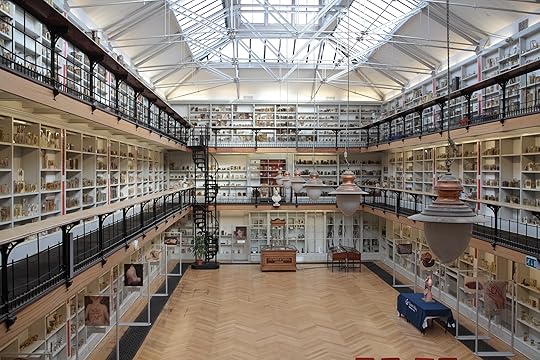
 If you want to have a gander at Death Salon, Barts Pathology Museum, alluded to in the introduction, the link is
here
; obviously it is not for the squeamish.
If you want to have a gander at Death Salon, Barts Pathology Museum, alluded to in the introduction, the link is
here
; obviously it is not for the squeamish.
The introduction was fine if one holds no aversion for capital letter emphasis, or can rally enough to get through personal references that could worry those whose role in life is to empathise with the short life expectancy of the 'I' on Howard's computer.
The elephant in the room that needs to be addressed came just a page and a half into into the very first chapter:
Howard doubles down on this error on the very next page, and of course this reader started to question his take on Schrödinger's 'What is Life', which he references often, and a read of that is most definitely on the cards now.
I will continue to read through, his tone is chatty and the subject is interesting, however the outpourings will not be taken as gospel.
Discovery Magazine article
In this wide-ranging exploration of death, Jules Howard attempts to shed evolutionary light on one of our biggest and most unshakable taboos. He visits a salon that's trying to abolish our queasiness over talking about death. He also looks to the nematode, one of the most basic of life-forms, for clues about why near-starvation actually can prolong life. Encountering some of the world's oldest animals, and meeting the scientists attempting to unravel their mysteries, Howard also comes face-to-face with evolution's outliers--the animals that may one day avoid death altogether.
Written in an engaging style, Death on Earth's journey ends with the inevitable question: Can we ever become immortal? And if we could, would we really want to?
If you want to have a gander at Death Salon, Barts Pathology Museum, alluded to in the introduction, the link is
here
; obviously it is not for the squeamish.The introduction was fine if one holds no aversion for capital letter emphasis, or can rally enough to get through personal references that could worry those whose role in life is to empathise with the short life expectancy of the 'I' on Howard's computer.
The elephant in the room that needs to be addressed came just a page and a half into into the very first chapter:
This understanding of states moving endlessly toward disorder (in a closed system) was first offered up by Newton: it was, famously, his Second Law of Thermodynamics.'
Howard doubles down on this error on the very next page, and of course this reader started to question his take on Schrödinger's 'What is Life', which he references often, and a read of that is most definitely on the cards now.
I will continue to read through, his tone is chatty and the subject is interesting, however the outpourings will not be taken as gospel.
Discovery Magazine article

July 5, 2018
4.5 stars. Less sciency-science than I expected, more philosophical, and more about extinction than evolution, but for all that, just splendid. Such an entertaining writer. I've never laughed at a description of a panic attack before. Thoroughly recommended.

August 13, 2017
I was hoping for more from this book, I think. It glances into some of the issues covered in The Worm at the Core, which I also read recently — the anxieties we have about death, as a species, and how we handle it — but it backs away from any depth there. It sort of looks into decay and the reaction of other animals to death, but it doesn’t find much conclusive there, either. Honestly, I found it interesting enough to read at the time, but it seemed more like a musing about the process of trying (and failing) to write a book that’s really about death on Earth. I didn’t learn any new science or any cool facts, but I know all about Howard having a panic attack at an anti-ageing conference event and trying to teach his daughter about death.
You might find it entertaining, if that’s what you’re interested in, but it’s not really about death.
Reviewed for The Bibliophibian.
You might find it entertaining, if that’s what you’re interested in, but it’s not really about death.
Reviewed for The Bibliophibian.

March 10, 2016
I've never before come across a book that I found so likeable despite quite significant failings - most notably, the biggest scientific howler I've ever seen in a popular science title. It's like a friend whose company you enjoy, even though you know that you shouldn't. Underlying that likeability is Jules Howard's constant presence. Publishers like an author to put themselves into a book, to make it their own. Howard is so strongly part of the narrative that occasionally I wished he'd go out for a while.
In this respect, Death on Earth (are we laughing yet, Life on Earth fans?) reminds me of the remarkable books of Jon Ronson. Ronson's best books - the inspiration for the Louis Theroux style of knowing 'innocent abroad' first person TV documentaries - are marvellous. You are never quite sure how much what he writes is really what he feels and how much he is manipulating the reader, but Ronson takes you right into the world of psychopaths or psi abilities (to name but two of his books). In Death on Earth there is less of a sense of manipulation because Howard's progress is so bumbling that it's hard to believe it is anything other than the reality of life.
As yet I haven't really strayed onto the topic of the book - death. As Howard admits early on, many potential readers might consider this an off-putting topic. Yes, some strange individuals are obsessed with death, but most of us prefer not to think of it more than we have to. However, when it comes to it, the book doesn't exactly skirt around the subject, but equally doesn't push it in your face. It's not trying to present platitudes about death, but to examine behaviour and natural history linked to this inevitable eventual demise (or in the case of many living things, the early and tragic version).
In Howard's seemingly random meanderings he comes across a long-lived mollusc, ants dealing with death, frog and toad mortality, and plenty more. It's not that the book is without content. But somehow the content is always dominated, for good or ill, by his bizarre non-adventures - crossing half the country to bring home a dead magpie (used in a half-hearted failed attempt at an experiment in avian behaviour), suffering a frightening medical condition at a life-extension show at Olympia (oh, the irony) and haplessly confusing his very young daughter by trying to explain death to her.
I've put it off long enough - I need to detail the outstanding science fail. Howard writes: 'This understanding of states moving endlessly toward disorder (in a closed system) was first offered up by Newton: it was, famously, his Second Law of Thermodynamics.' If this doesn't leave you rolling around on the carpet guffawing, this is a confusion of Newton's second law of motion (in equation form, force = mass times acceleration) with the second law of thermodynamics, a totally different and hugely important nineteenth century development in physics. It is a bit like a literary expert referring to Shakespeare's novel War and Peace. Every book has a few mistakes, but this is in a class of its own.
It might seem difficult to reconcile giving this book four stars with the sometimes faint praise. But it is a tribute to the author that it remains enjoyable to read and it does have plenty of interesting content along the way. Getting there might be like taking part in a meandering conversation down at the pub - but sometimes that's exactly what you want out of a book. And after a few drinks, we might even forgive Newton's second law of thermodynamics. Perhaps.
In this respect, Death on Earth (are we laughing yet, Life on Earth fans?) reminds me of the remarkable books of Jon Ronson. Ronson's best books - the inspiration for the Louis Theroux style of knowing 'innocent abroad' first person TV documentaries - are marvellous. You are never quite sure how much what he writes is really what he feels and how much he is manipulating the reader, but Ronson takes you right into the world of psychopaths or psi abilities (to name but two of his books). In Death on Earth there is less of a sense of manipulation because Howard's progress is so bumbling that it's hard to believe it is anything other than the reality of life.
As yet I haven't really strayed onto the topic of the book - death. As Howard admits early on, many potential readers might consider this an off-putting topic. Yes, some strange individuals are obsessed with death, but most of us prefer not to think of it more than we have to. However, when it comes to it, the book doesn't exactly skirt around the subject, but equally doesn't push it in your face. It's not trying to present platitudes about death, but to examine behaviour and natural history linked to this inevitable eventual demise (or in the case of many living things, the early and tragic version).
In Howard's seemingly random meanderings he comes across a long-lived mollusc, ants dealing with death, frog and toad mortality, and plenty more. It's not that the book is without content. But somehow the content is always dominated, for good or ill, by his bizarre non-adventures - crossing half the country to bring home a dead magpie (used in a half-hearted failed attempt at an experiment in avian behaviour), suffering a frightening medical condition at a life-extension show at Olympia (oh, the irony) and haplessly confusing his very young daughter by trying to explain death to her.
I've put it off long enough - I need to detail the outstanding science fail. Howard writes: 'This understanding of states moving endlessly toward disorder (in a closed system) was first offered up by Newton: it was, famously, his Second Law of Thermodynamics.' If this doesn't leave you rolling around on the carpet guffawing, this is a confusion of Newton's second law of motion (in equation form, force = mass times acceleration) with the second law of thermodynamics, a totally different and hugely important nineteenth century development in physics. It is a bit like a literary expert referring to Shakespeare's novel War and Peace. Every book has a few mistakes, but this is in a class of its own.
It might seem difficult to reconcile giving this book four stars with the sometimes faint praise. But it is a tribute to the author that it remains enjoyable to read and it does have plenty of interesting content along the way. Getting there might be like taking part in a meandering conversation down at the pub - but sometimes that's exactly what you want out of a book. And after a few drinks, we might even forgive Newton's second law of thermodynamics. Perhaps.

April 8, 2020
It is a little hard to explain what I feel about this book. It didn’t have enough death in it for me. For a person who is browsing bookshelves and finds a book that is called “Death On Earth” I expected it to be less about human thoughts about death and more about death itself. I understand the author’s struggle as he writes about how a book about death wouldn’t sell and how much pushback he got on the book, but some people (such as myself) enjoy the darker, nitty gritty things. There are hints of fascinating information here and there but I struggled to keep focused on this book. I think the author did a good job because when I reflect on it, how much can you really talk about death in the animal kingdom?
April 2, 2016
A very clear and interesting exploration of topics that I'd never thought much about -- or even heard of, like semelparity. I like books like this one, where I go away smarter than when I started it!
I received this book as an ARC via NetGalley in exchange for an honest review.
I received this book as an ARC via NetGalley in exchange for an honest review.

April 24, 2018
Really insightful, learnt about the different systems in life and the animal world. Made me feel life is more precious that we realise.

May 2, 2016
I received DEATH ON EARTH as an ARC through NetGalley.com.
"In life, it's the occasions where you have to wear waterproof trousers that are generally among the most interesting." This is how Jules Howard opens Chapter Six of DEATH ON EARTH, which tells the tale of his trip to TRACES (Taphonomic Research in Anthropology: Centre for Experimental Studies). TRACES is a bit like body farms in America, where people can donate their bodies to science and the scientists study what different conditions do to the body and its decomposition process. TRACES, established in the UK by the University of Central Lancashire, does this with the help of pig carcasses. It's fascinating.
This was the chapter of DEATH ON EARTH during which you would least want to be eating lunch (especially a ham sandwich) but it's still full of humor and insight, just like the rest of the book. From personal anecdotes about his young daughter, to interviews with people whose jobs make them interact with death every day, DEATH ON EARTH is a fun read about a topic that most people don't think of as much fun.
One of my favorite chapters was the one where he attended a Death Salon, which is something I've always wanted to do. I participate in Death Cafes, which is less scholarly and more grassroots, but their aims are similar: to open up and normalise conversations about a topic that has become taboo, even though it's something that happens to all of us eventually, and touches our lives daily until it actually happens to us. I think DEATH ON EARTH is a book that ought to be brought up in both Salon and Cafe settings, because it does exactly the same thing, and with that invaluable sense of humor.
"In life, it's the occasions where you have to wear waterproof trousers that are generally among the most interesting." This is how Jules Howard opens Chapter Six of DEATH ON EARTH, which tells the tale of his trip to TRACES (Taphonomic Research in Anthropology: Centre for Experimental Studies). TRACES is a bit like body farms in America, where people can donate their bodies to science and the scientists study what different conditions do to the body and its decomposition process. TRACES, established in the UK by the University of Central Lancashire, does this with the help of pig carcasses. It's fascinating.
This was the chapter of DEATH ON EARTH during which you would least want to be eating lunch (especially a ham sandwich) but it's still full of humor and insight, just like the rest of the book. From personal anecdotes about his young daughter, to interviews with people whose jobs make them interact with death every day, DEATH ON EARTH is a fun read about a topic that most people don't think of as much fun.
One of my favorite chapters was the one where he attended a Death Salon, which is something I've always wanted to do. I participate in Death Cafes, which is less scholarly and more grassroots, but their aims are similar: to open up and normalise conversations about a topic that has become taboo, even though it's something that happens to all of us eventually, and touches our lives daily until it actually happens to us. I think DEATH ON EARTH is a book that ought to be brought up in both Salon and Cafe settings, because it does exactly the same thing, and with that invaluable sense of humor.

November 17, 2018
I recommend this book to anyone who like to think of an evolutionary and philosophical approach to death thereby finding meaning in life. There's more positive note about parasites, deathsplaing, grief and distress. If you love spiders, other ugly insects, frogs and donkeys this is a lovely book not to be missed. Quoting the key message of Jules Howard "death is so inherent to life" cleans up the window or lens through which one understands death. This book is also a reminder that on one hand humans are capable of forcing some species on earth to extinction, while on the other hand possessing irrational fear about anything that reminds us of death. This book is an excellent effort in science communication about a phenomenon that we all know but fail to understand holistically. Appears like some other reviewers who consider certain narrratives within this book as rambling have done in part with their privilege of being so and a lack of true understanding of biological complexity. -V
June 11, 2017
It was an interesting idea, but it never quite worked for me. The author was investigating his, our and the animal world's relationship with death. It followed the current trend of setting the information out in the form of a story as he visited various places and people to pursue a line of research on the topic.
There were some really interesting bits including the forensic research up in the north west. There really were some laugh out loud moments - the magpie and his daughter, as well as the trade show towards the end. But, altogether it felt as though it meandered too much without really providing a lot of information. Possibly it wasn't helped by reading it over quite a long period of time, but then it wasn't exactly difficult to put down.
There were some really interesting bits including the forensic research up in the north west. There really were some laugh out loud moments - the magpie and his daughter, as well as the trade show towards the end. But, altogether it felt as though it meandered too much without really providing a lot of information. Possibly it wasn't helped by reading it over quite a long period of time, but then it wasn't exactly difficult to put down.
June 26, 2017
Entertaining and gross. I learned a lot about maggots!
April 10, 2020
Just completely read this great book today and enjoyed every single bit of it both immensely & comprehensively! Even though it did honestly take me truthfully a little longer than I usually would, for me to read it in full length & still get allot of out of what Jules Howard wrote was good. I did have to pause and think on odd occasion to grasp what she actually had reviewed & comment on inside her (this) book, it got a little astray during the read, with her strategy of intertwining common-day informative academic techniques (reporting) & opinion with her own Jules' real life scientific operations & biodiversity (environmental) observations, and so on. The understanble part.
I kind of gotten aback with the fact it took her so long into chapters 3-4 to express herself effectively. it was good. Jules Howard has also included sections of morality chapters, which definately came later on put in it. This made & kept it more interesting through the boring known bits, but for a new book that I rented from our new local library nearby here in Cockburn city, just south of Perth, WA. That I certainly did find it was a fully focused deduced, dedicated & very worth while decision that I got myself cornered into doing; considering what we are dealing with in all these self-isolation times, just as of recently news.
So, "Death on Earth: Adventures in Evolution & Mortality"; by: Jules Howard. 4/5 content, 5/6 on intrigue and care of clear concise explanations & subjective introduction, middle & conclusion. Story: 3.5-4/5.
See what you think! Recommendable.
Enjoy! From: PCAM
I kind of gotten aback with the fact it took her so long into chapters 3-4 to express herself effectively. it was good. Jules Howard has also included sections of morality chapters, which definately came later on put in it. This made & kept it more interesting through the boring known bits, but for a new book that I rented from our new local library nearby here in Cockburn city, just south of Perth, WA. That I certainly did find it was a fully focused deduced, dedicated & very worth while decision that I got myself cornered into doing; considering what we are dealing with in all these self-isolation times, just as of recently news.
So, "Death on Earth: Adventures in Evolution & Mortality"; by: Jules Howard. 4/5 content, 5/6 on intrigue and care of clear concise explanations & subjective introduction, middle & conclusion. Story: 3.5-4/5.
See what you think! Recommendable.
Enjoy! From: PCAM
This entire review has been hidden because of spoilers.
October 31, 2025
I thought the sections from a conciously human perspective (particularly the section on extinction) were strong
I also really enjoyed the start of the section on mourning, but thought the second half ignored the words of Dr Thornton. Howard seems to ignore the core point, that it is impossible to know how an animal *feels* from observing it's behavior (in humans, would a lack of 'sad behaviour' mean somebody is not sad)
similarly, I thought some of the descriptions of scientific processes were too anthropomorphised. sure, I understand how evolution works, but for processes I don't already understand the pop-science lingo makes understanding precisely what is meant tricky in parts
there is a quote in the extinction section 'there is no meaning in nature. unless you give it meaning that is' - I felt like the book would be better, and equally interesting, if this mindset was applied to the whole text
I also really enjoyed the start of the section on mourning, but thought the second half ignored the words of Dr Thornton. Howard seems to ignore the core point, that it is impossible to know how an animal *feels* from observing it's behavior (in humans, would a lack of 'sad behaviour' mean somebody is not sad)
similarly, I thought some of the descriptions of scientific processes were too anthropomorphised. sure, I understand how evolution works, but for processes I don't already understand the pop-science lingo makes understanding precisely what is meant tricky in parts
there is a quote in the extinction section 'there is no meaning in nature. unless you give it meaning that is' - I felt like the book would be better, and equally interesting, if this mindset was applied to the whole text

February 23, 2018
This book is horribly written (in my opinion) but some-what entertaining. The author makes a rather poor (and unsuccessful) attempt to explore death in nature. There is no focus to this book, no thesis or structure - there is just a collection of chapters that briefly discuss whatever random, sometimes vaguely death related topic the author came across at any given time (I suppose this is the adventure part of the title?). The book struck me as being more about life and the strange habits of humans rather than death. Some of these animal stories were interesting, but all were rather superficial. The writing style is informal, science-lite, overly chatty with too many far too personal anecdotes and opinions. This is basically a shallow but fairly entertaining book to read if you don't feel like putting too much effort into your reading matter.

January 23, 2019
Jules Howard decides to write a book on a topic before he has an idea of what to actually write about. His publisher allows him to write a book about death, and for some reason he decides to write it in the style of Douglas Adams.
The problem with this is, that instead of writing a book that follows certain ideas and questions and tries to illuminate them, he just bumbles about asking other people what they do, and then when he finds something interesting to latch onto, he concludes that nobody knows, because the person he is talking to doesn't know.
Ultimately, this book is not about death, it is about the writer, Jules Howard, and his experience in trying to write a book about death. He tries to entertain with little stories here and there and about his journeys, but I bought the book because I wanted to read about science, and what was here was very dilute.
The problem with this is, that instead of writing a book that follows certain ideas and questions and tries to illuminate them, he just bumbles about asking other people what they do, and then when he finds something interesting to latch onto, he concludes that nobody knows, because the person he is talking to doesn't know.
Ultimately, this book is not about death, it is about the writer, Jules Howard, and his experience in trying to write a book about death. He tries to entertain with little stories here and there and about his journeys, but I bought the book because I wanted to read about science, and what was here was very dilute.
June 5, 2022
Pertama mengira buku ini bercerita tentang bagaimana kehidupan (dan kematian) bumi, dipandang dari sudut evolusi. Bagi saya menarik untuk menambah wawasan tentang bagaimana kehidup(mati)an berawal dan selanjutnya mengalir menjadi berbagai bentuk makhluk hidup di bumi. Ternyata agak terjebak dengan judulnya. Buku ini benar-benar bercerita tentang "kematian", misalnya kerang yang dikenal dengan nama "Ming" diketahui sebagai kerang tertua di dunia (umurnya 507 tahun). Ada juga cerita tentang peneliti yang melakukan riset bangkai babi. Riset ini ternyata penting untuk otopsi forensik. Berdasarkan riset bangkai babi tersebut kepolisian dapat membangun analisis tentang sebab musabab, lama waktu, dan lain-lain yang berkaitan dengan kematian korban. Bukan buku yang mudah dicerna memang.

October 20, 2017
I think I went in expecting a lot more. I thought this will be a Bill Bryson-esque approach to Death - hilarious, full of trivia and facts and research and heartwarming or touching. It somehow fell short of these expectations for me. I found Jules to be rambling about different things, trying to fit the story as he wanted it, and I felt out of tune sometimes.
Nevertheless, it was indeed a fascinating look at death amongst animal life, and it did have tons of trivia and facts. There are little bits that I have stuck in my head that will make for some unique dinner conversation. All said, I enjoyed the book, but not as much as I wanted to.
Nevertheless, it was indeed a fascinating look at death amongst animal life, and it did have tons of trivia and facts. There are little bits that I have stuck in my head that will make for some unique dinner conversation. All said, I enjoyed the book, but not as much as I wanted to.
September 7, 2021
In terms of pure content, this book is probably worth 3 stars. It doesn't go terribly in-depth about anything it claims to - evolution, in particular, is not really covered at all. However, this has got to be the most entertaining non-fiction book I've ever read. Jules Howard really has a way of making all of his anecdotes and experiences extremely entertaining. Sure, this book could definitely use a bit more... actual facts perhaps, but I would much rather read this again than some other non-fiction books I've read across the same vein, which are much, much more drab, despite their higher quality of information.
May 5, 2026
This was an extremely enjoyable non-fiction read. Death is a tricky subject and I felt that Mr. Howard did a great job balancing various factual angles, spiritual/sentimental angles, and personal stories & opinions.
I learned a lot and this book got me thinking, and to me, those are signs of some quality non-fiction. This is the first book I’ve read by this author (a friend owns the book and lent it to me when I spotted it on their shelf) but I will most definitely be seeking out their other work!
I learned a lot and this book got me thinking, and to me, those are signs of some quality non-fiction. This is the first book I’ve read by this author (a friend owns the book and lent it to me when I spotted it on their shelf) but I will most definitely be seeking out their other work!

March 17, 2018
A book about life, really. It's a ode to the way animals evolved to fight extinction by mastering death, in themselves and others. Amazing stories on how minuscule species feed, procreate or kill to allow species to survive. A telling call also about how we humans continue to alter the nature seamless rules affecting thousands of species and throwing them to the edge of extinction. Fun, entertaining and interesting. It's a shame it hasn't been translated to Spanish though.
March 19, 2025
4/5 for content, 2/5 for style, leading to a (generous) 3/5 rating. There are some fascinating insights in this book but it is dreadfully (over)written. There's about enough content for a decent long form article. Too much self-indulgent waffle, attempts to be funny which nearly all fall flat. Howard means well and it's hard to fault a book written with such sincerity. But also hard to justify why this wasn't edited down to an essay rather than allowed to balloon to 250 very thin pages.

October 22, 2019
I had no idea how this book was going to go, but somehow he pulled it off. To me it was quite random but his conclusions or insights did satisfy me. Did learn some interesting stuff. Written in quite a charming manner.

February 12, 2025
What is life. What is death. How are these two states defined or understood. Interesting look at how the life cycle of different organisms take to fulfill their purpose.
With information about some of the jobs he's helt and even the interconnectivety of writer and the world around them.
With information about some of the jobs he's helt and even the interconnectivety of writer and the world around them.

February 11, 2018
I couldn't get into this book. I didn't find it interesting and I thought it was boring.

February 18, 2019
You can troll vultures by painting pictures of dead animals on the roadway.
Hehe. Stupid vultures.
Hehe. Stupid vultures.
March 9, 2019
Too much first person narration, too personal.
Casted out questions, but don’t really answer them.
Maybe it is supposed to be philosophical? But the views are either new nor deep.
Casted out questions, but don’t really answer them.
Maybe it is supposed to be philosophical? But the views are either new nor deep.
May 20, 2022
An enjoyable book. Can't say it changed my life, but good company on a long and boring train journey.
June 14, 2022
A well researched, witty, and comprehensive look at death through an evolutionary lens. I had a great time with this book, and, if you’re going to die, I think you will too.
November 16, 2024
Who knew death could be so entertaining?!
Displaying 1 - 30 of 40 reviews