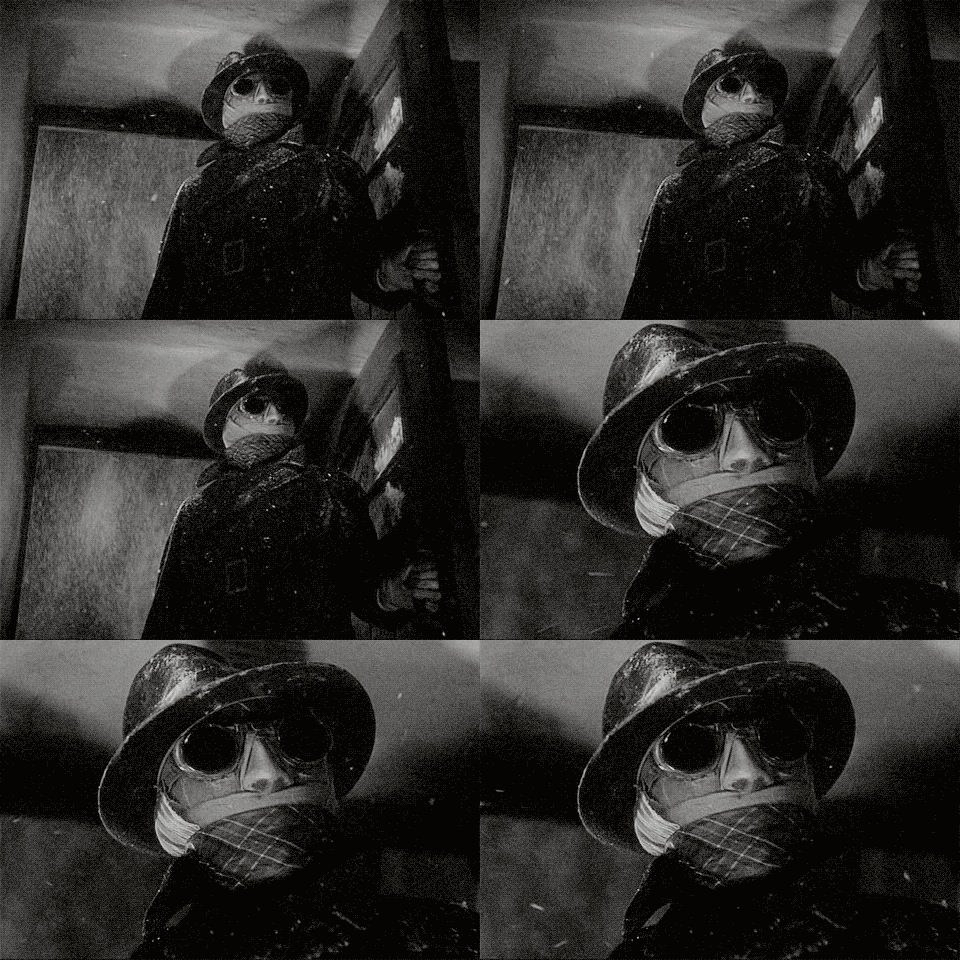
Invisibility and its discontents are, of course, at the heart of H.G. Wells’s 1897 novel The Invisible Man. But there’s also plenty of cheeky humour, some thoughtful exploration of the human psyche, and a sharp critique of the potential excesses of the scientific mindset, in this masterful short novel that is delightfully funny and profoundly frightening by turns.
We all know, of course, that Herbert George Wells was one of the founding authors of science fiction as a literary genre. Over a seven-year period of time, he wrote The Time Machine (1895), The Island of Doctor Moreau (1896), The Invisible Man (1897), The War of the Worlds (1898), and The First Men in the Moon (1901). These five short novels all featured a thought-provoking and thoroughly fantastical central conceit, but otherwise were grounded in realistic details of Victorian British life – a combination that readers found irresistible. Wells also wrote realistic novels that won the praise of critics; but it is these five “scientific romances,” along with the speculative “future history” The Shape of Things to Come (1936), for which he is remembered today.
The fantastical story of The Invisible Man begins in the very real village of Iping in West Sussex, on a cold and snowy February day. A stranger, heavily wrapped up against the cold, arrives at the Coach and Horses tavern and requests a room with a fire. The inn’s proprietors, Mr. and Mrs. Hall, take him in, but quickly become suspicious. The stranger is all wrapped up in bandages, prompting speculation among the regulars at the Coach and Horses’ bar – is he an escaped criminal, is he disfigured, is he a disfigured criminal? A great deal of scientific equipment is soon delivered to the stranger’s room, and Mr. and Mrs. Hall quickly start to find that their lodger, with his secretive ways and his frequent outbursts of ill temper, is more trouble than he’s worth – especially when the bill starts to go unpaid.
Instances of foreshadowing abound, as when Mr. Cuss, general practitioner, goes to the stranger, to ask him for a charitable donation. The stranger irritably admits that he is doing research, and then hurries to the fireplace to retrieve a paper that is in danger of burning. Mr. Cuss recalls that he saw “No hand – just an empty sleeve. Lord! I thought, that’s a deformity….What the devil keeps that sleeve up and open, if there’s nothing in it? There was nothing in it, I tell you. Nothing down it, right down to the joint. I could see right down it to the elbow, and there was a glimmer of light shining through a tear of the cloth” (p. 25).
But we all know that horror stories draw much of their power from the spectacle of the “big reveal.” The reader waits eagerly to see Frankenstein’s monster stir into unnatural life, or Dr. Jekyll’s first transformation into Mr. Hyde, or Christine Daaé pulling the mask from the face of the Phantom of the Opera. The Invisible Man has just that sort of “big reveal,” and it’s a beauty, as the stranger confronts the Halls and a group of supporters who intend to evict him from his room at the tavern.
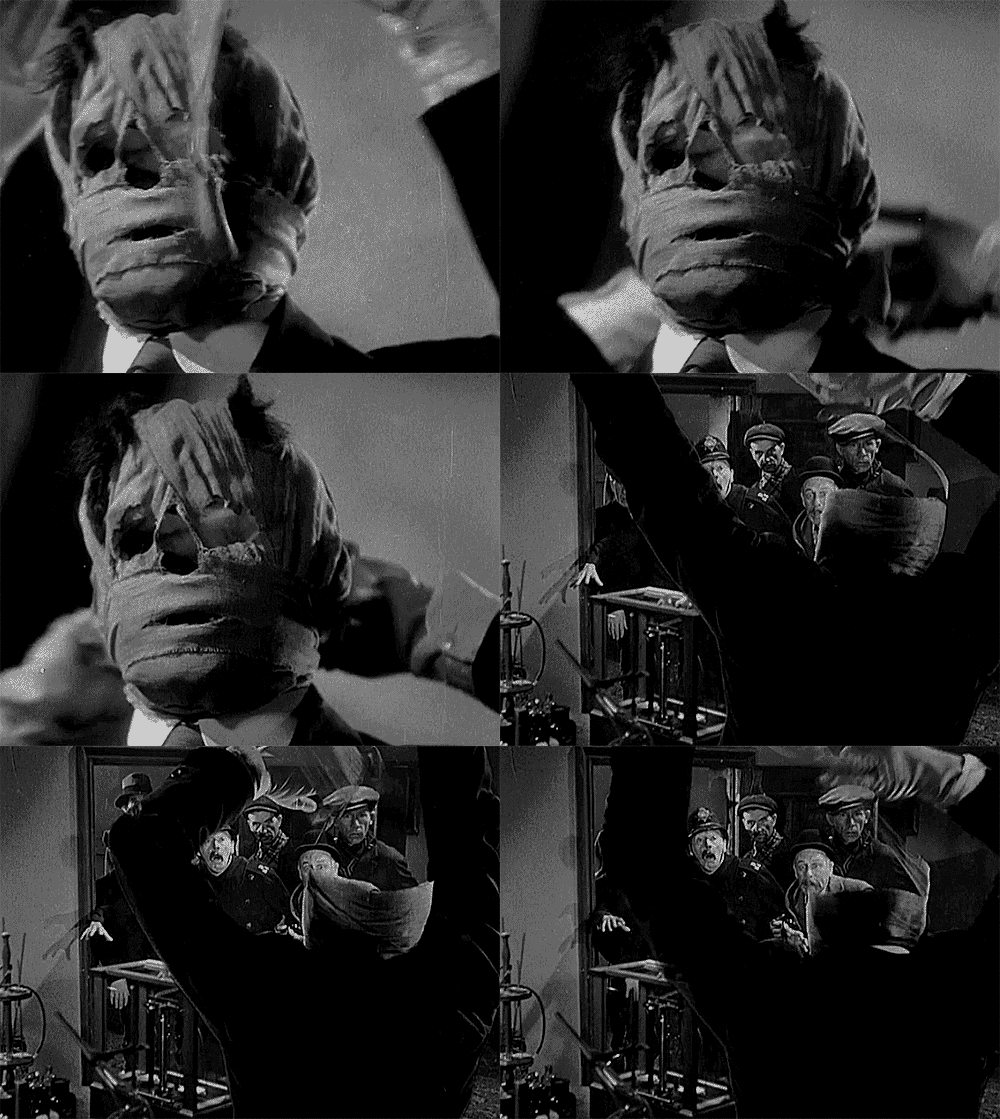
“You don’t understand,” he said, “who I am or what I am. By Heaven! I’ll show you.” Then he put his open palm over his face and withdrew it. The centre of his face became a black cavity. “Here,” he said. He stepped forward and handed Mrs. Hall something which she, staring at his metamorphosed face, accepted automatically. Then, when she saw what it was, she screamed loudly, dropped it, and staggered back. The nose – it was the stranger’s nose! pink and shining – rolled on the floor.
Spectacles, hat, bandages, and false whiskers come off in quick succession, and the onlookers are truly amazed and horrified:
It was worse than anything. Mrs. Hall, standing open-mouthed and horror-struck, shrieked at what she saw, and made for the door of the house. Everyone began to move. They were prepared for scars, disfigurements, tangible horrors – but nothing! The bandages and false hair flew across the passage into the bar, making a hobbledehoy jump to avoid them. Everyone tumbled on everyone else down the steps. For the man who stood there, shouting some incoherent explanation, was a solid gesticulating figure up to the coat-collar of him, and then – nothingness, no visible thing at all! (pp. 33-34)
The stranger, using his invisibility to his advantage, forces a visible accomplice to help him steal back the scientific books and papers that he had left at the pub. A tumult erupts as the people of Iping realize that the Invisible Man is back among them, and then “his temper, at no time very good, seems to have gone completely at some chance blow, and forthwith he set to smiting and overthrowing, for the mere satisfaction of hurting.” Toward that end, “The Invisible Man amused himself for a little while by breaking all the windows in the ‘Coach and Horses,’ and then he thrust a street lamp through the parlour window of Mrs. Gribble. He it must have been who cut the telegraph wire to Adderdean just beyond Higgins’ cottage on the Adderdean road” (p. 54). His talent for using his invisibility to cause chaotic breakdowns in the social order is evident. So is the unreasoning and absolute quality of his rage.
Eventually, the reader learns more about the stranger, the Invisible Man – to wit, that he is an ambitious scientist named Griffin. In a coincidence worthy of Dickens, Griffin stumbles upon the home of one Kemp, a friend and former colleague of Griffin. When Kemp watches Griffin smoke, he reflects that “It was strange to see him smoking; his mouth, and throat, pharynx and nares, became visible as a sort of whirling smoke cast” (p. 75). The book abounds in these haunting visual descriptions of the invisible.
Griffin tells Kemp that “I have made a discovery. I meant to keep it to myself. I can’t. I must have a partner. And you…We can do such things…” (p. 76) But later, while Griffin sleeps, Kemp reads the newspaper accounts of the Invisible Man’s exploits, and sees that Griffin’s behaviour “reads like rage growing to mania! The things he may do!” Kemp reflects with horror that “He’s not only invisible…but he’s mad! Homicidal!” Hearing, from the room below, that Griffin “awoke in an evil temper”, and that “a chair was flung over and the wash-stand tumbler smashed” (p. 79), Kemp finds himself thinking that he has no choice but to report Griffin to the authorities.
In an extended flashback, Griffin describes to Kemp his dreams of achieving invisibility – “To do such a thing would be to transcend magic. And I beheld, unclouded by doubt, a magnificent vision of all that invisibility might mean to a man – the mystery, the power, the freedom. Drawbacks I saw none” (p. 84). When his experiment first worked, he was jubilant: “I was invisible, and I was only just beginning to realize the extraordinary advantage my invisibility gave me. My head was already teeming with plans of all the wild and wonderful things I had now impunity to do” (p. 92).
And yet, another staple of what might be called the science-horror story is the moment when the scientist realizes the limitations of his science. Victor Frankenstein finds that he cannot control the monster whom he has brought to life. Dr. Jekyll learns that he cannot control his transformations into Mr. Hyde. Similarly, Griffin, who cannot restore himself to visibility, experiences what might be called the misadventures of the Invisible Man. He recalls how “I had no shelter – no covering – to get clothing was to forego all my advantage, to make myself a strange and terrible thing. I was fasting; for to eat, to fill myself with unassimilated matter, would be to become grotesquely visible again” (p. 102). I’m glad that none of the film versions of The Invisible Man I’ve seen, so far, have chosen to visualize that aspect of Griffin’s invisibility!
Griffin recounts to Kemp his memories of the confrontation at the Coach and Horses in Iping, and reflects bitterly on the emptiness of his scientific “triumph”:
“The more I thought it over, Kemp, the more I realized what a helpless absurdity an Invisible Man was – in a cold and dirty climate and a crowded, civilized city. Before I made this mad experiment, I had dreamt of a thousand advantages. That afternoon, it seemed all disappointment. I went over the heads of the things a man reckons desirable. No doubt invisibility made it possible to get them, but it made it impossible to enjoy them when they are got. Ambition – what is the good of pride of place when you cannot appear there? What is the good of the love of woman when her name must needs be Delilah? I have no taste for politics, for the blackguardisms of fame, for philanthropy, for sport. What was I to do? And for this I had become a wrapped-up mystery, a swathed and bandaged caricature of a man!” (pp. 108-09)
Eventually, Griffin realizes that Kemp has informed on him – and the enraged, invisible Griffin lays siege to Kemp’s home, intending to enact a murderous revenge. Wells’s ability to write a suspenseful passage really shines through here:
He started. There was a smash from below. He hesitated and went downstairs again. Suddenly the house resounded with heavy blows and the splintering of wood. He heard a smash and the destructive clang of the iron fastenings of the shutters. He turned the key and opened the kitchen door. As he did so, the shutters, split and splintering, came flying inward. He stood aghast. The window frame, save for one crossbar, was still intact, but only little teeth of glass remained in the frame. The shutters had been driven in with an axe, and now the axe was descending in sweeping blows upon the window frame and the iron bars defending it. Then suddenly it leapt aside and vanished. He saw the revolver lying on the path outside, and then the little weapon sprang into the air. He dodged back. The revolver cracked just too late, and a splinter from the edge of the closing door flashed over his head. He slammed and locked the door, and as he stood outside he heard Griffin shouting and laughing. Then the blows of the axe, with its splitting and smashing consequences, were resumed.
Kemp stood in the passage, trying to think. In a moment the Invisible Man would be in the kitchen. This door would not keep him a moment, and then –” (p. 125)
And thus The Invisible Man moves toward an exciting conclusion.
Looking back at this story of a scientist named Griffin – “the first of all men to make himself invisible”, “the most gifted physicist the world has ever seen”, with a “strange and terrible career” that “ended in infinite disaster” (p. 133) – I found myself once again comparing H.G. Wells’s Griffin with Mary Shelley’s Victor Frankenstein and Robert Louis Stevenson’s Dr. Henry Jekyll. All three of those stories are what we might call tales of science horror. There is no need for vampire folklore, or full-moon curses of the werewolf, or Egyptian spells for a mummy’s resurrection; the horror begins with a scientist’s ambition to achieve something that no scientist has achieved before.
In all three cases, ambition for scientific discovery is characterized by more than a bit of hubris. Drs. Griffin, Frankenstein, and Jekyll want to advance the frontiers of science, to be sure; but their “discovery” is not something that promises to improve the condition of the human race. They are not curing a disease, or making human life more comfortable, or crafting faster forms of communication or safer forms of transportation. Rather, their “discoveries” – infusing life into a human form stitched together from corpses; isolating the good and evil impulses within the human soul; making a human being invisible – promise great power for a few, and terror for the many.
"Terror" — fear of the unknown, as opposed to "horror" for fear of the known — seems a good word to use here. Edgar Allan Poe, responding in 1840 to criticisms of his tales of terror as something that would only work in a German cultural context, retorted that "Terror is not of Germany but of the Soul." A century and a half later, Stephen King wrote in Danse Macabre (1981), his non-fiction study of the horror genre, that "I recognize terror as the finest emotion...and so I will try to terrorize the reader. But if I find I cannot terrify him/her, I will try to horrify".
Both Poe and King were right, as the case of The Invisible Man shows. A monster that one can see -- Frankenstein's monster, Count Dracula, a mummy, King Kong, a werewolf, the Creature from the Black Lagoon, Godzilla, the xenomorph from Ridley Scott's Alien (1979) -- all of these visible threats have the power to horrify. The Invisible Man, a threat that one cannot see, has the power to terrify.
Wells in The Invisible Man also exploits an interesting psychological dimension – the human fear of being discovered in the act of doing something of which society, or God, would presumably not approve. “What if my guardian angel caught me doing this?” -- that sort of thing. With its scientific, ethical, and psychological dimensions, The Invisible Man is a singularly powerful and disturbing little novel.