

What do you think?

Conspiracy of Fools
From an award-winning New York Times reporter comes the full, mind-boggling true story of the lies, crimes, and ineptitude behind the Enron scandal that imperiled a presidency, destroyed a marketplace, and changed Washington and Wall Street forever.
It was the corporate collapse that appeared to come out of nowhere. In late 2001, the Enron Corporation—a darling of the financial world, a company whose executives were friends of presidents and the powerful—imploded virtually overnight, leaving vast wreckage in its wake and sparking a criminal investigation that would last for years.
Kurt Eichenwald transforms the unbelievable story of the Enron scandal into a rip-roaring narrative of epic proportions, taking readers behind every closed door—from the Oval Office to the executive suites, from the highest reaches of the Justice Department to the homes and bedrooms of the top officers. It is a tale of global reach—from Houston to Washington, from Bombay to London, from Munich to Sao Paolo—laying out the unbelievable scenes that twisted together to create this shocking true story.
Eichenwald reveals never-disclosed details of a story that features a cast including George W. Bush, Dick Cheney, Paul O’Neill, Harvey Pitt, Colin Powell, Gray Davis, Arnold Schwarzenegger, Alan Greenspan, Ken Lay, Andy Fastow, Jeff Skilling, Bill Clinton, Rupert Murdoch and Sumner Redstone. With its you-are-there glimpse into the secretive worlds of corporate power, Conspiracy of Fools is an all-true financial and political thriller of cinematic proportions.
It was the corporate collapse that appeared to come out of nowhere. In late 2001, the Enron Corporation—a darling of the financial world, a company whose executives were friends of presidents and the powerful—imploded virtually overnight, leaving vast wreckage in its wake and sparking a criminal investigation that would last for years.
Kurt Eichenwald transforms the unbelievable story of the Enron scandal into a rip-roaring narrative of epic proportions, taking readers behind every closed door—from the Oval Office to the executive suites, from the highest reaches of the Justice Department to the homes and bedrooms of the top officers. It is a tale of global reach—from Houston to Washington, from Bombay to London, from Munich to Sao Paolo—laying out the unbelievable scenes that twisted together to create this shocking true story.
Eichenwald reveals never-disclosed details of a story that features a cast including George W. Bush, Dick Cheney, Paul O’Neill, Harvey Pitt, Colin Powell, Gray Davis, Arnold Schwarzenegger, Alan Greenspan, Ken Lay, Andy Fastow, Jeff Skilling, Bill Clinton, Rupert Murdoch and Sumner Redstone. With its you-are-there glimpse into the secretive worlds of corporate power, Conspiracy of Fools is an all-true financial and political thriller of cinematic proportions.
784 pages, Paperback
First published March 14, 2005
Ratings & Reviews
Friends & Following
Create a free account to discover what your friends think of this book!
Community Reviews
Displaying 1 - 30 of 404 reviews

July 13, 2008
Would YOU like to cause the biggest bankruptcy in American history? Sure you would! Well, Enron has already gone kablooey, losing billions of dollars, throwing more than 20,000 people out of work, and contributing to at least one suicide. But you can use the Enron approach to management at your company by following these easy rules.
* Don't keep track of how much money is coming in.
* Don't keep track of when your bills are due. Petty details are boooooriiiiing.
* Reward people for getting a deal done.
* Don't reward people for getting a power plant built or for doing anything else that leads to actual, physical changes in the real world. Focus on the numbers that are on the paper.
* When you make a deal, take credit for all the earnings that year, even if the deal is supposed to last 20 years.
* When the deals don't make as much money as you thought they would, make secret deals to pump up the balance sheet and keep the stock price high.
* Don't reward people for controlling costs.
* Don't reward people for doing stuff like buying insurance for the company. A monkey could do that.
* For key positions, hire underqualified, incompetent people, plus a few thieves. Trust them.
* When someone asks you to sign a document, if other board members have already signed, don't bother to look too closely into what you are signing. You can trust the others.
* Leave $10 million in checks lying around uncashed. You're at a Fortune 50 company, so don't sweat the small stuff.
* When an accountant from an outside firm tries to find out specific information about your deals and about how the company works, complain to that person's supervisor that the person is "too rules-oriented" and "uncreative." Threaten to take your business elsewhere unless that specific person is reassigned.
* When reporters begin investigating your company, say, "I don't care what you say about the company. Just don't make me look bad."
* Spend your time flying around the world in a corporate jet, shaking hands with presidents and business leaders.
P.S. This book is soon to be made into a movie starring Leonardo DiCaprio.
* Don't keep track of how much money is coming in.
* Don't keep track of when your bills are due. Petty details are boooooriiiiing.
* Reward people for getting a deal done.
* Don't reward people for getting a power plant built or for doing anything else that leads to actual, physical changes in the real world. Focus on the numbers that are on the paper.
* When you make a deal, take credit for all the earnings that year, even if the deal is supposed to last 20 years.
* When the deals don't make as much money as you thought they would, make secret deals to pump up the balance sheet and keep the stock price high.
* Don't reward people for controlling costs.
* Don't reward people for doing stuff like buying insurance for the company. A monkey could do that.
* For key positions, hire underqualified, incompetent people, plus a few thieves. Trust them.
* When someone asks you to sign a document, if other board members have already signed, don't bother to look too closely into what you are signing. You can trust the others.
* Leave $10 million in checks lying around uncashed. You're at a Fortune 50 company, so don't sweat the small stuff.
* When an accountant from an outside firm tries to find out specific information about your deals and about how the company works, complain to that person's supervisor that the person is "too rules-oriented" and "uncreative." Threaten to take your business elsewhere unless that specific person is reassigned.
* When reporters begin investigating your company, say, "I don't care what you say about the company. Just don't make me look bad."
* Spend your time flying around the world in a corporate jet, shaking hands with presidents and business leaders.
P.S. This book is soon to be made into a movie starring Leonardo DiCaprio.

November 22, 2025
An excruciatingly detailed account of an absolutely unreal story that I can't believe actually happened. It's well done, but if you don't know anything about accounting, you're going to have a hard time understanding this one. I studied accounting and I still barely understood certain aspects. Then again, these moronic executives didn't either, so 🤷🏼♀️
I read this in preparation to see Quantum Theatre's production of (the play) Enron in November 2025!
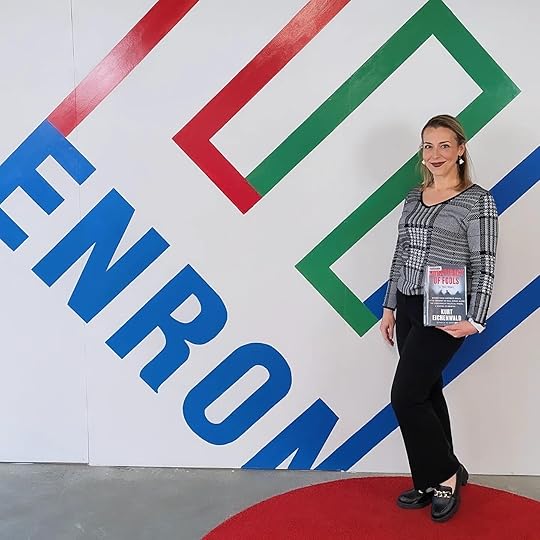
I read this in preparation to see Quantum Theatre's production of (the play) Enron in November 2025!

April 27, 2021
“This, then, is more than the tale of one company’s fall from grace. It is, at its base, the story of a wrenching period of economic and political tumult as revealed through a single corporate scandal. It is a portrait of an America in upheaval at the turn of the twenty-first century, a country torn between its worship of fast money and its zeal for truth, between greed and high-mindedness, between Wall Street and Main Street. Ultimately, it is the story of the untold damage wreaked by a nation’s folly—a folly that, in time, we are all but certain to see again.”
This book chronicles the rise and fall of Enron, the American energy company headquartered in Houston, that declared bankruptcy in late 2001. It centers on the actions of the company’s executives, board of directors, and management. It also portrays the downfall of auditing giant Arthur Andersen. I know people who were impacted by the company’s implosion. I always wondered what, specifically, had happened. This book provides the answers.
It is well-written in a series of vignettes focused on the key players. I have to give the author credit for making a book about accounting, finance, and consulting into a riveting page-turner. I think it helps to have a background in one or more of these disciplines to fully appreciate the details, but anyone can spot the greed, hubris, incompetence, and blind trust that led, ultimately, to the ignominious downfall and huge losses of jobs, pensions, and investments.
“Ultimately, it was Enron’s tragedy to be filled with people smart enough to know how to maneuver around the rules, but not wise enough to understand why the rules had been written in the first place.”
This book chronicles the rise and fall of Enron, the American energy company headquartered in Houston, that declared bankruptcy in late 2001. It centers on the actions of the company’s executives, board of directors, and management. It also portrays the downfall of auditing giant Arthur Andersen. I know people who were impacted by the company’s implosion. I always wondered what, specifically, had happened. This book provides the answers.
It is well-written in a series of vignettes focused on the key players. I have to give the author credit for making a book about accounting, finance, and consulting into a riveting page-turner. I think it helps to have a background in one or more of these disciplines to fully appreciate the details, but anyone can spot the greed, hubris, incompetence, and blind trust that led, ultimately, to the ignominious downfall and huge losses of jobs, pensions, and investments.
“Ultimately, it was Enron’s tragedy to be filled with people smart enough to know how to maneuver around the rules, but not wise enough to understand why the rules had been written in the first place.”

April 17, 2008
This book gives sobering data, while reading like a best-selling mystery--a bona fide page-turner.
The book is particularly relevant when we put the story of Enron into perspective: Geo. W. Bush's longtime personal friendship with Enron head Ken Lay; Bush's own businesses in the 1980s--Arbusto and Spectrum 7--also collapsing shortly after HE sold out his personal stock; numerous other financial giants coincident with Enron (eg., Arthur Anderson, Tyco, Worldcom, etc.) demonstrating the same fiscal irresponsibility; this pattern repeated in the recent (2008) Bear Stearns debacle.
Do you want to know HOW greed and corruption flourish (one assumes you already know WHY)? This book gives a detailed view of the process. I was continually astonished as I read. But then, I always am. (People sometimes accuse me of being cynical, but I can honestly reply every time: "To the contrary--I'm constantly amazed!")
A great companion book to Pigs at the Trough How Corporate Greed and Political Corruption Are Undermining America. We can't say we weren't told....
The book is particularly relevant when we put the story of Enron into perspective: Geo. W. Bush's longtime personal friendship with Enron head Ken Lay; Bush's own businesses in the 1980s--Arbusto and Spectrum 7--also collapsing shortly after HE sold out his personal stock; numerous other financial giants coincident with Enron (eg., Arthur Anderson, Tyco, Worldcom, etc.) demonstrating the same fiscal irresponsibility; this pattern repeated in the recent (2008) Bear Stearns debacle.
Do you want to know HOW greed and corruption flourish (one assumes you already know WHY)? This book gives a detailed view of the process. I was continually astonished as I read. But then, I always am. (People sometimes accuse me of being cynical, but I can honestly reply every time: "To the contrary--I'm constantly amazed!")
A great companion book to Pigs at the Trough How Corporate Greed and Political Corruption Are Undermining America. We can't say we weren't told....

March 3, 2012
675 pages, but the writer has a talent for telling stories,
and there are hundreds of stories here.
Very pleasant and interesting to read.
But is it all true?
The author makes it sound like the slimey ratfink Andy Fastow was 90% to blame,
and that Skilling and Lay barely knew what was going on.
I find that hard to believe.
In any case, Skilling is still in prison.
And CEO's are still looting companies with excessive pay and outrageous stock options.
and there are hundreds of stories here.
Very pleasant and interesting to read.
But is it all true?
The author makes it sound like the slimey ratfink Andy Fastow was 90% to blame,
and that Skilling and Lay barely knew what was going on.
I find that hard to believe.
In any case, Skilling is still in prison.
And CEO's are still looting companies with excessive pay and outrageous stock options.

September 8, 2017
By far the best 'behind the scenes' look at what was a very public and heavily reported event. Reading this was like watching a NASCAR race where you know there will be a wreck, you're just not sure when. The early chapters set the stage perfectly. A company that was far more lucky than skilled, filled with executives who had far more confidence than talent, doing transactions they were never meant to do. By the middle of the book, I was astonished at how deep the criminal activities and outright arrogance had penetrated throughout the company. By the final chapters, I was simply appalled at the blatant ignorance of leadership and the complete disregard for basic financial controls in a company that had already collapsed several months, perhaps even a few years, before anyone at the firm began to grasp that something was wrong. A great example of the extent that corporations placed profits and growth above everything else during the turbulent years of the rise and fall of the dot com business world.

February 13, 2018
Very thorough and interesting account of all the myriad of things that went wrong at Enron and Arthur Anderson. The culture is very familiar to me from my days in big law.
April 28, 2008
I can't believe how many pages I slogged through for absolutely no reason. What a waste of 784 perfectly good pieces of paper.
First of all, let me say that I generally mistrust nonfiction books that have so much dialog, particularly when it stretches back into the 1980s. Seriously, did everyone involved have such photographic memories. And, while Eichenwald does a whole thing at the beginning about what is and isn't true to life, it still felt weird. Not, however, as weird as the many comments along the lines of: "X was quietly repulsed by Y chewing with his mouth open". Are you kidding me? Eichenwald so obviously aches to be the John Grisham of nonfiction. But nonfiction isn't Grisham, things aren't that cliched in real life, and Grisham is an awful writer anyway.
But here is the real bad stuff: most of the time, sources are anonymous. To be expected in this kind of book, perhaps, but sorta unnerving when the author basically takes the stand that both CEO Ken Lay and Jeff Skilling were both just crappy supervisors who, when it came down to it, didn't ask the right questions of Andy Fastow, wicked and evil villain of the piece (who, by the way, may have been smart enough to pull the wool over everyone's eyes, but was actually a pretty dull bulb himself).
I don't know. I feel like I did learn some stuff about the Enron fall, and the actual mechanics of the kind of accounting and deals that led to the disaster, but I question Eichenwald's notions of motivation. Moreover, I found it odd how totally Eichenwald failed to put the whole Enron scandal in ANY broader context. The way the book was written, it really seemed as if the company was operating in a vacuum without any sort of connection to other businesses (except those, like Arthur Andersen, who were directly implicated) or to the country as a whole. It also seemed strange that so many people were so outraged by Andy Fastow and the Enron schemes but really never opened their mouths.
Less a case of forest for the trees as "Couldn't see the Sahara for that two or three grains of sand you kept staring at crosswise."
Very disappointing and very odd.
First of all, let me say that I generally mistrust nonfiction books that have so much dialog, particularly when it stretches back into the 1980s. Seriously, did everyone involved have such photographic memories. And, while Eichenwald does a whole thing at the beginning about what is and isn't true to life, it still felt weird. Not, however, as weird as the many comments along the lines of: "X was quietly repulsed by Y chewing with his mouth open". Are you kidding me? Eichenwald so obviously aches to be the John Grisham of nonfiction. But nonfiction isn't Grisham, things aren't that cliched in real life, and Grisham is an awful writer anyway.
But here is the real bad stuff: most of the time, sources are anonymous. To be expected in this kind of book, perhaps, but sorta unnerving when the author basically takes the stand that both CEO Ken Lay and Jeff Skilling were both just crappy supervisors who, when it came down to it, didn't ask the right questions of Andy Fastow, wicked and evil villain of the piece (who, by the way, may have been smart enough to pull the wool over everyone's eyes, but was actually a pretty dull bulb himself).
I don't know. I feel like I did learn some stuff about the Enron fall, and the actual mechanics of the kind of accounting and deals that led to the disaster, but I question Eichenwald's notions of motivation. Moreover, I found it odd how totally Eichenwald failed to put the whole Enron scandal in ANY broader context. The way the book was written, it really seemed as if the company was operating in a vacuum without any sort of connection to other businesses (except those, like Arthur Andersen, who were directly implicated) or to the country as a whole. It also seemed strange that so many people were so outraged by Andy Fastow and the Enron schemes but really never opened their mouths.
Less a case of forest for the trees as "Couldn't see the Sahara for that two or three grains of sand you kept staring at crosswise."
Very disappointing and very odd.

June 16, 2014
There are occasions--plane crashes, Chernobyl, Long Term Capital Management--when smart, highly trained people fuck up in a way "oops, my bad" just won't cover. I'm not sure why, but I can read about that stuff endlessly. I think my interest might have to do with the way it exposes gaps in our thinking? Or maybe it's just prurient. I don't know.
Probably you're one of the 99.9% of the population that finds such things either too boring for words or slightly off-putting. But if you're nodding slightly to yourself right now, pick up Conspiracy of Fools. It's the good stuff.
Probably you're one of the 99.9% of the population that finds such things either too boring for words or slightly off-putting. But if you're nodding slightly to yourself right now, pick up Conspiracy of Fools. It's the good stuff.

December 19, 2016
The whole book was remarkably well done. I've never read a non fiction book that feels like a great fiction narrative.
I believe this story should be mandatory for every MBA student's graduation. For the non-business nerds, it is still a fascinating look at the inner workings of corporate greed to an extreme level. Very well written.
I believe this story should be mandatory for every MBA student's graduation. For the non-business nerds, it is still a fascinating look at the inner workings of corporate greed to an extreme level. Very well written.
January 29, 2017
It is very rare for me to give a book a 5 so the fact that I gave this one 5 stars should give a hint how much I liked it. I'm not sure what I found so compelling about this book but I was up late several nights reading it. Even though I knew how it was going to end it was sort of like watching a disaster movie, you know it is going to turn out ugly but you still have to watch (or read in this case) Once things started unravelling, Eichenwald kept up the tension through devices like after an event saying this deal would only be in place for two weeks. Really it has an obvious villain, an obvious dupe, and an out of touch king, all classic fiction types. The one piece that I would have liked is an addendum to list who was tried for what crimes and how they fared. The book ended with Ken Lay at his arraignment.

June 20, 2019
I first heard about Enron around when it happened circa 2002. Back then, it didn't mean anything to me, yet I somehow remembered. 17 years later, I decided to learn more and got this book.
It's gripping.
It reads like a novel. There is mystery, drama and action – all surprising to find in a book about a corporate accounting scandal. It's quite long, but very readable. It was tricky to keep track of the huge cast of characters, but that's with real events. I don't know how accurate vs. embellished it is, but it feels real. On the negative side, there is a lot of accounting/economics/business terminology, but it's understandable if you're focused.
Overall, it did really feel like a conspiracy of fools. The outcome of all the crime and negligence felt predictable and at the end, I couldn't help but wonder how the executives really let it happen.
It's gripping.
It reads like a novel. There is mystery, drama and action – all surprising to find in a book about a corporate accounting scandal. It's quite long, but very readable. It was tricky to keep track of the huge cast of characters, but that's with real events. I don't know how accurate vs. embellished it is, but it feels real. On the negative side, there is a lot of accounting/economics/business terminology, but it's understandable if you're focused.
Overall, it did really feel like a conspiracy of fools. The outcome of all the crime and negligence felt predictable and at the end, I couldn't help but wonder how the executives really let it happen.
July 26, 2015
This book presents Andy Fastow, Enron CFO, as the principal architect behind the fall of Enron, diminishing the legitimacy of the US financial institution, feeding the CA energy crisis and international problems, specifically in India and Latin America.
Fastow created accounting entities which were used to hide Enron debt. He initially named himself the owner of these entities and got the board to dismiss any conflicts of interest. He then played loose with accounting rules and received required 3% investment from a third part - a non-executive co-worker. Why wouldn't you trust your CFO, right?
Fastow takes fees for running these entities - which ultimately end up being recognize as Enron years later. Basically he embezzled and gave others a piece of the pie to go along with it. Skilling, Lay and the board don't go into details so they think it's all on the up - hey, Fastow is reducing expense and increasing profit. Gotta love it.
He's creating an trading & loan office within an oil delivery company.
Enron's profits are huge. They're the big guy on the block. Well, how do you get this by the external accounting review (arthur andersen) and the ratings companies (Moody?) Well, both those companies receive money from Enron for other business. If you don't sign off, maybe that business will go somewhere else. You're numbers will be down, then you're job will be on the block. It's a soft approach to a strong-arm tactic. Politics uses a version of this too. Ask the wrong question of the president and you're access to the white house is cut-off. You can't be a WH correspondent and not have access.
You get the SEC to sign-off by describing partially what you are doing.
Seems good, and hey, the company gave money to Bush Sr, Bush Jr and Ashcroft. Lay's a big Bush family friend. This is obviously a trustworthy company.
Now, packed with your CYA from the SEC and Anderson the board is assured that nothing can go wrong.
All during this Enron has a number of other shady things going on. It sales is eager to book deals ( a multi-billion facility in India) but without any review of what actual costs are. They also get creative and create an energy market in CA which they then manipulate to shakedown a state by holding them as captive consumers.
The snowball effect happens (no, not Warren Buffett), things start to leek. The culture of loyalty and pettiness internal starts to crumble. Deals fall through, economic triggers are hit.
The hidden debt's ugly head appears and the company is actually 2-3 billion in debt. Just as a deal for Enron to be bought by Dynergy, the #2 company always made fun of by Enron, an economic trigger hits, an additional 690 millions is owed, and the final nail is driven into the Enron casket.
Really, this story is about greed. That greed drove Fastow, Skilling, Lay, the Enron Board, Moody's, and Arthur Anderson. There needed to be regulations and review in place that were completely third party, without conflict of interest or influence. Every system, ultimately, is as good as its people. In a culture of greed and unfettered profiteering this is what happens, and will happen again.
There's a saying about Texas businessman and how they take pride in your great losses as much as your great wins. The cost those losses are to everyone else never seem to make it to the balance sheet.
So Fastow, the inflection point in this crime, created multi-billion debt, destroyed a company (Enron would have rebounded from their other problems if Fastow didn't do what he did, and perhaps they never would have engaged in those endeavors without his presence), damaged the world economy, contributed to the destruction of an accounting firm, destroyed peoples livelihood, retirements, jobs, and more... and received just six years in jail. That's all. Skilling received 14 years and Lay died before his sentencing.
The issue with an unregulated capitalism is that you only know that you shouldn't have done something after the fact. By then, all the potential destruction has already been done. Case in point: the dodo. Market forces drove the extinction of an animal because immediate profits were greater than preserving (regulating/protecting) them and creating a sustainable market that could have lasted a hundred years or more.
The book should really have been titled "Conspiracy for Greed" as they weren't fools - just greedy businessmen.
Fastow created accounting entities which were used to hide Enron debt. He initially named himself the owner of these entities and got the board to dismiss any conflicts of interest. He then played loose with accounting rules and received required 3% investment from a third part - a non-executive co-worker. Why wouldn't you trust your CFO, right?
Fastow takes fees for running these entities - which ultimately end up being recognize as Enron years later. Basically he embezzled and gave others a piece of the pie to go along with it. Skilling, Lay and the board don't go into details so they think it's all on the up - hey, Fastow is reducing expense and increasing profit. Gotta love it.
He's creating an trading & loan office within an oil delivery company.
Enron's profits are huge. They're the big guy on the block. Well, how do you get this by the external accounting review (arthur andersen) and the ratings companies (Moody?) Well, both those companies receive money from Enron for other business. If you don't sign off, maybe that business will go somewhere else. You're numbers will be down, then you're job will be on the block. It's a soft approach to a strong-arm tactic. Politics uses a version of this too. Ask the wrong question of the president and you're access to the white house is cut-off. You can't be a WH correspondent and not have access.
You get the SEC to sign-off by describing partially what you are doing.
Seems good, and hey, the company gave money to Bush Sr, Bush Jr and Ashcroft. Lay's a big Bush family friend. This is obviously a trustworthy company.
Now, packed with your CYA from the SEC and Anderson the board is assured that nothing can go wrong.
All during this Enron has a number of other shady things going on. It sales is eager to book deals ( a multi-billion facility in India) but without any review of what actual costs are. They also get creative and create an energy market in CA which they then manipulate to shakedown a state by holding them as captive consumers.
The snowball effect happens (no, not Warren Buffett), things start to leek. The culture of loyalty and pettiness internal starts to crumble. Deals fall through, economic triggers are hit.
The hidden debt's ugly head appears and the company is actually 2-3 billion in debt. Just as a deal for Enron to be bought by Dynergy, the #2 company always made fun of by Enron, an economic trigger hits, an additional 690 millions is owed, and the final nail is driven into the Enron casket.
Really, this story is about greed. That greed drove Fastow, Skilling, Lay, the Enron Board, Moody's, and Arthur Anderson. There needed to be regulations and review in place that were completely third party, without conflict of interest or influence. Every system, ultimately, is as good as its people. In a culture of greed and unfettered profiteering this is what happens, and will happen again.
There's a saying about Texas businessman and how they take pride in your great losses as much as your great wins. The cost those losses are to everyone else never seem to make it to the balance sheet.
So Fastow, the inflection point in this crime, created multi-billion debt, destroyed a company (Enron would have rebounded from their other problems if Fastow didn't do what he did, and perhaps they never would have engaged in those endeavors without his presence), damaged the world economy, contributed to the destruction of an accounting firm, destroyed peoples livelihood, retirements, jobs, and more... and received just six years in jail. That's all. Skilling received 14 years and Lay died before his sentencing.
The issue with an unregulated capitalism is that you only know that you shouldn't have done something after the fact. By then, all the potential destruction has already been done. Case in point: the dodo. Market forces drove the extinction of an animal because immediate profits were greater than preserving (regulating/protecting) them and creating a sustainable market that could have lasted a hundred years or more.
The book should really have been titled "Conspiracy for Greed" as they weren't fools - just greedy businessmen.

November 11, 2017
You may have heard of the collapse of Enron, a massive energy conglomerate that went bankrupt in the early 2000's. There have been several books, articles and documentaries that covered the event. This book by Kurt Eichenwald not only provides the most authoritative behind-the-scenes look at what unfolded, but is also one of the best business books written in the last 20 years.
This book most reminded me of Too Big to Fail, another great book that covered a subsequent event, the financial crisis of 2007-2009. If you liked that book, you will love this one as well. The book is written like a narrative story and always keeps the reader interested (however, you do need to know a little bit about investing or finance so it will be a bit tougher than the usual book). The author does a good job fleshing out many of the key characters and does a good job of presenting a balanced view of them; there wasn't just one bad guy but a bunch of them and it's never obvious if what one is doing is unethical or illegal.
Eichenwald has spent a considerable amount of time on the research behind the events and does an admirable job piecing together all the disparate and highly complex financial actions carried out by the numerous characters. It's almost like a business detective story.
I think this is one of the best narrative-style business books written in the last 25 years. Given the subject (with complex financial transactions and confusing organizational structure and numerous characters), the book might be a little more difficult for those not familiar with finance, investing, or the energy business. Nevertheless, I would recommend it to all with an interest in business history. Those into investing should definitely read this book (or others like it) to get a feel for what can, and does, happen at companies--even one repeatedly ranked by Fortune as the most innovative company in America.
This book most reminded me of Too Big to Fail, another great book that covered a subsequent event, the financial crisis of 2007-2009. If you liked that book, you will love this one as well. The book is written like a narrative story and always keeps the reader interested (however, you do need to know a little bit about investing or finance so it will be a bit tougher than the usual book). The author does a good job fleshing out many of the key characters and does a good job of presenting a balanced view of them; there wasn't just one bad guy but a bunch of them and it's never obvious if what one is doing is unethical or illegal.
Eichenwald has spent a considerable amount of time on the research behind the events and does an admirable job piecing together all the disparate and highly complex financial actions carried out by the numerous characters. It's almost like a business detective story.
I think this is one of the best narrative-style business books written in the last 25 years. Given the subject (with complex financial transactions and confusing organizational structure and numerous characters), the book might be a little more difficult for those not familiar with finance, investing, or the energy business. Nevertheless, I would recommend it to all with an interest in business history. Those into investing should definitely read this book (or others like it) to get a feel for what can, and does, happen at companies--even one repeatedly ranked by Fortune as the most innovative company in America.

June 14, 2010
This is a long book - almost 700 pages - but an easy read. Everyone knows the story of Enron from the anecdotes, and I've read a few other books on the subject, but this is by far the best and most complete. It does a great job of tracing how some minor decisions years earlier - to use mark-to-market accounting, to form off-balance-sheet entities that really weren't, managed by Andy Fastow, who probably shouldn't have been managing a McDonalds - led to it's ultimate collapse.
The "Conspiracy of Fools" title is fitting- while Fastow and a few others committed massively illegal acts, much of the other players - including Lay and Skilling - are portrayed primarily as incompetent - they didn't bother to find out what was really going on. The book also highlights a few other people, especially Jeff McMahon - who sounded warnings about the behaviors and were ignored.
There are a number of lessons from this book, but the biggest is probably that you should read anything you sign.
The "Conspiracy of Fools" title is fitting- while Fastow and a few others committed massively illegal acts, much of the other players - including Lay and Skilling - are portrayed primarily as incompetent - they didn't bother to find out what was really going on. The book also highlights a few other people, especially Jeff McMahon - who sounded warnings about the behaviors and were ignored.
There are a number of lessons from this book, but the biggest is probably that you should read anything you sign.

March 28, 2014
If Shakespeare was alive, he would have stolen this book's plot and written a play: The Tragical Death of Enron. It's got it all.
An aging ruler must choose his successor - a boring, responsible guy or an exciting, dashing, brilliant risk taker. He chooses the risk taker. But although his successor is exciting and bold, he lacks the inner strength and moral compass to guide the kingdom. Things quickly start to go wrong, so he chooses a clever man to look after the kingdom's money - one he knows will cheat and lie for him. But in the end, the clever man cheats and lies for himself, and the new leader, full of hubris, is brought down by his inability to face his own failure. The kingdom ends up in ruins, the risk taker is imprisoned, the old ruler dies broken and shamed, and the thief walks away with millions.
It's a great story, and all true.
An aging ruler must choose his successor - a boring, responsible guy or an exciting, dashing, brilliant risk taker. He chooses the risk taker. But although his successor is exciting and bold, he lacks the inner strength and moral compass to guide the kingdom. Things quickly start to go wrong, so he chooses a clever man to look after the kingdom's money - one he knows will cheat and lie for him. But in the end, the clever man cheats and lies for himself, and the new leader, full of hubris, is brought down by his inability to face his own failure. The kingdom ends up in ruins, the risk taker is imprisoned, the old ruler dies broken and shamed, and the thief walks away with millions.
It's a great story, and all true.

June 13, 2011
This was a detailed account of the Enron scandal by the Wall Street Journal reporters who helped to break it. It is a very well done and informative book that is especially good on tracing the evolution of the Enron business model and how it came to ruin. While the final result is a damning indictment of Enron, its law firm, and Arthur Anderson, the overall tone is not as negative as your might think and sometimes it seems as though they let Skilling and Lay off the hook when they were ultimately accountable. In conjunction with Bethany McLean's "Enron: The Smartest Guys in the Room", it gives a fairly comprehensive picture of the scandal.
July 13, 2020
This book provided a very comprehensive overview of the Enron scandal. It is very long (680 pages), but the writing was engaging throughout. The amount of detail provided was necessary to get the full picture of what happened at Enron.
April 19, 2017
Very easy to read and understand. The author goes to great lengths to explain the mechanism behind the various schemes Enron utilized in order to fake their profits.
Highly recommended.
Highly recommended.
May 26, 2026
I never thought I’d say it, but this book about essentially accounting rules was thrilling! It read like a horror novel and the slow build to the climax of the ultimate fall got me hooked. Really long read, but worth it.

May 4, 2015
I loved "The Informant" and have been excited to read this for a while. I was surprised to find that this was a far less salacious story. I figured the strip clubs and out of control expense accounts would factor in prominently and it gets barely a mention. It was more a story about management than scandal. But for that reason, it is meatier and more nuanced story. It is not a morality tale at all.
Eichenwald's style of rebuilding sworn testimony into a narrative takes some getting used to. You get some scenes like:
Jeff Skilling walked into the restaurant a few minutes late but no one seemed to mind. He was wearing a blue sport coat.
"Hello, Jeff," said Ken Lay.
"Hello, Ken," said Skilling.
The book will explain that Ken Lay ordered chicken parm and on and on. Eichenwald pored through old expense reports and receipts to add these amusingly banal details that would be crossed out by any editor of a novel. That "color" doesn't add a lot to individual scenes but over the course of a long book, it adds up to a rich character study. I found myself rooting for Enron a little at the end - not the bad guys but the people scrambling to keep the ship afloat.
The major strength of the book - the facts told in a narrative - becomes an irritating liability at the end because you really just want to know who did what and why. You know the answers yourself but you want the author to issue a final judgement like there is at the end of any long piece of historical nonfiction. But, of course, you can just google the major players and draw your own conclusions. But still - it's a little strange to take the earnestness of a corporate criminal at face value. The little added first person asides like, "Are you kidding me?" are fantastic for cutting through the insane justifications.
I have the same problem with this book as I do with many like it - I wish there had been more about the real people who were hurt. There are some good passages here, but it would have been nice to put the finger pointing in contrast with people who had their retirement accounts wiped out or were put out on the street without severance after thirty years of service. The failure to take care of their own employees is, to me, Enron's greatest sin.
Overall a great book and so thorough about explaining the complicated machinations behind the downfall. For people who are interested in management, I can't recommend it enough. It's a perfect example of what not to do.
Eichenwald's style of rebuilding sworn testimony into a narrative takes some getting used to. You get some scenes like:
Jeff Skilling walked into the restaurant a few minutes late but no one seemed to mind. He was wearing a blue sport coat.
"Hello, Jeff," said Ken Lay.
"Hello, Ken," said Skilling.
The book will explain that Ken Lay ordered chicken parm and on and on. Eichenwald pored through old expense reports and receipts to add these amusingly banal details that would be crossed out by any editor of a novel. That "color" doesn't add a lot to individual scenes but over the course of a long book, it adds up to a rich character study. I found myself rooting for Enron a little at the end - not the bad guys but the people scrambling to keep the ship afloat.
The major strength of the book - the facts told in a narrative - becomes an irritating liability at the end because you really just want to know who did what and why. You know the answers yourself but you want the author to issue a final judgement like there is at the end of any long piece of historical nonfiction. But, of course, you can just google the major players and draw your own conclusions. But still - it's a little strange to take the earnestness of a corporate criminal at face value. The little added first person asides like, "Are you kidding me?" are fantastic for cutting through the insane justifications.
I have the same problem with this book as I do with many like it - I wish there had been more about the real people who were hurt. There are some good passages here, but it would have been nice to put the finger pointing in contrast with people who had their retirement accounts wiped out or were put out on the street without severance after thirty years of service. The failure to take care of their own employees is, to me, Enron's greatest sin.
Overall a great book and so thorough about explaining the complicated machinations behind the downfall. For people who are interested in management, I can't recommend it enough. It's a perfect example of what not to do.

October 7, 2018
Solid narrative of the Enron scandal (though it dragged on a bit as the audiobook was 30+ hours). One of the roots of the problem (brought on by Jeff Skilling mostly) was mark-to-market accounting, where forecasted future profits were counted as actual profits. This led to everyone prioritizing getting a deal done over the actual merit and consequences of the deal. My opinion afterwards was that Ken Lay and Jeff Skilling created a culture of growth obsessed greed and creative/illegal accounting (either through entitled ignorance or willful blindness) and Andy Fastow was the most powerful/toxic one at the end who got the brunt of the blame.
Quotes:
- “Enron was becoming a virtual cult of creativity, often placing swagger over substance. New ideas were celebrated for their newness, for their potential; tried and true businesses like the pipelines were almost derided.”
- "A eureka moment. It suddenly struck Mince as so obvious. The executives entrusted with reviewing all the LJB transactions; Causey, Buy, the boar, approached their duties casually, giving everything just the once over. They seemed to figure that somebody else was doing the tough analysis, but no one was."
- Awesome answer from the interview with the author at the end:
"The one universal I have seen is that the culture of a company creates the character.... if you have a company where someone stands up and says 'this 30 million dollar deal is improper and here's why...' and that person is rewarded for that, even if they end up being wrong, you will have a company culture that attracts people of character. If you have a culture where that person will be shot and receive a terrible bonus, and get a terrible review for 'not being a team player' then you're on the path to having me knock on your door. Ultimately, when you punish people for standing up for their integrity and reward people for cutting corners, you will go further down the path of illegality than you could ever imagine... it's like a form of peer pressure.... when you punish the people of character, they leave.... culture leads to character or culture attracts character, and that's how these scandals all tend to happen."
Quotes:
- “Enron was becoming a virtual cult of creativity, often placing swagger over substance. New ideas were celebrated for their newness, for their potential; tried and true businesses like the pipelines were almost derided.”
- "A eureka moment. It suddenly struck Mince as so obvious. The executives entrusted with reviewing all the LJB transactions; Causey, Buy, the boar, approached their duties casually, giving everything just the once over. They seemed to figure that somebody else was doing the tough analysis, but no one was."
- Awesome answer from the interview with the author at the end:
"The one universal I have seen is that the culture of a company creates the character.... if you have a company where someone stands up and says 'this 30 million dollar deal is improper and here's why...' and that person is rewarded for that, even if they end up being wrong, you will have a company culture that attracts people of character. If you have a culture where that person will be shot and receive a terrible bonus, and get a terrible review for 'not being a team player' then you're on the path to having me knock on your door. Ultimately, when you punish people for standing up for their integrity and reward people for cutting corners, you will go further down the path of illegality than you could ever imagine... it's like a form of peer pressure.... when you punish the people of character, they leave.... culture leads to character or culture attracts character, and that's how these scandals all tend to happen."
October 24, 2017
There are a couple ways you could approach the Enron story. You could tell the events as discovered by outsiders and as prosecuted by lawyers. You could take an analytical storytelling approach seeking to understand what went wrong. You could give a chronological omniscient insider's account. The author chose the latter, and I think this was a mistake.
Lay and Skilling are almost made out to be the protagonists of the book while Fastow (and to a lesser extent Copper & Glissam) is the antagonist. This is good and fine for storytelling but I find it remarkable that both Lay and Skilling received or were slated to receive greater criminal sentencing than Fastow. In other words, this book doesn't engage at all with the perspective of the prosecution.
I don't feel like I learned much about truly why Enron failed (yes, reporting future earnings as current earnings is the root, but it is much more complicated). I spent a lot of time learning about the lives of people I don't care about in a laborious and repetitive account.
Lay and Skilling are almost made out to be the protagonists of the book while Fastow (and to a lesser extent Copper & Glissam) is the antagonist. This is good and fine for storytelling but I find it remarkable that both Lay and Skilling received or were slated to receive greater criminal sentencing than Fastow. In other words, this book doesn't engage at all with the perspective of the prosecution.
I don't feel like I learned much about truly why Enron failed (yes, reporting future earnings as current earnings is the root, but it is much more complicated). I spent a lot of time learning about the lives of people I don't care about in a laborious and repetitive account.

August 14, 2018
Enron is not just a story about numbers, it's a human tragedy.
I read this book with my mouth wide open. I am not the smartest cookie in the tub but I could not fathom how so many people allowed so many crimes to happen. Enron didn't just end with the ending of a business, it TRANSFORMED accounting laws and practices. It absolutely changed America's perception of our homegrown companies.
Captivating, absolutely fascinating story. This book was beyond throughly written. I had watched a few documentaries about Enron but none of them touched the NUMEROUS causes of Enron's crash like this book did. At times, the author tried to pinpoint which mistake led to the inevitable downfall of the company but that is an impossible task. Kurt also tried to find the main perpetrator behind Enron's demise and while many will debate that Andy Fastow is that person, I'd have to disagree. There isn't one Enron executive who is clean. I knew how the story was going to turn out and I was still captivated. Great book.
I read this book with my mouth wide open. I am not the smartest cookie in the tub but I could not fathom how so many people allowed so many crimes to happen. Enron didn't just end with the ending of a business, it TRANSFORMED accounting laws and practices. It absolutely changed America's perception of our homegrown companies.
Captivating, absolutely fascinating story. This book was beyond throughly written. I had watched a few documentaries about Enron but none of them touched the NUMEROUS causes of Enron's crash like this book did. At times, the author tried to pinpoint which mistake led to the inevitable downfall of the company but that is an impossible task. Kurt also tried to find the main perpetrator behind Enron's demise and while many will debate that Andy Fastow is that person, I'd have to disagree. There isn't one Enron executive who is clean. I knew how the story was going to turn out and I was still captivated. Great book.

May 8, 2008
Enron at the end of the 20th century became a breeding ground for probably the most complex business scandal in history, but Eichenwald expertly breaks it all down & puts it in highly readable perspective. He explains in detail how an old-school pipeline company grew into a multi billion-dollar game of Three-card Monte, and how a handful of journalists & second-string market analysts finally began to uncover the scam. At the same time, he never takes his eye off the personalities behind it all: the way Andrew Fastow's rapacious greed started the company down a path to inevitable destruction, the way Jeffrey Skilling's blinding arrogance turned him into a high-stakes con man, & the way Ken Lay's grandfatherly incompetence morphed into genuine corruption.

November 29, 2014
I enjoyed the book when I first read it. I did enjoy it and I gave it 5 stars. I have followed Kurt Eichenwald the reporter ever since. In recent times Kurt Eichenwalds political bias has made me have a rethink especially given the political claims that were made or not made (i.e. the Clinton dirt). I am worried that Kurt is the kind of writer that will not investigate something that does not fit his political views, and I also wonder if he is inclined to present the facts in such a way as to support his political views. What is the truth of what happened at Enron? Im no longer as sure as I was.
February 6, 2018
Should be required reading for anyone in love with the unfettered free market. But why is Andy Fastow not still in jail?? And is Ken Lay really dead? And what do Dick Cheney, Karl Rove, Trent Lott and Phil Gramm have in common? Oh yeah, they're all scumbag Republicans and they all loved Enron.
The book explains why, when asked to find a VP for Bush, Cheney only came up with his own name - it's because he and Karl Rove were too busy sucking up to Ken Lay at the time to do any research.
The book explains why, when asked to find a VP for Bush, Cheney only came up with his own name - it's because he and Karl Rove were too busy sucking up to Ken Lay at the time to do any research.

March 20, 2008
I would never think I'd enjoy a book about Enron so much. Actually, if you asked me what would make a boring book topic, Enron would probably be in the top five. But this book is definitely not boring. I have to agree with what I've seen other commenters say that this book is so well-written, it reads like more like a novel than non-fiction.

June 13, 2020
Highly recommend this for anyone interested in financial scandals, corporate greed and legal drama. While I am not especially well-versed in the intricacies of trading, I found the author offered a sufficient level of detail to allow me to understand what Enron execs were doing wrong — while still writing dialogue that was compelling.
January 13, 2010
Difficult to overstate how much more substantial this book is compared with the many quickie-business-expose's out there. Published in 2005. Wonder if Eichenwald is working on a book about the Dastardly Derivatives Debacle.
Displaying 1 - 30 of 404 reviews