Time, Space and the Future. Here is your passport into the fascinating world of science fiction...eleven dazzling, jet-propelled, rocket-paced tales of tomorrow by one of today's leading writers.
Contents:
Disappearing Act Adam and No Eve Star Light, Star Bright The Roller Coaster Oddy and Id The Starcomber Travel Diary Fondly Fahrenheit Hobson's Choice The Die-Hard Of Time and Third Avenue
Alfred Bester was an American science fiction author, TV and radio scriptwriter, magazine editor and scripter for comic strips and comic books.
Though successful in all these fields, he is best remembered for his science fiction, including The Demolished Man, winner of the inaugural Hugo Award in 1953, a story about murder in a future society where the police are telepathic, and The Stars My Destination, a 1956 SF classic about a man bent on revenge in a world where people can teleport, that inspired numerous authors in the genre and is considered an early precursor to the cyberpunk movement in the 1980s.
Alfred Bester emerged during science fiction’s Golden Age and indelibly marked the ‘50’s with two groundbreaking novels (telepath detective story The Demolished Man, swashbuckling revenge tale The Stars my Destination) and roughly two dozen pieces of short fiction. Starburst collects under one cover eleven of the most ambitious and memorable of these short works.
As a reader Bester enjoyed a wide range of stories, from Alexander Dumas to James Joyce, but as a young writer he concentrated on science fiction. In 1942, in his late twenties, he began to write for DC and other comics (Batman, The Green Lantern, The Phantom, Mandrake the Magician) and later for radio detective dramas (Nick Carter, The Shadow, Charlie Chan, Nero Wolfe). From comics he learned how to prepare a titanic battle and choose the right fantastic detail, and from the mysteries he learned how to write tough dialogue, craft a tight plot, and create a noir atmosphere. By the time he returned to short stories in the early ‘50’s, he had also acquired a fondness for outsize personalities, men with extraordinary gifts: the genius, the hero, the psychopath, and—the one who interested him most—the man who was a mixture of all three.
This fondness is demonstrated not only in his two novels but in many of the stories collected here. In “Adam and No Eve,” we meet scientific genius Steven Krane who is so reckless he would risk the murder of the Earth just to test his new rocket fuel, in “Fondly Fahrenheit” a psyschopathic android with a gift for murder, in “Star Light, Star Bright” a boy with a “genius” for being left alone, and in “Oddy and Id” a genius with a gift for extraordinary luck who is being groomed to be the ruler of the world. And then, perhaps the best of all, is “The Starcomber,” in which a Faustian artist of genius who has regressed into madness meets an improbable Mephistopheles and begins his journey to become a decision-making adult.
The other half-dozen stories—many of which are brief with expert plots and laconic dialogue--deal with everything from time-travelers with buyer’s remorse, a peculiarly unpleasant form of sex tourism, and the last defiant individualist left on earth.
This is a collection of eleven short stories by Alfred Bester. It is the first book I have read by this author, but I have read the book itself more than once in pre-GR days.
Most of the stories were written in the early 1950's with one (Adam And No Eve) previously published in 1941.
Generally the stories had a theme of the allure of time travel but the need to accept your own time; and the need to grow up, be a mature man or woman, to face your problems like an adult. All very good advice for any person in any age.
As in most story collections, I had my favorites. Adam And No Eve was one of them. In this story we meet Steven Krane, who is in a situation that he never expected, and one that he does not know how to handle. All he knows is that he must get to the sea. If he can find it. This story caught me off guard at the end and made me cry.
And it is not easy to read aloud when you are all weepy. Oh, I should mention that this was the latest book in the Zapata Reading Club. Two members, myself and my husband Marco. We used to read aloud together when we first moved to Mexico, but with one thing and another popping up that fun pastime got put aside.
But now, with him still in Mexico, me in Arizona with Mom, and contact through telephone calls or emails only, we decided we would try to resurrect our reading hobby. I picked a few books out of my vast collection, looking for ones I thought would interest him and would also be fairly quick to read. No thousand page chunksters on our lists! We take turns picking and we read three times a week. Well, I read. lol
If I have already reviewed a ZRC book for GR, I decided I would not list it officially as Currently Reading. That is why this is our third reading selection but only the first title to be reviewed and added to this bookshelf. It is my turn to pick the next book, and although I will not say here what it will be (Marco reads my reviews and I want to surprise him on Saturday, our next reading day) I will say that I have reviewed it for GR back in 2015.
Now, back to what I am supposed to be talking about in a review: the book!
It was quite clear that like most sci-fi authors of his day, Bester was concerned with the looming threat of nuclear war. And the thought of escape. One story in particular explored this topic. Hobson's Choice tells what happens to a statistician when he tries to find the reason for a population surge in an area where one of The Bombs fell. What does he discover and what will the discovery mean for him?
One story that I did not like at all was The Starcomber. Mostly because it was very difficult to read aloud. As clever as it can be to have a character who uses eccentric language and a plot line that repeats itself every few pages with only slight differences, to read such a story aloud was sheer torture. I confess by the end I was reading very fast, and not from excitement, just from my need to get done!
Something that is interesting to me about reading like this is our different reactions to each story. Sometimes I was confused by the comments Marco made about a story, sometimes he was confused by mine. Once we had a good laugh when I asked him what his reaction had to do with the particular story we had just finished and he admitted he did not know, it was just what had popped into his head as he listened to me read. lol
So the Zapata Reading Club is fulfilling its purpose: we are entertained, we have many more topics to discuss (on top of the zillions of things we already talk about), and we share a little magic the way we used to when we were actually able to be in the same country. On Reading Days, the world shrinks to myself, Marco and the characters on the page. And when I finish for that day, whether it is in tears or laughter or sometimes more than a little confusion, we have shared another moment that makes our present a happy one and keeps us moving towards our future.
I highly recommend both this book and the idea of reading aloud with your partner. Try it sometime and see for yourself how much fun you can have!
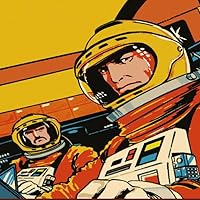
Alfred Bester (yes, Koenig's B5 character's name is an homage to him) is best remembered for his novels The Stars My Destination and The Demolished Man, but he was also a very accomplished short fiction writer. Starburst was his first collection and appeared as a mass-market paperback original from Signet in 1958. (The candy wasn't introduced until 1968.) It contains eleven stories, two original to the book, one from Pohl's Star anthology series, two from Campbell's Astounding magazine, one from Fantastic, and all of the rest from F & SF magazine, and Bester dedicated this book to the F & SF editors. The oldest story is Adam and No Eve, something of a minor genre classic (the title says it all), from a 1941 issue of Astounding, but all of the rest of the stories are from the 1950s. Bester was a very imaginative writer, and he combined the sharp satire of Pohl with the wacky humor of Sheckley to good effect. My favorites are Of Time and Third Avenue (a contemporary man finds an almanac from the far future world of 1990), Fondly Fahrenheit (a good robot detective story), and The Starcomber (a funny and thoughtful story that I remember under the original title, 5,271,009.) The cover is one of my favorites; it's one of Richard Powers least psychedelic efforts and looks more like the work of Chesley Bonestell.
Starburst collects eleven stories written by Alfred Bester from 1941 to 1958, and is rightfully regarded as an essential historical reference to the genre. The science fiction reader will easily see how Bester influenced writers like Robert Silverberg, Barry Malzberg, and Samuel Delany, among many others who followed in the new wave. As Harry Harrison wrote in his introduction to The Demolished Man, Bester was "one of the handful of writers who invented modern science fiction."
A Manhattan native, many of Bester's stories take place in New York when we are not embarking on far-future visions of interstellar travel. But for the writing that defines the best of the genre, the science fiction trope is merely a backdrop to analyze the human condition in the age of technological advancement. These stories clearly demonstrate that Bester was among the first who made that definition of the genre possible - what Malzberg described in Breakfast in the Ruins as "a dangerous literature, born to snarl at the heart of all intellectual and technological advance."
The highlights are plentiful. Disappearing Act offers a sharp sociological critique of post-WWII America that remains as alive as ever. Adam and No Eve follows a scientist who selfishly launches his malformed rocket into space and destroys all life on earth. We follow his final moments as he painfully crawls through an ash-laden radioactive landscape. Bester resolves in Stapledon fashion, compressing into an orb of painful understanding. Oddy and Id and The Starcomber - perhaps the finest Faustian tale I have encountered in science fiction - showcase Bester's breadth across literature and ancient history.
But the crown of the collection belongs to Fondly Fahrenheit. Silverberg called it perhaps the finest short story ever to come from science fiction, and Malzberg seconded the opinion. Bester madly oscillates between the first and third person, telling the tale of a maddening protagonist and his psychotic android - a projection of his alter ego - as they embark on a killing spree across the galaxy. In an era of automation and machine advances unknown, it has aged like a Bordeaux. It is a masterpiece, and belongs among the greatest literary achievements the genre has produced.
I enjoyed the collection immensely and there is nothing amiss here. It comes with my highest recommendation.
Auch in seinen Stories pflegt Bester den dymnaischen Stil, der mir schon beim vor kurzem gelesen Roman "Sturm aufs Universum" aufgefallen ist.
Er liebte offenbar Zeimaschinen und Psi. Die Vorstellung, dass jemand das Talent haben könnte, seine Wünsche wahr werden zu lassen, kam in mehreren Stories vor.
Manche Stories sind durchkomponiert und haben eine starke Pointe. Andere sind eher undiszipliniert. Manche sind einfach zu verstehen, andere eher rätselhaft. Aber langweilig ist keine davon. Trotzdem gebe ich nur 2.5/5
I started listening to this while half asleep and didn't realise it was a collection of stories. I couldn't work out what was going on and initially my notes were just me trying to figure it out. It didn't help that the first story would flash to different time periods with different characters without explanation.
Once I started again, after a nap, the situation became clear and I was able to enjoy the book as it was intended.
I'm not great with accents, but I "heard" all of these stories in an old Manhattan accent, (think Richard Feynman). It's probably the incorrect accent to attribute to the language used, but all of these stories did have a particular lingo. For example the following quoted exchange came up regularly:
"The hell you say" "The hell I don't"
There's a bit of a formula to most of these. They mostly involve a few people discussing some strange phenomenon. One person describing what they've seen to the incredulous other(s). And they don't much explore the consequences unless by way of a little twist at the end.
These are not really "what if" stories because they don't really explore the consequences very much. These are more like "look at this curiosity" stories, perhaps designed to leave you to do the imaginative explorations.
I was pretty bored with the first few stories but then I thought that the second half was much better. It's my first read of Alfred Bester and I'm interested in checking out his novels.
Disappearing Act. (3 stars) The opening is a fairly bleak snapshot of a nuclear war. This is about a wartime illness that affects patients rather uniquely. These patients are casualties of the new warfare (i.e. nuclear) and the "experts" believe they can now use their minds to teleport, sort of. It's been a while since I read a story where the teleportation was a mental trick rather than a technological feat.
Adam and No Eve. (3 stars) A new rocket fuel brings about a catastrophe. This is a story of over confidence and perhaps carelessness in science. About not knowing when to stop pushing the envelope. Thankfully in the end, life goes on even without us. - "Life is too beautiful to perish at the mad act of one mad creature."
Star Light, Star Bright. (3 stars) "He was afflicted with an education and a sense of humor." - In this one a couple of cons bump heads and then team up to find a boy genius. The plan is to cash in on the child's talents but things don't go to plan. A bit of a lame story with a good ending.
The Roller Coaster. (1 star) This one starts out pretty rough and you might just want to skip it. A cad is harassing and assaulting a woman with a knife and demanding sex. It's very unsavoury. Not long after that there's a bit of a jarring line about kids, - "Who can tell if a kid really knows someone or not? They're only half human anyway." - So after a page this story is pretty 1 star and I'm thinking that we better be getting a great concept heavy story. Well it's not really that. One man telling another about his imaginary romance that ended in an imaginary murder and the very real departure of his now ex-wife. The end is a bit of a twist but didn't make up for it.
Oddy and Id. (3 stars) About a man who is prone to good luck. - "Natural phenomena are less often produced by nature and more often produced by man." - The end of this one is a bit more fun than the others. 3 lucky stars.
The Starcomber. (3 stars) This one involves another lucky guy, who also appears mildly insane or at least barely comprehensible to the people around him. When he talks he mixes up languages and puts out quite a few quirky turns of phrase. - "Speak, old fish and chips." - Starcomber breaks the mould a bit and does more showing than telling. It's unfortunate that I didn't enjoy the concept very much because it was a more enjoyable bit of storytelling. An artist regresses first mentally and then physically to childhood. There's something about alien opressors in the middle but I didn't get it. The end is about how children are generally ignored. This story is also quite a bit longer than the others. Also, this one says "God damn" a lot.
Travel Diary. (4 stars) Diary entries and snippets of text from in-universe historical texts take us through the first truly scifi tale in the collection. FTL travel allows our diarist to see the solar system and beyond. When they get out to Alpha Centauri they muscle their way into a time travelling excursion. - "Funniest thing about the trip is fact that we could hardly understand the people there. In 1665 they couldn't speak their own English." - probably the most fun in the collection and my personal favourite. It ends with a quote that I find hilarious - "The universe is a great place to visit, but I'd sure hate to live there."
Fondly Fahrenheit. (4 stars) This setting is gritty and brutal. It's about an android who has somehow broken their prime directive, to do no harm to humans. It also touched on the difficulty of finding usefulness in a world where robots and androids perform all of the work. There are clues about why the malfunction occurs and also clues foreshadowing the final twist throughout the story. It's written with a little bit of a poetic verse feeling about it and I quite enjoyed it.
Hobson's Choice. (4 stars) This is a wartime story. A researcher is trying to understand why the birthrate is booming at the centre of a disaster area while it steadily drops off in any direction away from that location. All of this, though, is a preamble for the interesting discussion about time travel that finishes out the story.
The Die-Hard. (2 stars) There was not much to this. Just a conversation between an older generation dude and some younger folks. To no surprise the "Old One" thinks that modern life enhancements are taking our humanity away.
Of Time and Third Avenue. (3 stars) This one is little more than a conversation about the perils of knowing the future but I enjoyed it.
This is a pretty good collection, but kinda badly mislabelled.. only the 1 of the 11 stories take place in space.. most are post-atomic war, or a present setting. I guess someone must have just really liked the art.
I think a couple of the stories were a bit too similar to be in the same collection... I suspect they would have read better alone, but otherwise it's well worth reading if you haven't read them.
Dissapearing Act(1953): In the War for the American Dream, General Carpenter has molded America into a nationof experts..every knows some specific job. Can the secret of Ward T at St. Albans be the key to victory?
AWESOME anti-war message that walks the line between telling a good story and delivering its moral. I liked this one even over the more famous one later.
Adam and no Eve (1941): The sole survivor of a space travel accident struggles to survive and re-poulate Earth... a little too similar to the one before it in setting, but not bad. I like the concept of a 'last man on Earth' doing all he can to try to re-ignite the species.
Star Light, Star Bright (1952): A principal and a mobster team up to find a ten year old who seems ahead of his time...is a genius, a mutant or something else? Good story, would make a great episode of Twilight Zone.
The Roller Coaster (1953): A bit of a new twist on Time Travel... Decent for a 7 page story.
Oddy and Id (1950): Alot like Star Light, Star Bright, but with a more sinister twist, and set in the future a bit. Meh. Probably the only one in the collection I felt wasn't worth it.
5,271,009 (or, The Starcomber) (1954): Yet another one about a guy that can do anything he wants, only this one has a Latin name and talks with weird idioms, so he made me thing of the MOST INTERESTING MAN IN THE WORLD. He wants a painting, but his favorite artist has lost his muse... he kidnaps him and uses his wizard powers to put the guy through a a bunch of different scenarios that are very much stories within the story. Those are good(especially one where he puts the guys 33 year old brain in his 10 year old self), but the main story doesn't end... just implies that it's keep happening 5,271,009 times. No idea if that number has signifigance or not... is that a word maybe if you put it on a calcuator upside down... Boolies? I got nothing. I hate stories that don't end, but the stories-within-the-story were good enough to be worth the read
Travel Diary (no date): cute fill in of a rich socialite on galactic vacation... made me smile a couple times.
Fondly Fahrenheit (1954): This one is in the Sci-Fi Hall of Fame book... a Asimov-ian Android goes bad, and his drifter owner has to deal with the consquences... excellent, fun story I've read before.
Hobson's Choice (1952): In WWIII America, a statistican finds out the population is miraculously growing.. the cause sends him on a trip to Kansas... and to some time travellers. Not a particularly good plot, but some very interesting thoughts about time travel, and a cool formatting trick I didn't really get until the end.
This felt alot like Time Hoppers by Robert Silverberg, only in a shorter form. Makes me wonder if there's a connection (Time Hoppers was writting in 1967).
The Die Hard (no date): A far future version on an old guy telling the kids to get off his lawn, more or less. Just a short fill in.
Of Time and 3rd Avenue (1951): A man buying a 1950 almanac gets a 1990 one instead, and someone from 1990 comes to get it back... this one is HILARIOUS for the extreme language and culture changes it implies just 40 years in the future.. cool twist ending, too... great for such a short (8 pages) story .. but I suspect it wasn't thought so at the time.
----------------- 2020 edit: Apparently I had 2 copies of this in my pile(though, judging by the fact the alternate title of Starcomber isn't listed, maybe a different version)... I was pretty sure as I was reading it I'd read it before, but with short story collections, one can never be sure if it was in a different collection or not.
As I go back and read my comments from 5 years ago, I find my opinions haven't changed much... I definitely thought of alot of the same things as I was reading. I did like Starcomber even less, though.
I think I really need to read Demolished Man one of these days to get a true read on the author who one of my favorite sci fi villains was named after.
Alfred Bester is a new author for me; he was a "big gun" writer in the fifties, having won several "SF Novel of the Year" awards. Such is the fleetingness of fame; I had never heard of him. I am the poorer for not having read him before, and the richer for having found him.
Starburst is an anthology of his short fiction, so it's a great way to get started. His fiction is the kind of SF that doesn't get written anymore--smart, idea driven, witty. Some things grate; by contemporary standards, many stories are over-narrated, a la Isaac Asimov. Even with the presence of many characters, the main voice in the story is still the narrator's. Like the best of Asimov, though, the reader doesn't mind, because the voice is one that's worth hearing.
Many of the stories are old-style fifties "punch line" stories, in which the story sets up a mystery or raises questions, and everything waits for and is resolved in the last line of the story. These are fun but don't "stick" the way some of the other stories do.
Bester's characters often desire escape, often wishing they could live in another time and place. In many of the stories, the characters get what they wish for, and live to regret it. Bester's heroes are often chronologically grown men who need to grow up, and who have illustion painfully stripped away; sometimes they are better off for confronting reality, and at other times, not.
Like many other mid-century authors, Bester is concerned with the arms race, with the possibility of nuclear war, and with the fear that the world won't survive humankind's stupidity.
Really good fiction; if you grew up reading SF and liked the short storeis of authors like Isaac Asimov or Robert Heinlein, you will really enjoy Starburst and the opportunity of getting to know Alfred Bester.
I was disappointed by how much I did not enjoy most of these short stories, particularly because I found The Stars My Destination and The Demolished Man really remarkable. (Part of why it took me months to get through this slim book.) Bester is a better novelist than short story writer. "Fondly Fahrenheit" and "Disappearing Act" were pretty good; the rest were forgettable.
"Can you spare price of one cup coffee, honorable sir? I am indigent organism which are hungering." The stories in here are deeper and better than the cover blurbs would have you believe. This quote is from "Hobson's Choice" which is about people, feeling out of place and unhappy in their time, but who don't really belong to any other time. Some of my other favorites include "Oddy and Id" and "Disappearing Act."
Cold War Sci-Fi stories from the 50's firmly grounded in morality. Time travel, nuclear warfare and a touch of whimsy. Favorites are "The Roller Coaster" about a thrill seeking couple from the future playing havoc on lost souls in the 1950's, "Of Time and Third Avenue" about man who purchases an Almanac from the future, and "Disappearing Act" about the war for the American Dream and the shell-shocked "veterans" who keep vanishing from Ward T. Cool stuff.
I bought a small stack of old mass market sci-fi books for 25 cents each a while back and so far, out of the ones I've read, I'm not sure if I got my moneys worth. This book is a fairly entertaining collection of sci-fi short stories. The stories ranged from so-so to decent reads but none stood out enough to be singled out.
Not quite the thrill ride of The Stars My Destination but high-octane blasts of story.
Starburst collects eleven short sci-fi tales from one of the masters of the genre. Bester's fiction is politically astute and stylistically satirical. His concerns about American idealism seem to power his writing instincts.
Mind you, it must be said that these stories shares a fair few of the same themes as the aforementioned novel. Namely spontaneous bodily transport, vicious individuals and odd creoles that sound futuristic. That being said, there is also a range of premises and scientific detail that makes each tale stand out.
Unfortunately some of them didn't quite connect with me due to their constrained page counts. I can't help but think certain ideas deserved more narrative invested in them to be truly satisfying. On the other hand, there were also a couple of stories that had ideas that I didn't care for at all, non-starters weighed down by played-out tropes.
However, I did find plenty of short fiction gems in this book that keep me keen to read more of Bester's bibliography. The next will likely be a novel. For now though, I recommend Starburst to fans of The Stars My Destination and sci-fi with sharp social commentary.
Notable Stories
• Disappearing Act - an evergreen critique of US warmongering and the power of escapism.
• Fondly Fahrenheit - one of Bester's more famous tales about genetically modified identity crisis.
• The Die Hard - a short musing on old world belligerence in a forward-thinking utopia.
This is my first time reading Alfred Bester. ‘Starburst’ is a collection of 11 short stories written during the 1940’s and 1950’s for various magazine publications.
Bester is a sharp writer. Unlike many of his contemporaries, he seemed drawn to disturbing and adult themes. Every story in the collection is solid, though I can say I truly only enjoyed 3: ‘Star Light, Star Bright’, ‘Fondly Fahrenheit’ and ‘Of Time and Third Avenue’.
I will certainly try his stand alone novels as some point. 5.5/10
I found this book, a collection of short stories, as I started decluttering my house. It was only after I began reading the first story that I realized I remembered its every word. Now, over sixty years later, it's obvious why Alfred Bester is my favorite author.
A solid collection from Bester. Some of the stories have a great hook or twist, and I was impressed how much focus Bester put into beating up on sci-fi as escapism in these stories.
While it's been many years since I've read this collection, I still remember many of the stories, which is unusual. I recommend it if you like Golden Age oddities.
Worthwhile collection of Twilight Zone style zingers. Most dealing with time travel. Skip over The Starcomber, a dated hipster exercise in authorial excess (much like this sentence!)
Schräge Geschichten von Zeitreisen, Mutanten, schizophräne Androiden, Allmachtphantasien und Weltuntergängen. Etwas in die Jahre gekommen und nicht unbedingt die besten Geschichten von Alfred Bester.