Unaided by his parents and his friends, young Ned Covington must face alone the phantoms that stalk the night and, in a cataclysmic battle, he confronts the forces of evil in all their disguises
Thomas Tessier grew up in Connecticut and attended University College, Dublin. He was the author of several acclaimed novels of terror and suspense, plays, poems, and short stories. His novel Fog Heart received the International Horror Guild's Award for Best Novel, was a Bram Stoker Award finalist, and was cited by Publishers Weekly as one of the Best Books of the Year. He lived in Connecticut.
Ten-year-old Ned and his parents move from the city to a small town on the coast for a quieter pace of life. Ned is a bit of a loner and spends a lot of time in his own head. He has quite an imagination and still believes in the idea of monsters being under the bed. Settling into the new house and exploring the area, including an abandoned building, enforce these ideas in Ned's mind.
This was such a great read! It's a bit of a slow burn but excellently written and builds up to a rather trippy climax. The idea of an entity that can take different forms and plays on your fears is a really fascinating one and is used to great effect here. I'm surprised this novel isn't more well known and that I haven't heard it compared to It by Stephen King (or vice versa since Phantom came out four years before It).
I loved the way Ned was written. Tessier did an excellent job of creating a believable child character and capturing the feeling of being that age; the innocence and the ability to see magic and adventure in everything.
Ned and his parents arrive into town during the summer so school is out which means Ned doesn't get chance to meet any other local kids. Instead, he makes friends with two old codgers who run a bait and tackle shop. The relationship between these three characters was genuine, wholesome, humorous and all around lovely. It was one of my favourite elements of the book.
I really enjoyed the scenes where Ned explores the abandoned spa. In particular, there is a scene involving spiders that genuinely made my skin crawl! It was so well done and effective. It still makes me shudder to think about it.
My least favourite parts of the book were when it focuses on Ned's parents, either individually or as a couple. These were definitely necessary to flesh out their characters and to give context but I kept wanting to get back to Ned's story!
Overall this is a wonderful coming of age story that manages to be both creepy and touching. It takes place during the summer so it's a perfect summer read. Highly recommended!
Sometimes these old horror paperbacks are much more than light entertainment. "The Cook," "Elizabeth," and "The Girl Next Door" come to mind. Thomas Tessier was a poet and humanist at heart, and felt that a good story driven by real human characters came first, even if the publishers wanted something full of spooks and scares and gore. He would come up with a well-developed cast in his mind, so that whatever horror they experienced really impacted the reader. He would allow his characters to shape and mold the story, and he kept doing it until his deadline.
Tessier himself sums up his approach, and as a result, summarizes why we read horror, “I don’t worry about running out of strange ideas, because what I try to write about is not so much the mere strangeness but the people, the characters and what happens to them. Life is full of terror and beauty, and they can’t be ever separated, and in that conflict is our endless drama.”
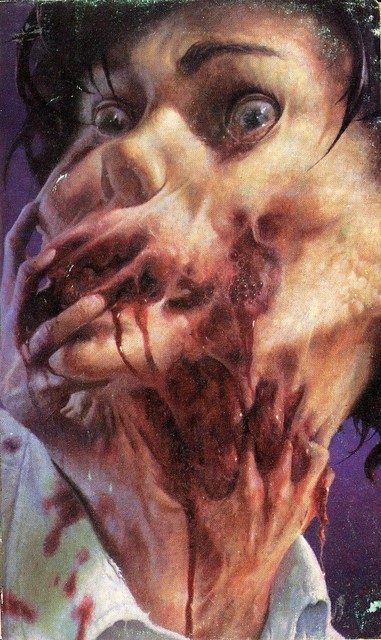
"Phantom" really showcases Tessier's artistry. For this reason, the novel was up for a World Fantasy Award in 1984, and barely lost out. But I can also see why horror fans, expecting a lightweight pulp monster mash based on the cover, might not have talked much about this book in the Eighties, because it is a character study more than anything else. In fact, I rate it up there with the great coming-of-age stories of the era from the likes of Stephen King and Robert McCammon.
It's about a young boy named Ned. His family moves from the big city to a small fishing village. His mother has severe asthma, and it is hinted that she may also have some mental health issues. Ned witnesses his mother almost die of an acute attack one early morning, and this traumatized Ned, who is convinced all varieties of phantoms and boogie men are out to take his family and leave him all alone. Tessier writes this scene with incredible realism from a child's limited perspective, and it is scarier than any supernatural haunt.
Fortunately for Ned, moving to a new place is not as scary as it could be, because he befriends two old "proggers" who make a living as tinkerers and by selling fishing bait. Named Peeler and Cloudy, they are as colorful as their names suggest, and they spend their time wading about in creaks and marshes, catching crawfish, earthworms, perch, bluegill, and snapping turtles. They are more than happy to have little Ned for company and end up being surrogate grandparents, schoolin' the youngster on a thing or two. They know all the history and secrets in town, which is why when they find out where Ned and his family lives, they grow worried for the boy. A sinister history surrounds their property, and Ned is soon to discover that there may really be such things as phantoms.
It's a psychological take on the haunted house story, and one with very likeable characters who all act in believable ways. Even the child character is great. Normally I cannot stand children in novels, because they are usually written by authors who do not seem to remember anything about what it is like to be a kid. Tessier does. This takes the story, mostly told through the eyes of Ned, to a whole new level. And because all his characters have empathy and intelligence, the dialogue is a joy to read and gives you a warm glow inside.
Which is fortunate, because there is a lot of chit chat and fooling around in this novel. Tessier takes his time having his characters never be static. Cloudy fiddling with an old alarm clock and a blender. Peeler hoarding Iron City beer cans. Ned looking at pond scum under a microscope. Everything is carefully done to give the reader a sense of a character's personality and backstory. But it does make for a bit of slow reading. Halfway through the novel, I almost forgot this was supposed to be a horror story.
Tessier was not only interested in character development, but exploring the phenomena of the paranormal through psychological and metaphysical analysis. The crux of Tessier's argument is in a story told to Ned by his father Michael. When Michael was a kid, the moon appeared in the sky one night much larger than he'd ever seen it. In his child's mind, he thought this meant that the moon was on a collision course with Earth. He pointed the moon out to a neighbor, who said, "Yes, the moon is beautiful this evening." The child thought it was Armageddon. The adult thought it was beautiful.
This theme runs throughout the entirety of the book, painting portraits of how the human mind ultimately decides reality through the lens of our own neurologic hardwiring. It's very Kantian. We have developed mechanisms to avoid making fatal errors in judgement. As Peeler puts it, you don't go wading into a pond barefoot, not because you SEE the snapping turtle, but because you ASSUME he is there. Otherwise, you may end up missing a toe. We are primed to assume the worst, because if we didn't, we'd likely not survive as a species.
But then again, sometimes things aren't as scary as they seem either. Or our expectations make something out to be grander than what it really is. In one very Proustian chapter, "Goodbye, Greta Garbo," Tessier focuses on Ned's mom reading two books by a celebrated author, only to be terribly disappointed that this so-called genius is a hack.
And so what is the truth? When Ned's mother appears to be attacked by unseen forces, is it asthma or phantoms? Similarly, in the last half of the story, after Ned destroys a seemingly useless scarecrow in the meadow near his bedroom window, he himself starts being assaulted by apparent evil forces. Had the scarecrow actually been some kind of protective guardian? Is Ned now being stalked by a phantom or does he have a medical condition? Ned decides it is time to stop hiding under the covers from the Boogeyman, to face his fears, and to decide what things are for himself.
In summary, this is a really beautiful and sometimes chilling novel with incredible literary depth that you may not expect from a paperback from hell. But don't think that its "elevated" status means that the book is written in flowery language or hard to read. Quite the contrary. Tessier has been called "a man of few words," meaning he believes in being succinct. His sentence structures are very simple and easy to digest, but yet are never choppy or juvenile. The novel was can be appreciated by children Ned's age and up.
Scoring this novel proves difficult. As a pulp horror paperback, I can't recommend it that highly to folks who are wanting to pick up a fast-paced gory thriller. But as an overall novel, I say this really is outstanding.
So is "Phantom" worth reading? Take Tessier's advice and see for yourself...
This is a tough one to rate, but I’ll go with 4 stars. This is my third Tessier novel now, and I should know at this point that he’s not going to deliver expected, standard fare. I’m sure many reading this book expecting 80’s horror pulp because of the cover, might be disappointed in this deliberately paced character study-take on the coming of age tale. This book predates IT, and all the followers though, and Tessier does not approach this material in the same way. Don’t get me wrong, there are plenty of scenes of the kind you might expect in that kind of novel, and they’re gloriously well written, but the author is also trying to grasp and wrestle with ideas that are far more existential. The nature of reality, and what children can believe in, versus what adults can believe in. How we all tell ourselves the things we need to in order to continue to function day to day. The nature of death, and fear of forces beyond our understanding. The writing is excellent, which is no surprise, and the characters extremely well drawn - especially our protagonist Ned and his two elderly friends, Peeler and Cloudy - I absolutely loved them. The conversations they had between themselves and with young Ned were delightful. This book was not what I expected it to be, but I’ll be thinking about it for some time.
My second time through with this book, and enjoyed it just as much. It's my favorite of Tessier's; The Fates seemed like a paint-by-numbers "first novel" and "Fogheart" was just too distant and nihilistic (both well-written, of course). I especially appreciated how the mysteries were left mysterious. Some endings were left loose, not all the answers were provided.
Solid writing. A coming of age tale hints at things that go bump in the night of our minds. The slow burn tale gets bogged down in description and dialog at times, but overall, it is an enjoyable novel.
4.0 stars! Coming of age horror tale Nine-year-old Ned's parents move from Washington DC to a off-road tiny coastal town, around the summer of 80. Ned's a lone child, whose new friends are two 60 something grizzled wharf rats. One white man (Peeler), one black man (Cloudy) in a run-down bait-shop.
Tessier does a great job developing character. Each characters voice unique. Old-timers fixing antiquated appliances, piddling, fishing shallow swamps with live worms. Peeler, Cloudy, and Ned are a pure pleasure to listen to. Tessier scores a poetic bulls-eye, preserving early 1900 rural North Atlantic dialects. Phantom notches a rare trifecta- endearing, scary, touching.
Ned's mom "Linda" and dad "Michael" dance a dynamic, cooling and sometimes turbulent waltz. Their twist-and shout ballet, marital interplay rings true, plays well, crammed full of Linda's gut emotions, Michael's shallow pop-psychological diagnostic repartee's, ensnaring the reader's attention and self examination.
Ned's summer explorations made me ache for bygone, halcyon yesteryear's. A simple time when kids played outside, fished, and explored grassy ponds, old piers, and abandoned buildings- gone by dawn, back in time for dinner.
Traditionally, "coming of age" sub-genre horror novels highlight multiple boy's and girl's interpersonal relationships. Novels like: Stephen King's "It", Dan Simmon's "Summer of Night" and Robert McCammon's "Boys Life". Instead of boy bicycle gangs, Phantom provides a bird's-eye-view into nine year old Ned's solitary summer, blossoming self awareness ,scary solo explorations, coupled with lazy hazy afternoons, spent jawing at a junky bait-shop, enthralled by old men's tall-tales and local history lessons .
All-in-all, Thomas Tessier delivers a well crafted and original story. The scenes in the old abandoned spa building were seriously scary. I got emotional a few times. I identified strongly with Ned's mom Linda, because like Linda, I had an only child...a boy.
You'll like Phantom if you like- -preadolescence coming of age stories -nostalgia for the 70's and beyond -dialogue like Stephen King's avuncular favorite uncle rural idioms - creepy more than gore - are attracted by horror novels but stay for a good stories
The authors imagery and ability to make me feel the young protagonists terror, was incredible. The novel switched POV, a technique that is often poorly mastered. Tessier had no such problems, and though the point of view shifted within chapters, within scenes, I had no trouble discerning between the characters because each one was a unique identity.
I doubt I shall forget in a hurry the abandoned spa-house where Ned goes to face the monster. He finds spiders. Lots of spiders. Webs so dense that they have a presence, a malevolance that is chilling to witness.
Tessier’s 1982 novel is all tease and little else; young Ned moves with his parents to a new town on the seaside, hangs out with some old geezers and has a fever dream. Somewhere along the way there are ominous hints about vague horrors… but they never really manifest themselves. Phantom isn’t just quiet horror; it’s mute as fuck.
It starts well, though, with a real-life health scare. But that’s all. A ridiculously long dungeon crawl in the middle of the slim novel brings an already glacial pace to a standstill; and to really batter the reader into a coma, the novel soon presents the reader with another dungeon crawl with very little variation.
Now the quality of writing here is excellent, there’s no question about that; but after a while it gets increasingly difficult to enjoy a novel that constantly keeps baiting the reader, yet never goes anywhere.
My disappointment is possibly multiplied by high expectations: Tessier has a great rep, the coming-of-age genre rarely fails, and the US paperback cover has a vague folk horror feel that is utterly absent in the novel itself. On the other hand, quiet horror is an acquired taste, and if it doesn’t tickle your fancy, it just comes across as so much pointless noodling. And Phantom is a stellar case in point.
Ned’s fever dream at the end, with all its surrealism, is slightly reminiscent of H.C. Andersen‘s fable The Story of a Mother. A fine piece of horror, that one. Phantom, well…
Read all my reviews at mikareadshorrorfiction.wordpress.com
In 'Phantom', ten-year-old Ned finds himself drawn to a whole new world when he moves to a new place with his parents. He befriends two old men who clearly know the history behind his house yet refuse to tell him. When he begins exploring an abandoned building, he realizes that there is something within that will not leave him alone..
Despite the suspenseful, creepy premise, the story simply failed to live up to it. Instead of presenting a strong dark mystery coupled with lots of tension and questions, it was dull and repetitive. Basically, there were many long-winded narratives that seemed to go on and on without actually contributing to plot development or character growth. Ned's experiences in the dilapidated building were a snoozefest. I found my mind wandering several times and as much as I wanted to enjoy this book, I couldn't because it never got better.
In terms of characters, all of them were disappointingly one-dimensional. Ned was an introvert and somewhat of a loner but that didn't mean he had to be boring. His parents were stereotypical - his father was the practical, rational one while his mother was emotional. It was ironic that they supposedly cared about him yet they failed to notice how disturbed he was after visiting the building on his own. To make things worse, the full story behind what had happened to one of the families that used to live in Ned's house was never provided - only some vague information.
Overall, 'Phantom' was a dreary read due to the directionless storyline, snail-like pacing and forgettable characters.
Subtly supernatural novel about a nine year-old boy who is beginning to explore the mysteries of life and the natural world around him. I found it a bit slow, but it handles well the perspective of a child and the myths children create to explain things that are beyond their understanding. Like Stephen King's The Girl Who Loved Tom Gordon (which contains similar themes), it would make a good "scary story" for younger readers.
Published as “horror”, it is scarcely that. More of an adolescent-coming-to-terms-with-death tale that just…wasn’t terribly engrossing. It could almost be a YA novel if it weren’t for one strangely graphic exchange but there are much more rewarding such tales out there.
This entire review has been hidden because of spoilers.
Like all of Tessier's work, Phantom is a difficult creature to describe. It is both fantastic and, in some ways, a failure for the same reason as all of Tessier's work. Tessier is a writer who tries to do new things with old concepts using some absolutely FANTASTIC writing techniques. Unfortunately, his experimental approach is doomed to divide most readers.
To be brief: this is the story of Ned, a boy who has a near-death experience as a young child. For the rest of his life, he is haunted by the fear of death, something that is emphasized by his over-protective mother. His parents move to a small town into a house known ominously as "The Farley Place". Ned finds himself the victim of supernatural goings-on, ultimately leading to a final confrontation in one of the bleakest versions of the afterlife I've ever seen...sort of. I think.
That's sort of the issue with Tessier as a whole: I would group him with Ligotti and Campbell as a horror writer who really knows how to make vague language and the power of suggestion work in an atmospheric sense. He creates a winding narrative littered with conversations and bizarre scenes that don't seem important until the very end...and even then, their significance is never fully explained. This is a book that bears reading two or three times, which unfortunately, is more of a chance than most readers will give it.
This is not a straightforward ghost story in the vein of Amityville Horror: this story bears some thinking about. It's something that a particular kind of horror fan will enjoy, so I recommend it tentatively.
Whatever else can be said about ever-underrated and never-exactly-prolific Tessier, not two of his novels are alike, and one can never predict where any single one of them will go. This one, "Phantom", is a coming of age story in that primal sense, being a story of young boy's initiation into adolhood and realities of life and death. It is packed with archetypal initiatic images and situations, from the chthonic bowells of the abandoned spa to the final confontation with a negative anima figure. Pace is rather slow, and supernatural is used sparsely for the most part. Nevertheless, Tessier is able to infuse locations with numinous dread without resorting to overt supernatural manifestations. And, when supernatural presence is concretely invoked, or when outlandish landscapes are presented, it is done in vivid and impactful manner. Novel's finale, for example, is not something that any reader will likely forget. Story is told in omniscient third person, with inner state of each important character being presented in great detail. Tessier's characters think and act in believable and relatable manners: be it the protagonist, his sickly mother or his old-timer friends, you'll care for them. Now, some of this might've made for some ponderous, pretentious writing, but Tessier's prose is anything but. His writing is crispy clear, utterly unpretentious, simple but not simplistic. This is an example of intelligent, "literary" genre-fiction work that never sacrifices its readability and addictiveness.
I first heard of Tessier's Phantom via the Top 40 horror novels on the Horror Writer's Association website. The list is available here: http://www.horror.org/readlist.htm in alphabetical order.
The book was a quick read. Very crisp and concise. And it was a classic, supernatural-presence tale of horror and suspense. A straight-forward spooky tale without too many twists or turns. Just genuine fright. The ending, I will say, was not what I was expecting. Which came as a shock, considering the book mainly followed the plot structure of classic ghost stories.
Overall, it wasn't bad. But it wasn't anything to write home about either. Would I put it on my list of top 40 horror novels? Probably not. But I can see why people liked its simplicity at a time (it was published in the 1980s) when horror writers seemed to be getting more and more convoluted.
Phantom was a huge disappointment to me. It was so slow in the build up (despite being a small book) that it was over before it had a chance to have any deep fearful points in it. I almost thought at the end it was going to pull off a huge comeback as there is a point where it felt like it really had potential for a ground breaking finish that would be as good as any horror movie ending, yet it fizzled out and ended with out much at all. It was much like when you pop open champagne and it doesn't make that pop sound. It just ended. Hopefully, because this was an earlier book by Thomas Tessier, that he got better from here. either way, this will be the last book I will read of his. It was too much of a miss to try again.
Phantom is a horror story and a creepy tale of Ned Covington who is only ten years old. Ned is going to find more than he bargained for when he explores an abandoned building near his home. Good writing and a few spine tingling thrills.
This is the novel I would use to introduce people to his work. Unlike some of his work , the main character, Ned, is likable and his relationship with the two older men especially Cloudy gives some of the best lines of the book. It’s a child’s coming of age of book dealing with death. Despite the heaviness , it is an enjoyable read . It’s surprisingly heartwarming and describes the coastal towns of Delaware, Maryland and Virginia well.
“Phantoms”, a spaced-out odyssey about a boy connecting with the spiritual world, doesn’t do this Tessier any justice. Skip it. Stick to the horror classics “Rapture” and “Finishing Touches” instead. New editions of both novels will be published through Valancourt shortly.
Ned Covington carries a ball of fear in his stomach, fear that some shade will grab at his limbs as they hang from his bed in the night, fear that something may be stalking the corridor outside his room, and fear that something terrible might happen to his parents.
This all happens when Ned is less than five years old and culminates in him witnessing his mother having a severe asthma attack which comes to affect the lives of the whole family. Scroll forward five more years and Ned is now living in the coastal resort of Lynnhaven, part slowly dying fishing town, part accumulation of horror tropes, with little to recommend it, other than the prospect of a decent fish supper and the spooky abandoned old spa house up on the hill.
And this is maybe where my problem lies because after a reasonable start The Phantom becomes a story of promise but little delivery as SPOILER ALERT spooky events and situations aplenty arise, from scarecrows to spiders and bees to a dead body, and the tension builds but do they culminate in a climactic tumult of terror as they say in the pulps? No – they sort of diminish and become hallucinatory and the phantoms of the title are so vague and amorphous that they offer little threat, of course this isn’t helped by the Scooby Doo characterisation of Ned’s closest confidants, Peeler and Cloudy, two old salts whose down-home shucksiness is distracting before you even contemplate why a ten year old boy’s best friends are two old men? I know horror doesn’t have to lead anywhere and quiet menace can be great but you have to have characters you can root for and I didn’t really take to Ned or his disassociative parents or the local yokels.
Have said that the book is reasonably well written with that 80’s horror around every corner feel and there is just enough to keep your pages turning, but in the end – meh. 3 stars.
On s’attend à un percutant livre d’angoisse et d’horreur, et on découvre les peurs irrationnelles d’un enfant portées à leur apogée. Pas mal fait, ça me fait penser au Tour d’écrou d’Henry James, en beaucoup moins transcendant. On finit tout de même par comprendre assez vite que rien n’est réel, si ce n’est pour le petit garçon. Et tous cas l’auteur retranscrit parfaitement la psychologie d’un enfant en proie à ses terreurs, ses angoisses et ses superstitions. J’ai un peu de mal à le classer dans « Fantastique ».