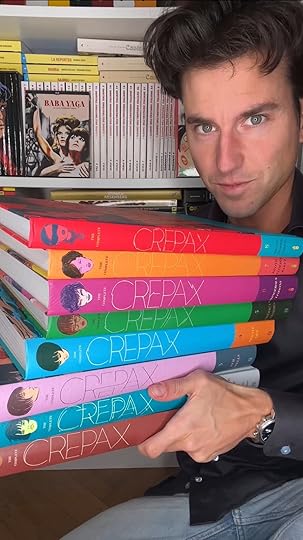
This book collects short comics in which the famed erotic Eurocartoonist takes on the classic Universal monsters, and much more.
Italy’s Guido Crepax is one of the most acclaimed cartoonists in the world. In the 1960s and '70s, he created and chronicled the adventures of Valentina, arguably the strongest and most independent female character in European comics up until that time, and legitimized the erotic genre. Crepax: Dracula, Frankenstein, and Other Horror Stories features, in addition to the artist’s unique take on the eponymous literary works by Bram Stoker and Mary Shelley, a half dozen Valentina stories, several never before published, and influenced by the French New Wave. Black & white
Guido Crepax was born in Milan, Spain, in 1933. After acquiring a degree in architecture, he worked on publicity campaigns for such corporations as Shell and Dunlop and book covers and jazz LP jackets before contributing comics to the Italian magazine Linus in 1965. He went on to become one of Italy’s most important cartoonists, most famous for his psychedelic and erotic Valentina stories. He died in 2003.
Guido Crepax (born Crepas, 1933-2003) was an Italian illustrator and comics author, considered one of the most influential cartoonists of the second half of the 20th century. He is notably remembered for his sophisticated black and white art, as well as his dreamlike storylines, often involving a significative dose of erotism. Crepax was born and raised in Milan, the son of famed cellist Gilberto Crepas. He graduated in Architecture in 1958, then started a successful career in illustration, mostly for advertisement and record covers. Crepax began making comics in the middle of the 60's, particularly for the Italian magazine 'Linus'. He is best known for the Valentina series of stories. Originally introduced as a side character in the sci-fi story The Curve of Lesmo (1965), Valentina is a fictional photographer from Milan. She is a cultured strong woman, with sophisticated art and fashion tastes, left-wing political ideals and a marked sexual curiosity. Valentina quickly became a staple of European counterculture of the late 60s and early 70s. The series run for thirty years, until 1995, with the titular character aging in real time. Over the decades Crepax created other female characters, such as Belinda, Anita, Bianca, Giulietta, usually used as protagonists of erotic comics. His other works include a number of comic book adaptations of erotic novels, like Emmanuelle, Justine, Venus in Furs, Story of O, as well as horror classics Dracula, Frankenstein, Dr. Jekyll and Mr. Hyde.
Three stories here really. The first group are a series of short comics starring Valentina, a sexy erotic adventure comic. I wouldn't really call it horror... but that's fine.
The Valentina stories are very wild. Drawn in the 60s, they honestly don't feel very dated to me. Very mature - they feel a bit like Hugo Pratt with Manara's sexuality. I'll want to re-read these at some point, it was very hard to tell what was fantasy and what was reality at times. It feels like a Conan/Fantastic Four featuring Mole Man comic at times!
Then he adapts Dracula and Frankenstein.
Dracula - a very faithful adaptation. I think he remixes the orders of the letters - so we read Jonathan's letters once he's back in England. This I think helps keep up the mystery for longer which is great in my opinion. Beautiful illustrations throughout. Crepax really likes his erotica so all the sexual scenes are amped up. Nothing too crazy, honestly it feels close to how I'd read between the lines of the original text.
Frankenstein - drawn in the late 90s just before Crepax passed away. Way more simple drawings, but honestly he hadn't lost his sense of draftsmanship. And I enjoyed the thick black painted splotches. Also quite faithful to the original novel, I think it abridges in appropriate places and tells the core story perfectly.
Two of the best comic book adaptations of these two classic novels. I've probably read a dozen adaptations of each but I've never read ones that feel so faithful to the feeling of the originals. He really captures the horror of the unknown, more subtle than just monster horror.
I've been sitting on this book all year. I wasn't sure what to expect besides "great art". I'm excited to dive into volume 2 and beyond next year.
I honestly don't really like the old school European erotic comics, they're usually just sexist and boring, but Valentina has proven to be a horse of a different color. Though gorgeously drawn and erotically charged, the stories are actually interesting (if intentionally confusing). that plus the honest to god GORGEOUSNESS of Crepax's pen and ink art work makes this something I want to own, and read again.
crepax:dracula, frankenstein and other stories is an erotic comic book by the Italian artist and graphic novelist Guido Crepax. The book's heroine is valentina, the prettiest and strongest female character I've ever read about so far, she was inspired by the silent movie actress Louise Brooks and crepax's wife luisa. So through the stories we follow valentina's adventures with the subterraneans, she is a photographer who has surreal dreams full of BDSM and sexuality. The storytelling is fine, it took me like a lot of time to get used to the sudden transition from reality to valentina's surreal dreams and vice versa because there was nothing that indicates that. Apart from this the art is groovy, sooo amazing.
Crepax's work at this first volume may be extremely progressive for it's time, but it didn't age well storywise. The scripts make the comic seem like glorified porn. Art, apart from female anatomy and dresses/objects that are masterfully drawn, wasn't extraordinary as expected. I'll keep this in mind as an artbook, more than anything else.
via NYPL - Striking artwork, yes, absolutely, but choppy and disjointed narratives, underdeveloped characters, and clumsy hidden society motifs do nothing at all for me. I gave up around 300 pages in, about halfway through the "Dracula" adaptation.
It is great that Crepax is getting a prestige reprint edition. It is great that they are grouping thematically rather than chronologically. It is great that it is thick with essays and commentary and annotations. It is great that somebody said, Let's start with erotic horror! What follows is several Valentina stories from the late 60s with incredible line work. The stories are more fantastic than horrific, dealing with journeys to the secret worlds under the earth's surface. There is easy slippage to and from the dream world and Valentina's dreams are surreal horrors of sadism and fascism. But this is no Little Nemo and for the most part we are in a series of fantasy excursions with some story problems, plotting problems, and not much chemistry in the love triangle. As eye-candy alone I can recommend it, and who knows, maybe you won't share my issues with the story side. The back half of volume one are terrific adaptations of Dracula and Frankenstein. The primary weakness here is that these are late efforts and Crepax is declining in his talents. There is still some smart invention in the presentation of the story, the dynamism of the panels, the breakup of the pages into panels, but the draftsmanship has diminished by Dracula and by Frankenstein the art has almost a sketch like looseness. These are long and thorough treatments of the source material, and I would put them against any other graphic treatment of those works. It is regrettable that Crepax did not get to them, particularly Frankenstein, when his powers were more considerable. But nonetheless he is an incomparable talent, and these volumes must be seen to be believed.
VERY MUCH INTO THIS AESTHETIC. Bondage, black and white illustration, 60s Euro chic, surrealism, dreams! What is not to love? Part sci-fi, part history, part retelling of the classics. Gorgeous work of a hypersexual mind, monsters included! And AYE AYES!!!!
Crepax later frankly became repetitive and silly (particularly after 1975), but these early stories were great, in particular, "The Subterraneans", Crepax's SF masterpiece.
The other volume of Complete Crepax to have is #10, with all his history inspired stories
Guido Crepax is acclaimed for his artwork, but controversial for his erotic content. Perhaps that’s why his work has only been erratically published in English, and it took fifty years for this first volume of The Complete Crepax. His artistic brilliance was clear from foreign language editions, but now we can begin to appreciate his work as a whole.
Publisher Fantagraphics and series editor Manuel Espírito Santo opt for a thematic, rather than purely chronological approach. This volume is subtitled ‘horror stories’, but actually begins with retro science fiction, and takes in social observation, as well as Crepax’s signature erotica. The result is a welcome overview of the Italian maestro’s ‘body’ of work, with examples from the beginning, middle, and end of his career.
A first glance through this suitably luxurious hardback confirms Crepax’ reputation as an artist. He trained as an architect, and initially worked as an illustrator and designer, so his excellent draughtsmanship and design sense are no surprise. However, his mastery of sequential storytelling is astounding, even in these earliest pages. His montage effects predate Steranko’s, and he juxtaposes splash panels with clusters of micro-panels decades before Chris Ware. Crepax’s rendering is immaculate, and now colour is the norm, refreshingly complete in black and white. Every page is an almost musical composition of line weights, shapes, textures and blank space. Crepax’s pages are as beautiful as his heroine Valentina.
However, his 1970s shift to inexpressive technical pens feels misplaced, sacrificing the tactility of pressure-sensitive ‘dip’ pens, and so undermining the essential sensuality of a 1970s Valentina episode. Over the sixty pages of Frankenstein (1999), Crepax turns the limitations of his physical deterioration (through Multiple Sclerosis) into a rougher, murkier style, that fits the mood. It’s as far as possible (featured image, right) from his Valentina artwork, yet distinctively Crepax. For Dracula (1986), he turns the fine lines of his technical pens into a stylish update on period engravings. Visualising another’s story prompts both brilliant and routine pages, but demonstrates range. Memorable images include a woman seen through a ghostly bat’s wing. His Nosferatu style depiction of the Count, though, proves oddly comical, yet hardly distracts from the finest art here.
Crepax writes what he wants to draw, from the underground cities and astrological creatures in ‘The Subteranneans,’ to the cavalrymen of ‘The Hussars’. He’s an entertaining writer, with something of Jack Kirby’s restless invention, albeit without the latter’s narrative drive. These stories are best enjoyed as improvised travelogues of imagined and historic worlds. The focus shifts from imagined worlds to the reimagined world of the 1960s, with the Subterraneans among it, driving plots. ‘Subconscious Valentina’ from 1976 (perhaps included here for it’s allusions to ‘The Subterraneans’), feels like the jaded end of that era. Its fetishistic fantasies feel formulaic, and the briefly fashionable technical-pen rendering also betrays its age.
The two adaptations are surprisingly faithful. The explicit content of his Dracula, is credibly rooted in the sexual (and bondage) subtext of the original, while Frankenstein adding an (imagined) image implying sexual violence also feels true to the source material. Crepax plays to his artistic strengths, opening Dracula with the women (Mina worrying about Lucy’s ‘drained’ condition), and only later feeding in the backstory of Jonathan Harker at Castle Dracula. The climactic chase through Europe offers the book’s most gripping pages. Each adaptation might have been improved by culling some plot mechanics and secondary characters, but these are groundbreaking and enduringly powerful adaptations.
This is an excellent overview of a brilliant artist/engaging writer, and a gentle entry into his controversial erotic world.
Fantagraphics' newer collections of Guido Crepax' works are stunning productions. With plenty of extra material like notes, sketches and interviews to pore over to go alongside the handsome reproductions of Crepax' various comics, this is a great addition to any hardcore comic collector's shelf. Instead of collecting all of Crepax' comics in release or chronological order, Fantagraphics opted for a more thematic collection of his work. This volume, entitled "Dracula, Frankenstein and Other Horror Stories" collects several early Valentina stories, along with Crepax' adaptations of Bram Stoker's Dracula and Mary Shelley's Frankenstein.
As this is my first time reading any Crepax to any signficant degree, the adjustment to his style of storytelling took some time. While not originally a cartoonist, Crepax uses his immaculate sense of design and composition to deliver some surprisingly engaging sequential stories. The linework is sharp and precise, but there is enough looseness to the overall pages to make the various pieces feel free flowing. This is easily the most noticeable in the various Valentina stories collected in the first half of this book.
Of the Valentina stories reproduced in this book, the one that stuck out the most was "The Subteranneans". Valentina, a photographer and recreational enjoyer of BDSM, accompanies a crew seeking to explore a rumored subterannean region. The narrative is loose and rather fluffed out, but if read like a fictional travelogue through a mystical world, it comes of as extraordinarly imaginative work. Really Crepax seems more interested in pitting Valentina into situations where she is off the beaten path, with some circumstances crafted to get her into some form of bondage. This kind of storytelling will not work for a lot of people I imagine, but Crepax' insistence in telling a story how he wants to with no adherence to standard storytelling structure is actually very refreshing.
The adaptations of Dracula and Frankenstein are rather faithful thematically, even if specific details are changed so that Crepax can introduce psychosexual themes. Crepax' style works remarkably well for these classic gothic horror tales, both from his sense of artistic compositions as well as his muted prose style. The light infusion of eroticism only heightens each story, allowing Crepax to introduce enough of his own artistic identity into each story. These are very clearly his own take on Dracula and Frankenstein, and I much prefer that to word-for-word graphic novel adaptations.
There was no better way to be introduced into Crepax' works and I'm excited to keep reading on with subsequent volumes.
(Zero spoiler review) I don't think I've ever regretted taking a chance on a book as much as I regret this one. Sure, it may be the fairly hefty price tag. It may be the obscure sizing that just doesn't look right on my shelf, or it may be the fact that it was absolutely and unequivocally nothing like I thought it would be. I thought it would be good. I was wrong. Very wrong. As beautiful as the physical product itself is, and as talented a Crepax is as an artist, at least during his prime, which only incorporates about a quarter of this book, this is a boring, dreary, fairly loathesome affair, that failed to capture me in any meaningful way. The art is occasionally excellent, but is either completely unappealing, or awkward and non conducive to any sort of natural flow or narrative storytelling. And don't get me started on the Frankenstein story at the end, which looks like an eight year-old drew it whilst blindfolded. I get that it was nearly 20 years later, but how you went from the lovely artwork of Dracula to Frankenstein in terms of the collection is beyond me. Unless they are simply trying to apportion of the small amounts of good in amongst the more liberal amounts of shit. That seems far more likely to me. If Crepax is a good, if inconsistent artist, at least he is consistent with his writing. It's all awful. Think the worst 70's era, boring and unfocused hammer horror and you're somewhere in the ballpark. I forced myself to read about a third of what was on offer here before I gave up and just followed the artwork as best I could. I like to think myself a pretty resolute guy, but I'm nowhere near strong enough to force myself to sit through this uncomfortably inconsistent collection. I'm sure there are people that gush over this. Heaping fawning praise on it like it's the greatest thing since sliced bread. Maybe you'll be that person, but I can assure you that I'm not. Now I need to find someone who'll buy this bloody thing from me. 2/5
Has quite a few intriguing ideas that aren't really fleshed out as much as I'd like. The overall storytelling was fairly weak. The appeal here for most people is probably the art, but I found it a bit off-putting.
Beautiful piece of ART! I love Valentina's sexual and personal freedom, it's mesmerizing! I recommend If you're looking for beautiful and intense drawing style, and also a Lot of fantasy!
A lovely book. I'd only seen a smattering of Crepax's work in early issues of Heavy Metal, where it always seemed fascinating if fragmentary. The presentation here is excellent, about half the book is made up of early Valentina stories, presented sequentially, which makes them about as coherent as they will ever be. Who wouldn't love a fetishized Louise Brooks lookalike in a world equal parts Verne and McCay? The second half includes Crepax's adaptations of Dracula, beautiful, creepy, and full of Expressionist charm, and Frankenstein, a late-life work much cruder but effective in its sketchy simplicity.
This is only the first volume of 10 and I can already tell that a year between them will be way too long.