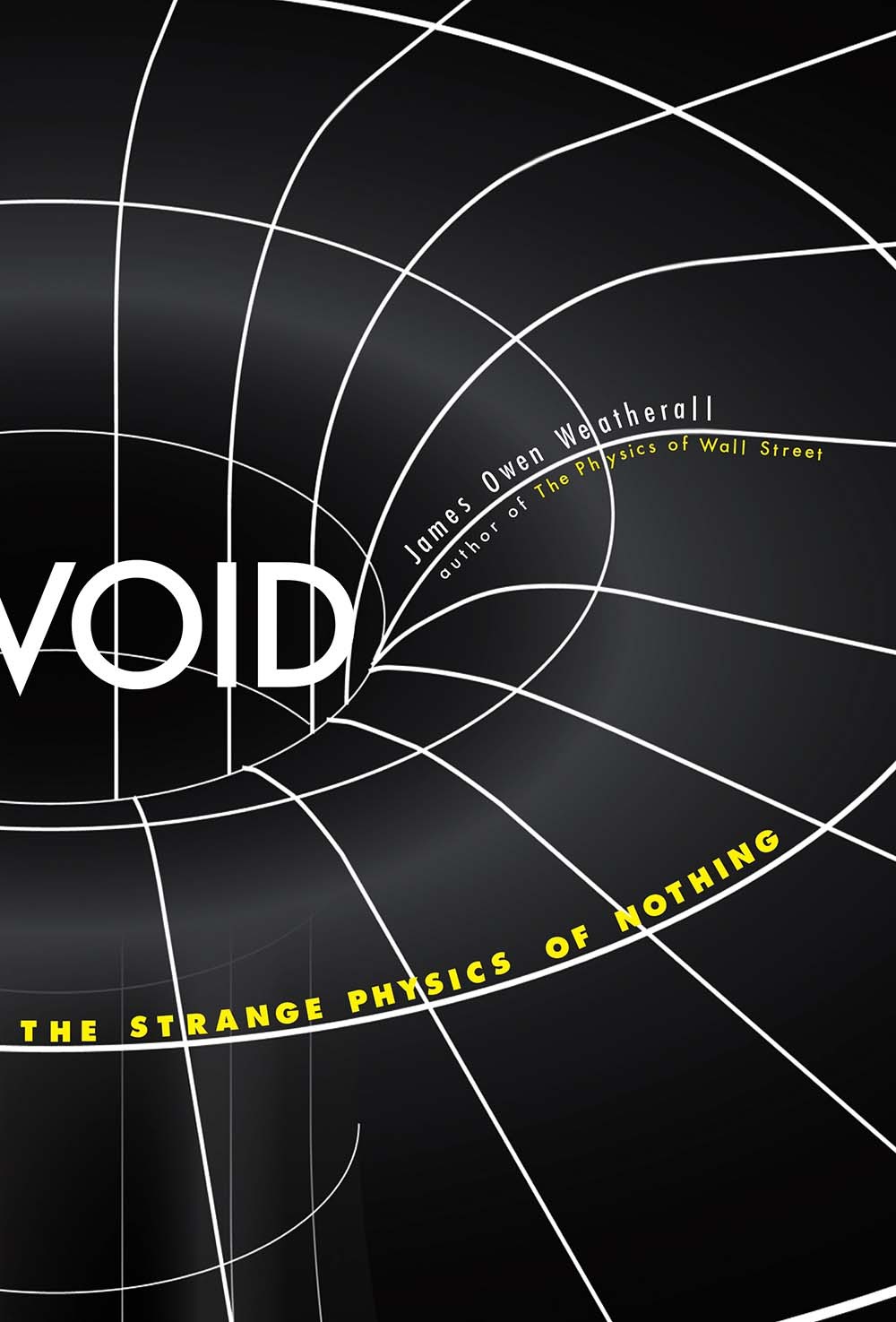
“Nothing” isn’t easy. As a concept, it has lots of roots and branches. It has technical significance in physics. That technical concept has philosophical roots going back to pre-Socratic days. And of course it has everyday significance, in everyday language. Weatherall would really like to keep it all tied together. While his focus is on the evolution of the concept within physics, he also maintains an eye on how that evolution squares, or fails to square, with what we commonly mean by “nothing”.
The book is not a technical physics book — Weatherall plays to his strengths as a philosopher of science. You won’t find formulas. But you will find what, to me, were some enlightening discussions of physics concepts, kept at a conceptual level. He’s not teaching us the physics itself — he’s tracing the evolution of a concept.
Historically, “nothing” has evolved through long philosophical controversy. Pre-Socratic philosophers like Democritus tried to account for observed physical reality in terms of objects moving through a void. A void was necessary, on those early atomist accounts of motion — if space were filled, there would simply be no room for objects to move. Descartes, as Weatherall recounts, rejected the notion of empty space as incompatible with the essential attribute of spatiality, extension — a space without extension, i.e., empty space, would be a self-contradiction. Newton, though, reclaimed the void as a vital element of his physics, with absolute space and forces acting at distances.
Weatherall gives an excellent account of Leibniz’s disagreement with Newton, on both the very idea of empty space and Newton’s account of motion through absolute space. Leibniz’s objections to the coherence of Newtonian absolute motion have a modern feel to them, appealing to the lack of an assured fixed point (other than a hypothesized invisible grid) from which to observe motion in absolute terms. With all things in motion, no one thing, unless chosen arbitrarily, provides a fixed point from which to observe and measure motion — all measures are relative to the motion of the observer.
But the meatiest part of the discussion starts with Maxwell, and runs through relativity theory and quantum theory. Maxwell brought the notion of fields into the discussion and, with it, revived the idea of a plenum pervading all of space, leaving no part of space truly empty. With relativity, of course, space itself has attributes — a potentially curved geometry that does not depend on the existence of any “things” within it.
And with quantum theory, the everyday notion of “nothing” takes a very serious hit. Even vacuum is characterized by quantum fluctuation. There simply is no fact of the matter about whether a region of space is empty or not until a measurement is made, and the validity of that fact lasts only as long as the measurement itself. Before or after measurements, there is again no fact of the matter.
As Weatherall says, we don’t have a single sense of “nothing” running through all of these physical and philosophical theories, much less one that maintains faith with our everyday notion of nothing as simply the absence of anything. Science, and philosophy as well, demands that such everyday notions “get transformed as they are put to work for scientific purposes.”
What we are left with, I think, is difficult to comprehend. The “nothing” that the quantum theorist studies is not exactly the same nor completely different from the everyday “nothing” that we brought to the discussion as laypersons. It does in fact, in scientific fact, turn out that the “nothing” that strictly contains no things and has no properties doesn’t exist. But it also turns out, plausibly, that what the scientist has done is better describe what we mean by “nothing”, that there is no problem with our everyday concept of “nothing” as complete absence, but that, in scientific contexts, that complete absence isn’t what we think it is.