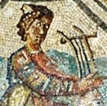
In Roman Britain, AD 189, every slave knows his lot in life depends solely upon the morals—or lack thereof—of his master. Fortunately for one young Glevum slave, Junio, his owner believes heartily in rewarding years of loyalty and service. Libertus, a former slave turned pavement-maker, is to grant Junio his freedom in an elaborate ceremony at the Basilica Law Court. And what better moment than the manumission to announce the boy's engagement to be married? But the young couple's happiness is threatened by a terrible omen: the gruesome discovery of a corpse, hastily concealed in a shallow grave. Who is it? And, more importantly, who would go to any lengths to cover up their heinous crime? Determined to solve the mystery before the impending nuptials, Junio joins his mentor Libertus in trying to piece together an elaborate mosaic of murder.
This delightful book by Rosemary Rowe is already the 9th part of the wonderful Libertus mystery series. The historical foreword featuring at the beginning of the book is very well researched and the details are all explained in a really fine fashion. The storytelling is of an absolute top-notch quality, for the author has the ability to keep you as a reader really spellbound right until the end. This tale is set early in the year of AD 189 during the reign of Emperor Commodus and this same tale provides great likeable characters within this exciting murder mystery. The story itself is about Junio, former slave of pavement-maker Libertus, who's now on the verge of being granted his freedom by his former master by getting engaged to a girl when all of a sudden a gruesome discovery of a corpse threatens the new couple's happiness in their first roundhouse. So it's again time for our pavement-maker/investigator Libertus and his assistant Junio to dig deep into their findings and to find the perpetrator of this gruesome mosaic murder. A very intriguing murder mystery of a great series created by Rosemary Rowe wherein this formidable team of "Libertus and Junio excel again"!
As good as ever but with one.little caveat. The villain of the.piece is.obvious from almost the beginning, his motive is not quite so obvious until we learn of.other events. Who the murder victims are and why they had to.die.are where the real.mystery is in this story. So, it still hits all the right points and delivers a suspenseful take, quite complex and with lots of Roman mysticism and superstition.......................
I found this book in the Liberatus mystery series to be one of the most enjoyable because we really go to see the freed pavement maker taking his crime solving skills right where it would matter the most: where he, his patron, and his family live. As always, Liberatus' thoughts are often funny as he observes the conflict between Romans and natives, but the emotional quality felt more intense this time because his entire family is involved.
Only one thing really spoiled it for me. I am an Ancient Historian who has studied slavery in both the Greek and Roman worlds for over two decades. The gendered nature of the manumission process made no sense to me, reflected no sources that I can recall, and frankly are unnecessary to show that Romans and natives were both patriarchal cultures.
Junio has been freed and adopted by Libertus so he, like Libertus, is now a Roman citizen. In celebration of the event, the family has been invited to a banquet that Marcus is giving in honor of Lucius Julianus, his cousin visiting from Rome. Although Roman in many ways, Libertus and Junio both prefer to live in Celtic round houses. However, when a body is found at the site where Junio hopes to build, the project is in danger of being considered cursed. An intriguing plot and well-researched setting in Roman Britain.
Liked the book and am enjoying the series thus far - like all mysteries the twisting facts can be a bit difficult to follow.
One question I remain puzzled by - corn has been mentioned multiple times in the series and was a major part of one book - I thought corn was a north American food developed by the Indians of central America - how can you have a corn official in Britain around 200 AD ??
I really enjoyed this one, more than the last. I was pretty sure "who done it" (though not why - Libertus wasn't quite sure either) and that always helps. I enjoyed the people, especially Libertus and his family and their regard for each other. I liked that his family and even his patron's slave girl helped him solve the mystery.
The Roman legal procedures were fascinating. It helped that they were for happy things!
The mystery was a little convoluted, and the writing was overly wordy, but I still had a fun time! It was a cozy mystery that took me back to the 80s and 90s style mysteries that I read as a young adult.
Once I read a mystery set in Roman times that was so good that I keep trying to remember who the author is so I can read more. Alas, the Roman Sleuth genre is wide enough I'll have to keep my search. Rowe, while a dedicated historian who crafts good plots, is not the master of this genre.
This novel isn't terrible; it has some strengths. For one, it's set in Roman times, but in England, so that's unusual. The characters are a mixture of Roman citizens and slaves, and the native Celts.
The main character, Libertus, has apparently been around for a few books, as the first scene deals with the manumission and adoption of his former slave/son Junio. If I'd been with him for the previous books, I'd doubtless love to hear of this new plot development with beloved characters, but as it was, the ceremonies just set the scene for the gruesome murder that threatens to curse their new dwelling.
The mystery itself is complex enough to intrigue even veteran-mystery readers, though Liberus' reason for investigating is quite contrived. They say they want to find the owner of the body so that they can placate its ghost before the festival of the Lemures (the wandering dead.) They eventually give the corpse a funeral to set the shade to rest even before Liberus discovers who it is (meaning that the investigation has no point) but Liberus investigates anyway, because otherwise there wouldn't be a mystery. He interviews slaves, inspects bodies, and otherwise does all the smart sleuthy things needed to let the reader know what nefarious deeds were afoot. That part I liked.
The strength, and the weakness of this novel is in its research. Rowe seems confident enough in this milieu that I trusted her to get the details right. I just didn't care as much about the details as she did. I growled in frustration every time she interrupted the storyline to tell us of some aspect of the culture not pertinent to the plot. I found it clumsily done, too. She has Liberus tell of us aspects of the culture in his internal voice that should have been relayed in dialogue with other characters, and she has the characters discuss other aspects of the culture that could merely have been shown through their actions.
In one scene, for example, the house slave tells Liberius, "...You'll find a bowl of water and a special pot of altar ashes in the servants' ante-room. You are to rinse your hands and face and mark your forehead before you join the family. This is formally a house of mourning now."
Surely, someone who had been raised in this culture would have known of this ritual? And later on the same page, Liberius performs this ritual. Why not just have the slave say, "this is a house of mourning now," and have Liberius do the ritual? A unique culture is nice, but I wanted a mystery, not a textbook.
Another thing Rowe does with the exposition is say, things to the effect of "but women would not be invited to join in, as women did not have the same rights as men." Rowe does this in at least three places in the novel. This does two things for me, as a reader. One, it interrupts the story with a bizarre non-sequitur thought for a pavement-maker to have. A Roman citizen living in AD 189 has not heard of suffragettes, and it would not occur to him that women would have the same rights of men, so it felt out of place for him to comment on it.
The second thing that these asides did for me was remind me of what a shitty, shitty time women have had throughout--well, pretty much all of human history, but especially before 1990. (But she only does this for women. Slaves in this novel seem to have an Uncle Tom-like complacency with their fate.) When I read a novel--any novel--set in a time not my own, I imagine I am there. Having the cruelties of the time and place re-framed with a modern sensibility took out some of the adventure and replaced it with unfocused anger. It was as if I were reading a Regency romance and the narrator pointed out every other chapter "Of course Miss Lucy would never have the same civil rights as her feckless brother, and in fact, she was considered incompetent to give testimony at court. If, for example, her dashing suitor Count Girard were to rape her at the party, the courts would place the blame squarely upon her." We wouldn't need to know this in order to get the gist of the story. All it does is raise my feminist ire and make what was otherwise a fun story unnecessarily dark.
I prefer historical fiction if they frame the gross injustices visited upon members of society within the framework of that society, and do not compare it with my own. This all goes with having characters that are truly members of their own culture, and not ones who have modern sensibilities.
So, in short, the mystery was well done, and the setting fascinating, but the clumsy and excessive exposition got in the way of the story too often to take it from the "merely okay" to the "quite good" category.
So this is the last book of the Libertus series that I've been able to get my hands on in Singapore. Sigh, I really wish they had all the books, because I want to continue reading - it's definitely been getting more and more original.
A Coin for the Ferryman starts with a status change for Junio. Libertus has decided to make him a citizen and adopt him as a son! Junio is a really likable character, so I'm glad that something good is happening to him. He's even going to get engaged! Unfortunately, a corpse is found on the site of his future house (and the land of Marcus), which threatens to curse their new home if the spirit isn't appeased by Lemuria. Wanting the happiness of Junio and tasked to solve the mystery by Marcus, Libertus has to race against time to find out who the corpse is and why he was murdered. (And contrary to the blurb on the back, Junio doesn't play a significant role in this book - Libertus' temporary slaves play a bigger part)
This book reintroduced Kurso, who became Libertus' slave three books back. I'm only pointing it out because he completely wasn't mentioned in two books back (not sure about the previous book, because I haven't been able to get my hands on it). It makes me wonder if there's an inconsistency here.
I really liked the mystery in this book. Libertus engages in a lot of detective work, and I could almost follow along with his thought process this time. There wasn't much action (although there were a few deaths), but there was a hint of the family tension within Marcus' family. I would so dearly love to read a book that talked about Marcus' trip to Rome with Julia. His mother sounds insufferable, and the type of character you'll love to hate.
A lot of previously background characters take bigger roles here, as the characters mature and move into different roles. I like this change, and I'm hoping some of these 'new' stars will play a bigger role in the later books.
I have this sitting in my bookshelf for a couple of years unread. As a Libertus fan, I am unable to explain how I overlooked it.
With Marcus about to set off for Rome together with his unwilling wife Julia, he accedes to Libertus' dearest wish - the freedom of Junio and his adoption as a son. Problems arise when the body of a defaced peasant dressed in celtic plaid is discovered in a ditch on the proposed site for Junio's roundhouse. May 9th, Lemuria, is only two days away, and all spirits should be appeased and at rest. It is important to discover the identity of this corpse and give it an appropriate burial.
An intricate plot. In most of this series some aspect of Roman/British life is examined - and this novel covers burial rites and the spirit world as well as the ritual manumission of slaves. I enjoyed the novel and I enjoy the period AD 189. There are some good twists and turns, although I had selected the murderer and identified the corpse fairly early on.
Libertus, the pavement maker in 189 a.d. Britian has decided to adopt his slave Junio as his son. As a gift, he has a piece of woodland cleared to build a house for Junio and his bride. A body is found on the land and Libertus needs to find out who the body is and who committed the murder before the Lemuria festival of the dead. This was a very good mystery and good characters. I will read more of this series.
Another in the Libertus the mosaic-maker mysteries set in 189 Roman Britain. It is an interesting read involving an unidentified body, a missing girl, and the poisoning death of Libertus' Roman patron's gate keeper. As usual in the series, Libertus has to put the various clues together to solve the mystery. Good story.
Life is never simple for Libertus, what with dead bodies, family obligations (joyous though they may be), and duty to his patron. I enjoy Rowe's sense of time/place in this mystery set in Roman Britain. The story stands by itself, with the mystery adding interest.
Well-plotted, but I felt it bogged down with the author having to throw in copious notes about Roman times so that I often felt I was either reading a sociology text or that the author was shouting "Look at me! I did research."
Enjoyed the story and the mystery. Have read some of the others in the series, and I thought this one was a little convoluted with lots of wandering about to get clues and "interview " people.
The next in the Libertus series. This time a death close to home, or at least one's patron home. Entertaining reads, but a certain sameness, after a while.
This entire review has been hidden because of spoilers.