Jump to ratings and reviews
Rate this book

Navi perdute

Rate this book
Per l’ingegnere navale Paul Mérault de Monneron niente è più sgradevole di imbarcarsi a Calais per attraversare la Manica. Come al solito, lo aspetteranno raffiche superiori ai venti nodi, onde alte come diligenze, capitani scorbutici e barcaioli disonesti. In più, stavolta, sulle spalle di Monneron grava un ulteriore tormento: un segreto impostogli dal ministero della Marina francese.
A chiunque gli chieda perché stia andando a fare incetta di bussole azimutali britanniche, telescopi notturni, termometri, farmaci anti-scorbuto e oggetti di scambio, dovrà rispondere di essere al soldo di un mercante spagnolo, tale Don Inigo Alvarez, che è in procinto di salpare per i mari del Sud. Peccato non esista nessun Don Inigo Alvarez.
La verità è che il governo francese ha chiesto a Jean-François de Galaup, conte di La Pérouse, di ripercorrere il viaggio d’esplorazione del leggendario capitano inglese James Cook. Copiarne le rotte, per emularne i successi. Per questo, augurandosi che l’Inghilterra non se ne accorga, il conte di La Pérouse ha tirato a lucido due fregate, la Boussole e l’Astrolabe, e ha assoldato duecento marinai e un folto gruppo di naturalisti, scienziati e matematici, promettendo di non fare ritorno fino a quando non avrà coperto ogni miglia di oceano navigabile.
Salpate da Brest nel 1785, le due fregate raggiungono la Patagonia, doppiano Capo Horn e l’Isola di Pasqua. Dopo due anni di esplorazioni, raggiungono infine i Mari del Giappone. In seguito a un’ondata di malattie che dimezza l’equipaggio e sanguinosi scontri con i nativi, nel febbraio del 1788 la Boussole e l’Astrolabe scompaiono all’improvviso, al largo delle coste australiane. Passeranno trent’anni prima che l’ammiraglio Jules Dumont d’Urville faccia luce sul mistero della scomparsa delle due fregate.
Ricostruendo dettagliatamente le abitudini della vita marinaresca dell’epoca e i rapporti con gli indigeni, Naomi J. Williams dipinge un affresco esaltante e ambizioso sulle tracce di uno dei più grandi esploratori del Settecento.
«Intelligente e suggestivo, come solo i migliori romanzi storici sanno essere» (Kirkus Review), Navi perdute è «un raro e perfetto equilibrio» tra un resoconto storico minuzioso e un romanzo d’avventura agli albori dell’era industriale.

400 pages, Paperback

First published August 4, 2015

53 people are currently reading
1500 people want to read

About the author

Naomi J. Williams

4 books56 followers
Naomi J. Williams is the author of Landfalls, a fictionalized account of the 18th-century Lapérouse expedition. Her short stories have appeared in numerous literary journals, including Zoetrope, A Public Space, One Story, Ninth Letter, and The Southern Review. A five-time Pushcart Prize nominee and one-time winner as well as Best American Short Stories honorable mention recipient, Naomi has an undergraduate degree in East Asian Studies from Princeton and an MA in Creative Writing from UC Davis. Naomi lives in northern California with her family and is working on her second novel, a fictionalized retelling of the life of Japanese poet Yosano Akiko.

Ratings & Reviews

What do you think?
Rate this book

Friends & Following

Create a free account to discover what your friends think of this book!

Community Reviews

5 stars
248 (28%)
4 stars
352 (40%)
3 stars
195 (22%)
2 stars
59 (6%)
1 star
17 (1%)
Displaying 1 - 30 of 191 reviews
Profile Image for Julie.
Author 6 books2,308 followers
October 17, 2015
So recently set adrift by two novels with multiple points-of-view, each chapter taking me through my paces with a new voice, each novel leaving me parched for emotional resonance as though I were desperate sailor drinking sea water, I thought, 'No, not again," when I embarked upon this voyage with Naomi J. Williams and her debut Landfalls.

Okay, I'll stop with the silly seafaring metaphors.

But I won't stop raving about this unputdownable tour de force, crashingly good, tsunami of a novel.

Williams offers a kaleidoscopic view of the ill-fated Lapérouse expedition of 1785-89, which saw two frigates filled with over two hundred men attempt a circumnavigation of the globe for the glory of science, human endurance, and the maritime prowess of France. With each chapter the kaleidoscope shifts, offering a different perspective—from seaman to scientist, Tlingit child to French castaway. Several of the chapters were published as short stories and in many ways this novel is a collection of individual works, as Williams leaps nimbly from voice, perspective, and style. Yet with each landfall, the threads of characters' lives are woven through the narrative, connecting each part to all those which precede it and the underlying tension of a well-paced thriller holds you fast. The author frames a daring, complicated structure and shores it up, page after page, with a gripping, marvelously inventive, and historically solid story.

The scope of Williams's research is breathtaking yet, like modern masters of the form Mary Doria Russell, Hilary Mantel, David Mitchell, you are drawn naturally, unresistingly into a distant era by flesh-and-blood characters. Heartstrings are pulled in the opening pages and are never released, until the gasping end. There is humor and irony, violence and tragedy, longing and despair. I greedily devoured the pages of a dreamlike obsession with a child bride at a Chilean outpost, gasped at the crystalline and savage beauty of Alaska, burned with anger over sadistic priests on the California coast, mourned love found and lost during the heartbreaking Siberian journey of a translator and his devoted bodyguard. The scope of history and setting, of character and voice and emotion, is nothing short of astonishing.

This is simply the best of what historical fiction can be: a voyage of discovery that speaks to the imagination and the heart, swallowing the reader whole like a literary whale.

Profile Image for Magdalena.
2,064 reviews889 followers
October 15, 2016
An epic voyage, undertaken with the grandest of ambitions.

I had no previous knowledge of the Lapérouse expedition before I read this book and I did not read about it on the internet until I just had a couple of pages left of the book to read. Two frigates left Brest in 1785 with two hundred men on board in a brave attempt to circumnavigate the globe. Every chapter in Landfalls is told from a different point of view. Both from the crew, natives, and other Europeans they encountered on their journey.

I had some problem with the story I must admit. Mostly because I had no previous knowledge of the journey and also with the shifting between the characters. So it took a while for me to really get into the story, and some characters left a bigger impression on me than others did. I especially liked the chapters with the captains Lapérouse and de Langle point of view.

One of my favorite part of the book was when they reached Alaska and everything that happened there. It was then I really started to enjoy the book. I think the chapter with the native girl in Alaska, her point of view was just so amazing to read. Just think how it must have been, never seen Europeans before. Amazing.

Also, the last part of the book, the mystery of what happened to the shop was just so fascinating to read about.

I recommend this book to anyone that wants to know more about the Lapérouse expedition or like to read historical fiction.

Thank you Piatkus for providing me with a free copy for an honest review!
Profile Image for Patryx.
459 reviews152 followers
June 1, 2018
Il romanzo ricostruisce le vicende della spedizione francese, capitanata da Jean-François de Galaup, che aveva avuto l’incarico di ripercorrere le tappe di James Cook per scoprire terre a lui sfuggite e dare anche alla Francia un posto d’onore nella storia delle grandi esplorazioni geografiche compiute nel XVIII secolo.
Purtroppo la spedizione non ebbe successo e quasi tutti i suoi membri scomparvero nei pressi delle Isole Salomone: furono necessari trent’anni per capire cosa fosse successo.


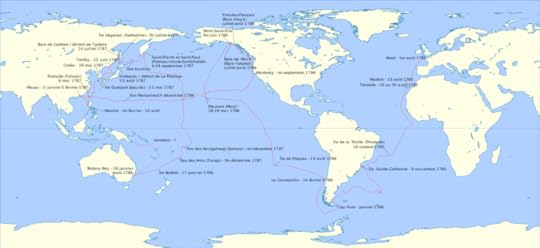
L’itinerario della spedizione di Jean Francois de Galaup conte di Laperouse.

L’autrice utilizza stili narrativi differenti nei vari capitoli del libro riuscendo a integrare struttura linguistica e narrativa con il tono emotivo del racconto. I tempi verbali oscillano tra il presente, il passato prossimo e il passato remoto accentuando la percezione della cronaca e dell’immediatezza: è come ascoltare una radiocronaca in cui il cronista descrive in diretta ciò che accade a beneficio di un ascoltatore distante nel tempo e nello spazio. Il punto di vista della narrazione varia in ogni capitolo: a volte è affidato a uno dei personaggi a volte, invece, è un osservatore onnisciente che sa già quale triste destino aspetta gli equipaggi delle due fregate, la Boussole e l’Astrolabe, e cerca di ipotizzare anche cosa sarebbe accaduto ai vari personaggi, una volta tornati in patria: sarebbero stati travolti dagli avvenimenti storici messi in moto dalla Rivoluzione francese? Sarebbero sopravvissuti o comunque una morte prematura era ciò che li avrebbe attesi in ogni caso?
Come si sarebbe mosso Lamanon in un futuro del genere? […]Suo fratello Auguste sarà arrestato nel 1793 e languirà in prigione per più di un anno prima di essere infine rilasciato. Robert, a causa dei rapporti più stretti con personaggi quali Condorcet e Lavoisier, probabilmente avrebbe rischiato di fare una fine anche peggiore. E questo ci porta a riflettere su una questione: cos’è peggio, una morte violenta per mano degli indigeni la cui lingua e collera risultano incomprensibili, o una morte violenta per mano dei propri cittadini la cui lingua e collera pensavate di condividere?

La complessa architettura messa a punto è allo stesso tempo l’elemento che maggiormente contribuisce a rendere artificiosa tutta la narrazione: è come se l’autrice avesse deciso di fare un esercizio di stile per ogni capitolo, se per assolvere un compito assegnato o per suo piacere personale non saprei ipotizzare.
Profile Image for Laura F-W.
237 reviews153 followers
November 17, 2015
(4.5 stars)

This is a beautiful, enthralling and vivid book. I finished it yesterday and I already know that it’s one of those that will stay with me and be sloshing around my brain for the next few weeks.

Landfalls is a fictionalised account of the Laperouse voyage of discovery, which set out in 1785 from France with the aim of exploring unknown parts of the world and adding to scientific knowledge.

If, like me, your French maritime history is a *little* rusty, then I would strongly recommend not googling the expedition before you read the book because spoilers. Having said that, this book would be thoroughly enjoyable regardless of how much you know about the expedition and the circumstances surrounding it.

Upon the orders of Louis XVI, two ships - the Boussole and the Astrolabe - set sail from Brest in August 1785. They were tasked with sailing across the globe to establish new trade routes, improve maps and make scientific discoveries.


(The Boussole and the Astrolabe at Port des Francais, now Lituya Bay, Alaska)

Williams tells the story from the perspective of several characters on the two ships - including captains, engineers, sailors and scientists - as well as the various people that the expedition encountered. In the hands of a less talented writer, this could easily have been a story told just through the eyes of upper-class, white French men, but I was amazed at the diversity of voices that Williams managed to use, including several well-rounded female characters. The book is also full of humour, and some parts are genuinely funny - a big achievement when writing about naval history.

I have to admit that the beginning was pretty slow, and I was suspicious at first. But the spectacular writing and vivid characterisation slowly drew me in until I really felt like I was there on those boats with the characters, celebrating their triumphs, mourning their losses and standing at their side as they discovered new and amazing things.

I highly recommend this book, especially if you're a fan of historical fiction.

(With thanks to NetGalley and the publishers for sending me an ARC in return for an honest review)

----------------------------------

Previous review:

This was absolutely enthralling and beautifully written. Full review to follow closer to the release date.

Thanks to Netgalley and the publishers for sending me an ARC.
Profile Image for Ettore1207.
402 reviews
May 17, 2018
Un ottimo debutto per una scrittrice da tenere d'occhio. Il libro narra di una storica spedizione francese, sulle orme di Cook, avvenuta attorno al 1780. Non aspettatevi avventure di mare, dato che le vicende si svolgono quasi tutte, in realtà sulla terraferma. La narrazione avviene sotto 10 diversi punti di vista (marinai, botanici, nativi ecc.), e ciò la rende molto interessante. Un plauso all'autrice che, oltre a possedere una grande fantasia e capacità di scrittura, si deve essere documentata molto bene sul piano storico.
Profile Image for Jane.
820 reviews785 followers
January 18, 2016
In her first book, Naomi J Williams has spun a lovely fiction round a fascinating piece of history.

Two ships, the Boussole and the Astrolabe, set sail from Brest in August 1785; carrying officers, crew, engineers, artists, scientists, priests, interpreters and others. They were sailing under the orders of Louis XVI, into a world that was only partially mapped and very little known. They were to circumnavigate the globe; to create new maps and to open up trade routes; and to bring knowledge and understanding home to France.

It was hoped, of course, that this expedition would cast a shadow over that of Captain Cook.

I knew nothing at all about the history, I resisted looking it up, and I’m very glad that I did; I’m sure that I would have loved the book even if I had foreknowledge, but coming to this narrative as I did made it an enthralling voyage of discovery.

‘Landfalls’ is a collection of tales told in different voices. Some are told in the third person, by the most observant of omniscient narrators, but most are told in the first person, by some of the very different men who sailed on the two ships and by some of the people whose lives they touched.

The range of the stories is wonderful – a young man very nearly out of his depth as he seeks vital supplies and intelligence in London; a journey across the Russian Steppes for another young man who had always been destine to leave the expedition there, for work in the diplomatic service; a misjudgement of currents in uncharted territory that could have terrible consequences; a man found dead, in circumstances that are far from clear ….

Some are stronger that others, and I wasn’t surprised to learn that several had originally been short stories, but they come together to make a whole that is more than the sum of its parts. Because the progress of the expedition is always at the centre of the narrative, and because that expedition always felt so real and so alive.

The scope of the research that underpins this novel is extraordinary; and that it was a work of love, and that the author gained a real depth of understanding of her subject is obvious. The fiction that she built on fact was both wonderfully inventive and utterly believable.

She manages a large and diverse cast of characters with aplomb; threading them in and out of different stories. I didn’t doubt that she always knew exactly who was on each ship, what each person’s role was, what their history was, how they fitted in to the life of the expedition. If only the man called on to write a report after a certain incident had known as much ….

She writes perceptively of the complex relationships between people who much live and work at close quarters; the strain and tension between those who are not compatible and the bonds that are strengthened by shared experiences by those who are. She understood that even men who yearn to travel and explore feel the pull of home, and wonder and worry about the people they left behind.

Each and every one of the places where the expedition finds land is vividly realised. The diversity and the differences were explored; as were the different perceptions of explorers and natives, and the gulf of understanding between them. I wondered how it must have felt, whether it was possible to understand, that your who world was just one stop on a journey, a place to do business and acquire fresh supplies before moving on ….

I was so impressed with the way Naomi J Williams assembled her pieces, to create a whole that had so many aspects and so much breadth and depth. A few of the pieces seemed less than perfect – an early story that went on for far too long; a late story that seemed less important than others that might have been told – but when I saw the whole I didn’t think about that, I thought about the lives, about the history, about so many things.

And so I have to say that ‘Landfalls’ is a very fine historical novel, that it sent me on a voyage of discovery, the like of which I could never have imagined; and that it spoke to both my head and my heart.
Profile Image for David Reviews.
159 reviews228 followers
August 18, 2015

Landfalls tells the story of the 1785 voyage of two French ships in their quest to make new discoveries in a partially mapped world of the time. Commissioned by the French government of Louis XVI to sail around the globe they were to record new lands, verify charts and make new scientific findings in the name of France. Naomi Williams brings to life these voyages and expeditions conjuring wonderfully drawn scenes of faraway lands explored by brave seafaring men. Her fictional story is haunting and evocative and is narrated by various individuals on or related to the expedition. Based on true accounts from journals of the time the writing is sensitive and humane providing a beautifully imagined story that proves a fascinating read.

Captain Jean-François de La Pérouse is in charge. The two ships the Boussole and the Astrolabe have the latest navigational equipment of the time and along with the sailors they are carrying men of science. The expedition's aims were to correct and complete maps of the Pacific area, establish trade contacts and add to French scientific knowledge. Their objectives were geographic, scientific, ethnological, economic, and political while sending back reports through existing European outposts in the Pacific.

La Pérouse and his crew have moments of triumph and of tragedy which are well described by the various narrators including some amusing moments. It is however easy to feel the tensions and the heart-break of men losing friends and colleagues as some explorations prove more dangerous than could have been expected. The expedition lasts four years as they make their way to numerous islands and usually welcoming isolated early European outposts. The sights and peoples described are engaging and believable some with their own stories to tell. If you enjoy inventive historical fiction then I’m sure you will enjoy this novel as much as I did. It was a hugely interesting read and as educational as it was enjoyable. (ARC received)
Profile Image for Rebecca.
4,191 reviews3,452 followers
November 12, 2015
(3.5) An enjoyable novel of eighteenth-century maritime adventure, based on a true story and reminiscent of Matthew Kneale’s English Passengers and Peter Carey’s Parrot and Olivier in America. As the title suggests, the book zeroes in on the stops the boat makes rather than on the daily drudgery of sailing on the open ocean. Williams moves between the perspectives of various crew members and outsiders, sometimes employing first person and sometimes third. Key chapters are set in South America, California, Alaska, Macao, and the Solomon Islands.

I especially enjoyed a chapter from the point-of-view of a native Alaskan girl – one of the few times the novel focuses on female experience. One character’s sled journey across Russia is another highlight. Some sections were less able to hold my attention; I thought the time in Concepción would never end, for instance. It’s also a challenge to keep all the characters with names starting with “La” straight.

In general, though, this is cracking historical fiction. Enjoy it as such, without doing any Google searches that will ruin it for you. That there is vague resonance with Jamrach’s Menagerie tells you all you need to know about the journey – but despite minor tragedies along the way, the book maintains a light-hearted spirit.
Profile Image for G.G..
Author 5 books141 followers
July 9, 2017
A wonderful novel I was very, very sorry to finish.

Every Australian has heard of Lapérouse, the French captain who in March 1788, “after a six-week sojourn at Botany Bay…sailed off into the Pacific and was never heard from again” (Robert Hughes, The Fatal Shore: The Epic of Australia's Founding, p. 85). There’s even a suburb of Sydney named after him. Naomi J. Williams’ meticulously researched book tells the story of Lapérouse’s voyage in fictional form. We begin at the French port of Brest in spring 1785, follow one character on a shopping trip to London the following month, and then we’re off: in Tenerife, August 1785; in Concepción, Chile, February-March 1786; at Lituya Bay in Alaska, July 1786; in fog on the North American coast, August-September 1786; in Macao, January 1787; in Russia, 1787-1788; off the coast of Maouna Island in the South Pacific, December 1787; at Botany Bay, February 1788; on Vanikoro in the Solomon Islands, August 1791; then back in France for chapters set in April 1816 and March 1829.

Most of the characters really existed, but some—the native inhabitants of Alaska, “New Holland” (as Australia was then known), and Vanikoro—must be her own creations. All are drawn with a deep sympathy that is more than merely well observed: Williams has a profound understanding of human character, and a wry wit that shows rather than tells.

There is nothing magical realist about Williams’ writing, but I particularly enjoyed those passages where she steps forward and writes in her own voice. One example:
What if, some two years, three months, and fifteen days after this afternoon of letter writing [home, from Tenerife], instead of joining the men who leave the ships to collect water and stretch their legs at an unknown cove in Samoa, Lamanon [the physicist, mineralogist, and meteorologist] were to remain safely aboard [Lapérouse’s flagship] the Boussole? And what if, instead of foundering in a storm in the Solomon Islands the following spring, the Boussole, at least, were to make it back to France? (p. 43),
Williams postulates two possible outcomes for the aristocratic scientist: his work will be published, his scientific legacy secured. But then he would have made it back to France in time for the revolution:
Which leaves us to meditate on a question: Which is worse—violent death at the hands of natives whose language and anger you do not understand, or violent death at the hands of fellow citizens whose language and anger you thought you shared? (p. 45)
Such are the questions she invites us to ponder with Lapérouse, the men under his command, and the people he encounters on his long voyage of discovery. My only regret is those “hundreds of pages I ultimately discarded” that Williams mentions in her Afterword: how I would love to have read those too!

Profile Image for Liz Barnsley.
3,765 reviews1,076 followers
September 16, 2015
Landfalls is a fictional account of a real historical journey – some beautifully vivid writing and in depth and cleverly drawn characters made for a really terrific read and something a little different for me – I do like different.

It does take a while to get going – but the core feel of it will draw you in anyway – the author focuses on a selection of characters, not only those engaged in the voyage, but those they encounter and she weaves a stunningly evocative story that is engaging throughout.

I knew nothing about the historical reality that this tale is based on, now I am aware of it I actually think that made this better – there was no expectation of anything, no knowledge of what may have been to come for the characters you end up getting so involved with. Naomi Williams explores many emotional and practical themes here and it is seriously excellent – one of those “sink into another time and place” novels that makes reading such a wonderful thing.

A very authentic feel tells me that the research was done to perfection, Naomi Williams has a very impressive voice which she imparts into her characters and if you like Historical fiction (which yes I tend not to, but occasionally like now I’m partial to – it has to be good) you will love this and I think it is one that will stay with me.

Happy Reading Folks!
Profile Image for RitaSkeeter.
712 reviews
June 18, 2017
From the interesting approach to the subject matter to the beautiful cover, this was a book destined for me to fall in love with. Unfortunately, as can be seen from the rating, things didn't work out that way.

I loved the idea of the way the author structured the book. The title describes what the author does really; she follows the Laperouse (my apologies Jacquette, that I am unable to work out how to include the all important accent) expedition, with particular focus on the occasions when the ship makes 'landfall'. The author gives snapshots of the interactions between the expeditioners and those living when they make port - both indigenous and colonisers.

It's a really fantastic idea, and one I loved the idea of, but in practice it didn't work for me. Basically that 'snapshot' was too limited in scope, in development, in interest, for me to have any connection to either the characters or the events. I had thought that focusing on the 'landfalls' would release the book from the tedium of the weeks and months at sea. However, I found the book boring with the author being unable to bring to life the characters, the locales, or the voyage for me.

Disappointing, as it was a wonderful premise for a novel.
Profile Image for Deb Omnivorous Reader.
1,994 reviews180 followers
March 16, 2020
As difficult a book to review, as for me it was to read. Initially I was very excited by it; a fictionised telling of the Louis XVI instigated, 1785 'expedition around the world' I love reading history, fiction or otherwise and I am always excited by a good historic voyage.

My first disappointment was over the fact that the voyage was barely described, but I told myself, 'Oh well, it is called Landfalls after all'. That is the thing, the different stories talk almost exclusively about the landfalls of the voyage with little framework to put to locations in.

That brings me to my second issue: This is meant to be a novel and in fact it is a collection of short stories at best, or vignettes at worst. The stories are linked through the 1785 expedition, but they do not form a cohesive novel, they are not written in the same narrative style, from the same perspective or even with the same characters. This makes the reading experience exactly like a short story collection and for myself, I rarely read short story collections, I just don't care for them that much.

Then there is the fact that the history does not really seem to be the focus as much as I hoped. Now, there is no doubt in my mind that the author did a lot of historical research, I am certain she is very well read on the subject and understands the minutiae of the era well and these details do come out at times. However I remain unconvinced about the way in which all that research was used in the writing, the history was never well integrated but rather dropped in to the narrative or used to prop up the things the author was more interested in; the history seemed always detached from the storytelling.

As an example of the odd detachment of the historical facts, the first chapter is a perfect example. It is about a member of the expedition going to London to buy instruments (more or less) for the voyage. As a first chapter it seemed odd, but I thought it would maybe lead into the story, or the character would be important later. Neither of those things occur, the main character is barely mentioned hereafter, the instruments are barely touched upon and the purpose of this chapter is not clear at all. While reading it, I became convinced that it was an example of an author researching a subject and becoming so entranced with 'new' or small details that they just have to put them into the story. That can work, for some stories and some authors but often the segue is just too great and here it is kind of bewildering.

What exactly do I mean by 'the storytelling'? The author seems to really enjoy telling the inner stories of individuals, her 'stories' are the inner pains, confusions and longings of whichever character she happens to be focusing at the time. She is very good at that and I see she has written a lot of short stories before, this writing style is very short story appropriate. The history and the voyage seem almost like an accidental setting in which to explore the inner insulted dignity of one 'savant' the inner doubts of a Captain, the miserable lives of the women on shore that are met at different stops. All this inner writhing however, never creates a three dimensional character, they mostly seem flat and with few meaningful dialogues between the characters, no actual relationships between the different characters ever really develop. This is a perfectly valid kind of writing, but not what I was expecting from this novel because a voyage is a perfect way to create relationships between individuals.

All the characters are so miserable! This is the journey of a lifetime, surely some of them must have enjoyed it some of the time? We don't see much of them though, we just get grimness. This is especially true of chapter 9, which is an isolated story (as they all are) of a Russian speaker who disembarked after the Russian portion of the voyage to travel overland to the embassy with dispatches. Goodness he is a misery guts! The trip took over a year, through Russia and the most exciting and unique experiences, nothing to do with the voyage at all, of course, but I kept thinking how exciting it could have been in the hands of someone who liked writing about adventures instead of about whining. Even the guide in the story tells Lesseps to buck up.

Another personal issue I had with these stories is that the author clearly has a far superior understanding of geography to myself. Far FAR superior, I often needed to google place names to figure out where we were talking about. The map in the front was next to useless for the journey as we heard nothing about the time at sea to give us context, there was no map for the Russian segment. By the end I was also googling for historical details and there was no framework in the stories in which to put them.

The epilogue was bewildering; an unfocused, sentimental misty reminiscence by 'we' about the voyage 'We' being presumably the people who die on it (which is, you know, almost everyone). Aside from the mention of the fact that the places in the text are now known by other names, I can see no reason to have put it in. The last chapter 14, 'Relics' made a perfect ending, in fact it was actually one of the better stories in the collection. If you have to have a misty waffling by 'we' about the history of the journey surely the prologue would have been a better place? At least it would have served as fair warning to the readers.

So, to summarise, we have short stories instead of a novel, about miserable people who are hating life, and examinations of inner torments or "...a web of voices and narratives." as the cover would have it, instead of a voyage of adventure. It is however well researched, beautifully written, if you enjoy the style (which I obviously did not), as well as being an unusual concept and will, I am sure be very enjoyable to many people. Some of the stories are pretty interesting in themselves, they should never have been unnaturally bound and tortured together like a bonsai, to try and make up a novel though.
Profile Image for Kirsty.
2,794 reviews190 followers
May 2, 2018
Naomi J. Williams' Landfalls was my final choice on my Around the World in 80 Books challenge journey. I selected the novel, which takes place in several geographical locations - 'From the remote Alaskan bay, where a dreadful tragedy unfolds, to the wild journey Barthelemy de Lesseps undertakes from the far east of Russia to St Petersburg' - as my Pacific Islands choice. I did not really know what to expect with the novel; whilst I love stories of exploration, I have been rather disappointed with similar tomes in the past. The blurb, however, did intrigue me, promising to take me along on 'an epic voyage, undertaken with the grandest of ambitions.'

Landfalls begins in 1785, and tracks many different characters who are connected in various ways with the real-life four-year long French government-backed expedition. Williams tells us, as she introduces some of the novel's characters, that 'this is to be a voyage of scientific and geographical discovery - but every person on board has their own hopes, ambitions and dreams.' The first chapter begins in spring of this year, at the French port of Brest. The voyage, which is being prepared at this point, is 'meant to compete with the accomplishments of the late Captain Cook, a voyage that is supposed to be secret until it departs.'

Williams' writing is intelligent; whilst the descriptions are sadly few and far between, the prose seems very natural, and the third person perspective which has been used for several of the chapters sits well with the myriad stories which unfold. I found it rather problematic after a while that each chapter employs a different narrative style. The first is relatively fragmented, and others are long streams of prose given in the third or first person perspectives. The structure feels effective at first, but as the novel goes on, it is rather a jarring technique.

The use of so many different narrative voices and characters almost made the novel feel like an interlinked short story collection. Whilst rather a rich and multilayered story is created, I personally enjoyed and connected with some of the chapters, but not with others. My interest waned when the particular story which Williams was telling did not grab me at all. Despite the way in which Williams based this novel upon a real expedition, the characters felt largely unrealistic, and two-dimensional.

Landfalls has been meticulously researched. It is an ambitious novel, particularly for a debut. Sadly, I did not find the book an immersive one; as soon as I became interested in a particular character or thread of the story, it would end - sometimes quite abruptly - and something entirely different would be focused upon. There was an imbalance here.

I felt as though Landfalls had far more potential than was realised, and the reading experience was slow and not overly enjoyable. Williams seems to subscribe far more to 'tell, don't show' than I personally like in my fiction; no vivid pictures were created, or even attempted here, despite the exotic and varied locales which Williams had at her disposal. The novel did not come together for me; it felt as though several loose ends had not been tied up, and the detachment which was present in most of the chapters did not endear me to the novel or its characters. There was not enough emotion here; whilst Williams sets out to show the effects such a voyage would have had on myriad characters, there is no real depth of feeling to be found within the pages of Landfalls.
Profile Image for Mosco.
451 reviews44 followers
November 22, 2019
La storia principale di questi 2 capitani matti in giro per terre sconosciute su gusci di noce, porta incapsulate le storie di alcuni personaggi minori, ma non per questo meno interessanti o meno avventurose. I protagonisti compaiono ogni tanto nella narrazione principale, se ne imparano i nomi e i loro tratti distintivi, li si vede affaccendati nei loro compiti fino, nel bene o nel male, ai loro quindici minuti di celebrità.

Sì, in giro per terre più che per mari: la maggior parte delle avventure e disavventure, come diceva preoccupato il capitano, succedono lontano dalla protezione delle fregate: infatti è a terra che glie ne capitano di ogni, fino a scomparire nel nulla.

Le storie di esplorazione e di avventura mi piacciono un sacco adesso come mi piacevano da ragazzina, e questa ha soddisfatto il mio cuore bambino.
Profile Image for Fay Roberts.
109 reviews9 followers
January 4, 2016
Initially drawn to Landfalls by the stunning cover of a stark white background with vivid flowers, and the comparison of the author to David Mitchell, I started to have regrets about the book as soon as the subject matter sank in. Did I really want to read about a French sea voyage taking place in the 1700’s, apparently famous but one I’d never heard of, taking place at a point in history I had no interest in? It turns out the answer was yes, I did, as I rate this book an enthralling 4.5 stars.

Less of a novel and more a collection of short stories on a theme, Williams manage to turn what could be a very dull subject matter into an intriguing study of an ill-fated voyage.

Throughout the first half of the book I was educated in all manner of things 18th century. Williams has a gift of educating without seeming like she is. The subtle references to fashion, social hierarchy, politics, and sexual attitudes made the life of the people of that time become vivid and real. One of the most intriguing aspects for me was discovering what life in a Spanish Mission could entail and the social nuances involved in parentage and prestige in colonies.

This book is obviously meticulously researched. I was surprised when I reached the end and discovered that the author was American. It adds a new depth of skill to her writing and research that she was able to so accurately capture the feeling of casual and affectionate contempt and suspicion we Europeans have for each other.

By switching the focus of each chapter of the book to a new viewpoint and a new area of life on board or in a colony the story stays fresh and vibrant. The first half manages to impart a wealth of knowledge in an entertaining way (like Horrid Hiotories for adults) and the second half wonderfully captures a pervading sense of doom.

This was a wonderfully engaging and captivating book, meticulously researched and perfectly structured. Williams has a wonderful style and structure to her prose. Whilst inventive and fresh in construction, and portraying a possibly dense and dull subject matter, Landfalls is still accessible to the garden variety Bestseller and Book Club readers. I hope this wonderful debut novel achieves commercial success as I am sure that it will achieve critical acclaim and crop up on some of the prize lists this year.

The only downsides I found were that it is difficult to keep track of the long French names throughout the novel but someone with a better memory wouldn’t have problems with this. Also, as a personal preference, I wasn’t 100% sure about the points of view of natives. I loved the fictionalised version of their culture and beliefs but the Williams’ voice is so strong that it eclipses the simplistic notions she is trying to portray, and although her sentence structure changes to mirror their characters her vocabulary doesn’t. These chapters are still strong, interesting and vital to the narrative but were the weakest area in the book for me.
Profile Image for Nancy Oakes.
2,021 reviews924 followers
Read
November 10, 2015
like a 3.6

I didn't love this book as much as others seem to have, so if somebody in the US wants my copy (hardcover, signed), it's yours. Free, I'll pay postage. Someone please give it a home!!!!


Here's part of the blurb: "In her wildly inventive debut novel, Naomi J. Williams reimagines the historical Lapérouse expedition, a voyage of exploration that left Brest in 1785 with two frigates, more than two hundred men, and overblown Enlightenment ideals and expectations, in a brave attempt to circumnavigate the globe for science and the glory of France."

I didn't actually choose this book for myself; it was the choice for October from Book Passage's signed first editions club. However, when I read that very same blurb paragraph, I was immediately hooked and into the vacation book bag it went. I have this strange fascination with all things seafaring explorers, and I figured this was going to be great. And for a time, I was well into it. Landfalls begins with a visit to England by a French naval engineer who's come in disguise to pick up needed things for the voyage of two ships, the Boussole and the Astrolabe, both of which are under the command of Jean-Francois de Galaup, Comte de Lapérouse. The expedition (thankfully there's a great map of Lapérouse's travels in the front of the book) went from 1785 to 1788, at which time no more word was ever heard from le Comte or from anyone else still with him. I say "still with him," because like many other voyages of the time, a number of the explorers/crew on this expedition didn't survive some of the ever-present dangers of contact with other cultures. In real life, according to Wikipedia, Lapérouse vanished from the face of the earth somewhere in "Oceania;" Williams puts his last sighting somewhere in the Solomon Islands.

But back to the book. It is labeled as a novel, but to me it read much more like a collection of vignettes that occur before, during and after the expedition. Once the expedition begins, the author's major focus here is not life on the sea but rather the "landfalls" the ship makes. For example, in Alaska, a young Tlingit girl witnesses her first Europeans and a major tragedy, which she tries to relate from her own cultural point of view; as another example, in Monterey California, the story switches to a series of letters back and forth in which Spanish missionary contact with the French explorers is related. Another episode is related in Concepción, Chile, where Laperouse finds himself in a bit of competition with an expedition member for the wife of his host, wrestling with his conscience because of the wife he'd left behind.

The best chapter in this entire book is "The Report," in which an officer is commanded to produce a report after a horrific tragedy, and as he works his way through it, the reader is made privy to a terrible revelation. Indeed, there are many moments in this book where the reader is right there at some major event, feeling what the characters feel (the scene in Concepción with the hot-air balloons, in Monterey where the good Catholic priests beat their religion into the indigenous people, or a much later scene where the character watches in despair as the hope of rescue disappears on the horizon). Sometimes this approach works, sometimes it doesn't quite do it (as in the scene through the Russian winter), and on the whole, I came away feeling like my job as a reader here was to put a series of disjointed stories together to cohere as a novel which wasn't really my responsibility at all.

Despite my negative niggles though, there is much to enjoy about this book, especially in how Ms. Williams reimagines and interprets an expedition that most people have never heard of. But it's not just the expedition itself that captured my interest. She goes big and bold, for example, in the chapter "Lamanon at Sea," where she imagines a scientist's return to France in the midst of the Terror, offering her readers a look at the sort of society in which Enlightenment ideals have gone wildly astray leading to social and political upheaval of the worst sort. The way she writes this part of the chapter is just unbelievably good and I found myself at various points in this book unable to put it down.

So far readers are loving this book. The Historical Novel Society rates it positively, as does Katherine A. Powers at The Christian Science Monitor. I have to agree that Landfalls is a highly intelligent work; had it not felt so disjointed and jarring and distinctly non-novelish, I probably would have enjoyed it much more than I did. Still, I would most definitely recommend it to anyone who likes quality historical fiction. I will also say that it is very, very obvious that Ms. Williams has spent a LOT of time researching her material, something that the history person inside of me greatly appreciates.
Profile Image for Caroline Mersey.
291 reviews23 followers
November 9, 2015
Landfalls is the debut novel by Naomi J Williams. It was published by Little, Brown (who kindly gave me a review copy through NetGalley) on 22 October 2015. Landfalls unfolds for us a fictionalised version of a true story: the doomed French voyage of exploration led by the Comte de Laperouse in the 1780s. Both ships mysteriously disappeared in the Pacific Ocean in 1788.

Structurally, Landfalls is a very interesting novel. Williams chooses to write each chapter from the perspective of a different character, writing only about those times where the expedition’s ships make landfall as part of their voyage of exploration. That allows her to explore the different members of the crew, their relationships with one another and their thoughts and feelings about the voyage.

Some of those chapters are intensely moving, in particular those dealing with the loss of life of some crew members at various points during the voyage. We see the grief of those left behind, struggling to make sense of their loss and find ways of explaining it to distant family members. In others, Williams shows the narrow and limited lives of those living in far-flung colonies. The arrival of the expedition ships provides a welcome dose of excitement and fresh company that can have profound effects on those visited by the expedition.

Only two chapters are told from the perspective of female characters. One of the chapters shows the disastrous loss of two of the ships longboats in a freak accident while surveying a harbour in Alaska. The woman is one of the indigenous people from the tribe living in the area. Towards the end of the novel, we see the end of the Laperouse expedition from the perspective of another indigenous woman, this time form the Solomon Islands. Both women are left baffled by the strange Europeans visiting where they live, whether in a brief visit, or the survivors of the doomed expedition.

Overall, Landfalls is a fascinating and accomplished novel that allows Williams to showcase her skills as a writer. Its braided narrative structure reminded me slightly of Ian Pears’s An Instance of the Fingerpost, albeit with less close weaving between the individual storylines.
Profile Image for Carol Bakker.
1,544 reviews137 followers
December 14, 2015
Bravissimo to Naomi Williams, author of this, her first novel!

It was a challenging launch for me: the Lapérouse Expedition? 1785 France? My brain didn't have any hooks for the loops of this story to Velcro to. I ran across new seafaring vocabulary every chapter. Although it's not exotic, "landfalls" was not a word I could confidently define*.

The structure also sloshes against solid understanding: a new location and new narrator for every chapter, feeling like a collection of autobiographical essays. Looking back from the end of the book, I see this as brilliant move.

This is an epic voyage that rewards the patient reader. This is writing which delights the discriminating reader. Williams compels you to care; at the end you feel empty.


*I read this book concurrently with Tim Severin's The Brendan Voyage where "anticipating a landfall" and "made a landfall" are common phrases. But the ultimate synchronicity came while I read C.S. Lewis' A Grief Observed: "...the journey ends. How can I assume a harbour? A lee shore, more likely, a black night, a deafening gale, breakers ahead--and any lights shown from the land probably being waved by wreckers. Such was H.'s landfall. Such was my mother's. I say their landfalls; not their arrivals."
Profile Image for Brian.
25 reviews10 followers
June 24, 2018
I read this one for my book club and I'm really glad I did. I think this is one of my favorite books that I read for the book club and I think one of my recent favorites overall, as well. The author, Naomi Williams, really draws you in to the story and can write characters very well. I very much felt a connection with several of the characters, and there were passages here that actually brought a tear to my eye. That's something that has not happened from a book in quite a while. For anyone interested in historical fiction who also wants an excellent adventure novel with interesting and likable characters, I can't recommend this book highly enough.
Profile Image for Chris Blocker.
710 reviews192 followers
March 2, 2016
I was really attracted to this book. From the beautiful cover to the promising description (“grounded in historical fact . . . refracted through a powerful imagination”), Landfalls appeared to me a definite win. Then it went nowhere for me. That is to say, it was incredibly dry, which is ironic considering that this is a novel at sea, but—a ha!—'tis not a novel at sea at all, but a collection of stories that occur when the sea voyager is docked, a fact that should be obvious by the blatant title but wasn't clear to me until the third chapter or so. That sentence feels like it needs several exclamation points, doesn't it? Okay, let's go back. ...wasn't clear to me until the third chapter or so!(!!)!! Doesn't have the same effect now, does it? Okay, moving on.

So reading Landfalls had its ups and downs. Many of these stories didn't resonate with me. Some really did. But I think the book's greatest flaw is its very concept, that of focusing only on the landfalls of the Lapérouse expedition. Seafaring voyages are made by what happens at sea, not on land. On land, the characters are not stretched in the same way. The reader doesn't really get to know these characters and how they have interacted and grown together. The characters are put at sea together and more than six months pass before their first landing. What happens in all this time? How have these men grown? How have they rallied together? How have they struggled with one another? These are the stories I want. Instead, what we're offered are the men's time cavorting with Spanish dignitaries and locals. Indeed, these moments are important too, but I feel like I'm missing a big chunk of the story. Frankly, for the most part, I had trouble differentiating the characters because I never really got to know them on the voyage. I felt like I was locked away in the hold of the ship, then, upon reaching land, I was released and allowed to follow whatever crewmember I wanted until the ship again disembarked. Then, the process was repeated over and again. By the end, I felt unsure of where I was in the world and who I'd spent all that time with.

As I stated earlier, there are definitely some strong moments in this novel. A few of the stories—particularly those where members of the crew interact with locals of a very different culture—are simply amazing. Throughout the book, the writing is flawless. Indeed, Williams is an exceptionally talented author. As a whole, however, Landfalls didn't keep me interested enough. I was promised magic, but what I was given did not shine.
Profile Image for Maggie.
525 reviews56 followers
August 27, 2015
Usually, when I enjoy a book, it's because it has a few outstanding qualities that make it a great read despite whatever else is flawed, or even just average, about it. Landfalls, however, is the rare book that excels in almost every area. The writing is absolutely gorgeous. The characters--and there are many of them--seem fully human. Williams is skilled at portraying the intricacies and subtleties of human relationships, both between people who know each other well and between people who barely know each other at all. The research for the book was clearly beyond meticulous, and yet it is always woven naturally into the story.I also thoroughly enjoyed the book's format. Most of the chapters could stand as individual short stories; some are truly exquisite works of art in their own right. Part of the reason the format works so well is because each stop on the journey really is a mini-story of its own, so it does not feel like a forced conceit as it might in a different sort of book. While the overall writing style is similar throughout, the stories are each a little different in that some are told from various viewpoints, or as letters, reports, etc. Another thing I appreciated about the book is that Williams clearly made an effort to stay true to the time period. Whereas any historical fiction book always says at least as much about the time period during which it was written as the time period it is written about, there's no obvious attempt to give 21st century sensibilities to the characters in order to make them more appealing. Additionally, despite the often grim storylines, there's plenty of humor in the book. There's also a lot to chew on. It's the kind of book I'll remember for a long time, and probably read parts of again. Landfalls is not a lightning-fast-paced book, which is more than fine. Not every book needs to be. The book really starts to hit its stride around the third chapter. I very much enjoyed the beginning, but it does start out at a leisurely pace, and I'd encourage anyone who is an impatient reader to keep going--it's well worth the trip. Definitely one of my favorite books for grownups (I'm a middle school librarian, hence that distinction) of the last few years.
Profile Image for Katy Kelly.
2,577 reviews105 followers
December 29, 2015
Utterly engaging historical account of a sea voyage.

It took a little while to settle to the change in narrator, but I loved the period from the get-go, the unfolding story of an exploratory sea voyage to surpass previous famous voyagers (Cook) and fill in maps in a time of discovery and enlightenment.

In a series of connected but not always sequential chapters, we see the preparations for the years-long voyage, life on board ship, storms, accidents, contact with native peoples, wrecks, and the voyagers (and their families) in the years after they first set sail.

Each chapter asks you to start from scratch and see the voyage from a new perspective, some characters are more likeable than others, more trustworthy and sometimes a new account backs up a previous one, or shows their narration to be unreliable. The picture builds of the hardships, camaraderie, dangers and adventures they undergo.

And their adventures are amazing. The world is such a different one, so much still unknown to these men, with communication and travel a world and several centuries away - it's an education seeing our small-seeming planet through their eyes.

I absolutely loved it. The fate of many characters is tragic, deaths at sea regular and brutal, some escapades taking several chapters and narrators to give us the full picture. Cleverly done.

This surprised me when I learned partway through (reading the notes at the end) that this is an account based on a real-life voyage and persons. It only made it all the more intriguing and astonishing, putting myself in the mindset of these intrepid explorers.

Fictionalised true account, and one that is beautifully conveyed. A superb way of accessing the past, and a very talented new writer. This was recommended to me and is one I won't hesitate to recommend to others.
Profile Image for Laura Lacey.
148 reviews25 followers
August 2, 2017
This was one of those rare things - a thoroughly researched and enlightening historical fiction novel that didn’t come across as a lecture. Williams is retelling the story of the Laperouse expedition, a voyage of scientific discovery, with the aim of more accurately mapping the known world, studying its flora and fauna, establishing trade routes and basically getting one over on every other country in Europe.

This is a period and an area of history I knew next to nothing about but Williams has evocatively brought it all to life in this novel. The characters are absolutely wonderful and completely distinct from one another - she manages to flit between characters with ease, never losing her reader and creating wonderful contrasts and amusing revelations. A particular favourite scene of mine was that of a sailor encountering a young native Alaskan girl - Williams tells the encounter from each perspective, showing how those sharing no language, experience or culture in common can interpret and understand one another.

There are many touching moments in this novel, as they suffer casualties and visit Europeans who have set up home in these far flung territories, away from their families, friends and any hope of a normal life. There is so much humour in the story and there are genuinely funny moments. I was absolutely swept along by the narrative, which focuses on the times when the ship makes ‘landfalls’, I enjoyed it so much I would like to have seen more of their adventures and seen a bit more how they spent their time at sea with nothing to do.

Thank you to Netgalley and Farrar, Straus and Giroux for providing an Advanced Reading Copy in return for an honest review.
Profile Image for Laura.
628 reviews19 followers
March 20, 2016
"Landfalls" by Naomi Williams chronicles the adventures of French explorers who, not to be outdone by the British, follow in the footsteps of the great explorer Cook in an attempt to circumnavigate the globe and fill in unknown parts of the globe. In other words, we are following a scientific exploration. I enjoyed the historical details in the novel--Williams definitely did her homework. Our world is so interconnected nowadays that its fascinating to read about a time/place when it literally took months for a letter to reach home, when sailors didn't know what they would find, when cultures were meeting each other for the first time, and when diseases such as scurvy were still attributed to wildly different causes (like stale drinking water!).

As other reviewers have mentioned the style Williams chose to use has advantages as well as disadvantages. By honing in on the literal landings of the voyage at various ports, Williams adroitly avoids dragging the novel out by describing 3 years of sea travel. Other historical novels I've read have sometimes felt almost encyclopedic in nature, and I feel this style avoided that. I also liked the different points of view throughout the book, as it was a nice way to give a more overarching lens to the story while still having a personal touch.
On the other hand, chapters jumped such huge gaps in times (sometimes 9+ months) that I felt important details were skipped. I agree with another reviewer that it was left to us, the readers, to string the story together into a cohesive whole.

Given 4 stars or "excellent" rating for originality, excellent prose, and interesting story. Definitely recommended!
Profile Image for Ben Stickney.
8 reviews1 follower
June 28, 2019
Amazingly well researched and intelligent book. Naomi Williams crafts an incredible series of excursions into the lives of French expeditioners, delightfully managing the line between fact and imaginative storytelling.
Profile Image for Julie.
255 reviews15 followers
January 9, 2016
Ports of call in differing voices
Both a voyage and a novel exploring the boundaries


From my Australian history I already had a vague understanding of the explorations of Lapérouse in relation to his arrival in Botany Bay so soon after Captain Phillip, but not much of an idea of his global expedition. This was an easy-to-read fictionalised account of his travels.

I think the narrative's fractured presentation is what made it so easy-to-read. Instead of a focus on the travails of life at sea, it was about "landfalls". The events at different ports of call, or associated land happenings, were told by a variety of voices. This gave a range of perspective and style, making it almost a collection of short stories that took us on a voyage of discovery of culture, of personality, of the world of the time. But it was much more than a collection of stories! The author showed the richness of maritime and scientific discovery, the bravery and tragedy of exploration and made us question the history of colonization.

I liked it, it was enjoyable reading, but I didn't love it. Some of the chapters were not as strong or resonant as the others.
Author 2 books132 followers
August 16, 2015
In Landfalls, Debut author Williams chronicles the ill-fated expedition of the Astrolabe and Boussole, which departed France in 1785 for the South Pacific. The fictionalized account of this map-making and territory-charting journey is an interesting read, in no small part because it is told through many characters’ perspectives.

Landfalls is a reminder of how enormous the world once was. Travel in the Age of Enlightenment did not include a McDonalds in Moscow, or a Starbucks in Samoa.

Williams has a gift with description, and her prose shines when she takes readers through uncharted territories. She also pays attention to changing social mores, and addresses the debates and social issues in a less politically correct era.

What really makes Landfalls, A Novel, special is that in this risk-averse publishing environment, original voices are endangered species. The book is void of vampires or dystopian themes, and there’s not a shade of grey in sight. It’s an intelligent, well-written, painstakingly researched account of adventure.

Highly recommended.
Profile Image for Huntleybrinkley.
127 reviews2 followers
January 7, 2016
Trying to post a few books I've read over the holidays in reverse order. This book of linked stories regarding the French exploration of the south seas was never on my radar until it was chosen by poingu and Jennifer for the alt-TOB and it was clearly a surprise. It is first and last an adventure story with plenty of detail but told from the point of view of various narrators. The strength of the novel unfortunately waivers based on the narrator chosen for the chapter; however most are fairly strong and overcome the weaknesses of some of the blander portions; I especially liked the Lessups chapters, Snowmen and the later chapter narrated by the captain's sister. The writing sometimes falters but overall it was a well told story that held my interest throughout. Recommended. Oh and beautiful book cover award.
Profile Image for Sonya.
885 reviews214 followers
March 10, 2017
3/5/2017: I'm not far into this yet, but already I can say the writing is excellent, full of period details, imagination, and strong characters (of which there are many, but the helpful character list at the beginning allows for quick checks.) I think more people should read this. Underrated and under-read.
Displaying 1 - 30 of 191 reviews

Can't find what you're looking for?

Get help and learn more about the design.