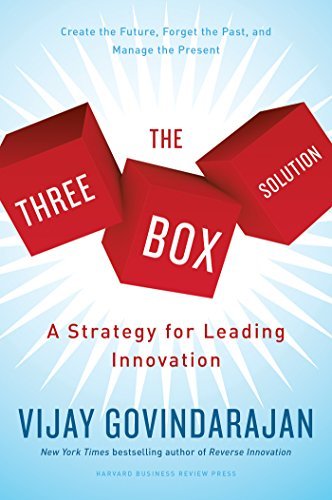
Leaders already know that innovation calls for a different set of activities, skills, methods, metrics, mind-sets, and leadership approaches. And it is well understood that creating a new business and optimizing an already existing one are two fundamentally different management challenges. The real problem for leaders is doing both, simultaneously. How do you meet the performance requirements of the existing business—one that is still thriving—while dramatically reinventing it? How do you envision a change in your current business model before a crisis forces you to abandon it?
Innovation guru Vijay Govindarajan expands the leader’s innovation tool kit with a simple and proven method for allocating the organization’s energy, time, and resources—in balanced measure—across what he calls “the three boxes”:
• Box 1: The present—Manage the core business at peak profitability • Box 2: The past—Abandon ideas, practices, and attitudes that could inhibit innovation • Box 3: The future—Convert breakthrough ideas into new products and businesses
The three-box framework makes leading innovation easier because it gives leaders a simple vocabulary and set of tools for managing and measuring these different sets of behaviors and activities across all levels of the organization. Supported with rich company examples—GE, Mahindra & Mahindra, Hasbro, IBM, United Rentals, and Tata Consultancy Services—and testimonies of leaders who have successfully used this framework, this book solves once and for all the practical dilemma of how to align an organization on the critical but competing demands of innovation.
Box 1. Vishnu. Vishnu is the God of preservation. So this box 1 is the performance engine. It is here key income is generated and therefore, it is also from work in this box that box 3 work focusing on creation is financed. Box 1 Vishnu is about core competencies, daily operations and delivery. Strong focus is on efficiency, details, precision, reliability and doing things right. Examples of Vishnu box 1 questions: - What do we do really well? How do we do that? - Who and where are our existing users / customers? - How can we do, what we do well, even better?
Box 2. Shiva. Shiva is God of destruction. So this box 2 is about forgetting and destroying what is no longer relevant, for example because technologies and/or user needs have changed. It is about getting rid of a way of thinking that has become obsolete. The better we are at removing road blocks in this box 2, the better we will be at creating in box 3. Location 2400: Examples of Shiva box 2 questions: - What do we need to stop thinking? - What do we need to stop doing? - What products / services do not create value for people anymore? - What buildings, machines, and/or other technologies do we not need anymore, because they are not designed for what users need.
Location 550: Beliefs that people, who work for Hasbro, wanted to get away from: - Customers are younger than 16 years old. - We are a product company. - We distribute through physical shops. - We are an American company.
Location 1450: Long-tenured employees in particular hold on to past successes. Another trap that blocks innovation is fear people have that new products / services replace the old ones. A third trap, which holds innovation back, is the competency gap meaning that focus is put on competencies needed for old products and less on competencies needed for new products with potential to create higher value for users.
Location 1400: The purpose of box 2 is to create protective structures and alternative competencies that allow box 3 innovations to flourish. For example, IBM needed a process for enabling, supporting, and rewarding innovators that could help develop new products / services, find new customers, develop new markets, challenge existing ways of thinking and ways of doing things.
Box 3. Brahma. The Brahma box 3 is about creating. It is about making investments today to get benefits in the future. An example of a box 3 initiative for a human being is doing sports regularly in order to stay fit / be healthy in the months / years ahead. Examples of Brahma box 3 questions: - What values do we have? - What is our purpose? - What new technologies are there? - What new needs do people have? - What economic changes are happening in different markets? - What do we need to learn? At location 2700, I understood that these signals / clues are most likely observed by curious new employees. - What new products / services do we need to develop and test? - What distribution channels do we need to test? - What places do we need to learn more about?
Location 2400: As we look for new opportunities / possibilities in box 3, we need to replace the microscope from box 1 with a telescope. Location 2700: Tata Consultancy Services uses a digital platform to enable its employees to share signals, perspectives and ideas.
Box 3 is also about testing ideas / trying out ideas at low costs / doing cheap experiments. Through pilot tests, we learn about what works / what users want and what works less / what users need less. Key in this regard is learning from feedback / results / mistakes / successes and continuing to iterate, for example improve design / content / functionalities and test again. That is why box 3 initiatives should be evaluated - as the author mentions at location 2600 - on their ability to learn and adapt quickly more than on reaching short term financial goals.
At location 2700, i learned that mavericks / innovators see the world as others do not. Therefore, they are able to develop unconventional solutions / services / products which others could not see. In this regard, think, for example, of Airbnb that enable travelers to stay at homes of other people. In this part of the book, I also read about Anand Mahindra who needed mavericks to challenge the ways things were being done at the company, come up with new ideas of how to do things, and try ideas out.
Innovation is easier said than done. There is no shortage of books promising to shine a light on the art of innovating within a company. Maybe this one is different? The author believes that companies can meet the performance requirements of their current operational business whilst working to change a working formula to yield greater bonuses in the future; all through the use of a so-called three box model.
It makes for a convincing, interesting read. Supported by a host of case studies and real-world examples, the author has provided a framework that can be examined and implemented by business leaders. Of course, the scope and source of the innovation has to come from within: the author can only show a way of transforming and implementing the innovative process. It is not necessarily going to be an easy process keeping everything in balance whilst seeking to move forward, yet it can be possible. Many top companies are already managing this. It is not a pie-in-the-sky piece of blue-sky thinking.
Many books talk loudly about innovation but tend to forget that a company may have existing operations that must be considered and it is not normally possible to have a “big bang” transformation. It was great that the author has considered this actual problem. Innovation is not just for start-ups or companies desperately seeking a new way forward!
You need to invest time and effort to consider this book and its message, yet it is a desperately interesting read, delivered in a powerful, concise volume that has the capability of leading to great things.
The book started very well and with a very interesting ideas. But, as I moved on I lost my interest in the book, the reasons are : 1- the writer is trying to make his simple idea to look so smart and out of this world. I think the basic idea came to him and then he tried to build a book around it. the idea is good but it should be presented in a blog or something not a book. 2- The book is not practical at all so if you are looking for some explanation about strategies this is not the book for you 3-The examples were very very long and repetitive. If you want to save your time I suggest the following 1- read the first chapter and understand the basic idea 2- read the takeaways at the end of each chapter
Excellent framework for thinking through the complex and fraught relationship between the need for stability and the need for innovation. In his model, box one is the present of your core business (which keeps your operations afloat), box two is the history of the organization (which is made up of the roots that feed your box one operations and the chains that hold it back), and box three is the organization's future innovations (that will, eventually, become the new core business if they succeed). The goal is to keep all three boxes in balance: support your box one, encourage your box two to feed its roots and cut its chains, and free your box three to create the innovation your organization needs to succeed.
Govindarajan doesn't sugar-coat the complexity of this relationship or the struggles and strain that trying to keep all three of the boxes humming along entails. Nonetheless, this is the best formulation of how to be realistic (and ambitious) with innovation that I've yet come across.
If you enjoy this book, you may want to check out his other books: How Stella Saved the Farm, and The Other Side of Innovation. "Stella" is a fable that explains the concepts in 3-Box narratively, and "The Other Side" goes into the nuts-and-bolts of setting up your third box unit.
Govindarajan outlines a deceptively simply yet often overlooked or poorly implemented strategy to secure the future, thrive in the present, and let go of debilitating veneration of the past within any organization or institution. His insights and tools apply equally well to public, private, nonprofit, educational or religious enterprises. In particular, I believe his 'box 2' skills should be seriously considered by any leader interested in the long-term sustainability of his or her endeavor(s).
Brilliantly simple strategies for managing change. This book focuses on organizations and yet the principles presented are easily adapted for individual growth. Change is inevitable, and Vijay highlights organizations whose leaders tend present responsibilities while preparing for the future. I especially appreciated the principle of intentionally letting go, "forgetting", those practices and patterns of thinking that prevent you from moving forward and adapting.
I'm sure this is a great book for those in the crux of the Corporate world figuring out strategies, but this was like being back in Econ 110. I wanted to understand it more, but felt like I needed to be currently living the system and applying it to make sense of it. Just a boring business book for me. I liked some of the case studies, I plugged through it, and it makes sense in parts, but more technical and wordy than I like.
The three boxes are a good way to name the three core activities that an organization needs to do: optimize the what’s working, reduce what’s no longer as valuable, and start new things. He offers some solid advice on how to keep them separate (classic mistake: trying to do all three with a single team, single budget process, etc.). And he has wonderfully diverse case studies. I took a star off because he could have been a lot more concise, but it’s a useful idea with good examples.
I really enjoyed how VG defined this and provided examples as well as challenges to successful applying. I see this book having the most impact when all the executive stakeholders read to allow for common terms and ability to hold each other accountable when falling into old comfort zones. This is a skill that definitely needs continued practice and I see myself coming back to this book.
I have read several articles sighting Govindarajan's Three-Box theory. It is a very quick read with current business examples. The theory itself is not difficult but the application principles provide for good thought and discussion for any organization.
The book is written in a simple manner with many points repeated for the purpose of emphasis. The author's industry experience of 35 years is evident in some pages which are worth their weight in gold and would help anyone who is willing to change his/her company's strategy
This was quite a good book on innovation and leadership within large organizations. The 3 box model is a good framework for the discussion, and I particularly appreciated the wide variety of examples from IBM to Willow Creek Church to URI and India’s M&M. Good business read.
It's a good overview of a fairly simple idea with some decent case studies. However, I found the Harvard Business Review article that introduced the three-box concept a better read than the book. So if you are short on time, pick up the HBR article and give it a read first.
Balance the past (forget old ways of working), the present (optimize run), the future (new business model - change) to get out of success trap. Need to selectively forget your core competency in order to invent\deliver the new business model
Incorporates reminders of many aspects of business management and considers diverse business models while thoroughly presenting the Three Box Solution model.
Bem básico na linha do que é necessário para inovar. Como na maioria da literatura que já li, esse aqui fala que o comportamento é essencial e distribui isso na metáfora das três caixas.
Simple and Powerful concept. One chapter on TCS and one on Mahindra are really very powerful examples of explaining the thought. Very simple yet effective way to approach everything in life.
Just didn't gravitate to this concept. Seemed forced and not really a strategy. Examples were often new companies doing something different. Not really going from box 1 to box 3.
Companies must strive between: -preserving successful business. -destroying unsuccessful ventures. -creating new business models.
[BOX 1] Mange the core business with an eye to maximize efficiency and profitability. Linear innovation required (incremental).
[BOX 2] Avoid the traps of the past, discontinuing practices and attitudes that are no longer relevant as the environment changes over time.
[BOX 3] Transform breakthrough ideas into new products and businesses. Nonlinear innovation (disruptive). Identifies new customers, reinvents the type of delivered value and the way it is delivered.
The boxes manage natural tension among preservation, destruction and creation. Successful companies spend too much time in BOX 1. And, BOX 1 and BOX 3 require very different set of innovation. By adopting PLANNED OPPORTUNISM, organizations can build several forward-looking competencies and experiment so they can pursue and influence unexpected opportunities that arise.
To anticipate changes that may occur, you have to pay attention to weak signals associated with technologies, markets, economy, consumer preferences, and demographics. Then create hypothesis about nonlinear changes that may coming your way.
Key Principles: 1. Guarantee future market leadership: engage in linear BOX 1 and nonlinear BOX 3 innovation. 2. If you are successful in BOX 1, you’ll have trouble taking bold action in BOX 3. So, selectively forget the past with BOX 2. 3. Take action in BOX 1 and BOX 3 simultaneously: optimizing current business models and creating new ones AT THE SAME TIME. This two activities require very different skills, metrics and approaches to leadership. 4. Managing the 3 boxes should be viewed as a journey rather than a project. 5. Leaders must remember that the future is now, build through daily actions.
Create the Future: Engage in BOX 3 innovation. Make key decisions with incomplete information. Having a great idea is essential but a high level of execution is key.
BOX 3 culture/values involve: -Restlessness and dissatisfaction -openness to outside ideas -eagerness for challenges -willingness to experiment -commitment to forget the past (BOX 2)
BOX 2 success traps: -Complacency trap. The believe that success relies on repeating what has been done in the past. -Cannibalization trap: Fear of new, innovative business models will endanger present prosperity. -Competency trap: obsession with box 1.
Box 2 is not about erasing box 1 skills, but to help create new ones that support box 3.
Mr. Govindarajan writes about another step in the process: kill your darlings. In other words, between the operation of a running business unit and an R&D unit, there should be another stop for managers.. pruning the business of ideas, processes and procedures which may be working but will ultimately not help the business achieve it's goals long term. That idea is novel, and the author does a great job of breaking down real stories on why.
I do understand that an amalgamation of these ideas exist in many other books but nothing as straightforward as this approach or as digestable as the author breaks it down to be. Killing off the priorities which will disable the business from focusing on building out new points of revenue is a difficult creature to discuss: moreover, there is obviously a lot of heavy lifting required for any business or manager to create this intentionally in the growth plan of any company or organization. Difficulty of implementation aside, this book is a must read for anyone in a management, leadership or owner's position looking to read about a cutting edge technique in business expansion theory.
Think of this book as a workbook. It is a step-by-step book that guides entrepreneurs through the process of asking important questions. If you are familiar with the Business Model Canvas and the Resource-Based View of the firm, you will probably notice that it's drawing on those ideas to help people with early-stage businesses walk through and consider the implications of the various segments on their business moving forward. It has questions and space to fill in the answers. This is super practical and covers all the key components. I would consider giving this, as a workbook, to people with early-stage firms. Very practical and hands-on for people at the early stage of developing an organization.
At its heart, this book is about balancing the tension between managing performance today while building the business of the future. The framework of three boxes is helpful for characterizing the needs of different parts of the business, but it is not particularly prescriptive except at the highest level. The case studies aren't very instructive; they could just as easily be lifted from the book and read in isolation. It feels like an attempt to overlay the author's narrative on a few corporate successes to justify the value of his system. In sum, the basic concept is useful, but the reader could skim 50% of the book without losing much content.
Outstanding book that squarely focuses on how to innovate in a company. People have spoken of ambidexterity (results now; results for the future). Peter Drucker speaks of 3 goals of management being delivering results now, growing people, and preparing an organization for the future.
Here VG speaks of sustaining, destroying, and creating. Special emphasis is placed on destroying old norms and practices to make way for the new: an essential space that must be created for new things flourish. Simple concept, powerful applications.
It's perhaps not groundbreaking but the simple exercise to put your ideas/possibilities/current projects in these three boxes makes them extremely easy to talk about. We had a workshop today at work using it and yeah, it was helpful. It did get repetitive but not to the point of exhaustion as the book is not that thick. There are no real difficult parts of it so just listening to it at 1.75x or 2x as an extended podcast and you get through it quickly. It's also totally fine to just read the first few chapters to get the gist of it
I really wanted to like this book but got really nervous after the first chapter didn't go anywhere. I think it was chapter 2, about Box 3, and the Keurig K-cup innovation that was the only one worth reading. But honestly I don't think I learned much, it was just an interesting story.
Box 1: Everyday work, Box 2: What you should stop doing, Box 3: innovative ideas. Just make sure you're spending the right amount of time in each.
what we learn from this book is the 3 box concept of prioritisation of improvement and innovation. 1. business as usual 2. short listed learning 3. breakthrough improvement project and list.
the book clearly calls out the action through templates.