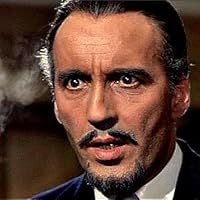
The name Christopher Lee was for many years synonymous with the best in screen horror. His Count Dracula remains unrivaled and his performances in classics like The Mummy, The Face of Fu Manchu, and The Wicker Man are just as striking. But Lee's film and television credits outnumber those of many other stars, and stretch well beyond the confines of Hammer Horror. Jonathan Rigby, author of American Gothic and English Gothic, chronicles Lee's entire career, including his starring role as James Bond's nemesis in The Man With the Golden Gun and his recent appearances in The Lord of the Rings and Star Wars trilogies. Compiled with the cooperation of Christopher Lee, and featuring a foreword by Star Wars creator George Lucas enthusiastically commemorating Lee as "breathing life into every character he plays," this is the definitive guide to one of cinema's last true legends.
I’ve had an ongoing, troubled “relationship” with Christopher Lee. On the one hand, I am acutely aware that he created many memorable roles ... and even enhanced what might otherwise have been truly disastrous productions. Conversely, I would sometimes read quotes from updates he sent to his fan club in which he made superior and condescending remarks about the possible result of an upcoming project ... and the first frame of film had yet to be shot! I considered that to be very poor behavior, indeed.
So, I’ve long been searching for an impartial overview of Christopher Lee’s life to lend understanding to my perspectives. At first, I was overjoyed to discover this book by Jonathan Rigby whose other books I’ve read of Gothic films from three different regions. Although I didn’t always agree with him, he always displayed remarkable insight and provided support for his reasoning.
However, his intent in this book was not to reflect on Christopher Lee’s life, but on his film and television work. In that, he again succeeded admirably. And considering how closely Christopher Lee identified himself with his work, the writer achieved both what he had intended and what I had wanted.
Lee had written an autobiography that had been reissued and updated called TALL, DARK AND GRUESOME, so Rigby spends very little time repeating what can be found there. Instead, much as he did with the GOTHIC books, he identifies Lee’s work, outlines the plot, and provides tidbits about the production. There was a great deal of information here that I had not known before.
Some of the points that really stayed with me were:
* It is not surprising given his performances that Lee considered his acting models to be Claude Rains, George Sanders, and Basil Rathbone. Hints of them are found in many of his portrayals. His acting idol, however, was Conrad Veidt. In fact, he had wanted to assume Veidt’s role in a remake of THE MAN WHO LAUGHS. That would have been a fascinating show;
* I had known from many of Lee’s fan club updates that he was less than enamored with the roles offered to him by Hammer Films. I had always thought that he was just being difficult with them, especially regarding the Dracula sequels. However, Rigby shows what Hammer lined up for Lee after his successes with THE CURSE OF FRANKENSTEIN and DRACULA. Seeing what was offered, it was obvious to me that Hammer misused his talents. Why?;
* It was a revelation to learn how Lee came to use “stillness” as a performance technique. It is apparent throughout his career, and it is amazingly effective!
There are also many photographs illustrating the various productions, some of them from Lee’s private collection. There is also an Appendix that deals with the inaccuracies in Lee’s onscreen history that have become legend. Rigby had direct access to Lee who was able to deny the erroneous appearances.
The book’s copyright was 2001 and his subject died in 2015, so Lee’s screen work is not complete. The last mentions were his upcoming participation in the second of the STAR WARS prequel movies and THE LORD OF THE RINGS. There would be other appearances (including a return to the revitalized Hammer Films). Fortunately, there are many resources available that can fill in the gap.
In addition to being another valuable resource book from Jonathan Rigby, I did gain insight into Christopher Lee and his attitudes. I’d had a great deal of respect for the actor. I now have that respect for the man.
Christopher Lee: The Authorised Screen History could also be called Christopher Lee: Jonathan Rigby´s fan letter to his idol. I understand his enthusiasism; Lee has a wonderful career which these modern stars cannot even dream, and Rigby sounds a bit like yours truly gushing about highlights of Hammer classics: he uses every superlative to tell how magnificent, glorious and sensational Lee is in every role. (The fact that Lee left his own country instead of paying it´s taxes is mentioned without criticism.) After suffering through English Gothic, I already knew what to wait from Rigby´s "observations" so they did not spoil interesting subject.
They under estimate the actor Christopher lee by saying nasty comments about him and his films, this i find distasteful he is not only a brilliant actor but a wonderful singer and writer,Take eg his autobiography full of interesting info about himself, his family and the war, a masterpiece of history of a man who never throught he would grow up being a wonderful film legend, i recommend this book to any that adore Christopher as much has i have, I shall never find a better dedicated actor who puts his roles into serious mode.
In some ways, a bit depressing. He was in so many movies and so many of them sound not worth the effort. But Lee clearly kept a good attitude and so he is an inspiration to us all.
There was a very nice story about his comforting a crying child actor on one of his movies from the 1990s. So "Dracula" had a heart after all.