

What do you think?

Meetings with Remarkable Manuscripts
This is a book about why medieval manuscripts matter. Coming face to face with an important illuminated manuscript in the original is like meeting a very famous person. We may all pretend that a well-known celebrity is no different from anyone else, and yet there is an undeniable thrill in actually meeting and talking to a person of world stature.
The idea for the book, which is entirely new, is to invite the reader into intimate conversations with twelve of the most famous manuscripts in existence and to explore with the author what they tell us about nearly a thousand years of medieval history - and sometimes about the modern world too. Christopher de Hamel introduces us to kings, queens, saints, scribes, artists, librarians, thieves, dealers, collectors and the international community of manuscript scholars, showing us how he and his fellows piece together evidence to reach unexpected conclusions. He traces the elaborate journeys which these exceptionally precious artefacts have made through time and space, shows us how they have been copied, who has owned them or lusted after them (and how we can tell), how they have been embroiled in politics and scholarly disputes, how they have been regarded as objects of supreme beauty and luxury and as symbols of national identity. The book touches on religion, art, literature, music, science and the history of taste.
Part travel book, part detective story, part conversation with the reader, Meetings with Remarkable Manuscripts conveys the fascination and excitement of encountering some of the greatest works of art in our culture which, in the originals, are to most people completely inaccessible. At the end, we have a slightly different perspective on history and how we come by knowledge. It is a most unusual book.
The idea for the book, which is entirely new, is to invite the reader into intimate conversations with twelve of the most famous manuscripts in existence and to explore with the author what they tell us about nearly a thousand years of medieval history - and sometimes about the modern world too. Christopher de Hamel introduces us to kings, queens, saints, scribes, artists, librarians, thieves, dealers, collectors and the international community of manuscript scholars, showing us how he and his fellows piece together evidence to reach unexpected conclusions. He traces the elaborate journeys which these exceptionally precious artefacts have made through time and space, shows us how they have been copied, who has owned them or lusted after them (and how we can tell), how they have been embroiled in politics and scholarly disputes, how they have been regarded as objects of supreme beauty and luxury and as symbols of national identity. The book touches on religion, art, literature, music, science and the history of taste.
Part travel book, part detective story, part conversation with the reader, Meetings with Remarkable Manuscripts conveys the fascination and excitement of encountering some of the greatest works of art in our culture which, in the originals, are to most people completely inaccessible. At the end, we have a slightly different perspective on history and how we come by knowledge. It is a most unusual book.
632 pages, Hardcover
First published September 22, 2016
About the author
Christopher de Hamel
52 books126 followersDr Christopher de Hamel is a Fellow of Corpus Christi College, Cambridge, and is Fellow Librarian of the Parker Library, one of the most important small collections of early manuscripts in Britain. For 25 years from 1975 he was responsible for all sales of medieval manuscripts at Sotheby’s. He has doctorates from Oxford and Cambridge and honorary doctorates from St John’s University, Collegeville, Minnesota, and Otago University, New Zealand. He is a Fellow of the Society of Antiquaries and a member of the Comité international de paléographie. He is author of numerous books on illuminated manuscripts and book collecting, including Glossed Books of the Bible (1984), The Book, A History of the Bible (2001), and Bibles, An Illustrated History from Papyrus to Print (2011). He was recipient of a festschrift in 2010, The Medieval Book, Glosses from Friends and Colleagues of Christopher de Hamel (ed. J. H. Marrow, R. A. Linenthal and W. Noel)
Ratings & Reviews
Friends & Following
Create a free account to discover what your friends think of this book!
Community Reviews
Displaying 1 - 30 of 328 reviews

August 13, 2020
"A clearly defined medieval book has a unique personality, and part of what we have been doing in our visits to collections has been to engage with manuscripts as individuals and to discover what they can tell us, which can be learned from nowhere else." pg 569
Meetings with Remarkable Manuscripts is more than a scholarly look at medieval manuscripts. It is a book for anyone who appreciates the intersection of art, history, politics, religion, and the rediscovery of forgotten things.
Readers learn about the tremendous amount of materials and effort that went into creating the manuscripts as well as why they were created, and for whom. These details are incredibly revealing.
"The 1,030 leaves of the Codex Amiatinus would have utilized skins of 515 calves or young cattle." pg 82
Christopher de Hamel attempts to trace the history of the books from their creation to the present. He visits libraries and museums across the world, relating stories of gorgeous buildings and caretakers both cautious and casual.
"The Book of Kells is so precious and so immediately recognizable that Bernard explained that it would be inappropriate to allow it into the reading-room." pg 102
De Hamel has chosen twelve books from different centuries. As the reader progresses through time, the development of binding techniques, art, layout styles and more unfolds before her eyes. It is like viewing a series of snapshots about humanity, revealed through manuscripts.
A majority of the books are about religion, others war, and still others are concerned with the movement of the stars through the sky. Curiously, at least to this modern reader, the books weren't necessarily created for the purpose of reading.
"Gospel was a work of art. It was a sacred object and a tangible symbol of divinity, enclosed in a cumdach, for sanctifying a church, for carrying in processions, for swearing oaths, and for veneration. ... Mere reading was secondary." pg 128
My favorite part of Meetings with Remarkable Manuscripts is the photo of the cover of each manuscript at the beginning of each chapter and the pictures of the pages scattered throughout the text.
"Those who meet famous people often remark afterwards how unexpectedly small the celebrated personage was in reality." pg 17
This is a book that celebrates bibliophilia. The author lovingly describes what it feels like to handle the manuscripts, critiquing the art and admiring the meticulous calligraphy. He makes you feel like you were there too.
One small criticism, this is a dense read and though de Hamel does his upmost to make the topic accessible, occasionally it ventures into the niche, though fascinating, world of medieval manuscript scholarship. But he never veers too far from the well-traveled path.
Highly recommended for book lovers everywhere. If you liked this book, you might also want to try Book of Beasts: The Bestiary in the Medieval World.
Meetings with Remarkable Manuscripts is more than a scholarly look at medieval manuscripts. It is a book for anyone who appreciates the intersection of art, history, politics, religion, and the rediscovery of forgotten things.
Readers learn about the tremendous amount of materials and effort that went into creating the manuscripts as well as why they were created, and for whom. These details are incredibly revealing.
"The 1,030 leaves of the Codex Amiatinus would have utilized skins of 515 calves or young cattle." pg 82
Christopher de Hamel attempts to trace the history of the books from their creation to the present. He visits libraries and museums across the world, relating stories of gorgeous buildings and caretakers both cautious and casual.
"The Book of Kells is so precious and so immediately recognizable that Bernard explained that it would be inappropriate to allow it into the reading-room." pg 102
De Hamel has chosen twelve books from different centuries. As the reader progresses through time, the development of binding techniques, art, layout styles and more unfolds before her eyes. It is like viewing a series of snapshots about humanity, revealed through manuscripts.
A majority of the books are about religion, others war, and still others are concerned with the movement of the stars through the sky. Curiously, at least to this modern reader, the books weren't necessarily created for the purpose of reading.
"Gospel was a work of art. It was a sacred object and a tangible symbol of divinity, enclosed in a cumdach, for sanctifying a church, for carrying in processions, for swearing oaths, and for veneration. ... Mere reading was secondary." pg 128
My favorite part of Meetings with Remarkable Manuscripts is the photo of the cover of each manuscript at the beginning of each chapter and the pictures of the pages scattered throughout the text.
"Those who meet famous people often remark afterwards how unexpectedly small the celebrated personage was in reality." pg 17
This is a book that celebrates bibliophilia. The author lovingly describes what it feels like to handle the manuscripts, critiquing the art and admiring the meticulous calligraphy. He makes you feel like you were there too.
One small criticism, this is a dense read and though de Hamel does his upmost to make the topic accessible, occasionally it ventures into the niche, though fascinating, world of medieval manuscript scholarship. But he never veers too far from the well-traveled path.
Highly recommended for book lovers everywhere. If you liked this book, you might also want to try Book of Beasts: The Bestiary in the Medieval World.

July 26, 2018
Amazing. Full stop.
I realize that the audience for this is extremely limited, but if you are interested in medieval history, manuscripts, historical importance and the art, then this is a great resource. De Hamel does more than show pretty pictures; he is the eyes and hands turning the pages that we cannot--okay, maybe there's a dozen people in the world that would be allowed to handle these manuscripts, but I'm never going to be one. He tells us things that we can't see from images: texture, application of pigment, the smell, the binding, sewing of the folios, etc. I learned more about manuscript creation from skin to gilding than anywhere else and it was all explained while perusing these incredible books. That they still exist fills me with awe.
Provenance (ownership history) obviously plays into the discussions of each of the works. These were the cherished belongings of the highest echelons of European society. War booty plays a role in most pasts, and through this the reader begins to understand the tug-of-war across Europe through the centuries as you follow the manuscripts from one library to the next.
I can't possibly summarize all the works, but I've included the list and some quotes and thoughts.
Gospels of Saint Augustine
Codex Amiatinus
Book of Kells - So famous that any comments are superfluous.
Leiden Aratea
Morgan Beatus
The tone discussing it was very fond. De Hamel's affection bled through with his discussion. Never sure why, but that it is an uniquely syncretic artwork no doubt plays a part as does the symbolism. Perhaps Beatus, the illustrator and scribe becoming one of the first named instead of as a group appealed. Whatever the reason, de Hamel made it seem charming. The shady provenance and high-flying ownership certainly added to the salaciousness with the dirty world of the black/gray market art trade.
Hugo Pictorus - Stunning
Copenhagen Psalter
The colors are magnificent, rich and exquisite in bejeweled extravagance. Yes, actual gems have/had been glued to the images.
Carmina Burana
Great example of the shift to use of vernacular. It is a great piece of German poem and song compiliation that brings to mind the later Grimm brothers' endeavor.
Jeanne de Navarre Book of Hours
Lovely, but more importantly to me and my curious mind is that de Hamel brings up a very interesting point that Book of Hours as a genre were almost exclusively made for woman. Wealthy women, who while educated, were not given tutelage in Latin; therefore, the books are often vernacular with the Bible verses in Latin, which anyone attending service would have a firm knowledge. When you combine this with the Carmina Burana that was German vernacular you see a trend that women because they were denied formal access were instrumental in knowledge disseminating through this transition. This is noted in this book as being true in Europe, but it is also true in Asia. The Tale of Genji authored by a Japanese noblewoman and lady-in-waiting was not written in Chinese, but rather hiragana. And this was happening in the eleventh-twelfth century.
It is absolutely fascinating and frankly, I'd love to read a book or dissertation on the language shift driven by women's use and democratization. IF anyone knows of one PLEASE let me know either in the comments or via PM--Thank you.
Hengwrt Chaucer
Visconti Semideus
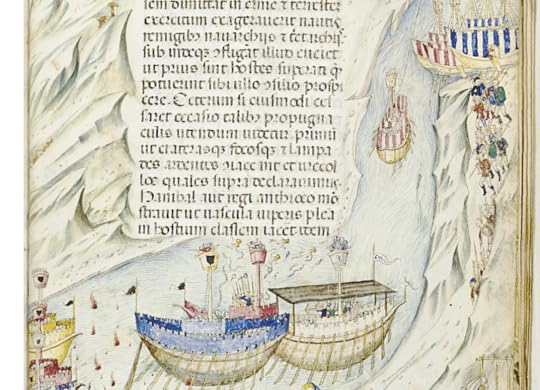
This, like the Hengwrt Chaucer and Carmina Burana, is not a religious text. It is more of a princely affairs' trio of works bound together. Think along the lines of Machiavelli's The Prince. It includes a section on warfare that I found enormously entertaining, because war machines and strategies always fascinate me. The vases filled with venomous vipers as a ship to ship volley is great, see them below.
Spinola Hours
Like all of the others before, this manuscript is exquisite, but the mystery of its genesis is probably the most interesting. It also plays a very special role in de Hamel's career as being the individual to bring a previously lost and at the time unknown work back into the public eye. And it is decadent in its illustrations.
There are more illustrations available to view HERE, I didn't want to clog the review with too many images.
I realize that the audience for this is extremely limited, but if you are interested in medieval history, manuscripts, historical importance and the art, then this is a great resource. De Hamel does more than show pretty pictures; he is the eyes and hands turning the pages that we cannot--okay, maybe there's a dozen people in the world that would be allowed to handle these manuscripts, but I'm never going to be one. He tells us things that we can't see from images: texture, application of pigment, the smell, the binding, sewing of the folios, etc. I learned more about manuscript creation from skin to gilding than anywhere else and it was all explained while perusing these incredible books. That they still exist fills me with awe.
Provenance (ownership history) obviously plays into the discussions of each of the works. These were the cherished belongings of the highest echelons of European society. War booty plays a role in most pasts, and through this the reader begins to understand the tug-of-war across Europe through the centuries as you follow the manuscripts from one library to the next.
I can't possibly summarize all the works, but I've included the list and some quotes and thoughts.
Gospels of Saint Augustine
The parchment leaves of the manuscript, as we saw earlier, are extremely fine and of tissue thinness, and they pick up the vibration and hummed and fluttered in time with the music. At the moment, it was if the sixth-century manuscript on its cushion had come to life and was taking part in the service. It occurred to me that maybe ancient Christian manuscripts always did that, for their parchment is generally much finer than in later books, and perhaps one for carrying early Gospel Books in processions at all was because this effect is astonishingly powerful and moving.-- about Gospels of Saint Augustine, 7th c. brought to England by Saint Gregory
Codex Amiatinus
Book of Kells - So famous that any comments are superfluous.
Leiden Aratea
Morgan Beatus
The tone discussing it was very fond. De Hamel's affection bled through with his discussion. Never sure why, but that it is an uniquely syncretic artwork no doubt plays a part as does the symbolism. Perhaps Beatus, the illustrator and scribe becoming one of the first named instead of as a group appealed. Whatever the reason, de Hamel made it seem charming. The shady provenance and high-flying ownership certainly added to the salaciousness with the dirty world of the black/gray market art trade.
Hugo Pictorus - Stunning
Copenhagen Psalter
The colors are magnificent, rich and exquisite in bejeweled extravagance. Yes, actual gems have/had been glued to the images.
Carmina Burana
Great example of the shift to use of vernacular. It is a great piece of German poem and song compiliation that brings to mind the later Grimm brothers' endeavor.
Jeanne de Navarre Book of Hours
Lovely, but more importantly to me and my curious mind is that de Hamel brings up a very interesting point that Book of Hours as a genre were almost exclusively made for woman. Wealthy women, who while educated, were not given tutelage in Latin; therefore, the books are often vernacular with the Bible verses in Latin, which anyone attending service would have a firm knowledge. When you combine this with the Carmina Burana that was German vernacular you see a trend that women because they were denied formal access were instrumental in knowledge disseminating through this transition. This is noted in this book as being true in Europe, but it is also true in Asia. The Tale of Genji authored by a Japanese noblewoman and lady-in-waiting was not written in Chinese, but rather hiragana. And this was happening in the eleventh-twelfth century.
It is absolutely fascinating and frankly, I'd love to read a book or dissertation on the language shift driven by women's use and democratization. IF anyone knows of one PLEASE let me know either in the comments or via PM--Thank you.
Hengwrt Chaucer
Visconti Semideus
This, like the Hengwrt Chaucer and Carmina Burana, is not a religious text. It is more of a princely affairs' trio of works bound together. Think along the lines of Machiavelli's The Prince. It includes a section on warfare that I found enormously entertaining, because war machines and strategies always fascinate me. The vases filled with venomous vipers as a ship to ship volley is great, see them below.
Spinola Hours
Like all of the others before, this manuscript is exquisite, but the mystery of its genesis is probably the most interesting. It also plays a very special role in de Hamel's career as being the individual to bring a previously lost and at the time unknown work back into the public eye. And it is decadent in its illustrations.
There are more illustrations available to view HERE, I didn't want to clog the review with too many images.

June 28, 2018
I have had an incredible amount of fun with this book: it shows very solid craftsmanship, care and experience; it reads very smoothly and contains a lot of suspense and humor, it is gorgeously published, and it is about ... medieval manuscripts. Yes, I know, that sounds very nerdy (my daughters think so), and so be it. But this is really unbelievably good.
Christopher De Hamel selected 12 Medieval manuscripts, exceptional books, handwritten and to a greater or lesser degree illuminated, starting from the late 6th century to the beginning of the 16th century. He describes how he goes to look for and consult them one by one, in various countries all over the globe, and in the most renowned national institutes or private collections, and we follow him while he holds the manuscripts and prudently turns them leaf-by-leaf. What is special is the attention the author gives to the 'materiality' of these manuscripts (how they feel, whether there are holes in them and what that means, if there are any spots on them, what can be deduced about the method of binding , the style of the lettering, etc.) and to the atmosphere in the places where they are now kept (he also describes in detail the often suspicious looks of the guardians who keep an eye on him when he consults those extremely expensive artefacts). And of course also the authors of the manuscript (in this case especially the 'scribes' and 'illuminators'), the client, the subject, the writing style and the illustration style are discussed extensively.
But the most intriguing and wonderful thing is always the improbable journey that all these manuscripts have made throughout history: from one country to another, from one monarch or rich business family to another, from one (whether or not loyal) collector to the other (one was picked up by an American soldier from the ground in the villa of Hermann Goering in Berchtesgaden). Regularly they dissappeared from the radar for centuries, but finally after a lots of detours they eventually are cherished and with the utmost care preserved.
And then, of course, there are the lavish illustrations that make everything that De Hamel describes so much more tangible: this is pure enjoyment! The only thing that disturbed me a bit in this book is the Anglo-Saxon preferences of the author: most of the selected manuscripts were made in England or have an English link, and all the measurement units that the author uses are English (inches and ounces), rather annoying for non-English-readers (why not give the metric units too?).
Still, - as if that is necessary -, in a very sympathetic epilogue the author expresses his passion for his study objects and he tries to make the reader eager to search for them and study them him/herself. Because, - and when I read that, I almost fell of my chair: an estimated 1 million Medieval manuscripts survived, obviously not all as valuable and beautiful as the ones selected here, but still. So, apparantly, even this seemingly exhaustive book only shines a corner of the veil. What a gorgeous read!
Christopher De Hamel selected 12 Medieval manuscripts, exceptional books, handwritten and to a greater or lesser degree illuminated, starting from the late 6th century to the beginning of the 16th century. He describes how he goes to look for and consult them one by one, in various countries all over the globe, and in the most renowned national institutes or private collections, and we follow him while he holds the manuscripts and prudently turns them leaf-by-leaf. What is special is the attention the author gives to the 'materiality' of these manuscripts (how they feel, whether there are holes in them and what that means, if there are any spots on them, what can be deduced about the method of binding , the style of the lettering, etc.) and to the atmosphere in the places where they are now kept (he also describes in detail the often suspicious looks of the guardians who keep an eye on him when he consults those extremely expensive artefacts). And of course also the authors of the manuscript (in this case especially the 'scribes' and 'illuminators'), the client, the subject, the writing style and the illustration style are discussed extensively.
But the most intriguing and wonderful thing is always the improbable journey that all these manuscripts have made throughout history: from one country to another, from one monarch or rich business family to another, from one (whether or not loyal) collector to the other (one was picked up by an American soldier from the ground in the villa of Hermann Goering in Berchtesgaden). Regularly they dissappeared from the radar for centuries, but finally after a lots of detours they eventually are cherished and with the utmost care preserved.
And then, of course, there are the lavish illustrations that make everything that De Hamel describes so much more tangible: this is pure enjoyment! The only thing that disturbed me a bit in this book is the Anglo-Saxon preferences of the author: most of the selected manuscripts were made in England or have an English link, and all the measurement units that the author uses are English (inches and ounces), rather annoying for non-English-readers (why not give the metric units too?).
Still, - as if that is necessary -, in a very sympathetic epilogue the author expresses his passion for his study objects and he tries to make the reader eager to search for them and study them him/herself. Because, - and when I read that, I almost fell of my chair: an estimated 1 million Medieval manuscripts survived, obviously not all as valuable and beautiful as the ones selected here, but still. So, apparantly, even this seemingly exhaustive book only shines a corner of the veil. What a gorgeous read!

Read
February 18, 2023A surprisingly interesting deep dive into a variety of manuscript books, with lots of interesting byways about their histories, MS production, scribes, politics, royal families, book collectors, and how they are now kept and shown. I wish it was full colour, and I also wish I'd read it in hardback rather than the cramped paperback.

August 16, 2018
Most of us will never get to handle the real copies of the Hengwrt Chaucer or the Book of Hours made for Jeanne of Navarre, but this book gets you pretty close, with Christopher de Hamel describing how each book looks and feels (though smell, on reflection, is lacking), and even how they’re stored and the reading rooms he visited to handle them. He describes where each manuscript has been, too, and what’s brought it to wherever it now lives. There’s a lot of detail, much of it focusing on the brilliant illuminations of some of these manuscripts (meaning that manuscripts without illuminations that nonetheless have great literary value are missed out), with a lot of black and white reproductions, and a few glossy full colour inserts.
I found it fascinating: it probably depends on whether this is something you’re interested in. I found it one of those restful reads where I could let a lot of the information wash over me: interesting at the time, but I don’t need to know it. (Unlike, say, specific examples of post-mating, prezygotic reproductive barriers. Did you know that various species of North American field crickets are reproductively isolated with each other because, though they can mate, the sperm fails to fertilise the eggs in heterospecific pairs? Now you know, or at least, it’s washed over you. I need to know it until the 11th June.)
Anyway, the point is, I really enjoyed it, though I doubt I’ve retained even half of the information. It can be a bit dense if this isn’t your interest, though.
Reviewed for The Bibliophibian.
I found it fascinating: it probably depends on whether this is something you’re interested in. I found it one of those restful reads where I could let a lot of the information wash over me: interesting at the time, but I don’t need to know it. (Unlike, say, specific examples of post-mating, prezygotic reproductive barriers. Did you know that various species of North American field crickets are reproductively isolated with each other because, though they can mate, the sperm fails to fertilise the eggs in heterospecific pairs? Now you know, or at least, it’s washed over you. I need to know it until the 11th June.)
Anyway, the point is, I really enjoyed it, though I doubt I’ve retained even half of the information. It can be a bit dense if this isn’t your interest, though.
Reviewed for The Bibliophibian.

March 3, 2018
I loved this book, the format was perfect, its language very accessible and it had tons of pictures that make you feel as if you are right there touching the books with the author . Don’t be afraid to dwell into this book, it is not too technical that makes it unappealing but not too simplistic that makes it nonsensical. It is a very descriptive book that analyses some of the oldest books in existence and at the same time gives you a background into what was happening at the time the book was being made , it makes for a compelling reading .
June 10, 2017
This is a remarkable book. When looking at medieval manuscripts in museums, I think most of us admire their beauty, marvel at the fact that they have survived so long and perhaps give a fleeting thought to the scribes who produced them. In this book Christopher de Hamel takes the reader on a journey which encompasses so much more - the role of these artefacts in the society of their times, their individual journeys through the hands of collectors and librarians and a glimpse of their current resting places and those who continue to consult them to learn from them.
The author's style is delightful. He wears his considerable learning very lightly and his excitement as he travels the world's libraries to examine the manuscripts is palpable. Often this is not his first encounter with them but he seems to discover new things every time. He confesses that he wanted to call the book "Interviews with Remarkable Manuscripts" as he felt this better conveyed the sense of these encounters and I agree - "Meetings" does not convey the sense of interaction or the dynamism of his quests for information from their beautiful pages.
De Hamel brings the libraries of the world to life in his accounts of his visits and his engagement with the custodians of these priceless items. Some of the library staff are remarkably snooty, clearly unaware of the expertise of the unassuming scholar they are dealing with. He often has to wear gloves to handle the books: I liked his account of viewing the Carmina Burana where, rather than protecting the book from his hands, the gloves absorbed a great deal of dirt from the book. He carefully preserved the dirty gloves as a souvenir but his wife threw them into the wash when he got home.
Without ever talking down to the reader he explains technical details such as the collation of leaves very deftly and enables the reader to join him in his interrogation of the books. He sketches the times in which the books were created and their uses. He traces their journeys and outlines the controversies about the areas of the manuscripts' experiences for which conclusive evidence is not available, for example the role of Chaucer's scribe in the production of the Canterbury Tales.
The illustrations are stunning. Even the scholarly notes at the end of the book are a joy to read as they too include descriptions of de Hamel's personal journey and his interactions with other scholars.
This is a book to treasure, just as the subjects described within it are treasured.
The author's style is delightful. He wears his considerable learning very lightly and his excitement as he travels the world's libraries to examine the manuscripts is palpable. Often this is not his first encounter with them but he seems to discover new things every time. He confesses that he wanted to call the book "Interviews with Remarkable Manuscripts" as he felt this better conveyed the sense of these encounters and I agree - "Meetings" does not convey the sense of interaction or the dynamism of his quests for information from their beautiful pages.
De Hamel brings the libraries of the world to life in his accounts of his visits and his engagement with the custodians of these priceless items. Some of the library staff are remarkably snooty, clearly unaware of the expertise of the unassuming scholar they are dealing with. He often has to wear gloves to handle the books: I liked his account of viewing the Carmina Burana where, rather than protecting the book from his hands, the gloves absorbed a great deal of dirt from the book. He carefully preserved the dirty gloves as a souvenir but his wife threw them into the wash when he got home.
Without ever talking down to the reader he explains technical details such as the collation of leaves very deftly and enables the reader to join him in his interrogation of the books. He sketches the times in which the books were created and their uses. He traces their journeys and outlines the controversies about the areas of the manuscripts' experiences for which conclusive evidence is not available, for example the role of Chaucer's scribe in the production of the Canterbury Tales.
The illustrations are stunning. Even the scholarly notes at the end of the book are a joy to read as they too include descriptions of de Hamel's personal journey and his interactions with other scholars.
This is a book to treasure, just as the subjects described within it are treasured.

September 4, 2021
Meetings with Remarkable Manuscripts [2016] - ★★★1/2
In this illustrated non-fiction book, the author, an academic librarian, presents twelve ancient manuscripts, their histories and speculations about their origin. One of the highlights for me was the talk about The Book of Kells, a beautiful Gospel book written in Latin and dating to the late eighth century. It has an "incomparable and distinctive artistry", and is still considered to be "the most precious object of the Western world" and "a national monument of Ireland at the very highest level" [Christopher de Hamel, Allen Lane, 2016: 134]. Another highlight was the description of the mysterious Leiden Aratea, an illuminated copy of an astronomical treatise by Germanicus, dating to the year 816. Christopher de Hamel comes across as very knowledgeable in his field and also talks engagingly about Carmina Burana, a manuscript of some two hundred and fifty poems, and dramatic and satirical texts written for students and clergy, dating to the eleventh and twelve centuries, and written in Medieval Latin.
The major downside for me was that the author presented interesting and insightful information alongside a myriad of his own random and largely irrelevant thoughts which range from everything under the sun, from what kind of a weather it was when he finally arrived to view any particular manuscript in person and what kind of people he met on his journey to view the manuscript, to how one should approach libraries that possess valuable manuscripts, what flags fly above their buildings and even notes on the culture: "In Italy...the word "no" is not necessarily a negative" [Christopher de Hamel, Allen Lane, 2016: 65]. The upshot is that, although the book contains much interesting information, much can also be skimmed in this book.
In this illustrated non-fiction book, the author, an academic librarian, presents twelve ancient manuscripts, their histories and speculations about their origin. One of the highlights for me was the talk about The Book of Kells, a beautiful Gospel book written in Latin and dating to the late eighth century. It has an "incomparable and distinctive artistry", and is still considered to be "the most precious object of the Western world" and "a national monument of Ireland at the very highest level" [Christopher de Hamel, Allen Lane, 2016: 134]. Another highlight was the description of the mysterious Leiden Aratea, an illuminated copy of an astronomical treatise by Germanicus, dating to the year 816. Christopher de Hamel comes across as very knowledgeable in his field and also talks engagingly about Carmina Burana, a manuscript of some two hundred and fifty poems, and dramatic and satirical texts written for students and clergy, dating to the eleventh and twelve centuries, and written in Medieval Latin.
The major downside for me was that the author presented interesting and insightful information alongside a myriad of his own random and largely irrelevant thoughts which range from everything under the sun, from what kind of a weather it was when he finally arrived to view any particular manuscript in person and what kind of people he met on his journey to view the manuscript, to how one should approach libraries that possess valuable manuscripts, what flags fly above their buildings and even notes on the culture: "In Italy...the word "no" is not necessarily a negative" [Christopher de Hamel, Allen Lane, 2016: 65]. The upshot is that, although the book contains much interesting information, much can also be skimmed in this book.

September 21, 2022
Ordinarily I give books away when I finish reading them – to make room for more books – but this one is a keeper, at least until I can find a large format coffee-table book of images from illuminated manuscripts. The pictures here are stunning; I actually searched through drawers until I found a magnifying glass so that I could get a better look at some of the details. Most people have heard of the Book of Kells, and perhaps the Très Riches Heures du Duc de Berry, but those are only two examples of an art that stretches back into antiquity. This book covers twelve magnificent productions, ranging from the 400s up to the 1500s, which means they were still being hand-written well after the introduction of the printing press around 1450.
This book has won a number of awards, including the Wolfson History Prize and the Duff Cooper Prize, and it is easy to see why. It combines scholarly descriptions of the details of manuscript creation, including parchment and paper, inks, pigment, illumination, and binding, along with a history of each of these works that reads almost like a detective story, as they were lost, found, stolen, carried off as war booty, or purchased for outrageous sums. The author remarks at the beginning that he chose twelve books, but there are many others that have histories and stories that are just as interesting. To my surprise, medieval manuscripts such as these are not as rare as might be supposed; he says that there may be a million of them extant today.
Some of these books were designed to be used as devotional materials, and they show the wear and tear of many years and many hands turning and slowly fraying their pages. Others were designed from the beginning to be treasured heirlooms; some the personal property of kings and queens, and others symbols of wealth and taste from rich bourgeoisie. One, the Carmina Burana, is a collection of poems and drinking songs.
In the last centuries before the printing press, the production of illuminated manuscripts like these became a sophisticated logistical effort in its own right, with entrepreneurs arranging for scribes, artists, and bookbinders, and farming out the work so that different groups were working on different sections at the same time. Some works of this kind were created specifically for the wealthy patrons who had ordered them, but others seem to have been produced with no specific buyer in mind, to be offered to whoever could afford them.
Tracking these books and their creators through time is a serious exercise in deductive reasoning. Scholars pour over the minute details of handwriting to identify the scribe involved, and then link that person to other manuscripts which can then provide a plausible – though never foolproof – guess as to where the manuscript was produced. One of the works studied is a very early version of the Canterbury Tales, and includes a discussion of evidence for and against identifying the specific professional scribe whom Chaucer employed to produce his work for sale or presentation.
Like the scribes, the illumination work was often divided between different groups, some of which might not even have been in the same city. It is these images which captive the reader; some of these pictures are masterpieces in miniature, with bold color, fluid action, and a clear understanding of the elements of composition. And the level of detail surrounding the main characters in the scenes is breathtaking. It is no wonder that these manuscripts are considered some of the finest examples that Western art has to offer.
Once they had been created works like these often moved around a great deal in their early centuries. One currently in Denmark may well have been produced in Paris for an English buyer who sent it as a gift to a royal relative in Holland, who passed it down to a child marrying into the nobility of Hungary, who had it stolen when their castle was sacked, causing it to vanish from sight for hundreds of years before being re-discovered and sold for a princely sum, now to reside as the treasured possession of a library.
This book is also the story of the people who collected the manuscripts. Some of them were motivated by an almost obsessive love of books, while others loved books but loved money more. There are several sad instances of unscrupulous characters who did not hesitate to mutilate books if they thought they could make them seem ever rarer than they were – as if they had been the personal possessions of kings – of if they believed that the pieces were more valuable than the whole, so pictures were cut out, and whole sections removed for separate sale.
The last book described is the Spinola Book of Hours, produced in Flanders between 1510 and 1520. By 1510 the printing press had been in use for sixty years, and there were presses in dozens of cities, turning out books by the tens of thousands. To think that even then there was a market for hand-written manuscripts provides some insight into the market forces at work. If the buyers had simply wanted a copy of the text they could probably have bought one, but the fact that they wanted scribes and illuminators to create a unique work for their own use shows the sumptuary value of works like this, bespoke productions flaunting the owners’ wealth and taste. Some things never change.
Christopher de Hamel’s enthusiasm for this subject is obvious, and even when he is discussing technical details of manuscript production my attention never wavered. This is a book of marvels and I kept lingering over the different scripts in use and the magnificent illustrations. De Hamel has convinced me to brave the traffic along California’s freeways to go visit the Getty museum and see its treasures.
This book has won a number of awards, including the Wolfson History Prize and the Duff Cooper Prize, and it is easy to see why. It combines scholarly descriptions of the details of manuscript creation, including parchment and paper, inks, pigment, illumination, and binding, along with a history of each of these works that reads almost like a detective story, as they were lost, found, stolen, carried off as war booty, or purchased for outrageous sums. The author remarks at the beginning that he chose twelve books, but there are many others that have histories and stories that are just as interesting. To my surprise, medieval manuscripts such as these are not as rare as might be supposed; he says that there may be a million of them extant today.
Some of these books were designed to be used as devotional materials, and they show the wear and tear of many years and many hands turning and slowly fraying their pages. Others were designed from the beginning to be treasured heirlooms; some the personal property of kings and queens, and others symbols of wealth and taste from rich bourgeoisie. One, the Carmina Burana, is a collection of poems and drinking songs.
In the last centuries before the printing press, the production of illuminated manuscripts like these became a sophisticated logistical effort in its own right, with entrepreneurs arranging for scribes, artists, and bookbinders, and farming out the work so that different groups were working on different sections at the same time. Some works of this kind were created specifically for the wealthy patrons who had ordered them, but others seem to have been produced with no specific buyer in mind, to be offered to whoever could afford them.
Tracking these books and their creators through time is a serious exercise in deductive reasoning. Scholars pour over the minute details of handwriting to identify the scribe involved, and then link that person to other manuscripts which can then provide a plausible – though never foolproof – guess as to where the manuscript was produced. One of the works studied is a very early version of the Canterbury Tales, and includes a discussion of evidence for and against identifying the specific professional scribe whom Chaucer employed to produce his work for sale or presentation.
Like the scribes, the illumination work was often divided between different groups, some of which might not even have been in the same city. It is these images which captive the reader; some of these pictures are masterpieces in miniature, with bold color, fluid action, and a clear understanding of the elements of composition. And the level of detail surrounding the main characters in the scenes is breathtaking. It is no wonder that these manuscripts are considered some of the finest examples that Western art has to offer.
Once they had been created works like these often moved around a great deal in their early centuries. One currently in Denmark may well have been produced in Paris for an English buyer who sent it as a gift to a royal relative in Holland, who passed it down to a child marrying into the nobility of Hungary, who had it stolen when their castle was sacked, causing it to vanish from sight for hundreds of years before being re-discovered and sold for a princely sum, now to reside as the treasured possession of a library.
This book is also the story of the people who collected the manuscripts. Some of them were motivated by an almost obsessive love of books, while others loved books but loved money more. There are several sad instances of unscrupulous characters who did not hesitate to mutilate books if they thought they could make them seem ever rarer than they were – as if they had been the personal possessions of kings – of if they believed that the pieces were more valuable than the whole, so pictures were cut out, and whole sections removed for separate sale.
The last book described is the Spinola Book of Hours, produced in Flanders between 1510 and 1520. By 1510 the printing press had been in use for sixty years, and there were presses in dozens of cities, turning out books by the tens of thousands. To think that even then there was a market for hand-written manuscripts provides some insight into the market forces at work. If the buyers had simply wanted a copy of the text they could probably have bought one, but the fact that they wanted scribes and illuminators to create a unique work for their own use shows the sumptuary value of works like this, bespoke productions flaunting the owners’ wealth and taste. Some things never change.
Christopher de Hamel’s enthusiasm for this subject is obvious, and even when he is discussing technical details of manuscript production my attention never wavered. This is a book of marvels and I kept lingering over the different scripts in use and the magnificent illustrations. De Hamel has convinced me to brave the traffic along California’s freeways to go visit the Getty museum and see its treasures.

February 19, 2018
'Meetings with Remarkable Manuscripts' is a beautifully produced book with gorgeous photos of twelve famous illuminated medieval manuscripts from the late 6th century to the early 16th century. The author, Christopher De Hamel, traveled to various libraries in Europe and North America after having received permission to examine specific ancient books. Photos of the libraries are included, too.
De Hamel traces the history of these manuscripts, and in doing so he also reveals medieval history. The fragile parchment pages of early biblical books were delivered from ancient Christian Rome to small, newly established rudimentary churches and monasteries in Ireland, England, France, Spain, Denmark, Italy and Germany. Monks diligently copied and recopied these pages delivered from Rome, some adding original details of local life on blank pages or they recopied the included drawings and stylized decorative calligraphy from Rome using local gold and paint to make more books.
These unknown monks possessed various levels of artistic and calligraphy skills, and they had to use local animals and materials which sometimes were not of the best quality, but without their efforts to recreate religious hymns, songs, poetry, a book or two of what we now call the New Testament, church calendars, inventory, accounting lists, monastery land purchases and building contracts, much historical information about people, places, technology, travel routes, patrons, and early versions of Bible stories would not be known. Copyists had their own style, too, so even while most monks making books were often anonymous, the original monastery or church could be identified by an era's usual customary style of artwork in that time and place. Also, a letter discovered in, for example, an Italian monastery might describe a certain early manuscript delivered to a pagan Ireland by a certain church official or monk, allowing dots to be connected by current historians and researchers. The Church kept meticulously records of what manuscripts were delivered where. Some original manuscripts were expected to be returned after having been copied by borrowers in other lands.
As the art of literacy leaked out into European society from the Church (whose members originally guarded the skill of reading and writing for themselves only), more of these beautiful hand-written books were demanded by wealthy secular readers. Many of the later medieval texts show the artistic improvement of drawing and painting techniques of text illuminations over the earlier texts, and are also easier for historians to trace owners backwards in time from the current owners. In the middle and late medieval periods, aristocrats, kings and queens had personalized Gospels, hymnals, poetry, Hours and Psalters made up for them. These bejewelled books moved from country to country with royal marriages, wars, disputes of succession and the passing of the power of aristocrat houses to rich merchants. These manuscripts had real jewels in the illuminations and calligraphy! Plus, they no longer were entirely religious or Biblical texts, but we're books of poetry or ancient Greek and Roman literature.
I was blown away, gentle reader, by the wealth of historical information professionals have been able to glean from these ancient books. It isn't just about the written text material, drawings or calligraphy. I had no idea.
Through diligent research, many professional organizations and interested individuals throughout history have also managed to recreate almost complete copies of some of these manuscripts by tracking down an early medieval recopied page here or there.
One of the fascinating bits of information I learned was why books are made into rectangular shapes. The manuscript format was developed from papyrus scrolls which were folded over into square-shaped 'codexes'. The folding over and hinging format was invented in the late Roman Empire. Papyrus began to be folded over and over, and over again, with pages hinged on their inner edges with writing on both sides for Christian liturgy and legal texts - easier to re-read and study. Codex manuscripts became common in the third and fourth century in Rome. Because of the way papyrus is made, in squares, the folding over and over for manuscripts reproduced the square shape. When the Roman Empire fell, the papyrus trade from Egypt also collapsed. So, animal skins were substituted. Mammals are rectangular, gentle reader, and when their skins are folded, they retain a rectangular shape. When paper began to be used, scribes were used to folding and cutting animal skins to this shape. Thus, our books today are rectangular.......omg. I need a moment.
Included are:
The Gospels of Saint Augustine
The Codex Amiatinus
The Book of Kells
The Leiden Aratea
The Morgan Beatus
Hugo Pictor
The Copenhagen Psalter
The Carmina Burana
The Hours of Jeanne de Navarre
The Hengwrt Chaucer
The Visconti Semideus
The Spinola Hours
Christopher De Hamel has catalogued many many illuminated manuscripts. He is a fellow of Corpus Christie College, Cambridge, and he was a librarian at the college's Parker Library where a collection of the earliest manuscripts in history are kept. Sotheby's has employed him as their manuscript expert.
The book has hundreds of photos, so a List of illustrations is included. There is an extensive Bibliography and notes section. An Index of manuscripts and of people are also in the back of the book. Everybody who was anybody in history owned an illustrated manuscript for a time! There may be a million fragmentary and entire manuscripts in private collections, libraries and museums. They are all a marvel to me, gentle reader - 2,000 years of, however imperfectly written or restored or rescued, a wonderful window into the past of recorded history. However, no worries prospective reader - the author only describes twelve of the most famous manuscripts and their history in a completely well-written manner for the general reader. Beautifully.
De Hamel traces the history of these manuscripts, and in doing so he also reveals medieval history. The fragile parchment pages of early biblical books were delivered from ancient Christian Rome to small, newly established rudimentary churches and monasteries in Ireland, England, France, Spain, Denmark, Italy and Germany. Monks diligently copied and recopied these pages delivered from Rome, some adding original details of local life on blank pages or they recopied the included drawings and stylized decorative calligraphy from Rome using local gold and paint to make more books.
These unknown monks possessed various levels of artistic and calligraphy skills, and they had to use local animals and materials which sometimes were not of the best quality, but without their efforts to recreate religious hymns, songs, poetry, a book or two of what we now call the New Testament, church calendars, inventory, accounting lists, monastery land purchases and building contracts, much historical information about people, places, technology, travel routes, patrons, and early versions of Bible stories would not be known. Copyists had their own style, too, so even while most monks making books were often anonymous, the original monastery or church could be identified by an era's usual customary style of artwork in that time and place. Also, a letter discovered in, for example, an Italian monastery might describe a certain early manuscript delivered to a pagan Ireland by a certain church official or monk, allowing dots to be connected by current historians and researchers. The Church kept meticulously records of what manuscripts were delivered where. Some original manuscripts were expected to be returned after having been copied by borrowers in other lands.
As the art of literacy leaked out into European society from the Church (whose members originally guarded the skill of reading and writing for themselves only), more of these beautiful hand-written books were demanded by wealthy secular readers. Many of the later medieval texts show the artistic improvement of drawing and painting techniques of text illuminations over the earlier texts, and are also easier for historians to trace owners backwards in time from the current owners. In the middle and late medieval periods, aristocrats, kings and queens had personalized Gospels, hymnals, poetry, Hours and Psalters made up for them. These bejewelled books moved from country to country with royal marriages, wars, disputes of succession and the passing of the power of aristocrat houses to rich merchants. These manuscripts had real jewels in the illuminations and calligraphy! Plus, they no longer were entirely religious or Biblical texts, but we're books of poetry or ancient Greek and Roman literature.
I was blown away, gentle reader, by the wealth of historical information professionals have been able to glean from these ancient books. It isn't just about the written text material, drawings or calligraphy. I had no idea.
Through diligent research, many professional organizations and interested individuals throughout history have also managed to recreate almost complete copies of some of these manuscripts by tracking down an early medieval recopied page here or there.
One of the fascinating bits of information I learned was why books are made into rectangular shapes. The manuscript format was developed from papyrus scrolls which were folded over into square-shaped 'codexes'. The folding over and hinging format was invented in the late Roman Empire. Papyrus began to be folded over and over, and over again, with pages hinged on their inner edges with writing on both sides for Christian liturgy and legal texts - easier to re-read and study. Codex manuscripts became common in the third and fourth century in Rome. Because of the way papyrus is made, in squares, the folding over and over for manuscripts reproduced the square shape. When the Roman Empire fell, the papyrus trade from Egypt also collapsed. So, animal skins were substituted. Mammals are rectangular, gentle reader, and when their skins are folded, they retain a rectangular shape. When paper began to be used, scribes were used to folding and cutting animal skins to this shape. Thus, our books today are rectangular.......omg. I need a moment.
Included are:
The Gospels of Saint Augustine
The Codex Amiatinus
The Book of Kells
The Leiden Aratea
The Morgan Beatus
Hugo Pictor
The Copenhagen Psalter
The Carmina Burana
The Hours of Jeanne de Navarre
The Hengwrt Chaucer
The Visconti Semideus
The Spinola Hours
Christopher De Hamel has catalogued many many illuminated manuscripts. He is a fellow of Corpus Christie College, Cambridge, and he was a librarian at the college's Parker Library where a collection of the earliest manuscripts in history are kept. Sotheby's has employed him as their manuscript expert.
The book has hundreds of photos, so a List of illustrations is included. There is an extensive Bibliography and notes section. An Index of manuscripts and of people are also in the back of the book. Everybody who was anybody in history owned an illustrated manuscript for a time! There may be a million fragmentary and entire manuscripts in private collections, libraries and museums. They are all a marvel to me, gentle reader - 2,000 years of, however imperfectly written or restored or rescued, a wonderful window into the past of recorded history. However, no worries prospective reader - the author only describes twelve of the most famous manuscripts and their history in a completely well-written manner for the general reader. Beautifully.

December 28, 2020
I am extremely blessed, honored and grateful that I spent my days in research libraries (and printing presses) before I could walk or talk; almost directly out of the womb. I’ve seen one of the original Tyndale translated Bibles, an original “Canterbury Tales” manuscript and multiple other manuscripts and illuminations. All that being said; I am not Christopher De Hamel. Who is Mr. Christopher De Hamel? De Hamel is one of the most sought-after paleographers (the study of manuscripts and their ownership) and one of the top leading experts in the field. Not many can hold a candle to De Hamel’s expertise. Despite his high status, De Hamel strives to reveal the world of paleography in, “Meetings with Remarkable Manuscripts: Twelve Journeys into the Medieval World”.
If forced to compartmentalize “Meetings with Remarkable Manuscripts”; then one might simply call the text an art history piece. However, this would be downplaying the sheer scope of the De Hamel’s writing. “Meetings with Remarkable Manuscripts” is a combination medieval art history, memoir, exposé, technical study and research supplement.
In “Meetings with Remarkable Manuscripts”, De Hamel presents twelve manuscripts throughout the course of 600 pages and breaks down various aspects of the artifacts: composition (paper, parchment, font, ink), creation process, history of ownership, use of the manuscript (purpose), his own journey to the research libraries to study the texts, etc. The twelve manuscripts are chosen based on distinct merits such as the actual fame surrounding the manuscript (for example, Jeanne of Navarre’s Book of Hours and an original “Canterbury Tales”), art quality, creation and ownership; to name a few qualifiers. This gives readers a variety of history lessons and a wide reach on the subject.
“Meetings with Remarkable Manuscripts” is very ‘heavy’ reading and is certainly not light even for those readers well-versed in medieval history, art, and/or manuscripts. Not only does De Hamel cover a lot of ground regarding the histories of each manuscript and the literal modern-day physical appearances; but he also tends to go off on tangents. “Meetings with Remarkable Manuscripts” often drones on-and-on and feels like it was missing a credible editor. Many portions of “Meetings with Remarkable Manuscripts” are apt for skimming resulting in an inconsistent, uneven pace that is very up-and-down with strong opposite end spectrum hitters (meaning, the text is either very strong or weak with little middle ground).
De Hamel loosens the text with occasional bouts of that good ole’ English sarcasm and sass, lightening the reader’s work load. Unfortunately, De Hamel sometimes takes this too far into a negative territory. Many readers and reviewers complain that De Hamel displays blatant sexism, misogyny and inequality of the genders; making derogatory, offhand and unnecessary comments regarding women ranging from one too many comments about women’s weight and looks to mentioning that, “…usually women sit in this part of the room” but not explaining context. Yet, all the men are credited as being helpful meanwhile women are generally described as being cranky. Not only does this have NO place in an academic piece; but it has no place ANYWHERE ! Quite bluntly, it is disgusting and takes away from De Hamel’s credibility.
Related to this, De Hamel is often pompous and arrogant commenting on how research library staff supposedly treats him like gold and gives him VIP treatment or he continuously shuns practices like wearing gloves when handling manuscripts like the entitled man that he is. First off, this once again should not be included in such a text and second: NO ONE CARES!!!! De Hamel sounds like a rock band groupie bragging about how many band members he’s had sex with.
On a more positive note, De Hamel is clearly very passionate and educated on the subject at hand and is amazing at the sleuthing that is the aim of paleography. There are illuminating moments (no pun intended) that exemplify why De Hamel is a leader in his career field.
“Meetings with Remarkable Manuscripts” is glorious in presentation with glossy full-color pages overflowing with beautiful, detailed images from each of the twelve manuscripts. “Meetings with Remarkable Manuscripts” is certainly a feast for the eyes.
Although not a huge defector, but noticeable, is De Hamel’s failure to translate all foreign language quotes and phrases. Why include these if most readers can’t understand them? Is this once again De Hamel’s ego assuming everyone knows multiple languages just because he does?
Los Angeles resident readers such as myself; will find especial delight in the mentioning of the Getty and its illuminated manuscripts, the Huntington Research Library (my favorite place in LA!) and its copy of an original “Canterbury Tales”.
De Hamel concludes “Meetings with Remarkable Manuscripts” with an emotional summary of the importance of the manuscripts plus a PSA about paleography and how (supposedly) everyone is encouraged to join the career field. Yes, I’m sure an arrogant, sexist male-dominated field is very ‘open’ (eye roll).
“Meetings with Remarkable Manuscripts” is supplemented with Notes (with run-on sentences covering the entire page so don’t expect much clarity) and a bibliography list.
“Meetings with Remarkable Manuscripts” is a beautiful visual piece on a marvelous topic. However, the text is clunky and inconsistent, De Hamel is conceited and demeaning to women and the text often divulges from the thesis. “Meetings with Remarkable Manuscripts” is suggested for readers with a deep interest in the subject but definitely not for novice readers or the ‘Average Joe’.
If forced to compartmentalize “Meetings with Remarkable Manuscripts”; then one might simply call the text an art history piece. However, this would be downplaying the sheer scope of the De Hamel’s writing. “Meetings with Remarkable Manuscripts” is a combination medieval art history, memoir, exposé, technical study and research supplement.
In “Meetings with Remarkable Manuscripts”, De Hamel presents twelve manuscripts throughout the course of 600 pages and breaks down various aspects of the artifacts: composition (paper, parchment, font, ink), creation process, history of ownership, use of the manuscript (purpose), his own journey to the research libraries to study the texts, etc. The twelve manuscripts are chosen based on distinct merits such as the actual fame surrounding the manuscript (for example, Jeanne of Navarre’s Book of Hours and an original “Canterbury Tales”), art quality, creation and ownership; to name a few qualifiers. This gives readers a variety of history lessons and a wide reach on the subject.
“Meetings with Remarkable Manuscripts” is very ‘heavy’ reading and is certainly not light even for those readers well-versed in medieval history, art, and/or manuscripts. Not only does De Hamel cover a lot of ground regarding the histories of each manuscript and the literal modern-day physical appearances; but he also tends to go off on tangents. “Meetings with Remarkable Manuscripts” often drones on-and-on and feels like it was missing a credible editor. Many portions of “Meetings with Remarkable Manuscripts” are apt for skimming resulting in an inconsistent, uneven pace that is very up-and-down with strong opposite end spectrum hitters (meaning, the text is either very strong or weak with little middle ground).
De Hamel loosens the text with occasional bouts of that good ole’ English sarcasm and sass, lightening the reader’s work load. Unfortunately, De Hamel sometimes takes this too far into a negative territory. Many readers and reviewers complain that De Hamel displays blatant sexism, misogyny and inequality of the genders; making derogatory, offhand and unnecessary comments regarding women ranging from one too many comments about women’s weight and looks to mentioning that, “…usually women sit in this part of the room” but not explaining context. Yet, all the men are credited as being helpful meanwhile women are generally described as being cranky. Not only does this have NO place in an academic piece; but it has no place ANYWHERE ! Quite bluntly, it is disgusting and takes away from De Hamel’s credibility.
Related to this, De Hamel is often pompous and arrogant commenting on how research library staff supposedly treats him like gold and gives him VIP treatment or he continuously shuns practices like wearing gloves when handling manuscripts like the entitled man that he is. First off, this once again should not be included in such a text and second: NO ONE CARES!!!! De Hamel sounds like a rock band groupie bragging about how many band members he’s had sex with.
On a more positive note, De Hamel is clearly very passionate and educated on the subject at hand and is amazing at the sleuthing that is the aim of paleography. There are illuminating moments (no pun intended) that exemplify why De Hamel is a leader in his career field.
“Meetings with Remarkable Manuscripts” is glorious in presentation with glossy full-color pages overflowing with beautiful, detailed images from each of the twelve manuscripts. “Meetings with Remarkable Manuscripts” is certainly a feast for the eyes.
Although not a huge defector, but noticeable, is De Hamel’s failure to translate all foreign language quotes and phrases. Why include these if most readers can’t understand them? Is this once again De Hamel’s ego assuming everyone knows multiple languages just because he does?
Los Angeles resident readers such as myself; will find especial delight in the mentioning of the Getty and its illuminated manuscripts, the Huntington Research Library (my favorite place in LA!) and its copy of an original “Canterbury Tales”.
De Hamel concludes “Meetings with Remarkable Manuscripts” with an emotional summary of the importance of the manuscripts plus a PSA about paleography and how (supposedly) everyone is encouraged to join the career field. Yes, I’m sure an arrogant, sexist male-dominated field is very ‘open’ (eye roll).
“Meetings with Remarkable Manuscripts” is supplemented with Notes (with run-on sentences covering the entire page so don’t expect much clarity) and a bibliography list.
“Meetings with Remarkable Manuscripts” is a beautiful visual piece on a marvelous topic. However, the text is clunky and inconsistent, De Hamel is conceited and demeaning to women and the text often divulges from the thesis. “Meetings with Remarkable Manuscripts” is suggested for readers with a deep interest in the subject but definitely not for novice readers or the ‘Average Joe’.

August 25, 2021
This is a beautiful book in every imaginable way. Christopher de Hamel, an expert in paleography and manuscripts, takes us with him to visit 12 of the world's most important manuscripts, including the Book of Kells, St Augustine of Canterbury's Gospel book, the Carmina Burana, and 9 others, a mixture of book types including Gospel books, psalters, books of hours, and a couple of secular books. Not only does he describe the appearance and history of each manuscript, he tells us what it's like to actually visit them - where they're kept, the size, how they're stored and bound, what the reading room is like, how the manuscripts are handled (gloves are not always de rigueur and Hamel seems a bit dubious of the modern insistence on wearing them).
As Hamel himself points out, actually viewing a manuscript is a far different experience than seeing even the finest digital copy. At one point, he describes seeing his own reflection in the gold illumination of a book; he teases out how each book was bound, discovers traces of earlier bindings, and finds the tiniest marks left by the original scribes as guidance; he also realizes quickly that the famous Carmina Burana is bound out of order. His wide experience enables him to make an ownership connection between three famous books of hours. He shares interesting experiences with us as well; his story of holding St Augustine's Gospel in Westminster Abbey so Pope Benedict XVI and Archbishop Rowen Williams could venerate it is just marvelous (Hamel to the verger holding the processional cross as they waited for their part: "Don't you sometimes think, "What am I doing here?" Verger, puzzled: "No, not really. This is normal work for us."). The book is never dry, thanks both to Hamel, who I suspect would be a very interesting person to talk to, and to his love of and interest in this fascinating subject.
The book is beautifully illustrated with color and, rarely, black and white images in the body of the text. Although printed on the same paper as the text rather than on glossy paper, the quality (and selection) of the illustrations is excellent and will repay close study. The chapter notes are extremely detailed and will guide you to the sources and also to reproductions of the texts themselves, some available online, others on CD-ROM or as printed reproductions.
This book was a deserved winner of the Wolfson History Prize a few years ago. I bought and read it at the time it was printed in the US, and am happy to have gone back and re-read what is a sparkling, lovely book.
As Hamel himself points out, actually viewing a manuscript is a far different experience than seeing even the finest digital copy. At one point, he describes seeing his own reflection in the gold illumination of a book; he teases out how each book was bound, discovers traces of earlier bindings, and finds the tiniest marks left by the original scribes as guidance; he also realizes quickly that the famous Carmina Burana is bound out of order. His wide experience enables him to make an ownership connection between three famous books of hours. He shares interesting experiences with us as well; his story of holding St Augustine's Gospel in Westminster Abbey so Pope Benedict XVI and Archbishop Rowen Williams could venerate it is just marvelous (Hamel to the verger holding the processional cross as they waited for their part: "Don't you sometimes think, "What am I doing here?" Verger, puzzled: "No, not really. This is normal work for us."). The book is never dry, thanks both to Hamel, who I suspect would be a very interesting person to talk to, and to his love of and interest in this fascinating subject.
The book is beautifully illustrated with color and, rarely, black and white images in the body of the text. Although printed on the same paper as the text rather than on glossy paper, the quality (and selection) of the illustrations is excellent and will repay close study. The chapter notes are extremely detailed and will guide you to the sources and also to reproductions of the texts themselves, some available online, others on CD-ROM or as printed reproductions.
This book was a deserved winner of the Wolfson History Prize a few years ago. I bought and read it at the time it was printed in the US, and am happy to have gone back and re-read what is a sparkling, lovely book.

February 4, 2018
Christopher de Hamel, if you're ever looking to round out a dinner party list, count me in.
Meetings with Remarkable Manuscripts is informative, exciting, accompanied by beautiful photographs. It's exhilarating, written in a very conversational style while still packing in as much context and information as humanly possible without boring the reader. I think a certain amount of base knowledge is anticipated by de Hamel, but he's otherwise good at expressing the ideas he's conveying in an accessible way.
I still think he needs a blog. He's ludicrously funny.
Meetings with Remarkable Manuscripts is informative, exciting, accompanied by beautiful photographs. It's exhilarating, written in a very conversational style while still packing in as much context and information as humanly possible without boring the reader. I think a certain amount of base knowledge is anticipated by de Hamel, but he's otherwise good at expressing the ideas he's conveying in an accessible way.
I still think he needs a blog. He's ludicrously funny.
May 9, 2018
Christopher de Hamel in an early chapter of this wonderful book tells about a museum showing of ancient Christian manuscripts in which one visitor was seen to kiss the display glass shielding an illuminated codex of the gospels. Similarly, I read some years ago of visitors prostrating themselves before icons from St Catherine’s Monastery in Sinai when these were at the Getty in Los Angeles.
Your typical museumgoer will consider such behavior quaint or eccentric but not long ago (in the grand scheme) it would have been thought unremarkable, a matter of course. This is still the case in some circles, but these circles are getting smaller in our enlightened, secular West. The numbers of worshipers diminish; the numbers increase year by year of those for whom worship is an alien or absurd notion.
Strictly speaking, kissing a gospel book or prostrating oneself before an icon is for a Christian an act of veneration, a step removed from the species of worship due to God alone. But only worshipers make such gestures, or such distinctions. Of course, one might say that all men “worship” one thing or another: wealth or power or pleasure, even individual notions of justice or patriotic duty. But this is to use the term loosely; this is worship without intention.
I was raised a worshiper and I worship still. At the traditional Catholic parish where I attend Mass, I pray, kneel, bow, make the sign of the cross, chant the Gloria in Latin and receive the Eucharist with intention. I say the Creed without the private reservations that troubled me as a younger man. I am rather more aware now of how little I can claim to understand, but I worship as a Christian because I believe that Truth is Christian.
As a worshiper, I stand with the majority in the “democracy of the dead.” Worship is something I have in common with my ancestors, and with yours. True, the objects of worship have changed. I say that my pre-Christian ancestors bowed their heads to Woden, Lugh or Jupiter in error. But at least they knew that worship was the proper response to finding oneself a human creature of transcendent yearnings and mortal constraints.
There’s no reason to think ritual worship was ever neglected by large numbers of people in the entire history of Homo sapiens until quite recently. Some will believe this is progress, but perhaps they fail to appreciate the profundity of the change or to wonder about its consequences. Worship is, among other things, an acknowledgement of our contingency and utter dependence, of the fact that we are not ontologically self-sustaining creatures. Christian worship especially is a school of humility, and humility is reason and realism when it comes to human nature. Without it we are tempted into fantasies of hubris, delusion, and worse.
As it happens, Christopher de Hamel approaches his subject with humility too, both as a paleographer and a writer. He knows the universal fascination inspired by the artifacts he describes. At the same time, he seems to understand that Christians and non-Christians will approach and interpret these artifacts in radically different and sometimes incompatible ways. People in the latter category will often miss the grand context of faith and devotion that is assumed by the works in question and still shared by their spiritual descendants today.
Meetings with Remarkable Manuscripts reads like a pilgrimage. Each chapter narrates an encounter with a specific manuscript, describing not only the book itself, its original purpose and the history of its ownership, but also how it is physically stored and handled, in what kind of institution and by what kinds of people. It became a sort of game for me to guess when de Hamel would be required to wear gloves or when the contact of human flesh with human artifact might still be allowed, at least to a credentialed expert.
Not all of the manuscripts included in de Hamel’s book are religious in content. He includes the Leiden Aratea (a work of ancient astronomy), the Carmina Burana (famous through Carl Orff’s musical adaptation), and the copy of Chaucer’s Canterbury Tales at the National Library of Wales (which I once saw in person). Most, however, are gospels or psalters or prayer books, starting with the rustic sixth-century Gospels of St Augustine, continuing through the Book of Kells (which I’ve also seen) to the sublime Copenhagen Psalter and the lavish Spinola Hours.
How strange it must be for a non-Christian, who has never set foot in a church or known an act of worship, to open a book like this. What are all these strange references and pious symbols? What is it all about? They tell us that the past is a different country, but for some it may be like a corner of unfamiliar countryside in their own native land; for others it may as well be Mars.
“There are two kinds of people,” we are often tempted to say, and never without some justification. Stepping into the museum, the non-worhiper sees in the gospel codex an item of historical curiosity; in the icon of Christ an inscrutable example of ancient portraiture. The worshiper, on the other hand, sees in each a sacred object cut off from the life of the community that gave it its holy character, relics of a still-living faith treated as taxidermy. He may be grateful to see them at all, but it pains him to see them behind glass.
Your typical museumgoer will consider such behavior quaint or eccentric but not long ago (in the grand scheme) it would have been thought unremarkable, a matter of course. This is still the case in some circles, but these circles are getting smaller in our enlightened, secular West. The numbers of worshipers diminish; the numbers increase year by year of those for whom worship is an alien or absurd notion.
Strictly speaking, kissing a gospel book or prostrating oneself before an icon is for a Christian an act of veneration, a step removed from the species of worship due to God alone. But only worshipers make such gestures, or such distinctions. Of course, one might say that all men “worship” one thing or another: wealth or power or pleasure, even individual notions of justice or patriotic duty. But this is to use the term loosely; this is worship without intention.
I was raised a worshiper and I worship still. At the traditional Catholic parish where I attend Mass, I pray, kneel, bow, make the sign of the cross, chant the Gloria in Latin and receive the Eucharist with intention. I say the Creed without the private reservations that troubled me as a younger man. I am rather more aware now of how little I can claim to understand, but I worship as a Christian because I believe that Truth is Christian.
As a worshiper, I stand with the majority in the “democracy of the dead.” Worship is something I have in common with my ancestors, and with yours. True, the objects of worship have changed. I say that my pre-Christian ancestors bowed their heads to Woden, Lugh or Jupiter in error. But at least they knew that worship was the proper response to finding oneself a human creature of transcendent yearnings and mortal constraints.
There’s no reason to think ritual worship was ever neglected by large numbers of people in the entire history of Homo sapiens until quite recently. Some will believe this is progress, but perhaps they fail to appreciate the profundity of the change or to wonder about its consequences. Worship is, among other things, an acknowledgement of our contingency and utter dependence, of the fact that we are not ontologically self-sustaining creatures. Christian worship especially is a school of humility, and humility is reason and realism when it comes to human nature. Without it we are tempted into fantasies of hubris, delusion, and worse.
As it happens, Christopher de Hamel approaches his subject with humility too, both as a paleographer and a writer. He knows the universal fascination inspired by the artifacts he describes. At the same time, he seems to understand that Christians and non-Christians will approach and interpret these artifacts in radically different and sometimes incompatible ways. People in the latter category will often miss the grand context of faith and devotion that is assumed by the works in question and still shared by their spiritual descendants today.
Meetings with Remarkable Manuscripts reads like a pilgrimage. Each chapter narrates an encounter with a specific manuscript, describing not only the book itself, its original purpose and the history of its ownership, but also how it is physically stored and handled, in what kind of institution and by what kinds of people. It became a sort of game for me to guess when de Hamel would be required to wear gloves or when the contact of human flesh with human artifact might still be allowed, at least to a credentialed expert.
Not all of the manuscripts included in de Hamel’s book are religious in content. He includes the Leiden Aratea (a work of ancient astronomy), the Carmina Burana (famous through Carl Orff’s musical adaptation), and the copy of Chaucer’s Canterbury Tales at the National Library of Wales (which I once saw in person). Most, however, are gospels or psalters or prayer books, starting with the rustic sixth-century Gospels of St Augustine, continuing through the Book of Kells (which I’ve also seen) to the sublime Copenhagen Psalter and the lavish Spinola Hours.
How strange it must be for a non-Christian, who has never set foot in a church or known an act of worship, to open a book like this. What are all these strange references and pious symbols? What is it all about? They tell us that the past is a different country, but for some it may be like a corner of unfamiliar countryside in their own native land; for others it may as well be Mars.
“There are two kinds of people,” we are often tempted to say, and never without some justification. Stepping into the museum, the non-worhiper sees in the gospel codex an item of historical curiosity; in the icon of Christ an inscrutable example of ancient portraiture. The worshiper, on the other hand, sees in each a sacred object cut off from the life of the community that gave it its holy character, relics of a still-living faith treated as taxidermy. He may be grateful to see them at all, but it pains him to see them behind glass.

Read
February 13, 2018A nearly perfect kind of coffee table book for me. Beautiful and erudite. A little too much emphasis on Christian texts for my taste, but that's what this author is known for so the focus makes sense.

October 12, 2025
Review originally published 14 Nov 2025 at Falling Letters.
I started reading Meetings with Remarkable Manuscripts back in January. I remember finishing 2024 with a hunger to read something medieval. It wasn’t on my TBR. I think I must have read something about it in passing in December? And decided to immediately request it from the library. Having read about 35% by mid-January, I then had to return it to the library. I checked it out again in the summer but didn’t make much progress. In October, I finally got it back and finished it during a dedicated day of reading.
Initially, I worried whether I would find myself lost in a sea of names, dates, and places. I may be more familiar with medieval manuscripts than your average person, but I haven’t exactly studied the subject. (My ‘credentials’: a course on the history of the English language that I took in my undergrad +10 years ago, a keen interest in Tolkien, many visits to admire manuscripts in international libraries and museums, once handled a Book of Kells facsimile.) But that worry proved needless.
Author Christopher De Hamel, a subject matter expert, excels at communicating his knowledge and enthusiasm to a lay audience. Yes, he occasionally doles out names, dates, and places in order to lay out the history and significance of a manuscript. But rather than simplifying the topic for a general audience, he explains why we should find it interesting and exciting as an expert might. Each manuscript offers a window into a different aspect of the field, such as illumination, authorship, political or religious climate of the day. De Hamel’s voice brings each experience to life in a compelling manner.
I cannot finish this review without noting the full colour images. The book would not be possible without them. They are part of the reason why my reading took so long! Reading the description of the image, why it’s significant, flipping back and forth to follow along, simply looking at an image in awe with no regard for time… not much to say here, just go appreciate the beauty of these manuscripts.
The Bottom Line: A dense yet entertaining and informative read, Meetings with Remarkable Manuscripts is one to pick up if you have a little more than a passing interest in the topic.
I started reading Meetings with Remarkable Manuscripts back in January. I remember finishing 2024 with a hunger to read something medieval. It wasn’t on my TBR. I think I must have read something about it in passing in December? And decided to immediately request it from the library. Having read about 35% by mid-January, I then had to return it to the library. I checked it out again in the summer but didn’t make much progress. In October, I finally got it back and finished it during a dedicated day of reading.
Initially, I worried whether I would find myself lost in a sea of names, dates, and places. I may be more familiar with medieval manuscripts than your average person, but I haven’t exactly studied the subject. (My ‘credentials’: a course on the history of the English language that I took in my undergrad +10 years ago, a keen interest in Tolkien, many visits to admire manuscripts in international libraries and museums, once handled a Book of Kells facsimile.) But that worry proved needless.
Author Christopher De Hamel, a subject matter expert, excels at communicating his knowledge and enthusiasm to a lay audience. Yes, he occasionally doles out names, dates, and places in order to lay out the history and significance of a manuscript. But rather than simplifying the topic for a general audience, he explains why we should find it interesting and exciting as an expert might. Each manuscript offers a window into a different aspect of the field, such as illumination, authorship, political or religious climate of the day. De Hamel’s voice brings each experience to life in a compelling manner.
Parchment is protein, edible to rodents. Probably when theook was neglected in the eighteenth century at Hengwrt, the upper conrers of all pages were nibbled away. (I see the glimmerings of a children’s story in there somwhere called The Rat Who Ate the Hengwrt Chaucer.) (pg 436)Now, I can imagine one might prefer a more objective, authorless presentation of the manuscripts than what De Hamel writes. For my part, I enjoyed living vicariously through De Hamel and exploring the manuscripts through his eyes. I appreciated his sense of humour. Even more so, I appreciated the sections where he acknowledged he wasn’t an expert on a particular point or that a particular matter icauses debate among experts. I found a couple takes (on general matters) a little questionable, but at least he doesn’t assert them as fact. He makes clear the differences between his personal opinion and generally accepted fact. Uniquely for a book about medieval manuscripts, he paints a vivid picture of what it is like to actually visit an institution and physically handle a manuscript, including the particulars of staff interactions and building design. Meetings with manuscripts, indeed.
What, then, was the compilers’ source of the poems and songs? This may be the unique collection gathered together for the first time, but the individual pieces were culled from earlier lives. Specialists in medieval music and literature have worked themsleves into frenzies of speculation on the poems’ origins and dates, arguing righteously with each other. These are dangerous waters of academia into which I am reluctant to dip as much as a toe. Scott Schwartz, a practicing lutenist, calls these the ‘Carmina Piranha’ with good reason. (pg 159)Delving into twelve manuscripts means this book is packed full of fascinating information. For example, I was always impressed to read about how researchers are able to track the travels of a manuscript over hundreds of years or narrow down its authorship. (“Considering the absolute rarity of any records and manuscripts from the seventh century to the eighth, this chapter has already benefited from some truly extraordinary coincidences of survival.” pg 84). This is one of those fields where we have discovered much, yet much more remains to be discovered.
I cannot finish this review without noting the full colour images. The book would not be possible without them. They are part of the reason why my reading took so long! Reading the description of the image, why it’s significant, flipping back and forth to follow along, simply looking at an image in awe with no regard for time… not much to say here, just go appreciate the beauty of these manuscripts.
The Bottom Line: A dense yet entertaining and informative read, Meetings with Remarkable Manuscripts is one to pick up if you have a little more than a passing interest in the topic.

November 3, 2020
Reading Christopher de Hamel's book is like taking undergraduate courses in history, library science and archival science all at the same time! The author invites the reader to come with him on a journey, a trip to visit some of the greatest medieval manuscripts in existence, and look over his shoulder as he studies them and points out incredible details in their authorship.
We learn the somewhat arcane details of ancient bookbinding and collation. We learn the difference between ancient uncial and Carolingian miniscule script. We get to know some of the key manuscript dealers from the last few centuries and follow the crazy and hazy history of how the documents made it from the medieval scriptorium to the modern national libraries in which they reside today. We even get to know the suspected names of the original monk scribes and talented illuminators who crafted these original masterpieces of so long ago! I had no idea what a large field of study this can be.
Perhaps most valuably, as I must admit some of the more technical details on quire collation and binding that de Hamel gets into went over my head, we get a very good sense of what medieval life was like. Not only are you almost be taken back into the scriptorium and smell the vellum and ink used in their creation, but the manuscripts themselves describe so many aspects of how people lived back then. There were books of hours and psalters, of course, but there were also collections of rowdy and raunchy drinking songs and love poems, such as in the Carmina Burana. I have a newfound interest in getting to know more about Chaucer and his Canterbury Tales.
On the whole, I think this book is a fantastic read for any lover of books and history, and that probably describes many a GoodReads reader!
We learn the somewhat arcane details of ancient bookbinding and collation. We learn the difference between ancient uncial and Carolingian miniscule script. We get to know some of the key manuscript dealers from the last few centuries and follow the crazy and hazy history of how the documents made it from the medieval scriptorium to the modern national libraries in which they reside today. We even get to know the suspected names of the original monk scribes and talented illuminators who crafted these original masterpieces of so long ago! I had no idea what a large field of study this can be.
Perhaps most valuably, as I must admit some of the more technical details on quire collation and binding that de Hamel gets into went over my head, we get a very good sense of what medieval life was like. Not only are you almost be taken back into the scriptorium and smell the vellum and ink used in their creation, but the manuscripts themselves describe so many aspects of how people lived back then. There were books of hours and psalters, of course, but there were also collections of rowdy and raunchy drinking songs and love poems, such as in the Carmina Burana. I have a newfound interest in getting to know more about Chaucer and his Canterbury Tales.
On the whole, I think this book is a fantastic read for any lover of books and history, and that probably describes many a GoodReads reader!

March 4, 2019
There is a lot of very interesting content here, but de Hamel's experience as someone with a very great deal of privilege is often uncomfortably apparent in ways that made it difficult to be absorbed in the book. I often found myself jarred back out; for instance, when he patronizingly scoffed at the idea that anyone who might be handling manuscripts would wear nail polish (who are we allowing in, after all? women? QUEERS??). Or when he made a joke about soldiers who had just sacked a town "ravishing" all the maidens.
That's called rape, Christopher. And it isn't funny.
Some parts shone. I loved hearing the often remarkably convoluted provenances of these items, the journeys they took to where they are today, and in what condition. As an art historian, I was somewhat less interested in the documentation of the order of quires, and would've enjoyed more time with the images and style, but then what do I know? I'm just an art historian, always jumping to conclusions. :/
That's called rape, Christopher. And it isn't funny.
Some parts shone. I loved hearing the often remarkably convoluted provenances of these items, the journeys they took to where they are today, and in what condition. As an art historian, I was somewhat less interested in the documentation of the order of quires, and would've enjoyed more time with the images and style, but then what do I know? I'm just an art historian, always jumping to conclusions. :/

October 7, 2020
This is not a book to be taken lightly! In the first place, it is heavy, at nearly 600 pages of reading! Then, the searches for the valuable and stunning manuscripts described read like the very best detective stories. The author's knowledge and expertise are amazing. The book has beautiful illustrations of all the sacred manuscripts. There are 12 chapters, each one describing a particular manuscript, beginning with the Gospels of Saint Augustine from the late 6th century and ending with the Spinola Hours from the 16th century. As Neil MacGregor says: 'An endlessly fascinating and enjoyable book' and I will certainly pick the book up and start again!
⭐⭐⭐⭐⭐⭐⭐⭐⭐⭐
⭐⭐⭐⭐⭐⭐⭐⭐⭐⭐

February 13, 2021
A beautiful collection and presentation of medieval manuscripts. Highly recommended.
But as a musicologist I regret not meeting a gregorian chant manuscript in this collection. It would be a meaningful addition to the other manuscripts, and a lot of readers would have been fascinated by the medieval music notatation, composition style and performance practice. The musicologists would enjoy to learn about the actual writing, the illustrations, and the whereabouts of one of those, also visually very attractive, musical manuscripts.
But as a musicologist I regret not meeting a gregorian chant manuscript in this collection. It would be a meaningful addition to the other manuscripts, and a lot of readers would have been fascinated by the medieval music notatation, composition style and performance practice. The musicologists would enjoy to learn about the actual writing, the illustrations, and the whereabouts of one of those, also visually very attractive, musical manuscripts.

December 26, 2016
"I hope that these encounters had conveyed some sense of the thrill of the pursuit and the simple pleasure of meeting an original manuscript, and asking it questions and listening to its replies." De Hamel has pitched it exactly. I love this book, wholeheartedly, a scholar writing with insight and passion - and wit and lively description.

May 13, 2025
This book is about a dozen of the rarest illuminated manuscripts from around the world. Most are religious texts - Chaucer’s tales being one of the exceptions.
Manuscripts are not exactly my jam. The book is illustrated well and the author is a strong writer and story teller, someone who would make a good dinner companion.
For fans of medieval history or perhaps religious scholars this book would warrant a higher rating.
3 stars
Manuscripts are not exactly my jam. The book is illustrated well and the author is a strong writer and story teller, someone who would make a good dinner companion.
For fans of medieval history or perhaps religious scholars this book would warrant a higher rating.
3 stars

August 21, 2017
The author wanted to call this book "Interviews with Remarkable Manuscripts" to reflect what he was trying to achieve, but was overruled by his publisher.
I think even more accurate would have been "Sunday Newspaper Glossy Interview Features with Remarkable Manuscripts" - but that would definitely have been overruled. However it does get to the heart of the book - which consists of detailed "interviews" with 12 famous medieval illuminated manuscripts, each housed in a different collection around the world. Hamel includes details of his journey to interview the manuscript, the manuscripts appearance and feel and also how it made him feel, incidental details of the interview (for example what he ate), small observations on the manuscript (often of additional notes or markings made by previous researchers or owners of the manuscript over the centuries), the back story of each manuscript (and of those with whom the manuscript has interacted over the years), quotes from others who know the manuscripts well .... all bought to live by sumptuous illustrations from the manuscript as well as technical details on its compilation (the way in which the pages are arranged, the script used etc).
A very readable and enjoyable introduction to a hidden but fascinating world (at the same time bringing history to life) - and far more informative and mentally satisfying than interviews with famous celebrities. At times, as in almost all non-fiction books, the detail becomes excessive (De Hamel is nothing if not an enthusiast for/obsessive about is subject) but when that happens, the reader can simply return to the illustrations.
I think even more accurate would have been "Sunday Newspaper Glossy Interview Features with Remarkable Manuscripts" - but that would definitely have been overruled. However it does get to the heart of the book - which consists of detailed "interviews" with 12 famous medieval illuminated manuscripts, each housed in a different collection around the world. Hamel includes details of his journey to interview the manuscript, the manuscripts appearance and feel and also how it made him feel, incidental details of the interview (for example what he ate), small observations on the manuscript (often of additional notes or markings made by previous researchers or owners of the manuscript over the centuries), the back story of each manuscript (and of those with whom the manuscript has interacted over the years), quotes from others who know the manuscripts well .... all bought to live by sumptuous illustrations from the manuscript as well as technical details on its compilation (the way in which the pages are arranged, the script used etc).
A very readable and enjoyable introduction to a hidden but fascinating world (at the same time bringing history to life) - and far more informative and mentally satisfying than interviews with famous celebrities. At times, as in almost all non-fiction books, the detail becomes excessive (De Hamel is nothing if not an enthusiast for/obsessive about is subject) but when that happens, the reader can simply return to the illustrations.

January 2, 2022
Meetings with Remarkable Manuscripts is a delightful and personal look into medieval manuscripts; the journeys they likely made on their way to libraries and museums today, what we can infer about who wrote them or why they were made from physical considerations (binding, calligraphy, textual corrections, even the smell of the parchment), the significance that these works made with such care must have had for those who commissioned them, and a fun look into the procedures and personalities of the people and institutions charged with their safeguarding. Every manuscript presented in this book were seen in person by the author, himself a top authority on these ancient documents, and he takes care to keep us engaged through the text as he prudently scans and analyzes them in turn, presenting to us a broad array of manuscripts of great historical significance (Hengwrt Chaucer, St. Augustine Gospels), gorgeous illumination (Spinola Hours, Carmina Burana), and incredulous survival odds (Hours of Jeanne de Navarre), among others. This period of European history, often incorrectly seen as backwards, is presented through these illuminated manuscripts as being one of vibrant cultural exchange and meaningful human progress, and I appreciate that the author offers such a helping hand in guiding us readers through these otherwise obtuse documents.
January 23, 2022
De hamel is a piece of work and being dragged off on tangents while attempting to learn more about the manuscripts he’s supposed to be focused on in this book was a chore. It does not help that his ego and classism are inescapable at every turn, though he seems almost wholly unaware of it, somehow.
I can’t recommend this book to anyone who wants to learn specifically about illuminated manuscripts. It’s just not really about that. They’re there, but they feel like background for everything else the author talks about, which is both a shame and waste of a reader’s time in my opinion.
This book feels like it’s for the Christian scholar who is looking to learn more about the author and the historical background of some key characters in history who might have owned or commissioned these manuscripts. Expect untranslated Latin, references to passages in the Bible you’re expected to know, and lots of snarky classist quips about anybody and everybody. Park the ego with your non existent car, dude. It’s a lot.
I can’t recommend this book to anyone who wants to learn specifically about illuminated manuscripts. It’s just not really about that. They’re there, but they feel like background for everything else the author talks about, which is both a shame and waste of a reader’s time in my opinion.
This book feels like it’s for the Christian scholar who is looking to learn more about the author and the historical background of some key characters in history who might have owned or commissioned these manuscripts. Expect untranslated Latin, references to passages in the Bible you’re expected to know, and lots of snarky classist quips about anybody and everybody. Park the ego with your non existent car, dude. It’s a lot.

April 20, 2018
This was fantastic! Christopher de Hamel is obviously supremely qualified to write a history like this, but he did not flaunt his credentials. Instead he let me experience his joy in seeing, touching, and studying the manuscripts he visited. I loved how he described the personality of each manuscript in vivid description along with fascinating history and story. For me it was one of those books that sticks in my thoughts and casts its color onto other experience, books I am reading, or things I am making. He is also a great narrator.

April 12, 2023
The production value of the hardback edition is wonderful.
De Hamel really doesn’t like using gloves but he does like the Dutch.
De Hamel really doesn’t like using gloves but he does like the Dutch.

August 24, 2026
What a wonderful book recommended by a friend, thank you Robin. The book is as much about Christopher de Hamel and his deep love of ancient manuscripts as about the manuscripts themselves.. and that is a wonderful thing. This isn’t a dry, non fiction instructional book but one teeming with enthusiasm and enjoyment. At the end I felt that a completely different world, one that I knew nothing about, had opened itself up to me and I loved it. I saw a review by Neil MacGregor that said that to ‘see a great manuscript is to enter a secret garden to which few have ever been granted access’. I would add that this book opened the garden gate and let me peer inside… it was a breathtaking view.
I think this book appeals to readers with many layers of experience. He describes the thrill of seeing these incredible manuscripts in person, the experience of arriving at whatever institute houses them and having them revealed in all their rat nibbled, faded, stained, aged and graffiti’d glory… de Hamel does the slow reveal exceptionally well….and when he describes the illustrations he does so with a kind wit that made me laugh out loud..a lot.
But the book isn’t all frivolous tales, it is also in depth enough so that I think readers more versed in the subject than I would not be short changed. I know little about the church and church politics through the ages. Mostly I kept up with the ‘stories’ if I took my time and read slowly with a little help from the www. A few times I was completely lost. But that is no failing of the book. In fact it was a fascinating peep into a world that feels utterly alien to me. It was an enjoyable challenge that didn’t detract from the pleasure I had reading this book one little bit.
The book can hardly be described.. it is history, stories of improbable survival, it is about scholarship, incredible, breathtaking skill, skulduggery, war, humour and ultimately the love of human achievement. Christopher de Hamel made me feel I was a friend accompanying him on a tour of this strange new world, and he made me feel like a comfortable companion, not someone who needed instruction. I love his writing style. It would be a memorable experience to view a manuscript with him, white gloves or not. .. what an absolute treat, he has an inquisitive mind that seems to find joy and humour in all he does.
My favourite chapters were Hugo Pictor and The Book of Kells but I enjoyed it all. I give no quotes or further details because the joy is in reading it for yourself.
As an aside, I read a bit of this in Foyles book shop on a trip to London, in the coffee shop.. there was a big display in the coffee shop talking about the decline of reading and what humanity loses from not reading.. and as I looked around, the 30 plus other customers were ALL on their phones… I should have given them all a copy of this book and told them to just try it.
I think this book appeals to readers with many layers of experience. He describes the thrill of seeing these incredible manuscripts in person, the experience of arriving at whatever institute houses them and having them revealed in all their rat nibbled, faded, stained, aged and graffiti’d glory… de Hamel does the slow reveal exceptionally well….and when he describes the illustrations he does so with a kind wit that made me laugh out loud..a lot.
But the book isn’t all frivolous tales, it is also in depth enough so that I think readers more versed in the subject than I would not be short changed. I know little about the church and church politics through the ages. Mostly I kept up with the ‘stories’ if I took my time and read slowly with a little help from the www. A few times I was completely lost. But that is no failing of the book. In fact it was a fascinating peep into a world that feels utterly alien to me. It was an enjoyable challenge that didn’t detract from the pleasure I had reading this book one little bit.
The book can hardly be described.. it is history, stories of improbable survival, it is about scholarship, incredible, breathtaking skill, skulduggery, war, humour and ultimately the love of human achievement. Christopher de Hamel made me feel I was a friend accompanying him on a tour of this strange new world, and he made me feel like a comfortable companion, not someone who needed instruction. I love his writing style. It would be a memorable experience to view a manuscript with him, white gloves or not. .. what an absolute treat, he has an inquisitive mind that seems to find joy and humour in all he does.
My favourite chapters were Hugo Pictor and The Book of Kells but I enjoyed it all. I give no quotes or further details because the joy is in reading it for yourself.
As an aside, I read a bit of this in Foyles book shop on a trip to London, in the coffee shop.. there was a big display in the coffee shop talking about the decline of reading and what humanity loses from not reading.. and as I looked around, the 30 plus other customers were ALL on their phones… I should have given them all a copy of this book and told them to just try it.

March 2, 2021
An absolute treat from cover to c— Well, to the end of the last chapter...before the massive bibliography. Reading about the life-cycles and history surrounding these twelve super rare and important rockstar status manuscripts has been pure self-indulgence. And I’ve loved it. De Hamel has to be one of the most appallingly privileged bastards on the planet, but he’s a fantastic guide and an excellent writer, not to mention a true expert and connoisseur of old books and medieval manuscripts. It didn’t come up in the book (not that I can remember), but did you know that any manuscript published on or before 1501 is called an incunabulum? Quick trivia!
You usually end a great something with a mic drop, but this is how he starts Chapter 1:
‘At the end of this chapter I will recount how Pope Benedict XVI and the Archbishop of Canterbury both bowed down before me, on live television, in front of the high altar of Westminster Abbey.’
*thud*
If you love old, gorgeously illustrated and illuminated (i.e., decorated with gold) manuscripts, in addition to their histories and all the fascinating stories and people that form a part of their creation and survival, then this book is the escapist treasure you may need in your life. It’s a big one, sure, but the pictures pad it out a lot, so there’s plenty of pretty things, like the exquisite Book of Kells, to gasp at.
You usually end a great something with a mic drop, but this is how he starts Chapter 1:
‘At the end of this chapter I will recount how Pope Benedict XVI and the Archbishop of Canterbury both bowed down before me, on live television, in front of the high altar of Westminster Abbey.’
*thud*
If you love old, gorgeously illustrated and illuminated (i.e., decorated with gold) manuscripts, in addition to their histories and all the fascinating stories and people that form a part of their creation and survival, then this book is the escapist treasure you may need in your life. It’s a big one, sure, but the pictures pad it out a lot, so there’s plenty of pretty things, like the exquisite Book of Kells, to gasp at.

Read
May 25, 2023this is a Chunky one I picked up because I missed zooming in 400% on scans of holes in the exeter book, the beowulf manuscript. It's big and one of those Huge works of criticism where it feels the author has heaved their entire career into it. But it's well written and entertaining and a long story short I recommend. It felt a little bit Old Boys club for a while but chris managed a feminist sentence & honestly I think my hackles were needlessly raised.
Besides my mumblings, there's nothing quite so electric as this proximity. De Hamel writes & detectives his way through medieval history in such ! an exciting way the glimpse of (probably) Bede's handwriting, st augustine;'s gospel, the light fingerprints brushing thru. golden. histories of art upturning in older shadows too I love books sm
Besides my mumblings, there's nothing quite so electric as this proximity. De Hamel writes & detectives his way through medieval history in such ! an exciting way the glimpse of (probably) Bede's handwriting, st augustine;'s gospel, the light fingerprints brushing thru. golden. histories of art upturning in older shadows too I love books sm
Displaying 1 - 30 of 328 reviews