'The Boy-scouts mistook my signal, and have killed the postman. I've had very little practice in this sort of thing, you see'
The British short story tradition is probably the richest, most varied and historically extensive in the world. This new anthology celebrates the full diversity and energy of its writers, subjects and tones, from the story's origins with Defoe, Swift and Fielding, to the 'golden age' of the fin de siècle and Edwardian period, ending with the First World War. Including the most famous authors as well as some magnificent, little-known stories never republished since their first appearance in magazines and periodicals, these stories are by turns topical and playful, ghostly and theatrical, rumbustious and sublime.
Hensher was born in South London, although he spent the majority of his childhood and adolescence in Sheffield, attending Tapton School.[2] He did his undergraduate degree at Lady Margaret Hall, Oxford before attending Cambridge, where he was awarded a PhD for work on 18th century painting and satire. Early in his career he worked as a clerk in the House of Commons, from which he was fired over the content of an interview he gave to a gay magazine.[1] He has published a number of novels, is a regular contributor, columnist and book reviewer for newspapers and weeklies such as The Guardian, The Spectator , The Mail on Sunday and The Independent. The Bedroom of the Mister’s Wife (1999) brings together 14 of his stories, including ‘Dead Languages’, which A. S. Byatt selected for her Oxford Book of English Short Stories (1998), making Hensher the youngest author included in the anthology.http://literature.britishcouncil.org/... Since 2005 he has taught creative writing at the University of Exeter. He has edited new editions of numerous classic works of English Literature, such as those by Charles Dickens and Nancy Mitford, and Hensher served as a judge for the Booker Prize. From 2013 he will hold the post of Professor of Creative Writing at Bath Spa University.[3] Since 2000, Philip Hensher has been listed as one of the 100 most influential LGBT people in Britain,[4] and in 2003 as one of Granta's twenty Best of Young British Novelists.[1] In 2008, Hensher's semi-autobiographical novel The Northern Clemency was shortlisted for the Man Booker Prize. In 2012, Hensher won first prize -German Travel Writers Award, and is shortlisted for the Green Carnation Prize. He also won the Stonewall Prize for the Journalist of the Year in 2007 and The Somerset Maugham Award for his novel Kitchen Venom in 1996. He wrote the libretto for Thomas Adès' 1995 opera Powder Her Face. This has been his only musical collaboration to date. His early writings have been characterized as having an "ironic, knowing distance from their characters" and "icily precise skewerings of pretension and hypocrisy"[1] His historical novel The Mulberry Empire "echos with the rhythm and language of folk tales" while "play[ing] games" with narrative forms.[1] He is married to Zaved Mahmood, a human rights lawyer at the United Nations.
With the sun hanging low on its western limit, the expanse of the grass-lands framed in the counterscarps of the rising ground took on a gorgeous and sombre aspect. A sense of penetrating sadness, like that inspired by a grave strain of music, disengaged itself from the silence of the fields. The men we met walked past slow, unsmiling, with downcast eyes, as if the melancholy of an overburdened earth had weighted their feet, bowed their shoulders, borne down their glances. (Joseph Conrad, Amy Foster, 1901)
It took me two years and two months to read this delightfully voluminous anthology of 36 short stories written by 36 British authors from cover to cover, which made it quite a unique reading experience to me. As I am fond of the short story form, never before was I given a birthday present that offered me so many hours of pleasure (besides the lovely feline Bella my children gifted me two years ago, but cats versus books perhaps constitute a pretty unfair competition?).
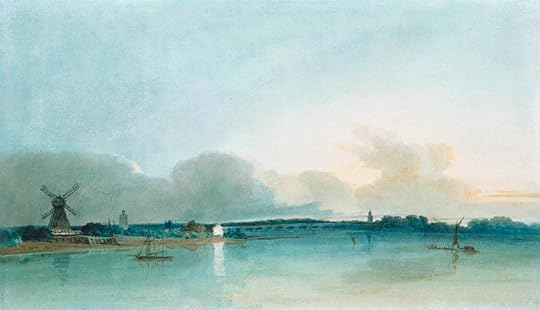
(Thomas Girtin, The White House at Chelsea, 1800)
As my acquaintance with British literature is at best patchy, it would be out of my capacity to judge the quality or representability of the selection Philip Hensher made. As a stranger to the Anglosphere I am sure I missed out on the finesse of its peculiar appeal to a British audience, but I mostly enjoyed this as a wondrous introduction that gives a flavour of the writing of a great variety of British authors, of which I only read one story (Silver Blaze by Arthur Conan Doyle) and eight authors (Mary Lamb, Dickens, Thomas Hardy, Conan Doyle, Conrad, Arnold Bennett, Kipling, D.H. Lawrence) before. Many names were new to me. Nine stories were written by women. I can be wrong but I don’t think a similar collection for Dutch short stories covering the same period (1706-1926) would do better from the gender point of view (I wondered about but couldn’t check Joost Zwagerman's De Nederlandse en Vlaamse literatuur vanaf 1880 in 250 verhalen), but among the names I found mentioned in a review on that anthology only features one woman, Maria Dermoût).
At first I had the impression the stories were organised chronologically by the year of birth of the authors, starting with Daniel Defoe (born in 1660) and ending with Buchan (born in 1875) or in order of date of publishing, but this was only roughly so (Dorothy Edwards, whose story precedes Buchan’s in the book, was born in 1903; Holiday Group by E.M. Delafield and Olive and Camilla by A.E. Coppard as first published in 1926 were more recently published than the last story in the collection which was published in 1915 (The King of Ypres).
The anthology gathers some very famous stories like Stevenson’s The Body Snatcher, the aforementioned Silver Blaze by Conan Doyle, and The Village That Voted the Earth Was Flat by Rudyard Kipling – a vicious story of revenge and mass delusion and manipulation. Many of the stories have separate entries and are reviewed here on GR. I most enjoyed Jonathan Swift (Directions to the footman (very funny)), Frederick Marryat(South West and by West three quarters West, a sailor’s love story with a fairy tale element), Elisabeth Gaskell (Six Weeks at Heppenheim, Thomas hardy (The Three Strangers), Margaret Oliphant (The Library Window, beautifully written and atmospheric, a tad too long-winded), Max Beerbohm (Enoch Soames, for its playful take on the supernatural and social critique). Surprisingly my favourite story turned out to be Joseph Conrad’s Amy Foster – moving, profound, melancholic and gorgeously written. I was also touched by the feminist take of Dorothy Edwards (A country house, on the oppression of women in marriage). Both authors I will read more of. Stacey Aumonier’s story on a simple man in the Great War (The Great Unimpressionable) was a punch in the gut. T. Baron Russell’s A Guardian of the Poor and Arthur Morrison’s Behind the shade are wry stories on abject poverty, denouncing a merciless society in which poverty is a shame.
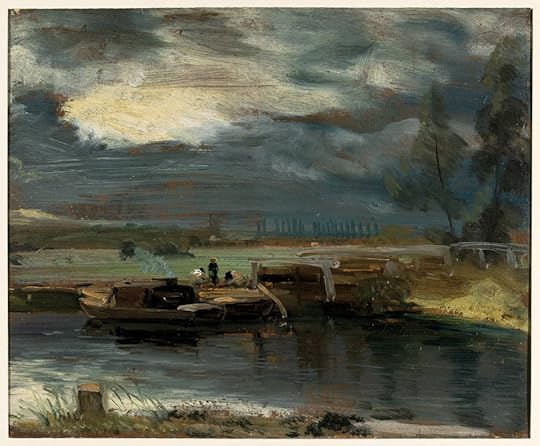
(John Constable, Barges on the Stour with Dedham Church in the Distance, 1811)
I was a little proud on myself for having had the discipline to skip the introduction from Philip Hensher who selected and compiled the stories and plunge into the stories directly. This turned out a good decision. The introduction is instructive, as rightly elaborating on how debatable the definitions of ‘British’, and ‘short story’ in this context are, touching on the formal limits of the form and situating it as a phenomenon in time in the broader and more rigid sense. Very interesting I thought how Hensher compares current reading habits of reading collections of single authors fiction instead of like in previous times reading a short story published in magazines or journals, clarifying that most of the stories were not intended to appear in a collection. Short story writing on a certain moment turned into a very lucrative business for some of the most popular authors (like Conan Doyle) and the publishing in magazines also implied that stories could swiftly respond to social and political change and events. Hensher also points at some of the distinguishing qualities which characterise the British short story (yielding to a national taste for the theatrical, playfulness, interest in the overlooked and the apparently insignificant (writing on proletarian subjects), characterised by withdrawn exactitudeness (as M.R. James wrote on the ghost story, 'Reticence conduces to effect, blatancy ruins it') as well as the extravagant and fantastical, use of mixed tones within one story, dependence on comedy in any and all circumstances, its love of Grand Guignol, its surprise quality in taking unforeseeable directions, its resting on suggestion and airy implication). I am not sure whether or not all of these features are really so uniquely or mostly British – all I know is I am glad that when starting this collection back in 2017 I went straight to the first story and didn’t come across Hensher’s in my humble opinion rather bold and disturbing opening statement that ‘The British short story is probably the richest, most varied and most historically extensive national tradition anywhere in the world’.
Hensher did the Herculean effort to plough through a very large quantity of British stories, systematically reading thousands of stories by hundreds of writers in journals, collections and magazines, to dug out his selection. It is hard for me however to imagine he did the same with the American, German, Japanese or Russian (Pushkin, Turgenev, Gogol, Leskov, Dostoevsky, Chekhov?)) short story traditions to assess them properly on their merits like he did with the British one. I thought this jingoistic slip of the tongue did Hensher’s titanic work a disservice, while it is in weird contrast to his acknowledgment later in his introduction 'that there is no point in trying to elevate one’s national writers in the form over another’ - by which he criticises Lorrie Moore and an unnamed Indian author for praising their own American and Indian short story tradition as extraordinary and powerful.
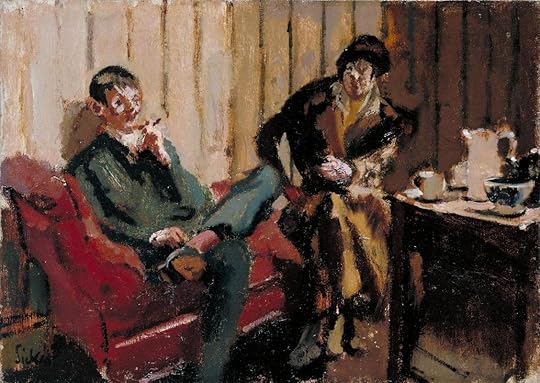
(Walter Richard Sickert, The Little Tea Party: Nina Hamnett and Roald Kristian 1915–16)
The book closes with mini biographical entries on all the authors sampled, which for someone new to many of these names is highly interesting as also pointing at the links between certain authors (like David Garnett and Dorothy Edwards).
As Philip Hensher in the introduction also alludes on some of the stories and authors he included in the second volume of British short stories (The Penguin Book of the British Short Story, Volume 2: From P.G. Wodehouse to Zadie Smith) I am tempted to read that second volume as well - slowly. Glancing through the copy of that second volume that meanwhile has arrived by post, I noticed that the general introduction is reproduced integrally. First I will however read English Literature: A Very Short Introduction, hoping it will be of help to gently broaden the horizon.
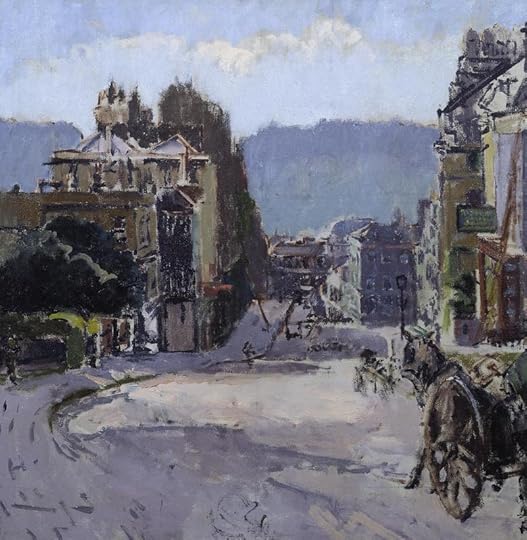
(Walter Richard Sickert, Bath, Belvedere, 1917)
If it is true, as some German fellow had said, that without phosphorus there is no thought, it is still more true that there is no kindness of heart without a certain amount of imagination. (Joseph Conrad, Amy foster)
Where would we be without stories written in the past and at present keeping our sense of imagination alive?
Varied and inspiring collection of some of the most beautifully written British short stories. Philip Hensher has chosen an eclectic group of stories, some from famous names such as Defoe and Dickens, others by authors who are less well-known today like Stacy Aumonier and Viola Meynell.
There is a wide range of topics covered, including those which have a particular resonance today such as poverty, exploitation of workers and hostility towards immigrants. There are also entertaining detective stories, ghost stories, studies of love and hate, slices of the lives of ordinary people. My favourites were Amy Foster by Joseph Conrad and Behind the Shade by Arthur Morrison - both of them are powerful but understated tales of the human condition. There were none I didn't enjoy, although I do find it hard to engage with stories where the dialogue is written in dialect - while it does make the story feel more authentic, it's just too much effort for me!
I also have the second volume of stories, covering more contemporary writers, and am looking forward to another enjoyable collection.
The Penguin Book of the British Short Story, Volume 1: Daniel Defoe to John Buchan.
Thirty-five stories by thirty-five authors, all significant writers of English literature. It’s like travelling through the history of the British short story, from 1705 to 1925.
It begins with Daniel Defoe’s A True Relation of the Apparition of Mrs Veal, the title itself giving a clue to this verbose and incomprehensible affair which I found almost unreadable. Then follows Swift’s advice to his footman, typically satirical, and a surprisingly unexpected story of a lesbian crossdressing deceiver by Henry Fielding.
Towards the middle, within the Victorian age, the stories tend to settle into more domestic scenarios, though the writing gets tighter and a greater economy of words and for the final quarter of the book, the stories have a contemporary familiar feel about them.
I enjoyed this book though, for me, there was a lot to get through - 750 pages. I had intended to dip in and out of this while reading another book but in the event they drew me in. Some names were unfamiliar but good to discover, such as Mrs. Ernest Leverson, Margaret Oliphant, James Hogg, and Frederick Maryatt, while others confirmed an earlier disliking of them - what is it with G.K. Chesterton? I don’t get it - and some old favourites; Dickens, Conan-Doyle (Holmes) and H. G. Wells. There were also some well known names in literature which I hadn’t read before, such as D.H. Lawrence, Rudyard Kipling, Saki, and Arnold Bennett.
The authors’ biographies at the back of the book make interesting reading too. A diverse range of professions these people had before turning to writing. Some unfortunate lives, as well. All in all a good collection.
I love short stories and knew that this magisterial collection of the best of British short stories would be a must-have. A few not so subtle hints later it magically appeared in my Christmas stocking. I've been alternating reading it with my other books and am quite surprised that I've got through the first volume by mid-May. It's a beautifully produced book and wonderfully edited and introduced by Philip Hensher. I'd only read three of the stories of the many contained in this first volume (those by Conan Doyle, M R James and Saki) so there were many surprises in store. The most pleasing discoveries (among many) were the stories by Thackeray, Elizabeth Gaskell, T. Baron Russell, Arnold Bennett and E. M. Delafield. The range of stories is excellent, covering everything from humour, crime, ghost stories, social comment and studies of environment and character. It's difficult to imagine a more effective or entertaining overview of the development of the short story in Britain. Now for volume two!
This book of short stories was hard- going but nevertheless interesting. It is a collection tarting with early writers such as Daniel Defoe up to and including the Edwardian period. There are famous British authors but also those unknown whose stories have never been republished since there initial issue. The stories vary in theme - some good and some bad [in my updates I have given a star rating to each] but overall an interesting collection There is a second volume published which relates to more modern writers which is on my TBR list
A truly awesome selection of 36 early British short stories, all by different authors, originally published between 1705 and 1926. The authors include a few that are still quite well known, together with others that have lost favour and vanished in the elapsed time. Consequently, the style varies considerably, yet the quality is high throughout. For example, stories by Conan Doyle, Saki, Chesterton and Kipling have been reprinted an incredible number of times, yet in the midst of this you will find a beautifully written piece by Margaret Oliphant in 1896, an author apparently responsible for more than 100 novels. My point here is that many of the authors were famous in their time, and many of the stories were not reprinted subsequent to their original publication and, perhaps, subsequent inclusion in the authors anthology. This might make a great sampler for the authors included, if only their other works were more accessible, but I shall keep looking. Brilliant.
Wonderful and varied collection of short stories, starting with a story by Daniel Defoe written in the early eighteens century. I’ve been dipping into this book over the last two years. Now on to the second volume of Philip Hensher’s selections, covering mostly the twentieth century, and ending with a story by Zadie Smith.
It's a big book which presents 36 short stories and in doing so is a snapshot of British literature from 1705 (A True Relation of the Apparition of One Mrs Veal by Daniel Defoe) to 1915 (The King of Ypres by John Buchan).
The majority of the stories were new to me and so were a lot of the authors. There are some obscure names but plenty of well known writers including Jonathan Swift Henry Fielding, William Thackeray, Elizabeth Gaskell, Anthony Trollope, Wilkie Collins, Charles Dickens, Thomas Hardy, Robert Louis Stevenson, Arthur Conan Doyle, Joseph Conrad, H.G.Wells, G.K.Chesterton, D.H.Lawrence, Mustard Kipling...the list goes on & with that caliber of writer you know there are going to be a fair few knock-out stories. As with all collections there are a few duds but that's very much down to personal taste and the tales cover a multitude of genres.
With so many quality stories it's virtually impossible to pick a favourite. The Body Snatcher was the most familiar to me and still stands up to another read. The Three Strangers was the first time I've read anything by Thomas Hardy. A very well written piece and makes me want to start on his novels. Enoch Soames by Max Beerbohm was another standout. A tales of a mysteriously forgotten writer that involves time travel and the devil!
There's a volume 2 that collects stories from the twentieth century and you can bet I'll be starting that soon.