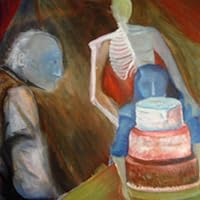
Beautiful, sophisticated, a bit world-weary, with a history of bad love affairs, Daphne Matthiessen flees New York city for charming San Francisco. There she plans to help her old school friend Agatha redecorate a house, but soon it is Agatha's friends, the Houston family, who take up most of Daphne's attention.
Alice Adams was an American novelist, short story writer, academic and university professor.
She was born in Fredericksburg, Virginia and attended Radcliffe College, graduating in 1946. She married, and had a child, but her marriage broke up, and she spent several years as a single mother, working as a secretary. Her psychiatrist told her to give up writing and get remarried; instead she published her first novel, Careless Love (1966), and a few years later she published her first short story in The New Yorker. She wrote many novels but she's best known for her short stories, in collections such as After You've Gone (1989) and The Last Lovely City (1999).
She won numerous awards including the O. Henry Award, and Best American Short Stories Award.
An obvious precursor to Bridget Jones (& herself probably a latter version of Jane Austen's Emma), our heroine Daphne Matthiessen is both a spitfire & a wallflower. A sexual creature, she perambulates great Western cities always in thirst for immediate affection, always in want of true love. Rich Rewards reads like an early version of Sex and the City. Also, TALES of the City--the ins-&-outs of adult love taking place mostly in San Francisco.
Alice Adams is a revelation. Her Daphne is a character so well constructed that solely the faulty ending deserves demerits from this memorably rich overall experience.
I couldn't figure out what Alice Adams's "rich rewards" were. Protagonist Daphne seems to stumble through life with a brief starter marriage (she cheated) and a string of unloving, addicted, or semi-abusive boyfriends, arriving at age forty in San Francisco in the late 70s in order to decorate her newly-wealthy best friend Agatha's upscale house. Once there she befriends a family Agatha knows, who at first glance are tall, stately, beautiful Californians, but whose carefree blondeness hides dysfunction and violence. There's lots of foreshadowing suggesting that Daphne will eventually meet up with one of her first lovers, a rugged Parisian economist with an enviable cock.
Adams portrays San Francisco as a moneyed city but tinged with menace, fog, and break-ins, where your carpenter has luscious coffee-colored skin and a dreamy butt, but turns tricks downtown once he's off the clock.
In a blurb Anne Tyler calls Daphne "a perceptive, intelligent woman, one of the most admirable female characters in recent fiction." I couldn't figure out that one, either.
Alice Adams is one of those authors who merges in my mind with (not coincidentally) Anne Tyler and Ann Patchett, and probably one or two other Ann(e)s and Alices, who all seem to write books that land one notch above chick-lit. "Rich Rewards" is readable and nicely short, and I appreciate that its Penguin cover features Alex Katz's painting of his wife Ada.
This is my first foray into Alice Adams. We scavenged her entire oeuvre and I am interested enough in her writing to keep going. This really is a window into the past - specifically San Francisco in the 1980's as seen through the eyes of a 40-year-old woman. It's quite fascinating and really sad. It's a window into the mind of a woman who is frightened a lot, of everything. It's a window into the mind of a woman who doesn't understand that things just happen in the world, and they are not directly related to her. I was disappointed to be the only reviewer of this book, because I really want to hear what others thought of it. The 1970's was a time of great independence for women, but you can see how wobbly so many are. The characters in this book are the kind of women on whose backs the current generation of women stand and for that reason, this book is fascinating to read. This is women's cultural history - its triumphs and its horrors.
*I did not read the "Kindle Edition" - mine is a first-edition hardback, published in 1980*
Once I got past the unnecessary use of the word cock in the opening pages I discovered a quiet, subtle, thoughtful book. The protagonist has a compassionate outlook that is a lovely way to experience the book. I enjoyed reading the historical perspective on the 60's and 70's from a book written in 1980. The last sentence of the novel was perfect. Probably pushed my stars from 3 to 4 with just the ending.
I find it hard to believe that this book receives good reviews. The tone of the narrator is full of pathos, and her reflections are very shallow. There's meat in the material, but she doesn't bother digging for it. Her reader, like her narrator, must be satisfied to view the characters who people her world as completely flat, with little connection, insight, or conclusion given to the events that unfold. A girl who wears sweaters and knits art. A dead junkie ex-boyfriend. Not inherently boring figures, but when handled with the shallow critical observations of the protagonist, the result is stupefying, and only the readability and brevity of the work urges its conclusion.
Maybe, it is something to do with Daphne's 5os, 60s mentality, adjusting itself to the wacky new world of the 70s. The narrator often wants to ask a question, but usually refrains. She wants to speak, but isn't asked, and sees the with-holding of personal information in herself and others as polite, something that keeps her (and others) from feeling uncomfortable. Maybe because, to people like her mother, to talk about bad things was to be seen as a complaint, and so her reserve is not only tactful, it is demonstrative of strength. But I like my narrators to say something, or at least, if they must keep it from the others in their book world, to still think it privately in words, and share it with me.
I hoped this book would get better the further I got into it, but it did not. I felt the characters were totally unrelatable and not well developed. I wish I could remember what list or recommendation I used to order this book, so I can avoid that list or recommendation in the future.
I tend to enjoy novels about women moving to new cities. I don't know exactly why. This one started out intriguingly but never developed enough depth for me to really get hooked. The protagonist (so unmemorable I forget her name; I read it a little over a month ago) was interesting, but the troubles she got into ended up amounting to very little thematically.
Felt liked I had stepped back in time to the 1970s - somewhat implausible but none the less a well written quick read - found the book on shelf in a friend's vacation home and needed something to read over the weekend. I can't imagine who or when someone bought it. Even the cover design was very dated.
I thought I was going to find this slighter and more irritating than it was. There is a kind of weightlessness to it, but also a level of perception and empathy I hadn't at first appreciated.