

What do you think?

The Great Courses
The American Civil War
This course examines the American Civil War with emphasis on the period from 1861 to 1865. There are 48 separate lectures given by Gary W. Gallagher, Ph.D. of the University of Virginia. Each lecture is approximately 30 minutes in length. Professor Gallagher is recognized as one of the top hitorians of the Civil War and is a prolific author.
Audio CD
First published January 1, 2000
About the author
Gary W. Gallagher
138 books106 followersGary W. Gallagher, the John L. Nau III Professor of History at the University of Virginia, is the author or editor of many books in the field of Civil War history, including The Confederate War; Causes Won, Lost, and Forgotten: How Hollywood and Popular Art Shape What We Know about the Civil War; and The Union War.
Ratings & Reviews
Friends & Following
Create a free account to discover what your friends think of this book!
Community Reviews
Displaying 1 - 30 of 106 reviews
March 8, 2019
Garry Gallagher is Professor of History at the University of Virginia and the author and editor of many books on the American Civil War. In this book (I listened to it on audio) he delivers a series of 48 lectures examining on the background to the war, the repercussions following Northern victory and how the conflict affected all people in America. Along the way he delves into some pretty deep detail on how armies were recruited, strategic breakdowns of key battles, pen pictures of leading figures and many more related topics. The audiobook was accompanied by a comprehensive word document aimed at helping the listener fully get to grips with the subject matter.
Although this is effectively a course designed for students or others wishing to study the war, it’s actually pretty easy listening. Gary has an engaging and enthusiastic delivery and the information is very well structured into bite sized chunks. I liked too that the author/presenter is prepared to nail his colours to the mast on some much debated and contentious issues. And although I did occasionally refer to the word document (and sometimes other sources) I felt that the only reason for me to do this was an occasional desire to refresh, ingrain or further explore particular elements covered in the lectures. This is clearly a massive subject and to undertake an exhaustive review it would be necessary to augment the information contained herein with additional study on the detail of the many components of the war, but I believe that the material here is comprehensive enough to satisfy the interest of all but serious students of the conflict.
I started out with only a very rudimentary knowledge of some key events and in the course of imbibing the the 24 hours or so of information supplied it certainly fleshed out my knowledge considerably and, for me, it also threw up a number of surprises, namely:
- I’d always been led to believe that the United States had, from the very start of the war, held an overpowering superiority over the Confederacy. However, Gary’s assertion is that at the outset, when the various advantages and disadvantages were taken into account, the chances of either side winning was relatively equal. The North had money and numbers heavily weighted in their favour but this was somewhat negated by the home field advantage held by the South. In terms of senior military figures, both had sets of Generals who had been trained at West Point and blooded in the Mexican War.
- I hadn’t realised that Maryland, bordering the nations capital, was at the time of the war a slave state and early in the conflict it remained quite possible that this state could itself have chosen to declare secession from the Union. I was also surprised to learn that at one-point Confederate troops ventured as far north as the suburbs of Washington D.C.
- I’d no idea that President Lincoln’s preferred way of dealing with freed African American slaves was to have them removed from the American continent and shipped to to Africa or the Caribbean. Or that he had trialled this concept in an ill fated venture using Haiti as the haven for this colonization experiment.
In summary, I found this to be an excellent way of gaining a good overview of the war and all associated elements. I’d certainly be encouraged to explore this way of learning about other key historical events.
Although this is effectively a course designed for students or others wishing to study the war, it’s actually pretty easy listening. Gary has an engaging and enthusiastic delivery and the information is very well structured into bite sized chunks. I liked too that the author/presenter is prepared to nail his colours to the mast on some much debated and contentious issues. And although I did occasionally refer to the word document (and sometimes other sources) I felt that the only reason for me to do this was an occasional desire to refresh, ingrain or further explore particular elements covered in the lectures. This is clearly a massive subject and to undertake an exhaustive review it would be necessary to augment the information contained herein with additional study on the detail of the many components of the war, but I believe that the material here is comprehensive enough to satisfy the interest of all but serious students of the conflict.
I started out with only a very rudimentary knowledge of some key events and in the course of imbibing the the 24 hours or so of information supplied it certainly fleshed out my knowledge considerably and, for me, it also threw up a number of surprises, namely:
- I’d always been led to believe that the United States had, from the very start of the war, held an overpowering superiority over the Confederacy. However, Gary’s assertion is that at the outset, when the various advantages and disadvantages were taken into account, the chances of either side winning was relatively equal. The North had money and numbers heavily weighted in their favour but this was somewhat negated by the home field advantage held by the South. In terms of senior military figures, both had sets of Generals who had been trained at West Point and blooded in the Mexican War.
- I hadn’t realised that Maryland, bordering the nations capital, was at the time of the war a slave state and early in the conflict it remained quite possible that this state could itself have chosen to declare secession from the Union. I was also surprised to learn that at one-point Confederate troops ventured as far north as the suburbs of Washington D.C.
- I’d no idea that President Lincoln’s preferred way of dealing with freed African American slaves was to have them removed from the American continent and shipped to to Africa or the Caribbean. Or that he had trialled this concept in an ill fated venture using Haiti as the haven for this colonization experiment.
In summary, I found this to be an excellent way of gaining a good overview of the war and all associated elements. I’d certainly be encouraged to explore this way of learning about other key historical events.

September 14, 2018
I read The Killer Angels in 8th grade and I’ve been obsessed with Gettysburg and the Civil War ever since. I have a 20-minute-long “If I were ever on Drunk History this would be my story” tirade I go on occasionally, when I’ve had some drinks and the people around me don’t know the entire history of the HL Hunley, which of course they don’t. It’s a great story, I promise. I imagine watching a mid-30s woman from Oregon suddenly burst into a detailed history of the Civil War takes people aback. I recently had a conversation with an old co-worker who I’ve known for years, but the Civil War has never come up before with us, because…why would it? Then he said he was going home to Franklin, Tennessee for Christmas and I said, “Oh, there was a great Civil War battle there! Totally useless, lots of generals died.” He looked at me and said, “Where the hell did that come from?”
I’m no Civil War scholar, but I obviously enjoy it. I was the perfect audience for this lecture from the Great Courses. I can’t imagine who else it would be good for. There was so much information here, it seemed like you needed at least a passing knowledge of the Civil War in order to learn about the Civil War. About half the lectures were straight up battle history, about flanking maneuvers and digging trenches and full-frontal assaults. I loved it, but I’m not an objective opinion. I don’t know who else would like it.
The narrator, Professor Gallagher, had a great point of view of the whole war and I loved hearing his opinions. I especially loved his use of primary sources and his constant refrain of “look at what people thought at the time.” The dichotomy of Confederate arguments pre- vs. post-war was disheartening. I have a pity for the South I’ve never felt before. I don’t think it has ever really recovered from this war, a wound in its side that has festered for the last 150 years.
I want to visit a battlefield more than anything now. How have I never been to one? The best I can claim is Arlington Cemetery and Robert E. Lee’s house.
Update:
I have now been to a battlefield!! YAY!! The Battle of Stones River outside Murfreesboro, TN. Check out this anachronistic photo I took during the maneuvers of the day.
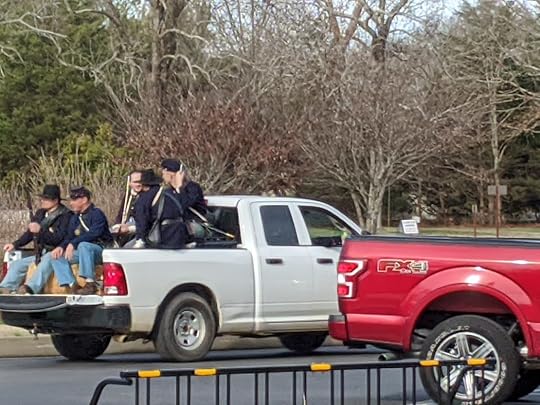
Doesn't that just scream "AMERICAN SOUTH"?
I’m no Civil War scholar, but I obviously enjoy it. I was the perfect audience for this lecture from the Great Courses. I can’t imagine who else it would be good for. There was so much information here, it seemed like you needed at least a passing knowledge of the Civil War in order to learn about the Civil War. About half the lectures were straight up battle history, about flanking maneuvers and digging trenches and full-frontal assaults. I loved it, but I’m not an objective opinion. I don’t know who else would like it.
The narrator, Professor Gallagher, had a great point of view of the whole war and I loved hearing his opinions. I especially loved his use of primary sources and his constant refrain of “look at what people thought at the time.” The dichotomy of Confederate arguments pre- vs. post-war was disheartening. I have a pity for the South I’ve never felt before. I don’t think it has ever really recovered from this war, a wound in its side that has festered for the last 150 years.
I want to visit a battlefield more than anything now. How have I never been to one? The best I can claim is Arlington Cemetery and Robert E. Lee’s house.
Update:
I have now been to a battlefield!! YAY!! The Battle of Stones River outside Murfreesboro, TN. Check out this anachronistic photo I took during the maneuvers of the day.
Doesn't that just scream "AMERICAN SOUTH"?

July 6, 2024
A five star course for certain!! Gary Gallagher knows his civil war inside out. I have read quite a bit about this topic and the time period and still learned by listening through these 48 lectures. Professor Gallagher is well spoken and has no distracting speech mannerisms. What makes this a five star course is that his lectures are so compelling and fact filled. You feel like you are sitting down and having a conversation with a person who is overjoyed to be sharing some great stories about a monumental event in American history.
48 lectures is a lot to listen to. But this allows the professor to give full weight to the important aspects of this complex topic. You will get the reasons why the war started, how the war was fought, northern and southern strategies, personalities on both sides, key battles, the home front, how African Americans experienced the war on both sides, and the consequences of the war. Professor Gallagher shows you the difficulty that Lincoln had with General McClellan, as well as the trouble in finding the right person to replace McClellan. You get to see why Lee was so beloved in the south, but other generals were not. As an example of new learning in this course, Professor Gallagher talks about the Battle of Mobile Bay and its importance, something I had not read about before. Another topic that he gave attention to was why Braxton Bragg, Joseph Johnston, and Jubal Early were all subpar in their leadership roles, in comparison to Philip Sheridan or William Sherman (although he also shows the less flattering aspects of Sherman). I was always eager to get back to these lectures, because I knew what I was going to be hearing was so worth my time and would satisfy my intellectual curiosity on the topic. One of the very best courses made by the Great Courses!!
48 lectures is a lot to listen to. But this allows the professor to give full weight to the important aspects of this complex topic. You will get the reasons why the war started, how the war was fought, northern and southern strategies, personalities on both sides, key battles, the home front, how African Americans experienced the war on both sides, and the consequences of the war. Professor Gallagher shows you the difficulty that Lincoln had with General McClellan, as well as the trouble in finding the right person to replace McClellan. You get to see why Lee was so beloved in the south, but other generals were not. As an example of new learning in this course, Professor Gallagher talks about the Battle of Mobile Bay and its importance, something I had not read about before. Another topic that he gave attention to was why Braxton Bragg, Joseph Johnston, and Jubal Early were all subpar in their leadership roles, in comparison to Philip Sheridan or William Sherman (although he also shows the less flattering aspects of Sherman). I was always eager to get back to these lectures, because I knew what I was going to be hearing was so worth my time and would satisfy my intellectual curiosity on the topic. One of the very best courses made by the Great Courses!!

April 28, 2019
Nice coverage of a vast and complex subject. I'd give it a solid 3 1/2 stars that were an option.
The American Civil War, a subject so impressed on the popular imagination, even up here in Canada, that we just call it “the Civil War,” as if it were the only one. There have been countless books written about it or various parts of it. Like World War II, it’s been picked over so thoroughly that one wonders if there’s much left to be said on the subject. Of course, there is and I’ve probably not finished reading about it myself. War is such a fascinatingly bizarre subject that military history is always going to be on my reading list somewhere. I saw what war did to my dad, so I’m always going to want to know more about it in all its variations.
This is a nice overview of the subject. It covers all the maneuverings and the battles, the victories and the defeats without getting too up close and personal with the blood and gore. There are plenty of books that do that and I’ve read a few of them. It gives you a nice summary to demystify the events. I guess for most of us it’s like the U.S. Army marches forth to suppress the rebellion, gets driven back by the rebels and the fight is on. Then they spent four years having big set-piece battles until the South gives up and it’s over. Clearly there is a lot more to it than that and you get a pretty good sense of how it all unfolded here.
Plenty of other stuff is covered too. You get the politics and the economic policies and the debates (Oh the endless debates!) and all the other less interesting minutia that is needed if you’re going to have a proper war. It’s all here. There is the preamble and the aftermath and all that stuff too. There’s a nice selection of information about the home front and the experience of the war from the point of view of that other half of the population that mostly wasn’t shooting at each other, that being the female half. And, of course, there is the great subject at the center of it all, slavery. Yes, folks, slavery and its attendant racism was at the heart of everything here without question. Yeah, I’d say it’s a pretty thorough coverage for the amount of time available for these lectures.
If you’re interested in a solid overview of the American Civil War, this will fit the bill nicely.
The American Civil War, a subject so impressed on the popular imagination, even up here in Canada, that we just call it “the Civil War,” as if it were the only one. There have been countless books written about it or various parts of it. Like World War II, it’s been picked over so thoroughly that one wonders if there’s much left to be said on the subject. Of course, there is and I’ve probably not finished reading about it myself. War is such a fascinatingly bizarre subject that military history is always going to be on my reading list somewhere. I saw what war did to my dad, so I’m always going to want to know more about it in all its variations.
This is a nice overview of the subject. It covers all the maneuverings and the battles, the victories and the defeats without getting too up close and personal with the blood and gore. There are plenty of books that do that and I’ve read a few of them. It gives you a nice summary to demystify the events. I guess for most of us it’s like the U.S. Army marches forth to suppress the rebellion, gets driven back by the rebels and the fight is on. Then they spent four years having big set-piece battles until the South gives up and it’s over. Clearly there is a lot more to it than that and you get a pretty good sense of how it all unfolded here.
Plenty of other stuff is covered too. You get the politics and the economic policies and the debates (Oh the endless debates!) and all the other less interesting minutia that is needed if you’re going to have a proper war. It’s all here. There is the preamble and the aftermath and all that stuff too. There’s a nice selection of information about the home front and the experience of the war from the point of view of that other half of the population that mostly wasn’t shooting at each other, that being the female half. And, of course, there is the great subject at the center of it all, slavery. Yes, folks, slavery and its attendant racism was at the heart of everything here without question. Yeah, I’d say it’s a pretty thorough coverage for the amount of time available for these lectures.
If you’re interested in a solid overview of the American Civil War, this will fit the bill nicely.

May 18, 2015
I found these 48 lectures to be an interesting way to learn about events during the American Civil War. The narrative thread supplied more than descriptions of battles by also including lectures on civilian life, women, politics, and economics. The everyday camp life of the common soldier, fate of prisoners, and African Americans (both slave and free) were also covered.
Additionally the lectures included brief biographical sketches of several dozen key actors of the era as well as occasional stories and quotes of interest. In particular I appreciated Gallagher's emphasis on quotations dating from the time of the war, not quotations from after the war. Often the view of participants were quite different when view from the vantage of years later.
There was limited coverage of the conditions leading to war and reconstruction after the war. Obviously, there isn't time enough for everything to be included.
Here's a trivia question and answer I learned from these lectures:
Additionally the lectures included brief biographical sketches of several dozen key actors of the era as well as occasional stories and quotes of interest. In particular I appreciated Gallagher's emphasis on quotations dating from the time of the war, not quotations from after the war. Often the view of participants were quite different when view from the vantage of years later.
There was limited coverage of the conditions leading to war and reconstruction after the war. Obviously, there isn't time enough for everything to be included.
Here's a trivia question and answer I learned from these lectures:
Question: When and where was the last shot fired in the American Civil War?
Answer: The last shot fired in defense of the South was fired from the deck of the CSS Shenandoah on June 22, 1865 in the act of capturing whalers off the Alaskan coast near the Arctic circle.
Comment: This was over a month later than the last meeting of Confederal executive Cabinet on May 5, 1865 when the Confederate Government was declared dissolved.

November 27, 2017
Finally finished it! Before this course, the Civil War was a blur to me. All I knew was North v South, Union v Confederacy, and of course, slavery. Professor Gallagher does a tremendous job of laying out all the major and minor characters of the war. He takes you to the battlefields and the skirmishes, into the halls of congress and the senate, and into the lives of the presidents of the U.S. and the Confederate states of America. He dispels the myths of men like Grant, Lee, Jackson and Sherman. He teaches us about how these men, along with many other commanders and politicians, pulled the strings in what many Americans at the time called the "Rich mans war and the poor mans fight". This course helped me see more clearly the movements of troops throughout these legendary battles and the timelines. I also learned a great deal about Lincoln and his true motives for the Emancipation Proclamation, the 13th amendment, and just how hypocritical Jefferson Davis and Alexander Stephens were from the very start of secession. The American Civil War is a really fascinating history. There are so many great stories that go largely unheard of. Stories of endurance, courage, cowardice, horror, comedy, defeat and victory. I highly recommend this Great Course to any history buff and especially anyone who is fascinated with the history of the American Civil War. If you don't want to trudge through the flourishing language of McPherson's "Battle Cry of Freedom", if you want the facts in a more concise delivery, then this Great Course is for you. I absolutely loved it!

August 24, 2020
Yes, I know, this isn't a real book. The Great Courses are definitely a favorite way to keep up with things I should remember or learn new things. This is one of my top favorites of the ones I've listened to. (The two physics ones were frankly way over my head!)
Growing up in a Northern state, I feel like I wasn't taught much of what was included in these lectures. As expected, nothing was as cut and dry as we (as the winners) made things out to be. The series is taught in a very balanced fashion and it feel like I have a much better grasp of what the war was about initially and how things shifted.
I also really appreciated the variety of focus - not just on battles, but also on economics, politics, what life was like for all those affected, etc. Formerly I only really remember being taught battles so it was very interesting to hear more of how all were affected. It's sad that our country went through a civil war, but I'm glad to better understand it.
Growing up in a Northern state, I feel like I wasn't taught much of what was included in these lectures. As expected, nothing was as cut and dry as we (as the winners) made things out to be. The series is taught in a very balanced fashion and it feel like I have a much better grasp of what the war was about initially and how things shifted.
I also really appreciated the variety of focus - not just on battles, but also on economics, politics, what life was like for all those affected, etc. Formerly I only really remember being taught battles so it was very interesting to hear more of how all were affected. It's sad that our country went through a civil war, but I'm glad to better understand it.

October 8, 2023
Having flipped through more pages on the American Civil War than I can remember, I've come across my fair share of fascinating tidbits, enthralling anecdotes, and a mosaic of perspectives. Still, I was in search of that one book that stitched together the complex tapestry of events, without overwhelming me with microscopic details. Gary Gallagher's "The American Civil War" was that guide.
What this book does exceptionally well is offer readers the much-needed bird's-eye view of the war. It's one thing to read about isolated battles or individual figures, but to see the entire chessboard, to understand how each move led to the next, is another level of appreciation. For me, the experience was like fitting the final pieces into a vast mosaic, revealing the grand picture that had previously been elusive. From major events to the lesser-known happenings, Gallagher covered a significant breadth of the war.
Lots of fascinating detail in this book too. For example, one of the interesting takeaways was the revelation that most all of the Union generals were Democrats who supported slavery. It's these nuanced pieces of information that I find fascinating. Gallagher really does his best to climb inside the head of so many of the actors in this historic drama.
While this book was great, but there were a few troughs. Gallagher's detailing of individual battles, while commendably precise, tended to drag on at times. Although I am someone who enjoys knowing the nitty-gritty of things, the detailed descriptions sometimes threatened to muddle the overarching narrative.
Also, my curiosity about the everyday lives of the participants felt somewhat unsatisfied. I would have liked to learn less about big battle plans and more about the daily lives of the participants. While grand strategies and iconic leaders are central to the story, the heart of any war lies in the lives of its foot soldiers. I would've loved to dive deep into their daily routines, challenges, and survival strategies. For instance, how did they manage to brave the chilling cold of snow-covered landscapes with scarce supplies? How on earth did they escape from freezing to death? What did they do for entertainment? What did they eat? These are the small details that make this kind of book come alive for me.
Another facet that could use more illumination is the political underpinnings leading up to the war. While Gallagher touched upon this, I found myself yearning for more. The war was as much a result of boardroom machinations as it was of ground battles, and a deeper dive into these political currents would have painted a more holistic picture.
This book taught me so much. Its ability to convey the broad scope of the war, while also spotlighting nuanced details, showcases Gallagher's meticulous research and storytelling prowess. It's the kind of book that not only educates but also captivates. Sure, it’s not the perfect comprehensive guide, but it comes pretty darn close.
What this book does exceptionally well is offer readers the much-needed bird's-eye view of the war. It's one thing to read about isolated battles or individual figures, but to see the entire chessboard, to understand how each move led to the next, is another level of appreciation. For me, the experience was like fitting the final pieces into a vast mosaic, revealing the grand picture that had previously been elusive. From major events to the lesser-known happenings, Gallagher covered a significant breadth of the war.
Lots of fascinating detail in this book too. For example, one of the interesting takeaways was the revelation that most all of the Union generals were Democrats who supported slavery. It's these nuanced pieces of information that I find fascinating. Gallagher really does his best to climb inside the head of so many of the actors in this historic drama.
While this book was great, but there were a few troughs. Gallagher's detailing of individual battles, while commendably precise, tended to drag on at times. Although I am someone who enjoys knowing the nitty-gritty of things, the detailed descriptions sometimes threatened to muddle the overarching narrative.
Also, my curiosity about the everyday lives of the participants felt somewhat unsatisfied. I would have liked to learn less about big battle plans and more about the daily lives of the participants. While grand strategies and iconic leaders are central to the story, the heart of any war lies in the lives of its foot soldiers. I would've loved to dive deep into their daily routines, challenges, and survival strategies. For instance, how did they manage to brave the chilling cold of snow-covered landscapes with scarce supplies? How on earth did they escape from freezing to death? What did they do for entertainment? What did they eat? These are the small details that make this kind of book come alive for me.
Another facet that could use more illumination is the political underpinnings leading up to the war. While Gallagher touched upon this, I found myself yearning for more. The war was as much a result of boardroom machinations as it was of ground battles, and a deeper dive into these political currents would have painted a more holistic picture.
This book taught me so much. Its ability to convey the broad scope of the war, while also spotlighting nuanced details, showcases Gallagher's meticulous research and storytelling prowess. It's the kind of book that not only educates but also captivates. Sure, it’s not the perfect comprehensive guide, but it comes pretty darn close.

September 15, 2017
Prof Gary Gallagher presents a thorough survey of the American Civil War, concentrating almost exclusively on the period between 1861 and 1865. His lectures (clearly and strongly presented) deal briefly with the causes leading up to this horrendous conflict, including brief bios of some of the key historic figures, from Henry Clay's Missouri Compromise in the 1840's to Dred Scott and Charles Sumner in 1857 and finally the election of Abraham Lincoln. The next 44 lectures deal with the war itself...battles (including strategies, maneuvers and personalities), examination of the economic situations in the North and South, discussions of what the conflict meant to African Americans (both free and enslaved), as well as 2 hours of lectures explaining the views and roles of women in the North and South. The final lectures deal with the implications of this conflict in which more than 600,000 men were killed and nearly 4,000,000 enslaved blacks were freed. Within each lectures the fact presented are supported by letters and journals from generals, soldiers, wives and loved ones that reflect the thoughts and fact (as they knew them) for the cause for and progress of the war. This emphasis on the context of the time eases concerns about any revisionist 'twisting' the facts.
One of my major motivations to review the history of the Civil War was to more clearly understand the bases of current racial controversies that swirl about our country, stemming from displays of flags and statuary from the Confederacy. At the same time I revisited the novels 'A Team of Rivals' and 'Lincoln' (Gore Vidal) as well as Spielberg's film 'Lincoln'. These lectures served to stitch the myriad of stories with the equal myriad of facts. All this lead to an historian Gallagher very frequently cites, James M McPherson, who has written award-winning books about the war ("Battle Cry for Freedom"), and is the considered an (the?) expert on the Civil War. Clearly, the conclusions reached by Dr Gallagher in the last lecture regarding the “Myth of the Lost Cause” are influenced by McPherson's views that he (McPherson) had expressed citing concerns about neo-Confederates in Arlington National Cemetery. I'll go no further here...
These lectures are top notch and very much recommended...a coupon, when on sale, will soften the blow...money well spent.
One of my major motivations to review the history of the Civil War was to more clearly understand the bases of current racial controversies that swirl about our country, stemming from displays of flags and statuary from the Confederacy. At the same time I revisited the novels 'A Team of Rivals' and 'Lincoln' (Gore Vidal) as well as Spielberg's film 'Lincoln'. These lectures served to stitch the myriad of stories with the equal myriad of facts. All this lead to an historian Gallagher very frequently cites, James M McPherson, who has written award-winning books about the war ("Battle Cry for Freedom"), and is the considered an (the?) expert on the Civil War. Clearly, the conclusions reached by Dr Gallagher in the last lecture regarding the “Myth of the Lost Cause” are influenced by McPherson's views that he (McPherson) had expressed citing concerns about neo-Confederates in Arlington National Cemetery. I'll go no further here...
These lectures are top notch and very much recommended...a coupon, when on sale, will soften the blow...money well spent.

August 20, 2017
I really enjoyed this lecture series, and it was fairly unbelievably timed. I started it about a week before the protests started for the removal of the statues of Jackson and Lee in Charlottesville. I knew the basics of the civil war, but Gallagher did an excellent job of going into enough to properly fill in so much of the pertinent information and then tying it all together in a way that was quite enlightening; especially given these current events.
He starts with the build up to war and the sentiments on either side that moved us all in that direction, both on the legislative and popular levels. I found myself regularly surprised by the mixture of complexity and simplicity of what was actually going one; for example, there were so many things that contributed to the beginning of the war that you would be hard pressed to even compile an exhaustive list, all those things were exasperated by the physical and cultural separation between the north and the south so it became easy to villainize and, essentially dehumanise, your opponents to the point where war became palatable, but had the issue of slavery not been there, had there not been this central disunity, there would not have been a war.
Gallagher did a great job of describing many opposing views on the various, more controversial aspects of the war, but then he would err on the side of going with actual writings during the time as opposed to later interpretations, and when there was general uncertainty, he would not put much weight on the topic. He also did a good job of spending time discussing the war itself, intermingled with political impetuses, popular opinions, international opinions, and the impact that the war had on the various aspects of the civilian population as well as on those actually involved.
I highly recommend this series as it was enlightening, engaging, and very apt during our current time.
***Spoiler Alert***
The North wins, but Lincoln is assassinated.
He starts with the build up to war and the sentiments on either side that moved us all in that direction, both on the legislative and popular levels. I found myself regularly surprised by the mixture of complexity and simplicity of what was actually going one; for example, there were so many things that contributed to the beginning of the war that you would be hard pressed to even compile an exhaustive list, all those things were exasperated by the physical and cultural separation between the north and the south so it became easy to villainize and, essentially dehumanise, your opponents to the point where war became palatable, but had the issue of slavery not been there, had there not been this central disunity, there would not have been a war.
Gallagher did a great job of describing many opposing views on the various, more controversial aspects of the war, but then he would err on the side of going with actual writings during the time as opposed to later interpretations, and when there was general uncertainty, he would not put much weight on the topic. He also did a good job of spending time discussing the war itself, intermingled with political impetuses, popular opinions, international opinions, and the impact that the war had on the various aspects of the civilian population as well as on those actually involved.
I highly recommend this series as it was enlightening, engaging, and very apt during our current time.
***Spoiler Alert***
The North wins, but Lincoln is assassinated.
April 18, 2020
An excellent course by a very talented, knowledgeable, and engaging teacher. Professor Gallagner does a wonderful job of trying to present the conflict in terms of how both the North and the South thought of it before, during, and immediately after the war. He does a great job of explaining the battles both tactically and strategically.
He also touches on how the North moved from fighting a war almost solely to preserve the Union to fighting a war to end slavery. He also presents the Confederate perspective, from fighting to be able to expand slavery to at war's end realising that society's views on slavery were changing and the need to paint their struggle as one for state's rights and freedom...hence the Lost Cause writings. However, Professor Gallagner gives the Southern perspective in a way that while it calls them out for their racism and for the Lost Cause writer's largely sucessful attempt to bend history, it does not protray them as the American Nazis, a viewpoint that seems to be increasingly popular today. A course well worth your time.
He also touches on how the North moved from fighting a war almost solely to preserve the Union to fighting a war to end slavery. He also presents the Confederate perspective, from fighting to be able to expand slavery to at war's end realising that society's views on slavery were changing and the need to paint their struggle as one for state's rights and freedom...hence the Lost Cause writings. However, Professor Gallagner gives the Southern perspective in a way that while it calls them out for their racism and for the Lost Cause writer's largely sucessful attempt to bend history, it does not protray them as the American Nazis, a viewpoint that seems to be increasingly popular today. A course well worth your time.

June 13, 2018
I listened to this Great Course. It was wide and sweeping, but at times I had trouble following aurally because Gallagher included an unclear antecedent. I understand that it is a lecture, and there are probably diagrams and slides and note outlines, but during the time I was listening (vehicular commute), I did not have access to any of these materials.
That said, I have a greater appreciation for the "softer" side of the American Civil War, the intangibles. What people thought before the war, and how they thought it was going to be a few brief skirmishes. How entire towns were decimated, because their young men from the same geographic region were put into the same companies. Women's and black's perspectives on the war. There's so much to talk about, and still yet I feel I could listen to another 48 lectures on the Civil War.
That said, I have a greater appreciation for the "softer" side of the American Civil War, the intangibles. What people thought before the war, and how they thought it was going to be a few brief skirmishes. How entire towns were decimated, because their young men from the same geographic region were put into the same companies. Women's and black's perspectives on the war. There's so much to talk about, and still yet I feel I could listen to another 48 lectures on the Civil War.

December 14, 2018
This is an excellent series of lectures (48 in all) covering the American Civil War. I "read" it as an audiobook while working out at the gym. Gallagher covers, at a high level the major military actions of the war. But I really enjoyed a review of the events leading to the war, periodic asides to describe what was happening at the home fronts in the North and the South, the political events internally and internationally, description of conditions in POW camps and a review of northern and southern remembrances of the war.
This is a very good Lecture Series and I highly recommend it!
This is a very good Lecture Series and I highly recommend it!

July 29, 2017
Excellent overview course of the civil war. Gallagher has an engaging lecture style and manages to deliver a highly digestible balance of historical chronology and battlefield manueuverings together with broader overviews of societal issues and trends. I particularly appreciated his attention to historiographical issues. His lectures are carefully crafted so that they impart a depth of understanding while remaining accessible.
July 1, 2017
One couldn't really ask much more out of a macro-level Civil War course than what's here. A fair and detailed overview of the timeline, causes, battles, major players, and sentiments. I bought this course with a desire to learn more about the Civil War and now I know more.

May 9, 2018
A long study on the Civil War, narrated by bonafide professors, experts on the subject and excited. I enjoyed it.

June 7, 2026
First my notes organized and put into my book review template with help from Chatty KathyGPT followed by my raw book notes
Synopsis/Summary:
A broad history of the American Civil War covering the political lead-up, secession, military campaigns, emancipation, naval warfare, home front conditions, Reconstruction-era consequences, and competing interpretations of the war’s causes. The course emphasized that slavery was central to secession and explored how the Union’s war aims evolved from preserving the Union to including emancipation as a military and political necessity.
Why I chose to read book:
I have recently read about WW1 and WW2 so it made sense to see other US military conflicts before that allowed us to rise to the occasion in the great conflicts of the 20th century.
What I liked about book:
* Helped separate myths from reality regarding the causes of the Civil War. Powerfully showed that the South was fighting for slavery - it did this by simply quoting writers and thinkers from the South just before and at the beginning of the Civil War.
* It was fairly comprehensive and looked at the war from many angles.
What I disliked about book:
N/A
Concepts/Ideas Introduced:
* Free Soil Movement.
* Winfield Scott’s Anaconda Plan.
* Black colonization movement supported by Lincoln early in the war.
* Emancipation as a military necessity rather than purely a moral objective.
* The Lost Cause interpretation of the Civil War.
* Scorched earth warfare as practiced in the Shenandoah Valley.
* The strategic importance of naval warfare during the Civil War.
Interesting Factual Claims:
* Harriet Beecher Stowe’s Uncle Tom’s Cabin was influential enough that Lincoln jokingly referred to her as the woman who started the war.
* The proximate cause of the Civil War was the Confederate attack on Fort Sumter after Lincoln attempted to send provisions to the garrison. Lincoln’s shipment was intended to provide food rather than military reinforcements.
* Kansas and Missouri were essentially already fighting a preview of the Civil War during the 1850s.
* West Virginia was formed after Virginia seceded, and was almost named Kanawha.
* At the 1862 Battle of Munfordville, Union Colonel John T. Wilder sought the honest assessment of Confederate General Simon Bolivar Buckner before surrendering. Wilder later became one of the Union’s most innovative commanders as leader of the Lightning Brigade.
* During the war roughly half a million slaves escaped, approximately one-seventh of the enslaved population in the Confederacy.
* Lincoln supported black colonization early on and sent approximately 500 freed slaves to an island near Haiti, where the effort became a disaster and more than 130 died.
* Most Blacks did not want to leave the United States through colonization programs.
* Slavery in Washington, D.C. was abolished with compensation paid to slaveholders.
* Approximately 80% of Confederate military-aged men served during the war.
* Confederate replacements were often added to existing units, helping maintain cohesion, whereas Union units frequently dwindled through attrition.
* During the New York City draft riots, rioters murdered Black residents, burned an orphanage, and interfered with firefighting efforts.
* By the end of the war, something costing $1 at the beginning of the war cost approximately $92 in the Confederacy.
* Confederate civilians were asked to save urine from chamber pots because nitrates could be extracted for gunpowder production.
* Naval battles connected to the war occurred as far away as France and Brazil.
* The Confederacy successfully deployed a submarine against Union forces.
* Pennsylvania coal miners proposed tunneling beneath Confederate lines at Petersburg and detonating explosives, creating the famous crater.
* During the Battle of the Crater, the mine explosion successfully breached Confederate defenses, but Union troops became trapped in the crater itself and suffered devastating casualties.
* The Confederacy adopted a policy of executing white officers leading Black troops.
* The Emancipation Proclamation was announced following Antietam after a Union victory, after midterm elections, and after the danger of British intervention had diminished.
* Union field commanders repeatedly attempted to abolish slavery within their theaters of operation through military orders, but Lincoln often revoked these actions on the grounds that they exceeded military authority.
* Sheridan’s destruction of the Shenandoah Valley was intended to deny the Confederacy an agricultural base.
* Roughly 38% of Confederate armed forces died during the war.
* After the war only one Confederate, Andersonville commandant Henry Wirz, was executed by the United States government.
* Jefferson Davis was imprisoned for roughly two years after the war but was never tried for treason.
* Robert E. Lee arrived at Appomattox expecting arrest but instead received relatively generous surrender terms.
Things this book made me understand better/deeper:
* If you read what Confederate leaders were saying during and after secession, it’s clear that it was not primarily about constitutional theory; slavery was central. The notion of states’ rights appeared much more strongly after the war.
* The North’s position on slavery evolved over time and was shaped by military realities, political constraints, and the actions of enslaved people themselves.
* Emancipation was not a foregone conclusion. Lincoln moved cautiously and was often behind some of his own generals in taking anti-slavery actions.
* Many of Lincoln’s decisions regarding emancipation appear to have been driven by military and political realities as much as moral conviction.
* Colonization remained a serious idea among some Northern leaders much longer than I realized.
* Naval warfare was a much larger part of the Civil War than I previously understood.
* The Civil War was already partially underway in places like Kansas before the official outbreak of hostilities.
* Inflation and economic collapse in the South were severe and often underappreciated.
* Trench warfare was a significant feature of the later stages of the war.
* Unit cohesion mattered enormously in combat, which helps explain why Confederate practice of adding replacements to veteran units may have provided an advantage.
My great grandpa had a relative that I’ve heard stories of a few times, the story goes like this: he got a letter from his wife saying she had just had a baby and he got this while away at war. He was in Savannah, GA and wrote back to his wife to name the baby Savannah Georgia. I had never understood this as it was a southern center of culture and this relative was fighting for the north, Missouri albeit. But after listening to the lecture on Savannah, GA and how it was triumphant for the Union to march into Savannah after destroying much of the south on the way there and how this battle kinda represented the death blow to the south, I can see how my northern ancestor chose to name his daughter that.
Opinions updated/changed/Disconfirmation:
* After ingesting all of this information, it’s my opinion that the North fought the war to preserve the Union and the South fought to preserve slavery. Writings from 1861 demonstrate this.
* The Lost Cause interpretation appears much less credible when viewed alongside secession documents and Confederate policies toward Black troops and policy of hanging white commanders of black regiments.
* Lincoln’s actions in Maryland were much more aggressive and anti-democratic than I previously understood, including suspension of habeas corpus, arrests of legislators, voter suppression, and suppression of Confederate sympathizers.
* General McClellan comes across as either extraordinarily timid or potentially disloyal. His repeated reluctance to engage the enemy was much more extreme than I previously understood.
* I had assumed emancipation was primarily driven by anti-slavery sentiment in the North, but the war appears to have pushed many Northerners toward abolition for military reasons.
* Reconstruction-era leniency toward Confederate leadership was greater than I would have expected given the scale of the rebellion and loss of life.
Ideas I got while reading:
N/A
Memorable quotes:
* “The Shenandoah Valley should be laid waste such that any crow flying over it would have to carry its own food.”
* Lincoln’s famous joke to Harriet Beecher Stowe about being the woman who started the war.
Taking Action:
N/A
Chewing on/Food for thought:
* How should Lincoln’s suspension of civil liberties in Maryland be evaluated? Necessary wartime measure or one of the most anti-democratic episodes in American history?
* To what extent did enslaved people themselves force emancipation through mass escape and self-liberation?
* How different would the war have been if McClellan had aggressively pursued Confederate armies when he had opportunities?
* Why were postwar penalties for Confederate leaders so limited despite the scale of the conflict?
*
Readings referenced (ones that come to mind):
* Uncle Tom’s Cabin
* Lee’s volumes on the war
* States Rights in the Confederacy
Rating I would’ve give if I read book when it came out
Enter text here
6 month + rating:
Enter text here
6 month + impact:
Raw Book Notes:
Uncle Tom’s Cabin kinda is responsible for the law starting - Abe Lincoln joked to Harriet Beacher Stowe about it.
Free Soil Movement
If you read what confederate leaders were saying during and after secession, it’s clear that it’s not about constitution but totally about slavery.
Winfield Scott’s Anaconda Plan to choke out the South
The proximate cause of the Civil War was the Confederate attack on Fort Sumter which was in Charleston, SC. The base was a union base though states in the Deep South including SC had seceded. Lincoln wanted to send in food to those troops with an unarmed shipment but the confederates fired on the fort instead.
What Abe Lincoln did in Maryland was kinda crazy. Possibly the most blatant anti democratic stuff in US history. Voter suppression, suspension of habeas corpus, arresting legislators who were confederate supporters.
Kansas and Missouri had essentially already started fighting the civil war in the 1850s over whether or not Kansas would be a slave state
West Virginia was formed after Virginia seceded and then West Virginia seceded from Virginia and became its own state.
West VA was almost named Kanawha
At the 1862 Battle of Munfordville, Union Colonel John T. Wilder — then an inexperienced volunteer officer and businessman with little formal military training — found himself surrounded by a much larger Confederate force under Braxton Bragg. Unsure whether continued resistance was courageous or futile, Wilder unusually sought the honest opinion of Confederate General Simon Bolivar Buckner under a flag of truce. Buckner personally showed Wilder the Confederate positions and artillery strength, after which Wilder concluded surrender was unavoidable. The episode became notable for Wilder’s unusual candor and humility, especially since he later evolved into one of the Union’s most innovative commanders with the famous Lightning Brigade.
General McClellan for the Union was a pussy and possibly a traitor
During the Civil War ~ half a million slaves escaped to the north forcing the issue for the Union as to what to do as far as emancipation. 1/7th of slaves in confederacy
Lincoln was originally a big supporter of black colonization and 500 freed slaves were sent to an island near Haiti but they got scammed by a speculator who hadn’t provided any infrastructure and over 130 died before they were brought back the next year.
Most blacks didn’t want to leave the US
After the Battle of Antietam, the North announces emancipation. This favorable timing is after midterms, after a successful victory and after threat of Britain supporting the South ended.
Abolition was eventually framed as a military necessity with the war powers clause - this was bc there wasn’t sufficient anti slavery sentiments in the north.
Union field generals kept trying to ban slavery in their theaters of war via field orders but Lincoln would tell them they didn’t have authority
In DC, slavery was ended and slaveholders we’re compensated
About 80% of Confederate war aged men served in the Civil War.
The confederates would add new men to existing units whereas the union wouldn’t add new men to units as casualties mounted - this had a positive effect for confederates
In response to northern draft there was riots. Democrats in NYC hung blacks and burned down an orphanage and prevented fire department from putting out fire.
By end of war in the south, what cost $1 at the beginning of the war costed $92 at the end of the war
Civil War Chamber Pots: Confederate gunpowder production required saltpeter (potassium nitrate). Because of shortages, civilians were asked to save urine from chamber pots, which could be processed into nitrates for making gunpowder.
Naval conflict was a big part of the war
Naval battles were fought in France and Brazil
Confederates used a submarine successfully against the North
Trenches were used in later part of war. One group of Pennsylvania coal miners had the idea to build a mine shaft under the confederate earth works and blow them up from underneath- it worked, killing several hundred confederates instantly but then the union soldiers got trapped in the crater and hundreds if not thousands were set on fire.
The lost cause says the civil war wasn’t about slavery but when the union fielded black troops the south adopted a policy of hanging any white officer leading black troops
the infamous mandate given by Union General Ulysses S. Grant to General Philip Sheridan during the American Civil War instructed Sheridan to lay the fertile Shenandoah Valley in Virginia to such utter waste that any crow flying over it would have to carry its own food. This brutal military directive—often referred to historically as "The Burning"—was a "scorched earth" strategy executed in the fall of 1864. Sheridan's cavalry was ordered to destroy crops, burn barns, and kill or seize all livestock. The goal was to cripple the Confederate army's ability to survive in the region and to erode civilian support for the war by entirely depleting the valley's agricultural resources.
Something like 38% of the South’s armed forces died during the civil war died
After the war only one confederate was executed by the north and that was a guy in charge of Andersonville prison camp where many union soldiers died as POWs. Jefferson Davis got 2 years. Lee and everyone else just got off Scot free. Lee showed up to Appomattox expecting to be arrested but was given good surrender terms and walked out.
After ingesting all of this info, it’s my opinion that the north fought the war to preserve the union and the south fought to preserve slavery. Writings from 1861 demonstrate this.
Synopsis/Summary:
A broad history of the American Civil War covering the political lead-up, secession, military campaigns, emancipation, naval warfare, home front conditions, Reconstruction-era consequences, and competing interpretations of the war’s causes. The course emphasized that slavery was central to secession and explored how the Union’s war aims evolved from preserving the Union to including emancipation as a military and political necessity.
Why I chose to read book:
I have recently read about WW1 and WW2 so it made sense to see other US military conflicts before that allowed us to rise to the occasion in the great conflicts of the 20th century.
What I liked about book:
* Helped separate myths from reality regarding the causes of the Civil War. Powerfully showed that the South was fighting for slavery - it did this by simply quoting writers and thinkers from the South just before and at the beginning of the Civil War.
* It was fairly comprehensive and looked at the war from many angles.
What I disliked about book:
N/A
Concepts/Ideas Introduced:
* Free Soil Movement.
* Winfield Scott’s Anaconda Plan.
* Black colonization movement supported by Lincoln early in the war.
* Emancipation as a military necessity rather than purely a moral objective.
* The Lost Cause interpretation of the Civil War.
* Scorched earth warfare as practiced in the Shenandoah Valley.
* The strategic importance of naval warfare during the Civil War.
Interesting Factual Claims:
* Harriet Beecher Stowe’s Uncle Tom’s Cabin was influential enough that Lincoln jokingly referred to her as the woman who started the war.
* The proximate cause of the Civil War was the Confederate attack on Fort Sumter after Lincoln attempted to send provisions to the garrison. Lincoln’s shipment was intended to provide food rather than military reinforcements.
* Kansas and Missouri were essentially already fighting a preview of the Civil War during the 1850s.
* West Virginia was formed after Virginia seceded, and was almost named Kanawha.
* At the 1862 Battle of Munfordville, Union Colonel John T. Wilder sought the honest assessment of Confederate General Simon Bolivar Buckner before surrendering. Wilder later became one of the Union’s most innovative commanders as leader of the Lightning Brigade.
* During the war roughly half a million slaves escaped, approximately one-seventh of the enslaved population in the Confederacy.
* Lincoln supported black colonization early on and sent approximately 500 freed slaves to an island near Haiti, where the effort became a disaster and more than 130 died.
* Most Blacks did not want to leave the United States through colonization programs.
* Slavery in Washington, D.C. was abolished with compensation paid to slaveholders.
* Approximately 80% of Confederate military-aged men served during the war.
* Confederate replacements were often added to existing units, helping maintain cohesion, whereas Union units frequently dwindled through attrition.
* During the New York City draft riots, rioters murdered Black residents, burned an orphanage, and interfered with firefighting efforts.
* By the end of the war, something costing $1 at the beginning of the war cost approximately $92 in the Confederacy.
* Confederate civilians were asked to save urine from chamber pots because nitrates could be extracted for gunpowder production.
* Naval battles connected to the war occurred as far away as France and Brazil.
* The Confederacy successfully deployed a submarine against Union forces.
* Pennsylvania coal miners proposed tunneling beneath Confederate lines at Petersburg and detonating explosives, creating the famous crater.
* During the Battle of the Crater, the mine explosion successfully breached Confederate defenses, but Union troops became trapped in the crater itself and suffered devastating casualties.
* The Confederacy adopted a policy of executing white officers leading Black troops.
* The Emancipation Proclamation was announced following Antietam after a Union victory, after midterm elections, and after the danger of British intervention had diminished.
* Union field commanders repeatedly attempted to abolish slavery within their theaters of operation through military orders, but Lincoln often revoked these actions on the grounds that they exceeded military authority.
* Sheridan’s destruction of the Shenandoah Valley was intended to deny the Confederacy an agricultural base.
* Roughly 38% of Confederate armed forces died during the war.
* After the war only one Confederate, Andersonville commandant Henry Wirz, was executed by the United States government.
* Jefferson Davis was imprisoned for roughly two years after the war but was never tried for treason.
* Robert E. Lee arrived at Appomattox expecting arrest but instead received relatively generous surrender terms.
Things this book made me understand better/deeper:
* If you read what Confederate leaders were saying during and after secession, it’s clear that it was not primarily about constitutional theory; slavery was central. The notion of states’ rights appeared much more strongly after the war.
* The North’s position on slavery evolved over time and was shaped by military realities, political constraints, and the actions of enslaved people themselves.
* Emancipation was not a foregone conclusion. Lincoln moved cautiously and was often behind some of his own generals in taking anti-slavery actions.
* Many of Lincoln’s decisions regarding emancipation appear to have been driven by military and political realities as much as moral conviction.
* Colonization remained a serious idea among some Northern leaders much longer than I realized.
* Naval warfare was a much larger part of the Civil War than I previously understood.
* The Civil War was already partially underway in places like Kansas before the official outbreak of hostilities.
* Inflation and economic collapse in the South were severe and often underappreciated.
* Trench warfare was a significant feature of the later stages of the war.
* Unit cohesion mattered enormously in combat, which helps explain why Confederate practice of adding replacements to veteran units may have provided an advantage.
My great grandpa had a relative that I’ve heard stories of a few times, the story goes like this: he got a letter from his wife saying she had just had a baby and he got this while away at war. He was in Savannah, GA and wrote back to his wife to name the baby Savannah Georgia. I had never understood this as it was a southern center of culture and this relative was fighting for the north, Missouri albeit. But after listening to the lecture on Savannah, GA and how it was triumphant for the Union to march into Savannah after destroying much of the south on the way there and how this battle kinda represented the death blow to the south, I can see how my northern ancestor chose to name his daughter that.
Opinions updated/changed/Disconfirmation:
* After ingesting all of this information, it’s my opinion that the North fought the war to preserve the Union and the South fought to preserve slavery. Writings from 1861 demonstrate this.
* The Lost Cause interpretation appears much less credible when viewed alongside secession documents and Confederate policies toward Black troops and policy of hanging white commanders of black regiments.
* Lincoln’s actions in Maryland were much more aggressive and anti-democratic than I previously understood, including suspension of habeas corpus, arrests of legislators, voter suppression, and suppression of Confederate sympathizers.
* General McClellan comes across as either extraordinarily timid or potentially disloyal. His repeated reluctance to engage the enemy was much more extreme than I previously understood.
* I had assumed emancipation was primarily driven by anti-slavery sentiment in the North, but the war appears to have pushed many Northerners toward abolition for military reasons.
* Reconstruction-era leniency toward Confederate leadership was greater than I would have expected given the scale of the rebellion and loss of life.
Ideas I got while reading:
N/A
Memorable quotes:
* “The Shenandoah Valley should be laid waste such that any crow flying over it would have to carry its own food.”
* Lincoln’s famous joke to Harriet Beecher Stowe about being the woman who started the war.
Taking Action:
N/A
Chewing on/Food for thought:
* How should Lincoln’s suspension of civil liberties in Maryland be evaluated? Necessary wartime measure or one of the most anti-democratic episodes in American history?
* To what extent did enslaved people themselves force emancipation through mass escape and self-liberation?
* How different would the war have been if McClellan had aggressively pursued Confederate armies when he had opportunities?
* Why were postwar penalties for Confederate leaders so limited despite the scale of the conflict?
*
Readings referenced (ones that come to mind):
* Uncle Tom’s Cabin
* Lee’s volumes on the war
* States Rights in the Confederacy
Rating I would’ve give if I read book when it came out
Enter text here
6 month + rating:
Enter text here
6 month + impact:
Raw Book Notes:
Uncle Tom’s Cabin kinda is responsible for the law starting - Abe Lincoln joked to Harriet Beacher Stowe about it.
Free Soil Movement
If you read what confederate leaders were saying during and after secession, it’s clear that it’s not about constitution but totally about slavery.
Winfield Scott’s Anaconda Plan to choke out the South
The proximate cause of the Civil War was the Confederate attack on Fort Sumter which was in Charleston, SC. The base was a union base though states in the Deep South including SC had seceded. Lincoln wanted to send in food to those troops with an unarmed shipment but the confederates fired on the fort instead.
What Abe Lincoln did in Maryland was kinda crazy. Possibly the most blatant anti democratic stuff in US history. Voter suppression, suspension of habeas corpus, arresting legislators who were confederate supporters.
Kansas and Missouri had essentially already started fighting the civil war in the 1850s over whether or not Kansas would be a slave state
West Virginia was formed after Virginia seceded and then West Virginia seceded from Virginia and became its own state.
West VA was almost named Kanawha
At the 1862 Battle of Munfordville, Union Colonel John T. Wilder — then an inexperienced volunteer officer and businessman with little formal military training — found himself surrounded by a much larger Confederate force under Braxton Bragg. Unsure whether continued resistance was courageous or futile, Wilder unusually sought the honest opinion of Confederate General Simon Bolivar Buckner under a flag of truce. Buckner personally showed Wilder the Confederate positions and artillery strength, after which Wilder concluded surrender was unavoidable. The episode became notable for Wilder’s unusual candor and humility, especially since he later evolved into one of the Union’s most innovative commanders with the famous Lightning Brigade.
General McClellan for the Union was a pussy and possibly a traitor
During the Civil War ~ half a million slaves escaped to the north forcing the issue for the Union as to what to do as far as emancipation. 1/7th of slaves in confederacy
Lincoln was originally a big supporter of black colonization and 500 freed slaves were sent to an island near Haiti but they got scammed by a speculator who hadn’t provided any infrastructure and over 130 died before they were brought back the next year.
Most blacks didn’t want to leave the US
After the Battle of Antietam, the North announces emancipation. This favorable timing is after midterms, after a successful victory and after threat of Britain supporting the South ended.
Abolition was eventually framed as a military necessity with the war powers clause - this was bc there wasn’t sufficient anti slavery sentiments in the north.
Union field generals kept trying to ban slavery in their theaters of war via field orders but Lincoln would tell them they didn’t have authority
In DC, slavery was ended and slaveholders we’re compensated
About 80% of Confederate war aged men served in the Civil War.
The confederates would add new men to existing units whereas the union wouldn’t add new men to units as casualties mounted - this had a positive effect for confederates
In response to northern draft there was riots. Democrats in NYC hung blacks and burned down an orphanage and prevented fire department from putting out fire.
By end of war in the south, what cost $1 at the beginning of the war costed $92 at the end of the war
Civil War Chamber Pots: Confederate gunpowder production required saltpeter (potassium nitrate). Because of shortages, civilians were asked to save urine from chamber pots, which could be processed into nitrates for making gunpowder.
Naval conflict was a big part of the war
Naval battles were fought in France and Brazil
Confederates used a submarine successfully against the North
Trenches were used in later part of war. One group of Pennsylvania coal miners had the idea to build a mine shaft under the confederate earth works and blow them up from underneath- it worked, killing several hundred confederates instantly but then the union soldiers got trapped in the crater and hundreds if not thousands were set on fire.
The lost cause says the civil war wasn’t about slavery but when the union fielded black troops the south adopted a policy of hanging any white officer leading black troops
the infamous mandate given by Union General Ulysses S. Grant to General Philip Sheridan during the American Civil War instructed Sheridan to lay the fertile Shenandoah Valley in Virginia to such utter waste that any crow flying over it would have to carry its own food. This brutal military directive—often referred to historically as "The Burning"—was a "scorched earth" strategy executed in the fall of 1864. Sheridan's cavalry was ordered to destroy crops, burn barns, and kill or seize all livestock. The goal was to cripple the Confederate army's ability to survive in the region and to erode civilian support for the war by entirely depleting the valley's agricultural resources.
Something like 38% of the South’s armed forces died during the civil war died
After the war only one confederate was executed by the north and that was a guy in charge of Andersonville prison camp where many union soldiers died as POWs. Jefferson Davis got 2 years. Lee and everyone else just got off Scot free. Lee showed up to Appomattox expecting to be arrested but was given good surrender terms and walked out.
After ingesting all of this info, it’s my opinion that the north fought the war to preserve the union and the south fought to preserve slavery. Writings from 1861 demonstrate this.

March 1, 2022
Back in Gary’s arms and it feels so right.

June 29, 2019
(NOTE: I'm stingy with stars. For me 2 stars means a good book or a B. 3 stars means a very good book or a B+. 4 stars means an outstanding book or an A {only about 5% of the books I read merit 4 stars}. 5 stars means an all time favorite or an A+ {Only one of 400 or 500 books rates this!).
I very much enjoyed these lectures. Gallagher states that “the principal goal is to convey an understanding of the scope and consequences of the bloodiest war in our nation’s history—a struggle that claimed more than 600,000 lives, freed nearly 4,000,000 enslaved African Americans, and settled defi
“The South between 1788 and 1860 offered many contrasts to the North. The population grew less rapidly. The South was not as urban, and public works were not as extensive. The biggest city in 1861 was New Orleans, with 160,000 people. Because of its smaller population, the South was falling behind in the House of Representatives.
About 80 percent of the economy in the South was focus on agriculture, and slavery exerted a major influence on economic development. Leaders were large, wealthy landowners and slaveholders. Only 25 percent of the population held slaves, and only about 12 percent had twelve or more slaves. However, all Southern whites had a stake in slavery, because it gave them status, regardless of their economic position. Agrarian dominance was based on cash crops, and ‘King Cotton’ was the most important.” (4-5)
“Southern religion differed from that in the North in important ways. It was more personal. It was less interested in societal reform and more interested in personal salvation. And education and reform movements did not thrive in the South. Many people in the South held negative perceptions about the North. They viewed Northerners as cold, grasping people. They thought Northerners were more interested in money than anything else.” (15)
“At the importance of the fact that the outcome of the war was not predetermined. Either side could have won, and the Confederacy more than once came close to persuading the Northern people that the contest was too costly in lives and treasure.’ (21)
“The North had an edge of about War; between 750,000 and 850,000 served in the Confederate Army.” (21-22)
“The Northern economy, boasting approximately 110,000 businesses involving 1.3 million workers, dwarfed that of the Confederacy (with 18,000 business employing 110,000 workers). The North had as many manufacturing establishments as the Confederacy had factory workers. The Northern railroad network was more extensive and modern, with 22,000 miles of track, compared to only 9,000 in the Confederacy. And the Northern production of iron, ships, textiles, weapons, draft animals, and other crucial items far outstripped that in the South.” (22)
“The North began the war with a professional army and navy, although this advantage was less important than might be assumed. The United States Army was only 15,000 strong and was spread across the continent; most units were west of the Mississippi. The United States Navy had only 42 vessels in commission, and most of these were patrolling far from the South. It was a deep-water cruising navy not skilled in coastal or riverine warfare.” (22)
“However, the Confederacy also possessed significant advantages. War aims favored the Confederacy, which only had to defend itself to win independence. The American Revolution offered an example of a weaker power winning over a stronger power. The Confederacy could win just by demoralizing the Northern people.” (22)
“Defending home ground conveyed advantages to the Confederacy. The side defending its homes often exhibits greater motivation than an invader. Geography often favored the Confederacy as well. The sheer size of the Confederacy (more than 750,000 square miles with 3,500 miles of coastline) posed a daunting obstacle to the North. And Confederates generally knew the terrain and roads better than Northerners. Access for commerce was provided by more than 200 mouths of rivers and bays. The Appalachian Mountains presented an obstacle, and the Shenandoah Valley provided a protected corridor for military action against the North. Rivers were a mixed bag—they sometimes served as avenues of advance for the Federals (as in the Western Theater along the Tennessee and Cumberland Rivers) and at other times posed barriers to Northern armies (as in Virginia).” (23)
“The poor Southern transportation network would also complicate Northern logistics. The Vicksburg campaign of 1863 is one example, and the infamous “mud march” in Virginia (January 1863) is another.” (23)
“In terms of political leadership, I will argue that Jefferson Davis provided capable direction to the Confederate war effort, although his performance inevitably suffers in comparison to Lincoln’s deft leadership. Unknown at the time hostilities began—and a subject of intense Union and Confederate interest for at least two years thereafter—were the attitudes abroad. England and France represented a potentially signicy win the kind of support the colonies received from France during the Revolution, the entire balance sheet of the war would be upset. Absent major intervention from abroad, the victory would go to the side that mustered its resources and exploited its advantages most effectively to maintain national morale and purpose while convincing the opposing population that the war was not worth the cost.” (24)
“There were 824 officers on the active list at the outbreak of the war. Of this total, 640 stayed with the North and only 184 went with the Confederacy. Of the approximately 900 professional officers in private life, 114 served the North while 99 served the South. Several factors largely offset the fact that roughly three-quarters of all West Pointers and other pre-war professional officers fought for the North.” (24-25)
“A total of 2,000 men had trained at VMI, and about 1,700 served in the Confederate States Army (CSA), especially in the Army of Northern Virginia.” (25)
“Political realities forced both sides to use politicians as generals. Lincoln appointed these “political generals” based on party affiliation and nationality. There were many famous, albeit not overly capable, political generals during the Civil War.” (25)
However, Lincoln and Davis both did well as war leaders.” (25)
“… some observations about how modern Americans should try to understand the people and events of 1861–1865. The North remained focused on war-related issues for some time. During the twelve years of Reconstruction, Republicans followed through on emancipation by adding the fourteenth and fifteenth Amendments to the Constitution and trying to build their party in the former Confederate states using black voters and white allies.” (186)
“Republicans waved the “bloody shirt” in labeling the Democrats a party of treason responsible for the suffering of the war. Republican military leaders and other veterans often ran successfully for ofce (four former generals— Grant, Hayes, Gareld, and Benjamin Harrisonwon the presidency between 1868 and 1888). The Democrats struggled to regain their position as the majority party in national politics. They did elect Grover Cleveland twice, followed by then Woodrow Wilson in 1912.” (186)
“The North erected monuments and wrote accounts of the war but gradually turned away from the conflict and focused on other issues.” (186)
“The white South devoted considerable effort to making sense of its profound defeat. White Southerners had suffered relatively far more than Northerners. A higher percentage of their soldiers had been killed or maimed. Their social system had been radically altered through emancipation. Their economy had been disrupted. And they lived for several years wit occupying troops that reminded them of their defeat.” (186-87)
“The ‘Myth of the Lost Cause’ was an attempt to fin d something positive I the failed struggle for independence.” (187)
“Southerners who held this perspective insisted that honor was not forfeited inlacing to a vastly superior foe. The myth also played down the importance of slavery as a factor in secession, instead stressing constitutional issues.” (187)
“Bitterness toward the North lingered for many years in the white South. Confederate monuments were erected throughout the South. Birthdays of treat leaders, such as Lee and Jackson, were celebrated as state holidays well into the 20th century.” (187)
I very much enjoyed these lectures. Gallagher states that “the principal goal is to convey an understanding of the scope and consequences of the bloodiest war in our nation’s history—a struggle that claimed more than 600,000 lives, freed nearly 4,000,000 enslaved African Americans, and settled defi
“The South between 1788 and 1860 offered many contrasts to the North. The population grew less rapidly. The South was not as urban, and public works were not as extensive. The biggest city in 1861 was New Orleans, with 160,000 people. Because of its smaller population, the South was falling behind in the House of Representatives.
About 80 percent of the economy in the South was focus on agriculture, and slavery exerted a major influence on economic development. Leaders were large, wealthy landowners and slaveholders. Only 25 percent of the population held slaves, and only about 12 percent had twelve or more slaves. However, all Southern whites had a stake in slavery, because it gave them status, regardless of their economic position. Agrarian dominance was based on cash crops, and ‘King Cotton’ was the most important.” (4-5)
“Southern religion differed from that in the North in important ways. It was more personal. It was less interested in societal reform and more interested in personal salvation. And education and reform movements did not thrive in the South. Many people in the South held negative perceptions about the North. They viewed Northerners as cold, grasping people. They thought Northerners were more interested in money than anything else.” (15)
“At the importance of the fact that the outcome of the war was not predetermined. Either side could have won, and the Confederacy more than once came close to persuading the Northern people that the contest was too costly in lives and treasure.’ (21)
“The North had an edge of about War; between 750,000 and 850,000 served in the Confederate Army.” (21-22)
“The Northern economy, boasting approximately 110,000 businesses involving 1.3 million workers, dwarfed that of the Confederacy (with 18,000 business employing 110,000 workers). The North had as many manufacturing establishments as the Confederacy had factory workers. The Northern railroad network was more extensive and modern, with 22,000 miles of track, compared to only 9,000 in the Confederacy. And the Northern production of iron, ships, textiles, weapons, draft animals, and other crucial items far outstripped that in the South.” (22)
“The North began the war with a professional army and navy, although this advantage was less important than might be assumed. The United States Army was only 15,000 strong and was spread across the continent; most units were west of the Mississippi. The United States Navy had only 42 vessels in commission, and most of these were patrolling far from the South. It was a deep-water cruising navy not skilled in coastal or riverine warfare.” (22)
“However, the Confederacy also possessed significant advantages. War aims favored the Confederacy, which only had to defend itself to win independence. The American Revolution offered an example of a weaker power winning over a stronger power. The Confederacy could win just by demoralizing the Northern people.” (22)
“Defending home ground conveyed advantages to the Confederacy. The side defending its homes often exhibits greater motivation than an invader. Geography often favored the Confederacy as well. The sheer size of the Confederacy (more than 750,000 square miles with 3,500 miles of coastline) posed a daunting obstacle to the North. And Confederates generally knew the terrain and roads better than Northerners. Access for commerce was provided by more than 200 mouths of rivers and bays. The Appalachian Mountains presented an obstacle, and the Shenandoah Valley provided a protected corridor for military action against the North. Rivers were a mixed bag—they sometimes served as avenues of advance for the Federals (as in the Western Theater along the Tennessee and Cumberland Rivers) and at other times posed barriers to Northern armies (as in Virginia).” (23)
“The poor Southern transportation network would also complicate Northern logistics. The Vicksburg campaign of 1863 is one example, and the infamous “mud march” in Virginia (January 1863) is another.” (23)
“In terms of political leadership, I will argue that Jefferson Davis provided capable direction to the Confederate war effort, although his performance inevitably suffers in comparison to Lincoln’s deft leadership. Unknown at the time hostilities began—and a subject of intense Union and Confederate interest for at least two years thereafter—were the attitudes abroad. England and France represented a potentially signicy win the kind of support the colonies received from France during the Revolution, the entire balance sheet of the war would be upset. Absent major intervention from abroad, the victory would go to the side that mustered its resources and exploited its advantages most effectively to maintain national morale and purpose while convincing the opposing population that the war was not worth the cost.” (24)
“There were 824 officers on the active list at the outbreak of the war. Of this total, 640 stayed with the North and only 184 went with the Confederacy. Of the approximately 900 professional officers in private life, 114 served the North while 99 served the South. Several factors largely offset the fact that roughly three-quarters of all West Pointers and other pre-war professional officers fought for the North.” (24-25)
“A total of 2,000 men had trained at VMI, and about 1,700 served in the Confederate States Army (CSA), especially in the Army of Northern Virginia.” (25)
“Political realities forced both sides to use politicians as generals. Lincoln appointed these “political generals” based on party affiliation and nationality. There were many famous, albeit not overly capable, political generals during the Civil War.” (25)
However, Lincoln and Davis both did well as war leaders.” (25)
“… some observations about how modern Americans should try to understand the people and events of 1861–1865. The North remained focused on war-related issues for some time. During the twelve years of Reconstruction, Republicans followed through on emancipation by adding the fourteenth and fifteenth Amendments to the Constitution and trying to build their party in the former Confederate states using black voters and white allies.” (186)
“Republicans waved the “bloody shirt” in labeling the Democrats a party of treason responsible for the suffering of the war. Republican military leaders and other veterans often ran successfully for ofce (four former generals— Grant, Hayes, Gareld, and Benjamin Harrisonwon the presidency between 1868 and 1888). The Democrats struggled to regain their position as the majority party in national politics. They did elect Grover Cleveland twice, followed by then Woodrow Wilson in 1912.” (186)
“The North erected monuments and wrote accounts of the war but gradually turned away from the conflict and focused on other issues.” (186)
“The white South devoted considerable effort to making sense of its profound defeat. White Southerners had suffered relatively far more than Northerners. A higher percentage of their soldiers had been killed or maimed. Their social system had been radically altered through emancipation. Their economy had been disrupted. And they lived for several years wit occupying troops that reminded them of their defeat.” (186-87)
“The ‘Myth of the Lost Cause’ was an attempt to fin d something positive I the failed struggle for independence.” (187)
“Southerners who held this perspective insisted that honor was not forfeited inlacing to a vastly superior foe. The myth also played down the importance of slavery as a factor in secession, instead stressing constitutional issues.” (187)
“Bitterness toward the North lingered for many years in the white South. Confederate monuments were erected throughout the South. Birthdays of treat leaders, such as Lee and Jackson, were celebrated as state holidays well into the 20th century.” (187)

August 18, 2022
If there is a way to provide a comprehensive and approachable study of the Civil War in one place, this is it. Of course, this one course cannot give a deep analysis of everything. But Gallagher really helps the listener appreciate the causes, events of, and effects of the war.
Best of all, Gallagher upends some conventional wisdom about the war. He doesn't rehash the "state's rights" justification for secession, making it clear the war was about slavery. And the eastern theater bias (which I had never realized) is revealed, showing that the Union was achieving great success in the west before bringing it east.
Even if, like me, you've studied the war already, this course has many things to offer. Highly recommended.
Best of all, Gallagher upends some conventional wisdom about the war. He doesn't rehash the "state's rights" justification for secession, making it clear the war was about slavery. And the eastern theater bias (which I had never realized) is revealed, showing that the Union was achieving great success in the west before bringing it east.
Even if, like me, you've studied the war already, this course has many things to offer. Highly recommended.

November 1, 2013
very well done audio series. a fellow I knew in Peace Corps got so made when anyone implied the Civil War was about slavery on the Southern side. it was always and only about states' rights. this author fights that rewriting of history by listening to the southern actors of the day--Davis, Lee, etc. they all said it was a war to defend the institution of slavery. this series was about lot more than that, but I appreciated the author focusing on what people said then...not what the historians have rewritten since then.

July 31, 2023
I’ve listened to a handful of offerings from The Great Courses and while they can sometimes be tedious this series on the Civil War was completely engaging. It was a balanced, well thought out, and entertaining look at the entire Civil War period. Worth checking out if you’re new to the conflict or if you’ve been a student of it for years.

February 3, 2024
In 2000 The Great Courses released University of Virginia History Professor Gary Gallagher’s 48 lecture course “The American Civil War.” The course has four parts beginning with an overview of the events that led to the start of the war, the 1860 Presidential election, Southern state succession events, and the start of war at Fort Sumter. He also discusses the demographic and cultural character of southern and northern soldiers, the battle in Maryland at Bull Run, the battles for control of border states, and the battles in Virginia at Shiloh and Corinth. These battles culminated in “Peninsula Campaign” for the control of the Southern territories bordered by the James and York rivers. The second part of the course discusses emancipation of slaves, the challenges of provisioning soldiers, and the legendary bloody battles at Antietam, Gettysburg, Vicksburg, and Chattanooga, The part 3 course lectures focus on the impact of warfare on African Americans, wartime reconstruction, naval River warfare, women at war, and the battlefield stalemates between the North and South in 1864. The final set of lectures in Part 4 describes the battles that led to the surrender of Southern armies, the treatment of warfare prisoners, and the impact the civil war had on America’s politics, economics, and cultural values over the past 150 years. The 241 page guidebook has monthly war timelines, a comprehensive glossary of terms, and annotated bibliographies . (P)

May 21, 2026
Perhaps a mandatory book for high schoolers and govt workers esp the State Department, Department of Defense oh Lord here I go going to start listing them all.. too funny. the point is are you seriously going to kill your neighbor so you can starve to death an what is your plan for medical aid when your leg is blown off and your laying on the battlefield and Trump said no pain meds. Dont say NO because that is EXACTLY what is happening. Can you say Veteran,, Okay say this. UKRAINE and who funded that when it would have been over in a few days or never started but that person running for Presidency had a meeting and what do you suppose they talked about with Russia.... how long this should last, what weapons, how many bodies, how many children will we negotiate. Perhaps think on this book, think on it a LONG TIME. 180 days of Sodom. What happened to that guy and he was just the writer and then think about reading this book BLOOD LIBEL and then what does that Old Testament say about BLOOD. Oh you Christians... what is your communion. What is a Communion... hmmm see how things even the CIVIL WAR and think what was it about, Slavery...hahahahhaha READ IT READ IT READ MORE and what would you do if right now someone from the 'government' came to take away your car or house or both. It's no longer allowed to own it belongs to the people anyone can come and use it. THINK PEOPLE THINK.

October 21, 2018
Following my curiousity and interest in the American history around slavery leads, of course, to the Civil War, which I felt I knew near nothing about except that it happened. This was an excellent way for me to learn a lot more about it. The military campaigns weren't really my main interest, so I might have zoned out a bit during some of those chapters (the beauty of audiobooks) but the course also covers a lot of fascinating societal and historical context, in both the North and South: the economics, how women fared (white and black, northern and southern), the political context. It also solidly refutes that whole "the civil war wasn't even about slavery! it was about states rights!" argument. The Civil War was about slavery. The South left the Union because it wanted to preserve the institution of slavery.
I also appreciated that the author/teacher didn't exaggerate or glorify either side, and in particular he made quite clear that the North went to war to protect the union; but emancipation was not an easy sell. The North may have defeated slavery but it was also still, overall, a deeply racist place itself.
Now I've gotta find something good to read about reconstruction and how we get from the end of the Civil War to today.
I also appreciated that the author/teacher didn't exaggerate or glorify either side, and in particular he made quite clear that the North went to war to protect the union; but emancipation was not an easy sell. The North may have defeated slavery but it was also still, overall, a deeply racist place itself.
Now I've gotta find something good to read about reconstruction and how we get from the end of the Civil War to today.

April 20, 2023
AS a non-American I get endlessly confused by the American Civil War. I get confused between the Union, the Federals, the Confederates, The Copper-bottoms and even the Democrats and the Republicans, let alone which of the hundreds of generals fought on which side. In 40 half hour bites Gary Gallagher takes you through the sequence of events that led to the ACW and to the military actions that happened. He takes a look at the home fronts, the societies involved, the perspective from the non-combattants and the ways that society in the USA changed as a result. Inevitably, many battles occurred simultaneously in different theatres and, I suspect that this is from where my confusion comes. I also do not know the geography well enough and an audiobook does not provided maps (this might be something to consider) and found that listening whilst looking at internet maps really helpful, particularly where so many Rivers are key features of the geography and of the Armies themselves.
Am I less confused? A little. Professor Gallagher has opened up the period in a very appetising way and I very much appreciate his attitude of interpreting events based on what you know about attitudes at the time.
Am I less confused? A little. Professor Gallagher has opened up the period in a very appetising way and I very much appreciate his attitude of interpreting events based on what you know about attitudes at the time.

May 25, 2022
As someone who has studied the American Civil War exhaustively, I largely enjoyed this. With that said, there were several inaccuracies within it. Yes, the South holds Robert E. Lee up high, as he should be historical. His wife illegally taught slaves how to read. He freed his slaves before the War, whereas Generals like U.S. Grant didn't. At the end of the day, they were both soldiers & far better than many of the politicians who never soiled their own hands with the blood of men.
Personally speaking, I had family who fought on both sides of it. There is supposedly a lot of cover-up in regards to Camp Douglas (Chicago, Ill). The only family member that I've found of mine who died during the war - died there (i.e. from pneumonia). He's listed as one of the men buried in a mass grave. Due to that, it specifically interests me. ...Still, this was quite good. I would add that all of my Federalist/Union Soldier relations came from Harlan County, Kentucky. My Confederate relatives were spread out. I enjoyed this & loved the instructor's enthusiasm. This easily deserves 5-stars all the way. I too hope that it inspires people to delve into history.
Personally speaking, I had family who fought on both sides of it. There is supposedly a lot of cover-up in regards to Camp Douglas (Chicago, Ill). The only family member that I've found of mine who died during the war - died there (i.e. from pneumonia). He's listed as one of the men buried in a mass grave. Due to that, it specifically interests me. ...Still, this was quite good. I would add that all of my Federalist/Union Soldier relations came from Harlan County, Kentucky. My Confederate relatives were spread out. I enjoyed this & loved the instructor's enthusiasm. This easily deserves 5-stars all the way. I too hope that it inspires people to delve into history.

July 22, 2023
1. Prelude to War
2. The Election of 1860
3. The Lower South Secedes
4. The Crisis at Fort Sumter
5. The Opposing Sides, I
6. The Opposing Sides, II
7. The Common Soldier
8. First Manassas or Bull Run
9. Contending for the Border States
10. Early Union Triumphs in the West
11. Shiloh and Corinth
12. The Peninsula Campaign
13. The Seven Days' Battles
14. The Kentucky Campaign of 1862
15. Antietam
16. The Background to Emancipation
17. Emancipation Completed
18. Filling the Ranks
19. Sinews of War—Finance and Supply
20. The War in the West, Winter 1862–63
21. The War in Virginia, Winter and Spring 1862–63
22. Gettysburg
23. Vicksburg, Port Hudson, and Tullahoma
24. A Season of Uncertainty, Summer and Fall 1863
25. Grant at Chattanooga
26. The Diplomatic Front
27. African Americans in Wartime, I
28. African Americans in Wartime, II
29. Wartime Reconstruction
30. The Naval War
31. The River War and Confederate Commerce Raiders
32. Women at War, I
33. Women at War, II
34. Stalemate in 1864
35. Sherman versus Johnston in Georgia
36. The Wilderness to Spotsylvania
37. Cold Harbor to Petersburg
38. The Confederate Home Front, I
39. The Confederate Home Front, II
40. The Northern Home Front, I
41. The Northern Home Front, II
42. Prisoners of War
43. Mobile Bay and Atlanta
44. Petersburg, the Crater, and the Valley
45. The Final Campaigns
46. Petersburg to Appomattox
47. Closing Scenes and Reckonings
48. Remembering the War
2. The Election of 1860
3. The Lower South Secedes
4. The Crisis at Fort Sumter
5. The Opposing Sides, I
6. The Opposing Sides, II
7. The Common Soldier
8. First Manassas or Bull Run
9. Contending for the Border States
10. Early Union Triumphs in the West
11. Shiloh and Corinth
12. The Peninsula Campaign
13. The Seven Days' Battles
14. The Kentucky Campaign of 1862
15. Antietam
16. The Background to Emancipation
17. Emancipation Completed
18. Filling the Ranks
19. Sinews of War—Finance and Supply
20. The War in the West, Winter 1862–63
21. The War in Virginia, Winter and Spring 1862–63
22. Gettysburg
23. Vicksburg, Port Hudson, and Tullahoma
24. A Season of Uncertainty, Summer and Fall 1863
25. Grant at Chattanooga
26. The Diplomatic Front
27. African Americans in Wartime, I
28. African Americans in Wartime, II
29. Wartime Reconstruction
30. The Naval War
31. The River War and Confederate Commerce Raiders
32. Women at War, I
33. Women at War, II
34. Stalemate in 1864
35. Sherman versus Johnston in Georgia
36. The Wilderness to Spotsylvania
37. Cold Harbor to Petersburg
38. The Confederate Home Front, I
39. The Confederate Home Front, II
40. The Northern Home Front, I
41. The Northern Home Front, II
42. Prisoners of War
43. Mobile Bay and Atlanta
44. Petersburg, the Crater, and the Valley
45. The Final Campaigns
46. Petersburg to Appomattox
47. Closing Scenes and Reckonings
48. Remembering the War

October 22, 2024
Gary Gallagher’s Great Course on the Civil War was everything we were looking for and more. The spouse wanted battle information and I was interested in politics and the when and where. The Course consists of 48 lectures of about 30 minutes each. It took us almost two months to listen to them, in the car, as we ran errands.
A few facts surprised us: almost all the generals were West Point graduates, most Union soldiers fought to save the Union, not to free the slaves, and most Generals did not follow up on battles they won to injure their opponents more.
Gallagher was a good presenter; however, his frequent throat clearings might irritate a few listeners. Since he seems unbiased towards either side or any characters, we were curious as to his education. He studied in Colorado and Texas and taught at Pennsylvania State and the University of Virginia.
The Course was well worth the Audible credit and the time we spent listening and discussing it.
A few facts surprised us: almost all the generals were West Point graduates, most Union soldiers fought to save the Union, not to free the slaves, and most Generals did not follow up on battles they won to injure their opponents more.
Gallagher was a good presenter; however, his frequent throat clearings might irritate a few listeners. Since he seems unbiased towards either side or any characters, we were curious as to his education. He studied in Colorado and Texas and taught at Pennsylvania State and the University of Virginia.
The Course was well worth the Audible credit and the time we spent listening and discussing it.
May 19, 2022
I reallllly enjoyed the narrator. He was perfect for this book and he's got a very pleasant voice. There's a bit of coughing throughout but it's easy to look past given his performance. This breaks down the civil war so well I feel like I have a completely new understanding of it. Watching Ken Burns' documentary just confused me. My only real critique is that for the majority of the book it is linear by date but then out of nowhere he'll talk about women in the war and skip way ahead or blacks as a whole in the war. I would have much rather had him do the whole linear story and then pick out specific things he wanted to cover in order to appease current trends. Overall this series really makes you realize how shitty the South was and how weird it is that people glorify the confederate flag still to this day. Those are bad people but likely mostly out of ignorance.
Displaying 1 - 30 of 106 reviews