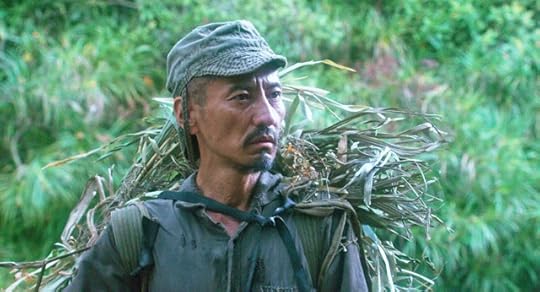
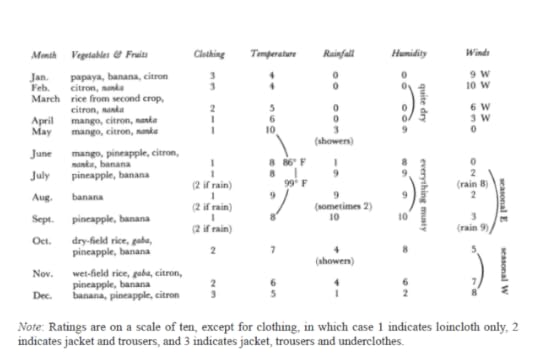
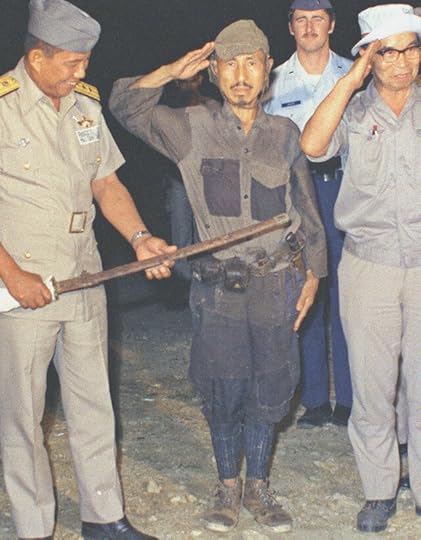
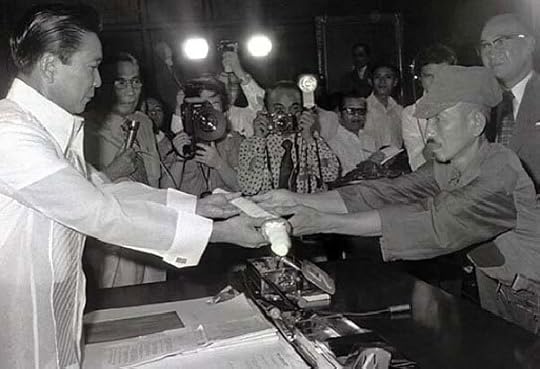
I just finished reading this book about Lt. Hiroo Onoda's 30 year odyssey as a WWII Japanese military officer hold-out on the Island of Lubang in the Philippine Islands. In fact, I was in the U.S. Navy at the time of his final surrender in 1974 and was stationed in Misawa, Japan myself. I directly remember when this happened and I was amazed that there were still holdout soldiers from WWII hiding in the jungles. It made me wonder, at the time, how many other straggler Japanese soldiers there might be from Borneo to Malaysia and all the other islands in the Pacific that might still be holding out like this soldier did...maybe they died from disease, accident or sickness in the ensuing years after Japan's surrender in August, 1945, never knowing that they should come out of hiding to surrender. First of all, I have to say, that I deeply admire this man and his absolute conviction to carry out his orders - no matter what army or ideology such a soldier or military man serves or adheres to, I believe we must respect and honor his loyalty, bravery, absolute commitment to his duty and his country. He went beyond and above the call of duty. As a fellow military man myself, and as an American, I salute Lt. Onoda because he demonstrated the highest caliber of the meaning of "duty" itself as well as being an outstanding officer of his country's military. I do not know if he ever received any official honors for his enduring duty, if he was ever recompensed by Japan for 30 years in the jungles or if the Japanese Government ever took the time to promote him (albeit, after the fact), which I believe they should have done when he returned to Japan in 1974. I lost track of this incident in the following years but never forgot about it. And now, in 2014 I finally get to read his personal story on the matter. Mr. Onoda finally passed away this year in January, 2014 at the age of 91 years old! I came to read his book not only because I had personally experienced this surrender in 1974 while stationed in Japan, but because I have relatives myself who are Japanese (by marriage through my siblings) and it has always seemed that I have had Japanese somewhere in my life associations (my best friend as a child was Japanese-American). I believe that I have, through life experiences, come to at least know something of the Japanese Culture and the mentality, habits, drives and thinking of the Japanese People. In my studies of WWII, I have often wanted to know, "what were the Japanese thinking?" I wanted to hear "the other side of the story" from fighting men - I wanted to know the personal thoughts, drives and motives that made the Japanese a fierce military fighting machine. I realize that in EVERY war, the goal of governments is to dehumanize the enemy - even more so, if the enemy is the one who started the conflict. Yet, we must ALL remember...the Japanese are not just a product of their culture and traditions but they TOO, are human beings. And while their culture might demand of them Bushido thinking, under all the layers of culture, lies a human being who has all the needs that we do - the need for safety, food, shelter, respect, dignity, equity and most of all, love. When we go to war we know we have to kill an enemy in compliance with our orders and our duty to our own country, regardless - and if we think we are killing an enemy and not a human being, it makes it easier to carry out that duty. Lt. Onoda was a human being, ONE OF US, in the human race. But he was also a product of his culture and his times. What clearly comes through all the pages of his book is that he was thoroughly and completely dedicated to his duty right on up to the day he surrendered in 1974. In this regard, we can completely understand the terrible difficulties we faced in WWII against hundreds of thousands of like-minded Japanese soldiers...anyone who reads this book can then better understand what American and other allied troops faced in battles like Guadalcanal, Saipan, Iwo Jima, Guam, Okinawa or in the Philippines. This book not only reveals the determination of the common Japanese soldier, but reflects the mind of the Japanese People, then AND today as well. This book reads like a Robinson Caruso rendition, the day-to-day struggle to survive in the jungles, alone, without any contact from friendly outsiders that one could trust. Yes, several search parties and many other attempts were made to convince the three main hold-outs to come out and surrender - but in reading the book, we can understand why they refused. Lt. Onoda's orders commanded him to hold out, as a secret intelligence gathering soldier...and as Lt. Onoda admits many times in the book, it was easy, to twist evidence to their own narrow and tiny boxed-in thinking, mainly because they refused to hear facts or recognize the truths presented to them multiple times in multiple ways to convince them to surrender. I suggest that anyone who considers themselves to be a war historian or anyone who has any interest in WWII in the Pacific, to read this book carefully and slowly and to follow it in reference to battles, tactics and underlying thinking of "What were the Japanese thinking." I recommend this book highly to anyone who has the slightest intention of ever understanding the Japanese mind, especially, the Japanese military mind. I also recommend this book to anyone who thinks we should not have dropped the atomic bomb on Japan - because, if the millions of Japanese soldiers readying themselves for the invasion of Japan in 1945 were anything at all, like Lt. Hiroo Onoda, there is no doubt we would have lost 1,000,000+ allied soldiers in the offensive action. The fight to take Okinawa, the 100 days it took to take Okinawa and the ferocious defense the Japanese Army took to stand against overwhelming allied forces to take Okinawa, is all too real evidence that we had to drop the bomb...unfortunate as that is. Now, in 2014, it is too late to go back and ask those remaining few who might still be alive, to write similar work as this. We do not often hear what our old foe had to say because every distant drum beat has come from America and our victory - drowning out the voices of the past that there was another side to that war - one I think we never wanted to hear. This book lets us hear a tiny portion. PS - I abhor the war crimes and atrocities committed by the Japanese military all over Asia. I condemn those crimes as I would any crime like them, then or since. Yet, Lt. Onoda (according to his account) was not involved in those crimes and did not make decisions that lead to their commitment. I see Onoda as one lone soldier, carrying out his official duty as any good soldier in any army would have done.