

What do you think?

The Dance of Death
An invaluable new reproduction of Holbein’s woodcuts of The Dance of Death
One of Hans Holbein’s first great triumphs, The Dance of Death is an incomparable sequence of tiny woodcuts showing the folly of human greed and pride. Each image is packed with drama, wit, and horror, as a skeleton mocks and terrifies everyone from the emperor to a ploughman. Taking full advantage of the new literary culture of the early sixteenth century, The Dance of Death took an old medieval theme and made it new.
This edition reproduces a complete set from the British Museum, with many details highlighted and examples of other works in this grisly field included. Ulinka Rublack introduces the woodcuts with a remarkable essay on the late medieval Danse Macabre (the Dance of Death) and the world Holbein lived in.
For more than seventy years, Penguin has been the leading publisher of classic literature in the English-speaking world. With more than 1,700 titles, Penguin Classics represents a global bookshelf of the best works throughout history and across genres and disciplines. Readers trust the series to provide authoritative texts enhanced by introductions and notes by distinguished scholars and contemporary authors, as well as up-to-date translations by award-winning translators.
One of Hans Holbein’s first great triumphs, The Dance of Death is an incomparable sequence of tiny woodcuts showing the folly of human greed and pride. Each image is packed with drama, wit, and horror, as a skeleton mocks and terrifies everyone from the emperor to a ploughman. Taking full advantage of the new literary culture of the early sixteenth century, The Dance of Death took an old medieval theme and made it new.
This edition reproduces a complete set from the British Museum, with many details highlighted and examples of other works in this grisly field included. Ulinka Rublack introduces the woodcuts with a remarkable essay on the late medieval Danse Macabre (the Dance of Death) and the world Holbein lived in.
For more than seventy years, Penguin has been the leading publisher of classic literature in the English-speaking world. With more than 1,700 titles, Penguin Classics represents a global bookshelf of the best works throughout history and across genres and disciplines. Readers trust the series to provide authoritative texts enhanced by introductions and notes by distinguished scholars and contemporary authors, as well as up-to-date translations by award-winning translators.
208 pages, Paperback
First published January 1, 1538
About the author
Hans Holbein
194 books10 followersHans Holbein the Younger (c. 1497–1543) was a German-Swiss painter and printmaker who worked in a Northern Renaissance style, and is considered one of the greatest portraitists of the 16th century. He is called "the Younger" to distinguish him from his father, Hans Holbein the Elder, an accomplished painter of the Late Gothic school.
Ratings & Reviews
Friends & Following
Create a free account to discover what your friends think of this book!
Community Reviews
Displaying 1 - 30 of 52 reviews

Read
August 11, 2018Wow, absolutely incredible, a lucky find.
Spotting the spine on a bookshop shelf I thought 'what is this? Did masterpainter Hans Holbein write books too?'
Well no, he didn't, but this is a book and he is not it's writer. What the book is, is a reproduction of his woodcut series The Dance of Death with the the Alphabet of Death, and in this edition an accompanying essay by Ulinka Rublack.
In the 1520s Holbein was based in the Swiss city of Basel, there he was a struggling artist and in an effort to become a wealthy and successful artist he set upon a scheme to collaborate with a woodcut carving expert to make a series of prints, a cycle on the theme of the dance of death to be sold as separate individual sheets, in order to demonstrate the skills of the artist each print was 65 by 48 mm or 2"3/7th by 1"8/9ths of an inch on a full sized sheet of blank paper. In this edition the publishers kindly increased the reproductions to 127 by 97mm and they still seem absurdly detailed, the fingers twitch for a magnifying glass. Well Hans Holbein proposes, while God disposes, Death was so charmed that he danced off with the carver and a few of the printers involved and the project fell through first in Basel, and then in Lyons where the wood cuts ended up, however eventually still in Lyons - one of the great centres of printing at the time - Holbein's pictures were bound into a set and published with some text - this edition then pirated and printed in various European centres, Holbein naturally never saw a groat, a penny, or another coin in any currency of the profits - but that's the publishing world of Early Modern Europe for you, by the time of the eventual publishing success Holbein was in England painting The Ambassadors, and in time he specialised in painting the good and the great of Tudor England and got to be able to buy himself a big house in Basel.
Of course you may be thinking that you have seen The Seventh Seal and found Death leading a variety of people through a jolly dance far less fun than you might have expected, and indeed not only are these woodcuts also in Black and white, but the general idea is similar, the series starts with the Creation, illustrates the story of Adam and Eve before plunging into portraits of representatives of the social classes from the Pope, via the emperor, a King, Duke, Duchess, Cardinal, Bishop and so on, down to a Ploughman, a child, the Last Judgement and the Arms (as in heraldry) of Death. Amazingly detailed and witty, in the commentary the images are placed in the context of the Reformation, and the artist's desire for guilders and ecus to appeal to as large an audience as possible, but also to ideas of social justice, Death takes the rich and powerful by the hand while they have their gazes fixed on other wealthy people, or their worldly goods while they ignore the poor. Death at the same time labours with Adam and the Ploughman, perhaps not the constant companion you most desire, but at least someone who is with you when you need them. Often Death holds an hourglass - their time is up, or maybe, if they paid by the hour, then they paid too much.
Tremendous. An amazing thing to own, find your own copy
Spotting the spine on a bookshop shelf I thought 'what is this? Did masterpainter Hans Holbein write books too?'
Well no, he didn't, but this is a book and he is not it's writer. What the book is, is a reproduction of his woodcut series The Dance of Death with the the Alphabet of Death, and in this edition an accompanying essay by Ulinka Rublack.
In the 1520s Holbein was based in the Swiss city of Basel, there he was a struggling artist and in an effort to become a wealthy and successful artist he set upon a scheme to collaborate with a woodcut carving expert to make a series of prints, a cycle on the theme of the dance of death to be sold as separate individual sheets, in order to demonstrate the skills of the artist each print was 65 by 48 mm or 2"3/7th by 1"8/9ths of an inch on a full sized sheet of blank paper. In this edition the publishers kindly increased the reproductions to 127 by 97mm and they still seem absurdly detailed, the fingers twitch for a magnifying glass. Well Hans Holbein proposes, while God disposes, Death was so charmed that he danced off with the carver and a few of the printers involved and the project fell through first in Basel, and then in Lyons where the wood cuts ended up, however eventually still in Lyons - one of the great centres of printing at the time - Holbein's pictures were bound into a set and published with some text - this edition then pirated and printed in various European centres, Holbein naturally never saw a groat, a penny, or another coin in any currency of the profits - but that's the publishing world of Early Modern Europe for you, by the time of the eventual publishing success Holbein was in England painting The Ambassadors, and in time he specialised in painting the good and the great of Tudor England and got to be able to buy himself a big house in Basel.
Of course you may be thinking that you have seen The Seventh Seal and found Death leading a variety of people through a jolly dance far less fun than you might have expected, and indeed not only are these woodcuts also in Black and white, but the general idea is similar, the series starts with the Creation, illustrates the story of Adam and Eve before plunging into portraits of representatives of the social classes from the Pope, via the emperor, a King, Duke, Duchess, Cardinal, Bishop and so on, down to a Ploughman, a child, the Last Judgement and the Arms (as in heraldry) of Death. Amazingly detailed and witty, in the commentary the images are placed in the context of the Reformation, and the artist's desire for guilders and ecus to appeal to as large an audience as possible, but also to ideas of social justice, Death takes the rich and powerful by the hand while they have their gazes fixed on other wealthy people, or their worldly goods while they ignore the poor. Death at the same time labours with Adam and the Ploughman, perhaps not the constant companion you most desire, but at least someone who is with you when you need them. Often Death holds an hourglass - their time is up, or maybe, if they paid by the hour, then they paid too much.
Tremendous. An amazing thing to own, find your own copy

September 3, 2018
I read this because of Jan Maat’s very helpful and enthusiastic review. One reason I read it is that I am interested in comics, in sequential art, which Scott McCloud told/reminded me has been around for centuries. Holbein is known more for his paintings today, but in his time he was especially known for The Dance of Death, accomplished between 1523 and 1525, which I am tempted to call a comic book, though it is most certainly a sequential visual narrative, beginning with Adam and proceeding through history, where Death visits a range of people, one per black and white woodcut. The Swiss version of the Reformation was happening all around him so it gets reflected in his drawings. Yes, even the rich and powerful are visited by Death. The Great Equalizer.
Each image itself tells its own story, sometimes with wit, sometimes with horror. Of course as Ingmar Bergman’s The Seventh Seal, focused on The Great Plague--The Black Death, peaking in Europe from 1347 to 1351--reminds us, the sixteenth century wasn’t the only time people thought of the mythological/allegorical/literal character of Death. Holbein picked up on that theme and made it his own, for his time. An amazing work of art, which I got from the library, but now will buy, for sure.
But read Jan Maat’s review for a more thorough and entertaining treatment.
The whole sequence/narrative of The Dance of Death can be viewed here for free:
https://publicdomainreview.org/collec...
But also included in my Penguin edition is Holbein’s “Alphabet of Death” which can be found here:
http://www.dodedans.com/Eholbeinalf.htm
which I had not recalled seeing before, but it is clear where Edward Gorey got his similar idea for his own Alphabet of Death. As Jan Maat reminds me, there's a comic strain that runs from Holbein through 7th Seal, which is very much also in Gorey. Maybe this is the origin of the concept of"Black humor," that it originates in stories of the Black Death:
https://www.brainpickings.org/2011/01...
The Knight meets Death in The Seventh Seal by Ingmar Bergman and plays chess with him:
https://www.youtube.com/watch?v=f4yXB...
The Dove, a 1968 film that parodies Bergman's Seventh Seal, has its own appearance of Death, though not as a chess player, but a badminton player (!), and again, extends this idea of making fun of Death:
https://en.wikipedia.org/wiki/The_Dov...
Each image itself tells its own story, sometimes with wit, sometimes with horror. Of course as Ingmar Bergman’s The Seventh Seal, focused on The Great Plague--The Black Death, peaking in Europe from 1347 to 1351--reminds us, the sixteenth century wasn’t the only time people thought of the mythological/allegorical/literal character of Death. Holbein picked up on that theme and made it his own, for his time. An amazing work of art, which I got from the library, but now will buy, for sure.
But read Jan Maat’s review for a more thorough and entertaining treatment.
The whole sequence/narrative of The Dance of Death can be viewed here for free:
https://publicdomainreview.org/collec...
But also included in my Penguin edition is Holbein’s “Alphabet of Death” which can be found here:
http://www.dodedans.com/Eholbeinalf.htm
which I had not recalled seeing before, but it is clear where Edward Gorey got his similar idea for his own Alphabet of Death. As Jan Maat reminds me, there's a comic strain that runs from Holbein through 7th Seal, which is very much also in Gorey. Maybe this is the origin of the concept of"Black humor," that it originates in stories of the Black Death:
https://www.brainpickings.org/2011/01...
The Knight meets Death in The Seventh Seal by Ingmar Bergman and plays chess with him:
https://www.youtube.com/watch?v=f4yXB...
The Dove, a 1968 film that parodies Bergman's Seventh Seal, has its own appearance of Death, though not as a chess player, but a badminton player (!), and again, extends this idea of making fun of Death:
https://en.wikipedia.org/wiki/The_Dov...

August 7, 2021
Death doesn’t usually become an issue until middle age. Death itself comes to all ages – the centenarian, the newborn, the twenty-five year old. But death as an issue, as a preoccupation, comes when the first signs of decay are noticed. The gray hair. The crow’s feet. Then it looms over everything.
As it is in our lives, it is in our culture. Death loomed over the culture of the Middle Ages. If consciousness began sometime around the second millennium BC, then it was roughly 3,500 years old in the late Medieval Period.
Dante had his midlife crisis at thirty-five. By this reckoning, the macabre in Medieval art was right on time.
“The days of our years are threescore years and ten; and if by reason of strength they be fourscore years, yet is their strength labour and sorrow; for it is soon cut off, and we fly away” (Psalms 90:10).
When consciousness reached middle age sometime around the 15th century, death became an issue. In the Late Middle Ages – as in middle age – consciousness had to reconcile itself to its finitude. It had to live with the awareness that it would end before it even figured itself out.
Thus was the danse macabre born.
Having read Paul Binski’s Medieval Death, I was curious to see Hans Holbein’s complete woodcut series. I knew that the macabre had a streak of dark humor, but I was unprepared for how funny some of Holbein’s skeletons would be.
For example, the googly-eyed skeleton who surprises the merchant from behind. This skeleton definitely has a sense of humor to be able to make such a funny face when he is in fact nothing but bones.
Another funny one – the female skeleton with pendulous breasts who crashes the empress’s entourage of fashionable ladies. Vanity of vanities! All is vanity!
The skeleton who comes for the astrologer holds a skull in his hands. A double memento mori. A skeleton holding a skeleton. He holds out the skull dramatically, but the astrologer does not notice.
In contrast, the miser notices quite vociferously when the skeleton who comes for him gleefully grabs up his money by the fistful. The miser looks more concerned about losing his gold than losing his life.
Sometimes the humor is subtle. The skeleton who comes for the parish priest carries a lantern in one hand and a bell in the other. His hands are full, so his hourglass is tucked casually under his arm.
The naughtiest skeleton is the one who beats on a drum positioned on his groin. The lady and her escort don’t even notice him there dancing and drumming. This is one of only two woodcuts where the skeletons are actually dancing, but it’s one of five where the skeletons are playing musical instruments.
There are horns, drums, xylophones, and a citole. Professor Ulinka Rublack says the musical instruments create a “dissonant world of sound and movement” (126). She appears to base this claim of dissonance on Hartmann Schedel’s Liber Cronicarum. In this well-known woodcut, five skeletons dance. One of them plays the flute. She says the flutist’s fingering suggests a dissonant sound. (Can a single note be dissonant?)
Movement I definitely think can be indicted by a still image. The position of the body in a still image suggests the position that preceded it and the one that will follow it. Schedel’s dancing skeletons seem to be having a good time. So do the skeletons jamming in Holbein’s “Bones of All Men.”
This dark humor is not an invitation to not take life so seriously. This is no carpe diem, live for today, laugh in the face of death imagery. Holbein’s Pictures of Death express a Protestant morality. The general theme of the danse macabre is that Death comes for everyone, high and low, rich and poor, young and old. No one escapes Death.
Nor is the skeleton iconography a mockery of Death, for Death is not ignoble. On the contrary, the joke is on us. We’re the ones who die. But the joke is a cosmic joke, not a mockery of the human condition. Though the skeletons mock the elites, terrify them, expose their cruelty and injustice, Death comes as a relief to the poor and the old. And he comes not as a trickster, but as a thief for the child.
The dark humor of the macabre is a serious business. Its subject matter is nothing less than the horror of existence, the burden of consciousness, the doom of mankind. The macabre makes us face it. And how better to look Death in the face than to look it in the face?
As it is in our lives, it is in our culture. Death loomed over the culture of the Middle Ages. If consciousness began sometime around the second millennium BC, then it was roughly 3,500 years old in the late Medieval Period.
Dante had his midlife crisis at thirty-five. By this reckoning, the macabre in Medieval art was right on time.
“The days of our years are threescore years and ten; and if by reason of strength they be fourscore years, yet is their strength labour and sorrow; for it is soon cut off, and we fly away” (Psalms 90:10).
When consciousness reached middle age sometime around the 15th century, death became an issue. In the Late Middle Ages – as in middle age – consciousness had to reconcile itself to its finitude. It had to live with the awareness that it would end before it even figured itself out.
Thus was the danse macabre born.
Having read Paul Binski’s Medieval Death, I was curious to see Hans Holbein’s complete woodcut series. I knew that the macabre had a streak of dark humor, but I was unprepared for how funny some of Holbein’s skeletons would be.
For example, the googly-eyed skeleton who surprises the merchant from behind. This skeleton definitely has a sense of humor to be able to make such a funny face when he is in fact nothing but bones.
Another funny one – the female skeleton with pendulous breasts who crashes the empress’s entourage of fashionable ladies. Vanity of vanities! All is vanity!
The skeleton who comes for the astrologer holds a skull in his hands. A double memento mori. A skeleton holding a skeleton. He holds out the skull dramatically, but the astrologer does not notice.
In contrast, the miser notices quite vociferously when the skeleton who comes for him gleefully grabs up his money by the fistful. The miser looks more concerned about losing his gold than losing his life.
Sometimes the humor is subtle. The skeleton who comes for the parish priest carries a lantern in one hand and a bell in the other. His hands are full, so his hourglass is tucked casually under his arm.
The naughtiest skeleton is the one who beats on a drum positioned on his groin. The lady and her escort don’t even notice him there dancing and drumming. This is one of only two woodcuts where the skeletons are actually dancing, but it’s one of five where the skeletons are playing musical instruments.
There are horns, drums, xylophones, and a citole. Professor Ulinka Rublack says the musical instruments create a “dissonant world of sound and movement” (126). She appears to base this claim of dissonance on Hartmann Schedel’s Liber Cronicarum. In this well-known woodcut, five skeletons dance. One of them plays the flute. She says the flutist’s fingering suggests a dissonant sound. (Can a single note be dissonant?)
Movement I definitely think can be indicted by a still image. The position of the body in a still image suggests the position that preceded it and the one that will follow it. Schedel’s dancing skeletons seem to be having a good time. So do the skeletons jamming in Holbein’s “Bones of All Men.”
This dark humor is not an invitation to not take life so seriously. This is no carpe diem, live for today, laugh in the face of death imagery. Holbein’s Pictures of Death express a Protestant morality. The general theme of the danse macabre is that Death comes for everyone, high and low, rich and poor, young and old. No one escapes Death.
Nor is the skeleton iconography a mockery of Death, for Death is not ignoble. On the contrary, the joke is on us. We’re the ones who die. But the joke is a cosmic joke, not a mockery of the human condition. Though the skeletons mock the elites, terrify them, expose their cruelty and injustice, Death comes as a relief to the poor and the old. And he comes not as a trickster, but as a thief for the child.
The dark humor of the macabre is a serious business. Its subject matter is nothing less than the horror of existence, the burden of consciousness, the doom of mankind. The macabre makes us face it. And how better to look Death in the face than to look it in the face?

August 29, 2016
|Holbein's wood engravings begin with Death in the background as Adam and Eve fall. From this moment onwards, Death is forever present. Either you are led to your grave as he plays his drums, or you ascend during the Last Judgment.
Sometimes Death is seen as justice, denouncing greed and bribery, but it is important to remember that he is not selective. Death affects all classes, ages, and sexes. He also likes to play musical instruments whilst doing his job.
Some of my favourites:
The fool, as he plays music with Death

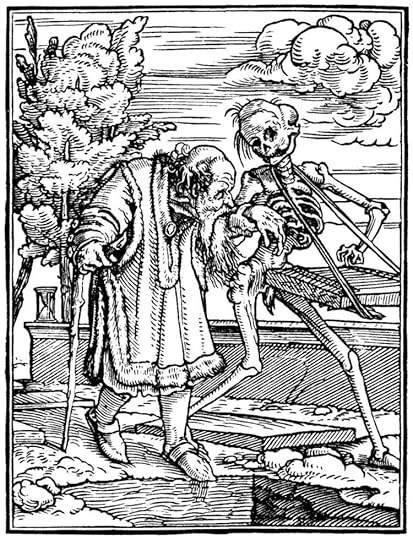
Death, playing on a dulcimer, leads an old man into his grave
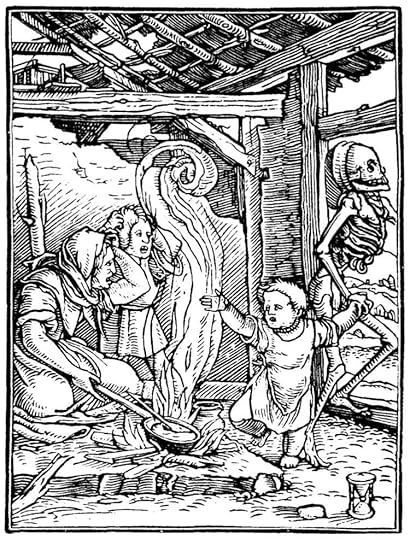
Death steals the youngest child.
Sometimes Death is seen as justice, denouncing greed and bribery, but it is important to remember that he is not selective. Death affects all classes, ages, and sexes. He also likes to play musical instruments whilst doing his job.
Some of my favourites:
The fool, as he plays music with Death
Death, playing on a dulcimer, leads an old man into his grave
Death steals the youngest child.

January 22, 2022
Only counting this read because I spent the last 24 hours writing an essay on this series of pictures. Plus, I translated the latin and french so i did read something 🤩
August 15, 2018
Hans Holbein the Younger is perhaps my favorite portraitist. His painting of the merchant Georg Giese holds a special fascination, though I’ve never seen it in person (it’s in Berlin). On a recent east coast vacation, my family and I were able to see Holbein’s portraits of Sir Brian Tuke and the infant Edward VI in Washington DC, and of Margaret Roper (daughter of Thomas More) and the so-called Man in the Red Cap in New York City. I wish we’d seen the portrait of Margaret’s father at the Frick, but by that time we were so overgorged on museums we preferred sweating like pigs under the angry sun in Central Park.
It was in New York, too, at the Strand Booksore, that I bought a copy of Holbein’s Dance of Death. As a wordless woodcut novel (of sorts), you might compare it to Frans Masereel’s Passionate Journey or Lynd Ward’s God’s Man. But the differences are telling, I think. As moderns, Ward and Masereel (who was far the better of the two) each describe the story of an everyman hero struggling against various oppressive forces and lures of society toward a pinnacle of achievement or self-realization. In Masereel’s story, the tale ends with the protagonist’s enlightened spirit straddling the ball of Earth in the form of a cosmic skeletal flaneur.
The hero, or antihero, of Holbein’s story is Death. He makes his first appearance as an interloper, a jaunty skeleton playing the lute alongside Adam and Eve at their tearful expulsion from Paradise. He goes on to consort with bishops and feast with kings. He fraternizes with judges and merchants and soldiers. He drives the plow, bribes the official, takes the child away from her parents. He keeps house with all, is the bosom companion in every endeavor, the noseless horror lurking behind every joy. Man’s achievement are nothing to him, man's self-realization mere farce. But Death is conspicuously absent from two panels that bookend Holbein's story, The Creation and The Last Judgment.
It was in New York, too, at the Strand Booksore, that I bought a copy of Holbein’s Dance of Death. As a wordless woodcut novel (of sorts), you might compare it to Frans Masereel’s Passionate Journey or Lynd Ward’s God’s Man. But the differences are telling, I think. As moderns, Ward and Masereel (who was far the better of the two) each describe the story of an everyman hero struggling against various oppressive forces and lures of society toward a pinnacle of achievement or self-realization. In Masereel’s story, the tale ends with the protagonist’s enlightened spirit straddling the ball of Earth in the form of a cosmic skeletal flaneur.
The hero, or antihero, of Holbein’s story is Death. He makes his first appearance as an interloper, a jaunty skeleton playing the lute alongside Adam and Eve at their tearful expulsion from Paradise. He goes on to consort with bishops and feast with kings. He fraternizes with judges and merchants and soldiers. He drives the plow, bribes the official, takes the child away from her parents. He keeps house with all, is the bosom companion in every endeavor, the noseless horror lurking behind every joy. Man’s achievement are nothing to him, man's self-realization mere farce. But Death is conspicuously absent from two panels that bookend Holbein's story, The Creation and The Last Judgment.
October 20, 2016
This is a fine book. It's mainly Holbein's drawings given a page of each, but there's also clear text that provides the context and describes the drawings.
I've written a blog about it, arguing that it will be the prefect Christmas present:
https://richardswsmith.wordpress.com/...
I've written a blog about it, arguing that it will be the prefect Christmas present:
https://richardswsmith.wordpress.com/...
March 30, 2021
Goodreads makes it difficult to review books using woodcuts - but if I could, I'd chisel the heck out of this.

July 14, 2012
Yo sé que estas ediciones baratas dan desconfianza, pero debo decir a su favor que es una buena edición. Es bilingüe y es edición facsimilar con los grabados de 1538. Además, la traducción es de José M. Tola, que originalmente salió en 1977 en una edición de Premiá y en su momento esa y una edición de Madrid (Erisa 1980), eran las únicas dos ediciones. Aunque la de Madrid su introducción no venía firmada y reproducía no la versión de 1538 sino la de 1758. Así que ésta es una edición confiable que rescata Ediciones Coyoacán y es muy barata (de 60 a 70 pesos según donde se compre). Ayer que fui a tomar café con mi querido amigo Iván Viñas, decidí comprarla aunque para mi fortuna, Iván me la regaló.
A mi me viene de perlas para mi proyecto, pues resuelve muchas de mis dudas sobre la concepción de la muerte por aquellos años. Y une las tres partes esenciales: el discurso, la intención y una representación. Además reelabora versos de la biblia para unirlos con la figura de la muerte y la salvación. Los grabados van más allá de lo que dicen los versos de Holbein. Es decir, primero un verso de la biblia ("Médico, cúrate a ti mismo" Lucas 4,23) después una re-elaboración del verso en una cuarteta que una el concepto de lo que dice la biblia con lo que es (o será) la muerte: "Tú conoces bien la enfermedad / para asistir al paciente / Y sin embargo no podrás decir / del mal que tú deberás morir." Y después viene una representación gráfica del concepto que va más allá de la cuarteta, así como la cuarteta fue más allá del verso de la biblia. Además es interesante la cantidad de voces, pues mientras el verso de la biblia le habla a alguien, los de Holbein pueden hablarle a alguien o pueden estar en una primera persona. Podría seguir escribiendo cosas sobre este libro, pero creo que cada quien debe leerlo y disfrutarlo a su manera.
A mi me viene de perlas para mi proyecto, pues resuelve muchas de mis dudas sobre la concepción de la muerte por aquellos años. Y une las tres partes esenciales: el discurso, la intención y una representación. Además reelabora versos de la biblia para unirlos con la figura de la muerte y la salvación. Los grabados van más allá de lo que dicen los versos de Holbein. Es decir, primero un verso de la biblia ("Médico, cúrate a ti mismo" Lucas 4,23) después una re-elaboración del verso en una cuarteta que una el concepto de lo que dice la biblia con lo que es (o será) la muerte: "Tú conoces bien la enfermedad / para asistir al paciente / Y sin embargo no podrás decir / del mal que tú deberás morir." Y después viene una representación gráfica del concepto que va más allá de la cuarteta, así como la cuarteta fue más allá del verso de la biblia. Además es interesante la cantidad de voces, pues mientras el verso de la biblia le habla a alguien, los de Holbein pueden hablarle a alguien o pueden estar en una primera persona. Podría seguir escribiendo cosas sobre este libro, pero creo que cada quien debe leerlo y disfrutarlo a su manera.
August 9, 2012
A lovely book of Holbein's woodcut.

January 1, 2024
'Death levels all'. This was a fascinating insight into an enigmatic artist who used the motif of the dance of death to comment on inequality, injustice, and irrationality during a turbulent time in European history.


May 19, 2025
Fun book about hans holbein and his death dance art

August 19, 2026
Fueled my obsession for death prints and provided really interesting context to Holbeins approach - solid!

December 12, 2023
Sixty percent of this is written in French, and since I don’t speak that language, I moved on to the English part of the book which comprises of pictures with a biblical reference followed by a short poem.
The photos begin with Adam and Eve being tossed out of Paradise by God and forced to labor their way through life. After that every photo is about dying. No mater what you do or how high you rise is society, there is one true denominator, no one escapes death.
When viewing the pictures, remember, this work was written in 1538, thus it reflects the artistry of Medieval Europe.
Three stars.
The photos begin with Adam and Eve being tossed out of Paradise by God and forced to labor their way through life. After that every photo is about dying. No mater what you do or how high you rise is society, there is one true denominator, no one escapes death.
When viewing the pictures, remember, this work was written in 1538, thus it reflects the artistry of Medieval Europe.
Three stars.
October 23, 2019
I initially picked this book up because of the cover image (yup, guilty). When I turned to the rear cover, I discovered that the book I was holding contained the complete collection of Hans Holbein's The Dance of Death, which is a series of stamp-sized wood carvings from the sixteenth-century Reformation. Astounded by the level of detail in each of the exploded images contained in the section titled The Alphabet of Death, I purchased the book to learn more.
The commentary section--written by Ulinka Rublack--provides a quantity of biographical information about Hans Holbein as well as historical stories from the same period.
I'd suggest this book to those that are interested in Holbein's work, have a macabre proclivity toward death in art, or are otherwise attracted to historical nonfiction or the Reformation period of European art history.
The commentary section--written by Ulinka Rublack--provides a quantity of biographical information about Hans Holbein as well as historical stories from the same period.
I'd suggest this book to those that are interested in Holbein's work, have a macabre proclivity toward death in art, or are otherwise attracted to historical nonfiction or the Reformation period of European art history.

January 10, 2018
an excellent edition of Holbein's woodcuts focused on death and its effect on all aspects and levels of society in renaissance Europe. Here each woodcut is enlarged to full page size to better see the exquisite details. The original woodcuts were roughly 3 inches by 2 inches!
almost worth the price of admission itself is Ursula Reblack's 100 pages biographical essay which cover's Holbein's life and the creation of the woodcuts and how the social political and religious turbulence of reformation Europe affected their creation.
almost worth the price of admission itself is Ursula Reblack's 100 pages biographical essay which cover's Holbein's life and the creation of the woodcuts and how the social political and religious turbulence of reformation Europe affected their creation.

December 3, 2015
Hans Holbein the Younger (Artist & Printmaker, German, circa 1498-1543)
41 very small woodcuts by Holbein. When will I learn? I expected to see full size artwork - as on the cover - throughout the book. Instead, 2x3" illos more like big postage stamps. And, of course, the text is in medieval French so you know I bought this solely for the artwork. The rating reflects my disappointment in the illo size: miniscule. Holbein's a master but break out your magnifying glass for this one. Bummer.
41 very small woodcuts by Holbein. When will I learn? I expected to see full size artwork - as on the cover - throughout the book. Instead, 2x3" illos more like big postage stamps. And, of course, the text is in medieval French so you know I bought this solely for the artwork. The rating reflects my disappointment in the illo size: miniscule. Holbein's a master but break out your magnifying glass for this one. Bummer.

December 24, 2017
Wonderful edition of Holbein's woodcuts. The pictures themselves show death approaching both high and low, and are highly critical of the lives of those who live in pomp but ignore the poor. An excellent short biography of the artist and contextualization of the work in terms of Reformation politics is included.
February 17, 2018
Bought the Dover Fine Arts edition, may look into the Penguin one because the woodcuts are reproduced in this book at about 1 inch wide by 2 inches tall and the bulk of the French text is not translated, only the Bible passages and rhymes accompanying the woodcuts are and you can't just plug French from the 1500's into Google Translate.

June 18, 2017
A really great way to learn about a particular artist. The first 100 pages or so are dedicated to the woodcuts from Holbein, followed by a contemporary commentary on the woodcuts, plus a short biography of Holbein, which sets the scene for the period under which they were crafted.

June 16, 2016
Fascinating leather bound limited edition with beautiful woodcut illustrations of one of Holbeins key works.

September 1, 2016
Bravo Holbine

March 4, 2017
Commentary is good but it is hard to pair up images with commentary, especially as there are no page numbers on the images.

June 21, 2018
Maravillosísimo <3

August 2, 2018
the commentary is interesting although not groundbreaking and the reproductions are nice, the pictures themselves are kinda charming in a "rowdy party skeletons harass men who wear silly hats" way
September 4, 2020
Holbein desarrolla con destreza y mordacidad los vicios de la Iglesia católica a inicios del siglo XVII a través de sus grabados en madera. En un contexto de reformas políticas y religiosas impulsadas por Martín Lutero, Les simulachres and historiees faces de la mort -como fue publicado por primera vez en Lyon, en 1538 -nos presenta a la muerte acompañando a todas las clases sociales. Los símbolos, posiciones y gestos de los personajes retratados con ella, reflejan la crítica hacia las defectos y soberbia de las clases más favorecidas: la realeza y los religiosos. El ensayo elaborado por la historiadora Ulinka Rublack permiten situar los grabados de Holbein en el contexto político, social y religioso adecuado.
Holbein skillfully and scathingly develops the vices of the Catholic Church in the early seventeenth century through his woodcuts. In a context of political and religious reforms promoted by Martin Luther, Les simulachres and historiees faces de la mort -as it was published for the first time in Lyon, in 1538- introduces us to death accompanying all social classes. The symbols, positions and gestures of the characters portrayed with her reflect the criticism towards the defects and arrogance of the most favored classes: royalty and religious. The essay prepared by the historian Ulinka Rublack allows Holbein's engravings to be placed in the proper political, social and religious context.
Holbein skillfully and scathingly develops the vices of the Catholic Church in the early seventeenth century through his woodcuts. In a context of political and religious reforms promoted by Martin Luther, Les simulachres and historiees faces de la mort -as it was published for the first time in Lyon, in 1538- introduces us to death accompanying all social classes. The symbols, positions and gestures of the characters portrayed with her reflect the criticism towards the defects and arrogance of the most favored classes: royalty and religious. The essay prepared by the historian Ulinka Rublack allows Holbein's engravings to be placed in the proper political, social and religious context.

January 31, 2021
Very interesting subject on Hans Holbein’s The Dance of Death woodcuts. These tiny pieces of art were barely bigger than 6cm x 4cm.
The book gave detailed descriptions of the dance, no-one is immune to death except, I hope, when my time comes to leave this earth there are no grotesque skeletons having a jolly good old time.
One paragraph describes the concoctions used to mix colours: egg yolks - town hens v country hens (who knew!), urine, dung and lead. So popular!
Art, through the ages, has evolved so much you sometimes forget art isn’t just a cow, in a tank, with formaldehyde. The statements behind the works were (still don’t understand the cow) relevant to the time and gives us valuable insight into history. Just a shame we won’t be able to see what people make of the cow in a few hundred years.
The book gave detailed descriptions of the dance, no-one is immune to death except, I hope, when my time comes to leave this earth there are no grotesque skeletons having a jolly good old time.
One paragraph describes the concoctions used to mix colours: egg yolks - town hens v country hens (who knew!), urine, dung and lead. So popular!
Art, through the ages, has evolved so much you sometimes forget art isn’t just a cow, in a tank, with formaldehyde. The statements behind the works were (still don’t understand the cow) relevant to the time and gives us valuable insight into history. Just a shame we won’t be able to see what people make of the cow in a few hundred years.

June 20, 2020
(Review is the 1789 edition in ECCO) What a strange volume — almost half of it is an interminable discourse on minute details of the origin and history of the frescoes, which in the end I skipped a lot of. And then the images and poems are so simplistic it’s hard to imagine them being read by the same people invested in the preface. I probably would have found it more compelling if the image reproduction of ECCO had been higher quality; the poems themselves appeared to just be very bland rhyming versions of the biblical verses. It makes me wonder who would have been reading this book in the 18thC, and what they thought of it.



November 10, 2022
Un compendio de las imágenes sobre la danza de la muerte de Hans Holbein junto con una cita bíblica tanto en latín como en español y una pequeña rima en francés también relacionada. Acompañadas de una introducción a la temática y textos de la época. Las ilustraciones tienen detalles muy interesantes y el autor hace crítica a la corrupción de las altas esferas, pero mostrando claramente que la muerte es igual para todos, desde el más inocente al más corrupto, recordándote que tienes fecha de caducidad.
Memento Mori💀
Memento Mori💀
Displaying 1 - 30 of 52 reviews