Tom Thomson did it better than anyone else. He stands as the most important artist in Canadian history. A forerunner of The Group of Seven, Thomson created paintings that shaped the way Canadians view their land. The mystery of his death continues to stir speculation and spin off theories, but the emotional response to his paintings is stronger than ever. Although he died before he was forty, Thomson's compelling works ignited a powerful national art movement and create lasting icons for a young country. Tom The Silence and the Storm contains the most extensive collection of his work ever published, 177 paintings in vivid color and many more in black and white. Nearly 80 of his brilliant sketches are reproduced to their actual size, giving them an immediacy almost equal to the originals. This is the only book that reproduces over 140 paintings that had never been reproduced in color before. The accompanying texts, by artist Harold Town (1924-1990) and art historian David P. Silcox, provide an aesthetic commentary and full biographical chronicle. This special 25th Anniversary edition of Tom The Silence and the Storm marks the 125th Anniversary of the birth of Canada's most popular and beloved artist and the 85th anniversary of his death.
Harold Barling Town, (June 13, 1924 – December 27, 1990) was a Canadian artist who worked in many different media and modes, but is best known for his abstract paintings.
He was a member of Painters Eleven, a group of abstract artists in Toronto between 1954-1960.
In the 1960s, Town developed colourful monotype prints which he called Single Autographic Prints, a phrase he never explained. These won him awards in Ljubljana, Yugoslavia and Santiago, Chile, and the prints were acquired by the Museum of Modern Art in New York.
My ardent affection for Tom Thomson continues to grow as I continue to explore his life and artistry. I was able to get this ebook from the library and it far surpassed all my expectations in both formatting, education and enjoyment. To have eighty percent of his art in one collection is a true treasure.
The introduction is both audacious and purple and so unlike Mr. Thomson's art that it served as a very cheeky counterpoint. The main chapters were informative and interpretive and I disagree with much but that only added to my own appreciation and burgeoning admiration. As my partner and I continue to move away from human interaction and spend more and more time solitarily focusing on our own art, domestic crafts, nature and spiritual practices this book was a both a boon and a balm.
I was moved immensely sometimes to blissful tears as I meditated on some of the paintings and sketches and truly was soul food for me.
My darling partner has ordered me a hard copy and this will truly be one of my most favorite art books and will be added to our small collection.
Mr. Thompson's early death is now just not sad for me but tragic as who knows where his art would have led...
I am including three of my most favorite paintings....
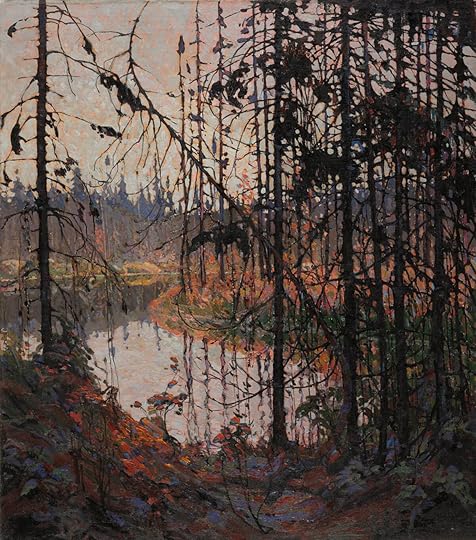
Northern River 1914-1915
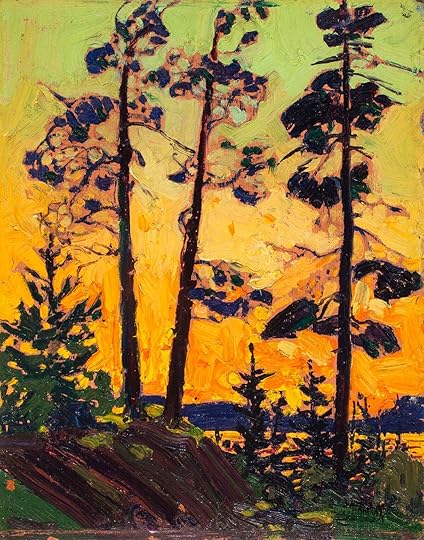
Pine Tree at Sunset 1915
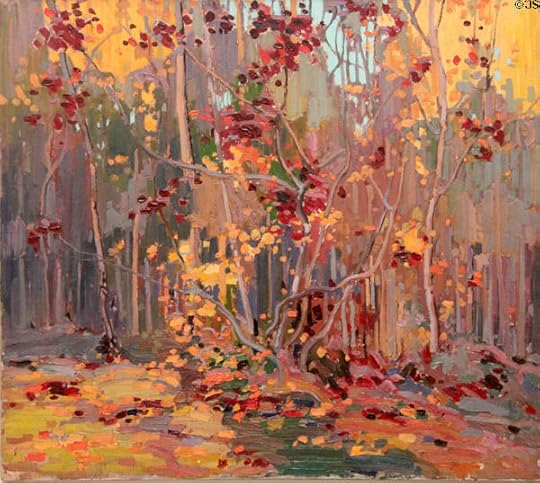
Maple Saplings 1916
Rest in peace Mr. Thompson and thank you for your vision of our Ontario Near North which is now my home...
Absolutely gorgeous colour representations of Tom Thomson's paintings and sketches, along with interesting biographical information and artistic assessment.
Few coffee table books like this are as well organized chronologically and theme wise as this book. It is well researched informative and inspirational. A Thorough pleasure to read and observe some of the best paintings ever done by a Canadian!!!
This is the second read for me. I received it as a gift in 1978. Recently I listened to a YouTube video 0n Tom Thompson and this book was mentioned. It is mainly pictures of Tom's work. The authors talk about his work and the men who worked with painted with and supported him. He died, likely falling from his canoe and striking his head. Many stories have grown around his death making him a bit of a mystery. It would have been interesting had he lived to see the direction he may have taken his painting. This is a beautiful book and has been republished.
Until I arrived in Vancouver a few weeks ago I had never heard of Tom Thompson. Which in some ways is a pity because it means I’ve been many years not knowing some stunning Canadian landscape portrayals and a handful of spectacular flower paintings. On the other hand there’s not much better than coming across an artist out of the blue and realizing that as isolated as Tom Thompson was from the developing trends in European art at the turn of the 20th century, he was nevertheless formulating his own particular style that had he lived longer may well have tipped over into full blown expressionism.
But he didn’t live longer. On July 8th 1917, Thompson’s body was found floating in Canoe Lake in Algonquin Park, Ontario. Did he fall or was he pushed? Well, the authors talk about that too but their book was published in 1977, sixty years after the event when theories still multiplied and science wasn’t helping out much. Now, more than a hundred years on, with much improved forensic skills to hand, it seems no one knows for sure where to find the body. Maybe everyone prefers the mystery.
Given the large format, you might be forgiven for mistaking this for a coffee-table book but it’s not. In fact it’s about as close as we can get to seeing Thompson’s oil sketches in their original size, without turning up at an exhibition. I enjoyed it immensely.
The thirtieth anniversary revised edition of "Tom Thomson: The Silence and the Storm" offers an abundance of attractive reproductions of Thomson’s art. The text, however, suffers from at least two disappointing and surprising factual errors about the facts of Tom Thomson's death.
On pg. 49, the text states: “[Thomson’s] feet weren’t tangled in wire, as has been repeatedly suggested, because [Mark] Robinson noted at the time the body was recovered that Thomson had carefully bound copper fishing line around a sprained ankle to give it support."
What are the errors?: - In 1917, Mark Robinson did not record finding fishing line on Thomson’s corpse. - Mark Robinson never, ever mentioned anything about Thomson having an ankle sprain.
For a fuller explanation, with web links to evidence, read my comments at: goo.gl/HLXX5p
Grew up with this book in my home. As new immigrants to Canada in the seventies, it was a revelation. Many years later I recall canoeing in the spot where Tom Thomson mysteriously died. It was like coming home. This book, as Thomson's work is part of my heritage. I love it.