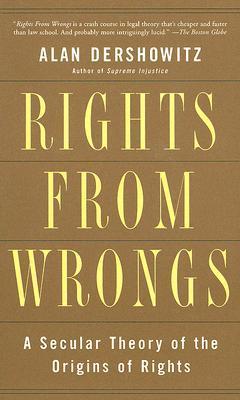
This is a wholly new and compelling answer to one of the most persistent dilemmas in both law and moral If rights are "natural"-if, in the words of the Declaration of Independence, it is "self-evident that all men are endowed . . . with certain inalienable rights"-where do these rights come from? Does natural law really exist outside the formal structure of humanly enacted law? On the other hand, if rights are nothing more than the product of human law, what argument is there for allowing the "rights" of a few people to outweigh the preferences of the majority? In this book, renowned legal scholar Alan Dershowitz offers a fresh resolution to this age-old Rights, he argues, do not come from God, nature, logic, or law alone. They arise out of particular experiences with injustice. While justice is an elusive concept, hard to define and subject to conflicting interpretations, injustice is immediate, intuitive, widely agreed upon and very tangible. This is a timely book that will have an immediate impact on our political dialogue, from the intersection of religion and law to recent quandaries surrounding the right to privacy, voting rights, and the right to marry. More than that, it is a passionate case for the recognition of human rights in a rigorously secular framework. Rights from Wrongs will be the first book to propose a theory of rights that emerges not from some theory of perfect justice but from its from the bottom up, from trial and error, and from our collective experience of injustice.
Alan Morton Dershowitz is an American lawyer, jurist, and political commentator. He is the Felix Frankfurter Professor of Law at Harvard Law School. He is known for his career as an attorney in several high-profile law cases and commentary on the Arab-Israeli conflict.
He has spent most of his career at Harvard, where, at the age of 28, he became the youngest full professor in its history, until Noam Elkies took the record. Dershowitz still holds the record as the youngest person to become a professor of law there.
As a criminal appellate lawyer, Dershowitz has won thirteen out of the fifteen murder and attempted murder cases he has handled. He successfully argued to overturn the conviction of Claus von Bülow for the attempted murder of Bülow's wife, Sunny. Dershowitz was the appellate advisor for the defense in the criminal trial of O.J. Simpson for the murder of his ex-wife Nicole Simpson and her friend Ronald Goldman.
Rights from Wrongs is a good introduction to human rights as interpreted by the American common law system and examined through a philosophically inquisitive lens. While I certainly don't agree with everything Dershowitz says (I particularly disagree with him on the issue of organ donation), this short book gets a lot done without getting lost in legal jargon. Very, very, briefly summarized: Dershowitz's overarching theory is that rights are fundamentally culturally enforced and kept "alive." They don't come from nature or god, or even prescriptivist law. They come from the constant struggle to uphold ever-changing interpretations of rights. Those struggles are processed through an active and "alive" legal system, and rights are born.
Rights from Wrongs Secular Origin of the Theories of Rights Allan Dershowitz
Does God or nature provide us with a source from which we can “discover” our rights? Should human beings have rights even if nature provides none and even if God do not exist? If our rights cannot be discovered, by what means we should create them? These are among the questions presented in the Rights from Wrongs authored by Allan Dershowitz a professor of Harvard Law School and a foremost Legal Scholar of America. Without squandering his readers valuable time, Dershowitz concludes that rights do not originate from any God “Because, God do not speak to human beings in a single voice”, nor do our rights derive from nature “Because nature is valued neutral” (page8). Rights from wrongs posists history and experience as the forces that generate and contour rights. “Rights must be invented by human beings”, says Dershowitz, “based on experience, especially our long collective experience with wrongs created by human beings, and they must be advocated in the market of competing ideas.”(page85, 86). As part of his examination, Dershowitz passionately ask the incumbent question: Where do rights come from? And Why do we need rights? To Dershowitz the answer to these questions is the same, its experience. According to him “the first classic answer is that rights come from a source external to law itself, such as nature, God, human instincts, or some other objective reality. The theory (or precisely set of theories) is generally called natural law… the second classic answer is that rights are interna to law – that they are granted by the law itself. This is generally called positive law“ (page5). Dershowitz rejects both the natural and positive law premises for rights, as well as any tricky recombining of the two. His “goal”, “is to begin the work of constructing an approach that tests neither on the shadowy metaphysics of natural law nor the empty tautology of legal positivitism.”(page91). Dershowitz is particularly critical of natural law. “Experience” Dershowitz writes, “demonstrates that natural law, like other legal fictions, can be, and has been, used to justify many evils.” In the theory it can also be used to counteract evils, but the experience of the 20th century raise serious concerns about the actual utility of natural law, especially during time of crisis”(page72). That people have used natural law – most egregiously for justification for slavery - in tendentious ways is undeniable. This temptation continues in the present. Nonetheless over the centuries religious and secular thinkers have made recourse to natural law in subtle and thoughtful ways to illuminate questions of liberty, equality, and most importantly, freedom. Dershowitz posists that today the granting or contouring of rights must take into account with important new considerations. As he says, “Unless it can be shown convincingly that a claimed right is necessary to prevent serious wrongs, majority rule should prevail. The proliferation of claimed rights is necessary to prevent serious wrongs, majority rule should prevail. The proliferation of claimed rights not only trivializes those fundamental rights that have proves their value from experience, it endangers democratic governance itself. Rights are not right unless they prevent wrongs” (page168) Rights do also produce wrongs; Dershowitz writes “If rights are human inventions based on our experience with wrongs, then it is certainly possible that people may misunderstand the lesson of experience or to fail to recognize wrongs. It is also possible to misuse rights – to hijack them for narrow, temporary, partisan gain.” Therefore it is correct that Rights do not guarantee right outcome and produces risks, but again “experience”, “teaches that a world without rights is a world with even greater risks.” …………………………… In our country today, we are experiencing the situation of debates regarding the RH Bill. It is an accurate point of view in relation to this book review. The transitory of the bill is contradicted by the church in which they based their principle in the biblical law from God. On the other side, they based their principle on facts and the current situation of poor people who will benefit if the bill is passed. It is the matter of rights of the women to have a safe maternity, rights of the poor to have access in free contraceptives and to be informed about family planning, rights of the children to have an ensured future as per responsibility of the parents, and rights of every people to have a welfare society through reducing the “taong kalye, pamilyang kariton, malilimos, madurukot” with the help of the bill. For the church, they contest that it is wrong to prevent the formation of life through artificial methods as basing their principle from the bible. The question is, do these rights through the bill will prevent wrongs? As a matter of fact it is very evident in our country that majority of the population growth came from the poor. It is better if the growth of the population will come from the labor force in which most are financially stable to support a growing family. Based on the data of United Nations, Philippines population growth is below normal but with high mortality rate of children from birth to 5 years old as well as the high mortality rate of women due to miscarriage. The main cause of these mortality rates is poverty. The purpose of the bill is primarily to ensure that a family could afford the expense of its basic needs and importantly education, which will ensure the future of the children, as well as the safety of pregnant women. In the part of the government its goal is to lessen the future dependence burden from the poor and to maximize the potential manpower of the population for substantial economic growth and a lower income distribution gap. It’s in the hands of the law makers to decide, and it should be based on their conscience and the current factual situation of the majority of the people and based on our experience with wrongs. This bill may cause future problems but may save many lives of children and women.
This is an interesting read concerning the "philosophy" of rights, with some practical assertions. Politically, Dershowitz and i are generally pretty far apart, but his argument about the "experiential" nature of rights is very logical. The Professor does a great job making his argument. I would disagree with his basic premise that there is absolutely no basis for "natural rights" (I agree) of "God-given rights" ( I disagree), but he clearly sets out the experiential criterion for the evolution of rights. I would argue that some very very basic rights exist based in large part on moral presuppositions. These cannot be reached by "reason", but only through a transcendent manifestation outside of ourselves. My good friend Carlton Johnson who I highly recommend read this book, would disagree with my premise. We can discuss that elsewhere. This is an excellent work that is by no means "lawyerly", anyone interested in moral philosophy will enjoy.
You’ve got to be a little bit of a law geek to read legal philosophy for fun. Guilty as charged. Unlike Hart, Dworkin or even Nozick, however, Dershowitz is coherent and readable by the non-geek. He writes in plain language, uses stories, hypos and examples extensively, and really gets you thinking. It doesn’t hurt that his civil libertarian philosophy is consistently applied in the book and in his other writings, speeches and presentations. A giant in the field, the book is worth keeping on the shelf.
I always love Mr. Dershowitz's analysis. I study natural law and human behavior. I recommend this book to anyone interested in studying all sides of the issue.
Rights From Wrongs: A Secular Theory of the Origins of Rights by Alan M. Dershowitz
"Rights From Wrongs" is a very interesting book on the source of our rights from a welcomed secular point of view. Preeminent legal scholar and renowned criminal lawyer, Alan M. Dershowitz provides the readers with a lucid, engaging account on the secular origin of rights. Despite being broken out into three parts this book is really about two: the first half focuses on the origins of rights while the second half is the application of said theory of rights to specific controversies. This enlightening 274-page book is composed of twenty chapters and is broken out in the following three parts: I. The Sources of Rights, II. Some Challenges to Experience as the Source of Rights, and III. Applying the Experiential Theory of Rights to Specific Controversies.
Positives: 1. A well-written, well-researched book that is accessible to the masses. 2. A fascinating topic in the hands of a preeminent legal mind. 3. A welcomed and more compelling secular point of view. Engaging, coherent, well reasoned book. 4. This book addresses to satisfaction the question, "Where do rights come from?" 5. A direct challenge to the approach to rights taken by both classical natural law and legal positivism. Throughout the book, Dershowitz states a who's who behind the classical approaches and provides a fair treatment of their perspectives. He also proposes a third approach, one based on human experiences. 6. Thought-provoking book. The author weaves a fine web of legal brain teasers. 7. The implications of rights being a product solely of human invention. A recurring theme, human experiences as the source of rights. 8. Provides a thorough debunking of the notion of "God-given" and natural rights. "There are no divine laws of morality, merely human laws claiming the authority of God". 9. Great quotes throughout, "The complex relationship between the "is" of nature and the "ought" of morality must be mediated by human experience. The history of rights illustrates this complexity". 10. The function of rights. Great stuff. 11. Pressing the hot button topics with glee, Dershowitz style: gun ownership, abortion, gay marriage, censorship, the separation of church and state, the right to emigrate, animal rights, . 12. Learning from past injustices. Many great examples provided: slavery and the Holocaust to name a couple. 13. The notion that there may be multiple rights in a given situations...interesting. 14. Rights as they relate to restriction on governmental power. Basic rights. 15. A welcomed perspective on morality. The interplay between morality and experience. Very good examples including slavery. 16. The purpose of the Bill of Rights. The original intent of the framers. 17. A very good chapter on organ donation. What needs to be done. 18. Lessons for the future.
Negatives: 1. Not an in-depth book. Many topics get the quick over. As an example, the issue of separation of church and state. 2. Drives the main thesis home repeatedly. Rights come from wrongs. 3. Sometimes the author purposely leaves the reader hanging. 4. A couple of minor formatting issues. 5. No formal bibliography.
In summary, I really enjoyed this book and in fact wanted more. Dershowitz does a wonderful job of making this complex topic accessible to the masses and does so with the panache that characterizes him. This is not an in-depth tome and at times can be repetitive. That being said, this is a welcomed secular narrative. In a nutshell, the main premise of this book is that the best way to build an effective foundation of rights is on agreed-upon wrongs of the past that we should avoid. In other words, from human experiences. If you are looking for a worthwhile concise book on the origin of rights, you won't find many books better. I highly recommend it!
Further suggestions: "Congress Shall Make No Law Respecting an Establishment of Religion" by Robert Boston, "The Conservative Assault on the Constitution" by Erwin Chemerinsky, "The Oath: The Obama White House and the Supreme Court" by Jeffrey Toobin, "Nonbeliever Nation: The Rise of Secular Americans" by David Niose, "What Money Can't Buy: The Moral Limits of Markets" by Michael J. Sandel, "Making Our Democracy Work: A Judge's View" by Stephen Breyer, "Matter of Interpretation : Federal Courts and the Law" by Antonin Scalia, "The Majesty of the Law: Reflections of a Supreme Court Justice" by Sandra Day O'Connor, and "America's Unwritten Constitution: The Precedents and Principles We Live By" by Akhil Reed Amar.
The premise of the book, that rights exist in order to avoid or slow down the repetition of past wrongs committed by the human race, is a simple one... and one that I've found many of my associates seem able to accept ad hoc without much argument.
Alan M. Dershowitz will provide the arguments anyway, but most importantly he provides continually through the book a clarification on this view of the origins of rights. This clarification is that it is not a comprehensive doctrine that will yield a set of rights that we would find morally binding and logically valid. In his view, the establishment, and curtailment, of rights is a continual process. We ought to change our view of rights based on the experiences we continue to have. This includes experiences of wrongs we wish to avoid and experience as to whether the rights we establish help curtail those wrongs. As a result, once he starts talking about how this theory applies to real world issues, there are almost no resolutions presented to these issues (which include the questions of abortion, animal rights, and organ harvesting). Instead, he looks at the sides of the issue and how experience would inform each side.
As a result, this book provides more of a useful framework in which to debate what our rights ought to be instead of providing a comprehensive list of what those rights are. And, based on the observation that our world, society, culture and values change, such a comprehensive list is impossible. Such a framework is then useful when determining on the public stage what our rights ought to be.
In general, I'm wary of any legal strategy advanced by Dershowitz, because I so frequently disagree with his conclusions. But this book gave me a lot to chew on. Contemporary American- and European- law really suffers when we attribute our rights to 'natural law' or to God, and secular theories of rights morality are sorely needed. Dershowitz advances the idea that our 'fundamental rights' come from concrete experiences of wrong. In other words, we learn from our mistakes, or we should. His theory isn't perfect, but it's certainly a worthwhile line of thought. I recommend it if you're interested in this kind of thing, and it's relatively approachable for those people without law backgrounds.
This was a very approachable book with satisfying answers to several questions that had been bouncing around in my gray matter for a while regarding human rights. If rights are "inalienable," why have they been alienated with such regularity? If they're "self-evident," then why are periods of freedom and personal rights the exception and tyranny the norm? If "God did it" isn't a satisfying explanation for where our rights come from, what's the secular alternative? I walked away satisfied that a theory of rights can (and must) be built upon human experience, not natural law or an appeal to the divine.
A secular theory of rights-- like the right of free speech. Dershowitz argues that rights come from our experience with egregious wrongs, rather than from God or nature (as is often claimed by politicians). His dismissal of these latter possibilities is swift and compelling. The scientific method is offered as a viable alternative. This book is cerebral, but practical, as it allow me to better affect insight into political issues. I highly recommend this one.
I wrote a very length paper on this book for my Legal Basis of Public Administration course at American University while I was in my Master of Public Administration program there. While I enjoyed grappling with Dershowitz's ideas, I was ultimately less than impressed with his level of philosophical rigor. Nonetheless this book is well written and I enjoyed reading it.
Wow, took me almost a year and a half, but here I am. This book takes a "common sense" idea and weaves it into a well referenced, extremely focused discusion about rights in secular society both historically and presently. Do not look at the time it took *me* to finish it. I have a bad habit of reading non-fiction in fits and starts.
I found this book by accident in a second hand bookstore and I was in awe-at the several opening pages. It gets a quite confusing and require more philosophical approach as it get to further pages. An enjoyable read, nonetheless.