Saving Delaney is the heartwarming true story of a special needs baby and the unconventional family who fought for her right to life. Andrea Ott-Dahl, who with her wife Keston Ott-Dahl has two other children, agreed to act as a pregnancy surrogate for a wealthy Silicon Valley couple. When pre-natal testing revealed the baby would be born with Down Syndrome, Andrea was urged to abort the child. Instead, the Ott-Dahls chose to adopt and raise the daughter they would call Delaney, navigating legal, medical and emotional challenges. Despite heart surgery and an array of other challenges, Delaney at age 3 is alive, thriving, and an inspiration to every loving parent on the planet.
Disclosure: I was sent an advanced reading copy of this book by the publisher.
Girl meets girl. Girl, 44, is a self-described Queen Bee who drinks too much, likes to party, and considers herself a friend to the friendless (mostly socially awkward lesbians with too many piercings). Girl #1 was married and divorced and a single mom by the time she was 20, then had another child seven years later. She took care of her ailing mother for two decades, helping her overcome incapacitating health problems and defy death. At the end of her mother's life, she was there with her, holding her hand, helping her die peacefully. Now she just wants to have fun. Girl #2 has other plans. Girl #2, 28, falls in love with Queen Bee after they meet at a party. Girl #2 has too small children, a drunken, abusive ex-con ex-husband, and divorced parents (and lots of other family) who blame her for her dysfunctional relationships, and who constantly act disappointed in and disapproving of her. The two women, despite all the mismatch, fall in love. Hard.
And that's not even what this story is about.
Andréa and Keston have been together for a year and a half when they meet Erica and Liz, a wealthy Silicon Valley couple in their forties who have been struggling with infertility for years. Andréa offers to surrogate for Erica. She feels sorry for them, wants to help them, has two healthy children of her own, and--we later learn--she also wants to make amends for an abortion she had when she got unexpectedly pregnant when was trying to extricate herself from her abusive ex-husband.
Carrying a baby using her egg for Erica and Liz seems like the perfect thing to do. Andréa's not working and Erica says they would pay her to surrogate. Keston, whose children are all grown up and who feels like they have enough going on raising Andréa's kids, is not as sure. But Andréa is nothing if not persuasive and Keston is very loving and open to the idea. Once she sees how convicted Andréa is about having a baby for this other lesbian couple, she is won over and embraces the idea.
But getting pregnant turns out to be an ordeal. They are using donor sperm and a homemade contraption to inseminate her and Andréa has been using a hormone-releasing IUD that interferes with her fertility. Plus there's obvious tension between Erica and Liz and tension over money between the two couples. When Andréa doesn't get pregnant after many tries and even more dashed hopes, bad feelings quickly arise.
Things go from bad to worse once Andréa is actually pregnant. The baby tests positive for Trisomy 21 (Down syndrome) and Erica and Liz, her designated moms, ultimately decide they do not want to raise a child with genetic deformities and a possible heart condition. They want Andréa to get an abortion. So do Andréa's parents, the baby's grandparents, who are angry and bewildered first at the idea of their daughter being a surrogate and then at the idea of her having a baby with Down syndrome.
Keston, who narrates this book (though it is co-authored by both of them) has demons of her own to battle. She grew up the youngest of five children with a single mom who was very bigoted. She has always felt uneasy around disabled people. Worse than uneasy, she has been terrified and physically revolted by them. After visiting her oldest sister who was left severely disabled and mentally damaged from a stroke, she was so horrified and disgusted that she threw up. How could she--of all people--raise a child her mom would have referred to as an "idiot" or an "imbecile" or one of those people? Keston, if you remember, was dubious about the love of her life being a surrogate in the first place.
As you can see from this description, Saving Delaney tells an unusual and compelling story, bringing up many interesting and difficult issues. Keston is brutally and refreshingly honest about her own shortcomings. Once she overcomes her own prejudices and realizes how unfairly bigoted she has been, she calls herself the monster in the mirror. She apologizes to Erica and Liz for having told them she could never raise a child with Down syndrome. And she forgives herself for her lifelong terror of people with disabilities. She is also honest--and more than fair--about Erica and Liz and about Rod and Shawn, the gay couple that donates sperm to make the baby. Keston and Andréa manage to feel compassion for Erica, Liz, Rod, and Shawn's myriad (and infuriating) emotional struggles and give them second, third, and even fourth chances even as the two other couples act accusatory towards Andréa, ungrateful, and unkind.
The book is written in a blunt, no nonsense style. It's also often very funny. And very sad. Though some of the writing is distractingly clunky and the beginning of the book tries to do too much, the story is compelling enough that these shortcomings are easily forgiven. It ends right when Delaney is born, leaving the reader wanting more. I hope they write a sequel, "Raising Delaney," that details the open-heart surgery Delaney had as an infant and the experience of integrating her into their family and caring for her during the first year of her life.
Another criticism: I found myself wanting more details about the logistics of being a surrogate while raising a young family and fewer details about the furniture in any given room or what people were wearing. Every time Keston and Andréa went out to dinner with Liz and Erica to talk things over, I wondered who stayed with their kids (a disapproving grandparents? A babysitter? A friend?), who put them to bed, and if the children minded that their parents were gone. Andréa's two healthy children play such a bit part in the story, perhaps because it's written from Keston's point of view, and this reader would have liked to see more of them.
I also would have liked to know more about how Andréa felt about her pregnancy, besides the stress of dealing with Erica and Liz and coping with debilitating morning sickness, especially after they realize they are keeping their baby.
It was deeply disturbing to read about how mistreated Andréa and Keston were by their incompetent male obstetricians and how Andréa was actually abused during labor, though she and Keston don't seem to realize it. Andréa needed to push. But because the doctor wasn't there yet the nurse told her not to, actually putting her hand on Andréa's vulva to stop her. That is not labor and delivery. It's obstetric rape. Yet many women are not aware that acting this way towards a woman in labor is totally inappropriate, dangerous, and abusive. The state of maternity "care" in America is disheartening.
Ultimately, Saving Delaney is a testament to the power of love. Delaney is two years old, the authors tell us at the end, and meeting just as many milestones as typical toddlers. They credit early intervention. I wonder if it isn't also because Delaney always knew how much she was wanted by her two moms, and how profoundly she was, and is, loved.
"Saving Delaney is the heartwarming true story of a baby who is diagnosed with Down Syndrome and the unconventional family who fought for her right to life. Andrea Ott-Dahl, who with her partner Keston Ott-Dahl has with two other children, agreed to act as a pregnancy surrogate for a wealthy Silicon Valley family. When pre-natal testing revealed the baby would be born with Down Syndrome, Andrea was urged to abort the child. Instead, the Ott-Dahls chose to keep and raise the daughter they would call Delaney, overcoming their fears while navigating legal, medical and emotional challenges."
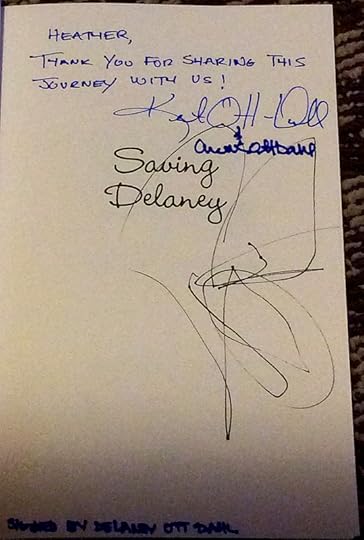
I'm not going to lie. I read this book for the chocolate. I was at BEA and the authors were signing right next to another author I was in line for. When I finished they had a short line and the BEA worker said that they were handing out chocolate with the book. That got my attention. I hadn't been interested in the book because I don't like babies. I'm also pro-choice and didn't care to read a pro-life screed. Turns out I'm really more pro-chocolate than anything. I went up and got a copy of the book. Delaney even signed it for me herself.
Now I'm glad that I read this book. The book is told from Keston's viewpoint. When her mother died when Keston was in her early 40s, she went through a bit of a wild time. She broke up with her long term partner and decided to just have fun for a while. She wasn't planning on meeting a woman in her late 20s with two young children and falling in love. She certainly wasn't planning for her new girlfriend to decide that she needed to be a surrogate for another couple.
Keston had always had a phobia about people with disabilities. This view was formed when she did some community service in a residential care facility. Since that time she had actively avoided any contact.
Trying to get pregnant as a surrogate wasn't easy for Andrea. Tensions rose between the Ott-Dahls, the prospective mothers, and the sperm donors as months passed with no pregnancy. Right when they were about to give up, Andrea got pregnant.
Routine prenatal testing showed abnormalities early. Andrea was the biological mother. An egg donor was not used. Now the question was, could she be made to abort her biological child if she signed a contract stating that the prospective mothers got to decide about any health concerns to the child? Should they keep a child with Down's Syndrome knowing Keston's issues with disabilities?
This book is the story of growing up and growing together. It is standing up for your family in the face of pressures from all sides. It is about learning to overcome your prejudices and convincing others to do the same.
Regardless of your personal opinions on abortion or surrogacy, I'd recommend reading this book. It gives the perspective of people wrestling with the tough choices that come with assisted reproduction that aren't usually heard.
I found this to be a truly inspirational story. I sat down to read this heartwarming story only to find that I was so captivated that I stayed up until I finished it.
As I read this amazing story that took us on a journey from surrogacy to birth... I found myself shedding tears of happiness as I fell in love with this beautiful little girl named Delaney and her parents Keston and Andrea. I know that at first Delaney was meant to belong to a couple who desperately wanted a child of their own, but I feel that Delaney chose from the start exactly who was meant to be hers. With all odds against her at times she fought for a reason. I found myself giving support to these two amazing woman who took this journey together to fight for Delaney’s right to be born. As I also fell in love with Delaney, the fighter, from the start.
This was such a compassionate story of the ups and downs that we all face as couples, parents, friends and families. To me it isn’t about whether you are straight or gay, whether you have money or not, or any of the other struggles that you face but just being there to love and support your partner unconditionally. I am a firm believer that things happen to us for reason. Those reasons may not be clear when they happen but everything is revealed when it needs to be. For whatever the reasons this happened two beautiful women have been given Delaney who has strengthened their love and bond for one another.
This is a story for all mothers everywhere. I am sure she brings such joy into their lives. I wish only the best for this beautiful family and hope that Ms. K Ott- Dahl will write more stories to share as Delaney grows. Ms. Ott- Dahl is a very gifted writer letting us into her life through her words and emotions.
This book is written so beautifully and exquisitely - I couldn't put it down! I felt so many emotions throughout the book but by the end, I realized how much my judgments had fallen by the wayside over the years. When I found out I was pregnant with my first child, my ex-husband informed me that he'd leave us if our child had any kind of disability or handicap and he reminded me of that stance when I was pregnant with our second son. As a mother, the only thing I wanted was to have a happy, healthy child but if either one of my boys had been born with something such as Down syndrome, I would have done everything in my power to make sure they were still loved, provided for and given every opportunity as a child who didn't have any disabilities. Ten years ago, I would have honestly said that I didn't think it was right for a lesbian couple to have a child in the first place but over the years, I have learned that good parents don't just come in "traditional" form of having a straight couple for parents. Loving a child takes a good person - and that can include a lesbian couple. Reading the story about this couple's journey, I soon found myself not thinking of them as a "lesbian" couple; rather, I thought of them as a committed set of parents who were willing to give their all for a child that others were willing to dismiss as a 'mistake'. It opened my heart and I found joy in their story!
I received a free copy of the book but that did not affect my review and all opinions are my own!
I wanted to like this book so much more than I did.
I really enjoyed the beginning, the girl meets girl, the beginning of the surrogacy, the emotions, etc. But the book lost me when Peanut became Delaney. Not because I couldn't understand, I do. I, too, had a prenatal diagnosis of Down syndrome and felt similar emotions of uncertainty, fear, and wondering about acceptance from others. The one thing that made me really cringe was even after they she became Delaney, the women were pro-Ds and learning everything they could about it, they kept calling, and describing her as, our disabled child. In a way I do get it, but they said they did so much research and after doing my own research, the disability took a back seat. I don't think of my son as my disabled child. And I truly hope they no longer think of Delaney that way. But that thought plagued the end of the book for me and I couldn't get past it.
It was absolutely the best I've read In a long time.the candy feet were so cute,an extra thank you for that.thank u so much for signing the book I show it to everyone everyone.the signatures were adorable.I am so glad I won this book.I received this book through goodreads free giveaways.
This book is a must read for anyone considering surrogacy. These women when through a lot with the people they were trying to help and the doctors. Thankfully, for Delaney's sake, they refused to give up on their little girl.