

What do you think?
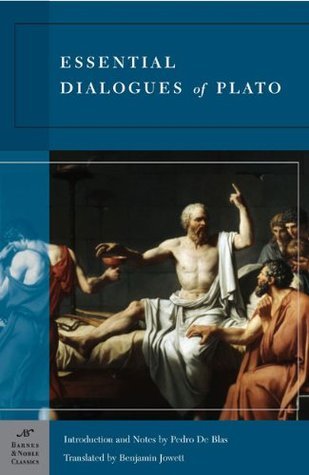
Essential Dialogues of Plato
Essential Dialogues of Plato, by Plato, is part of the Barnes & Noble Classics series, which offers quality editions at affordable prices to the student and the general reader, including new scholarship, thoughtful design, and pages of carefully crafted extras. Here are some of the remarkable features of Barnes & Noble Classics:
New introductions commissioned from today's top writers and scholars
Biographies of the authors
Chronologies of contemporary historical, biographical, and cultural events
Footnotes and endnotes
Selective discussions of imitations, parodies, poems, books, plays, paintings, operas, statuary, and films inspired by the work
Comments by other famous authors
Study questions to challenge the reader's viewpoints and expectations
Bibliographies for further reading
Indices & Glossaries, when appropriate
All editions are beautifully designed and are printed to superior specifications; some include illustrations of historical interest. Barnes & Noble Classics pulls together a constellation of influences—biographical, historical, and literary—to enrich each reader's understanding of these enduring works.
Plato is one of those world-famed individuals, his philosophy one of those world-renowned creations, whose influence, as regards the culture and development of the mind, has from its commencement down to the present time been all-important.
— G. W. F. Hegel
Western philosophy starts with Socrates and his student Plato. By way of the dialectic that evolved between master and student, Plato invented the philosophical method of inquiry and analysis, and became the first to use a logical framework to ask—and try to answer—the eternal questions about ethics, politics, art, and life that still haunt humanity: What is virtue? What is justice? What is the ideal form of government? What is the individual’s relationship to the state? Do artists have a responsibility to society, or only to their own creative impulse? Plato explores these issues through a series of dialogues, records of supposed conversations between Socrates and other Greek aristocrats. Although Socrates is nominally the main speaker in all of them, only the earlier dialogues document his thoughts, while the latter ones present Plato’s own ideas.
What is often ignored in commentaries on Plato’s work is its unique literary form. The dialogues are neither dramas, nor stories, yet they are skillfully fashioned by means of characters, narrative events, dramatic moments, and perhaps most surprising, a great deal of humor. Along with such exemplars of Plato’s thought as Symposium, Apology, and Phaedrus, this volume includes the first three books of Plato’s Laws.
Pedro De Blas holds degrees in Law and Classics. He has worked as counsel for several international organizations, including the United Nations and the World Bank, and he is currently a Ph.D. candidate in Classics at Columbia University. He has taught classical languages and literature at Columbia, the CUNY Latin and Greek Institute, and New York University’s Gallatin School.
New introductions commissioned from today's top writers and scholars
Biographies of the authors
Chronologies of contemporary historical, biographical, and cultural events
Footnotes and endnotes
Selective discussions of imitations, parodies, poems, books, plays, paintings, operas, statuary, and films inspired by the work
Comments by other famous authors
Study questions to challenge the reader's viewpoints and expectations
Bibliographies for further reading
Indices & Glossaries, when appropriate
All editions are beautifully designed and are printed to superior specifications; some include illustrations of historical interest. Barnes & Noble Classics pulls together a constellation of influences—biographical, historical, and literary—to enrich each reader's understanding of these enduring works.
Plato is one of those world-famed individuals, his philosophy one of those world-renowned creations, whose influence, as regards the culture and development of the mind, has from its commencement down to the present time been all-important.
— G. W. F. Hegel
Western philosophy starts with Socrates and his student Plato. By way of the dialectic that evolved between master and student, Plato invented the philosophical method of inquiry and analysis, and became the first to use a logical framework to ask—and try to answer—the eternal questions about ethics, politics, art, and life that still haunt humanity: What is virtue? What is justice? What is the ideal form of government? What is the individual’s relationship to the state? Do artists have a responsibility to society, or only to their own creative impulse? Plato explores these issues through a series of dialogues, records of supposed conversations between Socrates and other Greek aristocrats. Although Socrates is nominally the main speaker in all of them, only the earlier dialogues document his thoughts, while the latter ones present Plato’s own ideas.
What is often ignored in commentaries on Plato’s work is its unique literary form. The dialogues are neither dramas, nor stories, yet they are skillfully fashioned by means of characters, narrative events, dramatic moments, and perhaps most surprising, a great deal of humor. Along with such exemplars of Plato’s thought as Symposium, Apology, and Phaedrus, this volume includes the first three books of Plato’s Laws.
Pedro De Blas holds degrees in Law and Classics. He has worked as counsel for several international organizations, including the United Nations and the World Bank, and he is currently a Ph.D. candidate in Classics at Columbia University. He has taught classical languages and literature at Columbia, the CUNY Latin and Greek Institute, and New York University’s Gallatin School.
624 pages, Paperback
First published January 1, 1973
About the author
Plato
5,778 books9,119 followersPlato (Greek: Πλάτων), born Aristocles (c. 427 – 348 BC), was an ancient Greek philosopher of the Classical period who is considered a foundational thinker in Western philosophy and an innovator of the written dialogue and dialectic forms. He raised problems for what became all the major areas of both theoretical philosophy and practical philosophy, and was the founder of the Platonic Academy, a philosophical school in Athens where Plato taught the doctrines that would later become known as Platonism.
Plato's most famous contribution is the theory of forms (or ideas), which has been interpreted as advancing a solution to what is now known as the problem of universals. He was decisively influenced by the pre-Socratic thinkers Pythagoras, Heraclitus, and Parmenides, although much of what is known about them is derived from Plato himself.
Along with his teacher Socrates, and Aristotle, his student, Plato is a central figure in the history of philosophy. Plato's entire body of work is believed to have survived intact for over 2,400 years—unlike that of nearly all of his contemporaries. Although their popularity has fluctuated, they have consistently been read and studied through the ages. Through Neoplatonism, he also greatly influenced both Christian and Islamic philosophy. In modern times, Alfred North Whitehead famously said: "the safest general characterization of the European philosophical tradition is that it consists of a series of footnotes to Plato."
Plato's most famous contribution is the theory of forms (or ideas), which has been interpreted as advancing a solution to what is now known as the problem of universals. He was decisively influenced by the pre-Socratic thinkers Pythagoras, Heraclitus, and Parmenides, although much of what is known about them is derived from Plato himself.
Along with his teacher Socrates, and Aristotle, his student, Plato is a central figure in the history of philosophy. Plato's entire body of work is believed to have survived intact for over 2,400 years—unlike that of nearly all of his contemporaries. Although their popularity has fluctuated, they have consistently been read and studied through the ages. Through Neoplatonism, he also greatly influenced both Christian and Islamic philosophy. In modern times, Alfred North Whitehead famously said: "the safest general characterization of the European philosophical tradition is that it consists of a series of footnotes to Plato."
Ratings & Reviews
Friends & Following
Create a free account to discover what your friends think of this book!
Community Reviews
Displaying 1 - 27 of 27 reviews

September 16, 2016
It's been over a decade since I've read a collection of Plato's dialogues. I've read individual dialogues since then, but haven't read a collection for a while. I remember when I first read some of these dialogues; at the time I was really quite astounded at how many parallels there were between some of Plato's concepts and concepts one finds in the New Testament. I am still rather amazed at it. I am not, of course, saying that the New Testament is a conscious recapitulation of Platonic notions, what I am saying is that Plato, and probably Socrates and other Greek poets and philosophers, prepared the way for Christianity in some ways. I doubt Christianity would have spread as it did without the gentile populations having been exposed to some of these ideas. One should also note that Paul quotes Hellenistic writers at least 3 or 4 times in the New Testament. For my Christian readers who find this point offensive, I do suggest you read the dialogues of Plato carefully and read the New Testament carefully. If one is honest, one has to admit the parallels. The church fathers knew of the parallels as well. Many of them even claimed that Plato took his philosophy from the Old Testament; while this may be possible to a degree (Numenius certainly thought so), I would say many of Plato's ideas most likely owe their provenance to Zoroastrianism and various mystery schools (e.g. Orphism, Pythagoreanism, Egyptian Hermeticism, etc); and some others can probably be just attributed to Socrates and Plato's personal inspiration. At this point though it is really hard to know where Plato took his inspiration.
After reading Plato originally, I felt as though I had some acquaintance with him already, which is an odd feeling; but I think that it can be possibly explained to a degree. After the Bible, I don't think any body of written works has influenced Western civilization more than Plato's. One has to bear in mind that even Aristotle was originally a student of Plato's; so not even Aristotle with his acknowledged influence can be credited to the same degree as Plato. I don't want to come off as overly obsequious when it comes to Plato. I fully admit that I am more than a bit of a Platonist philosophically, but it doesn't mean I subscribe to all aspects of Platonism. Plato (or Plato's Socrates rather) often engages in unsound dialectic; conflating notions and terminology needlessly, while at the same time, engaging in trifling and pointless arguments, leaving necessary and relevant points unexplored. The Shorter Hippias is notable in that regard for some of the above problems. Euthyphro is another dialogue that engages in trifling arguments that come off as needlessly sarcastic quibbling more than relevant dialectic. Unlike the editor though, I actually enjoy Plato's imaginative etymologies and do believe there is more to his thinking there than just fanciful speculation.
I can't help feeling some degree of kinship with these dialogues. Many of them display sentiments I identify with as a Christian. There's the obvious interesting parallel between Socrates manner of state sanctioned execution and Jesus' state sanctioned execution. Both Jesus and Socrates made it a point to counter the prevailing ideas of the day and debate with those who were accredited with wisdom. They also both taught strongly ethical and moral codes. Plato probably based much of his ethics on what Socrates taught, so that is an interesting element of the dialogues. Of course, neither Jesus, nor Socrates, gained materially from their teaching, which is still altogether rare even today.
One must admit that Plato's notion of eros is often somewhat ambiguous. The love that he presents between philosophical teacher and student is where we get the term Platonic love. It's hard not to see some amount of homoeroticism in the Symposium and in other places, but it does seem more likely that Plato really wanted to get across a strong feeling of bond between an older master and a younger disciple. The New Testament never uses the term eros. It uses two other Greek terms phileo and agape. Without question, there is displayed a deep love between Lord and disciple in the New Testament. Plato's eros foreshadows this kind of love in a way, but the New Testament idea of love is profoundly spiritual, which is not the Platonic version. It is interesting, however, that the Christian mystics also saw in eros a kind of window through which one can see phileo and agape. Platonist language has often influenced Christian mysticism.
I want to avoid making this review too long, so in closing I'll just say it's always a great experience to revisit Plato. I plan on reading the rest of the dialogues not included here. This was a great collection but hardly "essential" though. Any collection of Plato's dialogues that leave out the Timaeus and the Republic could hardly be said to be the essential dialogues, but this has a lot of the great dialogues for a great price.
After reading Plato originally, I felt as though I had some acquaintance with him already, which is an odd feeling; but I think that it can be possibly explained to a degree. After the Bible, I don't think any body of written works has influenced Western civilization more than Plato's. One has to bear in mind that even Aristotle was originally a student of Plato's; so not even Aristotle with his acknowledged influence can be credited to the same degree as Plato. I don't want to come off as overly obsequious when it comes to Plato. I fully admit that I am more than a bit of a Platonist philosophically, but it doesn't mean I subscribe to all aspects of Platonism. Plato (or Plato's Socrates rather) often engages in unsound dialectic; conflating notions and terminology needlessly, while at the same time, engaging in trifling and pointless arguments, leaving necessary and relevant points unexplored. The Shorter Hippias is notable in that regard for some of the above problems. Euthyphro is another dialogue that engages in trifling arguments that come off as needlessly sarcastic quibbling more than relevant dialectic. Unlike the editor though, I actually enjoy Plato's imaginative etymologies and do believe there is more to his thinking there than just fanciful speculation.
I can't help feeling some degree of kinship with these dialogues. Many of them display sentiments I identify with as a Christian. There's the obvious interesting parallel between Socrates manner of state sanctioned execution and Jesus' state sanctioned execution. Both Jesus and Socrates made it a point to counter the prevailing ideas of the day and debate with those who were accredited with wisdom. They also both taught strongly ethical and moral codes. Plato probably based much of his ethics on what Socrates taught, so that is an interesting element of the dialogues. Of course, neither Jesus, nor Socrates, gained materially from their teaching, which is still altogether rare even today.
One must admit that Plato's notion of eros is often somewhat ambiguous. The love that he presents between philosophical teacher and student is where we get the term Platonic love. It's hard not to see some amount of homoeroticism in the Symposium and in other places, but it does seem more likely that Plato really wanted to get across a strong feeling of bond between an older master and a younger disciple. The New Testament never uses the term eros. It uses two other Greek terms phileo and agape. Without question, there is displayed a deep love between Lord and disciple in the New Testament. Plato's eros foreshadows this kind of love in a way, but the New Testament idea of love is profoundly spiritual, which is not the Platonic version. It is interesting, however, that the Christian mystics also saw in eros a kind of window through which one can see phileo and agape. Platonist language has often influenced Christian mysticism.
I want to avoid making this review too long, so in closing I'll just say it's always a great experience to revisit Plato. I plan on reading the rest of the dialogues not included here. This was a great collection but hardly "essential" though. Any collection of Plato's dialogues that leave out the Timaeus and the Republic could hardly be said to be the essential dialogues, but this has a lot of the great dialogues for a great price.
March 26, 2008
How do I criticize a monumental figure like Plato? I'm not a student of philosophy, this was my first foray into it, but I did find this book surprisingly readable. interesting dialogues (true to its title) on love, friendship, the nature of the state (the first half of the book is more interesting than the second, maybe my energy for it waned, but I also think it was because of the topics). Got swept in by the intellectual testing and prodding of the famed Socratic method at work.
January 28, 2023
Happy to see important dialogues on Platonic realism,Theory of knowledge, Political views
This entire review has been hidden because of spoilers.
June 30, 2026
Sokrates är en röv

February 10, 2020
A tedious read, but it occured to me that the subject matter of the individual dialogues is less important than the example of using logic to reason and debate. Later on in the book it also became clear, that one can use logic to come to a conclusion and still be wrong. Both very important messages to glean from this reading.
May 30, 2025
Diving into Dialogues of Plato is like stepping into the original masterclass on thinking. It’s astonishing how alive these texts still feel, even after 2,400 years. The questions Plato raises, through the unforgettable voice of Socrates, are not only foundational to Western philosophy; they’re deeply relevant to anyone who’s ever stopped to ask, What is the good life? or What does it mean to know something?
One of the most striking things about these dialogues is their accessibility. Unlike dry treatises, Plato gives us philosophy in motion, through conversations that twist, turn, and surprise. Socrates never tells you what to think; instead, he challenges how you think. As he famously says in the Apology,
“The unexamined life is not worth living.”
That line hits hard, not just as a philosophical idea, but as a call to live more deliberately. And the book is full of moments like this: quick flashes of insight that stick with you.
Take the Republic, for example. It’s where Plato delivers one of the most powerful metaphors in all of philosophy: the Allegory of the Cave. Here, he likens most people to prisoners who mistake shadows on a wall for reality, unaware of the true world outside.
“And when he remembered his old habitation, and the wisdom of the den and his fellow-prisoners, do you not think he would felicitate himself on the change, and pity them?”
It’s a timeless reflection on ignorance, enlightenment, and what it means to wake up to reality, a concept that still echoes in everything from education to politics.
Even the shorter dialogues, like Euthyphro or Crito, are dense with philosophical spark. In Euthyphro, Socrates questions the very nature of piety and goodness, asking:
“Is the pious loved by the gods because it is pious, or is it pious because it is loved by the gods?”
That single question has launched entire careers in ethics and theology.
What makes this collection especially valuable is how it balances Plato’s major themes; ethics, knowledge, politics, metaphysics, while showing the progression of his thought. You get the full range, from the playful and ironic Socrates of the early dialogues to the more system-building philosopher of the later works like Timaeus and Phaedrus.
Above all, Essential Dialogues is a book that doesn’t just inform, it provokes. It asks you to wrestle with your beliefs, to live with questions, and to stay curious. As Socrates says in the Theaetetus:
“Wonder is the beginning of wisdom.”
And truly, wonder is exactly what these dialogues still inspire.
Need I say more?
One of the most striking things about these dialogues is their accessibility. Unlike dry treatises, Plato gives us philosophy in motion, through conversations that twist, turn, and surprise. Socrates never tells you what to think; instead, he challenges how you think. As he famously says in the Apology,
“The unexamined life is not worth living.”
That line hits hard, not just as a philosophical idea, but as a call to live more deliberately. And the book is full of moments like this: quick flashes of insight that stick with you.
Take the Republic, for example. It’s where Plato delivers one of the most powerful metaphors in all of philosophy: the Allegory of the Cave. Here, he likens most people to prisoners who mistake shadows on a wall for reality, unaware of the true world outside.
“And when he remembered his old habitation, and the wisdom of the den and his fellow-prisoners, do you not think he would felicitate himself on the change, and pity them?”
It’s a timeless reflection on ignorance, enlightenment, and what it means to wake up to reality, a concept that still echoes in everything from education to politics.
Even the shorter dialogues, like Euthyphro or Crito, are dense with philosophical spark. In Euthyphro, Socrates questions the very nature of piety and goodness, asking:
“Is the pious loved by the gods because it is pious, or is it pious because it is loved by the gods?”
That single question has launched entire careers in ethics and theology.
What makes this collection especially valuable is how it balances Plato’s major themes; ethics, knowledge, politics, metaphysics, while showing the progression of his thought. You get the full range, from the playful and ironic Socrates of the early dialogues to the more system-building philosopher of the later works like Timaeus and Phaedrus.
Above all, Essential Dialogues is a book that doesn’t just inform, it provokes. It asks you to wrestle with your beliefs, to live with questions, and to stay curious. As Socrates says in the Theaetetus:
“Wonder is the beginning of wisdom.”
And truly, wonder is exactly what these dialogues still inspire.
Need I say more?

September 22, 2020
What is there to say about Plato's dialogues? You probably know what you're getting in to, here. I suppose what I liked about this book was trying to picture the surrounding cultural context and society it takes place in. Socrates goes out for a walk and runs into a friend. Socrates is invited to a dinner with high society. Socrates and his friend hang out on a riverbank and pass the time bullshitting.
Interesting, as well, trying to figure out Plato's stake in all this, and the political / social connections at work. Almost everything, I suppose, except the real content of Socrates's/Plato's philosophy. I appreciate that the theorizing here is aimed at something like a systematic understanding of life and how to live. A few incidental details here and there also give us a believable picture of Socrates's idiosyncracies.
Interesting, as well, trying to figure out Plato's stake in all this, and the political / social connections at work. Almost everything, I suppose, except the real content of Socrates's/Plato's philosophy. I appreciate that the theorizing here is aimed at something like a systematic understanding of life and how to live. A few incidental details here and there also give us a believable picture of Socrates's idiosyncracies.

September 24, 2023
It was a long time ago when I've red this book.
Handwrite of genuine genius mind of how to analyze, question everything, answer with question and turn every dialoge or conflict to your advantage with the retoric power of your converse adversary.
And you instantly realize how powerful thinkers were ancients in contrast to these modern times where almost everyone thinks that knows everything.
Handwrite of genuine genius mind of how to analyze, question everything, answer with question and turn every dialoge or conflict to your advantage with the retoric power of your converse adversary.
And you instantly realize how powerful thinkers were ancients in contrast to these modern times where almost everyone thinks that knows everything.
This entire review has been hidden because of spoilers.

November 21, 2019
I feel as though I could have done with a book a third the size and just read the republic to have come across the same ideas. A lot of plato’s earlier dialogues were intellectual precursors to his perfect society

July 1, 2022
Athens must have been such a grand state of its time for Socrates to die for it. His logical arguments are air tight; each time I thought them fallible, a further dissection of his arguments were made sound and complete! Plato expressed these dialogues masterfully.
November 14, 2025
I was first introduced to this woke in philosophy 101, 20 years ago. I have re-read this 3 times and delved into “The republic.” It was most recent read through of the collection, I finally understand, “ its the journey, not the destination” in terms of philosophical papers.

August 23, 2019
Helped me develop critical thinking and my debate skills.

March 26, 2020
More important for what it says about logic and reasoning and how it approaches its subjects than what it actually says about those subjects. Somewhat tedious, but definitely a worthwhile read.

May 29, 2021
I had so many questions about everything coming out of this book and I still have not recovered.
December 9, 2022
I understood so little. I'm sure rereading is a requirement, but Aristotle was more approachable.

March 14, 2024
A timeless treasure of philosophical discourse, offering profound insights into ethics, politics, and the human condition. Enlightening, thought-provoking, indispensable.

Read
January 12, 202518 pages - Socrates dialogue with Euthyphro on Piety

June 28, 2015
I feel like a bit of a heel offering such a low rating to a book collecting some of the best known work of a major figure in the history of philosophy (minus Republic) but if I'm being honest, this is just a very hard book to enjoy or really learn much from.
Maybe it's the translation. Maybe it's the few and far between footnotes. But what it really feels like is an extended display of asshole-ish behavior on the part of Socrates towards the people he is supposedly having meaningful philosophical discussions with.
A friend of mine told me a story a while back. He ran into someone he knew at a local restaurant. This third person is a former public figure and well-known blowhard. He's a bit of a public intellectual. He proceeded to casually ask my friend if he knew what was happening in the Middle East; my friend responded by saying yes, he was aware of recent developments. And the third person proceeded to say: well, explain it to me. Though somewhat caught off-guard, my friend went ahead and described recent events. After which, this third person said, no, not really, and proceeded to give a slightly different interpretation of recent Middle East history.
This is pretty much what Socrates is up to for the entirety of this book. Do you know about X? Oh yeah? Why don't you tell me about it? [After explanation.] No, I don't think you're right.
There are no doubt instances where the Socratic dialogue can be useful, but maybe it would me most useful in the hands of someone other than Socrates.
Moreover, the famous method more often than not finds these discussions being caught up in details that lack relevance toward any larger point. Or they are just hopelessly based on assumptions that were common in ancient Greece but not part of the reality we live in now.
Understanding the basics of Socratic/Platonic thought may be necessary for understanding the history of philosophic discourse, but delving too deeply into the less well-known dialogues was not a fruitful endeavor for me.
Maybe it's the translation. Maybe it's the few and far between footnotes. But what it really feels like is an extended display of asshole-ish behavior on the part of Socrates towards the people he is supposedly having meaningful philosophical discussions with.
A friend of mine told me a story a while back. He ran into someone he knew at a local restaurant. This third person is a former public figure and well-known blowhard. He's a bit of a public intellectual. He proceeded to casually ask my friend if he knew what was happening in the Middle East; my friend responded by saying yes, he was aware of recent developments. And the third person proceeded to say: well, explain it to me. Though somewhat caught off-guard, my friend went ahead and described recent events. After which, this third person said, no, not really, and proceeded to give a slightly different interpretation of recent Middle East history.
This is pretty much what Socrates is up to for the entirety of this book. Do you know about X? Oh yeah? Why don't you tell me about it? [After explanation.] No, I don't think you're right.
There are no doubt instances where the Socratic dialogue can be useful, but maybe it would me most useful in the hands of someone other than Socrates.
Moreover, the famous method more often than not finds these discussions being caught up in details that lack relevance toward any larger point. Or they are just hopelessly based on assumptions that were common in ancient Greece but not part of the reality we live in now.
Understanding the basics of Socratic/Platonic thought may be necessary for understanding the history of philosophic discourse, but delving too deeply into the less well-known dialogues was not a fruitful endeavor for me.

January 2, 2012
I read Apology, Crito, Protagoras, Symposium and Phaedo.
Plato writes of Socrates' many dialogues and the use of questions and answers that are known as the socratic method. Some of these dialogues are tough reading.
While reading Protagoras, I wanted to jump up and start diagraming on a whiteboard the arguments, as they were very difficult to follow.
Very moving narrative of Socrates death at the end of Phaedo.
Next up....Plato's Republic
# 12A of 133 on Clifton Fadiman's New Lifetime Reading Plan.
Plato writes of Socrates' many dialogues and the use of questions and answers that are known as the socratic method. Some of these dialogues are tough reading.
While reading Protagoras, I wanted to jump up and start diagraming on a whiteboard the arguments, as they were very difficult to follow.
Very moving narrative of Socrates death at the end of Phaedo.
Next up....Plato's Republic
# 12A of 133 on Clifton Fadiman's New Lifetime Reading Plan.
August 3, 2008
Essential reading for any serious student of philosophy, however not the best translation of Plato's writing.
Read
July 18, 2009I didn't read the entire book, just Symposium.
February 26, 2013
Interesting and some very valid arguments, but also some logical shortcuts that I didn't agree with.

May 15, 2013
Some parts are hard to follow without additional information and I had to consult my grandfather regularly. Very good and thought provoking!

May 3, 2024
im not smart enough for this book yet, lol, ill come back to you

October 30, 2013
Диалозите на Платон - малка книжка, която ми служи цял живот.

July 20, 2014
OK you caught me- im looking at my bookshelf from college - lol

October 27, 2015
Wonderful dialogs another Plato I enjoy
Displaying 1 - 27 of 27 reviews