This book is specially designed in Amazon's fixed-layout KF8 format with region magnification. Double-tap on an area of text to zoom and read."To be a philosopher is not merely to have subtle thoughts, nor even to found a school, but so to love wisdom as to live according to its dictates, a life of simplicity, independence, magnanimity and trust." This graphic novel biography relates the forward looking inspirational life of the great author, philosopher and pioneering ecologist. Henry David Thoreau was also the father of the concept, still fresh today (viz "Occupy Wall St."), of "civil disobedience" which he used against slavery and the encroachment of government.
Daniel ALEXANDRE, dit A.Dan, débute comme formateur en informatique et en maths, avant de faire du dessin son métier. Il travaille en tant qu'illustrateur dans le domaine de la nature et du tourisme, puis rejoint Grand Angle pour dessiner Tahya El-Djazaïr.
Thoreau: A Sublime Life is a short, evocative comics biography by French team, writer Maximilien Le Roy and A. Dan (Daniel Alexandre). It’s not a mere chronological biography—it’s too short for that—but even if it were twice the length they wouldn't have been interested in that. What they wanted to do is create a comics portrait of Thoreau through images and ideas, snapshots more than film, poetic images more than an in-depth philosophical biography. It’s their image of Thoreau.
I know Thoreau’s work, or did, and I bet most of you are familiar with him and can say a few things about him. Walden, “On Civil Disobedience.” I have a picture book of him called Henry (in part because I have a son, Henry) that I like, too. I've read a lot of his work, as I have Emerson. The transcendentalists!
This bio of Thoreau features some quotations from him, some of which I was unfamiliar. For instance, Thoreau taught for a short time in the Concord School. He hated the regimentation, the required discipline, so he schooled kids in his home, with his brother: “We came up with new approaches to education, outings in nature, more active participation with students, no more corporal punishment.” I’d like to know more about his approach, but we only get this glimpse. But you can build a whole educational philosophy based on that glimpse! And many have done just such a thing based on principles similar to the ones he articulates here.
“I just want everyone to explore their own path.”
You can see how young people in the sixties might have embraced him. And how his and Emerson's work might have been the precursor to the anti-philosophical American Pragmatism Of William James, W.B. DuBois and Jane Addams.
And on the environment and man’s historical ignorant rapacious use of it: “If a man walks in the woods for love of them, for half the day, he is in danger of being a loafer; but if he spends his whole day as a speculator, shearing off those woods, and making the earth bald before her time, he is esteemed an industrious and enterprising citizen.”
“Wanting to be famous means wanting to be contaminated.”
He read as deeply into Buddhism and Hinduism as Christianity. “The Brahmins understood that possessions end up possessing us.”
Thoreau was more spiritual than political, in general, though he was adamantly opposed to slavery, he hated the US-Mexican War, and he wouldn’t pay taxes to a government that thrived from such activities. He was also an anarchist of sorts, preferring the road less travelled and improvisation to authoritarian structures. He was an ecologist, and environmentalist, and we need him again, as always.
Michael Granger’s short essay on Thoreau completes the book, which I liked very much. The art from A. Dan, who studied biology and ecology, is great.
First, this was originally produced in French. It's interesting how many biographical graphic novels are produced in Europe about cultural figures in the U.S. — and they do such a good job of it.
Thoreau is a writer who is often romanticized, and this book does not avoid that tendency. The essay at the end, by Professor Michel Granger, provides more insight and background. The famous cabin on Walden's Pond, for instance, is usually described as "secluded" but was only a few miles from the family home—the essay does mention that, but when Thoreau is portrayed as living a life of freedom and independence at his cabin, it goes unsaid that his mother and sisters were delivering meals and doing his laundry. So much for living outside the structures of society.
Thoreau remains a huge influence for his idealistic approach to nature and living in freedom and splendid isolation. Romanticizing such a writer, one who never really left his parents' home but is held up as a model of independence, gets on my nerves.
The best part of this book is the essay at the end.
Quien busque profundizar en la figura de Thoreau se equivoca de obra, pero quien quiera tener un primer encuentro con este naturalista y filósofo del s. XIX y con su mensaje, va a disfrutar de un cómic interesante. En él encontrará un sucinto resumen, desarrollado en bellos dibujos, de la vida adulta de Thoreau. Los dos órdenes que hicieron notable al filósofo norteamericano están aquí representados, tanto su ideología política como su elogio de una vida retirada, de retorno a la naturaleza. Su defensa del abolicionismo -aunque activa, al margen de la violencia- fue quizás la forma en la que más directamente llevaría a la práctica la tesis por la que posteriormente sería reivindicado: la desobediencia civil. Aunque quizás, tal como muestra este cómic, su mayor rebelíon fue la de intentar llevar a cabo una vida apartada de la sociedad, el regreso a los valores primigenios de la naturaleza. Vivir la vida en sí misma, ausente de las cargas con las que la sociedad industrial y tecnológica nos marca, supone, hoy más que nunca en nuestro mundo globalizado, una revolución individual y social. Si el mensaje político de Thoreau, la rebelión contra el propio Estado que impone normas abusivas a sus ciudadanos, está más vivo que nunca, su reivindicación de otra forma de vida va quedando en manos minoritarias, minimizada por una Humanidad uniforme, más dependiente cada vez de su propia tecnología. El magnífico apartado gráfico de esta obra, hermoso en los paisajes, en las soledades de Thoreau, invita a romper con esa monotonía. A desconectarse, salir al monte y sentir el disfrute de, sencilla y llanamente, estar. Menos móviles, más Thoreau.
The subtitle A Sublime Life is an apt choice here, as the book veers into hagiography on several occasions. I did appreciate the deeper context and the glimpses into other parts of Thoreau's life: his dissidence and short incarceration for not paying taxes (The money goes to slavery and wars with Mexico - why would I pay for that? he asks the police chief), his meetings with abolitionists and ties to John Brown, and more about his transcendentalist personal philosophies.
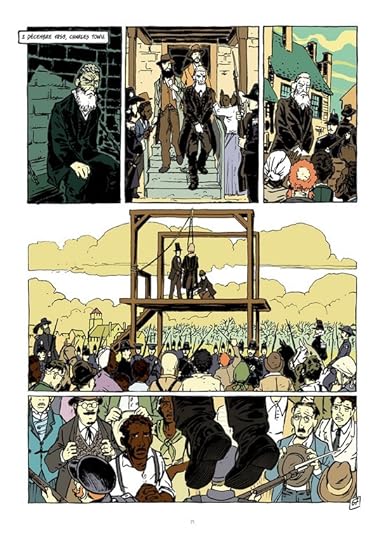
John Brown's execution after Harper's Ferry raid
The book concludes with a critical essay on Thoreau, and is well worth the read.
Flojita ilustración de la vida de Thoreau que intenta condensar su obra en algunos momentos ejemplares, nunca mejor dicho. El cómic no debería requerir la entrevista final al profesor Michel Granger, que explica muchas claves del pensamiento de Thoreau, aunque realmente es lo más interesante del libro.
I liked this short graphic novel biography of Henry David Thoreau. It made me curious and now I want to know more about him. The artwork is great, and it's quite poetic; although perhaps it looks at Thoreau as too much of a saint...
En oktoberdag för två år sedan pilgrimsvandrade jag från Concord till Walden Pond. Kan fortfarande inte verbalisera hur fantastiskt det var. Sublimt, kanske är ordet.
http://bloggar.aftonbladet.se/musikbl... Pers Aftonbladet-text om Walden-männen fick mig att ta fram den här ur TBR:en. Uppskattar de illustrerade glimtarna ur Thoreaus liv, men vem är egentligen målgruppen? Får högstadievibbar, men för läsaren utan förkunskaper är det alltför fragmentariskt. En sak jag blir positivt överraskad och lite rörd av är att Dagermans ord om Thoreau får mycket utrymme i inledningen.
Älskade t.ex. grafisk roman-versionen av Camus 'L'Etranger' och såg nyligen att Tabucchis 'Sostiene Pereira' också finns i det formatet. Det tillför alltid något att se ett älskat verk i ny bildtolkning.
A completely admiring graphic biography of Henry David Thoreau. Interesting visual interpretations of episodes from Thoreau's life and depictions of him as a naturalist, philosopher, abolitionist, and dissident. The author does a good job incorporating Thoreau's own words into the text.
This is a very interesting graphic novel treatment of the life of the famous philosopher, writer, and activist Henry David Thoreau. I had only an inkling of the scope of Thoreau's thoughts and activities - mainly, the usual impression of a philosopher, proto-environmentalist, observing nature at Walden Pond. I had no idea he was a fierce opponent of slavery and a supporter even of John Brown, who was hanged for trying to incite a slave revolt at Harper's Ferry, Virginia.
Thoreau was steadfastly real - kept to his principles no matter what - and his integrity (even if you didn't always agree with him) was what must have most impressed his listeners or readers. He was the opposite of a go-getter capitalist type - withdrawing to the pond, he reached for philosophical wisdom through hiking, observing nature, writing, reading - leading a very austere, scholarly existence for some years (although he was only a few miles from his family home). He was probably reacting to the waves of development and coming industrialization of the northeast - the mills in Massachusetts for example. It may be a stretch to compare him to Marx - but in both in a way were reacting to the Industrial Revolution and what it was doing to humanity.
This GN is a good introduction to the complex life of a great American philosopher. It's well-drawn and the limited/muted color palette seems to evoke the 19th C; the text is likewise clear and understandable.
Some quotes:
"[Thoreau:] [The Brahmins] ... have understood for a long time that possessions end up possessing the being."
"[Thoreau:] [It doesn't] matter how valuable law may be to protect your property, even to keep soul and body together, if it do not keep you and humanity together."
"[Thoreau:] I hear many condemn [John Brown and his] ... men because they were so few. When were the good and the brave ever in a majority?"
"[Thoreau:] [John Brown] ... liberated men from slavery... He is his own savior, but not an earthly one. And although he has nothing, he has everything..."
From the essay by Professor Michael Granger, which is included in the book after the GN:
"It was his opinion and abjection of slavery that made him reflect on the individual citizen's relationship to government: how does one behave when faced with laws that do not respect what the knew to be universal moral principles? Early in his life, he believed that conscientious objection, in which the act of non participation is innate, would be an appropriate response."
"...Thoreau defined a good life, to be made up of one's own culture, of voluntary simplicity, and of resistance to money and consumption."
"Writing though the middle of the 19th century, he lived in a time of incredible technological innovation. It would be easy to paint Thoreau as a Luddite because of his dismissal of fashion, consumerism, technological innovation, and capitalism. Living this way today would classify him as a reactionary or an extreme conservative."
"...he viciously criticized religion as stifling the individual and keeping it from evolving."
"...he was a social progressive, all without ever taking part in any organization of reformers or accepting to be a member of a political party. His assiduous and methodical observation of nature that drove him to develop an ecological vision remain pertinent even today."
"...he knew how to expertly talk about the simple life and of resistance to institutions and to traditions that abuse free thought."
"...he did not adhere to any organizations, as he expected very little good to come from a group of men."
"...he believed in the necessity of preserving nature, forests and other naturally aesthetic sites, by pulling the responsibility of its protection from landowners so as to entrust it to the community."
Thoreau: A Sublime Life is a graphic novel written and by Maximilien Le Roy and illustrated by A. Dan. It tells the life of a classic philosopher with an eye to modern concerns and context.
Henry David Thoreau was an American naturalist, essayist, poet, and philosopher. A leading transcendentalist, he is best known for his book Walden, a reflection upon simple living in natural surroundings, and his essay Civil Disobedience – an argument for disobedience to an unjust state.
Le Roy's foreword establishes his perspective, to show the various aspects of Henry David Thoreau's life as the father figure of civil disobedience: pacifist, abolitionist, philosopher, naturist, but one who sought to live his ideas in concrete, everyday experience. By subsuming the reader in Thoreau's day-to-day existence, his concerns come alive not as historical, in the years leading up to the Civil War, but as relevant to those seeking authenticity today. It’s a heady experience, being so caught up in another's life so effectively.
Thoreau: A Sublime Life is written and constructed moderately well. Dan and Le Roy argue that Thoreau was no intellectual scribbling in the woods, but a radical dreamer who had it in him to try to bring down the state. By showing Thoreau as the fiery abolitionist, who helped slaves escape to freedom, the outlaw arrested for not paying his taxes in opposition to slavery and the Mexican War, the appreciator of other cultures, and the revolutionary, who met and agreed with John Brown in wonderful fluid art.
A six-page ending essay by Michel Granger, a professor specializing in Thoreau’s life and work, discusses his political positions and philosophies. Granger makes a case for Thoreau’s status as a rebel that goes beyond the catchphrase of civil disobedience.
All in all, Thoreau: A Sublime Life is gives a luminous light to one of America’s most stirring writers of conscience.
While this should probably not be a person's only exposure to Thoreau's life and philosophy, as a work of art it is sublime. It is lush, and colorful, and detailed and the layouts compel your eye to linger on every page. It's an impression of the man more than anything else, and as such it serves as an invitation for the reader to do their own research on Thoreau and his writing. Highly recommended!
Creo que esta novela gráfica es una buena introducción al tema de la abolición de la esclavitud en Estados Unidos. Quizás se me queda algo corta de contenido, porque repasa la vida de Thoreau mostrando un par de escenas de cada año o situación importante, y podría haber aportado algo más. Los contenidos adicionales que hay tanto al principio como al final me parecen fundamentales para entender bien el contexto y todo lo que significa la novela gráfica y el dibujo me parece agradable.
je connaissais pas du tout la pensée de thoreau outre walden, du coup c’était vraiment intéressant de lire sur ses idées abolitionnistes par rapport à l’esclavage !
God, I had such high hopes for this one. Sitting on the library shelf, it seemed like it would be similar to the graphic novel Monet, which I found fantastic. Let me preface this by saying I rarely give one-star reviews. It is very hard for me to dislike a book enough to give it the lowest designation. As a writer, that hurts my soul. However, there were critical mistakes made all around. The writing style was dull, but that might have been because the story was so sanitized of content and details that there wasn't any writing that could have salvaged the narrative. I've read actual accounts of Thoreau that aren't the children's-book version that makes him seem like America's Plato. This read like the latter and not the former, except the kids' book gets a better rendition than what was typed out here. Speaking of typed out, they didn't mind the rules of comic dialogue. The speech bubbles were out of order more than once or it was hard to designate which illustrated character was speaking. The artwork was fine, but no more than that. In the version for Monet, they used his impressionist style and actual imprints of his work within the comic illustrations. Thoreau is just a philosopher, if that. I can't tell fully from this book alone.
"I learned this, at least, by my experiment: that if one advances confidently in the direction of his dreams, and endeavors to live the life which he has imagined, he will meet with a success unexpected in common hours."
I do not think we shared much of anything with him other than abolition of slavery. His orientalism, his constant appraisal of primitive lifestyle defined by him as "sublime" and all the mysticism he loved, I do not support them at any level. I am a transhumanist, technophile, I can never bear to listen to the irrational rants of the anarcho-primitivists.
Massa curt per saber-ho tot sobre la seva vida. Però sí ens porta al Thoreau "més real" i ajuda a desmitificar el personatge, fins i tot als que fa anys que el llegim, que "Amèrica" ens ha volgut vendre, per desactivar-lo d'alguna forma. No és el mite de la no-violència ni tan civil ni tan anarquista (sí, llibertari, sí en pro de la resistència, sí advocat de la vida simple i de l'efecte que la natura té en nosaltres, i d'alguns perills de la modernitat). Cop fort a la societat d'aquella època i a la hipocresia de l'abolicionisme (hola, Lincoln). Ja sabíem que a Thoreau no el podem etiquetar de manera tan simplista, i aquesta biografia en forma de còmic ens ho torna a dir i es reforça amb la intro i la gran entrevista final. Molt fidel adaptació d'alguns dels seus textos. I molt d'èmfasi en la imatge i poètica visual, amb molt de silenci, pausa i natura entre tant de discurs, que crec que reflecteix molt com sentia i vivia aquest home.
Beautiful artwork, solid print quality. Not being familiar with details of Thoreau's life, I learned a good amount from the comic and the essay that followed. As you can imagine, compressing 16 years of life into 76 pages of a graphic novel results in a rushed and disjointed narrative, which makes generous assumptions about reader's knowledge of the background. (Those not knowledgeable may find themselves frustrated by the lack of context.)
A quick bio of Thoreau's life. Its wonderfully illustrated, but it feels quite sparse on info. It seems that a certain level of knowledge is assumed going in to this one that I sadly did not have. I learned more from the post script than I did from the main body of work. A solid read, but it left me wanting more detail.
Adorato perché è uno degli argomenti che mi fanno battere il cuore. Sono proprio felice di averlo letto prima di iniziare con i veri e propri manoscritti di Thoreau come "Walden" o "Disobbidienza civile".