Jump to ratings and reviews
Rate this book

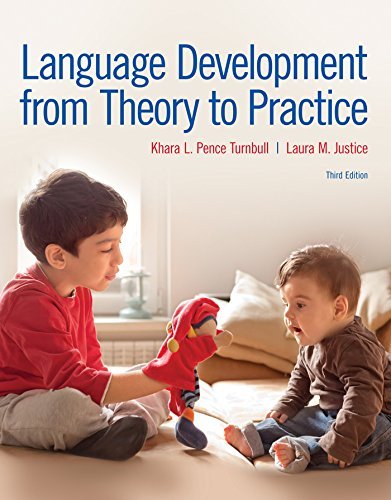
Language Development From Theory to Practice

Rate this book
Language Development From Theory to Practice provides a survey of key topics in language development, including research methods, theoretical perspectives, and major language milestones from birth to adolescence and beyond, and language diversity and language disorders. Each chapter bridges language development theory and practice by providing students with a theoretical and scientific foundation to the study of language development. The authors emphasize the relevance of the material to students’ current and future experiences in clinical, educational, and research settings; emphasize multicultural considerations and how they affect language development; focus on using evidence-based practices for making educational and clinical decisions; show the relevance of a multidisciplinary perspective on the theory and practice of language development; and include a number of outstanding pedagogical features to motivate and engage students.


The new edition builds on the strengths of the earlier editions while featuring a chapter reorganization that promotes better understanding, more detailed coverage of topics of particular interest to students, expanded categorization of language-development theories, and a variety of helpful new pedagogical features.

384 pages, Kindle Edition

Published February 22, 2016

6 people want to read

About the author

Ratings & Reviews

What do you think?
Rate this book

Friends & Following

Create a free account to discover what your friends think of this book!

Community Reviews

5 stars
4 (28%)
4 stars
4 (28%)
3 stars
4 (28%)
2 stars
1 (7%)
1 star
1 (7%)
Displaying 1 - 3 of 3 reviews
Profile Image for Tami.
435 reviews3 followers
February 11, 2020
Read for grad school. Lots of theory & good information about language development, but not a lot of practical application.
Profile Image for Isabel.
390 reviews
July 13, 2023
Hmm. I agree with @Tami who said that this has lots of theory and good info about language development. That is what earns this three stars.

This is a textbook for people planning to work in a speech focused or related field, so it has to tread a fine line. That's what made me appreciate this comment:
In some states, such as California via its 1998 Proposition 227, educational policy stipulates that English should be the official and only language of instruction. ...This is one area in which educational policy does not seem to reflect research findings, at least for English-only instruction. This is because the accumulated research on the benefits of immersion versus bilingual approaches, at least as applied to ELLs in the United States, indicates that bilingual approaches are more effective. (281)

Given that most of the readers of this book are students seeking a state-based certification or professional development hours for maintaining state licensure (like me!) that's a pretty bold statement. Sure, students are reading this, but it is state agencies that are recommending this book as part of coursework. That's quite a diverse set of needs the authors had to meet.

No matter how strong this book is in presenting scientific information, it cannot avoid the fact that cultural bias infiltrates the interpretation and implementation of practices "based" on this science. Here's another place the book whispers, "Be careful..."
Instead, Shiefflelin and Ochs summarized that differences in the communicative interactions between adults and young children "socialize children into different cultural orientations toward communication, meaning, and the social status of children" (p.174) 264

In another spot the authors advise: "It is thus important taht educators learn to recognize and value narratives representing a variety of cultural and socioeconomic perspectives," (215) even though we learn that diagnostics recognize copulas as a sign of advancement, and another section of the book informs us that copulas are simply not used in AAVE grammar.

That being said, the cultural bias of this book bummed me out pretty hard. Especially when it came to the Deaf community. Hard to swallow the image of the happy young woman sporting her cochlear implant knowing that at one point they had a tendency to electrocute their wearers. (Why wasn't this included at all?) Nor do they give voice to all the ways that language is more than something that can be systematically measured with timelines and likert scales.

I am troubled by the emphasis placed on "most children can __ by __ months/years." I would have appreciated just a tiny bit of "still, by adulthood, their language development stands at__." If, in fact, these differences in childhood language development timelines end up with adults who are experiencing language difficulties, I'd like to know what that looks like. If it all comes out in the wash...? Where would that leave us, I wonder.

Still the clear, concise scientific explanations including description of study designs and implications were excellent and earn this book 3 stars.
Profile Image for Amberlee.
166 reviews
May 12, 2023
My professor made these tests difficult, so I spent a good amount of time in these pages. I'm amazed by the way humans acquire language. It's truly incredible.
Displaying 1 - 3 of 3 reviews

Can't find what you're looking for?

Get help and learn more about the design.