Jump to ratings and reviews
Rate this book

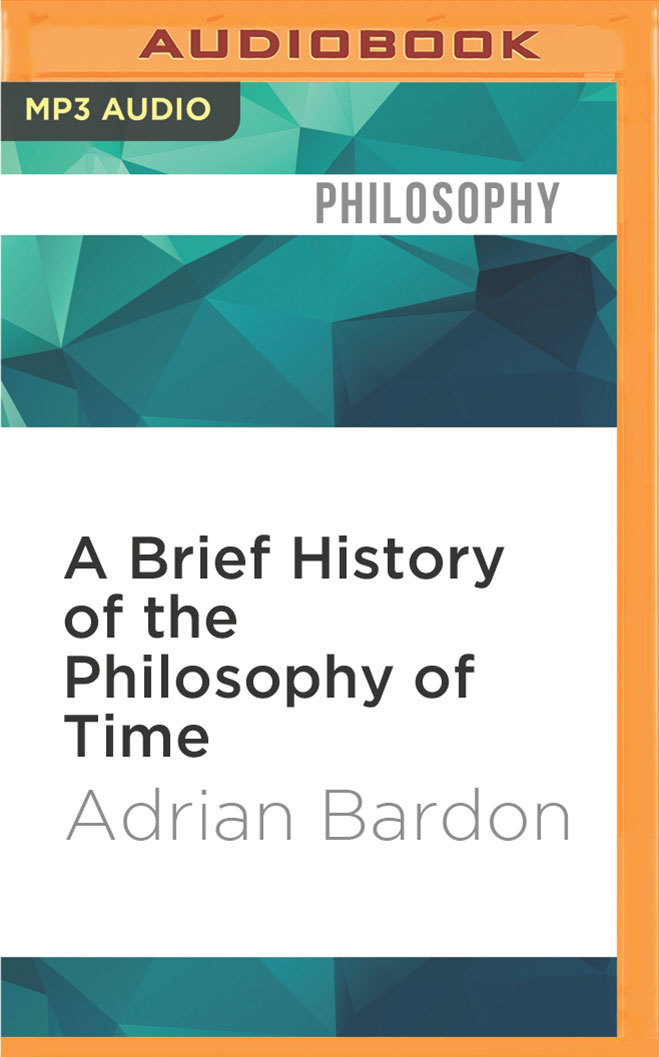
Brief History of the Philosophy of Time, A

Rate this book
Adrian Bardon's A Brief History of the Philosophy of Time is a short introduction to the history, philosophy, and science of the study of time-from the pre-Socratic philosophers through Einstein and beyond.

A Brief History of the Philosophy of Time covers subjects such as time and change, the experience of time, physical and metaphysical approaches to the nature of time, the direction of time, time travel, time and freedom of the will, and scientific and philosophical approaches to eternity and the beginning of time. Bardon keeps technical language to a minimum in bringing the resources of over 2500 years of philosophy and science to bear on some of humanity's most fundamental and enduring questions.

MP3 CD

First published January 1, 2013

69 people are currently reading
642 people want to read

About the author

Adrian Bardon

10 books8 followers

Ratings & Reviews

What do you think?
Rate this book

Friends & Following

Create a free account to discover what your friends think of this book!

Community Reviews

5 stars
88 (29%)
4 stars
116 (39%)
3 stars
75 (25%)
2 stars
10 (3%)
1 star
6 (2%)
Displaying 1 - 30 of 40 reviews
Profile Image for Marc Lamot.
3,450 reviews1,959 followers
December 15, 2019
“If an answer to the question “What is time?” still seems to elude us, perhaps it is because we have been asking the wrong question. Time is not so much a ‘what’ as a ‘how,’ and not so much a question as an answer”
Throughout the centuries, according to Adrian Bardon, the central issue in thinking about time has been whether time actually exists: is time tangible, as all kinds of language expressions (“time is running”, “I have time”) and our intuitive experience suggest? Is it not just a mental construction with which we (unconsciously) make order in chaotic reality? Or is time pure fiction and is there only a permanently shifting present? Dozens of philosophers and scientists have broken their brains on this issue and have taken up contradictory positions.

Bardon nicely takes stock of the discussion, in a very didactic and relatively accessible story. And, happily, his horizon is very wide. Of course, Parmenides, Aristotle and Augustine are discussed, how could it be otherwise. But Bardon also examines what the positive sciences have contributed to the debate. And I don't just mean the physics of the last centuries, especially Newton, Einstein, Planck and Hawking, but also human sciences such as cognitive psychology and neurology. The author explores their findings, theories and models, in a balanced argument. Occasionally he takes a side path that to me wasn’t really necessary, such as his parenthesis on the free will discussion or on the idle question of whether time travel is possible.

His carefully formulated final conclusion, which leaves room for different approaches (relationalistic, idealistic and realistic), will not satisfy everyone, especially those looking for black-and-white answers, but it is wise. It also opens up the prospect of progress, a slowly better understanding of what time is, and thus also reality, especially by asking new (philosophical) questions over and over again.
(rating 2.5 stars)
For a more elaborate review, see my History-account on Goodreads: https://www.goodreads.com/review/show...
Profile Image for Sense of History.
613 reviews891 followers
Read
March 14, 2025
I am approaching the end of my temporary reading program on the phenomenon of time and temporality. This book lists the various philosophical and scientific points of view, especially focussing on the question of whether time is real. To be honest, no matter how interesting, I think this is a very academic issue. As a historian I can only ascertain, and so does Adrian Bardon, that for us humans time indeed is tangible, that we constantly live 'in' time, and that we cannot but use notions of time and temporality in our lives to organize the world. Agreed, the notions past-present-future are vague and problematic, but we constantly use them to orient ourselves through chaotic reality. As Bardon correctly states, we cannot and must not ignore that empirical experience. “Our experience of the world is real and fundamentally involves dynamic temporality and temporal directionality. Whether or not a theoretical objective perspective would include change and direction is irrelevant to our human concerns.”

Of course, these theoretical approaches are relevant to a certain extent in formal historiography. Just think of the fierce discussions at the end of the last century, when the question was asked from a postmodernist perspective whether the study of history was not merely a representation, a construction, and - in its most radical version - independent of the question of truth. That approach was not senseless, because history to a certain extent IS a construction, there is no other way to put it. But the disconnection from the question of truth was clearly a bridge too far that opened the door to fatal relativism. Fortunately, the dust has settled down a bit, and reason has largely returned.

Just like Bardon concludes that different approaches are relevant but that we cannot ignore scientific realism, I argue for a step-by-step, careful questioning of the past, in a methodologically responsible and transparent manner, with insight into the immanent subjectivity, but also with a belief in a gradual growth of our knowledge of the past every time we approach history with specific questions from our own context. Acquiring 'ultimate' knowledge about the past is an utopian pursuit. But a pragmatic approach, aimed at a better orientation in the historical reality, and therefore also in the reality of today and tomorrow, is and must be the appropriate way that can be provided by the study of history. Nothing more, but certainly nothing less.
Profile Image for Jenny.
1,212 reviews102 followers
September 3, 2014
My brain isn't on a philosophy level today, but I really enjoyed this book. It's a good overview of the philosophy of time, just as Stephen Hawking's classic A Brief History of Time is a good overview of theoretical physics. This isn't a favorite, though, as Hawking's is because it's not as friendly in tone. I felt like I knew Hawking after reading his book, but Bardon feels to me like the aloof, always thinking philosophers that he says are just stereotypes. I see that philosophy is open to all fields, such as mathematics and physics, but Bardon's level is somewhat Olympian in nature.
Why did I give this book four stars, then? Because it makes sense, it's well written and well organized, and it's brief enough not to make my head hurt while still satisfying the question that I began reading with: what is the philosophy of time? If I ever had a question or needed to look something up quickly, I would use this as a reference. And in fact, Bardon used it as a text in his course on the philosophy of time.
(Now that I wrote several questions, I wish I had written my entire review this sophistic way, but I'm too mentally tired to actually rewrite it...)
I recommend this to any curious and pensive souls, to people interested in philosophy, and to literature lovers who read authors that were philosophy majors (i.e. David Foster Wallace and Jonathan Safran Foer) and want to know more about the groundwork of their theories on time that influence their writing.
Profile Image for Tuğçe Kozak.
278 reviews284 followers
Read
October 19, 2018
Bir buçuk ayda da olsa sonunda bitti. Kendisini Ntv yayınlarının çizgi bilim serisinden Zaman isimli kitapla beraber okudum tabi arada biraz uzaklaşıp öyküler romanlar okusam da sonunda kitabı bitirdim. Zaman felsefesini bir çok filozof ve bilim adamının görüşleriyle işliyor kitap, konuyla çok ilgilenmiyorsanız ağır gelebilir o açıdan es vererek araştırarak okumayı faydalı buluyorum.Kitabı tabi ki de ‘anladım zaman buymuş ‘diyerek bitiremiyorsunuz. Ama kafamdaki belli sorulara cevap oldu ve kafama yeni sorular doğurdu bu açıdan faydalı bir okuma oldu .
Profile Image for Benjamin Bryan.
Author 2 books35 followers
November 18, 2017
A good and approachable survey of the philosophy of time. The book includes the implications of modern physics to traditional schools of thought on the existence/function of time.
Profile Image for Stany.
36 reviews12 followers
February 6, 2018
Often what you are looking for is right in front of you. This is the case with this book. One of the big questions addressed in the book is whether there is such a thing as "passage of time". Well the proof is given by the book itself. The time you spent reading this book is wasted and can never be recovered.

Now let's be honest. Many of the questions asked in this book are very good. What bothers me is the approach the author takes to answer them. In particular, I object to the way he uses concepts and ideas from physics to motivate his point of view. The author shows a distinct lack of understanding of what relativity theory and quantum mechanics say. Or worse, he wilfully misrepresents them. As an example, he claims that action-at-a-distance is inconsistent with relativity theory. Well, it is not. Contrary to philosophy, where it is sometimes viewed as a sign of greatness, in science when a theory is inconsistent it is relegated to the long list of "that was a great idea, but ...". And as far as I know this has not happened with relativity theory.

Another example that bothered me is how he claims that there is no logical impossibility of time-travel. Regarding the famous grandfather paradox (you go back in time to kill your grandfather before you can be conceived), he says the solutions is simply that you would not be able to kill your grandfather. Period. Then comes a whole rant about why this does not cause a problem with free will. But frankly nothing sensible.

Some of the chapters, surprisingly those that were not really about time, were a little better.

But in summary. A waste of time.
Profile Image for Gordon.
14 reviews2 followers
February 15, 2018
A very readable and engaging introduction to the philosophy of time which, incidentally (or perhaps not so incidentally), touches on other important questions such as sensory perception, free will, time travel, and cosmology. The author draws from ancient philosophers, enlightenment thinkers and scientists, as well as contemporary philosophers and scientists, and helpfully highlights key concepts and ideas through bold text. In general, Bardon represents fairly both sides of an argument, although I do think that he too easily embraces a naturalistic framework, devoid of free will. The conclusion about time? "Relationists have a point in that much of what we have to say about time has to do with our mode of organizing and relating events...Idealists are right in that our grasp of time will always be mediated by our way of understanding things...Realists, however, get support from the fact that there are, objectively, more and less successful models of reality...[and] results in logic and physics entitle us to speak authoritatively in terms of a static space-time continuum." If, as he comments in his introduction, the harder part of philosophy is knowing exactly what questions to ask, then I believe that the author has done as much hard work as could be expected in this brief history.
6 reviews
October 29, 2019
The very best book on time for a layman

I have read and tried to read many books on this fascinating but maddening subject. This book is the most intelligible and intelligent compendium of 2400 years of thinking about the nature and contradictions of time. The author teaches them succinctly without ever insisting on one true answer. He leaves us much better equipped to ponder the questions without forcing us to accept any of the best answers - so far! It may be the perfect example of epistemology.
Profile Image for Lloyd Downey.
753 reviews
February 7, 2024
I've always been curious about time and thought that, maybe the philosophers might be able to shed some light. However,, even after completing a course on the Philosophy of time I was still mystified...maybe even more mystified than before. So maybe Adrian Bardon had the answers in this book? Alas, no. It is pretty much a re-run of the undergrad course that I did in The Philosophy of time. Interesting, yes...especially the history and the distinction between the three attitudes towards time: viz Over the centuries, theories about the nature of time have resolved into three main categories: idealism, realism, and relationism. Idealists believe that time is a merely subjective matter, and nothing in reality corresponds to it. Realists maintain that time is a real thing, a kind of underlying matrix for events. Relationists take something of a middle path; they believe that time is just a way of relating events to each other, but the relations it describes are real.
On Aristotle’s relationist view, time is a mere abstract measure of change. Newton’s theory, by contrast, treats time as a real thing unto itself. With this theory, Newton has fundamentally broken with the Aristotelian perspective holding time to be dependent on change; change is now best described as something that happens in time, even as time itself flows along. For an idealist like Kant, the most accurate way of talking about time would be adverbially, as a way of describing how we experience things. Newton treats time like a thing itself not, indeed, a material substance like a tree, a cow, or a body of liquid, but still something that has noun status. His understanding of time is therefore radically different from either a relationist or idealist conception: This is the return of temporal realism.

Leibniz's alternative is a conception of time and space as a set of relations holding between, respectively, events and objects. He was not a realist, in that he denies that time exists in itself. Neither is he an idealist, in that, like Aristotle, he thinks the time relation is a legitimate category for scientific and mathematical accounts of the universe. Thus we classify Leibniz as a relationist, just like Aristotle; the major difference between the two is that, like Augustine's, Leibniz's conviction about the nature of time is based primarily on a perceived conflict between temporal realism and religious dogma.

However, Leibniz has no convincing explanation for the water's centrifugal effort in Newton's spinning bucket. All Leibniz can say is that, well, such is the nature of circular motion: It exhibits a force that other sorts of motions do not. Newton's laws, in conjunction with his postulation of a universal gravitational force, do a very good job of explaining and predicting observable phenomena.

The question about space tends to be "Is space real?"; whereas the question about time (instead of "Is time real?") often becomes "Does time really pass?" But the latter presupposes the main question. If we want to coherently think of time as a thing that passes, it would seem we need to think of it as a thing, at least in some sense of
'thing’?

Relativity tells us we must think in terms of a real quantity, space-time, in order to address the ancient question of the reality and nature of time. Or, to put it a little more modestly, the stipulation that there is such a thing as space-time works in creating an effective mathematical model of what is going on. Now we need to understand space-time a little better, because we need to get into position to ask the question: Is space-time real?

Spatial distance can be measured by the amount of time it takes light to travel from one point to another; thus the concept of a light-year' (i.e., the distance travelled by a beam of light in one year). This means that there is a deep connection between the measurement of temporal intervals and the measurement of spatial intervals...... spatial distance can be measured by the amount of time it takes light to travel from one point to another; thus the concept of a light-year' (i.e., the distance travelled by a beam of light in one year).

Minkowski came up with a clever way of visually representing space-time, though only from the perspective of a particular observer: the light cone. From a given perspective, all of reality can be divided into three components: one's past light cone, one's future light cone, and ones absolute elsewhere.

Scientific realism is the view that successful scientific theories are to be taken literally: The entities that they describe, both the observable (like comets or three-toed sloths) and unobservable (like electrons or space-time), are to be taken to truly exist as described. The alternative is that the point of fundamental physical science is just to create a model that is essentially pragmatic, in that its purpose is just to help us systematize observations and predict events as we know them (and only as we know them). This alternative to scientific realism is called scientific instrumentalism.

Whether we take physicists' pronouncements about the nature of space-time to be relevant to reality depends on whether we take reality to be the subject matter of physics. The right answer to this will likely be nuanced and may require a modest interpretation of physical theories.

In terms of time and emotion...such as anticipation....all that is really going on is that at 2:15 p.m., I am apprehensive about my imminent tooth extraction; at 2:30 p.m., I am distressed about the pain as my tooth is extracted; and at 2:45 p.m., I am relieved that the experience is over. That's it. This account includes a sequence of appropriate, time-dependent emotional states, without having to be committed to one of these times actually being now and the others as past or future. The absence of any absolute now is perfectly consistent with my having beliefs, at any moment, as to what is 'currently happening, and as to what lies in the past or future.

Re: time with cause and effect: Unfortunately, although the causal analysis of temporal asymmetry may look attractive in some ways, it appears to presuppose the very concept that it aims to explain. The problem is that of coming up with a definition of causation that does not itself rely on the concept of temporal asymmetry. It would seem natural to define a cause as an event that brings about another event, or, alternatively, as an event that precedes another event according to natural laws. But each of these employs the notion of temporal precedence in defining the concept we want to use to analyze temporal precedence. We can't solve this problem by defining a cause either as an event necessitating another, or as an event increasing the probability of another (i.e., A causes B if events of type B always come after events of type A, or if events of type B typically come after events of type A). Remember —as we noted in discussing the thermodynamic arrow-that no sequence of events is truly irreversible according to the laws of nature.

One account of causation views the causal relation as a primitive, unanalyzable notion....... One big problem with holding causation to be primitive, however, is that this would seem to make knowledge of causal relations impossible. As David Hume pointed out, we do not experience causal relations over and above experiencing the related events themselves: All we ever actually experience are associations of events. It is the experience of these sequences of events that leads us to the idea that the events are causally related.

With the diffusion of ink in water. We have talked about how it is possible, if highly unlikely, for such a process to reverse itself and turn into a process of concentration, wherein the ink molecules happen to gather themselves together. [Actually, I’ve seen this done with rotating water and an ink spot....when the rotation is reversed the diffused ink collects back together in a single spot......pretty remarkable!!]. Note how the very description of the thermodynamic probabilities presumes a direction to time. The ink, we say, diffuses....... The statistical tendency toward (as opposed to away from) disorder is only the norm if we have assumed that time has a direction, and that processes tend to become more disorganized in that direction. Even calling a process "diffusion" rather than "collection" betrays the fact we have already established a direction for the process.

Clearly, psychology is the main reason why we tend to assign a particular direction to time. We remember only in one direction (backward") and anticipate in the other ("forward"). Why do things work this way? Why do we remember the past and not the future? At one point, Stephen Hawking proposed that memory and entropy are linked. In forming a memory, we reconfigure our neurons. This creates a local increase in order (within parts of our brain responsible for memory), but only at the expense of a slight expenditure of energy, a dissipation of bodily heat, and an overall entropy increase.

If time travel to the past is consistent with the laws of nature, then past events could be caused by future ones; this would lend further credence to the notion, put forth by Huw Price and others, that the one-way directionality of time is not an inherent aspect of nature.

So far we have only talked about travel into the past. If passage is real, then we travel into the future, so to speak, all the time. We also know, thanks to Einstein's special theory of relativity, that it is really pretty easy to 'slide' into the future simply by accelerating oneself around for a bit before returning to one's point of origin....... So far we have only talked about travel into the past. If passage is real, then we travel into the future, so to speak, all the time..... The more distance one traverses in the spatial dimension of space-time, the less of the temporal dimension one will have traveled, and vice-versa (within certain limits).

Unfortunately for Leibniz, compatibilism doesn't work very well in a theological context, if the point is to defend individual moral responsibility: According to his own understanding of things, God would be the one who intentionally created us with just such a nature that under the circumstances also preordained by God—we would do exactly as predicted. How could God then turn around and hold us responsible for the consequences? For this reason, theists tend to reject compatibilism in favour of a stronger notion of free will....... Kant's fellow German, Arthur Schopenhauer, succinctly expressed the paradox within compatibilism with the aphorism "Man can do what he wills but he cannot will what he wills."

It is indeed hard to accept the notion of a beginning to time.
Wouldn't a beginning to the universe have to be preceded by something that gives rise to it? But then this so-called beginning would not be the beginning of time itself: It would just be something that happens in time.

But it is not clear whether this information [Higg’s field, Higg’s boson] would do anything to address questions that Aristotle and Kant raised about the conjunction of temporal realism with the thesis that the universe had a beginning. If the Big Bang was the beginning of space-time, then space-time had a beginning. To make sense, this needs to be thought of as a beginning to time rather than a beginning in time: One lesson learned from Aristotle is that a beginning of time in time doesn't make any sense. It remains to be seen, though, whether we can make sense of a beginning to time.
One account that would avoid this problem is a version of the multiverse theory, where our universe is a development of, or from, another one inaccessible to us.

According to Bardon, multiverse theory is pretty depressing: In addition to reminding us of our own seeming insignificance in a vast universe, this theory makes our entire universe just a kind of multiverse belch. More to the point, the multiverse idea is both implausible and unhelpful when it comes to understanding time. First, the proposed existence of these other universes has no observational consequences, and the principle of parsimony in science (also known as 'Occam's razor') suggests that we should not posit any entities or phenomena not necessary to explain what we observe. Unnecessarily positing an infinity of other universes appears to constitute the ultimate violation of this principle, until and unless the multiverse is shown to be the best explanation for some data before us or shown to be strongly implied by a well-confirmed theory.*

Second, it is not clear—at least in the context of this discussion—that the notion of 'another' universe makes any sense: If it exists, is it not part of the universe by definition? There are other, technical contexts in which the notion of multiple universes may be useful, but it remains to be seen whether any such context would be pertinent to the fundamental philosophical question about time.

It is indisputable that the conclusions we have already reached about time do not mean that we should (or even can) abandon our ordinary ways of thinking about time, given that our experience of it is inherent to perceptual and emotional awareness.

Building on what we have learned from the history of the philosophy of time, I would propose the following: If an answer to the question "What is time?" still seems to elude us, perhaps it is because we have been asking the wrong question. Time is not so much a 'what' as a 'how,' and not so much a question as an answer. Time as we know it in experience is a matter of how we adaptively organize our own experiences; in a physical and cosmological context, it is a matter of how we can most successfully model the universe of occurrences. As such, time is an answer: a solution to the problem of organizing experience and modelling events.

So who is right, the relationist, the idealist, or the realist? The answer lies partly in seeing that each position has something to be said for it.
Relationists have a point in that much of what we have to say about time has to do with our mode of organizing and relating events. In that sense, you could call time a kind of relation. The measurement of time is possible only in terms of observed motions or changes, such as the orbit of the Earth. It is for this reason, as relationist P. J. Zwart points out, that we say (albeit only metaphorically) that "time stands still" in a place where nothing changes...... Idealists are right in that our grasp of time will always be mediated by our way of understanding things. Temporal experience is a kind of construction, rather than a mere reflection of nature. We can never penetrate to the sheer, naked reality of things as they are in themselves, unmediated by the conditions under which we experience things...... Realists, however, get support from the fact that there are, objectively, more and less successful models of reality...... The goal of the physical scientist is to find the most comprehensive and effective theory of nature. A theory that treats space-time as real exhibits a good 'ft' with observation in the limited sense that it is simpler while yielding wide-ranging explanatory and predictive power........ It is true that we can never know the universe or its laws independently of the conditions under which we can experience them. Yet the guidance we are able to glean from reality—via the experimentally confirmed replacement of inferior models of nature with superior ones —means that, despite inescapable limitations, we can hope to move closer to the truth. This fact makes some kind of realism about time, and a continued commitment to related ontological questions, defensible and even fruitful.

Regarding the nature of time itself, results in logic and physics entitle us to speak authoritatively in terms of a static space-time continuum.
At the same time, philosophy by examining the necessary conceptual presuppositions of experience), together with various empirical studies (such as neuroscience, psychology, evolutionary studies, and even social sciences like anthropology), can clarity the nature of, and limitations on, our experience of time.
These studies can validate our projective and irreducible experiencing of time as dynamic, as long as such validation is understood in the proper context.

The philosophical study of time and time awareness has yielded other substantive achievements. Zeno's challenges, for example, help us clarify what we mean by change and motion. Philosophical questions about temporal experience show us what to look for as we study time perception in the brain. The logical analysis of the dynamic theory of time bolsters the physical case for the static theory and helps us distinguish between real phenomena with respect to time awareness versus mere conceptual presuppositions; it also leads to important hypotheses about time awareness for evolutionary theory to pursue. The philosophical analysis of proposed explanations of time's directionality tells us what would or would not count as a scientific solution. A philosophical examination of the logical possibility of altering the past, in combination with a physical understanding of space-time, tells us what sort of time travel is possible. Chrysippus' conceptual analysis of freedom, together with an appreciation of the static theory of time, shows us what free will can (and cannot) amount to; this discussion, furthermore, needs to be taken into account in the application of the concepts of responsibility and justice in social contexts.

So Bardon more or less ends up with a bit of a damp squib....Space time gives us some good answers but doesn’t appear to be the complete answer and he gives lip service to a whole host of other disciplines without really demonstrating that they have anything solid to offer. So I’m not much further ahead than I was with my undergrad course. Pity. Still not a bad book. I give it four stars.
6 reviews
June 4, 2021
The introduction actually provides a really good overview on how philosophers go about investigating any difficult issue and connects the discussion of their methods to time.

Chapter 1 "Time and Change" contrasts the Eleatic (Parmenides, Zeno) idealist view of a timeless world with Aristotle's relationist response, which only partly addresses their objections to the existence of time, then moves on to the idealism of St. Augustine, pointing out the flaw in his view as well (where do temporal concepts or "ideas" come from in a timeless universe?)

Chapter 2 "Idealism and Experience" Discusses Locke's realist empiricist view on time and a mistake in it. I learned that Locke, primarily known as a political philosopher, developed empiricism ("All we learn is through experience and reflection upon it") as a direct reaction to the then prevailing claim that political and religious authorities had special insights to The Truth hidden from common folks, thus justifying their exalted status.
Then Kant's idealism is explained, but other than that his view also has problems, it was difficult to understand. (personal note:I think Kant is overrated simply because his ideas are apparently so difficult to understand or unclear that different philosophers come to different, and at times mutually contradictory conclusions about what he meant. That, to me, is not the mark of good philosophy, which is above all characterized by clarity). Finally, more modern philosophical approaches are discussed and compared to the results of psychology experiments like the phi phenomenon, Flash lag effect, the cutaneous rabbit and cross-saccadic continuity, which indicate that to a certain extent, we "reconstruct" time, duration or temporal order in our minds.

Chapter 3 "Time and spacetime" first describes the features of a Newtonian conception of time (and space) as an absolute thing in of itself, which replaced the relationist view of Aristotle and his physics, which considered time as essentially a device for tracking change. Subsequently, it contrasts it first with Leibniz's view of time as a relation between events, then with Einstein's relativity, where realism about time is replaced by realism about spacetime.

Chapter 4 "Does time pass?" Is divided into "reasons to think not" and "why it seems it does". The first part gives an accessible account of McTaggart's argument against the passage of time (though I don't follow why the problem with his A-theory isn't already in the set-up, by taking a future contingent to be true. "P will happen" in a sense can never be true: before it has happened, it is not a fact yet, and once it happens and thereafter, it has already happened. I see his infinite regress as merely confirming that we cannot take a future contingent to be true, not an argument against the passage of time).
Then it gives a reason against passing time from special relativity, but stumbles. It says "as strange as it sounds, if relativity is right then the dynamic theory of time is wrong". No! Only any *global* dynamic theory of time is wrong. But then, already the relativity of simultaneity tells us that time in relativity cannot be global. The insistence on "globalizing" time in relativity is what leads to the block universe view.
The second part does a good job of showing the drastic consequences of a static view, which unfortunately too few of its proponents seem to be aware of, e.g. rendering reality unknowable beyond our immediate sense impressions by annihilating causality, laws, probabilities etc. Everything becomes just one grand set of conjunctions e.g. each time you drop an object, it cannot be that the law of gravity "causes" it to fall, since a "cause" would presuppose a dynamic "before" and "after", which in a static universe do not exist. There is no law, only a conjunction of an object falling with an object being dropped.
The author then gives his own theory that the passage of time is mind-dependent: a psychological projection, the ascription of objective status to something inherently subjective, like color or virtue. The final passage in the chapter in my opinion throws the towel too soon on the prospect of science ever becoming reconcilable with our experience of time.

Chapter 5 "The arrow of time" briefly discusses the psychological, thermodynamic and causal arrows. It then brings in quantum physics and makes the claim that quantum entanglement "fundamentally conflicts with standard relativistic physics".
The issue is a very subtle one, and until we understand the mechanism for the enforcement of the quantum correlations, we cannot be absolutely certain, but under the standard textbook interpretation of Quantum Mechanics and the assumption that nothing is being superluminally trasmitted(very likely), the claim is false. I have explained this in some detail here:
https://www.quora.com/Does-quantum-en...

Retrocausation is considered favorably by viewing causation as a human projection enabled by the thermodynamic arrow of time against a fundamentally time-symmetric universe.

Chapter 6"Is time travel possible?" considers the question first from a logical perspective, discussing the grandfather paradox and concluding that it does not logically prohibit travel into one's past but only inconsistent stories about how the world is through time. It then considers time travel from the perspective of physical possibility, briefly discussing the Gödel Universe, wormholes and the twin paradox before concluding that, in the sense portrayed in science fiction, it is practically impossible to travel into one's past. It concludes with the question of why in a static universe travel into the future ("aging") is so much easier than travel into the past. I personally interpret this as evidence that the universe is not static.

Chapter 7 "Time and Freedom" begins by discussing forms of fatalism, which involves the absence of alternative possibilities: logical fatalism is discussed as a consequence of the application of two logical principles to future events: the principle of bivalence (also called law of excluded middle) and the principle of non-contradiction and implies that we are not free. In my view, the problem here is that non-modal logic is applied to an inherently modal situation, so I see logical fatalism as the result of misapplying logic. Metaphysical fatalism is discussed in relation to the static universe, and a way to escape absence of freedom due to Oaklander is proposed which I had trouble understanding as such.
Causal determinism is contrasted with fatalism (determinism: causal chain necessitates a particular future, fatalism: if statements about the future are timelessly true or false, then everything necessarily occurs as it does occur) and is then linked to scientific naturalism.
Compatibilism is offered as a response to both determinism and fatalism and some its implications are considered.
Chapter 8 " Could the Universe have no beginning or end in time?" expands the scope of inquiry to the entire universe, contrasting the views of Aristotle, Kant and Leibniz with modern cosmological findings, giving a brief review of modern physics as well as speculative extrapolations of it, and also delving into some theological questions. It concludes by wondering whether certain questions are simply unanswerable.
The epilogue considers this in more depth for the question "what is time?", coming down on the side that time may be more of an answer, namely to the question of how we organize our experiences as well as events all around the world. It concludes with a brief review of the many issues touched in the book.

Overall, this is a mostly good and accessible introduction to the philosophy of time. There are a few mistakes here and there (Leibniz was German, not Austrian; an infinitesimal distance is not zero etc.) but not enough to drag the work down significantly, except for a couple physics mistakes: 1) the author's failure to recognize that special relativity does allow for a local dynamic description of time, 2) the almost certainly false claim that Quantum Entanglement "fundamentally conflicts" with special relativity.
As the author's sympathies for a fundamentally static universe seem to spring in part from these misapprehensions, they should be taken with a grain of salt.
Profile Image for Shamiram.
192 reviews
Read
September 8, 2023
if i am being honest with myself, i do not think i will be finishing this book.
Profile Image for Addy.
214 reviews1 follower
July 25, 2021
"And yet for all the arguments of philosophers and physicists, the notion of giving up on dynamic change and the passage of time seems not only wrongheaded, but impossible. The primary reason for this is the way the difference between past, present, and future is wrapped up in deep-seated psychological and emotional attitudes that are universal to human beings. For example, the static theory entails that a deceased loved one is always alive at an earlier time. But knowing that the static theory of time is true doesn't make the loss of a loved one any less painful. Albert Einstein pretended otherwise. Speaking at the funeral of his old friend Michele Besso, Einstein said: "Now Besso has departed from this strange world a little ahead of me. That means nothing. People like us, who believe in physics, know that the distinction between past, present, and future is only a stubbornly persistent illusion." [...] The disconnect between what one knows and what one feels in this instance is striking."

"It seems nonsensical to suggest that our statements involving past, present, and future could, or should really be rephrased in terms that don't involve changing temporal determinations. This would require us, among other things, to admit that our feelings of relief, regret, fear, and hope are entirely misplaced. In Kurt Vonnegut's Slaughterhouse-Five, the protagonist comes to experience his whole life timelessly. He begins to appreciate that all the events of his life simply "be," rather than come to be and pass away. This actually instills in him a sense of peace in thinking both about missed opportunities during the early parts of his life, and his own death at the other, timeless end of his existence. But life isn't like this. This is not the way we actually experience things."

"This doesn't mean that dynamic change really happens. It only means that change is an indispensable part of our basic conceptual scheme—a necessary conceptual presupposition that makes coherent experience possible. As with the case of virtue and vice, our attribution of change to events in the world is a matter of projection, though in this case, this way of representing the world is necessary to our having any coherent representation of the world at all."

"Because the alternative is to kill the patient in order to cure the disease, our conclusion to the issue of reconciling our perception of time with the logic and science of time must be to accept that there will never be some sort of final unification of experience and reality. Logic and science will tell us one thing about reality, even as our perceptual and cognitive faculties shall, and must insist otherwise."

"As it is with "what time it is now," the direction of time means something to us, but it appears to mean nothing to the universe."

"The answer for Kant is "none of the above." Time is neither an infinite nor a finite quantity, because it is not a quantity. The problem with arguing about the extent of time is that time does not have an extent. Time is just the form in which we experience events, rather than a real bounded or unbounded container for events."

"We are capable of articulating questions that are grammatically well-formed, but literally have no answer. It may be that "why does the universe exist" is one of those questions. This is frustrating, but no one promised us that there was an answer to every question we are capable of asking. Our dissatisfaction with unanswerable questions, or with Hawkings' finite yet unbounded and unexplained space-time likely stems from an instinctive expectation, based on a natural and adaptive tendency to look for theories about how things work around us. If so, such dissatisfaction has more to do with the psychological resistance to accepting things the way they are than with a lack of information. A common problem, accepting our own mortality, is another example."

"My beliefs about the here and now, as well as about the subjective past and future, explain not only my actions, but also my emotions. Such beliefs constitute the essence of my basic experience of the world. Clearly, we would be missing something important if we totally ignored these perspectival assessments in favor of what things look like from the impersonal universe's standpoint. For one thing, we would be unable to live. This tension between what is objectively the case and what is subjectively significant is reminiscent of the existentialists' conclusions in light of their belief that the universe is godless and inherently valueless. Existentialists like Nietzsche, Camus, and Sartre characteristically hold this belief, yet insist that our choices, moral and otherwise, with regard to what we find important, do matter. Even though they also characteristically hold that freedom is itself an illusion, they maintain that our choices imbue the universe with value [...] Our lives are of no concern to the universe, but they are of immense concern to ourselves. And isn't that enough to go on?"

"As such, time is an answer—a solution to the problem of organizing experience and modeling events. So who is right: the relationist, the idealist, or the realist? The answer lies partly in seeing that each position has something to be said for it. Relationists have a point in that much of what we have to say about time has to do with our mode of organizing and relating events. In that sense, you could call time a kind of relation. The measurement of time is possible only in terms of observed motions, or changes, such as the orbit of the earth. It is for this reason that we say, albeit only metaphorically, that "time stands still in a place where nothing changes." Idealists are right in that our grasp of time will always be mediated by our way of understanding things. Temporal experience is a kind of construction, rather than a mere reflection of nature. We can never penetrate to the sheer naked reality of things as they are in themselves, unmediated by the conditions under which we experience things. Whatever we come up with as a description of nature will always represent a particular way of understanding nature, and never a final, unique, fully independent description. There is no way for us to step outside ourselves as a species and directly compare our representation of nature with nature in itself, in order to see if the former is an accurate reflection of the latter. Realists however, get support from the fact that there are, objectively, more and less successful models of realities. One of the best illustrations of this principle is the Michelson-Morley Experiment, and the way in which it pointed to the superiority of the theory of relativity over Newtonian absolute space and time. Einstein-Minkowski's space-time is part of a demonstrably superior representation of reality. It explains more and allows better predictions, even as physicists work on an even better theory."
Profile Image for  Amirali.
43 reviews2 followers
May 22, 2021
This is a book that does not dodge the big issues. Nor is it a book that leaves everything to science. Equally, it is not a book that shies away from the fact that science has a lot to tell us both about our own cognitive processes and the way we see the world, and about the way the world is, in itself. It appeals to a range of empirical findings and conjectures and takes seriously the idea that in coming to paint a full picture of our world and our place in it we need to fully amalgamate the findings of science with metaphysical enquiry. Moreover, because Bardon is interested not just in the nature of time as it is found in physics and metaphysics, but also in our place in a world that has time of that kind, the book will be of broad interest to those interested in how we, as agents in time, experience the world and how we explain the way we experience the world. Bardon focuses on question that go well beyond the issue of why we have the temporal phenomenology we do -- why it seems to us that time flows (if indeed it does) and why the now seems particularly important to us. He goes on to consider the question of whether, if certain views of time are correct, we as human agents have any freedom at all.
Profile Image for Alfred Yun.
43 reviews2 followers
March 28, 2017
Time is difficult to understand, because it is so fundamental to our experience. This book introduces you to the conflict between the Time of physics and Time as we experience it. The conflict, as Kant pointed out in his famous antinomy, seems to be irresolvable, since we cannot actually detach ourselves from Time as we experience it.

It would have been more interesting, if the author touched on Heidegger who examined Time as we experience it, which is honestly more interesting than McTaggart's inquiries.

Profile Image for Elizabeth F..
11 reviews
June 19, 2014
A slim little book packed full of provocative ideas. Bardon has a lively and engaging style and yet he doesn't dumb down the science or the philosophy. Although only about 170 pages long, this book took me two months to read, mostly because I'd read a section or two and then I'd pause and reflect ... well worth the effort for all the insight Bardon provides. If you've ever wondered whether time travel is possible, for example, look no further than this Brief History.
Profile Image for Joe Kurtek.
159 reviews
May 12, 2020
If you want to learn about the philosophy of time intertwined with a lot of physics and it’s evolution through history, this is a pretty interesting book. I thought it was a good read, but some of the abstract thought about space-time just kind of drags for me.

If you like philosophy, physics and cosmology - this is the book for you.
Profile Image for Ronin Aurelia.
2 reviews1 follower
February 1, 2024
Should be required reading for anyone who can read and should be read to those who cannot. Do I wish certain concepts had been explained further? Yes, frequently. But, at the end I realize this might just be the way the book begs to be read a second, third, or fourth time and it’s certainly a way to catalyze independent study in the reader.
Profile Image for Trevor P. Kwain.
Author 10 books2 followers
May 15, 2021
A great introduction to the concept of time. Very comprehensive. It covers the work done across millennia, from Greek philosophers to modern physicists, touching many points of view while keeping the subject approachable. Not ideal if you are already an expert on the subject.
Profile Image for Julián Hidalgo.
13 reviews
April 14, 2015
Well explained and very interesting. Excellent as a starting point.
Profile Image for Berktuğ.
33 reviews31 followers
March 15, 2024
"Shakespeare'i biraz bağlamından kopartırsak, hata belki de yıldızlarımızda değil kendimizdedir."


Bilimler bilimi Felsefe hakkında yazılmış bu muhteşem eseri yorumlamadan önce benim felsefeye bakış açımı anlatma gerekliliğini hissediyorum. Böylelikle neden kurgu-dışı dediğimiz türe ait bu kitabın her daim başvurulabilecek müthiş bir kaynak olduğu ve neden kusursuz olduğu daha rahat anlaşılacaktır.

Bana göre insan bakımından felsefe pratik ve teorik felsefe olarak ikiye ayrılır. Pratik Felsefe, dil öğrenimiyle beraber bilincin oluşmasıyla başlayan tamamen doğal bir süreçtir. Çocuk içine doğduğu bu uzay taşını anlamaya çalışma refleksiyle sorular sorar ve doğruya ulaşma çabasıyla cevaplarını arar. Her çocuk bu sebeple birer felsefecidir. Bu süreç içerisinde "Doğru kabul edilen yanlışlara" da maruz kalacak olan çocuğun zekasını da bunların arasından sıyrılma yetisi belirler. Pratik Felsefe büyüyünce de bitmez kuşkusuz. Yapılması kolay olan bu felsefe düşünebilen zihinlerin en güvenilir yardımcısı olacaktır yaşamı boyunca.

Teorik felsefe ise bu işin tarihine girer. Soru kalıpları üretir ve çağlar boyunca cevaplanamamış soruları ya cevaplar ya da sormaya devam eder. Teorik felsefeye maruz kalmak ise pratiği kadar kolay değildir. Ya direk felsefe öğrencisi ya da bir başka bilim dalının öğrencisi (her bilimin bir felsefesi vardır) olma gerekliliği vardır. Üçüncü yol ise tıpkı bunun gibi felsefe kitaplarını okumaktır.


Direk felsefe öğrencisi değilseniz bu ikili arasındaki en doğru uyum önce pratiğini yapıp sonra teorisine geçmektir. Nitekim zaman felsefesi modern insanlık kadar eski tarihiyle hala cevaplanamamış bir soru olduğu için pratiği de eninde sonunda teoriyle tanışma ile son bulur. Yaşamım boyunca zaman üstüne düşünmüş biri olarak en azından bu kitap sayesinde zaman konusunda hem felsefi hem de fiziki açıdan ulaştığım sonuçların tarafını da öğrenmiş oldum.


"Kısa Tarihi" şeklinde derlenmiş her esere önyargı ile yaklaşırım çünkü kısaltılabilen bir şeyin uzun halinin olmasını yadırgarım. Bu kitap konusunda da fikrim geçerli, kitap olduğu haliyle tam olarak olması gerektiği gibi. Açık bıraktığı kapılar veya değinmediği taraflar yok. Ki böyle bir konuda her tarafın detaylı savunmasına, her teorinin en ince ayrıntısına girmeye de gerek yok. Zaten kitapta "tarih" sadece hem sağdan hem soldan gelen fikir atışmalarının kronolojik sırası için kullanılmış durumda. Çünkü zaten yazarın da henüz başlarda vardığı sonuç gibi;

"Belki şeylerin zamansal temsili, sınırlı bakış açımız dikkate alındığında iki boyutlu bir resmin üç boyutlu bir manzarayı işaret etmesine biraz benzer şekilde, sadece yapabileceğimiz en iyi şekilde dünyayı resmetme yolumuzdur."


İçerik olarak kitabın neden bu kadar değerli olduğu konusuna gelecek olursak, ilk sırada anlatısı yer alıyor tabii ki. Kitap Elealılar'ın çığır açan soruları ile zaman nedir sorusuna cevap arayarak başlayarak bu yolculuğu sonuçlayana (elbette anlatı açısından bir sonuç :D) kadar götürüyor. Bütün bunları yaparken tarafları o kadar iyi kategorize edip birbirine cevap halinde ilerliyor ki 2500 sene geçmesine rağmen hala aynı atışmada sizi tutabiliyor. Üç tarafı olan "İdealistler, Gerçekçiler ve İlişkiselciler" kapışmasında benim gibi tarafınız belli olsa bile herkesin argümanındaki mantığı görmek mümkün. Yazar da bu konuda objektifliğini harika korumuş.

Bir diğer önemli detay ise, zaman gibi hem felsefi hem de fiziksel açıdan yorumlanması gereken bir konuyu bir felsefecinin fiziksel yeterlilik kısmında hiç zayıf kalmadan anlatabilmiş olması kesinlikle. Laplace'ın Şeytanı, Einstein'in İkizleri, Newton'ın Kabı, Hawking'in Sınırsızlığı tam olarak bir fizikçinin anlatacağı şekilde bir felsefeci tarafından anlatılmış. Adam zaten yıllardır zaman felsefesi dersi veriyor, bir zahmet anlatsın diyorsanız size Dilbilimci bir Matematikçi olarak bütün tarihi bilimsel çalışmaların temelinde iki farklı alanı başarılı bir şekilde birleştirmenin olduğunu düşündüğümü belirtmek isterim :D

Ayrıca, çok küçük bir şekilde yer verilse de yazarın fizibilite üzerinden kullandığı felsefi yaklaşım modeline hayran kaldım. Zaman yolculuğu için kullandığı ancak bana göre her alana uygulanabilecek olan "Mantıksal > Fiziksel > Pratik" uygunluk hiyerarşisi tam anlamıyla zihinsel doyurucu nitelikte bir bölümdü kitap adına.


Kitabın kesinlikle etrafta bir yerde bulundurulması gereken, hem felsefe hem de kurgu-dışı dediğimiz kitaplar arasında en başarılılarından biri olduğunu düşünüyorum. Tek kırgınlığım yazarın benim tarafıma yatkın olmasına rağmen, fiziksel açıdan yer aldığım "çoklu evren teorisi" kısmını hem;

"Çoklu evren teorisi çok bunaltıcıdır: Geniş bir evrendeki görünen önemsizliğimizi hatırlatmasının yanı sıra, bütün evrenimizi sadece bir tür çoklu evren püskürtüsü kılar."


diyerek hem de Occam'ın Usturası ile göz ardı etmesi beni birazcık üzmüştür :D Ne diyelim, belki bu yüzden bu muhteşem kitap zamanın sadece "kısa tarihi" dir :D

Her pratik felsefecinin okuması gereken bu eser için yazarımız ve hocamız Adrian Bardon'a teşekkür ederek kitabı kütüphanemin en özel bölümlerinden birine yerleştirmeye gidiyorum.
Profile Image for Chandler Collins.
462 reviews
August 25, 2025
“Building on what we have learned from the history of the philosophy of time, I would propose the following: If an answer to the question "What is time?" still seems to elude us, perhaps it is because we have been asking the wrong question. Time is not so much a 'what' as a 'how,' and not so much a question as an answer.
Time as we know it in experience is a matter of how we adap-tively organize our own experiences; in a physical and cosmological context, it is a matter of how we can most successfully model the universe of occurrences. As such, time is an answer: a solution to the problem of organizing experience and modeling events.”

“Philosophy accomplishes the most when it works hand-in-hand with the empirical sciences. The field of time studies is a terrific example of this partnership. Philosophical analysis clarifies the questions that need to be addressed in this area, and it is essentia. to understanding the significance of the results. The study of time is difficult, but we are not just spinning our wheels. The history of the philosophy of time is a history of progress- progress on a subject that could hardly be more elemental and momentous.”

This is a fantastic primer on the history and philosophy of time. Some of the major players in Bardon’s survey are Aristotle (no surprise), Parmenides, Kant, and Leibniz, though there are many other voices that come into play. Yet, this work is not merely descriptive historical study. Barron relies on historical voices to construct his philosophical conception of time. Rely on ancient debates, as well as modern scientific findings, Barron argues for a static rather than dynamic theory of time. The static theory does have some counterintuitive implications for our ordinary thinking about time, but Bardon also addresses our psychological experience of time. There were several points where I disagreed with Bardon—especially in some of his theological conclusions. Yet, Bardon’s book helps me to think about all the philosophical issues that belong to the domain of our conception of time: the issue of human freedom, the beginning and end of the universe, and even a philosophy of history itself! There is also a well done chapter in this book on the logical, physical, and practical possibility of time travel.

I still don’t know what I think about the nature and experience of time! On to more studying.
Profile Image for Cameron Davis.
86 reviews3 followers
July 28, 2020
This rating is largely a reflection of the fact that I couldn't understand much of this book. Maybe that's just because this book involves a fair amount of physics and I'm not good at physics-type thinking and don't have much of a background in physics, or maybe because it's because this book is less accessible than most introductory books. I'm really not sure which it is, but either way I enjoyed the book less because much of it went over my head, particularly the parts about the theory of relativity. I also got sense, when the book discussed topics with which I was already very familiar, of how much this book simplifies and condenses complex ideas. Obviously, that's somewhat inherent to an introductory book, but it made me think that maybe this book tried to do too much in 180 pages and that's what made it somewhat inaccessible.
Profile Image for Boyan.
123 reviews10 followers
October 2, 2020
I have read and tried to read many books on this fascinating but maddening subject. This book is the most intelligible and intelligent compendium of 2400 years of thinking about the nature and contradictions of time. The author teaches them succinctly without ever insisting on one true answer. He leaves us much better equipped to ponder the questions without forcing us to accept any of the best answers - so far! It may be the perfect example of epistemology.
2 reviews3 followers
December 23, 2023
Instead of laying out the different historical and current ideas around what time is and how we should think about it, the author takes a very specific point of view and tries to convince the reader of this conclusion. In doing so several physics topics are misrepresented. I stopped reading with a few chapters left as the contradictions piled so high I could no longer take the authors conclusions seriously.
69 reviews
March 10, 2019
This book seemed more mechanical in nature. It gave many dates about when changes to time took place. This reminded me of a text book. I was looking for the culture impact of time. This didn't really cover how people viewed time and the pressure caused by tracking this precious commodity. The book was highly researched; just not along the lines of my interests.
Profile Image for Paul Forrest.
84 reviews1 follower
February 26, 2021
Contrary to what some reveiewers have claimed, this isn't accessible, if by this we mean mostly understandable by an average member of the public. It's more suitable for a first year philosophy undergraduate.

I enjoyed the book, notwithstanding this. There were fair treatments of dynamic and static models of time, time travel and so on, although I still think Dainton's Time and Space is better.

The problem with audiobooks is the reader's stuck with whichever narrator was contracted for the job. I sometimes wonder what the authors are thinking when they engage a narrator who, to bastardize a familiar phrase, has a good voice for writing. The narration had little feeling, making the absorption of ideas more difficult.
3 reviews
September 18, 2023
Bazılarının zorlandı demesi aldatmasın.Gayet akıcı,sistematik ve yalın bir dille yazılmış bir kitap.Ve içeriği salt felsefeden ibaret ziyade bilim ve felsefenin harmanı bir içeriğe sahip.Eğer zaman konusunda belli bir sanit fikriniz varsa bu kitabın içerisinde bulup sonrasında fikirlerinizin temelden sarsılması mümkün.
Profile Image for Christopher.
991 reviews3 followers
September 30, 2017
Well, this does what it says on the tin. The book drags in a few things toward the end that I thought were unnecessary. It should be noted that this book is not neutral and that the author states his opinions, but also makes it pretty clear when he is doing so.
Profile Image for Hacer.
7 reviews
Read
March 1, 2020
Aslinda tam olarak okuyabildigim bi kitap degil. Ciddi bir felsefi terminoloji gerekiyor. Anlasilmasi cok kolay değil ama kitabin mukemmelliğini hissedebiliyorsunuz. Ileride tekrar daha anlamlandirarak okumak üzere rafa kaldirilmistir
3 reviews
March 7, 2024
Great for a general understanding of the different theories of time!

This is a great book for understanding the different concepts and theories about what time is supposed to be.
One of the great mysteries of our existence.
Displaying 1 - 30 of 40 reviews

Can't find what you're looking for?

Get help and learn more about the design.