The Prophet’s Hair is based around the religious tale of the theft of Muhammad’s hair. Much like The Monkey’s Paw by W.W. Jacobs, once one comes into contact with the relic of hair, those in possession of the relic would face wondrous or decimating events. Hashim the protagonist and main character happens upon the hair by accident. Like many humans ones possessions carry that possessiveness and greed for obtaining more, the same happens to Hashim the longer he carries the relic. Hashim soon becomes a religious hypocrite, claiming that he’s keeping it for an Islamic good—doing a favor, as well as an arrogant rich man. His son, Atta, knowing it’s destroying his father steals the lock of hair and tries to return it to the Mosque yet, fails. Huma, Hashim’s daughter, also realizing it needs to be returned, hires a thief to return the relic. However Hashim catches them, by Atta accidentally blowing their cover, and once finding out his daughter is behind it beats Huma to near death:
“Here [Atta] found his sister bruised and weeping in the hall; upstairs, in her bedroom, his mother wailed like a rand-new widow. He begged Huma to tell him what had happened, and when she replied that their father, returning from his brutal business trip, had once again noticed a glint of silver between boat and quay, had once again scooped up the errant relic, and was consequently in a rage to end all rages, having beaten the truth out of her—then Atta buried his face in his hands and sobbed out his opinion, which was that the hair was persecuting them, and had come back to finish the job”(3008).
Yet, despite all the commotion the thief manages to get away with the lock of hair. Eventually, the thief is caught, shot, and the relic returned to its rightful place in the Mosque; “The recovery of the prophet’s hair was announced at once on All-India Radio. One month later, the valley’s holiest men assembled at the Hazratbal mosque and formally authenticated the relic. It sits to this day in a closely guarded vault by the shores of the loveliest of lakes in the heart of the valley which was once closer than any other place on earth to Paradise”(3011). However, the thief’s four crippled sons and blind wife become cured from the relic only briefly being in contact with it, “But before our story can properly be concluded, it is necessary to record that when the four sons of the dead Sheikh awake on the morning of his death…they found that a miracle had occurred…they were all sound of limb and strong of wind…although her husband was dead she had regained her sight, so that it was possible for her to spend her last days gazing once more upon the beauties of valley of Kashmir” (3011).
The story holds many symbols, one importantly being that the hair was symbolized as a religious relic. It not only is considered a sacred object of the prophet Muhammad but, once lost causes riots and political ramifications and changes the families in ways that are often juxtaposed and bizarre: “The Thieves—no doubt alarmed by the pandemonium, by the procession through the streets of endless ululating crocodiles of lamentation, by the riots, the political ramifications and by the massive police search which was commanded and carried out by men whose entire careers now hung upon the finding of this lost hair…” (3005). Another symbol the relic could be discussed is how it was viewed as a secular object. The relic changes human being not the mean of itself.
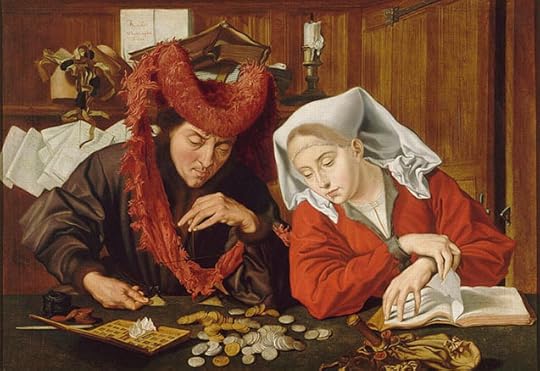
Hashim, the moneylender, changes its sacred religious value to just an object, “Naturally, I don’t want it for its religious value...I’m a man of the world, of this world. I see it purely as a secular object of great rarity and blinding beauty. In short it’s the silver vial I desire, more than the hair” (3005). Yet, with that in the end, underestimating the relics worth and mystical power, leads Hashim’s family to tragedy.
Irony also plays a role within this story as well. What Hashim says and does are altogether different, he claims to live honorably (3005) yet, he isn’t worthy of honor because, he treats his debtors cruelly and without remorse when behind of payments as a first example, “That afternoon, a trembling debtor arrived at the house to confess his inability to pay the latest installment of interest owed, and made the mistake of reminding Hashim, in somewhat blustering fashion, of the Qur’an’s strictures against usery. The moneylender flew into a rage and attacked the fellow with one of his large collection of bullwhips” (3007). In reading it’s clear he’s a violent man and a bigot in contrast to the teaching of the Qur’an; he is a pious and abusive individual.
Rushdie mocks people of religion that uses it for their own personal gain as well as those motivated by material things. The story overall is a perfect more fable, one of how those who use religion should use it to their own selfish means; he tells of how we should live in a understanding and humbling mindset and lifestyle. However, if we succumb to our envious desires there will be consequences in return.