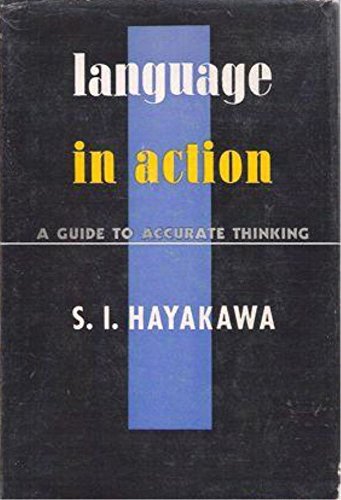
This summer, I was infected by an interest in semantics. Before then, I might use the term as dismissive, to state that a certain discussion does not matter too much - "that it's just semantics". Reading Hayakawa's "Language in Action" completely changed my perspective. Now I think nothing can be more important than the impact of words.
In the early pages, Hayakawa distinguishes between the world of senses and the world of words. A recurring theme is that our senses are extremely limited and deceiving us. In effect, most technology is being developed to extend the our senses. The world of words, on the other hand, is much bigger (see also Why Read). Languages extend our world, enabling us to describe imaginary worlds.
Words are cooperation mechanisms. This is somewhat surprising since we cannot use the same word even twice in exactly the same meaning. Think any word, for example a banal one such as 'car'. It has very different connotations for people - your brand new car, your first car, your freedom, family trips, a killing machine, a polluter, ... Even for a single person, the word cannot retain its meaning, since an hour later, your new car has aged a little, as has your perception of it.
If this applies to relatively simple terms such as car, how will people then think differently about equality, justice or any of the isms. These terms are often hotly debated. If we would spent more time explaining the values and ideas behind them, we may find that we're arguing issues on which we actually agree. Take liberalism, which is associated with socialism across the Atlantic. In Europe, it rather means less government, individual freedom, appreciation for entrepreneurship, taking personal responsibility, ... In this sense, how can America not be the most liberal country?
Hayakawa defines civilisation as "getting something for nothing". Most things are passed on to us from previous generations without charge: works of art and literature, laws and customs, the organisation of society, many of the buildings and roads we use, ... Imagine that we had to rebuild society from scratch - that would mean a much harder life for quite a few generations.
Societies might then be seen as cooperation mechanisms, and language is the tool we use to cooperate. Humans are not the only species to use language, but we're the only one that has taken language to the symbolic level, and in doing so, we could organise cooperation on a very large scale (compared to troops, herds, flocks or schools).
Successful cultures are therefore cultures that can organise collaboration on a larger scale, that can build larger pyramids or put men on the moon. To make larger groups collaborate depends on the public acceptance of the rich narrative that such a culture can project for its participants. Such narratives are provided for example by religion or history. The narrative needs to have integrity, otherwise it easily pops like a bubble while it has to last for generations.
Hayakawa is concerned with language as a cooperation tool. We should stop treating it in such a cavalier manner. Considering that we largely think like savages and babble like idiots, the cooperation function of language may easily collapse, according to Hayakawa.
A section I particularly enjoyed is the one on dictionaries. Hayakawa gives us some insight into how dictionaries are constructed and argues convincingly that we give too much authority to them. A dictionary writer is a historian, not a law-giver - he mainly reflects how a word has been used in the past, not how a word should be used. This is worth remembering the next time you consult a dictionary. A similar comment can be made on grammar: why are we more concerned with punctuation and prepositions than with the meaning of words.
Another section is on context. Just like the for the archaeologist, an artefact is useless without a record of the place and layer where it has been found with details of the surrounding objects, a phrase should always be seen in its context. Ignoring context, a very common occurrence in the media, is stupid at best. At its worst, it can be vicious. For every good quote, we can find an equally good quote saying exactly the opposite. Such is the power of context.
One of the uses of language is directive. Words control future events to an enormous extent, which is the reason why writers write and preachers preach. Almost all directive language contains a promise - just think about campaign messages - but these promises are too easily broken. Each broken promise undermines a little bit the trust we have in the cooperation mechanism we call language.
Hayakawa makes a most important distinction is between the intensional and extensional meanings of language (indeed, both terms spelled with an 's'). The intensional orientation of language focusses on connotation, i.e. what words evoke in us. This part can only be expressed in words. The extensional orientation focusses on denotation, i.e. what the words point to. Agreement is only possible on extensional meaning - intensional observations are deeply personal and unknown. When we are arguing or debating, we're too often oriented internally to what a word - e.g. an ism - evokes within us, without telling the other about these rich connotations because they are too personal.
Hayakawa summarises his book in nine rules to promote one's extensional orientation. Reading has a tendency to move us in the opposite direction, to produce excessive intensional orientation. We can avoid this by undertaking reading as a guide to life, i.e. to ensure a utilitarian purpose for all reading.
"Language in Action" is full of gems such as the above. It is a very practical book. Chapters are short. At the end of each chapter, there are some exercises. Hayakawa also invites readers to start collecting examples of dysfunctional communication that undermines language.