Jump to ratings and reviews
Rate this book

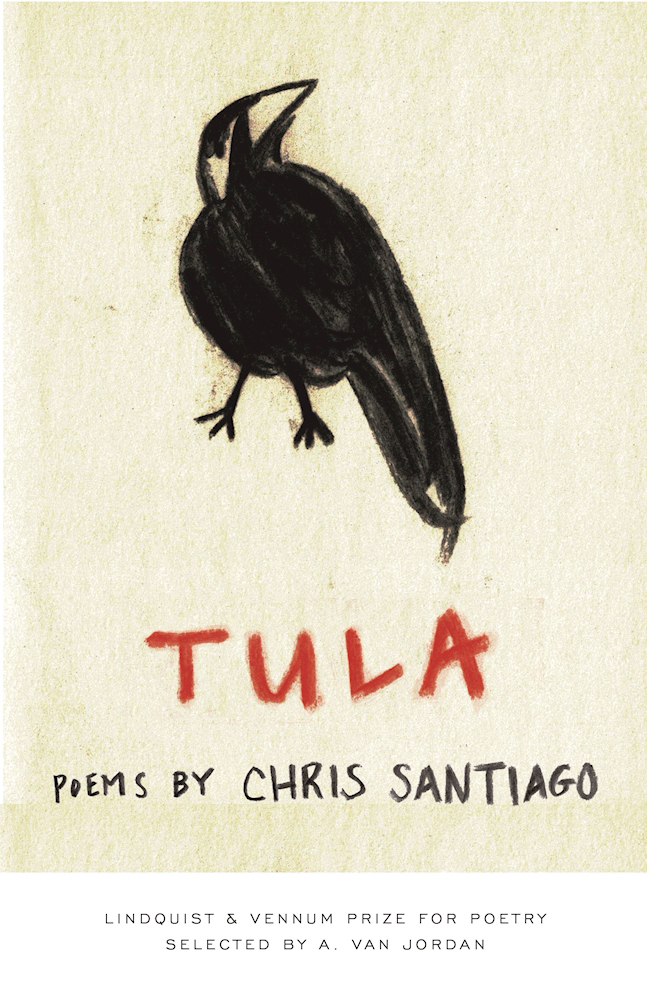
Tula

Rate this book
Prismatic, startling, rich with meaning yet sparely composed, Chris Santiago’s debut collection of poems begins with one word and transforms it, in a dazzling sleight of hand, into a multivalent symbol for the immigrant experience. Tula: Santiago reveals to readers a distant land devastated by war. Tula: its music beckons in rhythms, time signatures, and lullabies. Tula: can the poem, he seems to ask, build an imaginative bridge back to a family lost to geography, history, and a forgotten language?

Inspired by the experiences of the “blood stranger”—the second-generation immigrant who does not fully acquire the language of his parents—Tula paints the portrait of a mythic homeland that is part ghostly underworld, part unknowable paradise. Language splinters. Impossible islands form an archipelago across its landscape. A mother sings lullabies and a father works the graveyard shift in St. Paul—while in the Philippines, two dissident uncles and a grandfather send messages and telegrams from the afterlife.

Deeply ambitious, a collection that examines the shortcomings and possibilities of both language and poetry themselves, Tula announces the arrival of a major new literary talent.

96 pages, Paperback

First published November 1, 2016

1 person is currently reading
117 people want to read

About the author

Chris Santiago

7 books3 followers

Ratings & Reviews

What do you think?
Rate this book

Friends & Following

Create a free account to discover what your friends think of this book!

Community Reviews

5 stars
36 (38%)
4 stars
38 (40%)
3 stars
15 (16%)
2 stars
4 (4%)
1 star
0 (0%)
Displaying 1 - 9 of 9 reviews
Profile Image for Erika Schoeps.
406 reviews87 followers
March 26, 2017
I actually finished this a while ago, so this will be a shorter review.

Chris Santiago is a poet of Filipino descent-- his parents were born there, but he was not. He never learned the language completely, but he grew up learning pieces from his mother and being fascinated by the concept of language.

The poems in this book showcase a different experience from mine, but I often struggled because I felt as if these poems were too vague. I know that's an absolutely crazy criticism to make of poetry, but I really floundered around through this entire collection. At times, I would find a witty/beautiful/interesting turn of phrase that gave me a foothold, and then I would again lose myself. Some poems are more explicitly political, and those ones interested me the most. Santiago is not overly approving of the U.S. or the Philippines. He merely observes and plays with language.

The back of the book has historical and linguistic footnotes for the poems. I wish I had known about these footnotes at the beginning. I suspect there are some who enjoyed the experience without the footnotes-- I am not that person. I do plan on re-reading this with the footnotes in mind next time.
Profile Image for Jerrie.
1,032 reviews162 followers
February 25, 2017
In this book of poetry, the author explores love and language, along with his disconnect from his heritage as the child of immigrants. Throughout, he seems distressed at trying to learn Tagalog, but also revels in the lushness of the Philippines with many poems describing the islands. The poems are often intimate, relating to family and longing. This is a very good collection of poems that I enjoyed a lot
Profile Image for Amy.
485 reviews9 followers
May 30, 2017
Poems by the son of Filipino immigrants about home and exile. The poems gradually reveal the history of colonialism and oppression in the Philippines that made it impossible to stay.

But there are not undiscovered countries.

When I get to the Land of the Dead
there won't be a mile
of wilderness
of unspoiled earth.
The Kings & Papacy of the Dead
will have sent ships to every continent
to raze temples, to pack slaves,
to scorch the forests & libraries

into cities of black glass.
Profile Image for Martin Ott.
Author 14 books127 followers
January 26, 2018
Love this book. An important new voice in American poetry.
Profile Image for Trish (readtmc).
206 reviews31 followers
September 16, 2022
3 1/2 ⭐️

Themes: Diaspora, immigration, family, Philippine history, music, sound and language

“Tula” means poem in Tagalog and appears throughout the book. This was challenging (footnotes at the end provide some context). However, the poems about fatherhood were some of the most emotional. And, I appreciated the exploration of language. It’s nice seeing Ilonggo in print but, at the same time, I mourn the loss of my parents’ native tongue and connection, which is conveyed in several of TULA’s poems. Santiago says that not knowing his parents’ languages is foreign and familiar, which is how I felt about this collection overall (more the former than the latter).
Notable poems: “Counting in Tagalog,” “Where the Fathers Wait”
Profile Image for Rachel Lauve.
41 reviews7 followers
September 25, 2017
Chris Santiago’s fascination with language, of mother languages and mother tongues and his Filipino roots, is clear from the very beginning of his collection. Tula in Tagalog means “poem,” and while Santiago titles a number of his individual poems this, the language within each tula is the chain that links many of them together, as well as each speaker’s relationship with each language. “ultra / sound” combines Ilonggo/Hiligaynon, Tagalog, and Japanese, on the shared word ki-bo and its various definitions across languages. Features of Japanese culture swim through the pages, jumping from the waves and across poems, but each tula featuring Tagalog guides the collection. In “Gloss,” for instance, where Santiago writes, “hele mispronounced as heal / wakefulness a wound” and in the last poem of the collection, “Hele”. Santiago’s speakers are not perfect with their use of language, however, as in “Counting in Tagalog,” he writes “dalawa” only to correct himself with “She said two was not dalawa / but duha.” Santiago’s Tula is an exploration of the connections between language and culture, and what it means to be the child of an immigrant in relation to this.
88 reviews1 follower
July 11, 2023
"Before there were mirrors, there were tide pools." (from "[Island of the Shy Mynah Bird]")

This is a dream-like collection of poems with lots of imagery about birds, islands, family, speaking & singing in other languages, and the loss of hearing. There's a lot of playful experimentation with words and sounds in other languages, as well as with definitions and etymologies.

Excerpt from "Tula (I live mostly in dreams)":

I cross / oceans, carrying / moisture in my chest feathers. // But I have / no young, no / country to speak of. // My wings grow heavy-- / around me, miles / of water & silence.

Excerpt from "Where the Fathers Wait":

a remote outpost, perhaps // night, perhaps in another world, where // a door opens & your name / is called & you aren't cut off anymore / from the rest of the world: you are // the rest of the world.
Profile Image for Neva.
94 reviews12 followers
November 16, 2019
A touching book of poems connecting childhood, identity as a child of immigrants, and languages.
Displaying 1 - 9 of 9 reviews

Can't find what you're looking for?

Get help and learn more about the design.