Jump to ratings and reviews
Rate this book

Giordano Bruno: Philosopher/Heretic

Rate this book
Giordano Bruno is one of the great figures of early modern Europe, and one of the least understood. Ingrid D. Rowland's pathbreaking life of Bruno establishes him once and for all as a peer of Erasmus, Shakespeare, and Galileo, a thinker whose vision of the world prefigures ours. By the time Bruno was burned at the stake as a heretic in 1600 on Rome's Campo dei Fiori, he had taught in Naples, Rome, Venice, Geneva, France, England, Germany, and the "magic Prague" of Emperor Rudolph II. His powers of memory and his provocative ideas about the infinity of the universe had attracted the attention of the pope, Queen Elizabeth—and the Inquisition, which condemned him to death in Rome as part of a yearlong jubilee. Writing with great verve and sympathy for her protagonist, Rowland traces Bruno's wanderings through a sixteenth-century Europe where every certainty of religion and philosophy had been called into question and shows him valiantly defending his ideas (and his right to maintain them) to the very end. An incisive, independent thinker just when natural philosophy was transformed into modern science, he was also a writer of sublime talent. His eloquence and his courage inspired thinkers across Europe, finding expression in the work of Shakespeare and Galileo. Giordano Bruno allows us to encounter a legendary European figure as if for the first time.

350 pages, Kindle Edition

First published August 19, 2008

72 people are currently reading
606 people want to read

About the author

Ingrid D. Rowland

20 books11 followers
Ingrid Drake Rowland is a professor at the University of Notre Dame School of Architecture. She is a frequent contributor to The New York Review of Books. Based in Rome, Rowland writes about Italian art, architecture, history and many other topics for The New York Review of Books. She is the author of the books Giordano Bruno: Philospher/Heretic (Farrar, Straus, and Giroux, 2008); The Place of the Antique in Early Modern Europe; The Culture of the High Renaissance: Ancients and Moderns in Sixteenth Century Rome; The Roman Garden of Agostino Chigi Horst Gerson Memorial Lecture, Groningen: University of Groningen, 2005; The Scarith of Scornello: a Tale of Renaissance Forgery (University of Chicago Press, 2004). Her essays in The New York Review of Books were collected in From Heaven to Arcadia: The Sacred and the Profane in the Renaissance (New York Review Books, 2005).

Ratings & Reviews

What do you think?
Rate this book

Friends & Following

Create a free account to discover what your friends think of this book!

Community Reviews

5 stars
96 (30%)
4 stars
111 (35%)
3 stars
80 (25%)
2 stars
25 (7%)
1 star
2 (<1%)
Displaying 1 - 30 of 53 reviews
Profile Image for Sasha.
Author 15 books5,032 followers
January 2, 2015
It's hard when you only read one of many accounts of a controversial figure; now I only know one perspective well. Giordano Bruno was many things; by emphasizing certain aspects of his work, one can paint him as whatever one wishes. Among others, Bruno was:

- Some sort of pantheist who believed that God was infinite, the little things don't matter, and anyone who got bogged down in detailed questions of dogma was an ass.

- An obnoxious prick who considered nearly everyone an ass, and frequently told them so.

- A master of memory who made much of his living by teaching his system to others. We know that he had a great memory; it's totally unclear whether he really had a system for it, because all his publications on it were geared to attracting students and therefore frustratingly vague. Many of his students were certainly dissatisfied.

- A "Falstaffian" skirt-chaser, by which I mean both lecherous and mostly unsuccessful.

- A genius at picking out the right theories from the maze available at the time. He was correct that the universe is infinite and made of atoms, and that the stars in the sky are like our own sun and should therefore have their own planets. None of those ideas are his, but half the battle is picking the right things to believe, and he was aces at that.

- A magician whose mnemonic system may have been in part magical and who published books on magic that discussed...oh, some kind of bonding between planetary figures and the spirit.

- A heretic who believed that Jesus was (again) an ass who disproved his divinity by asking God for a mulligan just before his death, and that transubstantiation is a stupid idea.

I guess some Catholics still believe in transubstantiation, but they think it happens without changing the physical makeup of the wafer (which is why it doesn't taste like chicken*). Lame. Did you know they used to argue about whether a blessed communion wafer would turn into Jesus meat if a mouse ate it? Like, they were really worried about that issue. I bet the mouse doesn't care.

Bruno wasn't the courageous martyr he's made out to be. When first faced with the Inquisition, he apologized profusely on his knees, happily renouncing all kinds of beliefs. It was only when he realized the tide had turned against him and he was going to die anyway that he backtracked and got fresh with the Inquisitors.

Unfortunately, the transcripts of his defense haven't survived, so we have only a summary written later to go on; that's better info than we have on many trials, but it's still second hand. We don't know, then, the full extent (or not) of his defiance. And it looks like we don't know for sure whether he believed in extraterrestrial life. Generally, his belief in "the plurality of planets" implied that he also believed there might be life on them, but I can find no first-hand mention of him saying so.

He's a strange hero: a tiny little man given to running his mouth, insulting people, occasionally slapping them, running all over Europe to escape trouble, feeling sorry for himself, trying to get back in the graces of various people and churches, and failing due to his own obnoxiousness. He was possibly a charlatan, certainly a heretic, and a total asshole. But he was also way ahead of his time in many ways, and right about pretty much everything, and he went to the stake with one of the great last lines: "Perhaps you pronounce this sentence against me with greater fear than I receive it." So: a strange hero he is.

* All meat you haven't eaten tastes like chicken. If it's meat from an animal widely seen as gross, then it tastes like chicken but "a little gamy."

Rowland's book downplays the magic and fails utterly to penetrate the mnemonics; it positions him as a guy who got it right with the science and whose accepting views of different religions made him a forerunner to today's more liberal religions (such as they are). Is that correct? Probably. But I suspect one could write a book emphasizing the sorcery and come out sounding pretty believable, too. I suspect Rowland of failing the Nero Test:** given two historical possibilities, she's inclined to take the more interesting one even if the other is slightly more supported. And she often repeats herself; I caught her saying the same thing three times in two pages at one point. But it's clear and engaging enough; I wouldn't warn you off it if you wanted to read up on your Bruno.

** Nero may have put Christians in baskets atop poles and set them on fire to use as streetlamps, but he probably didn't. But it makes a great story.
Profile Image for Martin Fossum.
Author 6 books41 followers
July 28, 2012
Maybe I'll add more here later, but this book was a bit messy. Bruno was a dynamic and arguably brilliant late 16th century thinker, but Rowland managed to depict him as a somewhat hapless Dominican who didn't have suitable respect for the mortal threat of the Inquisition.

Hey, I'm a historian by trade here, and I wanted Rowland to bring this period of Italian and European history to life for me. Give me some smells, give me the stench of the sewers of Naples and give me a glimpse into the routine life of a cloistered Dominican. Yes, Rowland did some impressive translations (she did them all herself in this book) but her account of Bruno was sometimes repetitive, often times tepid in inspiration and curiously empty of doing a thorough job of relating the period's zeitgeist.

Teachers, don't assign this book. It put me to sleep many times, and I wouldn't wish this fate on anyone else. This book, it seemed to me, was something that had to be written (in Rowland's estimation;) consequently, the story suffers muted vitality and a loosened cohesiveness brought on by insufficient poetry and possibly, and most importantly, the absence of authorial affection for her subject.
Profile Image for Gina Scioscia.
28 reviews4 followers
April 4, 2011
As full of contradictions in personality as the church that burned him, Bruno emerges in Rowland's biography just slightly out of focus. As a scholarly writer, I can imagine Rowland did not want to embellish what she could not establish as fact. Unfortunately, this makes for a somewhat dry read as we follow Bruno's wanderings in Europe and try to understand him. What emerges in the end is the picture of a man who had harmed no one, who was simply a solitary thinker and writer, who wanted, mostly, to be left alone; a man who was murdered by an institution that claimed authority not only over his body, but also over his thought. It is a testament to the originality of his thought that it survived, and continued to inspire the generations that followed him: Kepler, Galileo, & Newton.
Profile Image for Katie.
508 reviews338 followers
August 8, 2011
This is a tough book for me to rate because it's the first book that I've read about Bruno. He's an inherently fascinating guy, full of massive contradictions and intelligence, and so the book winds up being inherently interesting because of its subject matter. As a biography, though, I think it spends a bit too much time ponderously following Bruno from city to city and not quite enough actually unpacking his ideas. Most chapters are interesting but unfocused.

In Ingrid Rowland's favor though, she's fantastic at picking out the right quotes to use, both within the chapters and in the epigrams.
Profile Image for Ana.
90 reviews
August 28, 2023
me gustó muchísimo jaudbahsbjababa es largo de cojones pero al mismo tiempo como que me encantó leerlo y parecía que no se terminaba nunca pero no me desesperé nada porque todos los capítulos son interesantes
en realidad creo que nunca dejó de interesarme la historia pero hace mucho que no me acerco a ella desde donde me gusta verla
Profile Image for Daniel Kukwa.
4,741 reviews122 followers
November 8, 2024
The conclusion/debrief/summation is front-loaded, and I didn't think it needed that kind of structure...but the rest of the book presents a warm and lush account of a man who paid the ultimate price for being too far ahead of his time...especially in a world where the successors of his executioners are too blinkered to take notice.
Profile Image for Shawn.
257 reviews27 followers
May 9, 2022
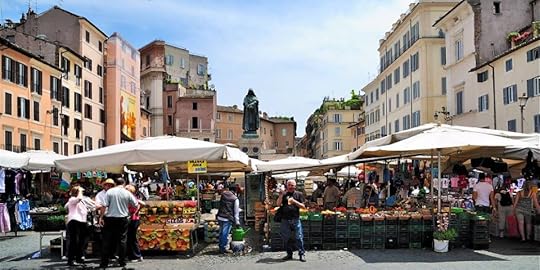
There is an open plaza or square in Rome known as the Campo de’ Fiori. One often finds a market there during the day and popular restaurants or bars in the evening. I was startled during my visit there, when I suddenly realized the bronze statue in the square was Giordano Bruno; and that I was standing in the very place where he was burnt alive by the Catholic Church in 1600.

I’d often read about the horrible tortures, beheadings, and immolations that the church inflicted upon people like Bruno, who would dare to express their views openly. I was at once struck by the horrible significance of the place where I stood; and I eventually realized that I was not alone in this awareness, for people all around the world had deposited flowers on Bruno’s statue, their deep sentiments fueling demand for the blossoms being sold in the square.

description
Campo de’ Fiori

It was not until 1983 that the Catholic Church officially pardoned Galileo, but no such pardon has ever been issued for Giordano Bruno. I suppose the church had to pardon Galileo because it became impossible to continue disputing the fact that the earth actually does revolve around the sun. In contrast, the church hasn’t yet realized with certitude the virtues of free speech, otherwise, Bruno would have been pardoned long ago. Granted, many of Bruno’s postulations about the universe remain unproven, but that is not the issue. The issue is whether or not a person should have the right to their own opinions and speculations, as opposed to being forcibly conformed or eliminated.

The Church has been historically slow in accepting rational inclinations that contradict its ancient viewpoints. It seems unbelievable to me that the Church’s list of banned books once included such classics as Les Miserables and The Count of Monte Cristo, which are among my very favorites. There is a lot of diabolical history associated with the Catholic Church that most American Catholics either don’t know or have chosen to ignore. Not the least of these is the Church’s position during WWII, when it excommunicated hundreds of communists but not Hitler.

It wasn’t until 1995 that divorce became legal in Ireland, and even then the voters had to dispute the Pope’s advice in the matter. Even today, the church remains intransigent in its refusal to endorse the use of condoms. The Church hypocritically supports members, like Joe Biden, who openly endorse abortion, while quietly excusing the systemic pedophilia infecting its priests. And yet, a poor burnt soul like Bruno can’t even be pardoned for thinking and writing what he believed to be true!

Seeing Bruno’s effigy in Rome inflamed my mind with realization of the ridiculous extent to which the church’s practices have retarded human progress. Unlike the flames that eventually died away after they turned Bruno’s body into ashes, the flames in my mind continue to burn vigorously and actually intensify whenever I see the be-robed magicians mixing up their potions, casting their spells, and mumbling their ignorant utterances to intimidate congregations. Any reasonable person devoting time to the study of Church history should invariably become similarly incensed.

The Church, an institution purportedly built upon the precepts of the world’s greatest purveyor of nonviolence, has itself been one of the most violent institutions in the history of the earth, actively participating in torture, censorship, beheadings, burnings of heretics, murderous crusades, inquisitions, genocide, forced conversions, and open persecutions of Jews, Protestants, Muslims, and heretics. It was not until 2005 that a pope would even issue an encyclical recognizing that “God is love”. This is because the church does not stand on love, but rather on judgmental attitudes, exclusionary practices, vengeance, and a threatening presupposition for detractors to burn in hell. Through their practices, particularly the burning of heretics, the church has actively worked to bring forth their vision of hell onto the earth.

The Beliefs That Bruno Died For

Bruno actually believed in God, it’s just that he believed God would one day pardon every creature, a concept of infinite mercy that the Catholic Church has never fully grasped. How can a church contending to be founded on the precepts of Christ burn someone at the stake when Jesus himself forgave those crucifying Him in the very throes of death? Those that accuse others of heresy are themselves the heretics for refuting the precepts of forgiveness extolled by Jesus Christ. All churches that fail to emulate Christ’s preaching or that stack on additional dogma are the very epitome of heresy, and their adherents are, whether they recognize it or not, indeed heretics.

When Bruno removed all the religious icons, pictures of Saints, and statuary from his living quarters, citing them as idols, he deeply offended a church that has its roots in the paganism of the ancient Greco-Roman pantheon. Even today, icons, graphics, statuary, relics, and ostentatious architecture continue to play largely in Catholic religious practices around the world. Bruno questioned whether Mary should be worshipped, seeing clearly that goddess worship had evolved out of Roman paganism. In contrast, Jesus spoke as follows in Matthew 12:46-50:

While Jesus was still talking to the crowd, his mother and brothers stood outside, wanting to speak to him. Someone told him, “Your mother and brothers are standing outside, wanting to speak to you.” He replied to him, “Who is my mother, and who are my brothers?” Pointing to his disciples, he said, “Here are my mother and my brothers. For whoever does the will of my Father in heaven is my brother and sister and mother.” -Matthew 12:46-50


Bruno also questioned whether or not Jesus was divine, underscoring the absence of scripture where Jesus actively solicits worship. In contrast, Jesus persistently points to God as the target for worship.

“Why do you call me good?” Jesus answered. “No one is good—except God alone.” -Mark 10:18 & Luke 18:19


Bruno cultivated the development of his memory and claimed to be able to teach others how to exercise this skill. The discussions in this book about Bruno’s obsession with memory bring to mind David Hume’s and Carl Jung’s contentions that what we choose to retain is how we create ourselves. If we contrive our personalities and demeanor by retaining certain memories and forgetting others, we can see how Bruno’s own choices for rebelliousness ultimately lead to his demise. But for Bruno to do differently would have made him a hypocrite and that is certainly what he was not.

Bruno believed in an infinite universe, not only in terms of the great expanse of the heavens but also in terms of infinitesimal worlds we cannot see. Infinite diversity is communicated to us in the natural concept of the sphere. One can endeavor to draw a perfect circle or mold a perfect sphere but, upon closer and closer examination, imperfections will always be found, and each successive attempt will render something slightly diverse and persistently imperfect in form. This is also revealed to us mathematically in the concept of pi, which is a decimal that never ends and never enters into a permanently repeating pattern, apparently rendering randomly distributed numbers forever and ever. In his book Contact, Carl Sagan suggests the creator buried a message in pi. It is a message of an unending quest for perfection, of a perpetual process of creativity, constantly growing, revising, and modifying. It is essentially the same as Plato’s concept that we see only contortions of the pure truth, forever trying to wade through the fake news, marred concepts, propaganda, cultic doctrines, and other half-truths that parade about us like cast shadows.

What will it mean for humans to eventually accept the universe as infinite in this way, not only in terms of largeness and smallness, but also in diversity, and in the unfathomably different life forms that are constantly writhing in evolutionary change? What will it mean for humanity to realize that everything persists in constant change, and that we are only ingredients in a vast primordial soup that bubbles forth rocks, men, skies, planets, and everything else in constant motion, forever altering, forever changing, forever becoming something else?

To become immortal is to become God’s idea of yourself, to participate in the creativity, to make your process of “becoming” as fluid as you can, embracing the change that is constantly occurring within yourself, and pursuing it as an adventure of discovery. Time is apparent only within the concept of a particular existence or state of being, but the whole, within which we are a moving part, suffers no limitation of time.

What is the obvious result of widespread belief in infinity? Clearly it is tolerance and acceptance of that which is different than thou. Conformity and assimilation become sinful because they destroy preliminary forms of existence and inject an egotistical notion that the universe should be conformed to one’s own particular nature. The murder of Bruno was nothing less than this sort of forced, compulsory compliance, which the church sought to impose forcefully upon populations. Bruno was obviously a person rejected at every level of human society, by both Catholics and Protestants, and even by social acquaintances, and he was ultimately burned into extermination by that society into which he could not assimilate.

The Fate of Nonconformists

This book is the sad tale of a controversial intellectual seeking broadly for acceptance but finding only rejections. The distressing theme haunting human history is the persecution of those who reject conformity, refusing to assimilate to that which they sense as wrong and ridiculous. There is a long list of nonconformists that have been murdered by society, including Socrates, Jesus, Bruno, Gandhi, Martin Luther King, and countless others.

The segregation of nonconformists starts in childhood, as some become persecuted or made fun of by talking differently, looking differently, or simply lacking the resources to conform to the dress and activities embraced by the majority. Children quickly isolate and target those among them who are different. This sort of shunning of uniquely different individuals continues into adulthood, and works to modify the personhood of those rejected, sometimes pressing them to embrace their differentiation all the more, as a sort of protest. Other times the resulting isolation drives those persecuted insane, as they respond to their tormentors violently, or otherwise confine themselves into a state of depression that afflicts them for their entire life.

For someone like Bruno, conforming to what one disbelieves is to assassinate one’s spirit; however, the price paid for sustaining individuality is isolation, persecution, and loneliness. Bruno travelled all over Europe looking for acceptance but couldn’t find it anywhere. Contrary to most people, Bruno wouldn’t sacrifice his radical notions just to gain acceptance. However, the costs turned out to be much higher than Bruno ever imagined, as he suffered a martyr’s fate. Authentic belief involves subscribing to something firmly enough that you will adhere to it no matter what, refusing to recant, even when threatened with death. There are few among us who can believe with that degree of authenticity.

Out of Paganism

Certainly, most religious people today are unaware of the way Christianity, particularly Catholicism, has been adapted out of pagan beginnings. Certainly, no Biblical basis exists for the worship of Mary, and those who study religious history can discern how Christianity was hijacked by the Romans, as a tool for political control, and how Mariology was synthesized from preliminary pagan mother goddesses (Dina, Minerva, Artemis, etc.).

One can find no place in the Bible where Jesus demands to be worshiped and certainly no place where he asks anyone to worship his mother. Instead, Jesus prays to an unseen God and openly instructs others to worship God. Jesus remarks “why ye call me good; only God is good.” If we follow scriptures, we find that God is good, God is love, and God is a consuming fire, but nowhere do we find that God is human. The deification of humans is a great historical idolatry practiced by mankind since ancient times.

Under interrogation, Bruno let his inquisitors know that he had long harbored doubts about use of the term “person” in reference to the Son and the Holy Spirit, and they viewed this as blasphemy because they were unable to conceive of God outside the bounds of personhood. Bruno’s more Platonic conception viewed “The Son” as God’s intellect (Wisdom or Logos) and The Holy Spirit as God’s pervading love, as opposed to the pantheon of characters and saints worshipped by the Church.

Unappreciative of the diversity of life forms, man insists on setting himself on top of everything, even to the extent of becoming God. And man does this by designing religions into complicated hierarchies that elevate man to its apex, such as pharaohs, Imams, Popes, or other cultic leaders. But worshiping a human circumvents the worship of love and goodness. Instead of kindling a consuming fire of love and goodness within ourselves, humans saddle themselves with rituals and creeds promulgated by the powerful, who seek to direct worship in ways that generate political control.

Into Pantheism

Spiritual manipulators want us to think they can somehow lift us out of our animal-like humanness and deposit us into the realm of the divine. We want to be elevated out of “who we are” instead of accepting that we are a minute part of an infinite universe that extends into the limitless expanse and reduces into infinitesimal worlds - both to an extent far beyond our perception, even with our most powerful telescopes and microscopes. Bruno opined that humanity’s acceptance of infinitude would bring revelational change because it would settle us down under realization that we are part of something much greater and that we are not, and will never be, the apex of creation.

Our best efforts are to legitimize ourselves as we are, by accepting our role within the larger existence, and focusing on the things that bring about our well-being, and the well-being of all the earth: caring for our environment, avoiding the chaos of war, reducing impoverishment, facilitating learning, maintaining health, etc. However, we turn from these important tasks to worship the wealthy and powerful. Instead of situating ourselves in the natural hierarchy of the universe, we place ourselves in a human hierarchy based upon wealth (mammon), and this imprisons us within tasks of pathological accumulation that take precedence over our natural inclinations.

Instead of proselytizing man-made doctrines, we should simply be spreading goodwill to one another, as opposed to brainwashing others into hierarchical systems designed to ensure obedience to governing elites. When we see our church as our world and our rituals as goodwill, then our kingdom will have come, for we will be living in concert with the infinite life forms above and below us, even though we see them not, but nevertheless sustaining our role in the hierarchy of nature. This sort of natural religion must subvert the prevailing idea that humans are the apex of existence, deserving of worship, or capable of being elevated into gods. Instead, there must come humility, the kind of humility that comes when one recognizes they are only a part of a larger whole, merely a cog in the wheel, a floating particle of dust that must support the health of the whole instead of becoming virally destructive.

I’ll close by citing the lyrics of an interesting song written about Bruno, that could easily apply to all martyrs and certainly those mentioned in this essay. It might be fitting for this song to be broadcast in the Campo de’ Fiori.

As the embers rose through the Roman sky
Tell me were you calm when they took your life?

Just before you go, tell us how the heavens flow
Weightless evermore, as you walk beyond that door
Shine forever true

Shared with us the world well before your time
Though they took your voice words forever shine

Just before you go, tell us how the heavens flow
Weightless evermore, as you walk beyond that door
Shine forever true

As they spoke your fate a fearless man replied
"As you will sentence me, your fear is beyond mine"

Just before you go, tell us how the heavens flow
Weightless evermore, as you walk beyond that door
Shine forever true


-The rock band Avenged Sevenfold, from the song Roman Sky on the 2016 Album The Stage.


-End-
Profile Image for TrumanCoyote.
1,109 reviews14 followers
October 15, 2012
A fascinating account of a fellow who was much more interesting than I thought he would be. I expected a retiring and oft-penitent monk, but instead there was this garrulous and larger-than-life (even though smaller than average) figure who traveled widely and wrote a great deal on numerous things. Rowland proves to be a nicely low-key and genial host throughout, and brings both Bruno and his times to life in admirable fashion (all the more remarkable of a feat when you consider that she really had very little to work with to aid her in this accomplishment). She also nicely delineates the differences between city-states in Italy as well as the differences between it and the rest of Europe. And her account of the difference of outlook between Aristotle and Plato was intriguing. Only on rare occasion does she descend into moments of fashionable modern-day Right Thinking (that unfortunately seems to be the best that one can hope for nowadays). The only other fault I can find with the book is that there are sometimes rather repetitious moments (it seemed like it could've been tightened up a bit before release).

At any rate, she definitely made her case that he was a "splendid writer"...the excerpts presented were fully as rollicking and rambunctious as The Anatomy of Melancholy and other works of all those great old 17-century English stylists. Now I plan to read some of Bruno's stuff in full, to see if it holds up over the long haul as well.
Profile Image for James.
160 reviews
April 9, 2012
I found this book difficult to read, not for its writing style, which I found to be very good, nor the story line, which was well presented, but for the descriptions of the creative savagery and brutality of the Catholic church.

Bruno was a brilliant man who believed divinity existed in all of us and that God in his infinite compassion would forgive every human being. He believed in an interconnectedness of all life. He was a believer in an infinite cosmos. Kepler sited Bruno as the conceiver of ideas, of which Kepler and Galileo were only architects.

This brilliant, harmless man, certainly one of the greatest thinkers in history, was brutally crushed by the church because his beliefs did not adhere to the church doctrine, particularly those parts of the doctrine which turned out to be fallacies.

I gave this book four stars because it is well written and Bruno's story is a fascinating one.

Profile Image for Anita.
16 reviews1 follower
February 13, 2019
I came to understand a lot about Poetry, science and the politics of religion from this book.

It's not an easy or a fast read- I took my time and savored it which is what I recommend anyone who wants to read this book do too, its beautifully written and should be enjoyed.
Profile Image for Stephie Williams.
382 reviews43 followers
April 22, 2014
Isn't all that good. To bad because Bruno had ahead of his times ideas. Althought he these ideas were not what one could call scientific. Compare his work to Galileo to get the picture.
193 reviews14 followers
October 10, 2011
Giordorno Bruno suffered, at least in some respects, the misfortune of being ahead of his time. Born in near Naples in 1548 and burned at the stake in Rome in 1600, Bruno managed to pack in a lot of traveling and writing in his 52 years. This nicely written biography not only describes Bruno’s life, travels, and trial for heresy, but it also serves as a nice introduction to his philosophy.

Some other readers were not impressed with this book, regarding it as dry, dull, and unfocused, among other criticisms. Many didn’t seem to like Bruno, calling him an asshole and worse. Others couldn’t read the book without trembling at the injustice of this innocuous little man being executed by the Big Bad Catholic Church for believing and publicizing heresies. One can agree that the Bruno’s inquisitors behaved badly and unjustly, however, without painting the entire Church as complicit. Rowland certainly doesn’t do that. In fact, according to her it wasn’t Bruno’s alleged heresy that got him burned. It was his argument that the Inquisition had no authority to determine what was heretical and what was not.

What follows is a long summary of the book, especially dealing with Bruno’s philosophy. If you are bored by this you will be bored by the book, and I just saved you a few bucks.

Educated at the Dominican college in Naples, one of the most populous cities of Europe, he became a Dominican friar. His primary influences at the college were Aristotle and Aquinas, whose dry scholastic logic he employed frequently, especially against the Inquisition. But his emotional temper was more attracted to the Ideal philosophy of Plato, whose writings aroused renewed interest beginning in the 15th century and interest in Plato continued to grow in the 16th. Bruno studied Plato at the Augustinian college in Naples. He was also familiar with the mystic doctrines of the Kabbalah. He saw Plato and the Kabbalah as complements to Christian theology. The religion of the ancient Egyptians also exerted a strong influence, especially the writings of the alleged ancient Egyptian, Hermes Trismegistus. He also learned the ancient art of memory, which he modified with some powerful additions and which he thought was a key to understanding the universe. And as a child the stoical outlook of his father also had an important influence on him. He studied the Stoic philosophy more formally later in his life.

His feats of memory were prodigious and well known, and one way he supported himself once he was defrocked and excommunicated was to offer to teach this art of memory to kings and nobles as he traveled throughout Europe (Lyon, Toulouse, Paris, London, Geneva, Venice, among others) seeking a permanent haven. He sometimes held back some of the most effective memory techniques, however. This occasionally got him in trouble with his clients. His last client, an unstable nobleman who appears to have been motivated by pique rather than honesty and piety, denounced Bruno as a heretic to the Inquisition in Venice in 1592. The Inquisition dug up an equally unstable but necessary witness against Bruno (canon law required at least two witnesses against an accused), and he was imprisoned for 8 years. During this time he was taken to Rome where the Inquisition was less lenient than in Venice, and he vexed the Inquisition by both denouncing most of what he had been accused of and demanding that the Pope order him to revoke his views on the universe and Christianity. It appears had the Pope done so Bruno would have recanted and been set free. A summary of the trial, written at the time of the depositions Bruno gave the inquisitors, remains to give us some insight into his defense, life, and thought.

But most of our insights to Bruno’s philosophy emerge from his plays, dialogues, and poetry. Rowland translates a large hunk of Bruno’s poetry in the style, rhymes, and meters of the original. The poetry translations are especially evocative. He wrote in both Latin and his native neopolitan Italian. The more scholastic writings he wrote in the structured Latin prose favored by the educated. But the philosophically adventurous ideas he poeticized in his native vernacular.
He seems to have been a kind of neoplatonist. Though many of his ideas seemed to fly in the face of Catholic dogma, he was able to show that his views were not so unusual. Although much of what he taught seemed new, he saw himself as renewing ancient philosophy, updating some of the ideas of Plato and reintroducing some of the truths of the Egyptians.

He was interested in the astronomy of his day and mathematics, especially geometry. He accepted the Copernican picture of the solar system. He believed that the stars were suns with planets revolving around them, and that many of the planets harbored life. He was one of the few of his day who understood that mathematics was the secret to all knowledge. Since his mind lent itself more to visual imagery, his mathematical understanding leaned more toward geometry than to calculation. Although a single divinity underpinned the universe, he viewed the universe as infinite (thus having no center) and there existed particles (atoms) that were infinitesimally small. Time is also infinite. He strove to produce a mathematics, an unsuccessful project until Newton and Leibniz invented the calculus a hundred years later, that reflected the infinities and the motions of the heavenly bodies he had surmised

Bruno wrote much about magic, but not the kind of magic that relies only on the supernatural or on conjurer’s tricks. He wrote of magic that was derived from the knowledge of how the world works. It involved an understanding of how magnetism and gunpowder worked, for example, and the art of memory was a crucial component to this magic. Bruno arranged ideas in his mind rather than manipulating external objects, and he believed that he could control the universe by storing and manipulating the knowledge in his mind. This internal mental architecture could be manipulated by the tool of imagination to turn sublime ideas into physical form. The understanding of the order--sense perception, imagination, and understanding--of how memory works reflects the harmony of the universe. Magic was divine when it involved supernatural principles, and natural when contemplating nature and her secrets. Sometimes what Bruno called ‘magic’ we would call common sense. Bruno saw parallels between his art of memory and the Kabbalah, another means of living the heavenly life.

For Bruno the universe is good and demands moral behavior. Yes, there is evil, but this evil results from the changeability of the structure of the cosmos. Evil is as self-inflicted as the agonies of lovers, he believed. The way to avoid evil is to follow the lessons expressed in the biblical Song of Songs and Plato’s Symposium. What they reveal is older than the universe: They, and Bruno, bring us closer to an understanding of philosophical love. “Love of God is the only love worth pursuing.” Divinity, Bruno believes, is in all things. So love all things. In a sense Bruno was a pantheist, though with a heavily Catholic strain.

His philosophy was so unusual that Bruno had trouble communicating it. He tried through drawings and diagrams as well through poetry. But these means were limited. He thought of himself as a Catholic, though his excommunication prevented him from taking the Communion and practicing the other rituals of his faith. He did not adhere to all the doctrines of the Church and believed that some of the dogmas were unimportant. These doubts were not unusual in his day and were not cause for punishment. Transubstantiation of the host during Mass was one of those dogmas disbelieved. He denied that God is only incarnate in Christ. God is incarnate everywhere, and substance changes everywhere in nature, not just in the Mass.

Sometimes he tried on for size the religious beliefs of where ever he happened to be, such as Calvinism when he lived in Geneva. But he always returned to his Catholic roots.
What sealed his fate in Rome was not any heresy he might have uttered. The Inquisition could not punish Bruno for his publicized beliefs. After all, even the illustrious Dominican Doctor, St. Thomas Aquinas, was inclined to agree more with Bruno than with dogma of transubstantiation. The other accusations against Bruno stood equally in question. Ultimately the inquisitors punished Bruno for his denial of their authority to determine what was and what was not heretical. They responded by showing their power. On February 17, 1600 he was burned at the stake in the Campo de’ Fiora, the Field of Flowers. Today a statue of him stands near where his pyre burned.

I don’t know if Spinoza had read Bruno, though he must have known of him and his death. Some of Spinoza’s ideas had points of contact with Bruno’s philosophy, and Spinoza, though he lived in a more tolerant society in the Netherlands, wisely arranged for the publication of his Ethics following his death. Leibniz did read Bruno, Rowland tells us, though he and Bruno did not have much in common except for a shared interest the infinitely large and infinitesimally small, for which Leibniz succeeded where Bruno failed to develop the mathematics to unlock their secrets.

Rowland does a lovely job of telling Bruno’s story and explaining his philosophy. She writes about the influence of Bruno’s teachers and earlier thinkers such as Cusanus and Ficino on his thinking. There is much detail of his travels and the people he associated with, and she describes his often irascible nature. Anyone interested in Renaissance or early modern philosophy who would like to learn more about Bruno, an unjustly neglected philosopher, will learn much from this book.
Profile Image for Christopher Taylor.
Author 5 books8 followers
January 19, 2022
He was tired. That is the only thing that makes sense. In 1591, Giordano Bruno, tired in spirit and body after years of travel throughout Europe, left the safety of Frankfurt for Padua, Italy, setting in motion the events that would lead to his death – burned at the stake – nine years later.

In this book, Ingrid Rowland doesn’t speculate as to why Bruno returned to Italy where he would soon face the Inquisition in Venice and then in Rome. In fact, her biography of Bruno is gracefully free of speculation. Instead, Rowland focuses on the known facts of Bruno’s life, as well as those people who directly engaged with or influenced him. It is a vivid story of a brilliant but difficult personality in a tumultuous time.

In the sixteenth century, religious strife was rampant and scientific thought was rising. Protestant sects were springing up throughout Europe and new thinking about astronomy and the character of the world was being explored with new vigour. Bruno was in the thick of these activities as both a philosopher (in the widest sense) and as a religious thinker. He taught at the best universities and moved among kings and queens, the aristocracy and the European intelligentsia. He was an unknown who made himself known through his deep learning, extensive writing, vibrant personality, eloquent speech and, at times, charm. He also had nasty tongue for those who ended up (or started off) on his bad side.

Rowland provides a good description of the social changes underway at this time, as well as the step by step journey that led Bruno from the village of Nola, near Naples, through the capitals of Europe to a prison in Rome and a stake in Campo de’ Fiori. It makes for good reading. The main weakness of this biography is Rowland’s decision not to address Bruno’s ideas more fully by setting them in a more generalized context.

Rowland does identify themes and personalities, but she does not set out a framework that would permit the reader to more easily navigate the many issues that arise. Instead, the reader has to piece things together, chapter after chapter, one place or personality after another. There is ample opportunity to miss a point or two. Or three.

That said, a more comprehensive book would have been a very different and much longer book. Rowland is clearly most interested in Giordano Bruno the man; and the reader gets a very good sense of this extraordinary personality in this biography. It may entice a reader to look for more.
Profile Image for Peter Crofts.
235 reviews29 followers
Read
July 27, 2021
I'm not going to rate this, all I can say is I'm underwhelmed. It's sloppy and doesn't really offer much in the way of detail or analyses. One of the reviews offered in my edition describes it as an "intellectual biography". Maybe, but I'd describe it more as intellectual tourism, as you'll come way from it with a couple of snapshots to share with friends and not much else.

I suspect this is a series of lecture notes fattened up to achieve the necessary heft to publish it as a book. It's roughly 300 pages long, but at least a third could be edited out. Perhaps that's where the problem lies, as it doesn't look like it's been edited at all. I'm not sure if it was even proofread. That's probably why Rowland continually repeats herself, after awhile it becomes a distraction and an irritant.

It also contains observations like this: "Finding a pattern to the forest is as elusive an undertaking as tracking prey". Observation? I meant clunkers. I find it very hard to retain my confidence in a historical text, when the author throws in this sort of Mr. Miyagi commentary. Ugh, what does that sentence even mean?

I don't think this book is, as one of the reviewers describes it, a "series of brilliant vignettes" but, as I said, a sewn together text of lectures notes. There's two pages of breathless praise at the front of my edition, they're so far removed from what I read that I wonder if they concern a completely different book.

Bruno is a fascinating figure, to be frank, chronology wise, you'd be just as well served by his Wikipedia page. From that move onto something like this: https://www.goodreads.com/book/show/2....
I'll post a review of it as some point in the near future. It is time well spent. This book was not.

Profile Image for Brian Hanson.
363 reviews6 followers
October 5, 2025
A fine biography of a figure whose brooding effigy in Rome's Campo de' Fiore has always captivated me. Working with relatively slim pickings in terms of surviving documentation (outside of Bruno's own bracing published works) Rowland makes magic of it. She seems to get inside her elusive subject, leaving the reader with a memorable portrait of an intriguing thinker whom one would probably have wanted to steer clear of in life. As to his thought: she deftly balances his theology with his proto-scientific theories - perhaps a tad too much about his memory-training tricks as compared with his visionary cosmology, but then those do become tied up with his ultimate fate. The whole tragedy of Bruno is - in Rowland's persuasive telling - that he did not, indeed his Age did not, have access to the mathematical tools that would have allowed his geometrical theories of the cosmos to become more than symbolic. Those tools would come, during the century following his death, but it would sadly be too late for Bruno.
Profile Image for Anthony O'Connor.
Author 5 books34 followers
January 20, 2024
This book provides the more usual view of Bruno - than the one by Yates just reviewed.
There is a thorough account of his travels around Europe, his interactions with other scholars, his works and ideas. He is shown to have been a brilliant and outstanding figure. In this book he is seen primarily as one of the early men of science. Always dangerous in the tumultuous 1500s. Reformation. Counter Reformation. He championed heliocentricity. And bravely proposed an actual infinity of other worlds. This seems a relatively tame idea now but back then it vastly contradicted deep religious dogmas. When in 1592 he strayed too close to Rome he was promptly snatched up as a heretic by the Catholic Church, imprisoned and tortured for eight years and then burnt at the stake in 1600. An early hero of the scientific revolution. Maybe. Or just not sufficiently cautious. You didn't mess with the Church back then. Any Church. They played hard ball.
Profile Image for Mun Jeong Soo.
1 review
June 17, 2022
Giordano Bruno is not well known figure to most of Asian, at least Korean people. Actually Giordano is well known fashion brand to me until so far and jonly noticed his name once from the book Galileo’s Daughter some time back. So it was very worthy to reading this book though it was not a very easy reading in many aspects including English language.
But I found this book is quite interesting in terms of abundance of information regarding the socio-political as well as cultural environment and its dynamics back in 16th and 17th century Europe. I could even imagine the views of those days. And again I came to understand the present life of each and everybody is the result of time accumulated since beginning.
Profile Image for Arianne X.
Author 5 books91 followers
January 12, 2025
Philosophy, a Matter of Life or Death

Bruno, philosopher and heretic, yes, but scientist or mystic, or both, or neither or something else? If we can classify or group Bruno at all, should it be with likes of Nicolas of Cusa, Ramon Llull, and Giovanni Pico Della Mirandola or with Copernicus, Kepler and Galileo or is Bruno unclassifiable and this is just what makes him Bruno? Bruno remains as ambiguous to us today as he was to himself and his contemporaries during his own lifetime. Ingrid Roland provides us with the example of how Bruno, in not knowing how to present himself, became a combination of the secular and the sacred, he dropped his birth identity of Filippo in favor of his chosen Dominican identity of Giordano, but discarded the habit of the friar. If he was anything, he was a blood martyr to philosophy.

Through his unique perspective on mathematics as massive mental geometries, which may seem very odd to us today, he advanced himself in the study of mathematics just short of the calculus as he envisioned an infinite and infinitesimal universe requiring a new method of calculation and observation capable of accommodating the infinite and the infinitesimal (an anticipation of the modern understanding of physics). What Bruno predicted with speculation is what Galileo confirmed with observation but in his speculations he also believed in the existence of demons, remained a convinced numerologist and retained the magician’s attachment to signs and seals. Poor Bruno, this was a time when astronomy and astrology as well as chemistry and alchemy had only just begun to hesitantly separate. Ingrid Rowland offers us the trinitarian Bruno for consideration, viz., the rigorous scholastic philosopher of Dominican education, the dreamy Platonic poet, the pugnacious and sardonic wit from the streets of Naples. In the Bruno trinity, we find the same contradictions as in the theological trinity. He was a mathematician and a magician when the lines between these occupations were very blurry and sometimes had the same meaning. He was all of these things; yet none of these things provides an adequate portrait of Bruno. The portrait of Bruno is difficult for us to paint today because for him, the heavenly archetypes that inhabit the imagination are more real than that of our mundane existence in the world. The purpose of science was not only to gain an accurate and literal understanding of the external reality of the cosmos but also to build the mental geometries and develop the imagination in order to contemplate the ineffable mysteries of creation. For Bruno, imagination was a key ingredient of science but this was also true of Einstein.

Bruno lived at a very odd time in history, a shadowy time when science was colliding with magic; when certain belief was colliding with philosophical doubt; and natural observation with received tradition – when the practice of philosophy was a matter of life or death and encompassed all of life and death - and all this without Ariadne’s thread by which to guide his steps through the ever shifting ground of ideological extremes. He lived at the precipices of knowledge, a time when superstition and ignorance were giving way to discovery and innovation, just not fast enough to save Bruno. He lived in a world where there was still room for the mysterious, where one could be both scientist and magician, both philosopher and believing mystic. But in the west, mysticism never really took firm root and was always suspect. Orthodoxy, not mysticism, was the paradigm in the west at this time. But we can still ask ourselves, how great is the gap between mysticism and rationality? After all, Einstein himself said that mysticism was “the sower of all true art and science”.

Bruno’s belief was in the universal brotherhood of the human race based on the realization of an infinite universe where we are only one of many inhabited planets situated in infinite time where we occupy only the slightest sliver of that time. I think that Bruno was at once a man ahead of time and a man very much a part of his time but to be a man ahead of his time was just what it meant to be thinking man of his time at this time in Western European history. Ultimately, it was Bruno the heretic that was condemned. Although he asked the Church to adjust to the realities of an infinite universe, it was his rejection of the extravagant metaphysical claims of the Catholic Church (virgin birth, resurrection, divinity of a living man, the doctrine of the trinity, transubstantiation, etc.) and not his cosmology that brought him to martyrdom. However, the former follows naturally from the later. Was Bruno an atheist? It depends on what one means by an atheist as this term is often used to describe a person who disagrees with a particular notion of God. From an orthodox Christian point of view, he was an atheist in not believing in the orthodox Christian version of God extant at his time and place. From a broader perspective, Bruno was not an atheist, he was more of a pantheist who seems to have seen God as the all-pervading world soul and the origin of the universe. He was also a Naturalis Christi in the scene of accepting the essential Christian social ethic of the Golden Rule.

Explaining to the rest of the orthodox scholarly community that they were “pedant asses” and “pious bigots” did not go far in endearing him to his accusers and judges. His further assertion that the Inquisition had no authority to judge him or even decide the definition of heresy and what counted for hearsay effectively backed the Inquisition into a corner and forced them to either exonerate or convict him as I suspect Bruno had intended. The Inquisition thus decided to make an example of Bruno to assert its’ authority.
Profile Image for LJ.
474 reviews3 followers
September 15, 2023
"Little Bruno never thought small"
An utterly brilliant book about the thought and life of Giordano Bruno.
Ingrid Rowland has done an incredible job of not only writing a truly fascinating biography on Bruno but also delving into his thoughts and ideas, explaining the complex ways in which he wrote in a way that is much simpler and understandable. The fact that she has also translated, or added the English translations, of Bruno's work and trial was so good.
I very much enjoyed how Bruno is presented in this book- as an unruly, stubborn, and difficult man but also breathtakingly brilliant, witty and someone who was admired and listened to. It was very well done.
Certainly, the best book I have read on Bruno, incredibly well written and endlessly engrossing.
633 reviews3 followers
September 8, 2021
The missing link is a concept that should be extended to the history of ideas, of art, and of sciences. Rowland makes a compelling case that Giordano Bruno represents such a figure, but one interesting in his own right. Posing the problems that calculus would solve in a way that demonstrated an understanding of what calculus would be, standing in a milieu of upheaval. A writer who, according to Kepler, had deeply influenced Galileo, but who was less able than Galileo to avoid censure.

The notion that we stand on the shoulders of giants should not be taken to mean that ONLY the prominent figures support us, but that we cannot overcredit the unheralded forebears on whom we depend.
Profile Image for Jeffrey Green.
241 reviews11 followers
September 12, 2024
This intensely and comprehensively researched biography is hardly an easy read, but for those interested in the intellectual history of late sixteenth century Europe (maybe not a huge demographic) it is fascinating and hugely informative.
It's shocking and tragic that a man was burned at the stake for teaching and believing things that in many ways anticipated what has become the essence of modern thought (although Professor Rowland makes it clear that Bruno was very much a product of his own age, not a prophet of modernity).
I especially admired Rowland's eloquent and ingenious translations from Latin and Neapolitan Italian.
7 reviews
June 1, 2023
As the author writes: “… Bruno had never done anything in his life except talk, write, and argue… he had fomented no rebellions, killed no one, tortured no one, stolen nothing …” (p268) Yet the Inquisition, headed by Cardinal Robert Bellarmine, had him burnt alive at the stake in Rome on the 17th February, 1600. Then, in 1930, Bellarmine was canonized by the Catholic Church. If you would like to gain some insight into how this travesty could have occurred, Ingrid Rowland’s book is an excellent choice.
Profile Image for Valerie Reyes.
123 reviews
February 17, 2023
Ambitious and well researched, this book presents a wide ranging backdrop to the life and times of Bruno. It is at times rather rambling and long winded, but certainly paints a picture of a turbulent time in European history. The book is less successful as a biography. Bruno often seems to get lost amidst all this history and we are left more with tantalising glimpses of the man and his philosophical thought rather than a clear image of this important Renaissance figure.
Profile Image for Yasmeen Jabri.
21 reviews2 followers
June 22, 2023
I appreciated the beautiful translation of Bruno’s works, however I really found this biography to be quite repetitive and tedious.

I was really excited to delve into his mystical beliefs, his understanding of the planets/stars, his thoughts on religion… however we’re only really offered a surface level historical account of his migration through Europe…

Discontinued reading after page 200-something.
7 reviews
March 7, 2021
Pretty biography with an intellectual/literary focus. Has a meta quality, where it follows in the "footsteps" of his reading and shows the traces that show up in his writings. Gives a pretty thorough picture of university life around a lot of Europe in the 16th century. As a science teacher, it was interesting to see where things were right before Galileo's time.
Profile Image for Giorgos Bt.
10 reviews
April 1, 2021
Interesting introduction to fascinating persona. I focuses on his education and the relationship Bruno had with the church. I'd prefer more information about his work on cosmology and hermeticism.

Nevertheless I'm shocked how easily people were sentenced to death by having different spiritual beliefs.
Profile Image for Ankh156.
37 reviews2 followers
August 4, 2018
Good, vivid account of The Nolan's errant life.
Profile Image for Ryan Hood.
27 reviews
June 20, 2019
Solid little bit of history and got me interested in Bruno as a writer, its explicit goal.
Displaying 1 - 30 of 53 reviews

Can't find what you're looking for?

Get help and learn more about the design.