Jump to ratings and reviews
Rate this book

Thomas Murphy

Rate this book
The acclaimed, award-winning essayist and memoirist returns to fiction with this reflective, bittersweet tale that introduces the irrepressible aging poet Thomas Murphy—a paean to the mystery, tragedy, and wonder of life.

Trying his best to weasel out of an appointment with the neurologist his only child, Máire, has cornered him into, the poet Thomas Murphy—singer of the oldies, friend of the down-and-out, card sharp, raconteur, piano bar player, bon vivant, tough and honest and all-around good guy—contemplates his sunset years. Máire worries that Murph is losing his memory. Murph wonders what to do with the rest of his life. The older mind is at issue, and Murph’s jumps from fact to memory to fancy, conjuring the islands that have shaped him—Irishmaan, a rocky gumdrop off the Irish coast where he was born, and New York, his longtime home. He muses on the living, his daughter and precocious grandson William, and on the dead, his dear wife Oona, and Greenberg, his best friend. Now, into Murphy’s world comes the lovely Sarah, a blind woman less than half his age, who sees into his heart, as he sees into hers. Brought together under the most unlikely circumstance, Murph and Sarah begin in friendship and wind up in impossible possible love.

An Irishman, a dreamer, a poet, Murph, like Whitman, sings lustily of himself and of everyone. Through his often extravagant behavior and observations, both hilarious and profound, we see the world in all its strange glory, equally beautiful and ridiculous. With memory at the center of his thoughts, he contemplates its power and accuracy and meaning. Our life begins in dreams, but does not stay with them, Murph reminds us. What use shall we make of the past? Ultimately, he asks, are relationships our noblest reason for living?


Behold the charming, wistful, vibrant, aging Thomas Murphy, whose story celebrates the ageless confusion that is this dreadful, gorgeous life.

MP3 CD

First published February 2, 2016

151 people are currently reading
1119 people want to read

About the author

Roger Rosenblatt

57 books148 followers
ROGER ROSENBLATT, whose work has been published in 14 languages, is the author of five New York Times Notable Books of the Year, and three Times bestsellers, including the memoirs KAYAK MORNING, THE BOY DETECTIVE, and MAKING TOAST, originally an essay in the New Yorker. His newest book is THE STORY I AM, a collection on writing and the writing life.

Rosenblatt has also written seven off-Broadway plays, notably the one-person Free Speech in America, that he performed at the American Place Theater, named one of the Times's "Ten Best Plays of 1991." Last spring at the Bay Street Theater in Sag Harbor, he performed and played piano in his play, Lives in the Basement, Does Nothing, which will go to the Staller Center for the Arts at Stony Brook, and the Flea Theater in New York in 2021. He also wrote the screenplay for his bestselling novel LAPHAM RISING, to star Frank Langella, Stockard Channing, and Bobby Cannavale, currently in production.

The Distinguished Professor of English and Writing at SUNY Stony Brook/Southampton, he formerly held the Briggs-Copeland appointment in creative writing at Harvard, where he earned his Ph.D. Among his honors are two George Polk Awards; the Peabody, and the Emmy, for his essays at Time magazine and on PBS; a Fulbright to Ireland, where he played on the Irish International Basketball Team; seven honorary doctorates; the Kenyon Review Award for Lifetime Literary Achievement; and the President's Medal from the Chautauqua Institution for his body of work.

Ratings & Reviews

What do you think?
Rate this book

Friends & Following

Create a free account to discover what your friends think of this book!

Community Reviews

5 stars
104 (26%)
4 stars
143 (36%)
3 stars
95 (24%)
2 stars
35 (9%)
1 star
10 (2%)
Displaying 1 - 30 of 96 reviews
Profile Image for Will Byrnes.
1,373 reviews121k followers
January 25, 2024
Dear Murph,
It occurs to me—your brooding mind being what it is—that you may think I’m trying to lock you up in the loony bin. I’m not. You probably ought to be locked up in the loony bin, but that condition long preceded your recent shenanigans. I’m concerned that you’ll harm yourself. It’s that simple.
Your dutiful and loving daughter,
Máire

Dear Dutiful and Loving,
I’m sorry, but I never had a daughter, and I don’t know anyone named Máire. My friend Greenberg used to sing about a table down at Morey’s. Is that you? Or are you the old gray mare, who ain’t what she used to be? Ah, but who is?

Dear Murph,
Go fuck yourself.

Dear Máire,
Oh! Now I remember you.
In the beginning was the word. If so, what signals the end? Is the end silence? Another, different word? A not word? And once you go, wordy or silent, what remains?

Have I told you about this? A life examined, a life remembered, a life imagined, a life still lived, a rich life, a passionate life, a life experienced to the fullest, with all the joys and miseries, gains and losses that entails, a good life, a long life, a life filled with poetry, a life of the mind and the body, an interesting life, a life story that is heading into the final chapters, a life shared with others, a life you will want to share.

A writer and a mystery man walk into a bar. The man, Jack, tells the writer he is dying, but cannot bear to tell his wife, says he does not know how, figures that if anyone could do it, it would be a famous poet. After putting him off, Thomas, a writer of some renown, agrees to do the deed, agrees to meet the wife, thus opening another chapter in his life.

While that will indeed be another chapter in a life, there are no chapters in this book. Thomas Murphy is made up of many small currents in a stream of consciousness. Recollections, observations, musings, inventions, tall tales, short tales, dreams, things that are and things that are not. (I counted 134, but I could be off by a few) We are regaled by the Thomas Murphy of the title, Murph, to most, who began on the Aran Island of Inishmaan, a bustling metropolis of about 160 souls, not counting livestock, imaginary beings, or dead ancestors, a place he visits in both his memory and imagination. As did many of his heritage, Murph emigrated to New York City, where he plied his trade as a writer for nearly half a century. He is a charming sort, someone who might have his own personal chip of Blarney Stone available for regular smooching. But his charm is nothing to his neurologist.

description
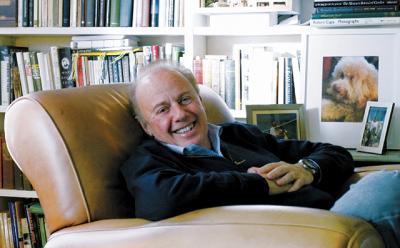
Roger Rosenblatt - from the Easthampton Star

Rosenblatt knows a bit about the Auld Sod
I know I don’t look it, but I’m Irish. I lived in Ireland for a while, my first child was conceived in Ireland, I speak a little Irish, I went back last year, I’ve been back a few times, there’s something in me — I don’t know, maybe the milkman was Irish — that grabs and embraces that country. Add that to the fact that my great, dear friend McCourt, he was a great guy. And he and I talked together in the department where I teach now, and we drank together and sang together — if you think I’m good, and boy am I good, you should’ve heard McCourt — we used to sing all night. I don’t know why this stirred in me before, but I wanted to write a satirical model, and I tried twice. And I started channeling McCourt. I could hear his voice in the dialogue. - from the Chautauquan interview
Murph has been losing his grip a bit of late. Leaving the eggs boiling long enough to start a fire in his kitchen; trying to open the wrong doors in his Upper West Side apartment building; walking into a friend’s pool, while fully clothed, having the odd hallucination. He keeps putting off return visits, fearful he will be declared mortal, and flawed, with the corresponding threats to his freedom that such a judgment entails. And that freedom means a lot to him. It means time with his four-year-old grandson William, time with the friends who remain, time to teach a class on poetry to the homeless, time to hoist a pint at a local watering hole, time to talk to each of the objects in his apartment, as a way of connecting, or maybe saying goodbye, to the love of his life, his late wife, Oona, gone a year. He grieves as well for the death of his closest pal, Greenberg.

Thomas Murphy is a meandering tale, a collection of observations, recollections, musings. If you could capture the image of an entire life in a mirror, then accidentally (on purpose) drop the thing on the floor (of a favorite watering hole, perhaps) the life would still be there, but in diverse bits. That’s Thomas Murphy. Look at this bit, then that. It is not totally random of course. The chronological threads are Murph being informed that he is facing some meaningful personal brain drain and coping with that, or not, and also his relationship with a much younger woman.

What is death? If your mind goes, do you leave along with it? What is life? Is a life disconnected from one’s mind a life at all? What is a poet who has no words?

There is so much here on connection to people, history, to memory, and to the beauty that surrounds us, sometimes in surprising places. You will laugh out loud, and may wet a tissue or two. But you will not be unmoved.

I was particularly touched by the scenes of Murph with his grandson William. They are fueled, no doubt, by Rosenblatt’s real-life experiences, as detailed in his memoir, Making Toast. In that book, he writes of having lost his 30-something daughter to a heart condition and moving in with his son-in-law and grandchildren in order to help out. The man knows a thing or two about being a grandfather and it permeates this book.

It is the wit and intelligence of Murph’s thought process and the deep feeling that travels alongside that make this a work of grandeur, a thing of beauty. Not only facing one’s inevitable demise, but offering ongoing thought and a poet’s view on the human condition, Thomas Murphy is a book of immense power, emotion, humanity, and transcendent joy. Don’t walk, don’t even run to your nearest bookstore (well, those of you who, like me, remain minimally afflicted by e-books). Call a cab. Steal a car. Go! Now! (well, you might wait until the 19th, if you are reading this before then) There is no doubt about it. Thomas Murphy is a masterpiece, and should not be missed.

Review posted – 1/15/16

Publication date - 1/19/2016


=============================EXTRA STUFF

A wiki on the author

An interview with Rosenblatt from The Chautauquan Daily

Those not of the place are likeliest to have heard of the Aran Islands from the 1934 ethnofictional documentary, Man of Aran

September 2018 - NY Times - Andrew McCarthy on a recent visit to the land of Synge - Ireland’s Aran Islands, Hiding in Plain Sight - on the islands as a place lost in time

description
On the road to Synge’s Chair, on Inishmaan, one of Ireland’s Aran Islands, which, as they did when the playwright J.M. Synge, can seem like places frozen in time. - Credit - Andy Haslam for The New York Times - from above article

Yes, the Upper West Side building where Murph resides, The Belnord, is indeed a real place.

Wiki on John Millington Synge an Irish writer of some note that Murph references from time to time
Profile Image for Angela M .
1,460 reviews2,113 followers
January 7, 2016
I didn't want this book to end. I could have read Thomas Murphy's thoughts on loss, life, death , aging , memory and love for at least a couple of hundred pages or more . I had a feeling from the beginning that this was my kind of book . I was right. I found writing that's poetic and characters that I wanted to know. If your looking for a lot to happen, you should read something else. This is a quiet book , a thoughtful and introspective book about a man's life. Immediately, the story is about aging and memory, but before the end I knew that it's mostly about life .

I liked Thomas Murphy right from the start and fell in love with him halfway through. He's intelligent , clever and funny and so creative and he's a poet. The thing is , he might have Alzheimer's. Thomas shares with us his memories of his childhood, growing up on the island of Inishmaan , off the coast of Ireland. We learn a lot about what it means to him to be Irish and his love/hate of the island and his love of the island he now lives on, Manhattan. His thoughts move seamlessly from present to past to present and back again . Sometimes, we are privy to his dreams . He tells us his philosophy on writing poetry, on babies' natural love for their parents, and about what makes us human. There is also the lighter and at times sarcastic side of him that is best illustrated in one of the funniest passages in the book , when he completes a take home test from his neurologist.

Mostly , though it's the poignant moments in his life that touched me , the relationships with his wife Oona , whose death he mourns , with his little grandson, William and their beautiful bond , and with Sarah who comes into his life when he least expects it. There's a recurring song in this story , "What are you doing the rest of your life" and Murphy quietly and at times not so quietly tells us what we should do with ours.

Thanks to HarperCollins and Edelweiss for this book that I think will be one of my all time favorites to read again.
Profile Image for Cecily.
1,325 reviews5,355 followers
May 28, 2021
I’m often charmed by aging curmudgeons, with twinkles in their eyes, as they pontificate on subjects from the serious to the silly, and teasing anyone narrow-minded, pompous, or who they disagree with. I think of Max Morden, and Alex Cleave, of Charles Arrowby, and of Jayber Crow. I think of my late father, too. But Murph primarily reminds me of Ebenezer Le Page, plus the bookishness of Stoner.

“Old Murph… The singing fool. Strong as a moth wing, a feather, a sheet of the thinnest vellum…. So gorgeous I could drown in my reflection in the pool. So hideous I shrink from the bathroom mirror like a mollusc to its shell. I am like no one else, except that on occasion I resemble me… My sea-blue eyes, blameless as sunlight, guilty as sin… Smart as a whip. Dumb as a post… Frail as pebbles… Sometimes I forget what a delightfully curious fellow I am.”
At school I failed every subject except solitude.
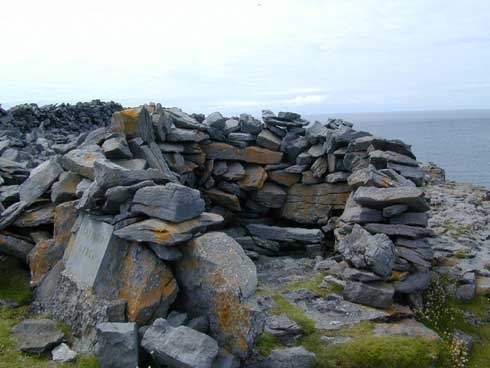
Murph is an islander, drawn to stone, but with a very soft heart. He left the tiny Irish isle of Inishmaan aged 22, and has lived on the island of Manhattan for half a century.

Image: Synge’s Chair (Cathaoir Synge) on Inishmaan, which plays a symbolic and literal part in the story. (Source)

A poem should consist of two parts rocks, one part daisy… It’s all about contrast.
He’s a successful poet, reminiscing about his life, often prosaically, using contrasts, contradictions, and fabrications. He gives tongue-in-cheek advice for solo cooking (lots of takeout), and his first point in “How to live old” is to “cultivate your most irritating qualities”. He’s good at that.

Memory is a belief, a kind of faith. You have to dream it up. Otherwise you have no past to cling to.
He repeatedly reminds readers that he forgets some things and imagines others. Episodes and images from the present and past seem randomly assembled, and are sprinkled with opinions about poetry, people, civil rights, and the limits of acceptable behaviour. The mock-antagonistic banter with his daughter, Máire, is funny, and he has a delightfully close, playful, and irreverent relationship with her 4-year old son, William.

Sometimes, the book is frustratingly disjointed, vague, and irksome, rather than charming or insightful. It might be better to read it all in one sitting like a novella, or little and often like poetry.

Nevertheless, I “carped the diem” and the final quarter of the book won me over: the delicate profundity of his connection with Sarah, a blind woman half his age, and the avoidance of a Hollywood ending.
I discovered you long before we met.”
“You are my braille.

(I almost forgave the bizarre way they met, which may not be true anyway.)

Life after loss; life anticipating loss

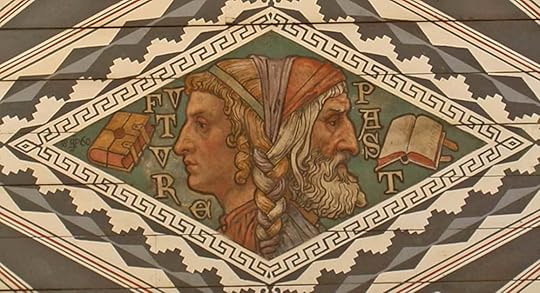
This is a Janus memoir, framed by loss. A “walk through the landscape of a life”.


Image: Janus, the Roman god of doors, beginnings and endings. (Source)

Murph’s beloved wife, Oona, died a year ago. Shortly after that, Greenberg, his best friend since their twenties, and so perfect that everyone hated him, was killed. Burdened with grief, he recalls loved-ones he lost long ago, and helps those who are lost while still alive (schizophrenics and the homeless).

He begins to consider “What should one do with the rest of one’s life?”. Máire is also thinking about the future, but for him, she’s thinking of loss, specifically of his memory and mental faculties.

One message is that it’s never too late to grasp happiness.
Another is that a second chance for one can be a loss for others.
Contrasts, again.

More generally, we need to think, look, and read like poets:
I see the world as a poem - a thing that lives between the lines.

Quotes about poetry

• “At night… I would go down to the beach and listen to the shifts of the tides. Then I would rhyme the stars. Stars rhyme, if you give them half a chance.”

• “We [Irish] make good poets because we know how to deal in absent things.”

• “Most of the poets of my race are not hard to understand. We just play hard to get.”

• “Tyrants dream down, businessmen dream laterally, poets dream up.”

• “As a poet, I have to believe in God… The whole process of writing a poem is mystical… The progression toward someone else’s design.”

Quotes about memory

• “I remember what I want to.”

• “Forgotten things… They live somewhere else, like the world’s not. They live in dreams.”

• “Words forgotten can be a pain. But the process of foraging for those words can be thrilling.”

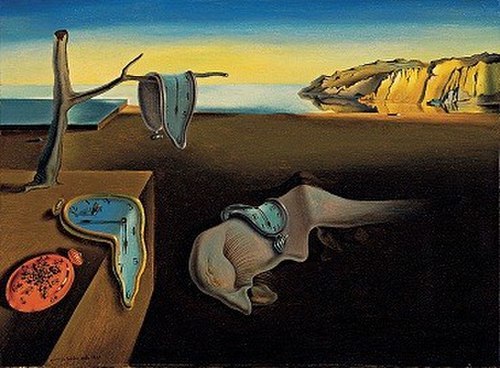
• “What if memory does not apply to the past, after all, but rather to something that will occur tomorrow or next week, and the past is something we only forget?... For all you know, the things you remember haven’t happened yet.” That reminded me of Martin Amis’ Time’s Arrow, which I reviewed HERE.


Image: Hard and soft in “The “Persistence of Memory” by Salvador Dali. (Source)

Quotes about loneliness

• “Everyone lives alone.”

• “Living alone is one thing, but dying alone?”

• “The worst part of blindness… is the loneliness.”

Other quotes

• “I am unable to participate in a sensible world wholeheartedly, which is why I dream things up.”

• “Fish, the invisible crop that seduced men to the ocean, where many died.”

• “Dad! I’m so excited to see Ireland. Darlin’, everyone is until they get there.”

Last words

Murph writes his own obituary. Here’s part of it. I’ve used ellipsis (three dots) where I’ve omitted bits, but the final ellipsis is in Murph’s text - typical of his humour.
“Thomas James Murphy, the celebrated poet, genius, cardsharp… raconteur, bon vivant, and all-round good guy… Mr Murphy, who was devilishly handsome, with a joie de vivre and a coupe de ville and his heavenly baritone voice and sea-blue eyes, sailed to New York in his early twenties, and at once established himself as a literary wunderkind… [After his wife died] It was said that “Murph”, as he was known, was never the same afterward, which most of his friends regarded as an improvement. Besides his perfect if pain-in-the-ass daughter, Mr Murphy is survived by his delicious grandson… Mr Murphy’s last words were… I forget.”
Profile Image for Diane S ☔.
4,901 reviews14.6k followers
January 10, 2016
Thomas Murphy has thoughts and opinions on many things, many, many things. Though he has lived in Manhattan for a long time he is originally from Ireland. He thinks of himself as a sentimental Irishman turned old fart as he is now seventy. His best friend is his young grandson William and he mourns the death of his wife and best friend. He is a poet, a singer and a teller of some awesome stories.

Quiet, introspective, tender and funny, Murphy's thoughts, meanderings and opinions are a wonder to behold. When he misses his wife the most, he talks and tells stories about the furniture they had bought together. He is quite a character and his only child, daughter Marai thinks he might be in the beginning stages of Alzheimer disease. Some of the funniest parts are when she gets him to go to the doctor and he is given a take home test. His answers are brilliant and spot on, many times wished I had the nerve to answer my doctors questions in this way. Also loved how the novel begins and ends with the question, "Have I told you this before?"

ARC from publisher.
Profile Image for Laysee.
631 reviews344 followers
April 30, 2020
The story takes place predominantly (via memory visitation) in Inishmaan, a small Irish town of 160 inhabitants. Its hero is Thomas Murphy (aka Murph), a poet in his 70s, who lives alone in a palatial and luxurious apartment in the Belnord (the Beautiful North). When the story begins, Murph is in trouble. He left some eggs boiling on the stove and almost burnt his house down. His concerned daughter, Maire, is sending him to see a neurologist.

Murph reminds me of some of my favorite curmudgeonly old men in fiction, such as Backman’s Ove and G. B. Edwards’s Ebenezer Le Page. He deems himself ’an old beauty’ and has a healthy self-esteem despite major losses in his life. What I love most is his self-deprecating humor and spontaneously uproarious wit. Because the story is presented as a first-person narration, we hear Murph cracking jokes, giving his neurologist hell, and driving his neighbors to distraction with his loud singing every night, hence risking eviction from the Belnord.

Lest we think he is just a difficult old man, Sir Thomas James Murphy is a distinguished poet. It warms my heart to see him visiting the homeless in a church shelter, many of whom are schizophrenics, encouraging them to write poems, and empathically connecting with their pain. Rosenblatt writes great dialogues and it is a treat to hear Murph being his ornery self. He is hilarious. Some of the best conversations are the ones he has on walks through Central Park with his young grandson, William, whom he loves more than life.

The story meanders as Murph walks through the landscape of his life. What we get are snatches of his recollections of the past and moments of his life in the present. It can be hard to read when one is inattentive. Yet, I have found that even when this happens, an episode will pop up and stab me gently in the heart.

It is a story about losses and how life goes on. The loss of a spouse, a close friend, and one’s memory is told with sensitivity. Murph misses his wife, Oona, who has died. “I don’t mind being alone, Oona. I mind being alone without you.’ So he creates a conversation with the furniture - every chair, lamp, stool, painting - he has acquired with her in their life together. He reminisces about time spent with his adolescent girlfriend, Cait, and his best friend, Greenberg, both of whom have died. He revisits memories of his daughter's childhood. Can a 72-year-old man with Alzheimer's looming ahead find love again? There’s a sweet aside with a little romance.

It is a story on writing poetry. The poets among my GR friends, are likely to love his poetry ‘workshop’ with the folks in the shelter. In his view, “A poem should consist of two parts rocks, one part daisy... If the rocks aren’t in the poem, you won’t be able to appreciate the daisy. And if you take out the rocks, so all that’s left is daisy, well, that’s all that’s left. It’s not yellow anymore. It wilts. You want hard language to convey soft thought, because in the end all poetry is about love, and no one wants love without a backbone. It’s about contrast...”

It is a story on the beauty of forgetting: ‘Words forgotten can be a pain. But the process of foraging for those words can be thrilling, like foraging for the right word in a line of a poem. The wrong word is wrong, to be sure. Still, it can be a beauty. A voyage. An obscenity. And incidents forgotten may be preferable to incidents remembered.’

It is a story about living life courageously. The refrain that runs through this novel is: What am I doing the rest of my life? Here is Murph’s take: ‘You lived. So live. More noisily than ever. Court life... Sing it a love song. Belt it out at the top of your lungs.... Sing it.’

Read Thomas Murphy. This is my first acquaintance with the author, Roger Rosenblatt, an American memoirist, essayist, novelist, and Distinguished Professor of English and Writing at Stony Brook University. I will be reading more of his work.
Profile Image for Dem.
1,264 reviews1,436 followers
July 3, 2019
I fell in love with the cover of this Novel but unfortunately the story didn't hold the same fascination or interest for me.

Trying his best to weasel out of an appointment with the neurologist his only child, Máire, has cornered him into, the poet Thomas Murphy—singer of the oldies, friend of the down-and-out, card sharp, raconteur, piano bar player, bon vivant, tough and honest and all-around good guy—contemplates his sunset years

This is a story of sorts but more one mans ramblings thoughts as he recounts his life story but for me it failed on many levels.

The humor while plenty and witty in places felt forced and unnecessary to the story so much so that it overpowered the character and story. I didn't have any feelings for the character and didn't make a connection with him. I found the writing vivid but too wordy and sometimes I felt I needed to re-read a paragraph to make sense of the story. This wasn't a novel I enjoyed reading but as it was a short read and I had a hard copy I did make it to the finish line.

An ok read but not one for my favourites shelf.

Having read the wonderful When All Is Said by Anne Griffin where the author balances out humor and story I was hoping for more of the same.
Profile Image for Karen.
748 reviews1,989 followers
May 6, 2016
Oh Murph.. what a character you are!! Had me laughing out loud at his conversations with his daughter and grandson.
Murph shares his feelings on life, memory, imagination..I really liked this book!
Profile Image for Carol.
1,370 reviews2,354 followers
March 12, 2016
3.5 Stars

I've been pondering over what to say about THOMAS MURPHY for a few weeks now wondering why his touching story did not blow me away or hold my attention like others of its kind.

Perhaps it's bc of the rather strange beginning or that it really doesn't have much of a plot or that I found it a bit wordy......I'm not sure.

What I remember about THOMAS MURPHY is this......he is 73 years old and a poet who is trying to figure out what to do with the rest of his life after losing his beloved wife OONA......he loves his little grandson and his daughter.......he writes a poem now and then, and sadly......he is slowly losing his memory.

While interspersed with mischievous humor and some interesting reflection of a younger self, overall, a bit slow going for me.

Profile Image for Cheri.
2,041 reviews2,972 followers
June 25, 2016
Roger Rosenblatt’s newest novel “Thomas Murphy,” tells the story of Thomas, who is a somewhat aging Irish poet born in Inishmaan, as he comes to terms with his daughter Máire’s concerns with his lapses of memory.

Now living in New York, Murphy is a strong, sweet, tender, lovable character, with a strong connection to his grandson William. Murphy charms everyone he meets, old friends and new ones alike, and will undoubtedly charm you, as well.
Profile Image for Phrynne.
4,041 reviews2,738 followers
October 5, 2018
Thomas Murphy is an aging poet, living on his own in Manhattan after the death of his much beloved wife. In this book he wanders through his thoughts about anything and everything at random but there is also a constant thread recounting his personal history which is totally compelling.

Murph's life, which began on an island called Inishmaan off the coast of Ireland, has been truly eventful, beginning with a very strange childhood and the death of his teenage first love. Now over seventy years old and living in America, we meet his daughter and grandson (both delightful people) and we hear about his wife and his best friend both now dead. There are many comedic moments as certain people try to prove Murph is losing his mind and he cannot decide whether he is or he is not.

This is a short book, but a slow read as the author packs so much into every sentence and the reader has to pay attention to every word to sort out Murph's fact from his fiction. His greatest concern is what to do with the rest of his life. I really hope those four knocks on the door in the last sentence mean his concerns are over.
Profile Image for Diane Barnes.
1,622 reviews446 followers
June 28, 2021
Good old Murph, friend, husband, father, grandfather, lover and old coot. I enjoyed his ramblings, loved his daughter and grandson, his discussions with his dead wife, and his determination not to be fit into a "slot" because of his age. What I thought would be a bittersweet ending turned into a happy one in the last paragraph.
Profile Image for JimZ.
1,298 reviews769 followers
June 18, 2020
I wanted to give this a higher rating because I really like Roger Rosenblatt. Roger Rosenblatt was a regular essayist for the MacNeil/Lehrer Newshour on the Public Broadcasting Corporation in the US…must have been 1990s through the early 2000s. He would be on every month or so…I loved hearing his voice and of course more importantly what he had to say in his 3-4 minute snippets. He seems like a gentle soul. And a person with a good deal of common sense and wisdom.
Some of that common sense and wisdom shone forth in the book spoken or thought by the central protagonist of the novel, Thomas Murphy, a poet living in New York City, who may have been showing early signs of Alzheimer’s. But unfortunately, at least in my view, the pearls of wisdom in this book were too far and between interspersed with a lot of meandering ramblings of the man (that had nothing to do with Alzheimer’s)… At times the book was ‘cutesy clever”…like Roger was showing off his writing skills….an example below.

Thomas Murphy is being interviewed by a newspaper reporter and the interviewer asks him if he has any regrets in his life. Murphy answers:
• To which I reply, beguiling as ever, Sonny, I’m going to travel inside you for a while, and let you feel the gravel I shovel in your blood, and the bulge and beat I cause in your pulse, as I run amok among your tissues, go at your muscles with a paring knife, your every inner town and village unbulwarked against my assaults. I shall practice debauchery in the caves of your lymph nodes, terrorism in your viscera, barbarism in your glands. I shall scrape out your spleen, plough some snow around your kidneys, and invite the monkey on your back to brachiate from vein to vein, all in an effort to cause as much pain as you can endure, more in fact. I shall assail your entrails, cause tumors on your humors, sup on your heart, and fling my empty oyster shells smack against your brain, which I will then toss out into the street for lack of payment of rent. When I have done all that to you to give you a taste of how the real world suffers, then see if you have the nerve to ask me: Regrets?
Okayyyyyy……

But for the pearls:
• Maybe it’s language that confines us. We simply do not have the language to deal with the past in the future. (What I took from that was that we can’t put ourselves one week from today and think about what transpired the week before…because it hasn’t happened…but is it “there”? Anyhoo, I liked the sentence.)

• When the sickness was devouring Oona (his wife)…I asked did she recall the time of her past good health. She said she could no more recall being robust than she could, in health, recall the pain and lassitude of illness. If we were able to return to the past in the body as well as in mind, she said, that would be grand. But it is part of nature’s unfairness that we can remember that we were healthy at an earlier time, without feeling any of it.

• But you believe in your memory anyway. Your childhood. Your parents. Your pals. Your lovers. Yourself. Your brave, cowardly, sensitive, senseless, adventurous, terrified self. You don’t have an accurate thought in your head, about you or anyone or anything in this holy mess of a life. But you believe you do. Memory is belief, a kind of faith. You have to dream it up. Otherwise you have no past to cling to. Right? You know I’m right.

• I love being a poet. And I do the best I can to make my writing useful (aesthetically, philosophically, practically) for others. But not for a moment do I think that my words are equal to life. If anything, they prove how inadequate I am to the grand discombobulation. So maybe that’s the true power of words—to show how puny they are in the face of everything they attempt to say. And maybe that’s why poets write, to show the powerlessness, in a storm at sea.

Wow, I sure could not write these zingers. Lovely and powerful and thought-provoking. 😊 I do recommend you read this book…its strengths outweigh the weaknesses.

Reviews (all very favorable which shows I am becoming a harsh critic ☹):
https://www.nyjournalofbooks.com/book...
http://www.washingtonindependentrevie...
https://www.newsday.com/entertainment...
Profile Image for Linda.
1,872 reviews1 follower
January 8, 2018
4.49 on 12/22/17

I laughed, I cried and I fell in love with Murph. ❤️ My emotions were all over the place. Beautiful read. Hey, less than 2 weeks into 2018 and I already have a favorite book, not bad. Thanks Will Byrnes for the recommendation.
Profile Image for Bill Mathis.
Author 10 books9 followers
August 10, 2019
This book by an award winning author is a wild ride, but well worth every minute. All I can say is read it! 5 Stars!
Profile Image for Linda.
152 reviews110 followers
August 7, 2019
I am a person who finds great fascination in sitting down with an elderly person and hearing their life story.If indeed I discover they are a delightful storyteller then I know I have hit a pot of gold. That is what I found in Thomas Murphy. Add to the fact that he is a curmudgeon and Irish and well, you can get the picture.
Profile Image for Melissa.
337 reviews21 followers
September 2, 2015
This was the first novel by Rosenblatt that I've read, but I won't make that mistake again. This will be on my personal list of Top 5 books this year. *Thomas Murphy* is a stream-of-consciousness narrative by Thomas Murphy, an aging, bestselling Irish poet who may or may not be suffering from Alzheimer's. It is hilarious, it is bittersweet, it is loving, it is sad; I was never sure what emotion I'd be feeling next. His wife, Oona, passed away a few years before the novel, and he's making the best of it by spending time with daughter, Maire, grandson, William, befriending folks at the homeless shelter where he volunteers, driving his apartment super crazy, or meeting strangers at the neighborhood pub. The book almost felt like Murphy's goodbye to his friends and family but also like a love letter to other Irish poets and authors (James Joyce in particular). Be ready to love this book, and be ready for it to stay with you long after you finish.
Profile Image for Lynn.
1,179 reviews
Read
March 26, 2016
I can't rate this one because I gave up about halfway through. This is not to say the writing wasn't good or that the main character was unappealing. It's just that the stream-0f-conciousness style was too exhausting. I enjoyed the imagery and the humor but I'm just not in a mental place where I want to do this much work. Reading is my escape and this one , though worthy I'm sure, is not for me right now.
Profile Image for Joy D.
3,151 reviews336 followers
November 17, 2017
Inventive, lyrical, poignant novel about an aging Irish poet, Thomas Murphy, battling grief, loss of memory, and a gradual decline in his mental health. We follow his non-sequential ruminations, sometimes veering into the realm of fantasy, as he reminisces about the past, comments on the present, and wonders about a tenuous future. His thoughts do not always “make sense” in terms of logic, but they reveal his mental state. Some might call him an unreliable narrator, as we do not know for sure if what he is relaying reflects reality. The language is poetic in many places, as may be expected in a book about a poet. Murphy’s relationships take a central role, including philosophizing about his daughter Máire, late wife Oona, good friend Greenberg, grandchild William, new friend Sarah, the homeless man Arthur, his neighbors, and others. He has a sharp wit, and humor is interspersed throughout.

It is a short book, and this may be a good thing as it takes a bit of brain power to follow Murphy’s thoughts. It’s not for everyone, as it has very little plot, and flits around as thoughts fly into and out of his brain, almost a stream-of-consciousness style. I found myself a bit disoriented at first, but ended up enjoying it quite a bit. It provides lots of food-for-thought on living life to its fullest. Recommended to readers of books on mental issues, and those who enjoy introspective, philosophical subject matter.

There are so many great quotes in this book, it has hard to select only a few. Here are several of my favorites (and a bit of humor):

“Bring it, Mr. Death, with your boney jaw and creepy cloak and outdated farming tools.”

“I figured you must be pretty good, he says. I could use a good poet. That’s a new one on me, I tell him. I never heard of anyone who could use a poet, good or bad.”

“The idea is to live a simple life, which is constricted and has boundaries, but to dream without limits, to have that power.”

“I should know by now, people are not to be explained or reformed.”

“In general don’t despair, and if you must, don’t force your despair on others. It’s unfair to add your despair to theirs.”

“Everyone is disabled, she said. Love exists for our disabilities.”
Profile Image for Penny (Literary Hoarders).
1,305 reviews166 followers
June 26, 2016
Wasn't that the most perfect gem of a book to read at just the right time? Thomas Murphy turned out to be a wee, slight book, coming in at just over 200 pages and is a little book to hold in your hands. But it is filled with awesomeness. Anyone that knows me, knows I'm a real sucker for reading about an old man that talks to, writes to and thinks about his dearly departed wife, lamenting the sadness he experiences without her. (I still think fondly about that old fart Angus in The Best Laid Plans) This is Thomas Murphy. An aging poet, he's in his 70s and is slipping slowly into dementia. His daughter is exasperated with him in getting him to see a neurologist. With a fantastic combination of tenderness and sardonic wit, I was charmed to no end by Murph. There were times when he had me laughing out loud, laughing so hard, my shoulders were shaking and his moments of great tenderness and appreciation for the moments he remembered in his life all made for wonderful reading.
Profile Image for James Murphy.
982 reviews26 followers
July 31, 2016
This little novel didn't hold up till the end. From what I'd read about this, I'd expected the character Thomas Murphy to be one of those irrepressible guys who exudes vaulting confidence as he butts heads with convention and battles with life's situations. I thought Thomas as shell-shocked and confused as the rest of us. And I thought the novel a little predictable, too.
Profile Image for Michele.
59 reviews1 follower
March 20, 2016
Less a novel and more a philosopher listening to himself think.
Profile Image for Teresa.
794 reviews
August 22, 2016
It took me a long time to finish this book because the narrative is not linear. This is the story of Thomas Murphy, an aging poet, who lives in NYC and is musing about the death of his wife, his childhood home in Inishmaan, his dreams, his forgetfulness, his daughter and her son, William, and his resistance to his daughter's request to see a neurologist. The language is beautiful at times and humorous at others. I had trouble though establishing the main character's thoughts as fact or fiction at times. More than halfway through the book, a situation develops that provides an intermittent plot line. Themes are beginning to repeat and events begin to take place in a logical sequence.

I liked portions of the book very much. The romantic poetry Thomas Murphy recants is beautiful. The descriptions of the Irish are something I might have expected from a book like "Angela's Ashes."

"Want to know why the Irish make good poets? Sure you do. You're dying to know. Well, we make good poets because we know how to deal in absent things, the things taken from our lives, like food and dignity. And legs. We've been learning to do without since the ancient Irish writings left out vowels. No vowels in ancient Irish. Try pronouncing a sentence of that. Then again, the spoken language of today adds more vowels when you expect less, too, just to prove our English is different. There is no word for yes or no in Irish and none in our use of English either. Ask an Irish woman if it's cold outside, she'll say 'It is.' Ask an Irishman if he's happy, he'll say, 'I am.' I take that back. No Irishman is happy. But you get the point."

I had to wonder reading this how someone with the last name of Rosenblatt could write about the Irish! Roger Rosenblatt was a Fulbright Scholar in Ireland. He also taught creative writing, Irish drama, modern poetry and the first African American course at Harvard.

If you enjoy books with a different structure and the musings of an old Irish soul, you might enjoy this book. But, the perfect descriptor is that the main character "ruminates" throughout.

966 reviews7 followers
February 4, 2016
There's hardly any plot, not much dialog. Instead there are the musings, the dreams and the fictions of the wonderful character Murph, an elderly poet with a wicked sense of humor, a fabulous sense of the absurd and a huge dose of creativity. How will Murph live on after his beloved wife dies and so does his best friend Greenberg? The book is Murph's musings on life, old age, parenting, having parents, Ireland's relationship to England, what it means to be Irish and much more. I loved Murph's present-day musings more than his recollections of his childhood. His interactions with his daughter and his grandson are priceless -- the depth of his love for them is obvious. This book is lyrical and slow -- intentionally, I'm sure -- as there is much to savor.
Profile Image for John of Canada.
1,122 reviews64 followers
January 14, 2018
Absolutely wonderful.For those who think Murph is Roger Rosenblatt I offer this.During an interview with the New York Times,Roger was asked-"Whom would you like to write your life story?"He answered "Jennifer Lawrence.I don't know how she writes,but I'd sure like to meet her."Roger can do no wrong in my opinion.His characters are beautifully drawn.Murphy is my new role model.Six stars.
1,178 reviews26 followers
February 10, 2017
Great concept but I found the smart aleck tone grating. It is sort of Kurt Vonnegut for the on the verge of dementia set (which I am uncomfortably close to).

I enjoyed the musings on life, art, etc. interesting but would have preferred something a bit more straightforward.
647 reviews4 followers
March 22, 2020
What a lovely window into the mind of a literate and elderly man! (Takes one to know one?) Thomas's madcap flights of fancy, and poetry, and speculation, are luminous ...giving [this] one hope for the possibilities of brilliance and meaning in times of anomia and lost words.
I have never understood why reviewers here think they need to recap the plot of a book -- are they still in third grade, writing a book report for Miss Lassen? -- but there were some gems in the book's prose that I want to memorialize. Here's one: "Would that I could dream up a new style of writing that would effect a new style of living. I mean, we so-called creative writers do not actually create anything. We simply respond to that which already has been created. But if we could create something, I'd like to do it through style. A new style, never tried before, the style of the world's not that merely by its own existence, by the statement of itself, made religions obsolete, and nations as well, and everything else that has gummed up the works since the works began..."
Thomas names himself a poet, and substantiates that claim with sentences like this one: "You may have evolved to eyeless petunias marooned at the farthest edge of Lusitania, where there is only fog and skulls, in a place so desolate, it makes Inishmann look like Metropolis."
And here, toward the end of the book, is advice for the elderly: "...intended for those who have just crossed the border of their seventies, and anticipate living on into their nineties. What should I do to make the best use of those added years? How best to spend my time? I'm glad you asked..." and here I condense: "1. Cultivate your most irritating qualities ... 2. Ever a dull moment. Excitement is an overrated reaction ... 3. Develop a good false stare ... An old man's stare is useful for girl-watching ...3a. And don't worry about being impolite. Politeness is for occasions where nothing is at stake... 4. Watch your step, literally. After the age of seventy you should regard your body as scrupulously as a garage attendant inspecting your car for dents... 5. Do not attempt to make amends with past enemies... In a similar vein, suppress urges to visit old friends. They're fine as they are, and things can only get worse. Ditto for class reunions... 5a. And if you have no enemies? Where's your sense of judgment, man?! 6. If you find yourself saying, I've wasted my life, you will. Don't say it, even if you can prove it. It's my experience that only men whine about such stuff. Women, smarter, just get on with it... 7. Save the world. Age affords an excellent opportunity to save the world. But you're running out of time..."
Reading this book was like a long conversation, possibly many mornings over tea, in a loquacious friend's company, punctuated with invitations to join the talk "Isn't that right?" and "Don't you think?" I loved it, half-a bubble out of plumb as it is, and unlike anything else I have ever read ... like a deep dive into a mind I wish I had.
Profile Image for Jean.
517 reviews43 followers
June 11, 2016
I read all of Roger Rosenblatt's books because I am fortunate enough to see him in person in the summer at the Chautauqua Institute. He has a dry wit and is very entertaining when he interviews other authors and talks about their works and his own. This latest novel is seemed somewhat autobiographical. He relates the story about an aging NYC poet and the meaning of the rest of his life now that his wife is gone. It is charming, hilarious, sometimes almost stream of consciousness, and lovable. I loved it, just like I love him when I see him. I recommend it but I think its an acquired taste.
878 reviews9 followers
March 24, 2019
I want to be Murph’s friend. I want to read his poetry. I want to call him up, meet for coffee, listen to his voice, lose track of time. Although slow, quiet, simple, this book is a tiny gem (only 223 ePages)—a wonderful companion on a “tarnished-silver afternoon”, or however long you can stretch it. When I finished this book, I felt a sense of loss akin to the passing of a new friend that I nevertheless felt as if I had always known.
588 reviews11 followers
February 29, 2016
Articulate, brilliant ramblings and musings of an aging man. Rosenblatt's writing is awesome! It seriously blows my mind. I love the rhythm of his words, his dry irreverent sense of humor and his profound observations on life. Truly an amazing book. I do believe that the character of Thomas Murphy is Roger Rosenblatt in disguise.
Displaying 1 - 30 of 96 reviews

Can't find what you're looking for?

Get help and learn more about the design.