

What do you think?

Sequential Drawings
Sequential Drawings
588 pages, Hardcover
First published January 1, 2016
About the author
Richard McGuire
23 books170 followersRichard McGuire is a regular contributor to the New Yorker magazine. He has written and illustrated both children's books and experimental comics. His work has appeared in The New York Times, McSweeney's, Le Monde and Libération. He has written and directed two omnibus feature films, designed and manufactured his own line of toys, and is also the founder and bass player of the post-punk band Liquid Liquid.
Ratings & Reviews
Friends & Following
Create a free account to discover what your friends think of this book!
Community Reviews
Displaying 1 - 30 of 74 reviews

January 4, 2017
Richard McGuire wrote Here, a sort of ponderous and epic visual exploration of time and space, moments captured in the same space over centuries. Clever and thoughtful, it is also a reflection on and series of experiments into comics and illustration, two of McGuire's related and chosen fields. Chris Ware called it a monumental achievement in the history of comics, and I agree.
Sequential Drawings may not be a monumental achievement, but it is pretty great stuff, nevertheless. 585 pages of images, in a 4 x 6 hardcover format, it features a decade of McGuire's New Yorker "spot illustrations" that happen to be wordless and also happen to be sequential--little short short stories, almost as minimal as possible, sometimes gags, sometimes just some thoughtful reflection. "Spots" are usually single images, which might be thought of as spatial "filler"in a newspaper or magazine. But McGuire, an inventor of toys, writer of children's books, and so much else, takes this form of the "spot' on seriously (and whimsically, playfully, too). How little does it take to tell a story? Sometimes, it's just a few lines, and in that space, McGuire is often thoughtfully entertaining.
Here's some images:
https://www.google.com/search?q=Richa...
Here's a New Yorker article on McGuire's Spot Illustration:
http://www.newyorker.com/culture/sara...
Sequential Drawings may not be a monumental achievement, but it is pretty great stuff, nevertheless. 585 pages of images, in a 4 x 6 hardcover format, it features a decade of McGuire's New Yorker "spot illustrations" that happen to be wordless and also happen to be sequential--little short short stories, almost as minimal as possible, sometimes gags, sometimes just some thoughtful reflection. "Spots" are usually single images, which might be thought of as spatial "filler"in a newspaper or magazine. But McGuire, an inventor of toys, writer of children's books, and so much else, takes this form of the "spot' on seriously (and whimsically, playfully, too). How little does it take to tell a story? Sometimes, it's just a few lines, and in that space, McGuire is often thoughtfully entertaining.
Here's some images:
https://www.google.com/search?q=Richa...
Here's a New Yorker article on McGuire's Spot Illustration:
http://www.newyorker.com/culture/sara...

February 27, 2018
The one-ultra-simple-image per page suggests a streamlined elegance of form and composition that this doesn't quite deliver. When creeping tedium causes me to let pages flash by into the animation of a flip book, however, these start to come alive, even if they can not be properly taken in that way. There's not so much to take in regardless.

August 23, 2018
Quando vou comprar hqs importadas sempre dou uma olhada na quantidade de páginas pra vê se vale a pena, nesse livro isso foi um destaque, quando vi lá 500 e poucas páginas, Richard mcguire, pantheon, a 80 reais! Não pensei duas vezes kkk Estava esperando um calhamaço, claro, com isso grande foi meu espanto quando ao abrir a caixa me deparei com um livrinho beeem pequeno que cabe na palma da mão, definiria como um microcalhamaço kkk. Designe perfeito! Pq o livro é composto por pequenas histórias contadas com ilustrações hiper minimalista, criativas e que deixam sempre um quê de pequena reflexão, então tudo orna! Um belo livro pra dá de presente.

March 28, 2017
Very poetic.

April 15, 2023
Surely a comic classic!
As a lifelong lover of comics, I've become active later in life in national efforts to preserve and highlight classic American comics. I'm active in helping to promote newspaper comics from 100 years ago, which were colorful classics on wider newsprint in glorious colors. And I'm active in trying to spread the word about contemporary comics as well. That's why I'm working my way through some of the volumes of the Pantheon Graphic Library. If you're a fan of comics and graphic novels, definitely take a look at the listings of that "Library" on Amazon.
I've been a fan of Richard McGuire for years. I followed "Here" years before it was a Pantheon book, for example. And I naturally was drawn to this beautiful little 2016 volume, "Sequential Drawings."
The word "classic" is thrown around a lot. I'm guilty of using it in magazine stories and reviews, myself, to make the point that something we're seeing now should be recognized as the classic it will be in the future. I hope that makes sense, even as I'm admitting to a bit of hyperbole now and then. Still, I'm convinced this enticing book will one day be recognized as such a keeper in the comic canon.
Why?
First, this book is a wonderfully eccentric size. Looking at the cover straight on, the dimensions aren't that much bigger than a cell phone! Of course, the book is a whole lot thicker than a phone. It's a little white brick of a book. And I'm directly addressing why I think people should buy this physical book rather than simply get the Kindle version. This book is an "object" that I'm going to savor placing in our home library. Clearly, the design and feel of the book is part of its special appeal.
Then, McGuire brings minimalism to a new level of distillation with his crisp line drawings. What astonishes me is that he pulls it off! He makes us care about his tiny sketches. I actually found myself tearing up as I read the opening short story, "Three Friends," which is about a mailbox, a parking meter and a trash bin on a city street and their long-suffering companionship. If that sounds nuts, then get a copy of the book and "read" McGuire for yourself. Or, in this case, look at the pages because there aren't any words except for the titles of his stories.
Also of note for me is "Rock, Paper, Scissors," which will change the way you look at that little game forevermore. I didn't find anything emotional about that story, but it's certainly fun.
Then, honest to goodness, I felt emotion welling again with "Knife, Fork, Spoon, Love Triangle." This one didn't grip me like "Three Friends," which is my favorite in the entire book, but it definitely pulls at the heart strings.
Finally, for those of you like me who occasionally lead small groups or teach, there are a couple of stories in this book that I'm definitely going to show folks. If you're involved in speaking, teaching or small-group leadership, you'll be tempted to show a few of these images to others. Chief among those stories are "Sharing Thoughts" in which McGuire simply uses geometric shapes to tell an all-too-common tale about communication—and "Gossiping Objects" in which the familiar objects on a bathroom vanity suddenly start telling tales to each other. I know I'm going to be suspicious of what my toothpaste tube is doing while the lights are out after this strange tale.
Lots of fun in this book. I definitely urge folks to ante up for the actual hardback. You'll want to keep this book in your collection of favorites.
As a lifelong lover of comics, I've become active later in life in national efforts to preserve and highlight classic American comics. I'm active in helping to promote newspaper comics from 100 years ago, which were colorful classics on wider newsprint in glorious colors. And I'm active in trying to spread the word about contemporary comics as well. That's why I'm working my way through some of the volumes of the Pantheon Graphic Library. If you're a fan of comics and graphic novels, definitely take a look at the listings of that "Library" on Amazon.
I've been a fan of Richard McGuire for years. I followed "Here" years before it was a Pantheon book, for example. And I naturally was drawn to this beautiful little 2016 volume, "Sequential Drawings."
The word "classic" is thrown around a lot. I'm guilty of using it in magazine stories and reviews, myself, to make the point that something we're seeing now should be recognized as the classic it will be in the future. I hope that makes sense, even as I'm admitting to a bit of hyperbole now and then. Still, I'm convinced this enticing book will one day be recognized as such a keeper in the comic canon.
Why?
First, this book is a wonderfully eccentric size. Looking at the cover straight on, the dimensions aren't that much bigger than a cell phone! Of course, the book is a whole lot thicker than a phone. It's a little white brick of a book. And I'm directly addressing why I think people should buy this physical book rather than simply get the Kindle version. This book is an "object" that I'm going to savor placing in our home library. Clearly, the design and feel of the book is part of its special appeal.
Then, McGuire brings minimalism to a new level of distillation with his crisp line drawings. What astonishes me is that he pulls it off! He makes us care about his tiny sketches. I actually found myself tearing up as I read the opening short story, "Three Friends," which is about a mailbox, a parking meter and a trash bin on a city street and their long-suffering companionship. If that sounds nuts, then get a copy of the book and "read" McGuire for yourself. Or, in this case, look at the pages because there aren't any words except for the titles of his stories.
Also of note for me is "Rock, Paper, Scissors," which will change the way you look at that little game forevermore. I didn't find anything emotional about that story, but it's certainly fun.
Then, honest to goodness, I felt emotion welling again with "Knife, Fork, Spoon, Love Triangle." This one didn't grip me like "Three Friends," which is my favorite in the entire book, but it definitely pulls at the heart strings.
Finally, for those of you like me who occasionally lead small groups or teach, there are a couple of stories in this book that I'm definitely going to show folks. If you're involved in speaking, teaching or small-group leadership, you'll be tempted to show a few of these images to others. Chief among those stories are "Sharing Thoughts" in which McGuire simply uses geometric shapes to tell an all-too-common tale about communication—and "Gossiping Objects" in which the familiar objects on a bathroom vanity suddenly start telling tales to each other. I know I'm going to be suspicious of what my toothpaste tube is doing while the lights are out after this strange tale.
Lots of fun in this book. I definitely urge folks to ante up for the actual hardback. You'll want to keep this book in your collection of favorites.
September 15, 2019
this was fine. “architecture” is by far the standout sequence here. “elevators” had a weirdly fatphobic vibe for literal line drawings. the drawings are good or whatever but they didn’t do anything that seemed very new. somehow these manage to convey a hetero white guy perspective, which is kind of amazing in so little content, but overall i’m just exhausted by. so it’s exactly like the new yorker, really

November 27, 2020
Fun little stories, amazing drawings. I love how much McGuire conveys with just a few beautiful clean lines.

January 19, 2020
This was a four star book, but I'm docking it a star for seemingly bending physics willy-nilly in the middle of a particular sequence for, I assume, some misguided sense of convenience in the service of creating delight. The book generated plenty of untarnished simple delight, so I postponed writing this review for a few days, to see if I could shake the one mishap, but in that time my annoyance failed to lessen, so bye bye star #4.
Here's the gist of my complaint. In one sequence we are following a series of framing and reflections as we move backwards through and outside of an apartment. So we're expanding out a three dimensional construct on each step in our heads which is quite fun, but in the middle at one point we are shown the ever shrinking and receding series in a mirror of an above the sink cabinet of a bathroom.
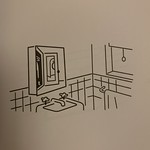
And in the next step, we are shown the same reflection, but this time through the window that was visible in the last step.

In other words, we are shown the exact same reflection from two different goddamn angles!
It shook me to my core.
Here's the gist of my complaint. In one sequence we are following a series of framing and reflections as we move backwards through and outside of an apartment. So we're expanding out a three dimensional construct on each step in our heads which is quite fun, but in the middle at one point we are shown the ever shrinking and receding series in a mirror of an above the sink cabinet of a bathroom.
And in the next step, we are shown the same reflection, but this time through the window that was visible in the last step.
In other words, we are shown the exact same reflection from two different goddamn angles!
It shook me to my core.

February 28, 2018
After reading this book, you'll start looking at everything with a new eye, asking yourself questions like is this a part of a painting, what happens after this stage, how would it look if I saw it from another direction, are these three inanimate things friends, etc.
The mastery, I guess, lies in the fact that with a few simple lines, McGuire makes you tell yourself a story as you flip the pages.
The mastery, I guess, lies in the fact that with a few simple lines, McGuire makes you tell yourself a story as you flip the pages.

June 23, 2017
Wat een heerlijk boekje! Heel anders dan Here, maar daarom niet minder straf: hoe McGuire in hele simpele (maar waarschijnlijk net daarom heel moeilijk te tekenen) illustraties zoveel kan vertellen. Inspirerend!


July 11, 2026
Always loved looking through this book as a kid! Some things have never changed!

January 6, 2023
Desde una difícil simpleza McGuire juega con la secuencialidad que distintos elementos pueden narrar.

November 14, 2016
Richard McGuires postkartengroßes Buch mit seinen Vignetten aus dem New Yorker zieren auf dem Cover zwei Büroklammern und ein Objekt aus Draht, das auch eine Büroklammer sein könnte. Hinter diesen Gegenständen hatte ich eine Geschichte vermutet, drei ungleiche Freunde, ein Projekt oder ein Beziehungsdrama. Doch es sind wohl „nur“ Objekte zum Thema „Draht“, gemeinsam mit einer altmodischen Haarklammer, einer Drahtfeder, einem Kleiderbügel und einer Klammer aus einem Bürohefter auf Vorsatzblatt und Titelseite. McGuires Vignetten scheinen eine Spezialität des „New Yorker“ zu sein. Auch wenn sie ursprünglich einmal Lückenfüller gewesen sein mögen, haben sie sich inzwischen zu einer eigenen Kunstform gemausert. McGuire erzählt mit wenigen Strichen Bildgeschichten, erzeugt dabei kleine Daumenkinos oder sammelt Ideen zu einem Thema. Jedes Bild steht für sich auf einer Seite, für das schnelle Blättern eines Daumenkinos viel zu schade! Für seine Bildgeschichten steht „Drei Freunde“, das Schicksal einer Parkuhr, eines Briefkastens und eines Papierkorbs. Die Dinge schneien ein, ein Hund pinkelt auf den Schneehügel, plötzlich lehnt da ein Fahrrad, es wird mit der Zeit demoliert. McGuires Gegenstände können sogar schwatzhaft sein, wie Rasierer, Zahnbürste und Schere in „Schwatzhafte Gegenstände“. „Berührt“ zeigt zunächst tippende, klickende und wischende Finger, bis die Emotionen hinter den Bildern deutlich werden – hier geht es um die Trennung in einer Beziehung. Auch die Freundschaft zwischen einem Quadrat und einem Parallelogramm berührt; denn hier erhalten selbst Sprache und Gedanken die geometrischen Formen ihrer Erzeuger. Thematische Sequenzen blicken in Wohnungen und auf deren Bewohner, ein Einblick in modernes Leben; sie reihen aber auch frei Vogelkäfige, Instrumentenkoffer oder Hüte aneinander.
Richard McGuire versteht Betrachter mit seinen Bildgeschichten und Einzelbildern zu berühren – so dass man sich am Ende wie der kleine Häwelmann wünscht: mehr!
Richard McGuire versteht Betrachter mit seinen Bildgeschichten und Einzelbildern zu berühren – so dass man sich am Ende wie der kleine Häwelmann wünscht: mehr!

December 6, 2019
I didn't know this existed until I waddled into a bookstore that focuses on remainders, and stepped out with a new book. :-)
This little brick is a very quick 'read', with each spread having only a page number and a single, simple drawing. The brick is split into several short sequences, multiple pages in length. You flick through the pages - not like a flip book but almost as fast - although the careful reader is rewarded with details; I'll admit that I flicked back to the start of sequences to make sure I absorbed everything.
I found it really intriguing that I kept trying to see a narrative in each sequence, and personalities in simple objects. Some sequences spoke to me less than others but I still enjoyed them. I suspect the key to enjoying this brick is to *not* expect a story or point to a sequence (and be delighted when you see one regardless).
This little brick is a very quick 'read', with each spread having only a page number and a single, simple drawing. The brick is split into several short sequences, multiple pages in length. You flick through the pages - not like a flip book but almost as fast - although the careful reader is rewarded with details; I'll admit that I flicked back to the start of sequences to make sure I absorbed everything.
I found it really intriguing that I kept trying to see a narrative in each sequence, and personalities in simple objects. Some sequences spoke to me less than others but I still enjoyed them. I suspect the key to enjoying this brick is to *not* expect a story or point to a sequence (and be delighted when you see one regardless).

February 2, 2017
Hooray! I read a 640 page book!*
I really loved Richard McGuire's Here, so I was thrilled that he has a new book. This is definitely more whimsical than that, but packs less of the punch too. A lot of the series' I liked best were the ones that, like Here, took place in one spot. I especially liked Framed, Bird Cages, Touring, Insect Fashion, and Burden. But they were all pretty great. Probably a longer review to come, but I make no promises.
*There's only one image on every odd page, so it's not any kind of accomplishment.
I really loved Richard McGuire's Here, so I was thrilled that he has a new book. This is definitely more whimsical than that, but packs less of the punch too. A lot of the series' I liked best were the ones that, like Here, took place in one spot. I especially liked Framed, Bird Cages, Touring, Insect Fashion, and Burden. But they were all pretty great. Probably a longer review to come, but I make no promises.
*There's only one image on every odd page, so it's not any kind of accomplishment.

January 4, 2021
This was fun to look at. Simplistic line drawings for the most part but done with such thought and appeal you’ll find yourself just staring at them and trying to work them out. There’s one illustration of a tipped over cup of coffee, and it’s all done in one elegantly looped line. Sheer genius.
Also such a quick read. I was done a lot sooner than I thought possible. Rounding up from a 3.5 to a 4.
It’s a right pain to read on a kindle though. There is no tracker bar for this. Plus the first few pages are just blank and you’re left struggling with your kindle like, is this the book? Or did my Kindle freeze? Oh and every single illustration needs two taps/ swipes before you can proceed. Not good ux but a good book nevertheless.
Also such a quick read. I was done a lot sooner than I thought possible. Rounding up from a 3.5 to a 4.
It’s a right pain to read on a kindle though. There is no tracker bar for this. Plus the first few pages are just blank and you’re left struggling with your kindle like, is this the book? Or did my Kindle freeze? Oh and every single illustration needs two taps/ swipes before you can proceed. Not good ux but a good book nevertheless.
October 20, 2020
One or two of the stories played cleverly with comic conventions, but the vast majority were pedestrian and unmemorable both as stories and as artwork. The book was also incredibly padded with just one small drawing on every other page (each facing page only had a page number). Once you include all the introductory pages and story title pages, this 588 page book actually boils down to about 222 images in total. At even 4 images per page, this could have just been a double-length comic book - and probably should have been.
June 7, 2021
I'm sure I could come up with some sort of critique about how deep and moving this minimalist form of art and expression still manages to convey so much... something... but that seems a bit pretentious, which is kind of how this feels. But, it's still enjoyable. Like a pretentious flip book. I mean, it's got slightly anthropomorphized cutlery/bathroom counter things/condiments; how could I not enjoy that?
I would recommend you flip through this in a bookstore or library if interested - it will only take a few minutes to get through all 500+ pages.
I would recommend you flip through this in a bookstore or library if interested - it will only take a few minutes to get through all 500+ pages.

November 15, 2016
A master performance of story telling reduced to its most minimal forms. While originally presented sequentially in the New Yorker, panels appeared pages from each other so that they had to make sense on their own (or at least had to be attractive--these are spot illustrations) as well as tell a bigger story, once read together.
July 23, 2018
I'm guilty of overlooking the 'spots' in the New Yorker, so it was nice to have them collected here. The book's size, while appropriate for these illustrations, felt a little awkward. I was interested in McGuire's work from his book Here, and this collection didn't live up to my (high) expectations.

May 5, 2017
I did not care for this book. The reality is that I am probably just not clever enough. I think it is saying something about me when the only sequence I really "got" and found funny was called "Insect Fashion" but there you go, that's just my high-brow sense of humor.

November 25, 2017
A cute little read about all the forgotten doodles in The New Yorker that Richard McGuire created. I especially liked "Three Friends," "Windows," "Touched,"and "The Hallway." Quick read, no words, amazing.

March 5, 2018
A book that is made marvelous by its restraint, the drawings make plain the wonder and humor to be had anywhere one is willing to humbly spend their attention and imagination. The opposite of ambitious in the best way possible.

March 24, 2021
Thought it was super cute, definitely a funny ocasional quick flip through type of book. My only disappointment was the size, it was miniature. I thought it could’ve been a phenomenal coffee table book for guest. But the simple creativity and effort put in is quality.

September 25, 2023
Just such a tiny, delightful sense of world and humor in its basest illustrative form — a wonderfully fun and considered display of objects as people and people as objects, really. I also think of magazine spot illustrations totally anew now!

February 22, 2017
I really enjoyed this, but I don't know how I would categorize it. An art book for sure. But a graphic novel? Nah.

June 29, 2017
I can't decide if I'm smart enough for this book.

July 7, 2017
Interesting but not worth the time. Some were delightful

July 14, 2017
via NYPL - Over two dozen sequences of spot illustrations created for The New Yorker. McGuire crafts beautiful minimalist statements that unfold silently and cryptically. Masterfully done.
Displaying 1 - 30 of 74 reviews