Anna-Lou "Annie" Leibovitz is an American portrait photographer whose style is marked by a close collaboration between the photographer and the subject.
Born in Waterbury, Connecticut, Leibovitz is the third of six children in a Jewish family. Her mother was a modern dance instructor, while her father was a lieutenant colonel in the United States Air Force. The family moved frequently with her father's duty assignments, and she took her first pictures when he was stationed in the Philippines.
In high school, she became interested in various artistic endeavours, and began to write and play music. She attended the San Francisco Art Institute. She became interested in photography after taking pictures when she lived in the Philippines, where her Air Force father was stationed during the Vietnam War. For several years, she continued to develop her photography skills while she worked various jobs, including a stint on a kibbutz Amir in Israel for several months in 1969.
When Leibovitz returned to America in 1970, she worked for the recently launched Rolling Stone magazine. In 1973, publisher Jann Wenner named Leibovitz chief photographer of Rolling Stone. Leibovitz worked for the magazine until 1983, and her intimate photographs of celebrities helped define the Rolling Stone look.
In 1975, Leibovitz served as a concert-tour photographer for The Rolling Stones' Tour of the Americas.
Since 1983, Leibovitz has worked as a featured portrait photographer for Vanity Fair.
Leibovitz sued Paramount Pictures for copyright infringement of her Vanity Fair cover photograph of a pregnant Demi Moore from a 1991 issue titled "More Demi Moore." Paramount had commissioned a parody photograph of Leslie Nielsen, pregnant, for use in a promotional poster for the 1994 comedy Naked Gun 33⅓: The Final Insult. The case, Leibovitz v. Paramount Pictures Corp., has become an important fair use case in U.S. copyright law. At trial, the United States District Court for the Southern District of New York found that Paramount's use of the photo constituted fair use because parodies were likely to generate little or no licensing revenue. On appeal, the United States Court of Appeals for the Second Circuit affirmed.
I expected to love this. I am a great admirer of Annie Leibovitz and I gave 4 stars two other Leibovitz titles that I recently read, so there was no reason not to expect the same here. But no. I do not wish to ever see this book again.
The premise is great: Leibovitz goes on a self-guided pilgrimage to places that mean something personally to her, and takes only the photographs that she wants to take with no outside agenda or assignments. She travels to places like Walden Pond, Val-Kill, and Georgia O'Keefe's house, and I thought it would be interesting to read about and see the places that inspire someone who inspires me.
But it wasn't. This was one of those books that I only finished because by time I realized that I wasn't going to like it, I was already far enough into it that I wanted the credit for reading the whole thing. The layout is terrible and is probably the biggest flaw. The text explaining the historical significance of the site and its significance to Leibovitz was rarely juxtaposed with the images referred to. On page 167 are photos of Louisa May Alcott possessions, while the accompanying text describes photos of Martha Graham's studio, while the photos of Graham's studio were on page 117 with accompanying text about Thoreau (and the text for Alcott was on page 64 accompanying photos of Eleanor Roosevelt's house). Confused? Yeah, me too. It's a bizarre, extremely frustrating layout and I can't imagine what they were trying to achieve with it.
Beyond that I was not moved by the photos at all, and as I said before this is one photography book that I will not care to revisit.
Saw Annie interviewed on "The Daily Show" discussing her new book, Women; and so while I wait my turn from the library, thought I'd look at some of her other work. I've got Portraits 2005-2016, which I'll review separately; but I looked at this one first, and it's…unusual.
Leibovitz writes that she wanted a project of her own choosing, not an "assignment" like most of her work; and so she chose to visit a number of locations of personal interest to her — homes of famous people mainly (Lincoln, Freud, Louisa May Alcott, Marian Anderson, etc.), with a few ringers thrown in (Gettysburg, Niagara Falls). So sounds great in principle, but then you get to the words and pictures…and there are problems. First, the narrative is just one continuous commentary on her various subjects, but it doesn't align AT ALL with the photos; so you may be reading about Lincoln, but then that's interrupted by eight pages of photos of Louisa May Alcott's home…and this is just too hefty a book to be constantly flipping pages back and forth.
But even more confounding are the photos themselves. I did a lot of photography in Taiwan, but that was all basic commercial stuff — factory shoots, product shots, touristy stuff for travel brochures, etc. Annie is a "fine art photographer," which I understand represents a totally different sensibility. But to me at least, I found the photos consistently dark and frankly kinda "WFT?" in terms of both subject and framing, with a lot of cluttered dark rooms, or views out windows, or dark "available light" close-ups of various objects: hats, desks, tchotchkes, etc. I mean, if I didn't know these were the work of a famous photog, in most cases my first thought (before reading the caption) was generally, "what is this a picture of, and why did someone put it in a book?"
So…why 4 stars? Well, first off Leibowitz's writing was in this case even more interesting than her photos, and made me curious to learn more about several people I've really never thought about before — e.g., Annie Oakley, Georgia O'Keefe, and Civil war photographer William Frassanito — so points for that. Plus, I loved the introductory essay by Doris Kearns Goodwin (and who doesn't love Doris?), who traced her whole fascination with U.S. presidents to a childhood trip to Gettysburg, (my favorite historic destination, now just a convenient 90 minutes away).
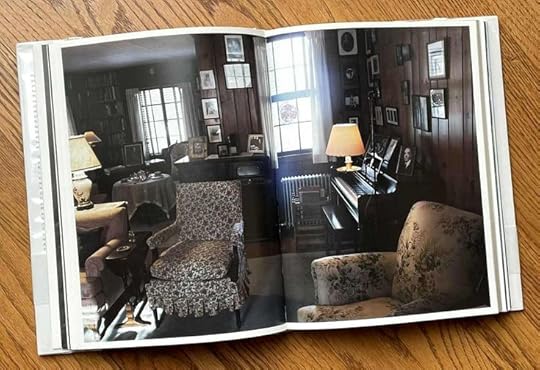
But mainly, this got a 4th star for one specific photo: Eleanor Roosevelt's living room/office in her Val-Kill home, several miles from both Franklin's family home in Hyde Park and a similar distance to my own childhood home on nearby Roosevelt Road, (I also attended Roosevelt High School, and regularly made out in the back row of the Roosevelt Theater and back seat at the Roosevelt Drive-In — Hyde Park is a very Roosevelt town). But back to the photo…there's a piano there; the VERY PIANO that my Dad — a music teacher and Val-Kill volunteer — used to play on holidays (and particularly the Christmas season) when tourists showed up.
Or so I remember it…I'm a little hazy on the details, because we never really listen to our parents' stories as much as we should, do we?; or properly appreciate the places we were raised. I'd give anything now to ask my folks any of a million questions; it would also be nice to conveniently revisit any of the places I took for granted as a kid — the Roosevelt, Vanderbilt or Samuel Morse homes, all just ten minutes from our old house; Pete Seeger's home or Frederick Church's "Olana," only slightly further away; the historic towns of Rhinebeck or Woodstock; or hell, just downtown Manhattan — a short 90-minute Amtrack from Poughkeepsie.
Anyway…Dad's piano, dark and cluttered, but photographed by Annie Leibovitz. Cool.
This is another book I picked up after seeing the author speak at City Arts & Lectures. Lately I've been really drawn to books about objects, or about people interacting with and discovering the stories behind objects. I think this is because my work is (in part, at least) also about objects- the objects that we are drawn to, that become sentimental to us, and ultimately that resonate with others as well. Leibovitz's book is not really about objects, it's about a journey she took that helped her discover something inside herself that she may have forgotten, or was perhaps never aware of. And many of the photographs within are of landscapes, but in visiting the homes of and places that inspired so many historical figures, she found herself unable to avoid being drawn in by the objects they left behind, and those images are the ones that speak to me the most.
In Leibovitz's lecture, she read about 3/4 of the book (it's a quick read) and showed us an equal number of photographs on a large projector screen. There were a number of those images that made me and the whole crowd gasp, like the one of Darwin's bird specimen, its neck coiled under and its feathers the most beautiful pale pinks and greens. The images were lovely- a departure from AL's well-known portraits and editorial pieces- many times snapshots that weren't that different from ones you or I might take when touring a historic home. But in the book itself, the images become secondary to the text. Not only are they printed rather small and often too dark to really see the beauty in them, but they are out of sync with the narrative so that you might be looking at Lincoln's top hat while reading about Georgia O'Keefe's southwestern home, or looking at Freud's sofa while reading about Annie Oakley. I found that disconcerting and wish that the publishers or editors or Leibovitz herself had insisted on formatting the book differently, whether as a non-fiction piece with corresponding illustrations, or as a large-format book of photographs with corresponding descriptions. Still, I really enjoyed reading the book, and it made me want to go back and read Maira Kalman's "And the Pursuit of Happiness," which also takes inspiration from historic homes.
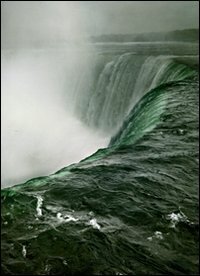
Annie Leibovitz's "Pilgrimage" sees her go around the world and shows us things as diverse as the last remaining shirt of Emily Dickinson, desert, waterfall on the cover, and so forth, with each section having a slim write up. There are better collections of Leibovitz work out there, this one has the advantage of being large and also including her luminous outdoor photography (all underexposed and as she says, "mysterious"). Still, one can't help but feel this is the travel book of someone with an infinite photography budget and that if anyone talented enough were afforded her equipment plus the travel trips, their collection may not feature as nice a sense for framing as Annie but surely the results wouldn't depart in the amount of depth and variety of the subjects, for it's not as if with her camera, much of anywhere in here, is Leibovitz really telling us or showing us anything new, in fact her shots in foreign countries feel somehow familiar and her shots of autumnal trees and landscapes are crisp and beautiful really I could set up my 35 mm in a setting similar to that, wait for the right time of morning, and take a bunch of shots until I landed on a keeper - so not much experimentation when, if any of her collections required some, it would be this one.
This collection of photos very unusual and so much more than a coffee table book. The text ties it all together and is as important as the amazing photos because it turns the seemingly unrelated images into the pilgrimage of the title. Here, within one volume you spend an afternoon in Virginia Woolf's cluttered home, a few days in the western U.S., and take a brief tour of Elvis Presley's Graceland, to name just a few. Annie Oakley's trunk fills a page and is architectural, as are sweet potatoes in the garden at Monticello. One of my favorites is Marian Anderson's concert gown, which is a combination of photos, each with a slightly different quality of light. That slight "imperfection" makes the compilation absolutely perfect for its close up rendering of the flowing fabric and the richness of satins and velvets, laid as if in panels. One page is just the bottom portion of the gown and it is so rich in texture and contrasts that you want to put out your hand and stroke it. My only complaint relates to the layout of the photo captions. Sometimes they preceed the photo, sometimes they follow it, sometimes they are on the page with it. I think I would have preferred that all of them were on the page with the photo. The text is not really divided by subject, though the subjects are grouped together, and there are no chapters to divide the subjects. As the text moved away, the captions relating to previous full page photos were for subjects discussed in the text pages back.
There are books that are not as well-written as its book review. This could be one. I found this book in a search of Susan Sontag's pilgrimage, after read New Yorker's book review on this book, I couldn't wait for reading this photographic book. However, it is very disappointing.
The book is about "list", and whoever knows Susan Sontag knows how important "list" is in the mind of Sontag. Sontag is making lists all her life. A.L. this time made her own list, and what's more attractive is that A.L. is famous for personal portray not objects, and none of the pictures in this book is person figure. Objects make people pilgrim. But the arrangement is confusing and disturbing my reading, besides, A.L.'s writing is like giving a biography introduction to everybody. Even though, in the end of the book, Spiral Jetty offers me a bit of light in a sense of "infinity", still I cannot like this book.
In the beginning of the book, it was saying the purpose of this book is to fulfill the idea that A.L. and Susan Sontag shared together: "to make a "Beauty Book"", again, people who know Sontag understand what does "Beauty" mean in her literature. But I have to say, I don't feel intelligent in A.L.'s pilgrimage at all.
Annie Liebovitz is in my opinion the greatest living and working photographer of our time, and while the book is filled with images that at times go straight to my heart it is really not a photography book - no f-stops or shutter speed or lighting talk. Rather she visits the homes and studios of 18th, 19th and 20th century artists, writers and cultural icons and the images she took away are intimate and personal and her writing just enhances them. The subjects range from Georgia O'Keeffe - stunning - there is a image of her worn bed covering at Ghost Ranch - stark simplicity - and there is another of the compass that Lewis and Clark took with them and the darkroom of Ansel Adams and the boots that Annie Oakley wore in her shows. It was a personal pilgrimage for Annie and I think it was meant to re-ignite her creativity after all the legal troubles. I would say it was a success.
I really wanted to like this book. I like Annie Leibovitz and I like some of her photography, like Whoopie Goldberg in the milk, and I got to see her studio in the Chelsea neighborhood near my friend's apartment which was cool, but, frankly, these photographs suck. The subjects of the photos are interesting, but the composition, lighting, cropping and many other elements that make up a good photograph are just lousy or missing. Annie seems to be much better at elaborately staged/propped/lit photos than documentary-type photos (what Cartier-Bresson calls 'decisive moment' photography). I was disappointed in her photographs of Suanan Sontag and her family in that other book too. I just can't recommend this book.
The text was extremely informative on many of my favorite historical people. But whoever put this book together did a horrible job. The text does not line up with the photos so you are constantly going back and forth.
This book is a huge disappointment and I am glad, I've bought it second hand for a very low price. I don't want to waste my time reading it too the end, so I stop halfway.
First: the photographs in it are very poor, if not lousy. Everyone could have taken these pictures. No magic, so style. Is it a kind of attitude like "people will buy my stuff anyway"? I don't know, but it really is shocking to see those pictures. But even worst: The pictures are not fitting into the text. You read about Emily Dickinson with the photos of Virginia Woolf's desk or about Henry David Thoreau with the pix of Freud's books. Why? Why has she not done this differently? Each house for its own? This really spoils everything. (who has edited this stuff?!)
Second: her writing style is somwhat boring and clumsy. Nothing that touches in any way whatsoever. Nothing really personal. Only facts you can read on Wikipedia or boring things like "Mrs. Soandso was very helpful".
Regarding that this is my first book of her (and I really adore her work!), I am afraid to buy another one.
Pilgrimage is a journal of a personal journey with close up observations of a number of historical and natural wonders. Renowned photographer, Annie Leibovitz takes us with her, starting at Emily Dickinson's house in Amherst, Massachusetts and continuing on to Niagara Falls with her children. She's not on assignment, just taking pictures of places and things that interest her. She visits Thoreau's cabin at Walden Pond, Ralph Waldo Emerson's home and Orchard House as well as the Isle of Wight. Two photos stood out for me; that of Virginia Woolf's writing table and also a shot of Sigmund Freud's couch. From Lincoln's bloodstained gloves to Marion Anderson's concert dress, to a hole in the bedcover in Georgia O'Keeffe's home, surely with access not ordinarily available, you'll find something of interest as well.
There are some very beautiful images in this book. Images of simple museum pieces etc that would be difficult to photograph and make your own, but Leibovitz accomplishes it. Unfortunately, most of the photographs are printed across two pages and are ruined by this. There also aren't all that many images, and the layout is confusing, with photos of each subject being placed in completely different parts of the book than he text. Much of the book is writing about some famous subjects and the places they resided while alive. The text is somewhat interesting and worth the few hours it takes to get through, but is nothing great or mind blowing.
These are the first photos I have seen by Annie Leibovitz aside from magazines. The range of what she photographed is vast: historical sites and possessions of famous people as well as intriguing areas like Niagara Falls. My favorites were the photos of Orchard House and other Alcott items as well as a dress worn by Emily Dickinson. The text accompanying the photos explained the process of how she arrived there and why she decided to include it in the book as well as providing lots of background historical information (actually a little too much).
Stunningly beautiful photographs of all the places Leibovitz felt the had to see. John Muir, Georgia O'keefe, Thoreau, Eleanor Roosevelt, Annie Oakley, Emily Dickinson. A walk through America with its most talented photographer.
My thoughts: 1. I don't know who arranged the photos within the prose of the book but I don't know what they were thinking. It would seem that the logical thing to do would be to put the photos that Leibovitz took at a particular place next to where she discusses visiting that place. I found it rather irritating that this was not done.
2. I know that Leibovitz is considered an amazing portrait photographer and I can only conclude that this is the only reason that this book was published. I did not feel that she had any real ability to take photos of still life. Her "pilgrimage" visiting places just because she wanted to rather than because she was on assignment felt like looking at the holiday photos of friends and family from a recent vacation. Hey, not many of the photos are brilliant but they are people that you know so you look etc. And I'm sure that Leibovitz friends and family would have enjoyed looking at her holiday photos. I'm not sure why it should be expected that the rest of the world would.
3. I did not feel that there was a coherent unity for the choices that Leibovitz made for this pilgrimage. I would feel that after reading a book like this which should be deeply personal that I would know the author somewhat better - that I would understand her passions. However, I have no understanding as to why Leibovitz visited the places that she did. The book felt somewhat impersonal.
4. It would be interesting to make a "pilgrimage" out of my own photos - or to bring this idea to the albums as I put them together.
5. Two photos in the book that I thought were brilliant: Niagara Falls (on the cover) and the photo of L.M. Alcott's desk in her room where she did a lot of her writing. I would have also taken a photo out the window - to give some idea of what Alcott looked at as she wrote but maybe it has changed too much for that to be worthwhile.
6. Annie Oakley - I "knew" who she was but learned more about her which makes me interested in learning even more about her.
My feelings on this book are mixed. Positives: The photos are beautiful. I've seen reviews where people talk about how awful they are. I could not disagree more. I don't really care anything about Georgia O'Keeffe, but Leibovitz's photo of O'Keeffe's handmade pastels was so moving to me. There are many things in this book I would love to see in person, and maybe one day I will. There are also things I'll never see because Leibovitz is privileged enough to go into the back archives of private places, and I'm grateful I have her photos of these places. Negatives: The layout of this book sucks. Like super sucks. I can't even believe Leibovitz was okay with it. It's as if a rookie graphic designer took all the photos, flowed them into this trim size, leaving some random space for text, then flowed the text in with no consideration for whether or not the text matches the photos discussed (spoiler: it doesn't). It's very disconcerting to see a photo spread of Martha Graham's old studio and the objects therein, but the text surrounding it concerns Abraham Lincoln. The whole book is like that, which is just a huge shame. I'm very glad I paid $4 for this book through Better World Books and not the list price of $45.
I was unable to find an official count of how many pages are photographs, but the book is more text than not. This is a photographic journey that Leibovitz took years after she and Susan Sontag dreamed of creating a Beauty Book of places they would visit together. Sontag died, and eventually Leibovitz wanted to create a book of places special to her. The book begins with a trip to Niagara Falls. She and her three children visited the falls on the Canada side, and she took a few snaps. The idea for the book solidified later. At first she planned to photograph places, but soon decided to also photograph artifacts. She worked with curators to obtain the pictures she envisioned. The places she chose are specific to her own interests, but include such figures as Emily Dickinson, Abraham Lincoln, Louisa May Alcott, Ralph Waldo Emerson, Thoreau, Mies Van Der Rohe, Georgia O’Keefe, and Ansel Adams. Even Annie Oakley makes an appearance. I thought this would make a “nice coffee table book,” to replace some of the ones I’ve donated over the years. It is far more than that. I read it cover to cover in two afternoons, with the book propped up on my lap.
Its an arbitrary journey through the people, history, places, and objects that are of interest to Annie Leibovitz. What I found particularly interesting is her approach to photographing and her artistic philosophy that comes through in the narrative. The book is a master work in vulnerability, meditation, and process. The photographer comes through, the artists shines, and for Leibovitz its a process of renewal with her craft after years of working on commercial shoots with agendas. This is her agenda less romp through the things that bear deep meaning. What I found disconcerting were the juxtaposition of the photographs and the narrative. At one point i gave up on the visual aspect only focusing on the narrative and once finishing, going through all the images to recall the details of the narratives. However, this process was not at all satisfying so I walk away a bit disappointed and unable to reconcile Leibovitz and/or the publishers approach on this end.
I really don't like this book. It has to go. The visual aesthetic is very dated, very 1960s-70s mass-market, very Readers Digest. Lazy subject selection, indifferent lighting, an eerie kind of analogue unsharpness, and sloppy compositions that you wouldn't expect from a professional photographer. The layout of the book reinforces this spirit of tedium and carelessness. There are countless double-page spreads that seem to have no other function than to inflate the sense of historical occasion ('great photographer pilgrimages to site of great national significance'), but don't give a toss about the reader's experience. The accompanying text is not Leibovitz's own. It was written and researched by a ghostwriter who is acknowledged at the back of the book. It's full of factoids and doesn't reflect the supposedly 'intensely personal' nature of this unsalvageable project.
I usually like the pictures of Annie Leibovitz and I also like her books. So I thought reading about the idea behind the book it could be great, because I also like historical persons a lot. I ordered it - second hand luckily. I have to admit I was not happy at all. Not with the pictures, not with the text. There are some facts she describes about the people's lives which are well know, not really something new. The text and the photos don't match - another confusion. And the photos are not special, all dark, nothing that really catches my attention.
Some text about why the person / place was on the photographer's list and alot of text about the person / place and a bit about the image taken. Text and image were not always in the vicinity of each other so sometimes you had to imagine and then say 'ahah'when you came across the photo, or 'what?' and then 'ok, now I understand what I saw a bit back'.
And the wording of the text didn't seem to be in first person but someone else talking about the photographer and her experience. I'm not sure who did the research, the speaker or the photographer, or both.
The photos are beautiful but not overly compelling. (I personally took a photo at Niagara Falls almost identical to the cover shot with no forethought. You pretty much can't help but take that photo.) As many others have mentioned, the layout of the book completely divorces the text from the imagery, which is frustrating and occasionally confusing. Annie as author does not let us in in any real way.
Voor een fotoboek moet het op zich veel hebben van tekst. Er zitten prachtige natuurfoto in, een paar mooie binnenkijkers en vooral het verloop van Annie's pilgrimage. Hoe is ze bij bepaalde stukken gekomen, hie heeft het ene gesprek geleidt tot een nieuw personage om te onderzoeken. Voor de geschiedenisliefhebber echt wel mooi om door te bladeren en te lezen. Helaas lijken de foto's wat lukraak neer gezet en wissel je gauw van beroemde personen. Dat maakt het minder leesbaar.
Annie Leibovitz's commentary about her journeys to see where certain significant figures from history, art, and literature lived reveals some unique ideas, feelings, and perspectives from a person we don't often hear speak. She photographed dwellings and artifacts, not people, in a departure from her typical work.
I learned new things about Virginia Woolf, Annie Oakley, Emily Dickinson, Georgia O'Keeffe, and many others.