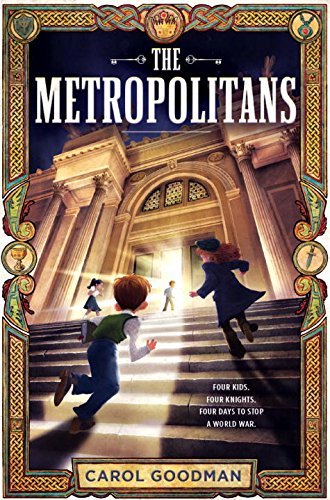
The day Japan bombs Pearl Harbor, four thirteen-year-olds converge at the Metropolitan Museum of Art where an eccentric curator is seeking four uncommonly brave souls to track down the hidden pages of the Kelmsbury Manuscript, an ancient book of Arthurian legends that lies scattered within the museum's collection, and that holds the key to preventing a second attack on American soil.
When Madge, Joe, Kiku, and Walt agree to help, they have no idea that the Kelmsbury is already working its magic on them. But they begin to develop extraordinary powers and experience the feelings of King Arthur, Queen Guinevere, Morgan le Fay, and Lancelot: courage, friendship, love...and betrayal. Are they playing out a legend that's already been lived, over and over, across the ages? Or can the Metropolitans forge their own story?"
Carol Goodman is the author of The Lake of Dead Languages, The Seduction of Water, which won the Hammett Prize, The Widow's House, which won the Mary Higgins Clark Award and The Night Visitors, which won the Mary Higgins Clark Award. She is also the co-author, with her husband Lee Slonimsky, of the Watchtower fantasy trilogy. Her work has appeared in such journals as The Greensboro Review, Literal Latte, The Midwest Quarterly, and Other Voices. After graduation from Vassar College, where she majored in Latin, she taught Latin for several years in Austin, Texas. She then received an M.F.A. in fiction from the New School University. Goodman currently teaches literature and writing at The New School and SUNY New Paltz and lives with her family in the Hudson Valley.
This is such an incredible book! A new favorite for me! It is brilliant in every single way, and I love it to pieces. The characters are so diverse and realistic because they have their own struggles, but work through them.
It is one of most diverse and character driven stories that I've ever read. Our wonderful leads are: An Irish girl who is called bossy but she's been stuck with responsibility her whole life. A German Jewish boy who wants to stand up but is scared that the ones he loves will be hurt. A Native American boy who is on the run from the law and can't remember his language. A Japanese girl who has always been made fun of and wishes that people trusted her.
All of this hits home more when you know that this book is set during World War II.
The story in itself is fantastic and it is all around marvelous. I could scream about how it deserves a million stars for days, but you should just go read it and enjoy.
This is a fairly typical MG adventure quest story. There are group of four kids who need to save each other and the world. They have all lost something significant and need a sense of family and community. The main four characters are a diverse group. The story has many Arthurian elements to it. It's not bad but its not fantastic. I don't think it brings much that is new or innovative to MG fantasy, and it could have used another couple of edits to pare down the content. It's a thick book with very small print. It's going to have a very niche audience when you bring all those things plus the WWII setting together.
I have always enjoyed middle school/children's mystery/puzzle/adventure novels. When I saw The Metropolitans was being compared to The Mixed Up Files of Basil E. Frankweiler with a National Treasure twist, I was super excited. Unfortunately, the book had a few too many unbelievable parts to it that I was unable to really enjoy the novel.
Essentially, The Metropolitans tells the story of 4 13-year old children during World War II who through some twist of fate end up together and working towards a common goal. That goal is to help divert a potential Nazi attack on New York City. The only way to prevent the attack is to run around the Metropolitan Museum of Art finding pages from a mysterious manuscript that will help them decode a message from a known enemy spy.
While working to prevent the attack, the children start developing these weird powers that seem like they are straight out of Arthurian legend. Throughout the story, the children learn more about their powers while exploring some of the pressing issues of the time (such as Japanese internment camps, mistreatment of Native Americans, homeless in the city, and the loss of family due to death).
On the outside, it looks like this novel might turn out to be something wonderful and even fun to read. There were just too many distracting aspects of the novel that really prevented this novel from being all that it could be.
The first distracting aspect of The Metropolitans was the overuse of 1940s slang by one character. I fully understand that times change and terms that are used in the 40s, such as malarkey, hunky dory, swell) would seem awkward today, but this just seemed forced. Only one character in the entire book used this slang language and each and every time she spoke she used it. I found it difficult to believe that these terms would be so widely used that they would be used by one character every time she opened her mouth, yet not one of the other characters ever uttered these time-specific terms.
Another distracting aspect was the instant friendship between the four main characters. In a children's novel I understand there isn't a whole lot of time to devote to developing friendships, but this novel took quick friendships to the extreme. Literally, within a matter of an hour or two, all the characters went from complete strangers who had never seen each other, never interacted and they became best friends forever.
The main characters practically could not live without the thought that they wouldn't be friends. This was only after 4 hours of knowing each other. They instantly took each other in to their houses, vowed to remain friends forever, and do whatever they could to help each other. It was just unbelievable.
Of course, it could be argued that their instant friendship was because they were the legends of Arthur reincarnated into the 40s. But their instant friendship happened before this occurred, wasn't really touched upon as odd, and was just left out there for readers to accept.
Lastly, the other main issue I had was the grab bag of diversity, as I would call it. The four main characters include a Japanese-American girl who is facing discrimination because of the bombing of Pearl Harbor and forced to deal with the hatred and issues that came up during the 40s, a Native American boy who was taken from his family and not allowed to really embrace his culture, a Jewish boy from Germany who ran from Hitler leaving his family behind and saw people die in the streets, and an Irish-American girl who lost her mother to illness and was forced to move in with her aunt while her brothers were sent to an orphanage because her dad had some mental breakdown and decided to be homeless.
I am all for diversity in novels especially children's novel. This, however, seemed extreme and unbelievable. The fact that every individual from every culture was magically represented seemed a bit too far-fetched for me to believe. Throw in the fact that conveniently each character had some catastrophic past that neatly addressed the issues of that time period and it took it to the completely unbelievable zone.
The overreach with diversity and issues served as a major drawback. There was so much going on and so many issues the author tried to cover that I don't feel any issue, from the horrors people saw in Germany to the hatred of anyone who looked Japanese just because of what happened with Pearl Harbor, was properly covered. It all seemed glossed over.
There were other issues with The Metropolitans that really took away from the novel, but they weren't as big of an issue for me as the three I explored above. Other issues included the rather clunky transition and use of Arthurian legend (it seemed forced and a bit difficult to understand exactly what happened as the novel was a mystery and then all of a sudden there are super powers and its fantasy), the lack of care or concern most adults showed in the novel, the fact 13 year olds just ran around the city hailing cabs and running all over the place during a national crisis, the 'seeing the light' moment that caused one character's father to stop drinking and living on the streets and become responsible, and the overuse of the ring-a-levio phrase that seemed to appear 3 to 5 times every chapter.
I will say that I did enjoy the setting. It was fun to explore the Metropolitan Museum of Art and hear about some of its exhibits.
Overall, I believe that The Metropolitans easily blends in with almost any other children's novel out there. It doesn't stand out in any way, shape or form, and has far too many unbelievable moments and underdeveloped plot points to make it an outstanding novel. That doesn't mean it won't be for you, but if you are looking for a book that will 'wow' you or really give the Arthurian legends a new spin, this probably won't help you.
Thank you to Kid Lit Exchange and the publisher for this review copy! All opinions are my own.
The Metropolitans follows four children brought together by Arthurian magic as they race to save the US from a Nazi attack. The characters meet at the Met, where they are confronted by ancient magic and dangerous villains. I liked that the four characters represented diverse views: a homeless Native American boy traumatized by his school’s efforts to assimilate him, a Japanese girl fearing prosecution after Pearl Harbor, a Jewish refugee, and an orphaned girl. The plot was a bit convoluted by the effort to introduce information about Arthurian legends and the magic wasn’t well-explained, but I did like the message of the story: to choose kindness and community over selfishness and ego. I’d recommend for fans of The Mysterious Benedict Society and other adventurous middle grade novels.
I read to 30% of this book and found it a struggle to keep reading. The story just didn't interest me that much as I thought it would be something completely different.
Seems I read one of this author's adult books and had the same issue so maybe she isn't for me?? Either way, this was a did not finish though I was looking forward to reading it.
I think my younger self would have loved this tale of four children flung together in NYC as the US enters WWII with a mission to be knights and ladies like King Arthur to save their city. They get to solve riddles in the museum. They found a magic book and are solving riddles. They represent a unique collection of minority groups. What's not to love? And that's what has me scratching my head. For some reason I just could not get into this. I'm trying to put my finger on why. It really isn't bad, and I will have no qualms recommending it to the fantasy fans at my school. I think the book tried to do too much by helping us get to know each of the four main characters in depth as well as understand the plot line of how these kids are now knights and how the book is magical and who the bad guys are (which isn't exactly simple) while having them solve cryptic clues too. By halfway through we have a lot of little bits but not enough of any one thing to hook me. I could have honestly waited to get to know the kids later once I was hooked on their need to save NYC. And that was being cryptically spun out between getting to know each main character, their background, and how they approached solving a clue. It really slowed down the pace and I found the book way too easy to put down. I've been trying to force myself through but I think I'm going to just give up and go onto something else. I've read enough to get the gist for talking it up to kids (which I will do), I've got a gauge on the content (a couple minor swear words, some spy violence and jousting violence including a gross seen where a face gets peeled away, and lots of prejudices faced by the characters). Recommended for patient readers and Arthurian legend fans, and those who like to see a wide array of minority groups in their reading.
I was excited to read this YA book because it seemed like it was "From the Mixed Up Files of Basil E. Frankweiler" meets National Treasure. Unfortunately, I think Carol Goodman should stick to writing adult fiction. I found the book boring and her 40s dialogue distracting (malarkey, holy smokes, hunky dory, etc.). I find it hard to believe that a middle schooler would get caught up in this book.
I know I've mentioned before on my blog my love for Arthurian legend, so I loved having that as part of the book! (Man, though, that manuscript was creepy. But I liked it.) The surprising workings-in at the end were my fave!
I also liked the way it addressed the theme of fate-vs.-free-will in a kid-friendly sort of way. That's something that pops up a lot in classic literature, but not as much nowadays, so it felt like recognizing an old friend. :)
It was super. suspenseful. I was on the edge of my seat for...a lot of the time, especially at the beginning.
The characters were Intriguing and Fun and Not Mix Up-able. (I really don't like multiple-cast books where the characters can get mixed up. This was not one of them, which was a definite plus. XD) The setting of WWII adds extra depth to the specific characters, which I LOVED.
And speaking of the setting, the way the story was grounded in the pop culture of the day was *chef's kiss*. (The MARVEL COMIC REFERENCES HELP I AM IN LOVE.)
I will note that at the end, I lost a bit of my suspension of disbelief and fell slightly out of love with it...for a couple of reasons. 1. I didn't think that Walt needed to 2. The villain's crazy-weird-power thing seemed like basically the same as the villain from . Which might not be a big deal, but since the book mentions those books but doesn't have any of the characters acknowledge the similarity...it felt like an elephant in the room. 3. So, the characters are in major peril, and they decide to 4. Then they . To be fair, I do kind of accept the logic of that one. 5. The writing of the action seemed...stilted. Kind of strange. Idk. I know action is hard to write, but it just seemed kind of jerky.
Overall, though, I really enjoyed it! I'm going to give it 3.5 stars, rounded up to 4 for Goodreads. :) Thanks to MovieCritic for the recommendation!
Wow, does this book check a bunch of my boxes in middle great lit. Historical fiction! Arthurian legend! Spies! World War Two! Fighting the Nazis! Diverse cast of characters! Kids (basically) on their own to save the world! I mean, there is so much here to like, and I want to LOVE this book.
The reason this one is just getting three and a half stars, though, is that the execution just didn't quite do it for me. I LOVE that Goodman has embraced the need for more POC in children's lit. But by including a Mohawk boy persecuted for his heritage AND a Japanese girl persecuted for her heritage AND an Irish girl picked on for her heritage AND a Jewish boy whose parents are probably being gassed by Hitler back in Europe, it just started to feel like the author had gotten a memo from her editor saying publishers were looking for books featuring any one of the following underrepresented populations as a character, and she decided to dump them all into one story. I mean, throw in a trans character and someone with a physical disability, and you get BINGO. This sounds harsh, and maybe these populations will just be glad to have a pretty good book with someone like them running around in it and won't mind that it's a bit everything-but-the-kitchen-sink. I just loved each of the characters individually and felt that it did them a disservice personally to have to share so much time with all their friends who were also working through these issues. Strangely, while reading, I had a passing thought that the Percy Jackson books also purposefully include a host of diverse characters, but somehow it's more deftly executed there (or I just have lower standards for those books because I see them as twaddle while this one is not). I do see how the discriminated minority identity was something they all had in common, and I do get that NYC has rich diversity, so this combo of characters is not historically impossible. Maybe because my foster mom training has me super sensitive to this very issue right now, I'm just really nitpicking.
My other issues with the book are similar in that I think she's about 85% successful in weaving together the mythology and historical setting, but there are things that are just a bit vague. These days, I read most of my middle grade lit on my nook, so often when I don't make a connection or something confuses me, I assume I just clicked forward on the screen too fast, and I don't make an effort to go back and clarify things. I read this book in its physical, paper form, and I read a lot of it sitting in a hospital waiting room without distractions and with the freedom to page back as needed, but there were some things that I think one more edit through might have smoothed out. The kids almost seem to have insta-trust with each other. I know in MG lit, we've got to throw the characters together and get the show on the road, but their group relationship is so important in the climactic scene that I feel we need a bit more of the process of getting there. And the plot was fast-paced, but I didn't really get why Walt needed to pretend to have gone over to the dark side.
And why did Goodman go out of her way to rewrite a legend featuring two men and two women for two boys and two girls, then got unclear about who embodied which Arthurian character? At that point, gender bending just confused me and didn't add to the story or the characters. She already rewrote Morgaine, so I was confused as to how she couldn't have done a similar 2017 update of Arthur and Guinevere, talking about what leadership is and isn't. This is one of the places where I feel contemporary feminism misses the mark by trying to assert equality through women occupying traditionally male positions of dominance rather than shifting the conversation to include traditionally female areas of strength. I know that's asking a lot from a book that I'll be handing to my ten year old, but I felt like there was some feminist message that the author was trying to convey through Madge's mythological identity, but I didn't understand exactly what the message was supposed to be. I did get the message that part of her enhanced gift was looking out for others and bringing out the best in others. Maybe that didn't seem like an impressive enough kind of leadership to the author, so she felt the need to identify her with the greatest mythological KING of England. As a Christian, I'm comfortable with the concept of a servant-leader, and as a mother of three girls, I don't want them to think their value lies in being just like their brother or father in any particular area. So I found the whole Madge-is-Arthur reveal to be ambiguous as best and at worst, subversive to girl power. I mean, if she really wanted to give Madge a royal connection, there are many strong female leaders in British history she could have tapped--Boadicea (a Celtic queen, which could tie in well with Madge's Irish heritage), Bertha (Aethelbert's wife who was instrumental in bringing Christianity to England, again, connecting to Madge's Irish Catholic heritage), Matilda (talk about a woman struggling to be a leader in a man's world), and even Good Old Queen Bess. Or she could have rewritten Guinevere and made her amazing. I mean, there are options!
All in all, the the potential in this book had me hoping for more. I have found myself talking a lot about it to my husband and ten year old. For all of the faults I've discussed here, the prose is solid, the characters obviously felt real to me, and the concept is really fun. If my oldest likes it, maybe I'll bump it up to four stars.
This entire review has been hidden because of spoilers.
I read this book for two reasons: 1. It is a retelling of the Arthurian legend, and I love the Arthurian legend! 2. It met the requirements of a couple of challenges very nicely.
This book did not disappoint and as a middle grades book I would definitely recommend it to that age group, as well as anyone of any age who enjoys the Arthurian legend stories.
3.5 I loved the premise and mash-up of genres - a magical & mysterious adventure with a twist on the legend of King Arthur set at the beginning of WWII - but it felt a bit long at times and not executed the way I hoped.
Loved it! Excellent kick-off to a new adventure series for young readers. I'm delighted to see a fresh and entertaining take on the timeless Arthurian legend. Quality writing, as well.
If you’ve been following along with discussions surrounding World War II books in the community, you will already know this but there aren’t many World War II books out there with Jewish main characters. Not only does The Metropolitans have a (German-American) Jewish main character, it also has Japanese-American, first nations & Irish-American main characters. The page space is split up b/w the four characters and while I cannot accurately speak for any of the rep since I am not from any of those groups, I did feel that it was done pretty well. (If you are from any of those groups and feel differently, I’d be eternally grateful if you choose to let me know so I may edit this review to reflect that!)
One of my favorite childhood books focused on the treatment of Japanese-Americans during World War II and I love that The Metropolitans actually discusses this mistreatment, making it clear that the American government also hurt people during the World War.
It is so ridiculously important that this book has a Jewish main character because even though there is so much literature out there about World War II, very rarely do we actually get to see and hear from Jewish characters. Walt’s voice was fleshed out and his feelings very real. I love that we got to spend so much page time with him. I love that he spoke up about how painful this was for him given that his parents were in France (where Jewish people were also being forced into camps). He spoke up about his experience in Germany during the uprise of Hitler and seeing his neighbors be taken away, about having to leave his parents behind as he travelled to America for shelter.
Through Joe the author also addresses the way America was treating (and continues to treat) Native Americans as they attempted to strip them of their cultures and languages.
The diversity in this book, in my opinion at least, does not exist for brownie points and the author really fleshes the characters out so they jump of the pages. Their stories are real because people experienced these horrible things IRL (no matter what some dumbasses say.)
The Arthurian myth element is beautifully incorporated into the book and actually made sense. It doesn’t attempt to fictionalize horrific realities, it instead works with them to create a powerful story. I loved how things came together and I love how roles weren’t genderized but rather contingent on the character’s personality traits.
I JUST REALLY LOVE THIS book and I wish I had been able to read it as a little middle schooler because it would have hands down been a favorite and revolutionized my life. Hopefully though, little middle schoolers today will be able to read and love it.
Note that I received an advanced copy of this book for review.
The story: Four very different teens are thrown together on Pearl Harbor Day, and discover that their mission is to pick up where King Arthur and his followers left off in medieval Britain in order to fight the evil that has survived since Arthur's day--now manifesting itself as the Nazis. But in order to realize their own powers, they'll have to learn to trust and work with total strangers--strangers who are NOT like them. Can they move past their differences and save the day before a Nazi plot poisons millions in New York City?
June Cleaver's ratings: Language G; Violence PG; Sexual content G; Nudity G; Substance abuse PG; Magic & the occult PG; adult themes (prejudice, war, death of a parent, abandonment, Nazi atrocities) PG; overall rating PG.
Liz's comments: I liked this one a lot, but I think regular readers of fantasy might be put off somewhat by the 1940s setting and slang (not the usual gritty urban fantasy or classic high fantasy set-ups they're used to) and by the unfortunate little-kid look of the front cover (the characters are actually in their early teens, not in grade school). Even so, it's worth hand-selling to any kid who likes a story with magic--or one with kids learning to face their fears. Keep an eye out for a sequel, because the set-up was totally there.
Four kids meet at the Met on Dec 7, 1941 and get thrown into a mystery involving King Arthur, Nazi codes and a forthcoming attack on the city. These are many of my favorite things, so I expected to adore this, and absolutely didn't. The beginning was far too quick--these kids were perfect strangers and yet they were suddenly BFFs with no real groundwork laid. The writing was choppy, and filled with constant awkward slang. It felt like a parody of the 40s more than really the 40s. It shifted from mystery to fantasy midstream. Honestly, this felt like a draft that needed a few more full revisions before it was ready. The characters felt boilerplate, too. It just never gelled. (Though props for having an American Indian character from a specific tribe, with specific language and history, and talking about the horrors they were subjected to the Indian schools. With his gift coming first, I was initially worried that he was a mystical American Indian, but that didn't really seem to come to pass.)
This book had some wonderful points. It was very historically accurate in terms of fashion, mannerisms, the mood during the war and everyday behavior and language. I liked the idea going in, of a King Arthur manuscript being the key to stopping the Nazis in the US. I also really enjoyed all the descriptions about the museum collections. I love books that take place in museums, or where a lot of the action happens in museums. However, overall, I just found it very dull. It would have moments of quick, amazing action punctuated by long chapters of boring bits. The uneven pace really put me off, I wished it had flowed better. The ending wasn't bad, not the best, or the worst book I have read. It was just OK.
okay, the premise of this book is so cool. four teens brought together by arthurian magic to the metropolitan museum to hunt for ancient book pages to stop a nazi attack... for god's sake, if this was written well it could have been my favourite book of all time! honestly, it takes a lot for me to actually skim pages at a time because the book is so boring, but that's exactly what happened when i read this book.
first, here's what i liked: the premise was obviously amazing. the characters were fine and i loved the fact that they amalgamated with the lives of characters in arthurian legends.
here's what i didn't like: the pace was so jagged and clunky. you'd have someone chasing a villain and then in the next paragraph you'd have a monologue branching off into the complicated backstory of that person, and then you'd have action again, followed by five pages of unbroken dialogue and then ten pages of arthurian legends. it was just weird, and i think that's why it was so boring for me. here's an example of some weird pacing.
Men and women were leaping from the windows to get away from the flames. "No!" Kiku screamed as a man fell burning into the harbor. "We have to get up there and stop her!" Kiku began running towards the statue, but Joe stood staring at the harbor, where the man had plunged to his death. He was staring at all the ships and remembering something Billie had told him about the city. The great city at the mouth of Hudson was what she had called it, and then explained what had made New York so important. Joe felt a pang in his chest as he remembered Billie. "I'm saving you, New York!" he cried, jumping from his position on the landing.
also, nothing was really properly explained. maybe this was because i skimmed over some parts, but how in hell did they manage to make the statue of liberty come alive? i feel like half the plot points, including that, weren't even relevant anyway. in the bit where one boy cracks the code it isn't explained how you're supposed to decode the book at all, which surely is a very important part of the story? this is what was said, if that helps bring my point across.
"So I betcha the code is to pick every seventh word and write it over the letters in the message, leaving out any duplicate letters, of course, and then copying out the rest of the alphabet...".
like, what? excuse me, carol goodman, is this a kids book or not? because if i can't get my head around it then children sure as hell can't.
one last thing, this book is fairly confusing for the target age that the author was going for. it quickly develops from a historical mystery to a fantastical adventure where reincarnated story characters get superpowers, make inanimate objects talk and kill a dragon-witch-lady.
Think of all the best books that feature a group of kids who become friends and go on to solve a mystery and save the day. The kids from Chasing Vermeer come to mind. Or what about stories like The 39 Clues, or the friends from The Infinity Ring series? And don't forget about Harry, Ron, and Hermione tracking down the Deathly Hallows, among other things. This book will be joining their ranks soon.
Madge, Kiku, Joe, and Walt all meet at the Metropolitan Museum of Art at a time in their own lives where they have suffered losses and feel lonely. It is also a time in our country when things are very rough. The Nazis are surging across Europe, and on the day the kids meet, Pearl Harbor is bombed. Suddenly their chance encounter turns into fate. They find themselves forming a group of modern knights, searching for the pages of a missing book of Arthurian legends. If they can solve all the clues and retrieve the lost chapters of the book, then they may be able to prevent an horrific attack on New York. Can four middle-school students foil the plots of enemy agents?
The Metropolitans is a delightful mix of urban fantasy, espionage thriller, and historical fiction. The world of 1941 America comes to life with Indian boarding schools, Japanese internment, Hoovervilles, and the Nazi threat. Cultural references such as Captain America, Captain Marvel, Little Orphan Annie, and King Kong are smoothly worked in to ground the story in the historical timeline. The Arthurian legend transfers into the Met and the lives of the children so that readers learn about Arthur, Guinevere, Lancelot, Morgaine, Mordred, and Merlin along with the protagonists. The action is fast paced. The clues take the knowledge and skills of all the group to solve, forging the bond between them stronger with each task that is completed.
This is a great read for those who have enjoyed any of the other books I mentioned, as well as for those who enjoy mysteries and historical fiction. It is perfect for a read-aloud because each chapter will leave listeners begging to hear more. Highly recommended for middle grades and up.
I read an e-book provided by the publisher through NetGalley.
The lives of four very different kids, a white orphan girl, a native American boy, a German Jewish boy, and a Japanese American girl, converge at New York's Metropolitan Museum of Art on the day the Japanese bomb Pearl Harbor. The four kids soon learn they have all had a similar dream about a mysterious man who coincidentally they have just witnessed running out of the museum with a page from a book of Arthurian legends called the Kelmsbury. They learn that more tragedy is about to be unleashed on the United States, and the plan is hidden among the pages of the Kelmsbury. If they can find the pages hidden around the museum and decode them, they can save New York from destruction. It will take a modern King Arthur, Guinevere, Sir Lancelot, and Morgan Le Fay with supernatural powers to accomplish the task, and these kids think they are the ones.
I suspect kids will like this book more than adults. I've noticed that kids like scavenger hunt/quest/puzzle books, and this book fits that category perfectly. For me, the plot had too many different elements, and I just couldn't get comfortable with it. Trying to tie King Arthur with World War II came off as clunky. Separately, I love both subjects, but having them together in one story diluted them to the point that I didn't love either one. Perhaps if the story had been simplified it could have worked. For example, take the fantasy out. No superpowers. Just four kids trying to use the Legend of King Arthur to solve a puzzle and prevent a disaster. Or keep the fantasy, but take out World War II. This author tried to do too much in one book.
Four unexpected heroes of this book come to life as they meet in the Met and uncover a plot that will cause danger and mayhem for the children. How do four young children save the world from a devious plot? This is an adventure mixing the Mixed-up Files of Mrs. Basil E. Frankweiler and National Treasure, Magic Tree House, as well as the Mysterious Benedict Society all rolled into one. The children gain special powers that allow them to assist in saving New York. What child doesn't want to be like King Arthur and his knights? The book has some slow sections, but for the most part would be highly engaging for a child, filled with historical information and adventure to maintain interest throughout. Some aspects may be difficult for some students to understand just due to life experiences, but the author does an exemplary job of making it come to life for the readers. Definitely worth the read, and worth having on your classroom library shelf, students will gravitate toward this book and all the adventures scenarios it has to offer the reader.
An Irish American, a Native America, a Japanese, and a Jew walk into a museum, and then save New York from a dragon by bringing the Statue of Liberty to life.
Sounds like a bad joke, doesn't it? Well it's worse than that...it's a 355 page JFIC novel.
The first nine chapters are so poorly written/edited, that I had to reread them several times...and nearly gave up on the book altogether. That would have been a shame.
While the editing gets somewhat better, the writing does not. It's just a totally unbelievable story, filled with stereotypical characters that, I think, the target audience would have trouble following due to lack of context. I mean, how many 10 year olds have any kind of knowledge of Arthurian legends AND WWII? Not to mention Indian Schools, Japanese-American interment camps, and Kristallnacht?
And what the hell is ring-a-levio, and why does the author feel the need to mention it on every other page??
Why bother with the two-star review, you ask? I've actually read worse books than this. But not much worse.
This is an action packed novel that combines historical fiction with fantasy. Four children find themselves chosen to save New York City from an AXIS plan to destroy it. The children meet for the first time at the Metropolitan Museum of Art. Madge is there to waste time before she can go back to the home of her aunt who took her in after the death of her mother and her father’s “falling apart.” Joe, a Mohawk boy, is on the run after escaping from the group home that wanted to wipe away his culture. Walt spends time at the museum since being sent to safety by his Jewish parents in Europe. Kiku, is a Japanese American, whose museum curator father is now seen as an enemy to the country. The four are brought together by a rare book of legends about King Arthur. Each will embody one of the legends characters, Arthur, Lancelot, Guinevere and Morgaine. This is a thrilling roller coaster of a read that features four strong children who face their fears and join together to stop evil. Full of action, adventure, and magic.
Thank you to Kid Lit Exchange for providing me with a free advanced copy of The Metropolitans in exchange for an honest review. All opinions are my own. The Metropolitans is a fast-paced adventure that would make any history-buff kiddo fall in love with the story. Join the four thirteen-year-old heroes (or villains) as they attempt to save the world following the attack on Pearl Harbor. Taking place at the Metropolitan Museum of Art (hence the title), history jumps off the page in the strangest ways! This fantasy allows the characters, and readers alike, to experience Arthurian tales that come to life as the teens attempt to stop more attacks on the US by the Nazis. It's a healthy mix of Arthurian tales, spies, and World War II, with diverse characters that will appeal to many middle-grade readers. It was reminiscent of Rick Riordan's Percy Jackson adventures and some fun timey-wimey Doctor Who fun. My only qualm is that there is so much history packed into this novel, that it felt a bit overwhelming. However, if you can't get enough historical fiction with a fantastical twist, you'll think this book is the bee's knees.
Four kids in the 1940s from wildly different backgrounds, all experiencing some form of hardship in NYC, find each other at the Metropolitan Museum. They are drawn there because they are the children of a prophecy, so there is a bit of fantasy and puzzles and history and friendship involved here. The puzzle itself is complex, but it's not really a mystery story--they find the answers without too much deduction because of course, they are the ones who are supposed to solve the mystery so they have the right skills. Definitely a book for anyone enthralled by legends of Arthur or intricate novels with puzzles and fantasy.
This was a pretty good middle grade quest adventure. It kept my attention and was suitably geared to its appropriate age range. I've seen a few reviews that dislike what they called "forced diversity" but we are talking about New York City. There aren't many places in the world that are as diverse, even in the 40s when this story is set, so I don't know what their problem is. The friendship of these four characters seemed no more implausible than the story premise, and that is what made me pick up the book and what will appeal to the intended audience. It's not supposed to be realistic; it's a QUEST FANTASY!
I had to read this book for my work at the Met, since a good part of the story unfolds there....hence the title. This is a middle school book that was fairly entertaining. The writing was pretty good, but some of the plot developments seemed like they were pulled out of a bag and thrown together willy-nilly. I'm sure young readers would enjoy the danger, the secret spy aspect and the World War II intrigue, plus the friendships and grit of the four young protagonist. For me, it was fun to read a story that was so closely connected with, and was often set in, my favorite place to be in NYC...the inimitable Metropolitan Museum of Art.
Thank you goodreads for sending me a copy of this book. 3.5 stars for me. A New York WWII setting about 4 lonely children who become friends. It's mixed in with some Authurian legend and let's defeat the Nazi spies plot. It also celebrates diversity. Is it realistic? Probably not, but it's nice to see a story celebrate what we have in common rather than what divides us. I rather liked the book but I am unsure about it's appeal to its intended audience. I think the thickness of the book will deter some from picking up the book. I enjoy the "old time" stories where kids are basically on their own without parents hovering over their every move.
A quick read that was intriguing enough to keep me reading until the end. I liked the different layers of the story - the big picture historical context, the mystery the characters had to solve, and their individual stories/struggles. The story took a more imaginative spin than I was anticipating, but clearly its fantasy book and not meant to be entirely believable. Not sure middle schoolers would pick up on all the different historical/cultural/literary references, but definitely some general moral themes to be learned from the story. I'm looking forward to passing this on to my young sister and see what she thinks!