A rich and engrossing thread of Romance runs through this tale of the motherless son of a valiant robber baron of Medieval Germany. Young Otto, born into a warring household in an age when lawless chiefs were constantly fighting each other or despoiling the caravans of the merchant burghers, is raised in a monastery only to return to his family's domain and become painfully involved in the blood feud between his father and the rival house of Trutz-Drachen. The narrative is told with Howard Pyle's consummate skill and illustrated with some of the most enchanting sketches ever done for a book of this type. Like the same author's version of The Story of King Arthur and His Knights and his collection of original stories known as The Wonder Clock , this book has become a legend, a modern story with the feel and sound of an ancient tale. It is a reading adventure that youngsters will not soon forget.
Howard Pyle was an American illustrator and author, primarily of books for young people.
During 1894 he began teaching illustration at the Drexel Institute of Art, Science and Industry (now Drexel University), and after 1900 he founded his own school of art and illustration named the Howard Pyle School of Illustration Art. The term Brandywine School was later applied to the illustration artists and Wyeth family artists of the Brandywine region by Pitz. Some of his more famous students were N. C. Wyeth, Frank Schoonover, Elenore Abbott, Ethel Franklin Betts, Anna Whelan Betts, Harvey Dunn, Clyde O. DeLand, Philip R. Goodwin, Violet Oakley, Ellen Bernard Thompson Pyle, Olive Rush, Allen Tupper True, and Jessie Willcox Smith.
His 1883 classic publication The Merry Adventures of Robin Hood remains in print, and his other books, frequently with medieval European settings, include a four-volume set on King Arthur. He is also well known for his illustrations of pirates, and is credited with creating the now stereotypical modern image of pirate dress. He published an original novel, Otto of the Silver Hand, in 1888. He also illustrated historical and adventure stories for periodicals such as Harper's Weekly and St. Nicholas Magazine. His novel Men of Iron was made into a movie in 1954, The Black Shield of Falworth.
Pyle travelled to Florence, Italy to study mural painting during 1910, and died there in 1911 from a kidney infection (Bright's Disease).
His sister Katharine Pyle was also a writer and illustrator. Their mother was the children's author and translator M.C. Pyle.
Otto of the Silver Hand was originally published in 1888 – and I am amazed that the content within this novel continues to be relevant in today’s society. This story is set in medieval Germany when castles, feuds, barons, knights, kidnapping, soldiers, and rescues were common. Violence, revenge, hatred are all themes that continue to permeate within our society. Yet, in both the past and present we can also find humility, gentleness, love, sacrifice and forgiveness. The traits that little Otto possesses will encourage children to see the good and evil in their world and strive to have a positive outlook on life, even when experiencing turmoil within ourselves. Otto’s gracious and forgiving nature will inspire the best in all who read this novel.
Otto's mother died during childbirth, and his father, a warlord, left him in a monastery for a proper and safe upbringing. As an older boy Otto's father returns for him, at which time Otto discovers the truth about his father's past, particularly about his part in the murder of Baron Frederick. As a result of the feud his father had a hand in, Otto is ultimately is the subject of revenge.
Howard Pyle's books are always fantastic, down to his illustrations. Otto of the Silver Hand is a quick read, but awesome all the way through. The characters created here - Ursela, Pauline, Hans - are all well developed despite the fact that it is a quick read, and of course, typical of 19th century literature aimed at children and young adults, there is a moral.
Good description of life in the Middle Ages. Engaging story that was surprisingly well received by young listeners. Chapters are fairly short and work well for reading aloud. Sentences are long, requiring big breaths, but are not excessively convoluted. There are a few archaic vocabulary words. Pyle's illustrations are, as usual, wonderful - so much great detail.
Howard Pyle had a formal writing style that he evidently thought mimicked how they spoke in the Middle Ages, and it won't work for some people, but I grew up on his Robin Hood and loved that, so when I found this book on Libby I was happy to give it a try. It's a shorter book than others I've read by Pyle, telling about the childhood of young Otto, whose father is a robber baron in Germany under the Hapsburgs. The story didn't focus as much on the young boy as it did Pyle's general idea of life then. There are some good scenes and a big adventure toward the end, but Otto is more a spectator than a participant. This didn't bother me, as I simple had fun with the story.
A beautiful story set in the Middle Ages — during a time when they say there was little truth, beauty, and goodness. This story shows another perspective.
He was a great lover of books, the old Abbot, and had under lock and key wonderful and beautiful volumes, bound in high skin and metal, and with covers inlaid with carved ivory, or studded with precious stones. But within these covers, beautiful as they were, lay the real wonder of books, like the soul in the body...
Howard Pyle wrote the story of robber barons in Medieval Germany. But is was his illustrations which enchanted me. My only exception is his depiction of older women. Every picture of the old nurse looks to me like a man in a woman's robe. But a small quibble when stacked against the sumptuous drawings.
I rounded up my stars because while the PLOT of this book wasn't too engrossing, I liked the overall atmosphere that the author created, a really clear evocation of the German states in the middle ages.
2.5. I really liked most of the story line, but it was impossibly hard to read and had some really depressing and graphic stuff in there. Somebody really needs to give this poor kid a break! Gotta love a happy ending though.
This tale was riveting. My 10yo daughter and I could not get enough. We listened on audiobook, but this is a book that will have a place in our home library. Otto of the Silver Hand was our introduction to Howard Pyle, and it had everything that makes a story shine. I am eager to read it again and to dive into Pyle’s other works.
I would give this book a 2 1/2 stars if I could. I found this book quite depressing, pretty much the whole way through. The setting is one in which there is continual warring between opposing factions. The ending also seemed rather lame, even though it is what you would consider a happy ending.
This is considered a classic for children, but I would recommend reading it yourself first to determine whether you feel it is suitable for your child.
2025: This is the my perfect book. It is short and to the point. There are monks, there are castles, there are capers. The kid gets his hand chopped off and is replaced with a silver hand, which is the most badass thing ever. There are fights and horses and they say thee and thou. There are cool illustrations. I do love this little book; I appreciate the length.
2023 Delightful little book about knights and monks and castles and stuff. And the kid ends up with a silver hand, which is pretty metal. Can’t wait to read it to my girls one day (I feel like it’s the same level as Narnia).
This is a fine book, as are all great offerings from the masculine Pyle. This is a dark and more exotic tale than Men of Iron, and more complex than his Arthurian tellings. It is a good book for a young man -- portraying the discipline of education, the excruciating hardship of pain and torture, the marvels of love, and the thrills of cloak-and-dagger intrigue -- though every young woman will be enthralled by the same.
A bit more brutal and gruesome than I was expecting. I would not recommend this book for young readers. The story is set in the dark ages and includes the superstition and Roman Catholic influence of that time. I enjoyed the book, but probably not read it again.
2026 Reading Challenge: read the books that have been on the ol' to-read shelf the longest. Book #3: Otto of the Silver Hand.
So good! So sad! (Also mildly suspenseful.) What a beautiful story of redemption.
As has already become the customary refrain of this reading challenge, why did it take 10+ years to finally sit down and read this book? This should have been handed to a particular young person at 11 or 12 years of age, or read aloud in company; it would have been beloved.
*Note on content for sensitive/very young readers:
- Robberies and murders are mentioned. -People are killed in various manners (not described very graphically). - People are taken captive and/or kidnapped. - Someone's home is ransacked and burned. - Someone is held in a dungeon and becomes maimed (not detailed). - Someone swears revenge and carries it out. - Battle with lances and swords is described. - Someone is mistaken for the devil. - Someone's mother dies (referred to, not detailed). - Some fathers die (in battle, somewhat detailed). - A child tells of being hit by a parent.
I read this with 8yo Peter for his book club. Pyle’s prose is elevated, which is stretching for an 8yo, but it is an exciting story of knights and feuds, without masking the real cost of these blood feuds. Evil choices come back on the heads of the choosers, and a just and equitable ending lies in store for the character we are rooting for.
…but, by the way, who is the protagonist? Because I’m not convinced that the eponymous character is the one whose desires are driving the story forward. …food for thought.
I read a condensed version of "The Adventures of Robin Hood" when I was nine or ten years old (I despise condensed books for children, incidentally), but have not given Howard Pyle a shot since then. It hasn't been because he was a bad writer, I just haven't thought much about it.
Recently I was reading up on him (I didn't even know he was American), and saw that he wrote a medieval story called "Otto of the Silver Hand", which was about the son of a robber baron in medieval times. That sounded right up my alley, so I found it at the Kindle store (it's free) and dug in. By today's standards it would be called a short story, or a novelette at best.
SUMMARY Otto is the young son of a German robber baron of medieval times. Although his father, Baron Conrad, has sworn to give up his days of raiding, the death of Otto's mother has sparked a violent cycle of vengeance and retribution between Conrad and another baron, Henry.
Otto is an innocent child raised by monks, but after his father fetches him to live at his castle of Drachenhausen, Otto soon becomes another victim of the relentless violence of the period, though even his terrible experiences may be of some worth to him if he can survive.
OVERALL: 3.2 out of 5 This book is a great medieval adventure story that is centered on the innocence of children and the violent, never-ending cycles of the warlords of that period. It's a curious relationship, and Pyle hits on the important aspects without overanalyzing things or forcing the reader through a long-winded speech about how horrible the fighting men were and comparing it against the suffering of children. Everything is in the story and doesn't need further elaboration.
The story isn't necessarily the best for children in my opinion; I think my seven-year old son would be horrified by what Otto goes through. The adventure and the final battle between the two warring barons is good stuff though.
After reading the story I saw some of Pyle's art he produced and I like it a great deal. "Otto of the Silver Hand" would be an impressive addition to any shelf with that kind of art.
Lastly, I would like to say that Google Translate renders Otto's motto "Manus Argentea Quam Manus Ferrea Melior Est" into "Hand with an iron hand is better than silver", when the meaning is supposed to be "A hand of silver is better than a hand of iron".
RATINGS BY CATEGORY CHARACTERS: 3 out of 5 Most of the characters are rendered simply, but act appropriately. Young Otto is fairly simple, but his dominant characteristic is innocence. Baron Henry is the villain, though he sees himself as a wronged man (and he is).
The best characters are the supporting ones though. One-Eye Hans is an interesting creation in that he is initially presented (I felt) as a dark, almost villainous character and I wondered if he was going to betray Baron Conrad, but he is an interesting and loyal character that the reader can enjoy.
Baron Conrad is probably the most interesting character here. Although he makes his living by robbery at the beginning, he turns into a noble character who must struggle against his own past sins.
PACE: 3 out of 5 This is a short novel written for children, so it moves quickly. Scenery is described, characters are introduced, and action occurs. There isn't a lot of filler material to slow things down.
STORY: 4 out of 5 The story is about innocence and the cycle of violence in medieval society. Otto is a good boy raised by monks and naïve about the world around him, while his father and all the other characters make their livings through violence and trap themselves in vicious revolutions of retribution and vengeance. It's a good story, and a great adventure. I particularly liked the "infiltrating the castles" scenes, of which there are two. The final battle is also excellent.
DIALOGUE: 3 out of 5 Pyle writes dialogue in an easy style that incorporates traditional thee and thou, but without feeling overwrought. The Baroness's initial plea for her husband to stop raiding is somewhat silly (she is exceptionally meek, which leads the reader to wonder why she's married to this man anyway, and how long she has abided by his criminal acts), and Otto's innocence maybe is a little overwrought, but it's generally well written.
STYLE/TECHNICAL: 3 out of 5 Pyle's style is appropriate for a children's novel, and the narrative is broken up by numerous chapters that make the story episodic and easy. His descriptions of places and action are clear and easy to follow.
He does resort to a storytelling method that must have been old even when the book was published in 1888. Otto is hurt in the course of the story, and Pyle keeps the nature of his injury secretive, even though the title of the book has already given it away. Not only does this idea fail, but it also leads a reader (particularly a modern one) who may not be thinking of the title, to wonder and fear if Otto is being molested or harmed in some other way that the author thought was too horrible to put into words.
The other problem (and this is a simple editing/revision error) is that after Otto's injury, he is described at one point as having his "hands clasped", which obviously wouldn't have been possible at the moment (and again, leads the reader to wonder if the injury is something more sinister than the book's title alludes to).
Excellent book especially for young children. Themes of virtue and self-sacrifice throughout. Depending on your discussions with them, it can even lead to existential questions including but not limited to venial and mortal sins, eternal life in hell and heaven, and the mercy and justice of God.
Great story, awesome illustrations. Howard Pyle is always worthwhile. The archaic vocabulary, foreign names, and long sentences make it a bit more challenging to read, but it’s worth it. Ages 12 and up.
I read this aloud to my kids for school. MD gave it 5 stars. MK, CN, and myself gave it 4 stars. We liked that Otto chose a different path from his father. A path of kindness and wisdom.
One of my son (8 y.o.) and I’s favorite reads together. A story of a boy in the Dark Ages whose heart is shaped by a childhood of peace, but who, as he comes of age, must endure a feud that marks his family and his body for the rest of his life. We finished the book feeling hopeful, a bit sorrowful, and very much in love with this story.
For as much Pyle that ended up my childhood bookshelf, I’m shocked I’ve never encountered this work. It’s a sweet middle grade novel with mature themes presented in age appropriate ways.
The narrative is fun and unquestionably Christian. The writing isn’t particularly advanced, but beggars can’t be choosers.
Not the worst, not the best. Some parts my kids found scary, and overall I thought it was really drawn out for what it was. I prefer Howard Pyle's other works.
I don't know if anyone would call this book a classic, though it is by Howard Pyle, famous for his King Arthur books and others in the medieval romance genre. But I think it could be and deserves greater notice as a groundbreaking novel for young people.
One sticking point is its pseudo-archaic English, with "What dost thou seek?" and "Thou couldst live as some others do." It is used only in the dialogue, and the narration is in plainer English, but it still is an impediment to understanding for many.
The genre as well is one that has lost favor, though it lies near fantasy and historical fiction on the Big Map of Literary Types (don't google it; I just made it up). Even more in 2019 than in 1888, it is type of book that is not to everyone's taste. In addition, it is more or less a middle grade book (though such designations came into existence long after the novel) which means that most of those with the reading skills to comfortably read the novel are too old for it.
It is almost the opposite of the hi/lo genre--high interest books written at a low reading level for reluctant readers. This book might be used in a class setting, but the language would remain difficult for many students at the age it is aimed at. OTOH, I'm an old man, and I liked it, so it could meet success with somewhat older students. I think. :)
With those caveats, I still think this book should be read more widely, and I believe an attractive edition could find favor with some audiences even now. It's a fun action story of cold-hearted knights and impregnable fortresses and bravery and cruelty and daring rescues. (No one is murdered by pirates.) The main character is sympathetic, a gently-raised boy with a good heart, and his father, though not a good man, has an interesting arc that ends with the reader seeing the good in him. It's not long at about 25,000 words--it is, after all, a children's book--and so reads quickly.
I liked how the author subverted so many of the expectations of similar novels--including his own. Otto's father is a literalrobber baron, a nobleman who robs and extorts those traveling through his lands. He is impatient, selfish, and only ethical within a narrow definition that made sense at the time but does not hold up now. The narrator explicitly points out the cruelty of the time, the immorality, the injustice; he shows how power was used to exploit the weak and the vulnerable. Partly, he does this by making his main character weak, or at least seemingly so. He's young, mostly raised in a monastery, and so good-natured and compassionate that he is considered simpleminded, but we know at the end he becomes (spoiler, I suppose--were you gonna read this?) a respected adviser to kings. He's not a fool. He's kind. To cruel men, those things look the same.
In effect, the author is saying, "Don't be fooled by chivalric romances. They disguise the brutality of that age as a period of righteousness and honor and call the oppression of the people by knights and nobles just and good." To my mind, this is very modern. This is the author admitting to impressionable young readers that we've lied to them, that we've sold them a pretty story, making them think that power systems like monarchy and serfdom are fair, the people are happy, when they were in fact typically brutal regimes with horrific oppression. To me, that kind of honesty in a children's book is badass.
[It's also illustrated by the author. That's a good thing, right? We need more of that, IMO.]
I found this novel entertaining and its message effective, and so I recommend it--even if you're old. :)
What would you do if you were the baby boy of the robber Baron Conrad, but lived your first twelve years among gentle monks in a monastery, until your father abruptly fetched you to live with him and his hard men in his castle? What would happen were your father to mend his ways and go swear fealty to the new Holy Roman Emperor, taking his men with him and leaving his castle and “little simple-witted boy” unprotected, “a sad mistake”? What would happen were Conrad’s feud-foe Baron Henry to get his hands on you, who know how to read but not to fight?
Howard Pyle’s compact novel Otto of the Silver Hand (1888) is that kind of story. It’s full of authentic details of life in the “dark ages” (food, clothes, work, arms, castles, monasteries, illuminated books, morals, etc.), suspenseful action (raids, rescues, pursuits, combats, etc.), vivid painterly descriptions (like “‘Forward!’ cried Baron Henry, and out from the gateway they swept and across the drawbridge, leaving Drachenhausen behind them a flaming furnace blazing against the gray of the early dawning”), and Pyle’s beautiful, arresting monochrome illustrations (from first letter of chapter decorations to full-page pictures).
Tom Sawyer (1876) and Huckleberry Finn (1884) were published about when Otto of the Silver Hand was, but Twain and Pyle couldn’t be more different in their approach to literature for children. Otto is sure no Tom or Huck! They speak slangy demotic English, Otto elevated medievalesque English (e.g., “Oh, father!” he cried, “oh, father! Is it true that thou hast killed a man with thy own hand?”). They are “bad boys,” active, spirited, clever, irreverent, independent, and hostile to book-learning and church-going. Otto is a “good boy,” passive, spiritual, religious, obedient, and gentle, and loves reading books, gazing at their illustrations, especially one of the nativity, and listening to stories. Unlike Tom and Huck, who constantly play, scheme, trick, and adventure, Otto never initiates anything: starting when he’s a baby (when his mother dies giving birth to him), without his input or outcry he’s picked up and carried from point A to B to C. The closest Otto comes to making a plan is when Pauline, the daughter of Baron Henry, lets him know his father Conrad is in the vicinity, and the boy asks the girl if she’ll let his father know he���s in Henry’s castle so his father can work out how to rescue him. Otto has no sense of humor, and his novel has but one funny sequence (when One-eyed Hans infiltrates the enemy castle), whereas Twain’s boys and novels are made of jokes, comedy, and humor. Tom and Huck laugh more than they cry; Otto cries more than he laughs. People who meet Otto find him “cracked.”
In Otto’s defense, he’s a holy child in the violent world of an allegorical historical fiction set in the German “dark ages,” not a “real” boy in a realistic historical fiction set in 19th-century America. Actually, Pyle may be more realistic than Twain in depicting the lack of a child’s agency in the face of adult tyranny, because Tom and Huck always outsmart any strict or sadistic adults they meet. Too often in real life, kids can only be passive and victimized, like Otto. While Tom and Huck are eternally boys, Otto grows from a baby to a man, so in a sense Pyle packs more of a person's life into his shorter novel than Twain does into his longer ones. And although Otto wants something very different from Tom and Huck, like them he sticks to his own way of thinking, no matter what life brings him.
Some people may not like their children reading a story in which a child is mutilated, but though we are in the room when it happens, Pyle finesses the act so we don’t “see” it happen or know it happened till later. The graphic violence he does show in real time occurs between men. Indeed, an interesting thing about the story, especially considering that Pyle also published The Story of King Arthur and His Knights (1903), is that it features no feats of derring-do, no knightly jousts or Arthurian quests. It depicts the violence of men as more horrible than glorious. Although at one point Conrad does heroically hold a bridge alone, the book should make children want to read, not to swordfight.
There are two spots of bad writing in the novel. Otto’s mother is disturbingly self-centered, and at one point Otto is said to “lay for a while with his hands clasped” when that isn’t really possible.
But mostly it’s really well written, with everything from tense suspense, like--
Minute after minute passed, and Schwartz Carl, holding his arbelast in his hand, stood silently waiting and watching in the sharp-cut, black shadow of the doorway, motionless as a stone statue. Minute after minute passed. Suddenly there was a movement in the shadow of the arch of the great gateway across the court-yard, and the next moment a leathern-clad figure crept noiselessly out upon the moonlit pavement, and stood there listening, his head bent to one side. Schwartz Carl knew very well that it was no one belonging to the castle, and, from the nature of his action, that he was upon no good errand.
To strange lyrical imagination, like--
But most of all they loved to lie up in the airy wooden belfry; the great gaping bell hanging darkly above them, the mouldering cross-beams glimmering far up under the dim shadows of the roof, where dwelt a great brown owl that, unfrightened at their familiar presence, stared down at them with his round, solemn eyes. Below them stretched the white walls of the garden, beyond them the vineyard, and beyond that again the far shining river, that seemed to Otto’s mind to lead into wonder-land. There the two would lie upon the belfry floor by the hour, talking together of the strangest things. “I saw the dear Angel Gabriel again yester morn,” said Brother John. “So!” says Otto, seriously; “and where was that?”
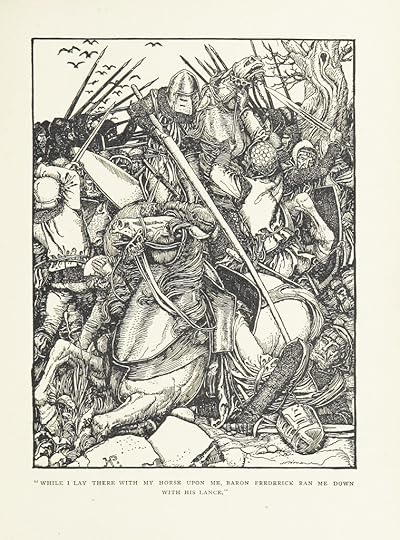
Pyle’s illustrations, especially the twenty-six full-page ones, are exquisite: beautiful, austere, detailed, absorbing, unforgettable. My mother read the book to me when I was ten, and I just now after fifty years reread it, and though I’d mostly forgotten the story, I had mostly remembered the pictures, and looked at them again with mesmerized deja vu.
Unlike with Twain’s works, the popularity of Otto of the Silver Hand has worn off by now, but it must have been popular in earlier times, for I detect its influence on artists like Maurice Sendak (e.g., cross-hatching) and Barry Windsor-Smith (e.g., trees) and writers like Lloyd Alexander (e.g., Taran and Eilonwy).
Pyle’s The Merry Adventures of Robin Hood (1883), The Garden Behind the Moon (1895), and Howard Pyle’s Book of Pirates (1921) are all much more entertaining, but Otto, the prototypical outsider children’s literature hero, really sticks with me and makes me think, because he is so passive and strange and strong.
This is 100% not my type of book to read, but I did find the bare bones of the story interesting. The way it's told and the way the dialogue is written was a big turnoff for me. However, I do understand that it's based on a Medieval story and written in the late 19th century and it might just all be elements that are consistent with the time period, so I'm willing to give it a slightly higher rating because the story it tells is actually interesting.
Sometimes anti-war sentiments get bogged down in, well, senitment, but this book far outdoes most. I love this wholesome, late-19th century medieval genre (a la Ivanhoe). There is something about this return to appreciating the premodern which is so refreshing after centuries of destroying religion, tradition, and all the good that the middle ages preserved. This book is very far from a fluff piece meant to sugar coat the middle ages, but rather it shows how in the darkness of worldly brutality, a christian flame flickered in the dark, holding the west together. The book starts off making that distinction, that there were some (mostly those in the church and in quieter areas) who preserved the teaching of Christ.
Interestingly, the story is centered upon a boy who is the son of a robber-baron, and the boy does essentially nothing physically heroic, but he is morally bold in his own way. His father is a bloodthiersty warmonger, but his mother had a conscience (however twisted, she didn't mind the spoils of war which her husband brought back). One time Otto's father returned nearly dead, and his mother went into labor at the sight, barely living long enough to give the boy his name before she died.
When Otto's father comes out of his coma, Otto is born and his wife is dead, so he takes the boy to a nearby monastery where his cousin (and maybe his brother as well?) lived. "Would that all the little children in these dark times be brought to the house of God and there learn mercy and peace instead of rapine and war" said the abbot. Right afterwards, Otto's father swears revenge on a the members of another family for a blood feud, and the abbot gives up trying to turn him away from it (doesn't use any scripture, easily could have, but meh).
There in the monastery, Otto is peacefully raised and befriends a man who is mentally handicapped (half-witted, head hurt as a child, abandoned at the monastery), and they form a bond, talking nonsense back and forth to each other. The other man, John, tells him of visions he sees. I loved this detail because it points out the longstanding anti-eugenics of the church, and it shows that even the mentally handicapped can still live fulfilling lives (John takes care of little Otto for a while, and is a good companion).
Otto also gets the privilege to learn latin (reading and writing), and has access to nice books at the monastery. At the age of 12, Otto's father returns and takes him back home, saying: "If you have made a milkmaid of the boy, I thank the dear heaven that there is still time to undo your work and to make a man of him". This turn is important because it points out that, contrary to modern atheistic propaganda, it was actually the church which held western civilization together (and propagated learning and the arts). It was straying from the church (literally and morally) that brought barbarism.
While at the family castle, he explores and finds some old worm-eaten books, and is one of only two people who can read in the castle. He also finds an old chapel which is dusty and unused except for a family burial place. This is an excellent metaphor for how tradition, specifically christian tradition, can be misused, as they don't really care about religion, they only use it as a way to deal with the dead; they only care about the dead insofar as they can give them longstanding feuds.
At one point, Otto learns that his father has killed a man, and then his father walks in, saying he's killed more than a few, stating: "Thou must get out of those foolish notions that the old monks have taught thee. Here in the world it is different from what it is in St. Michaelsburg. Here a man a must slay or be slain." Here we have a curious moral relativism, which is at odds with the objective morality that Otto was taught at the monastery. Ironically, after being chastised for the things he learned from the monks, Otto is summoned to read a declaration which is handed to his illiterate father. This is a perfect image of how modern ethics, arts, and culture are so indebted to Christianity that they can't even read.
Otto's father leaves to obey the summons of the emperor, and it's while he's away that the castle is stormed and Otto is taken captive. Otto fears he will die and begins praying as the family enemies of Otto's father drag him away. They don't kill him only (as is revealed near the end) cut off his right hand. This comes up later when Otto is freed (and unable to use a ladder, both because of exhaustion and because of his lost hand), and Otto's father reacts much the same way as Shakespeare's Titus Andronicus reacts to his daughter's dismemberment (bitter laughter).
Near the end, Otto's father sacrifices himself to let his son and the others escape, and Otto's father falls into a river with the other Baron (who has taken part in the family feud) and they both drown together in their heavy armor, never seen again. This feels like a good metaphor for how such feuds must end. There are three possibilities in these cases: either both sides kill themselves, both sides declare peace (as Otto proposes, saying he gave his hand to the daughter of the family enemy while a prisoner there, possibly referencing Romeo and Juliet), or lastly a third party (such as the government) may step in (which is also threatened at the end). The Emperor is portrayed as a modestly dressed and reasonable man, and finally all is good. Otto's wisdom wins him respect, and his missing hand is replaced with a silver, unmovable hand, one which can never raise a sword, even if it wanted to.
"A silver hand is better than an iron hand [fist]" is what the book ends on, and it ties things together well. The story could have stood to be a bit longer, but it was good for a children's novel, and I think the themes/morals of it were great. It showed a main character who is "nerdy" but who is right and who is able to teach the adults around him. He is a rebel but in the only meaningful way you can be. He doesn't dress stupidly or act disobedient; instead he rebels against the ways of the world, modeling a Christlike patience and wisdom. Wonderful :)
Beautifully wrtten and illustrated and a fast read. Great for ages 10 and up. I, as an adult, enjoyed it. Historical refences, some good vocabulary, themes to explore of honor, revenge and mercy. Learn how far a league is. Good descriptive pictures painted of suroundings, including sounds and smells. Helps the reader gain an understanding of the culture and lifestyle of the medievel German area of Europe. Written in a way to draw out empathy for the characters and their motivations and emotions. Great action scenes. Refreshingly unpredictable and unpretentious. Just a few details to give the impression you are reading something written by a contemporary of the medieval days, such as the woodcut print style of the illustrations, just a touch of a few "thee's and thou's" and Hint: to keep track of names of towns, places, castles and people, I wrote them out on a post-it, to keep from getting confused in the early chapters.