Jump to ratings and reviews
Rate this book

Dainty Series #3

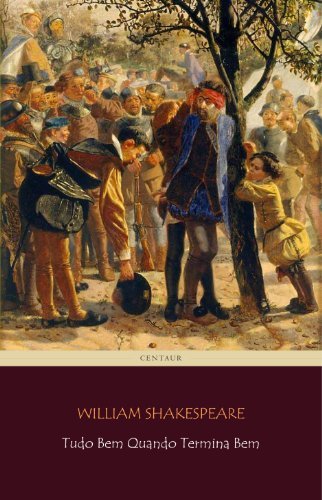
Tudo Bem Quando Termina Bem [com índice ativo]

Rate this book
Tudo Bem Quando Termina Bem ( All’s Well That Ends Well no original em inglês) é uma peça inicialmente classificada como comédia, embora alguns estudiosos prefiram vê-la como uma tragédia. Terá sido escrita entre 1601 e 1608, e foi publicada pela primeira vez no First Folio em 1623. É uma das peças menos encenadas de Shakespeare.

93 pages, Kindle Edition

First published January 1, 1604

557 people are currently reading
15701 people want to read

About the author

William Shakespeare

27.5k books46.9k followers
William Shakespeare was an English playwright, poet, and actor. He is widely regarded as the greatest writer in the English language and the world's pre-eminent dramatist. He is often called England's national poet and the "Bard of Avon" (or simply "the Bard"). His extant works, including collaborations, consist of some 39 plays, 154 sonnets, three long narrative poems, and a few other verses, some of uncertain authorship. His plays have been translated into every major living language and are performed more often than those of any other playwright. Shakespeare remains arguably the most influential writer in the English language, and his works continue to be studied and reinterpreted.
Shakespeare was born and raised in Stratford-upon-Avon, Warwickshire. At the age of 18, he married Anne Hathaway, with whom he had three children: Susanna, and twins Hamnet and Judith. Sometime between 1585 and 1592, he began a successful career in London as an actor, writer, and part-owner ("sharer") of a playing company called the Lord Chamberlain's Men, later known as the King's Men after the ascension of King James VI and I of Scotland to the English throne. At age 49 (around 1613), he appears to have retired to Stratford, where he died three years later. Few records of Shakespeare's private life survive; this has stimulated considerable speculation about such matters as his physical appearance, his sexuality, his religious beliefs, and even certain fringe theories as to whether the works attributed to him were written by others.
Shakespeare produced most of his known works between 1589 and 1613. His early plays were primarily comedies and histories and are regarded as some of the best works produced in these genres. He then wrote mainly tragedies until 1608, among them Hamlet, Romeo and Juliet, Othello, King Lear, and Macbeth, all considered to be among the finest works in the English language. In the last phase of his life, he wrote tragicomedies (also known as romances) and collaborated with other playwrights.
Many of Shakespeare's plays were published in editions of varying quality and accuracy during his lifetime. However, in 1623, John Heminge and Henry Condell, two fellow actors and friends of Shakespeare's, published a more definitive text known as the First Folio, a posthumous collected edition of Shakespeare's dramatic works that includes 36 of his plays. Its Preface was a prescient poem by Ben Jonson, a former rival of Shakespeare, that hailed Shakespeare with the now famous epithet: "not of an age, but for all time".

Ratings & Reviews

What do you think?
Rate this book

Friends & Following

Create a free account to discover what your friends think of this book!

Community Reviews

5 stars
4,132 (20%)
4 stars
6,491 (32%)
3 stars
6,960 (34%)
2 stars
1,905 (9%)
1 star
476 (2%)
Displaying 1 - 30 of 1,192 reviews
Profile Image for Bill Kerwin.
Author 2 books84.3k followers
August 16, 2019

I just can't bring myself to love this play, although I believe I understand what Shakespeare is doing here. He takes a fairy tale plot, adds a fiercely realistic setting (complete with a pointless war and friendly fire), adds a desperately mismatched romantic couple (Helena, a commoner and a control-freak, a woman of great passion and intelligence, obsessively smitten with the noble Bertram, a proud, shallow boy), tops it off by giving the comedy a mindlessly optimistic title and then spending most of his effort not just making the title come true, but making it come true in such a formulaic, makeshift fashion that the reader must mentally modify that jaunty title by the addition of a dozen cautionary interrogation points. The comic fop and braggart Parolles--sort of a cross between Pistol and Malvolio--helps out some, both thematically and as comic relief, but the whole thing still leaves me feeling a little creepy, with a bad taste in my mouth. But then . . . maybe that's the way Shakespeare wanted me to feel?

I don't think so, though. I believe his intention is a little more ambitious than that. He is certainly criticizing the forms and conventions of comedy, but I believe he also wishes to transcend them by producing a kind of meta-comedy--the sort of thing he would soon accomplish in Measure for Measure. In Measure for Measure, he succeeds by 1) distancing the reader by making the entire universe of the play slightly surreal, and 2) using the Duke as a God-like figure, thus inviting the reader to adopt an Olympian perspective for him or herself. Shakespeare tries something similar in All's Well That Ends Well, using 1) the radical disconnect between fairy tale and harsh realism in the plot, and 2)providing us with three ancient characters of good will--the King of France, the Countess and Lord Lafeu--who speak much about the nature of Time, suggesting the widened perspective and wisdom which may accompany Time's contemplation. As I said, he "tries" something similar, but I don't think he quite brings it off.
Profile Image for Ted.
515 reviews737 followers
August 19, 2016

Not 3 1/2, 4
I enjoyed this play more than I thought I would, partly due to the excellent production of it I watched. Certainly more to think about here than the previous two comedies I read.


I. All’s Well That Ends Well

The name of this play has become almost a hackneyed phrase in the English language. It’s a phrase that hackneyed me has used countless times, since I became familiar with it so many decades ago. But for all that, it’s not one of Shakespeare’s more popular plays, and is seldom performed.

No contemporaneous mentions of the play or quotations from it have ever been found. There are problems with the text; the style is uneven; and there’s no external fact or topical reference with the drama to accurately date its composition. However, the best passages have been taken as evidence of a maturity in the writer, hence it is typically placed in the latter half of Shakespeare’s works, and in my collection it has been placed between Troilus and Cressida (1602) and Othello (1603). This dating makes it the 25th of the 37 plays included.

Most critics have apparently agreed with Samuel Johnson’s verdict that although it has “many delightful scenes”, its characters are “not new, nor produced by any deep knowledge of human nature”, and that several of the most notable are quite unlikeable. My editor (writing in the middle of the last century) also notes that some modern readers are uncomfortable with moral aspects of the play. Both this observation, and the “unlikeable characters” seem silly to me. As always, Shakespeare, like any author, is writing for an audience, and his audience was the theatre audience of his own time. On top of that, I couldn’t care less about whether a fictional character is “likeable” … really, do you?

(Coleridge, by the way, went out of his way to defend Bertram, one of the characters easy to dislike, as perfectly justified in rejecting Helena as a wife - given his aristocratic birth and Helena’s station as nothing more than the daughter of a physician, basically a retainer of Bertram’s father.)


II. Shakespeare’s source

The source of this play cannot be argued about. It is based on a story in Boccaccio’s Decameron. The tale is found as the ninth story of the third day. One of Boccaccio’s female characters, Neifile, presides as queen on the third day, and thus relates that ninth tale. She has decreed that the stories on her day will be ones in which a person either has painfully acquired something or has lost it and then regained it.

The story she tells can be traced back to the Sanskrit dramatist and poet Kālidāsa in his The Recognition of Śakuntalā (which itself may go back as far as the 5th century).


III. From story to play

I thought for this play I’d write something about what Shakespeare did to turn Boccaccio’s story into a play.

III.a Boccaccio’s characters

In The Decameron (see this PDF: http://pinkmonkey.com/dl/library1/b1.pdf ), there are six characters. The first three are Bertrand, the young Count of Roussillion; Juliet, the young woman in love with Bertrand; and the King of France. These are all main characters for Boccaccio.

The other three characters are women of Florence: a widow; a neighbor lady to the widow; and the neighbor’s daughter, who is the object of Bertrand’s desires. (None of these women of Florence even has a name in the story.) It is only the second of these, the daughter’s mother, who gets much of a role in the story, for it is her to whom Juliet addresses her woes and makes her appeal. The daughter, in fact, is barely mentioned.

III.b What Shakespeare did with Boccaccio’s characters

In All’s Well, the first three characters are presented as Bertram, Count of Rousillon; Helena is the young woman (Shakespeare changes her name); and the King of France. These characters play in general the same roles in the drama as they do in the story.

Boccaccio’s three unnamed women of Florence become, for Shakespeare, four women of Florence. The Widow is still unnamed, but becomes the mother of Diana, the object of Bertram’s passions. Both the Widow and Diana are implored by Helena for aid in her scheme. Two other neighbor women to the Widow, Violenta and Mariana, are introduced as fairly minor characters. So here we have the first noticeable change made by Shakespeare: he’s decided that Boccaccio’s Widow & “mother” can be combined into a single character.

III.c How the Story, and Play, are told

This section is something of a spoiler, so ... (Also, its kind of anal, so ...)


III.d Shakespeare’s new characters.

Shakespeare added four major characters to his play. In this section I refer to percentages of All’s Well …. These were determined by estimating the column-inches that each scene occupied in my Complete Works, and making the simplifying assumption that each character in a scene is there for the whole scene, regardless of how many words the character speaks. Think of these percentages as an indication of the amount of time a character has on the Elizabethan stage.

The four new, significant characters are: the old Countess (Bertram’s mother), Lafeu, Lavache (the Clown), and Parolles. In adding the last of these, he introduced a major subplot to the play.

Shakespeare has Bertram and Helena each on stage about 60% of the play, the King of France 33%, and the Widow and her daughter Dianna about 20% each.

Parolles is on stage 2/3 of the play! He becomes, in a sense, the main character! In fact, 40% of the play has Parolles on stage with both Bertram and Helena. Of Shakespeare’s other inventions, Lafeu is present for half of the play, the Countess over 40%, and the Clown about the same as the two women of Florence.

In sum, Boccaccio’s Bertrand and Juliet can still make claim to being the stars of Shakespeare’s play. The King of France actually plays a more significant role on stage than he does in the story (because of his presence in the last scene). But every other character in All’s Well who is on-stage more than a few minutes is either an invention of the Bard’s, or a character from the story modified by Shakespeare.

III.e Shakespeare’s main scenes.

Of the 23 scenes in All’s Well, six are each 8% or more of the entire play, and collectively make up almost 60%. The other 17 scenes range between 5% and 1% of the play.

Shakespeare devotes acts I and II to the introductory material and the Paris scenes. These two acts comprise about 45% of the play, and follow Boccaccio’s story fairly closely. They do, however, include the new characters, even as they set up Helena’s deceit. Four of Shakespeare’s big scenes occur in these acts: I.i (Bertram, Helena, Parolles, Lafeu and the Countess), I.iii (Helena, the Countess and the Clown), and both II.i and II.iii (the same as I.i, but substitute the King for the Countess).

The second longest scene in the play is IV.iii, which has not a thing related to Boccaccio’s story - the scene in which Parolles is shown to Bertram to be the liar & traitor (among other things) that he is.

The longest scene (12% of the play) is the last one, V.iii. Every major character is on the stage except for the Clown.


IV. Movie/TV

For this play I watched episode 3, season 3 of the BBC Television Shakespeare. This production starred Ian Charleson (Bertram), Angela Down (Helena), Donald Sinden (the King), Celia Johnson (the Countess) and Pippa Guard (Diana). I also particularly enjoyed Michael Hordern (Lafeu), Paul Brooke (Lavache, the Clown) and Peter Jeffrey (Parolles). This enactment was superior to either of the movies I watched for my two previous plays. The players seemed comfortable with their Shakesperean roles, spoke like they were Elizabethans, and were clear and understandable. It was as if a play on the boards had been filmed, rather than a popular production for a movie audience. Perhaps the fact that none of the actors was a “star” helped.

The director, Elijah Moshinsky, seemed to approach the play as more of a serious drama than something done for laughs, or even as a play that would at least have a happy ending. To me, this raised the play up above the earlier comedies I’ve read, and also gave it a focus that I hadn’t sensed during my read. I loved it.

This production of the play is available in full on YouTube.
https://www.youtube.com/watch?v=Qjm7o...

By the way, starting at around 34 minutes is the scene in which Helena convinces the King to let her attempt his healing. I was quite surprised that the scene is played by both actress and actor as almost a two way seduction.


V. The Play and I – comedy?

This is the first of Shakespeare’s plays (in my old-age project) for which watching the play (above) really contributed to my appreciation and interpretation.

As I read the play, I thought about how it’s come to be classified as a “comedy”. A little research informed me that the “comedy” genre of Shakespeare’s plays is sort of a catch-all. Not a Tragedy; not a History; so a Comedy (the “Problem” plays being off in left field by themselves). The point being that there aren’t a whole lot of laughs in the play, not even of the suggestive, double-entendre type of banter that was plentiful in As You Like It. There is a bit of banter, usually involving Parolles or the Clown, but it’s not the same type – and when Parolles is involved, the laughs are always coming by another character insulting him, that is, laughter at his expense.

This was brought out in the TV production very well. But I was struck, watching that, by a rather sombre mood. This was highlighted by IV.iii (above), in which Parolles is shown, blindfolded, with his head pushed down on a table, and the soldier holding him saying, “There is no remedy, sir, but you must die … Come, Headsman, off with his head.” To which Parolles moans, “Oh, Lord, sir, let me live, or let me see my death.” Even though the “Oh, Lord, sir” echoes the Clown’s foolishness with the Countess in II.ii, it’s hard not to feel a pang of sorrow for Parolles, who must be experiencing the terror of thinking that his life is about to end.

And Parolles, after all, is not the only character with faults in the play. Bertram goes without saying; the King, having displayed a tyranny over Bertram in Act II, repeats the same dark fault in the last scene, as he is about to order another man to become Diana’s husband. Lafeu, a perceptive man, and one who earns our admiration for his kindness toward Parolles near the end, has nevertheless thrust his daughter forward as a suitable match for Bertram, no doubt calculating that to be connected with the Roussillion estate can be an advantage for him. Indeed, when we examine all the characters, we see in each of them, even Helena, examples of human beings like all others, who evince a combination of good and bad traits as they pass across life’s stage.

The King says, in the Epilogue
The King’s a beggar, now the play is done.
All is well ended, if this suit be won,
That you express content; which we will pay,
With strife to please you, day exceeding day.
Ours be your patience then, and yours our parts.
Your gentle hands lend us, and take our hearts.
This rather enigmatic speech does nothing to dispel a feeling of evening falling, life winding down as ever.

Comedy? More like a tragi-comedy.
Profile Image for Jason Koivu.
Author 7 books1,403 followers
February 25, 2015
All's well that ends well...sure, but does it really end well? Really?

A simple maid with the one remedy for what ails the king, cures him and receives as her reward the hand in marriage of a high-born courtier. The groom-to-be won't submit to wed such a lowly personage, nay! His refusal is seen as base and tarnishes his reputation, so he flees to the wars, for it is through deeds of bravery that he will redeem himself. Slight of hand and high japery set the scene for misunderstandings and tricky ruse de guerre in the realm of romance. Will they or won't they?!

A very fairytale story, that! Shakespeare tries to transform it into something a more realistic, but in the process creates a strange brew of the two.

What never rises above the land of make believe, imo, is that the simple maid ever finds attractive and purposefully pursues the asshole groom-to-be. This portion of All's Well That Ends Well parallels the Lizzy and Darcy struggle from Pride and Prejudice, except that it never quite makes enough to sense to satisfy this reader. Shakespeare fails to bring the couple together in a realistic way. In the end it's a flippant one-liner that switches hate to love. Is this a cop out? A comedy shortcut? Or just poor writing?

Maybe it doesn't really matter, because quite clearly this framework is meant to be a vehicle for the "comedy" strewn about the middle of the play. I used quotations around comedy, because I'm sarcastic like that. While cowardice can be comical, I don't find kidnapping, hostage threats of torture and death, and weaselly traitorous admissions to be hilarious good fun...well, for a little while, maybe. The scene with Parolles drags on and on, and we get it right off the bat, the guy's a coward. Yes, this scene is important for the big reveal at the end, but man does it go on too long.

It's failures like the above that kept me from loving this play like I have others. It's not bad, just not brilliant.
Profile Image for Brian.
825 reviews503 followers
December 3, 2022
“Love all, trust a few, do wrong to none.”

In giving this play 4 stars, I am comparing it against Shakespeare's other work, not against any other writer. This is supposedly one of Shakespeare's "problem plays", but I don't see the problem. We have characters who have extreme emotions (a favorite Shakespeare motif) and some situations that border on ridiculous, but the emotion and heart of the conflict reflects reality in a way that only Shakespeare can produce.

Plot, in short-Helena loves Bertram, a man who is her social superior. He spurns her. She later uses medical skills learned from her deceased father to heal the ailing king, who promises her anything for her service. She wants Bertram, he is forced to marry her, and then flees to war. She follows, and tricks him into recognizing her worth.

Although modern audiences may balk at Helena's throwing herself at a man who disdains her, we must remember that Helena is in love, and thus, not always rational. Love wants its desires, not practical realities.

Some highlights:
ALL’S WELL includes a wonderful Shakespearian character in Parolles. The man is a coward, a fool, and a braggart. The irony (and joy) of his character is that he knows and accepts these faults in himself. Despite his poor qualities, he is really the most honest character in this work. Read this play if for no other reason than to introduce yourself to this this great character.

Act 1:3 is a delight to read. Witty comic dialogue, and some beautiful language, especially as it relates to love is to be found there.

I love the character of the Countess of Rossillion, the mother of Bertram. She is probably the best older woman’s part that Shakespeare wrote.

Quotes:
• “Our remedies oft in ourselves do lie, which we ascribe to heaven.”
• “I am driven on by the flash, and he must needs go that the devil drives.”
• “It is the show and seal of nature’s truth, where love’s strong passion is impressed in youth.”
• “Honors thrive, when rather from our acts we them derive than our foregoers.”
• “The devil it is that’s thy master.”
• “Methink’st thou art a general offence, and every man should beat thee.”
• The soul of this man is his clothes. Trust him not in matter of heavy consequence.”
• “I find my tongue is too foolhardy.”
• “Simply the thing I am shall make me live.”
• “Praising what is lost makes the remembrance dear.”

Existential questions about self-worth and the paradoxical nature of humanity are the real crux of this play, and once again, Shakespeare shows us what it means to be human. As one character says in Act IV, "The web of our life is of a mingled yarn, good and ill together…”
ALL’S WELL THAT ENDS WELL demonstrates this in the dual nature of almost every character and plot device.

The new RSC Modern Library editions of the plays of Shakespeare are a quality trade paperback edition of the works of the Bard. This edition includes an essay on the performance history of the piece, and interviews with directors Gregory Doran and Stephen Fried. Mr. Fried’s answers give excellent insight into the play. Be sure to read them.
The Modern Library edition also includes a scene-by-scene analysis, which can help point out an image or symbol you might have missed. The edition also includes a nice “Further Readings” list specifically for this play. Frankly, all of the extra essays allow you to dive into the world of the play, and it is all included in one text.
Profile Image for Darwin8u.
1,833 reviews9,037 followers
September 15, 2017
“Love all, trust a few, do wrong to none.”
― William Shakespeare, All's Well That Ends Well

description

The most clearly problematic of Shakespeare's "Problem Plays" . Don't get me wrong. I love the dark, ambiguous, almost nihilistically modern tone of this period of Shakespeare. I think the peak of the three plays is clearly 1st: Measure for Measure, followed by 2nd: Troilus and Cressida, and 3rd: lastly, this.

To bastardize a line from Shakespeare's M4M to fit my cause and purpose:

"They say, best men plays are moulded out of faults,
And, for the most, become much more the better
For being a little bad."


Anyway, one of the redemptions of All's Well is Shakespeare is playing us and not just the players. He KNOWS audiences want resolution. He KNOWS it pays to let the boy get the girl. Hell, movies today show we are no different. We don't want ambiguity too much. We want a hero who gets the girl. Shakespeare says fine. I'll give you a nominal hero (who in reality is a real dick) and feed him (per request) to the girl. She will get what she wants (in the end) and the audience will get what they essentially keep demanding (in the end). And the result will be bitter. To again paraphrase H.L. Mencken who was talking about voters and democracy, fits also for theatre patrons. Shakespeare knows "that the common people know what they want, and deserve to get it good and hard." It is all very modern of Shakespeare and also very human. Just not humane.

One more point about this play. I adore Parolles. He isn't nearly as perfect as Iago later will be, but like Lucio from M4M and Thersites in T&C carries some of the best lines in the play.

Some of my favorite lines (just a brief sample):

“Moderate lamentation is the right of the dead,
excessive grief the enemy to the living.”
(Act 1, Scene 1).

“my idolatrous fancy Must sanctify his reliques." (Act 1, Scene 1).

“When thou hast leisure, say thy prayers.
When thou hast none, remember thy friends."
(Act 1, Scene 1).

“Our remedies oft in ourselves do lie,
Which we ascribe to heaven."
(Act 1, Scene 1).

“see that you come Not to woo honour, but to wed it" (Act 2, Scene 1).

“My art is not past power, nor you past cure." (Act 2, Scene 1).

“Hence is it that we make trifles of terrors,
ensconcing ourselves into seeming knowledge when
we should submit ourselves to an unknown fear."
(Act 2, Scene 3).
102 reviews317 followers
July 11, 2011
Where can you go after writing Hamlet? Only into the bitterest depths of irony and nihilism, apparently. All’s Well That Ends Well is part of the problem play trilogy that followed soon after the Danish Prince’s demise and Malvolio’s humiliation, and it appears on the surface to be less twisted than both Troilus and Cressida and Measure for Measure. But don’t be fooled. Shakespeare plays one of his greatest tricks on the audience here, achieving something difficult and deeply unsatisfying, which probably explains this play’s lack of staging popularity.

See, we like Helena. Shakespeare wins our sympathy for her early and often, but he also has her fall in love with Bertram, one of the shallowest d-bags the Bard has to offer. Harold Bloom points out that nearly all Shakespeare’s women marry beneath themselves, but the Helena-Bertram coupling might be the most egregious in the canon. Even so, why is this such a problem for the audience? Well, the plot focuses almost entirely on Helena’s pursuit of Bertram via means elaborate and occasionally of questionable ethics (but we don’t care because we like Helena!), and we can’t help but root for her success. Yet—and here’s the trick—this success wins her the shittiest prize ever, someone that will make her life miserable. I’m not exaggerating. Bertram wants nothing to do with Helena and tells her as much at regular interval. He’s a hopelessly immature, warmongering slut, hanging around with the scoundrel Parolles, who manages to be more relatable (if not likable) than Bertram following his acceptance of public disgrace and dispossession. But we’ve probably all had a friend like Helena, someone whose “imagination / Carries no favour in’t but Bertram’s”, who falls for someone we can’t stand. Such is life, such is love.

And it’s worse. Helena knows that Bertram is bad news:

“But, O strange men!
That can such sweet use make of what they hate,
When saucy trusting of the cozen’d thoughts
Defiles the pitchy night; so lust doth play
With what it loathes for that which is away.”

And yet she keeps holding on to that belief: all’s well that ends well. Ah, but who else can believe it? So bitter, Shakespeare!
Profile Image for Medisa.
321 reviews24 followers
December 11, 2025
این نمایشنامه مثل اکثر آثار شکسپیر زیرکانه‌ست اما نتونستم به اندازه‌‌ی کافی باهاش ارتباط بگیرم. برای من برترام یه شخصیت آشغال و متظاهر بود که حتی تو پایان نمایش هم دروغ می‌گفت و خب شک ندارم تغییری در شخصیتش ایجاد نشده بود، هلنا بیخودی حرص و جوش الکی می‌زد.
Profile Image for Michael Finocchiaro.
Author 3 books6,257 followers
April 6, 2022
It may be surprising to see me note this one with less than 5 stars, but I was irritated with All's Well That Ends Well because I found the love story inadequate. What Helena sees in her recalcitrant and wandering lover Bertram just totally escapes me. The bed trick was less convincing for me here than it was in Measure for Measure, and I just had a hard time building any empathy for Bertram or for Paroles or the other minor characters. The fact that Helena saves the King of France was a nice, somewhat revolutionary feminist touch, but I did appreciate some of the poetry such as:

The web of our life is of a mingled yarn, good and ill together.
(First Lord, Act 4 scene 3)

For we are old, and on our quick'st decrees
Th’inaudible and noiseless foot of time
Steals ere we can effect them.
(King, Act 5 Scene 3)

Fino's Reviews of Shakespeare and Shakespearean Criticism
Comedies
The Comedy of Errors (1592-1593
The Taming of the Shrew (1593-1594)
The Two Gentlemen of Verona (1594-1595)
Love's Labour's Lost (1594-1595)
A Midsummer Night's Dream (1595-1596)
The Merchant of Venice (1596-1597)
Much Ado About Nothing (1598-1599)
As You Like It (1599-1600)
Twelfth Night (1599-1600)
The Merry Wives of Windsor (1600-1601)
All's Well That Ends Well (1602-1603)
Measure for Measure (1604-1605)
Cymbeline (1609-1610)
A Winter's Tale (1610-1611)
The Tempest (1611-1612)
Two Noble Kinsmen (1612-1613)

Histories
Henry VI Part I (1589-1590)
Henry VI Part II (1590-1591)
Henry VI Part III (1590-1591)
Richard III (1593-1594)
Richard II (1595-1596)
King John (1596-1597)
Edward III (1596-1597)
Henry IV Part I (1597-1598)
Henry IV Part II (1597-1598)
Henry V (1598-1599)
Henry VIII (1612-1612)

Tragedies
Titus Andronicus (1592-1593)
Romeo and Juliet (1594-1595)
Julius Caesar (1599-1600)
Hamlet (1600-1601)
Troilus and Cressida (1601-1602)
Othello (1604-1605)
King Lear (1605-1606)
Macbeth (1605-1606)
Anthony and Cleopatra (1606-1607)
Coriolanus (1607-1608)
Timon of Athens (1607-1608)
Pericles (1608-1609)

Shakespearean Criticism
The Wheel of Fire by Wilson Knight
A Natural Perspective by Northrop Frye
Shakespeare After All by Marjorie Garber
Shakespeare's Roman Plays and Their Background by M W MacCallum
Shakespearean Criticism 1919-1935 compiled by Anne Ridler
Shakespearean Tragedy by A.C. Bradley
Shakespeare's Sexual Comedy by Hugh M. Richmond
Shakespeare: The Comedies by R.P. Draper
Tyrant: Shakespeare on Politics by Stephen Greenblatt
1599: A Year in the Life of William Shakespeare by James Shapiro

Collections of Shakespeare
Venus and Adonis, the Rape of Lucrece and Other Poems
Shakespeare's Sonnets and a Lover's Complaint
The Complete Oxford Shakespeare
Profile Image for leynes.
1,316 reviews3,682 followers
February 11, 2020
"All's Well That Ends Well" ... except for, umm, this play ... because it didn't end well at all but let's keep things in order and start at the beginning of this clusterfuck. Don't get too excited though, albeit the two star rating might seem low I still kind of appreciate this play and find it interesting. I am a huge fan of Willy's "problem plays" (aka the dark comedies aka all the plays in which he finally developed some interesting characters that are absolute shitheads and morally grey). The depth of the characters is great and I usually enjoy the morale dilemma that they find themselves in.

All's Well That Ends Well has a very simple promise: the young girl Helena is in love with the Count of Roussillon, Bertram. When she learns that the King is sick, she decides to make a deal with him. If she manages to heal him, she'll get to chose one of the lords of his court for marriage. If she fails, she will be executed. (sounds fair ... kinda not, but whatever) Luckily (for her, not for us because all the things that suck in this play are because of that), she manages to heal the King and choses Bertram as her husband. This scene (which happens toward the end of Act II) is one of the most vicious and awkward scenes in all of Shakespeare's canon, since all the gentlemen of the court reject Helena and Bertram openly voices his dislike for her by asking the King if he has to be "brought down", only because she raised him (the King) up.

That scene is so interesting on so many levels because it twists the power dynamic that is inherent to most Shakespeare plays (men in power, women submissive) ... whilst still not really twisting it. On the one hand, we see that Helena is in power (because the King granted her this position). However, when she proposes to Bertram she does so in the most submissive fashion ever. Like, for real, it's bizarre. Bertram quickly asserts his dominance by dismissing her. And you can't really be mad at him for it, since that whole deal between Helena and the King was made 100% without his knowledge and his consent. Forcing someone to marry somebody else is just not cool. But whilst Helena is willing to let it slide and accept Betram's decision, the King is absolutely not. He wants to assert his dominance because he feels like Bertram is disrespecting him by not following the rules he has established. So, all in all, it's just a clusterfuck of a power dynamic.

So far, so good. I like the moral problem posed in the first two acts. I liked the witty dialogue and banter and was somewhat intrigued. From Act III onwards, this play completely lost me. Basically, Bertram decides to flee from France in order to avoid marrying Helena. He's quite the shithead about it for telling her that he would rather die than have her for a wife. The Countess (his mother) is horrified at his actions and chooses Helena's side (which I found surprising). And Helena decides to follow him to Italy. There she learns that Bertram has fallen in love with the young Diana and wants to woe her. What then ensues is just plain right disgusting, since the two women make a deal and decide to perform the bed trick on Bertram. Before Bertram left France, he told Helena that only if she will obtain his family ring and will be carrying his child, he will accept her as a wife. Helena decides that Diana should woe Bertram and demand the ring from him. She should then make out a date with him on which they would have sex. What then ensues is that Diana gives the ring to Helena, and Helena takes her place on the date, so that Bertram (unknowingly) sleeps with her as opposed to Diana. This is basically rape, since Bertram never consented to sleep with Helena and the women tricked him into thinking he slept with Diana. It's disgusting, and the point of the play where I lost respect for almost all of the characters.

Helena then fakes her own death (what a mood), only to reveal herself at the right moment at the court of the King of France (because naturally Bertram came home once he found out his would-be wife was dead, lmao). Bertram then acts completely out of character by being impressed with Helena's actions and accepts to marry her since she fulfilled the two conditions he imposed on her earlier. It's so fucking ridiculous, and I don't get Shakespeare's narrative choice for the end at all. Why not have this play end without a marriage? He wasn't forced to write a comedy. I would've loved Diana to be a bit more opportunistic and fuck shit up by actually keeping the ring for herself or something like that. There was a lot of potential there. Bertram's conversion at the end is so sudden, it makes no sense at all. We don't need no happy ending, Willy. Get a grip.
Profile Image for Amr Mans.
61 reviews9 followers
May 26, 2017
المسرحية دي ليها قصة مختلفة معايا .. أول كتاب روائي اقرأه بحياتي، وكانت البدايات إن هواية القراءة تَنضُج عندي ..


أول مرة قرأتها كانت تعريب لبناني لـ"أنطوان مشاطي" وكانت بتعبيرات عربية مبسطة فيها طابع روائي عن الطابع المسرحية الموسيقية .. فضلت 4 سنين بدور عليها في جميع معارض مصر .. للأسف مش لاقيتها

أول قراءة في 30 ديسمبر 2013
...
ثم حالفني الحظ كثيرًا بصديق بحث عنها ولقاها لكن تعريب مصري لـ"محمد العناني" .. والحق يُقال إنه من أفضل التعريبات والترجمات اللي قرأتها لشكسبير .. ينطبع عليها الطابع المسرحي الموسيقي وترجمة معظم المسرحية في شكل شعر ونثر مُشكل ومُنسق بصورة جميلة جدًا .. بخلاف المقدمة الكبيرة عن شكسبير ودور الأدب المسرحي اللي إستعان بيه المترجم والحواشي والشروحات..
ثاني قراءة في 15 مايو 2017
...

المسرحية قصيرة، وليست من المسرحيات الشهيرة لشكسبير لكن فيها معان وحكم وعبر كثيرة جدًا عجبتني ..
فعلًا الحب لا يفرق بين اختلاف اللون او الوزن او الطبع وبه من المعجزات مالا يمكن تصورها!

"أَوَليسَ غَريبًا أنَّ دِماناَ مهماَ اختلفَ اللَّون أو الوَزنُ أو الطبَّعُ لدينا إن صُبَّت في حوضِ لَم يتَميز فيها شَيئٌ من هذا" - شكسبير

لكن بخلاف الحُب، الدرس المستفاد في خاتمة الرواية: "بالحق إنَّ كيدهنَّ عظيم!" :D

"وما من فتاة حاولت إثيات ذاتها وحقها في أن تنال من تحب إلا نحجت" - شكسبير

ليس ريفيو كامل أو مُرضي، لكن الكتاب سببه شخصي أكثر من ان يكون لي به نظرة عامة ..
Profile Image for Kim Griffin.
38 reviews3 followers
April 14, 2010
ALright, obviously I am biased - being that I will be playing the heroine May through September...but before all that, when I first read this play last winter it became my favorite play by Shakespeare. This is the best edition f the play, and has a brilliant introduction. Helena is the first female physician ever created, and her strength, daring, and unabashed lack of self-respect where her feelings for Bertram are concerned make her a fascinating subject and a great role model in many ways.
This play was the warm-up piece for Measure for Measure in many ways, as it is where Willy worked out the infamous "bed-trick," and between the speeches of the Countess and the King, contains some of the more beautiful musings on love, youth, and age that I have ever read or heard. I think that this play has the ability to truly reach people, and if you can't come see it this summer...even if you can!... you should definitely check it out.
Profile Image for Andrei Tamaş.
448 reviews370 followers
February 19, 2016
"Totu-i bine când se sfârşeşte bine", piesa lui Shakespeare, este... o tragedie evitată în ultimul moment (a se consemna!).
Poate din pricina asta, critica literară consideră piesa o comedie. E drept că titlul oferă, aparent, nuanţe comice, însă eu n-am văzut niciun dram de comic în piesă. Este mai degrabă o drama a cărei ultima scenă al ultimului act este comică (deoarece toţi sunt împăcaţi).
Nuanţele dramatice ale piesei (ce pot fi sesizate abia astăzi, iar nu în epoca lui Shakespeare) sunt date de genialele ipostaze ale discrepanţei dintre clase, a prejudecăţilor aristocratice ale epocii medievale.

"Pecete-a adevărurilor firii
E-n tinereţe ghimpele iubirii."


Caracterul feciorelnic al femeii medievale, lipsite de mijloace materiale, singura ei avere:
"Dar când
Culeasă-i roza şi rămân doar spinii,
Pe noi ne-nţeapă, şi voi faceţi haz
De jaful ce ne-a pustiit."


În antiteză cu o insinuare mârşavă a lui Parolles: "şi nu s-a născut nicio fecioara până nu s-a pierdut o feciorie. Metalul din care eşti tu făcută e bun pentru turnat fecioare. Prin faptul că ţi-o pierzi o dată, fecioria poate fi reînnoită în alte zece exemplare. [...] A ţine partea fecioriei înseamnă să-ţi învinovăţeşti mama, care şi-a pierdut-o ca să te facă."

Dimensiunea hiperbolică a limbajului:
"-Am să-ţi spun un lucru, dar să-l îngropi în ţine cât poţi de-adânc."
-Îndată ce mi-l vei spune, va muri, şi eu voi fi mormântul lui."


P.S., spre ruşinea mea, e prima piesă scrisă de Shakespeare pe care o citesc şi de aceea nu mă pot pronunţa "mai academic". Oricum, până la finele anului, mi-am propus să citesc opera completă (sper doar să-mi ajungă... TIMPUL!)...

Andrei Tamaş,
19 februarie 2016
Profile Image for David.
744 reviews230 followers
January 10, 2019
Middleton and Shakespeare here are blended;
This problem play doth suffer too much rhyme.
From first to last required excessive time.
Whether "well" or no, I'm glad 'tis ended!
Profile Image for ✰ Liz ✰ .
1,410 reviews1,339 followers
August 8, 2015


description

Summary:
"Set in France and Italy, All's Well That Ends Well is a story of one-sided romance, based on a tale from Boccaccio's The Decameron.

Helen, orphaned daughter of a doctor, is under the protection of the widowed Countess of Rossillion.

In love with Bertram, the countess' son, Helen follows him to court, where she cures the sick French king of an apparently fatal illness.

The king rewards Helen by offering her the husband of her choice. She names Bertram; he resists.

When forced by the king to marry her, he refuses to sleep with her and, accompanied by the braggart Parolles, leaves for the Italian wars.

He says that he will only accept Helen if she obtains a ring from his finger and becomes pregnant with his child.

She goes to Italy disguised as a pilgrim and suggests a 'bed trick' whereby she will take the place of Diana, a widow's daughter whom Bertram is trying to seduce.

A 'kidnapping trick' humiliates the boastful Parolles, whilst the bed trick enables Helen to fulfil Bertram's conditions, leaving him no option but to marry her, to his mother's delight."
description
~~~~~~~~~~~~~~~~~~~~~~~~~~~~~

This is not my favorite Shakespeare work but still a very engaging story. I especially enjoy a modern presentation of the work.

description
Profile Image for Jo .
930 reviews
September 24, 2024
I'm slowly making my way through Shakespeare's works again, and I say again because many of them I've read or studied during my school years. It's funny that the plays/works I studied for exams and such I still find problematic now. I honestly think that such intensely forced studying really sucks the pleasure out of a book and robs that sense of discovery of that 'First-time-read-through'.

This might be one of Shakespeare's more unpopular plays, but for me I think there is still laughter to be had from the Bard, despite the characters not being the brightest or the most spectacular. I can't say I'm completely satisfied with All's Well That End's Well, but I've definitely read worse.

I pitied Helena, and rather early on. Not only does she recklessly persue a man that is insubstantially sound, the worst thing about it is that this man has no interest in her, and she knows it. I mean, he chose to go off and fight in a war to be free of this woman. It would have been painful for me to continue on with it if this wasn't a Shakespeare play, but the Bard carried me along with his wit, and thus I chose to stay.

Helena spends the majority of the play finding ways to win Bertram over by any means necessary, so it would seem, but do we really care all that much? I mean, Bertram certainly doesn't. It's a difficult one to love entirely, I think.

This was a fun read in parts, and there is also the deeper meaning existing as with every Shakespeare play, but it isn't at my top spot. Maybe I'll try again in a few years.
Profile Image for Brad.
Author 2 books1,917 followers
July 3, 2021
I have a plan, and I am going to make it happen.

Sometime between 2021 and 2025 I am going to stage All's Well That Ends Well in my town; I am planning on 16 performances. In my staging, the two main actors, those who play Count Bertram and Helena will learn both parts and play 8 performances as Shakespeare's intended gender, then play 8 performances gender flipped.

Each performance will have a Q&A, which it will require mental health professionals and/or academics and/or those with experience who can speak to the plot and what it says and does, and how that plot alters and changes based on the gender of the roles, and what that says and suggests about the audiences watching.

Wish me luck. It could be a triumph or a gigantic mess. Regardless, I think it is an important way to stage this play, and I am old enough now that any fall out will merely destroy my life in theatre. But I am willing to give that a go. So no biggie.
Profile Image for Armita.
305 reviews38 followers
January 27, 2021
1. This play, next to A Midsummer Night's Dream, is my favorite Shakespeare comedy.
(I read some of the Goodreads' community reviews on this play and saw many people didn't like it as much as I did. Weird.)

2. Helena is a very well-written character. She deserves the world.

3. Yes, I felt bad about Bertram being forced to marry someone, but that doesn't make me hate him less for treating Helena like trash and being a cheating twat.

4. I loved most characters in the play. Even that chaotic dumb ass, Parolles.

5. Honestly, the fact that Shakespeare didn't use his old comedy plot for this play (i.e. people faking their identities and mistaking twins for one another.) was A HUGE RELIEF.
(I mean, yeah. Helena faked being a pilgrim once, but that wasn't the main plot and I'm thankful for that. -___-)

Profile Image for Elentarri.
2,062 reviews65 followers
March 16, 2023
Helena is certainly good at manipulation, but not terribly intelligent in terms of the shallow hypocrite she falls in love with. I wonder how much joy she thinks she will get out of her marriage by manipulation? I didn't think much of the subplot either. A mediocre play, but the Archangel audio-production did provide some entertainment while mowing the lawn.
Profile Image for Z..
319 reviews87 followers
February 20, 2022
The web of our life is of a mingled yarn, good and
Ill together: our virtues would be proud, if our
Faults whipped them not; and our crimes would
Despair, if they were not cherished by our virtues.


Measure for Measure 's disappointing younger (or perhaps older?) sibling. Hello again, bed trick. A fairytale story structure (as I'm not the first or tenth to say) without the fairytale cast. The most unromantic romance this side of Wuthering Heights , with both leads battling tooth and nail to out-asshole one another. (Bertram wins that battle, handily.) Maybe they really do deserve each other? The concept of consent found dead in a ditch. Still not having fun? Well, war sucks too. And the king's got a fistula—probably, research tells me, in his ass! Eyyy, who said this isn't comedy. Only the older characters are any good—it's kids these days who are the bastards—but don't worry, the elderly will get what's coming to them in the next play. Sing-songy dialogue reminiscent of Shakespeare's earlier work, but what was charming in A Midsummer Night's Dream feels uncannily out of place in Will's misanthropic phase—the naivety of the rhyming couplets jangling discordantly against the general cynicism. Same goes for the chipper title: several characters riff on it but no one seems quite able to believe it's true. Did Shakespeare do all this intentionally, to prove a point? We always like to assume he did, but who the hell knows, really.

I'm aware that on paper I'm making this all sound very interesting. On paper it is. Still not a very good play.
Profile Image for Marta.
1,033 reviews123 followers
August 13, 2021
This is one of Shakespeare’s “problem plays”, which is a euphemism for “not that good”. Accordingly, the most positive thing that comes to my mind is that it is at least better than Troilus and Cressida, because it does have a proper story arc and resolution.

The story is… weird. My edition says that Helena’s quest is a common medieval fairy tale motif: a woman who must win her husband into her bed with her wit. I do not recall ever reading such a fairy tale, but what do I know? As the magpie he is, Shakespeare borrows the story almost point-by-point from “Giletta of Naborna”, a contemporary story by William Painter.

The story would not be such a problem, if Bertram was not such a jackass extraordinaire. Helena is universally praised for her beauty, brains and moral virtue: every man would be happy to have her, except the one she wants: the spoiled Bertram. He resents her because a.) he is forced to marry her, which is a good reason; and b.) because she is not high born, which is a terrible reason. So, instead of refusing to marry her, he does the absolute worst: they marry and he immediately abandons her, thus tying both into a bind they can’t escape. He does more assholish things, like courting the Florentine lady Diana, who ends up becoming Helena’s helper at the end.

The female characters are the brains in the play, and are all quite admirable - except for the fatal flaw of Helena, that she loves this idiot that does not deserve to sniff her pinky toenail. The two main males are detestable. Apart from Bertram, his follower, Parolles is a major pompous hypocrite and a coward, to whose cringe-worthy self-humiliation almost an entire act is devoted. On top of this, much of the last act depicts Bertram’s humiliation. I am wondering if Shakespeare just wrote this fast to appeal to his audience’s base desires: humiliation was a commonplace punishment at the time (as I just learned from The Time Traveler's Guide to Elizabethan England).

The language is also not up to par: much of the play is in prose, not verse, and much of the verse rhymeth too much. Most of the dialogue is exposition, with very little character development or witty repartee. The tone of most of the play is dark, the happy resolution happens literally on the last page. I would have liked it more if Bertram had learned to love Helena by getting to know and admire her. As it is, it is very unclear if this play ends well, leaving an unsatisfied feeling.

Overall, not a favorite - there is a reason why this play is not staged too often.
Profile Image for Melanti.
1,256 reviews140 followers
April 20, 2017
Huh. "Problem Play." Well, it's certainly problematic!

Not his best, by far, in terms of dialogue, but really interesting when it comes to inverting traditional gender roles and casting doubt onto common tropes of romantic comedies.

I kind of think this is a more mature version of Two Gentlemen of Verona.

(Spoilers for both plays)
Profile Image for Anisha Inkspill.
497 reviews59 followers
February 3, 2021


Written in the late 1500s, this play seems ahead of its time in its role reversal, especially when Bertram is in a line for Helena to choose from to marry. What grabbed my interest with this read is how its story doesn’t gel, especially Helena’s motivation to marry Bertram. From his first line it’s pretty clear he is repulsed by her, but nothing he says puts her off, even when he goes off to fight a war to get away from her, she is determined to have him.

Helena as a character, is less interesting for me than Diana, who came across as rounded. Maybe because when Bertram is chasing Diana her response is more complex. Shakespeare gives Helena a huge bucket of goodness, which makes her seem unhuman. To me, Helena was a character yet in the making. This is because every now and then there are glimpses that counteracted her goodness before slipping away again. It was in these very small moments that she showed how she was smart, clever, and intended to be a few steps ahead of Bertram. Mind you, she also showed glimpses of darkness in her character, revealing a calculating coolness about her, especially when she intended to ‘win’ Bertram. Bertram is not a nice person, but this didn’t stop me from cringing when she spoke of him like he was a sport to her. I’m not sure if this is what William Shakespeare intended when he wrote this play, because it’s dubbed as a comedy (back then comedy meant ending happily rather than being funny). I didn’t find much comedy or humour in this one, instead I found it gripping as I wondered right to the end how Helena would get Bertram back.

Their story ends on the penultimate scene, the final one is where I am reminded that this is a play and all these people are just characters played by actors, like I’ve taken on this magical ride :)
Profile Image for Katja Labonté.
Author 31 books340 followers
August 16, 2024
3 stars. The first time I read this, I wasn’t impressed. I didn’t like the characters, I was bothered by the storyline, and I didn’t fully understand what was going on. Upon reread, I enjoyed this much more! I adapted the method of reading the play on my own (no edits, comments, nothing) and then reading a modern translation on LitCharts (https://www.litcharts.com/shakesclear...). I was thrilled to find I understood 98% of the play, and the few bits I missed were mostly due to obscure words/puns or very convoluted speeches.

So, typically Shakespeare, it's not exactly clean. (#understatement) The whole plot consists of Bertram being determined not to accept Helena as his wife, and then trying to seduce Diana, who partners with Helena to deceive Bertram by having him be with Helena when he thinks he’s with Diana, so that Helena can fall pregnant and make him accept her as his wife. There’s also quite a few bawdy jokes from the clown. I wasn’t a fan of Bertram at all (#anotherunderstatement) because he’s stubborn, stupid, and unscrupulous. I liked Lafeu and the King and the Countess; Parolles was hilarious despite being an absolute donkey; Helena I was pretty indifferent to—Diana + her mother as well.

There is no real moral to the play, but rather an ironic display of deceit. Helena claims that “all's well that ends well; still the fine's the crown; whate'er the course, the end is the renown,” essentially, “the end justifies the means,” and thus she and Diana assure themselves they’re in the right for deceiving Bertram… while he, when deceiving Helena, had assured her that it was for the best. There’s a continual overlap of deceit, strongly shown in the scene where the lords deceive Parolles to prove that he’s deceiving them. It certainly leaves you thinking about the value of “the end justifies the means” in the actual end.

As always with Shakespeare, there’s amazing writing, and absolutely delightful puns. The whole scene with Parolles’ kidnapping is hilarious, and Lafeu has plenty of excellent lines as well (so does the clown, when he’s not being nasty). Also, the King has a pretty great speech about nobility!

Overall, not my favourite, but I’m glad I reread it and I’d do it again. Maybe with censoring next time though.

*Quotes to come.*
Profile Image for Yules.
274 reviews27 followers
Read
April 21, 2023
Shakespeare swears off deontological ethics, and makes a case for consequentialism ("all's well that ends well"). But I am not at all convinced that Helena's plot does, in fact, end well. Like Mariana's love for Angelo in Measure for Measure, Helena's love for Bertram is confusing at best. He's a snob, a rake, a poor judge of character, and is above all very clearly uninterested and does not consent. Look here:

Beyoncé: if he liked it then he would've put a ring on it.

Bertram: When thou canst get the ring upon my finger, which never shall come off, [...] then call me husband. But in such a “then” I write a “never.”

Can't get any clearer than that. But Helena doesn't care: she wants what she wants. So, like Mariana, she uses a bed trick to snag herself an absolutely useless man. Ladies if you must resort to this, he ain't worth it!
Profile Image for Dunya Al-bouzidi.
694 reviews84 followers
October 15, 2016
"المواهب إذا لم تقترن بالفضيلة تتحول إلى نقائص مخزية."
|
"أود أن أموت لأني لا أحب أن أكون مصباحا خاليا من الزيت لا أضيء للأجيال التي خبا ذكاؤها ولم تعد آمالها تتعدى أناقة الملابس وبهرجة المظاهر التي تتبدد قبل أن يتغير زي الثياب."
|
"أحبب كل الناس يا ولدي، ولا تثق إلا بالنخبة منهم دون أن تسبب ضرر لأحد. تسلح لمجابهة عدوك بالتحذير لا بالعنف، واترك خصمك دوما تحت رحمة مقتضيات مصالحك. دع الناس تأخذ عليك السكوت ولا تفسح لهم مجال لومك على كثرة الكلام."
Profile Image for Kiana.
130 reviews17 followers
July 29, 2025
اشک های فراوانی که برایش ریخته‌ام بیشتر برای به‌یاد اوردنش بوده‌است تا برای ازدست رفتنش
Displaying 1 - 30 of 1,192 reviews

Can't find what you're looking for?

Get help and learn more about the design.