Jump to ratings and reviews
Rate this book
Rate this book
An attempted murder, the defection of a highly placed KGB official, and an explosive nuclear submarine chase beneath the Arctic Ocean seem to have little connection to one another. But they are the sparks that propel Pat Armstrong — also known as Harry Palmer — into the heart of a brutal East-West power play.And when Armstrong returns to his own apartment — where someone who looks and dresses just like him has taken up his identity — we are drawn into the world of spies and counterspies, plots and counterplots, that is Len Deighton's unbeatable trademark.

Paperback

First published January 1, 1974

64 people are currently reading
544 people want to read

About the author

Len Deighton

222 books929 followers
Deighton was born in Marylebone, London, in 1929. His father was a chauffeur and mechanic, and his mother was a part-time cook. After leaving school, Deighton worked as a railway clerk before performing his National Service, which he spent as a photographer for the Royal Air Force's Special Investigation Branch. After discharge from the RAF, he studied at St Martin's School of Art in London in 1949, and in 1952 won a scholarship to the Royal College of Art, graduating in 1955.

Deighton worked as an airline steward with BOAC. Before he began his writing career he worked as an illustrator in New York and, in 1960, as an art director in a London advertising agency. He is credited with creating the first British cover for Jack Kerouac's On the Road. He has since used his drawing skills to illustrate a number of his own military history books.

Following the success of his first novels, Deighton became The Observer's cookery writer and produced illustrated cookbooks. In September 1967 he wrote an article in the Sunday Times Magazine about Operation Snowdrop - an SAS attack on Benghazi during World War II. The following year David Stirling would be awarded substantial damages in libel from the article.

He also wrote travel guides and became travel editor of Playboy, before becoming a film producer. After producing a film adaption of his 1968 novel Only When I Larf, Deighton and photographer Brian Duffy bought the film rights to Joan Littlewood and Theatre Workshop's stage musical Oh, What a Lovely War! He had his name removed from the credits of the film, however, which was a move that he later described as "stupid and infantile." That was his last involvement with the cinema.

Deighton left England in 1969. He briefly resided in Blackrock, County Louth in Ireland. He has not returned to England apart from some personal visits and very few media appearances, his last one since 1985 being a 2006 interview which formed part of a "Len Deighton Night" on BBC Four. He and his wife Ysabele divide their time between homes in Portugal and Guernsey.

Ratings & Reviews

What do you think?
Rate this book

Friends & Following

Create a free account to discover what your friends think of this book!

Community Reviews

5 stars
231 (22%)
4 stars
418 (40%)
3 stars
316 (30%)
2 stars
61 (5%)
1 star
19 (1%)
Displaying 1 - 30 of 72 reviews
Profile Image for Fergus, Weaver of Autistic Webs.
1,270 reviews18.4k followers
December 5, 2024
This book marked a departure of sorts for Len Deighton. For one thing, the old secret service section chief Dawlish (his name a backhanded swipe, perhaps, at the very double 'n "dollish" doomed network of traitorous Kim Philby?) is gone.

Dawlish is done - the Empire of the Red Queen with him - and Harry Palmer himself, of Ipcress fame, is no more.

But our NEW intrepid, and very straight and no-nonsense Agent Armstrong will have his own array of messy dirty double dealings and muddy waters to contend with - including a do-or-die duel with a totally new and dangerous kinda double Red Queen - far, far away beneath the frozen polar icecap.

Which will prove a none-too-smooth Ice Cap to go! (Ouch.)

For she will NOT be the first Spy Who Loved Me, Armstrong promises...

Nor, truth to tell, will she have been the last? Deighton's early agents have souls on ice.

But it all makes for rollicking cool teen reading. And, perhaps for us readers a bit longer in the tooth, it sends its dark froideur into our aging shivering hearts to remind us, alas, of the vanity of human wishes along with the all-too-necessary way of all flesh.

And Armstrong must endure, his machismo untouched, somehow right up to the end. But we more squeamish souls look at his story, which must forever remain classified, and see the political origins of our current Stark New Terror:

For we citizens of the Terrifying Twenties read our newsfeed and at last know why -

Our long-standing Cold War has necessarily reversed itself -

And threatens self-ignition into a conflagration.
Profile Image for Alan (the Lone Librarian rides again) Teder.
2,710 reviews251 followers
May 18, 2022
Just When You Think You're Out, They Pull You Back In
Review of the Penguin Modern Classics paperback edition (September, 2021) of the original Jonathan Cape hardcover (1974)
But war's a game, which, were their subjects wise, Kings would not play at. - William Cowper (1731-1800) (Epigram used for Spy Story)
Author Len Deighton considers this the second of four 'Patrick Armstrong' novels, preceded by An Expensive Place to Die (orig. 1967) and followed by Yesterday's Spy (orig. 1975) and Twinkle, Twinkle, Little Spy (orig. 1976).
Many would like to think of 'Patrick Armstrong' as being a later version of Deighton's spy 'Harry Palmer' from an earlier book quartet (1962-1966). That is probably especially due to 'Palmer' being embodied by popular actor Michael Caine in the film pentalogy (1965-1996, 3 of them 1965-67 based on Deighton's books, 2 later ones 1995-96 based on original screenplays). Deighton has explicitly denied that association however. The 8 books are still often grouped together due to the spy being unnamed except for his alias, and for his being associated with the fictional security organization WOOC(P) (similarly unnamed) and its spy chief Dawlish. To increase the blurring of the lines, both Dawlish and Harry Palmer's Soviet nemesis Colonel Stok both appear in Spy Story.

Spy Story is somewhat of a tentative return after Deighton having taken a few year's hiatus from the genre to write a comic thriller (Only When I Larf) and war thriller (Bomber) in the interim. 'Patrick Armstrong' is only indirectly involved with spying as he now works in a war gaming centre, but where the job does still require him to go on submarine missions to gather data on Soviet naval movements. Much of the plot of the novel is involved in describing the gaming at the centre, where a new brash American, ex-Marine Col. Schlegel has assumed command, to the irritation of Armstrong's co-worker Ferdy Foxwell.

The espionage aspect becomes more explicit when Armstrong discovers that there is a cabal planning a Soviet Admiral's defection with a possible substitution into Armstrong's own previous life due to his physical resemblance with the Russian. Soviet agents under Colonel Stok also barge into his life. He finds out that his own previous apartment has been co-opted for the defection plan and the faction succeeds in semi-kidnapping him until he manages to escape. Eventually Schlegel and Dawlish appear to direct the final steps of the plot which was an apparent misdirection to scuttle German re-unification talks. Much of this is not clear until explained in the final chapter, so the reader is confused throughout. I LOL'd with one reviewer who wrote that they were still confused even after reading the plot summary on Wikipedia (spoilers obviously if you click through).

Primarily I missed the banter of the more cynical and sardonic 'Harry Palmer' character with his chief Dawlish from the earlier books. 'Patrick Armstrong' is not as entertaining.


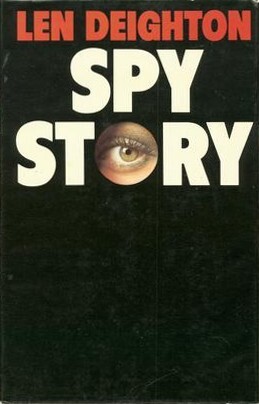
Cover image from the original 1974 Jonathan Cape hardcover edition. Image sourced from Wikipedia.

Spy Story is the 6th of my re-reads of the early Len Deightons (I first read almost all of them in the 60's/70's/80's) after having learned of the Penguin Modern Classics republication of all of his novels which were published during 2021 as outlined in an online article Why Len Deighton's spy stories are set to thrill a new generation (Guardian/Observer May 2, 2021).

Trivia and Link
Spy Story was adapted as the film of the same name directed by Lindsay Shonteff in 1976. A trailer can be viewed on YouTube here.
Profile Image for Feliks.
495 reviews
May 9, 2016
It is a somewhat morosely-told tale. Reads almost like a dreary English mystery set in the Cotswolds. There is a lot of bleak weather and dour, phlegmatic, stale Englishness in this light little work.

The pleasure in reading Deighton is the nimbleness of his prose; the occasional tiny flash of insight or cultural commentary. He will poke gentle fun at a crass new 'plastic thatched' farmhouse roof, or the way the wealthy serve sherry, or housing projects, or vegetarianism, or any number of other quirks in the setting around his characters. Somewhat similar to LeCarre but in a much, much milder register. Deighton is never biting or caustic.

The chapters trip sprightly along, never speechy or overburdened, which is to the good. Naturally, the inherent fun is that you know Deighton is laying a trail of clues for his protagonist --and the reader--to solve. Whatever it is, is so subtle that its impossible to predict--its all just an extended exercise in misdirection. Just so.

But while all that is smartly handled, the overall sluggishness of the characters and their behavior is a bit slow-going. The main character--is he really Harry Palmer?--is maddeningly low-energy, tepid, stolid. In this book--admittedly part of a wonderful series of novels--you grow impatient for him to do something. He seems sleepwalking, in a stupor or a fog. In the early Harry Palmer novels this generates tension-- because you knew Palmer was capable of kicking butt if necessary.

But this 'Pat Armstrong' character is pudgy, laconic, indecisive, vacillating. He's a non-smoker. Abstemious in habits. People walk all over him, he is browbeaten by his superiors. He's 'wallpaper'. I am not to the end yet but so far I can't label this one of Deighton's best conceptions; though of course--as I say above--the prose is supple.

Thankfully, there's many more Deighton oldies to look forward to.
Profile Image for Bradley West.
Author 6 books33 followers
June 26, 2019
I read Spy Story after An Expensive Place to Die and much prefer this labyrinthine intrigue with a typical jaded Harry Palmer proving he's smarter than the average retired intel officer . . . until he's unretired and needs to display some martial prowess, his wargaming expertise, his trans-Atlantic diplomatic skills and figure out what in the hell is going on in this le Carré-like thriller. I thought I had it all worked out until the last pages. It's such a good story, I suspect there's a kernel or two of truth to it.
Profile Image for J.
1,395 reviews235 followers
July 17, 2008
What is it with these British spy novelists? Modern spy stories, specifically of the American vein, are typically testosterone-brimming, gadget-wanking Cretin-A-Thons in which all the work of spying is managed by a few rubber noses, a silicon-based transmitter, a few ounces of plasticine explosives, and some rock-hard abs. While British historian, Len Deighton doesn’t provide readers with the kind of from-the-inside access that John le Carré brings to his work, he brings to the table the historian’s long-range view and the sense of bigger forces at work than merely governmental.

He also carries to his novels another ingredient solely lacking in many spy thrillers: a sense of humor. It is, of necessity, the kind of dry British wit, and this novel, a Harry Palmer book (most well known for the Michael Caine films) is perhaps less humorous than previous, but on more than one occasion I laughed out loud at a wry phrase or scenario. Alas, that they are all so contextually based that if I were to type out the lines that tickled me, they’d probably lie flat on the screen, devoid of mirth, a sort of disconnected thing. The best I can dig out is this bon mot: “I had the feeling she wanted me to confess that I couldn’t live without her, and the moment I did she’d leave me.”

Such is the quality of a Deighton book that mood and tone are so seamlessly interwoven with characters and events that the prose doesn’t so much sparkle as hang there unseen, a verbal scrim of near-complete transparency. The book is written in first person, which is, to my mind, a better way to tell a spy story in many respects. The ignorance of the narrator reads more naturally than third person or omniscient in which an assumed elision is preeminent. You, like the narrator, work benightedly trying to piece together the bits, trying to discover the outline of the puzzle from random pieces. In this way, this kind of spy story is more akin to a mystery than a thriller, though sharing elements of both, a trait forgotten it seems these days. As such, when something dangerous happens, it is given the added frisson of excitement for being out of place though never out of mind. We always believe that in a spy story, no matter how refined or intellectualized, someone is going to eat lead.

The plot is a multi-threaded affair involving a Russian defector, an impersonator for the narrator occupying his old flat, his staggering romance, and inter-departmental squabbling at the narrator’s office. Pat Armstrong, our narrator, also known as Harry Palmer, the protagonist of Deighton’s first four novels, has basically quit the life and is now clock punching at an intelligence examination division of British counterintelligence doing historical analysis of previous battles and engagements to learn as much as possible from computer modeling. If that sounds fairly removed from action, it is, and it’s this life Armstrong/Palmer’s chosen deliberately as a kind of faux renunciation of the life of espionage and intrigue.

What’s plaguing Palmer at this stage is an ability to commit to any particular action or course other than a sort of holding pattern of non-doing. His relationship with a young woman strolls on and she is fed up with waiting; his job is a perfect waste of his skills and talents, and he knows it; he is promoted to flunky for the American colonel Charles Schlegel the third who is taking over his employer as part of a NATO re-arrangement and he merely yes-man’s his way through it to the disgust of his former coworker. All of this while forces are moving in the background, using his identity as a possible alias for a defecting Russian nuclear submarine commander, while high-level talks are engaged for possible reunification of East and West Germany, and while a shadow group in British intelligence may be plotting treason. Like the le Carré from earlier, this book also takes place against the backdrop of reunification talks, which apparently stretched on forever.

While Deighton’s story doesn’t lack for the human angle, it is remarkably able at dropping in the larger world around them in a way quite similar to human life. We only grasp one small piece of the story, one tiny perspective in a fragmented multi-level world, and the first person narrative drives that home in a way that is particular and intimate without feeling cluelessly adrift. The novel’s double and triple-cross ending sketch a paranoiac’s dream-life in which no one can be trusted for absolute certainty and underscore that element of not fully knowing what motivates those around you and those against which you fight.
Profile Image for Checkman.
606 reviews75 followers
May 10, 2023
One of Len Deighton's classic spy novels. Part of what is referred to as "The Secret File" series. Like his earlier spy novels, published in the sixties, Deighton adhered to the murky redacted style of storytelling. Almost as if one is reading a file, but parts have been blacked out (redacted) leaving the reader guessing as to how the agent got from Point E to Point H. The late critic Pearl K Bell in her review of this novel (The New Leader Jan 1976) described the technique as such:
"... all murk and no menace.... evasive indirection has been Deighton's trademark since his first spy novel, The IPCRESS File, appeared in 1963. At the time, his obsessive reliance on the blurred and intangible, on loaded pauses and mysteriously disjointed dialogue, did convey the shadowy meanness of the spy's world, with its elusive loyalties, camouflaged identities and weary brutality."

I am a big believer in giving credit where credit is due. Ms. Bell hit the proverbial nail on the head.

The result is a novel that is smartly written, readable, intriguing and even amusing, but at times just a little too murky and inexplicable. Nevertheless, it isn't a waste of one's time to read and it serves as a historical artifact of the Cold War. One just has to be patient and have to the ability to fill in the blanks with one's imagination because there will be no answers provided. Well not all the answers, but at the end the big question will be answered.
Profile Image for Andrea.
528 reviews7 followers
June 16, 2019
Light weight but not piffle. Lovely humor. The plot is secondary to the writing. No it's not the Samson novels. It's not Bomber. It's not Winter. But a lovely break from some heavy going of late.
Profile Image for Paul Cornelius.
1,043 reviews42 followers
July 31, 2020
Len Deighton's ellilptical writing style meshes with the slow reveal in this story as well as the ultimate misdirection of the plot. In other words, I was surprised at the ending. Didn't see it coming. Put that along with Deighton's usual wit and oblique cultural references, and it all makes Spy Story one of his better efforts.

Despite the elliptical style, readers more attuned to the literal and step by step description of events will nonetheless find the footing secure. The plot is so steady and the characterization of Pat Armstrong so focused that it is difficult to be distracted by any minor, formal experimentation.

Speaking of Pat Armstrong, readers find out this is the name of the heretofore anonymous hero of the earlier spy books starting with The IPCRESS File. But don't get too excited. For it is also implied that this is an alias, a name adopted by the one time employee of the Secret Service who has now moved onto other things.

And am I the only one who saw a resemblance to Ice Station Zebra, the movie, I mean, as I've not read the book. To equate the lowbrow MacLean in any fashion with Deighton is sin enough, but to see similarities in the latter part of Spy Story seems downright shocking.
131 reviews
March 3, 2015
It says something of how Len Deighton understands the genre that he chose “Spy Story” to carry such a title. This novel is more downbeat and lacking in smart humour than those that have come to be called the Harry Palmer novels, and it is less formulaic than the Bernard Samson novels. In some respects, “Spy Story” is more downbeat, even, than John Le Carre’s “The Spy Who Came in from the Cold”, not because the story lacks drama but because it is often difficult to know what is going on. Accordingly, a vague unease pervades the book, whether the scene is an isolated Scottish submarine base, the War Studies Centre in London, where simulated war-games run in parallel to a Cold War crisis or a London flat with a mirror set of rooms and someone who resembles the central character and narrator, Patrick Armstrong. With deliberate confusion, the plot heads towards a tense rendezvous under the Arctic ice-cap, with the UK-US complexities that are also common to Le Carre’s fiction threaded into the Soviet threat.
Profile Image for David.
380 reviews19 followers
December 16, 2017
Deighton is on record as saying that the hero of this spy story is not the same unnamed spy from The Iprcess File, Funeral In Berlin etc, but that he is 'cut from the same cloth'. Indeed it is easy to see why people assume he is. He's previously been employed by Dawlish, knows Colonel Stok and is similary disaffected by the secret life.

Going by the cover name of Pat Armstrong, our protagonist works at the Studies Centre in London programming War Games alongside the well-heeled Ferdy Foxwell and under the beady eye of newly appointed boss Colonel Schlegel, a brash American. The story opens with Armstrong and Foxwell returning from a six week trip on a nuclear sub gathering intel on Soviet communications in the Arctic Ocean for use in the war game tactical scenarios. Armstrong, his car breaking down on his way home, breaks into his old flat to find that an imposter seems to be living his life, right down to faked pictures with Armstrong's parents!

There follows a complex thriller set against the background of German reunification talks and the possible defection of a Soviet Admiral. This being the 70s, there's even a shadowy right-wing cabal, including an MP, playing their own secret game of cross and double cross. Armstrong is caught in a complex web of deceit and, in the final third, of the novel the action moves to a remote Scottish Island and then on to a nuclear sub which is to rendezvous with the defecting Admiral. Or is it?

Deighton writes superbly, as ever, and you can tell he's done the research. While not hitting the heights of Funeral in Berlin, this is a tough, serviceable espionage thriller, well worth a read. I just wish he'd been inspired to find a better title for it!
Profile Image for Karan.
47 reviews49 followers
October 2, 2017
Crisp, dense plot with an unflappable hero. Just how I like my spy thrillers! :)
Profile Image for William A..
Author 3 books218 followers
July 9, 2020
This early effort by Len Deighton shows him feeling his way into the motifs that characterized his later spy novels. Deighton, who unfortunately is no longer with us, found a niche between the frivolity of Ian Fleming and the murkiness of John le Carre and Graham Green. This work contains all his favorite elements: nefarious politicians, ad hoc conspiracies by powerful people, existential stakes, and a hero with a beautiful accomplished wife who is just the man to untangle the web of deceit that threatens him. Mainly he relies on a wide range of knowledge to get results but when that fails he's capable of using other more earthy weapons.
Profile Image for Jak60.
732 reviews15 followers
April 18, 2016
The recipe to make a good book is pretty simple: you need a good story, and you need it well written. This is the case for many Don Leighton books (namely the Samson series), which I have enjoyed deeply. It is not the case of Spy Story, unfortunately; as it is Leighton's, the book is well written, as usual slow pace, light prose, soft irony, good dialogues. The story though is weak, simply too weak to make a good book overall. It took until page 122 of 305 (42% into the book) to get to the first real event of the plot, the one described in the first line of the "Book Description"...
Then, by the time you reach around page 180 (60%), a couple of leads have been planted to get you started thinking about what the whole mystery is about. At last, at page 200 (when you get into the last third of the book), the real thing starts...
So, when the set up takes about two third of the whole story, you feel like it is a little too diluted, without counting that large sections of the book are dedicated to illustration of war game techniques whichI could not relate to (nor eas I interested in).
So this was for me a 2,5 at best, but I decided to round it up to a 3 as a goodwill to Leighton, an author I love.
Profile Image for Bill Lawrence.
392 reviews6 followers
April 13, 2020
I found this while clearing out my father's house along with several Alistair MacLean books. I've never read any Len Deighton so picked it up to read this weekend. It's an easy enough read, although I feel it gets bogged down in the war gaming aspects, there is little in the way of a plot, not much action either, but it trundles along. What made it intriguing was it the difference 50 years has made. In the background is a conference on German re-unification and a conference chaired by the USSR between East and West. Reading it, now this has happened, offers an interesting perspective. It is not that Deighton got it wrong - his conclusions don't mesh with what happened in 1990 - but at the time, it must have seemed so implausible.
Profile Image for Allison.
209 reviews
November 16, 2018
I’m sitting here trying to figure out how this book could ever be described as action-packed as the action parts seemed to be few and far between.
I don’t know if I missed something, having not read any of the previous books but it felt like a lot of exposition was left out or very poorly explained.
The whole story felt like many different pieces that only sort of added up to a cohesive whole.
Some of the writing was creative, though, especially some of the descriptions.

Read for the 2018 Reading Challenge prompt, “A book you borrowed or that was given to you”.
Profile Image for Rodger Payne.
Author 3 books4 followers
July 4, 2020
I have read most of Deighton's books and enjoyed this one. Typical of many of his stories, neither the main character or the author seem to focus attention on events or pieces of information that turn out to be really important to the plot. Thus, the reader has to pay close attention and treat the story almost as if it's a mystery. In this case, there are mysterious elements from the early stages. The main character is a fairly typical protagonist in a Deighton spy tale. Interesting and even disturbing things happen to him, but he rarely seems to be leading the charge to make them happen.
497 reviews4 followers
November 14, 2015
A valuable and good read, essential to the overall story of The Secret File series. Its underlining theme is much like that of the Billion-Dollar Brain, whereas the Billion-Dollar Brain had as its theme the inadequacy of technology to fill the roles played by humans in the intelligence services, this book showed the inadequacy of relying on Wargames to properly simulate war conditions and human reactions to circumstances met within them.
Profile Image for Gabriel Smith.
8 reviews1 follower
May 1, 2014
A return to form after the disappointing 'An Expensive Place To Die'. The main character, 'Pat' is obviously the same man as the unnamed hero of 'The IPCRESS file' - a little older but not necessarily wiser.

The two main settings, a war games study centre and a nuclear sub are both interesting and I found myself wishing that more time was spent on the war game as it seemed a fascinating subject.
Profile Image for Paul.
990 reviews17 followers
April 1, 2018
This is a wasted book. There’s no need to write this. It’s purely an attempt at getting a character out of retirement, who was only put there in this novel anyway. Patchy, jumpy and incoherent from start to finish. I dearly hope the final “Harry Palmer/Patrick Armstrong” instalment is a darn sight better than this. Shockingly poor.
Profile Image for Richard Wagner.
Author 4 books18 followers
July 2, 2019
at first, it kinda felt like walking in on the middle of an espionage movie. once i figured out the people involved i got the hang of it. really good writing, punchy, noir-ish dialogue that was a delight. i'll be reading more Deighton.
Profile Image for Lisa Jackie Grima.
81 reviews
December 7, 2019
What can I say!! Len Deighton at his absolute best! I feel this book was written by design - for me!! It's full of really intense espionage and plenty of suspense. It's a must-read for any fan of espionage/cold war years.
Profile Image for Jeremy Hornik.
830 reviews21 followers
April 30, 2020
Picked up an ancient paperback from a little free library and read it over a few shelter-in-place nights. Is this story super disjointed or am I? I kept losing track of people and plot lines.
Profile Image for Trevor Seigler.
987 reviews12 followers
October 7, 2024
Reading through the Harry Palmer series, I knew that Len Deighton was my cup of tea. But in this book, the second in a different series focused on Patrick Armstrong, I realize that Deighton is absolutely becoming one of my favorite authors (well, again; back when I was a teenager, I read a few of his books and loved his work).

"Spy Story" is actually the second of the Patrick Armstrong series, I think, but it's really fine to read on its own. We meet Armstrong (a code name, maybe the same guy who was Harry Palmer earlier? Hard to say) just as he's come back from a mission; someone has altered the set-up at one of the safe houses he uses in London, and this naturally upsets him when it seems that someone else is pretending to be him. A high-level Russian admiral might be defecting, while a push to reunify Germany is drawing a lot of attention. Then there's the tension between Pat's boss in a war-games scenario and the new American higher-up put in charge of the department, with Patrick caught in the middle. And there's a persistent sense that all is not right with a certain member of Parliment who seems open to aiding the Russians.

This is taut, well-written spy fiction, from the days when the Cold War was still raging. As with the Palmer books, it's the narrative voice that carries the day even when the machinations seem over the top or hard to follow. Patrick Armstrong (if that's his real name) is a worthy successor to Harry Palmer in his sly, casual disregard for the niceties of espionage. I think it's safe to assume that I'll be trying to get my hands on more in the Patrick Armstrong series, especially in the wonderful Penguin Modern Classics editions. This "Spy Story" is a whole lot of fun.
Profile Image for David.
84 reviews4 followers
January 7, 2022
A solid but not stellar entry in the Len Deighton canon of spy stories (sic).
Is Patrick Armstrong the same person as the anonymous protagonist of IPCRESS File etc.. He could be, he clearly once worked for Dawlish who headed WOOC(P) from the first set of novels and is in this novel, and Armstrong seems to have certain elements of personality in common. I tend to think he is the same person just a bit older and clearly out of the “game” although Deighton himself wrote that he wasn’t - but was cut from the same cloth!
In Spy Story our protagonist is an ex-spy now working for an International Strategic Studies Centre. He inadvertently gets caught up in a plot to bring over a defecting Soviet Naval Admiral but there are deeper shenanigans at work and plots within plots especially when his old boss Dawlish appears on the scene.
The usual Deighton prose style is in play and it is full of the detail of the strategic war games played at the Studies Centre and of the Cold War submarine warfare of the era.
This entire review has been hidden because of spoilers.
Profile Image for Andy Onyx.
Author 5 books8 followers
Read
January 26, 2025
Finally completed my ‘field read’ of recent months. A perfect travel tome by the great Len Deighton, who by 1974 has honed his craft.

It’s not really edge of your seat stuff; not a lot happens a lot of the time, but that said over 20 short chapters we move from a urban London, to a posh house party in Notting Hill (before the area was posh- check out the movies The Squeeze and Performance to see what that was like), War Games institute in Hampstead, remote Scotland Highlands to the Arctic via nuclear submarine.

But Deighton writes so brilliantly that you’re happy to be along for the ride - (Read Simon Conway:modern equiv)

Unlike the pure Crime novel, which has clear resolution in its ending, the best examples of its sub-genre of Spy Fiction often close with a touch of ambiguity, leaving it to us to work out what exactly has happened and why; blessing/curse and this was no different.

Oh, and it’s the final appearance in print of the the previously ‘un-named’ spy, known on screen as Harry Palmer.

🎼The Old Man is Back Again (Len Deighton’s Theme) by Scott Walker.
Profile Image for Adrian Doyle.
Author 4 books4 followers
April 12, 2022
Picking up a Len Deighton novel is, for me, the equivalent of coming home. While I enjoy many genres and authors, there's something about Deighton's writing that really appeals to me. A combination of plot simplicity, cynical and smart characters and elegant prose combine to make this book a joy to read. It is further enhanced by coming from a time when even owning a phone (land line) was not a common thing. So the spies had to live on their wits.
Spy Story is up there with the best, a spy (finally with a name) who thinks he's escapes the world of espionage is dragged back in and needs all his skills to stay alive. The plot reminded me a little of 'The Looking Glass War' (Le Carre) and Dawlish has overtones of Smiley, albeit more ruthless (if that's possible). I enjoyed it so much I am reading another Deighton next.
Profile Image for Jay Rothermel.
1,289 reviews23 followers
November 21, 2024
Outstanding cat and mouse thriller.
Settings: London, wilds of Scotland.
Arctic ice cap.

Themes:

1972 year of publication. Context: proposed German reunification, but with Stalinist USSR still functioning.

Computer wargames.

"Happy" blackout ending:

Self-pity reached in and grabbed my breakfast. It hurt, and if you want to say it was nothing but a self-inflicted wound, I can only reply that it hurt none the less because of that. Ferdy had gone and Marjorie too: the comfortable little world I’d built up since leaving the department had disappeared as if it had never been.
‘Are they treating you well in here?’ said Dawlish.
‘Pickled fish for breakfast,’ I said.
‘The reason I ask,’ said Dawlish, ‘is that we have a bit of a problem … It’s a security job …’
I suppose I might have guessed that a man like that doesn’t fly to Norway to bring anyone grapes.
This entire review has been hidden because of spoilers.
Profile Image for David Evans.
830 reviews20 followers
April 14, 2025
I’ll read anything by Len Deighton - even his cookery book if I could get hold of it. This is the first part of the trilogy of Pat Armstrong stories. He’s a 1970s version of Harry Palmer - specs and all - who works at the Government’s war-game unit in Hampstead where variously WWIII scenarios are practiced in real time. Frankly the whole plot is very confusing and knowing that I also have to read Yesterday’s Spy and Twinkle Twinkle, Little Spy is making my brain hurt.
Still, this is brilliantly written, wryly amusing and rather terrifying in equal measure. A grim meal in a vegetarian restaurant gives a flavour:
‘There is no charge for the nut cutlet. It’s a way of getting customers to see how delicious a vegetarian diet can be.’ She picked up a slice of the pale grey mixture, using plastic tongs like an obstetrician.
Profile Image for Perry Middlemiss.
455 reviews5 followers
October 2, 2021
Our unnamed hero (this time assuming the alias of Pat Armstrong) has been seconded to the Studies Centre in Hampstead where he is assisting a series of submarine warfare games. It slowly becomes clear that a senior Soviet submarine Admiral wants to defect in order to obtain a kidney transplant. “Armstrong” gets dragged into the plot to procure and cover up the defection, and finds himself in some physical peril as a result. This novel displays all the hallmarks of Deighton’s prose: mis-directing plotlines; clipped dialogue; jagged drama flow (at times it reads as if every third or fourth sentence has been removed); first-person narration; and ever-fluid interpersonal relationships. Most of the time you get the feeling that narrator doesn’t know what is going on any more than you do. Which is about all you can expect from a spy novel. R: 3.3/5.0
Profile Image for Sherrill Watson.
785 reviews2 followers
November 19, 2022
See David's review. Published in 1974; some of the problems with the Russians are outdated.

The first part of the book is so convoluted, I wasn't sure WHAT was happening. Still am not. But I trusted Mr. Deighton to let Pat Armstrong pull me thru. Most of the time, he and Ferdy go along with the charade, seeming to know what was happening. He lets the other characters pull him hither and thither until finally, he goes, in a submarine, under the arctic icecap, with poor Ferdy, to pick up a Russian commander. Oh well. Well researched for the time.
Displaying 1 - 30 of 72 reviews

Can't find what you're looking for?

Get help and learn more about the design.