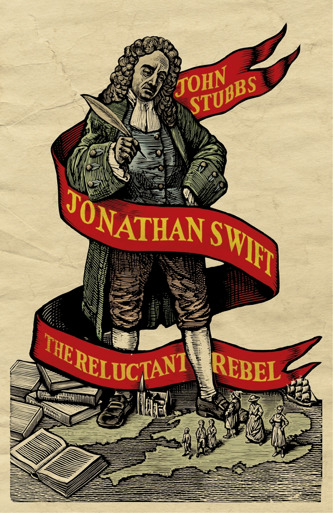
Bomb disposal expert? Water management authority? Conflicted lover of fresh fruits? Jonathan Swift has been known to us under many guises, most enduringly strange, but this new biography provides even more aspects of him hitherto unseen.
Perhaps most surprising is a glimpse of Swift not as the terminally aloof, near-psychotic genius he’s usually been painted as (though there’s plenty of that to go around, too) but as possessing an intense emotional life traditionally denied him, ranging from the ‘grouchy humaneness’ he showed subordinates, to the fully committed passions he held for those he loved. To read so convincingly into this side of his subject makes Stubbs something of a Columbo of 18th century biography (‘one last thing, sir…did the poem’s last line touch an authentic note of regret in your dealings with Miss Johnson?’)
Reluctant Rebel charts our hero's rise from his early beginnings in Dublin and Whitehaven, to becoming the most venerated cannibalism advocate of his age. From his years as Wildean wit about town, Swift's early satirical scalps were notable, and included the Duke of Marlborough. Of the Drapier letters - a literary project anonymously written and aiming to refute the English government’s attempt to debase Irish coinage - Stubbs writes: ‘It was arguably the first time in British history that a purely popular campaign of protest reversed a political decision of central government.’ Quite a claim!
The cast of characters roughly equals War and Peace squared, and if you can’t tell your Arbuthnots from your Arbuckles, your wigs from your Whigs, you might fairly run for the hills. Stubbs is particularly strong on the history - there are impressive summaries of the Civil War, the Revolution of 1688, the reign of Anne and the Hanoverian succession - but interestingly refrains from quoting much on the literary side. When he does, his strong suit is the poetry, and he manages to make lesser-known pieces like Cadenus and Vanessa, and the back n forth verse with Pope and Sheridan, both stimulating and relevant.
The strongest chapter in the book is its last - Sanctuary - which touchingly presents the Dean’s growing loss of faculties, and assesses Swift’s literary reputation with a clear sightedness historically eluding such great critics as Johnson and Orwell. It also puts forward fair accounts of Francis Wilson (who has been critically viewed as trying to profit from the last days of his friend’s illness) and The Earl of Orrery, another sometime friend, initially sweetness and light, whose posthumous account is about as charitable as a committed campaign of arson against Amnesty International.
You might wonder where my opening remarks come in. Well - Swift intercepted a bomb designed to assassinate Tory Lord High Treasurer Robert Harley; he once observed Dublin was in danger of flooding by examining the water supply with no more than a few friends and a wooden pail; and he adored fruit but mistakenly believed it aggravated his Menieres Disease. There’s even more of interest, besides all that, to be found in Reluctant Rebel.