Jump to ratings and reviews
Rate this book

33⅓ Main Series #40

Court and Spark

Rate this book
Court and Spark is Joni Mitchell's most overt attempt at making a hit record, full of glossy production, catchy choruses, and even guest stars from every stratum of rock culture, high (Robbie Robertson) and low (Cheech and Chong). The record was a smash, reaching number two on the charts in March of 1974, spawning three hit singles; "Help Me", "Free Man in Paris" and "Raised on Robbery", and cementing Mitchell's position as a commercial as well as an artistic force. Sean Nelson, a well known musician himself (Harvey Danger, the Long Winters), is particularly well equipped to understand all the elements that went into the making of this classic album, and he does so with clarity and wit.

126 pages, Paperback

First published December 18, 2006

13 people are currently reading
289 people want to read

About the author

Sean Nelson

1 book2 followers

Ratings & Reviews

What do you think?
Rate this book

Friends & Following

Create a free account to discover what your friends think of this book!

Community Reviews

5 stars
21 (9%)
4 stars
85 (37%)
3 stars
87 (38%)
2 stars
28 (12%)
1 star
6 (2%)
Displaying 1 - 30 of 42 reviews
Profile Image for Alan (the Lone Librarian rides again) Teder.
2,714 reviews256 followers
December 30, 2024
December 30, 2024 Update In a nice bonus track update. I read a fine article about the 50th year anniversary of Court and Spark in Canadian🍁 journal The Walrus 🦭 from its year end summary. I had missed the article when it first appeared back in January 2024. You can read it now at Joni Mitchell’s Best Album Is Turning Fifty. It’s Not Blue..
Note, my 3 stars is for the book. The album itself is definitely 5 ⭐⭐⭐⭐⭐ stars.

Unfocused Without Spark
Review of the Continuum paperback edition (November 20, 2006), prior to the 33 and 1/3 series now published by Bloomsbury Academic.

That's one thing that's always, like, been a major difference to me between, like, the performing arts to me and being a painter. Like a painter does a painting, and he does a painting. That's it. You know, he's had the joy of creating it and he hands it on a wall somewhere, somebody buys it, somebody buys it again or maybe nobody buys it and it sits up in a loft somewhere till he dies, but he's never - nobody ever says to him - nobody ever said to Van Gogh, "Paint a Starry Night again, man!" - an excerpt of Joni Mitchell's patter between songs on the live album "Miles of Aisles" (1974), expressing the rut of having to perform the same songs in the same style over and over again.

I've enjoyed several of the 33 and 1/3 series of books about various favourite recordings, but I have to admit that Sean Nelson's Court and Spark just doesn't capture the sheer joy and exuberance of that album. The book takes a long time getting into gear. Even the writer himself says at about the 30% mark that he hasn't forgotten what the book was supposed to be about, while excusing his introductory diversions.

Nelson spends a considerable amount of time extolling the greatness of what is arguably Joni Mitchell's top run of album recordings, stretching from "Blue" (1971) to "The Hissing of Summer Lawns" (1975) but the focus doesn't begin to centre on "Court and Spark" until page 41 and then is over by page 101 (the book is only a total of 126 pages).

"Court and Spark" was a major transitional album in Mitchell's recording career. It marked her change from folk singer to pop singer with hints of the jazz-fusion to come. It began her several album association with the jazz group L.A. Express as her backup band. It was the height of her mass market recording popularity, as later albums became more jazzy and experimental. This book does note all of those important points but somehow misses the mark in capturing the magic of it all. Regardless, a 3-star "Like", because it is still about Joni Mitchell 😍.


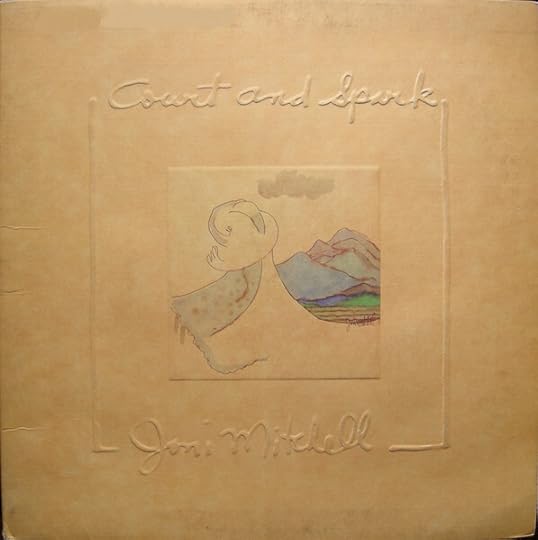
The cover of the "Court and Spark" LP album (Asylum Records 1974) with painting by Joni Mitchell. Image sourced from Discogs.

Soundtrack
Listen to the full 11-track Court and Spark album via a YouTube playlist which starts here or on Spotify here.

Bonus Tracks
Listen to the 96 track "Joni Mitchell Archives Box Set Vol. 3 The Asylum Years 1972-1975" which includes alternate takes and live concert versions of songs from the Joni Mitchell albums "For the Roses" (Asylum Records 1972), "Court and Spark"(Asylum Records 1974) and "The Hissing of Summer Lawns" (Asylum Records 1975) via a YouTube playlist which starts here or on Spotify here.

Trivia and Links
Joni Mitchell's Court and Spark was initially published by Continuum but is now part of the Bloomsbury Academic 33 1/3 series of books surveying significant record albums, primarily in the rock and pop genres. The GR Listopia for the 33 1/3 series is incomplete with only 38 books listed as of June 2024. For an up-to-date list see Bloomsbury Publishing with 197 books listed as of June 2024.
Profile Image for Paul Bryant.
2,413 reviews12.6k followers
August 13, 2010

Get your sick bag out now.

"The narrator of "People's Parties" feels like a cipher among the beautiful people, but not (necessarily) because she isn't beautiful, too. It's because she can detect the unspoken pain lurking in every exchange, in every fellow traveler standing in the corner thinking he's nobody, and it prevents her from being a good party guest. As the song moves toward its close, the party still presumably raging on, she wishes for "more sense of humor / keeping the sadness at bay / throwing the lightness on these things / laughing it all away." The final line expands into a stack of Mitchells singing in tight harmony, and is soon joined by another Joni chorus offering a shrill, teasing counterpoint ("laughing it all, laughing it all, laughing it all"). And as the final word stretches into a long, multi-syllabic sound — "away-ee-hee-ee-ee-heeeee"—the outro takes on the character of a chant, like her wish for increased levity were being pulled taut to reveal what she really wants: to be away. It's telling that she wishes for more sense of humor
rather than, say, the resolve to stay away from the parties in the first place — but she told you when she met you she was crazy. It's not that she wants to belong (the sad fact is that she already does belong); she wants to be able to mask the way she really feels, the better to endure the incredible sadness all around her. The ultimate reveal in this little Altman film — and the real reason why only Altman could direct it — is that while the narrator is spending all her time feeling separate from all the people at this party, she never quite grasps the fact that she is perfectly one of them, and perhaps more poignantly, that the alienation she feels keeping her separate from her counterparts is precisely what unites them all. As the picture fades, to the tune of a dozen Joni Mitchells in an incantatory crisscross, the image of a roomful of prosperous guests, all angels in various stages of falling, all convinced they're alone, no matter how together they are."


It just goes on and on and on like this, its insights all handmedowns and its style the screech on a blackboard in an undergraduate seminar on 1970s rock culture. It depresses me in the same way Court and Spark itself depresses me, which is not in the way Joni intended at all, it being the album which marks the parting of the ways between myself and herself. And also, it's exactly the kind of "rock criticism" I would have written at the age of 22. Somebody stopped me then and I'm forever grateful now.
This 33 1/3 series is so cute like a series of little teeny cute things can be but it's like the bad boy in class with the pretty eyes - one minute he'll be writing a dream of an essay, next minute he'll be in the head's office for posting embarrasing videos of teachers on youtube. The idea that the great variety of albums considered in this series each demand an individual style is obvious and right, but wild eclecticism should not preclude exacting editorial standards. So this is your formal warning - anything even remotely as crap as this Joni Mitchell gobshite here and you'll be all in detention - all of you! And your punishment will be to listen to all those interviews with Joni herself where she denounces in the bitterest terms the rock business and its vile conspiracy to make her extremely rich.
Profile Image for Antonomasia.
986 reviews1,492 followers
December 20, 2015
Over the last few days I've been reading the (3) 33 1/3s I own and hadn't looked through before; before the unwritten reviews completely meld together in my head, I'll start this - the second of those books in order of album release year, and of reading.

Back when I got it, I was listening to a lot of Joni Mitchell, albeit tentatively. I liked her earliest hippie stuff, and bits of of the later 70s albums and the recent gravel-voiced ones. And, damn, how cool a title is Don Juan's Reckless Daughter? Court & Spark was the album I liked least of all, but oh I want to know more about her and there's this small book...

Sean Nelson - not a name I recognised off the bat - was/is frontman of Harvey Danger (whom I only know for 'Flagpole Sitta', one of those records so catchy it's almost impossible to refer to without getting it stuck in your head ... It could hardly be more different from J.Mitchell, hyper and dark, leaving a wired, overtired feeling like having gorged on cheap sweets - or 'Jet Boy, Jet Girl' on repeat). Nelson states near the beginning: there's no new interview material ... I’ve attempted a critical appreciation of the record from the lyrics outward (though I’m a songwriter and musician of sorts, I have almost no music theory to apply to this task) - and that's why I wasn't so keen on this book. The other two I just read, (Piper at the Gates of Dawn and Low) are heavy on the musical side, ample analysis of the tracks and their construction in the studio with quotes from those involved - and that's what made them interesting.

There's a level of fandom at which you'll be interested in almost anything about an artist, but I'm definitely not there as far as Joni Mitchell - this album in particular - is concerned. So this guy's take on the lyrics and so forth leaves me meh. If these were the opinions of an author I already liked, or someone I knew, at least I'd have cared from that angle. (His quotes and insights about Mitchell, though, did give me insight into some of the words of more obscure musicians.)

Whilst it could be more evocative, he's not bad at creating a sense of time and place. The aftermath of the 60s: not quite so toxic as in some portrayals, the essential personality here is a woman who thinks, yeah, this free-spirited guy is sexy, definitely my type a few years ago, but that's not quite where I'm at - maybe I don't want the hassle. (The great tragedy in “Court and Spark” lies in having outgrown the romance of youth without having lost the thirst for romance... the heaviest of themes, that freedom never comes without consequences.) The mid-seventies was the high watermark (arriving later than the one Hunter S. Thompson claimed to have spotted for 60s culture as a whole) of the record industry, bigger sales, bigger influence than before or since. And this record tapped into that with the balance of integrity and radio-friendliness that everyone wanted. Nelson's long, chronologically higgledy, survey of her other work keeps returning to 'The Boho Dance', an intelligent reflection on selling out, that once-essential concept which has been proclaimed dead and buried many times in C21st commentary.

There was a strength of personality I was hoping to hear about, and didn't. The lack of interviews? Or maybe that's not who she is; maybe Joni Mitchell, for all her stubbornness, will seem a bit beige to someone who grew up hearing [about] female stars like Madonna, Courtney Love, PJ Harvey, Justine Frischmann ... though musos might make me admit that of those only PJH is a musician of similar talent, the others being pop stars for whom publicity is an essential part of the act.

Perhaps an obviously feminist interpretation of Joni Mitchell would have been livelier. There are snippets here one could be built on: in the popular imagination of the time (which hadn’t yet fully reckoned the notion of a female musician who wrote and performed all her own material and called her own shots), she was probably best known as a distinguished also-ran: a folk artist with a big cult following and a number of famous friends and lovers...
her famous selection, by the pre-corporate (not to mention prefeminist) Rolling Stone, as “Old Lady of the Year” in their music awards issue of February 4, 1971— the year she released her shattering album Blue.

Or In pop music, the theme of “waiting” has a long and storied tradition as a stand-in for sexual frustration...“Car on a Hill” transforms the pop version of “waiting” from a guy waiting for a girl to give it up to a woman waiting for a man to be a man.

Close friends know that I've felt barely able to listen to music for a couple of years, especially songs with lyrics. With this toe in the water I wasn't going any deeper than tunes I already owned. Which turned out, in the case of Joni Mitchell, to be only one Best of, Dreamland, on an old backup. It has two tracks from Court & Spark, 'Help Me' and 'Free Man in Paris'. Old geek habits die very hard, and a few minutes later I'd made a chronological list of the songs on the compilation & the original albums they were from [*wants to go back in time & tell earlier self physical media are useful because the booklets have done these things already*], and was messing about comparing several different media players. [I wanted to like JRiver because it hasn't got the personal associations the others have, but its big echoey sound, whilst surely great for parties and wall-mounted speakers, wasn't intimate & detailed enough for headphones.]

Okay, it's only a couple of songs, but listening to them two or three times brought back the feeling I remembered from the whole album. As with Feist, I'd wanted to really like this because it would be a bit more 'normal' and 'grown-up', but I just didn't, it wasn't to be. Court & Spark was to me like a pair of C&A flares in a vintage shop; try them on for a minute, looks pretty good - keep them on for longer and urgh, the scratchy airlessness of the polyester. The sound is too 70s MOR-AOR; stuck in treacle in nowheresville; it made me glad to have been a kid in the 80s as this music would have made me feel even more trapped than I already did; when I was young I was glad not to have been a teenager in the days of punk because it sounded a tad scary, but if I'd been surrounded by sounds like this I'd have been ravenous for disruption. On one page, Nelson mentions the New York Dolls and Roxy Music ... what manna! Even allusion to the cheesy glam rock of Elton John is a relief.

(Another thing which applies to a lot of Mitchell's music - and the Feist - why I might enjoy an odd track or two mixed in with other stuff rather than whole albums at a time - is a general aversion to slower very treble-y songs, for want of a better term. There's something more mysterious to it than mere frequency - timbre? - as well; but I find them draining, overly, unpleasantly emotive, almost as if they were strumming my nerves, especially when there's little or no bass to ground them - and me.)

Anyway, the moral of the story is simply: don't bother with a 33 1/3 unless you love the album.
Profile Image for Sandy.
577 reviews117 followers
August 18, 2011
What a great idea Continuum Publishing has going with its 33 1/3 series: little books dealing with some of the greatest records of the past four decades, each one lovingly written by a different author, and each functioning, in essence, as a 120+-page collection of liner notes for those priceless albums. First on the list, for me, of the 50+ titles in the series so far, was No. 40: Sean Nelson's thoughts on Joni Mitchell's 1974 masterpiece "Court and Spark," surely one of the greatest pop records of its decade, as well as Joni's most commercially successful album to date. It is quite obvious that Mr. Nelson, a Seattle-based writer and musician, is enormously fond of this classic, although he makes it very clear that he is not a member of Joni's "cult of devotees" who follow "wherever Mitchell leads." Rather, his fondness for the Big Mitch's music seemingly extends only up to the mid-'70s. (And this might be as opportune a moment as any to mention that I AM one of those "devotees" that Nelson sniffs at, and believe that Mitchell is not only the greatest Canadian who has ever lived, but also one of the world's foremost living artists, the ultimate nature girl, and a true Renaissance woman, all wrapped up in one yummy package. Anyway, you know where I'M coming from!) But Nelson seems to have done an inordinate amount of thinking about "Court and Spark," and manages to analyze the record's lyrics so deeply as to come up with insights that I'd never even considered before (and I've owned the record since the day of its release in January '74). For instance, Nelson convinces us, in his arguments, that the female character in "Car on a Hill" is most likely different than the one in "People's Parties" and "The Same Situation." He calls attention to the slightest change of inflection in Mitchell's voice at the tail end of "Just Like This Train" and the heartbreak suggested therein; makes us see how "Down To You" (my favorite Mitchell song of all time...and that's saying something!) is the thematic linchpin of the record; and illustrates how the lyrics in "Help Me" build in emotional impact with each verse. These are all items that Ms. Mitchell's legion of fans may have recognized subconsciously, but Nelson, using a method of analysis that mainly deals with the album's words and their message--as opposed to the music itself--really lets those fans appreciate the album anew by bringing these matters to the fore. He writes extremely well--indeed, the style of this "mini monograph" almost suggests a doctoral thesis--and with some humor (I had to laugh out loud when he calls Joni's records after 1975 her "difficult period") and self-deprecation ("What the hell do I know?" he asks at the book's conclusion). He even forestalls the inevitable question of why an author would choose Mitchell's "Court and Spark" to write about, as opposed to, say, 1970's "Ladies of the Canyon," 1971's "Blue" or 1972's "For the Roses" (all of which I prefer, by the way, but that's just me), by convincing us that "Court and Spark" represents a culmination of Mitchell's "musical Freitag's Triangle." His statement that the best Mitchell record "is the one that's playing right now," however, is surely undercut by his later pooh-poohing of the artist's last three decades' worth of work. (And honestly, how many folks out there could pop 1988's "Chalk Mark in a Rain Storm" into their CD player and regard it as the best Joni music ever?!?)

Nelson makes other statements guaranteed to raise the hackles of many a Joni fan. He is largely dismissive of "Ladies of the Canyon," a record that winds up on my turntable more than any of her others ("a wistful piece of hippie utopianism," in Nelson's view), and doesn't even seem to have a high regard for the critical and fan favorite "Hejira" (1976). He calls "Court and Spark"'s "Raised on Robbery" "the least impressive song" on the album, and claims that Joni's band, the L.A. Express, seems to be "condescending to the music" and assuming "a swagger it doesn't earn." (Perhaps Nelson, who admits that he was a child when this album was released, would eat those last words if he could have seen Joni and the L.A. Express blast the roofs off of many venues with this encore finale during the album's tour in 1974!) Worse than the inflammatory comments (I'm kidding, Sean!) are the occasional errors of fact that the author is guilty of. He misquotes the lyrics of Joni's songs on at least three occasions (for "The Boho Dance," "My Old Man" and "Trouble Child"), misspells "Rene Auberjonois" (sorry, Odo), and falsely states that Mitchell's 1975 live album "Miles of Aisles" contains "radical jazz-rock rearrangements" of some tunes from "Court and Spark." (The only song from "Court and Spark" on "Miles of Aisles," in actuality, is "People's Parties," and is quite faithful to the original acoustic rendition.)

These slips undermine only slightly, however, what is in essence a very-well-thought-out examination of one of Mitchell's greatest accomplishments. If I seem to be raising frivolous objections here, I suppose it must be because I tend to get a tad defensive when it comes to my favorite recording artist. Though the book is riddled with typos (it is to be hoped that the other entries in the 33 1/3 series have been composed with more attention!), Nelson's lucid, loving and enthusiastic work ultimately proves to be a very nice tribute to this wonderful record and its genius of a creator. It makes me want to pick up several more volumes in the 33 1/3 series, such as the ones for "Electric Ladyland," "Exile on Main St." and "Forever Changes." I sure do hope that the authors of those volumes have put as much thought and passion into their essays as Sean Nelson apparently has with his. The bottom line is that all fans of Ms. Mitchell in general and "Court and Spark" in particular should enjoy his work. Just be prepared to take some exception with some of Nelson's "idiomatic logic"!
Profile Image for Jake Sauce.
56 reviews14 followers
January 20, 2023
Far too much lyrical analysis in this one, basically a long track by track review bookended by much more interesting interview bits.
Profile Image for Ruth.
794 reviews
May 12, 2009
This is my second foray into the 33 1/3 series. I liked this one a lot and would recommend it to Joni Mitchell fans, but only if you are pretty familiar with the album in question, because it is basically a close reading of each track and how they fit together, bookended by close-ish readings of Blue (he thinks the whole thing is one person's story) and To the Roses on the front end, and The Hissing of Summer Lawns (he thinks it's too cold, detached, and harsh) on the back. I automatically bonded with the author when he talked about hearing Joni Mitchell for the first time in his mom's car and how she was singing along, although for him it was to the radio and for me it was a tape, one I subsequently wanted to hear over and over again. It's funny, though, b/c Court and Spark was never one of my favorite Joni Mitchell records- I like her sweet, old-fashined earth mother 60s songs, the totally heavy and personal songs from Blue, and some of the jazzy stuff she did later, and I like some particular tracks from Court and Spark, like "Trouble Child" and "Free Man in Paris", but Court and Spark as a whole wasn't ever up there on the top of my list. The author maintains that this record is pretty much pop perfection, though, and his ideas about why, which mostly have to do with the way it captures life & love in the city (LA) in the 70s, and also about how the instrumental parts say all the things that are unsaid in the texts about the emotions of the characters, are interesting enough for me to listen to it with new ears, (which maybe I'll do after I write this). The 33 1/3 series is 2 for 2!
Profile Image for nathan.
56 reviews6 followers
May 9, 2017
A smart, deft, and thoughtful exploration of Joni Mitchell's "Court and Spark," examining the album song-by-song. Nelson draws in analyses of Mitchell's earlier work to situate his readings of the tunes from C&S and does an excellent job of making sense of the cultural, literary, and musical aspects of each song. However, the final sections which chronicle Mitchell's later career output were underwhelming. Nelson is quite brutal in describing Mitchell's '80s output (which Nelson finds to be poorly produced synth-and-drums-laden schlock) and '90s output (which Nelson finds unlistenable due to the Mitchell's "husky wheeze"). Nelson seems to have some difficulty in separating his specific tastes from whether or not there is interesting or inviting material on Mitchell's later albums, or whether there are any new emotional areas that her new ragged, smoky vocal style can reach that she couldn't access previously. (Here I think of Mitchell's orchestral re-recordings of "A Case of You" and "Both Sides Now" which have a melancholy and lived-in bittersweet feeling that is so much different from her first takes of those songs thirty-plus years before.) Nelson also hates Mitchell's paintings for some reason and doesn't like that she uses self-portraits on album covers (despite the fact that pop musicians regularly plaster their albums with their faces).

The analysis of C&S as a rich, textured, deep record is excellent, but I wish Nelson would've interrogated his own tastes a bit more regarding the material and songs that he doesn't care for.
Profile Image for Chris  - Quarter Press Editor.
706 reviews33 followers
July 18, 2016
I'm still fairly new to the 33 1/3 series, but I'm loving it.

Honestly, I read this simply because of my fandom for Sean Nelson and his former band, Harvey Danger. His lyrics have always interested me, I've heard that he's been in / co-written some films, and I was curious about his writing in general.

As expected, it's a bit pretentious. But for me, that wasn't a bad thing. I had a feeling it would be written as such. However, it feels normal for Nelson. The book reads like a conversation with your smarter best friend, who might be a little bit of a dick, but you don't care because they're so damn interesting. That is the case here.

What I've heard of Mitchell's music, I haven't liked. It didn't click with me. But while reading this book, I found a deeper appreciation for her music, and it made me really, really, really want to listen to this album.

For me, that's what good writing about music should do; it should make us WANT to listen, and this book definitely did that.

You may not like the voice Nelson strikes, and perhaps he does spend a bit too much time on the context of Mitchell's quadrilogy of albums, but it still opened up Mitchell's album to me in a way I never would've expected. Perhaps this would be different for Mitchell fans, and I get how it could be problematic, but it was quite enjoyable as a whole.
Profile Image for Jesse.
Author 20 books60 followers
September 18, 2007
Pretentious writing about a pretentious album by a pretentious musician. Next!
Profile Image for Augusto Delgado.
292 reviews5 followers
September 14, 2023
What a waste of ink and paper, or ones and zeroes.

As a Joni Mitchell fan of decades, thanks to this "book" I've just discovered that there was some folk lyricist named Joni Mitchell that wrote words for a folk singer named Joni Mitchell.

The author does loads of rabbiting about what line of a song lyrics connects with some previous song with similar words (although the music may be different) while discovering some meaning immediately contradicted by a "but".
No more ifs or ands or buts does not apply here, the reader will find at least a couple of "buts" inside each paragraph.
It looks like the author has taken the chore of write a tract hired by those magazines critics without any knowledge about music; and is stuck like Emma Thompson's character in "Love Actually" wondering about his and his mum's sentimental education.

Being a 33 1/3 series one crucial thing is missing behind this unbearable verbiage: The Music.
You spin an LP because you want to hear music, songs, be transported to alternate mindsets by geniuses like our Joni, while feeling the connections between notes, sounds, instruments and words. You cannot make abstractions from one to the other if you arr to talk about such an album, at least not throughout a whole book.

A reader acquires such a book from these series because the interest on find about more about the beloved albums one once owned. BUT the "narrator" only sees words with a shallow reference to music, that he's probably deaf to and don't understands. Evidence is in his sorry disregard for what came after Court & Spark.

This stenographer has got it all wrong. Court And Spark marks the crucial starting point of the colossal growth of Joni Mitchel as a musician, her evolution from lovely folk singer, to the huge musical institution she became, leading "the boys" and subsuming them to her genius vision. That musical journey was triggered by Court and Spark towards the galactic limits of Hejira until reaching the spaceport of Shadows and Light. It. Was. Not. The end. So this ends up being a wasted opportunity to deal with the musicianship perfection of Court and Spark as a foundation for the new heights that were accomplished.

Two stars is a tad generous, thank it to Joni.

Profile Image for Rob.
420 reviews25 followers
December 2, 2025
In between being a goldie folkie lightning rod with different tunings that influenced everyone and being a jazz-funk-folk explorer with extraordinary bands and compelling song-narratives, Joni Mitchell became a superstar. There she was in her "peak period" (1971–75), unassailable, free, yearning.

Court and Spark was Mitchell’s most overt bid for a hit record, saturated with glossy LA production, radio-friendly hooks and a guest list that runs from Robbie Robertson to Cheech & Chong. It reached No. 2 in the US, No. 1 in Canada, went double platinum, and spun off three hit singles: “Help Me”, “Free Man in Paris” and “Raised on Robbery”. What interests Nelson in choosing this one out of so many possible candidates is how an album so steeped in jazz chords, emotional ambivalence and Hollywood ennui could become such a mainstream success—and what it meant, as a young listener, to grow up inside that sound.

The key word there is “listener”. Nelson writes not as a neutral scholar but as a musician and fan whose own artistic life is tangled up with Mitchell’s. (He’s best known from Harvey Danger and The Long Winters, which means he’s intimately familiar with both pop hooks and cult devotion. This little book begins—and ends—in the back seat of a navy blue late-’60s VW in Los Angeles, with a young Nelson riding around a “sprawling, horrible, beautiful” city while his mother drives and Joni plays on the car stereo. It’s there, between 1974 and ’79, that he discovers Court and Spark and, by implication, a version of himself.

This framing is not a cute anecdote tacked onto a standard track-by-track breakdown. It’s the governing structure. Nelson circles back to that childhood car again at the end, giving the text a deliberately circular shape—a “grand modernist novel” that begins where it ends. The album is the subject, but the real plot is an apprenticeship: how a boy in the back seat becomes a songwriter by listening obsessively to a woman who is reinventing what popular song can do.

Nelson tries to mirror Mitchell’s compositional habits in his prose. One of his signature moves is the use of leitmotif: he’ll establish a phrase or image—a rhetorical “hook”—and then return to it later just in time for the repetition lands as echo, joke and little stab of melancholy all at once. Van Gogh’s Starry Night becomes one such recurring figure, looping through the book much as certain lyrical images recur across Mitchell’s own work. It’s an approach that feels less like straight criticism than like writing alongside the record.

At the same time, Nelson treats Court and Spark itself very much as a work of narrative art. He’s less interested in whether a chord substitution technically counts as jazz-rock than in how this sequence of songs tells the story of a woman, her friends, her city, and the failures of the era that produced them. In his reading, Mitchell’s Asylum-years run—For the Roses, Court and Spark, The Hissing of Summer Lawns—functions as a kind of novel told in albums, charting the progress of a narrator through fame, love affairs, self-consciousness and a creeping sense of cultural rot. Court and Spark is where that story intersects most directly with commercial pop, which is precisely why it fascinates him.

He does, of course, talk about the music, and he’s strong on how Mitchell’s folk roots intertwine with the LA studio jazz of Tom Scott and the L.A. Express, the Crusaders, and the parade of session players that drift in and out of the record. Nelson is alive to the tension between what some term the “soft rock” surface—those radio-bright arrangements, the gloss that made the album such a smash—and the uneasy material underneath: depression in “Trouble Child”, emotional stalemate in “Down to You”, the sharp social x-rays of “Free Man in Paris”. Court and Spark, in his telling, is less a mellow 70s comfort object than a document of someone trying to reconcile public success with private complexity.

One of the book’s strengths is its refusal to isolate Court and Spark from the rest of Mitchell’s work. Nelson insists on reading it in relation to Blue and For the Roses behind it, and Hissing just ahead, arguing that the album represents a pivot point where “confessional” songwriting, jazz curiosity and pop ambition align—for the last time, perhaps, before things get stranger and more difficult for the casual listener. That broader arc gives the book a sense of the stakes involved: this isn’t just “the album with the hits”, it’s the crux of a career and an era, and a dive into the phase where she would really start to push the envelope.

This intensely personal, novelistic approach means this isn’t the place to come for those who want a purely factual making-of—the studio diaries, who played what on which take, which mic was used on the drums. Some books in the 33 1/3 series lean on that kind of detail; Nelson does not.

Nelson’s central conviction—shared by critics and the album’s long-lived reputation—is that Court and Spark is where Joni manages the trick of being both wildly sophisticated and genuinely popular, a double status that allowed her, briefly, to be a “commercial as well as an artistic force” at the top of the US charts. Some got there and chose to go more commercial, some got there and got vertigo. That tension animates the whole book. You can feel him wrestling with the same question the album poses: what does it mean to make something this intricate and then hand it over to the blunt instrument of mass culture?

Nelson has joked elsewhere that, for true believers, “the best Joni Mitchell album is the one that’s playing right now”. He argues here, gently but firmly, that Court and Spark is the record most capable of proving that point to a sceptic. As a piece of writing, the book is less user’s guide than companion novella—funny, slightly obsessive, structurally playful, and deeply respectful of the intelligence of its subject and her listeners. She, prickly but beloved, knew full well that she had more complex fry to fish and went ahead and did exactly that. And this multifaceted confection was what gave her the key to that particular journey.
2 reviews
July 11, 2022
Sean Nelson's approach to Joni Mitchell's Court and Spark is a wonderful blend of historical research and emotive, sensitive writing. By examining the context in which Mitchell created the album, Nelson draws interesting conclusion about its conception and subject matter. However, being written in the early 2000s (and by someone who is so familiar with Mitchell's music and career) – it does suffer from a slight bit of bias. Yes Court and Spark and Blue are her most definitive and accessible albums, but Nelson writes off her more experimental (and quite pop-leaning) work in the 80s and 90s as too heady for her pre-established audience. This tends to be a trend amongst older critics and fans of Mitchell's work, and although it doesn't overpower Nelson's brilliant analysis, it is a bit of shame.
Profile Image for False.
2,432 reviews10 followers
October 20, 2024
I bought this hoping the author would delve into the details of the production of this album, which stands out in the pop world (in the same way `Revolver' stands out as being a near-perfect gem) - I'm very interested in how Ms Mitchell comes up with her extraordinary words and sounds. However, this book doesn't go there - the author chooses instead to provide an exegesis of the sounds and words, a narrative that takes the reader through the album as if a single story (or possibly more than one story) was being told by Ms Mitchell. It's quite an effective approach, and allows the reader to enjoy "hearing" the album as if for the first time. You might not agree with the author's various opinions or conclusions about each song (I didn't, for example, on "Raised on Robbery"), but the journey is very rewarding.
Profile Image for Alex Wexelman.
134 reviews8 followers
October 19, 2017
One day I'll write one of these suckers, but for now, I'm content reading as many of 'em as I can get my grubby paws on. 'Court and Spark' is the 11th notch on my belt and ranks among the better ones. First of all, I admire Sean Nelson for eschewing the obvious, and road too often trodden, of another sendup to 'Blue.' To quote Dan Bejar of Destroyer, Blue is, "so etched in stone that I wouldn’t know how to draw from it."

Nelson traces a moment from his childhood when "Help Me"'s trip around the tom-toms kicked open a world of pop music and a life-long passion for the genius of Joni. Combining autobiography with densely researched criticism, Nelson breaks down the album track-by-track and paints a rapturous portrait of one of the few living legends at the apotheosis of her power.
Profile Image for Hannah Eads.
4 reviews4 followers
March 26, 2024
I guess I should have skimmed a bit before buying because I assumed there would be some discussion on how the record was written and produced instead of just lyrical analysis. I don’t mind delving further into some of my favorite lyrics of all time, but I didn’t learn anything new or anything about her creative process. What I did learn is that some people think that her voice sounds bad on Hejira, which is NUTS to me?!
I’m just glad she added her music back to Spotify as I finished reading this :)
400 reviews7 followers
September 4, 2018
I went into this fairly blind on the album and Joni Mitchell in general, at least nothing beyond the songs I've heard on the radio over the years and general pop culture knowledge of her career (something I'm working on remedying now!), but I really enjoyed this. I thought it was among the more successful of the 33 1/3 series, walking through the album nicely and teasing out the general themes all while tying it into a larger context without making it too personal or too technical.
Profile Image for Wif Stenger.
68 reviews12 followers
April 12, 2019
Excellent close reading that focuses almost entirely on the lyrics (unlike James Bennighof's "Words and Music of Joni Mitchell" which despite the title does the opposite). Lost points for the last chapter in which he dismisses everything she did afterwards, as her late 70s albums are some of my all-time faves by anyone.
Profile Image for Ashley Jane.
274 reviews2 followers
January 4, 2021
Joni is a musical goddess, but I never quite appreciated Court and Spark as much as I did while and after reading this book (a lovely birthday present from my sweetheart).

People's Parties is something I never paid much attention to before but it's now my absolute fave on the album. I'd be so damn proud to write a song like this.
425 reviews67 followers
October 24, 2017
omg lol i can't believe im capable of disliking something written about joni mitchell so much lmao. lorrie moore, maggie nelson, and zadie smith do so much more only in anecdote about joni than this book could evr do!
Profile Image for Orianna.
14 reviews
January 1, 2026
maybe the best piece of music criticism I've ever read? it's so personable and addicting to read. I read this when I was working as a pizza delivery driver and I spend like 5-10 minutes parked after every delivery so I could keep reading this book.
Profile Image for Jeff Hoppa.
19 reviews1 follower
June 28, 2017
Loved the tour through "Court and Spark," but sad the author didn't find more to appreciate in Mitchell's work after that record, especially "Hejira," a personal favorite.
7 reviews2 followers
June 19, 2021
Pretentious and awful, makes a lot of sense why they hid the prices of this overpriced book. I'm a Joni Mitchell fan but I should've turned it away when the cashier rung it up for me.
1,185 reviews8 followers
February 1, 2022
A fine appraisal of a fine album in the context of her catalogue, with great lyrical analysis and a superb opening chapter that puts memoir into the mix.
Profile Image for great hit.
21 reviews1 follower
September 27, 2022
Perfect album, and a fun
read because it's Joni
but wow
what a terrible book
Profile Image for Jordan.
54 reviews39 followers
September 10, 2019
I love the 33 1/3 series because it usually provides so much social context for each album's creation, as well as the artist's personal history that influenced their work. I was disappointed by this book on Joni Mitchell's "Court & Spark" album since it lacked these contextual details. The author instead went song by song giving their personal interpretation of the lyrics. With the album coming out of such a unique period in music & laurel canyon culture, it just seems like a missed opportunity.

For more reviews, check out @GetLitBookclub on instagram.
Profile Image for Jim Coughenour.
Author 4 books227 followers
July 12, 2010
A few nights ago I discovered a half-shelf of the 33⅓ series in a used bookstore, and exchanged all my credits for a small stack of titles – covering classics I know inside out to others I barely recognize. I guess I was seduced by the format. In any case, Court and Spark is the first I've finished. — And if you're too cool for Joni Mitchell, stop here. Every rock music critic sounds like a pretentious idiot. That's a given.

Sean Nelson explicates C&S song by song, taking JM's poetry seriously (as does Camille Paglia, comically, in Break, Blow, Burn). As a guy who bought this album on its release in 1974, I was skeptical, but Nelson's burbling commentary convinced me he "got" this easily-abused album. Particularly at its midpoint:

"Down to You" is the climax of the climactic work in Mitchell's uninterrupted run of masterworks. Ultimately, it why this book is about Court & Spark instead of Blue or For the Roses or The Hissing of Summer Lawns. All those albums deserve books to extol their bountiful virtues. But only one of them has "Down to You."

I agree. "Down to You" captures the liminal epiphany of sex, desire & sideways insight, and I still savor its lush, quizzical orchestration. But then I realized he didn't get it at all; he turns the song into a sermonette. (The promiscuity of the 70s gets no respect.) I was also surprised by the pissy conclusion in which he moralizes about Joni's moralizing. But so what? This book was a guilty pleasure, like blathering with a friend about an ancient favorite with unashamed enthusiasm.

Profile Image for Carrie.
41 reviews41 followers
March 15, 2012
This is the first book I've read in the 33 1/3 series, and I already want to read another one. This really is the ultimate pleasure reading -- what could be more fun than reading a short book all about why one of your favorite albums is so great?

Needless to say, since I love Joni Mitchell's "Court and Spark," I enjoyed this book. It felt like the literary equivalent of late-night, inebriated conversations I've had with friends in which we analyze our favorite music. And that's not a bad thing. It just means that this book is a lot more about personal responses to the music and the author's personal theories on what Mitchell's songs are about than it is about the actual history of the album. The style is very stream-of-consciousness, and while some of the diversions are confusing, I liked the conversational, personal nature of Nelson's writing.

The last chapter lost me a bit. He closes the book by talking about the Mitchell's decline as a musician after "Court and Spark," and while that may be true, it was a bummer note on which to end the book. I could've done without most of that chapter. But otherwise, I enjoyed Court and Spark quite a lot. I'd recommend it to any fan of Mitchell's music.
18 reviews1 follower
March 7, 2016
Nelson's passion for the artistry of the album shines, as does his personal connection to the music and the place and time of its creation. Made me want to find out more about the hedonistic LA of the 70s, so I'm checking out Joan Didion and the Los Angeles Play's Itself doco referenced in the book. Must get around to reading my copy of Hoskyn's Hotel California while I'm at it.

While fairly informative about the recording's background and it's context in Mitchell's development, Nelson's lyrically analysis is intensive, and for those who don't like that sort of thing I wouldn't recommend it. I found his insight into the songs themes and the lonely and tormented characters they portray convincing, as I do with his argument for why this is Mitchell's greatest LP. However, he is very damning of her late output and character in the final chapter, which seemed a little too subjective and felt a disappointingly sour conclusion (not that I'm a huge Mitchell fan or defender). Some of the footnote commentary was too conversational for my liking also, but all up this was a top read and one of the better 33 1/3 books I've read.
Displaying 1 - 30 of 42 reviews

Can't find what you're looking for?

Get help and learn more about the design.