Nicht viele Texte aus dem Lateinunterricht können von sich behaupten, verfilmt worden zu sein. Petrons »Gastmahl des Trimalchio« kann es. Fellini hat es in Szene gesetzt – Karl-Wilhelm Weeber legt nun eine Neuübersetzung vor. Trimalchio, der Gastgeber, ist ein freigelassener Sklave und neureich. Er prahlt vor seinen Gästen – auch sie Freigelassene – mit seinem Reichtum und seiner angeblichen Bildung (die er gar nicht besitzt!). Man versucht, die feine Gesellschaft nachzuahmen, so gut es eben geht. Das Werk ist vor diesem Hintergrund nicht nur eine amüsant zu lesende Posse, sondern auch ein Stück römische Sozial- und Mentalitätsgeschichte.
"O woe, woe, man is only a dot; Hell drags us off and that is the lot; So let us live a little space, At least while we can feed our face." - Petronius, The Satyricon
Vol 21 of my Penguin Little Black Classics Box Set. Trimalchio's Feast is a section from Petronius' famous work The Satyricon. It was hard to read this and not think of Donald Trump, but this book isn't the first time I've linked (in my mind) our current political spot with Nero's Rome.
"spent his days in sleep, his nights in attending to his official duties or in amusement, that by his dissolute life he had become as famous as other men by a life of energy, and that he was regarded as no ordinary profligate, but as an accomplished voluptuary. His reckless freedom of speech, being regarded as frankness, procured him popularity. Yet during his provincial government, and later when he held the office of consul, he had shown vigor and capacity for affairs. Afterwards returning to his life of vicious indulgence, he became one of the chosen circle of Nero's intimates, and was looked upon as an absolute authority on questions of taste (elegantiae arbiter; note the pun on Petronius' cognomen) in connection with the science of luxurious living."
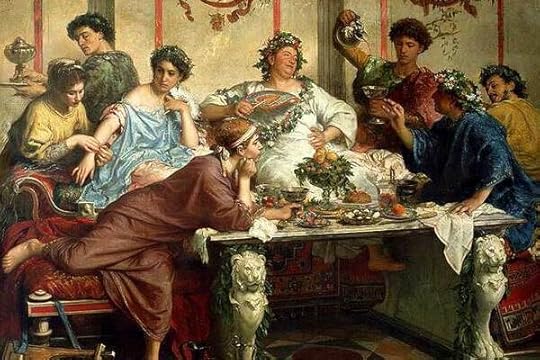
The Feast of Trimalchio is everything you would imagine an over-the-top Roman feast would be. Music, wine, debauchery, slaves, food nested in other foods, an over-abundance of money, satire, witicism, insults, and again lots and lots of wine and food.
If you love everything Roman, you will enjoy this. Even though it is fiction, it does give a glimpse of what the 1% in Rome during Nero might have lived like, because Gaius Petronius Arbiter WAS the elegantiae arbiter for Nero. He even died with style.
Feasting in Nero's Rome ca 60 AD A review of the Penguin Little Black Classics Kindle eBook (February 26, 2015) of a section excerpted from J.P. Sullivan's full English language translation The Satyricon and the Fragments (1965) from the Latin language original (ca 60 AD).
Trimalchio's Feast is a lengthy excerpt from the satirical fiction Satyricon reputed to have been written by a courtier to the Emperor Nero (27AD - 68AD) and known as Gaius Petronius Arbiter (ca 27AD - ca 66AD). The evidence for the time of writing is due to references to people and events of Nero's time in the text. Many assume that Nero himself was the model for Trimalchio. Only portions of the fuller text survive and various editions often supplement the story in order to bridge the gaps.
The overall story is about the wanderings and adventures of the character Encolpius and his rivalry with Ascyltos for the affections of the boy Giton. Roughly in the middle of Satyricon they end up as guests at a feast given by the rich merchant Trimalchio. The feast is basically a catalogue of the various meal courses served to the guests and the stories told by the host and various guests. One of the guest's stories is a werewolf tale.
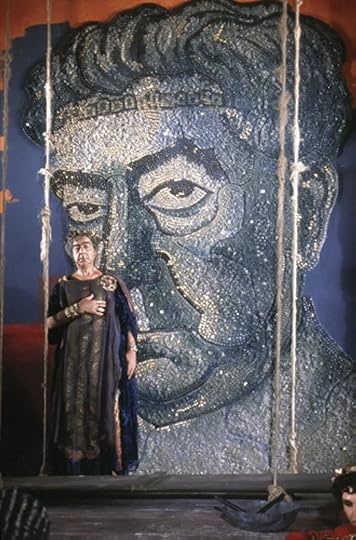
Actor Mario Romagnoli as Trimalchio in the film Fellini Satyricon (1969). Image sourced from IMDb.
My overall impression of the story was that it was rather tame, but that is probably because of my having seen the film Fellini Satyricon which is a very exaggerated and fantasized adaptation. The elaborate nature of the fictional dishes prepared by the cooks were certainly over the top as a way portraying indulgence and excess.
As with Penguin's other little mini-book series of Modern Classics, the lack of any Introduction or context explanations in these Penguin Little Black Classics make for only a 3-star GR Like.
Trivia and Links Further to the above use of Trimalchio as a code word for indulgence and excess, another interesting historical note is that one of F. Scott Fitzgerald's working titles for The Great Gatsby (1925) was Trimalchio in West Egg.
Satyricon including Trimalchio's Feast has been adapted twice for feature films. The best known adaptation was Fellini Satyricon (1969) dir. Federico Fellini, which is a very exaggerated surreal version that goes well beyond the original text. You can see a trailer on YouTube here.
The lesser known adaptation is Satyricon (1969) dir. Gian Luigi Polidoro. The producers had registered the title first, which is why Fellini's version has the title it does. You can watch the entire movie on YouTube here.
This edition of Trimalchio's Feast is No. 21 of Penguin's Little Black Classics series of Penguin Classics short stories, poems, essays and novel excerpts which numbers 127 volumes.
Trimalchio's Feast is in the public domain in both its original Latin and in early translations of The Satyricon. It can be read online as from the end of Chapter 26 to the middle of Chapter 73 (the 141 Chapter divisions are modern day insertions in the text) of The Satyricon at various sources such as Wikisource's Satyricon Liber (for the Original Latin) and The Satyricon of Petronius Arbiter (1922 translation by W.C. Firebaugh).
What could be a wonderful book is marred by a truly horrible translation. A typical translation from 1965 with no thought for the source material, accents from cockney London through Yorkshire with a stopoff in the 17th century, spiced with jazzy sixties terms an swearing.
LISTEN UP PENGUIN IT'S TIME TO UPDATE THE TRANSLATION OF THIS CLASSIC.
Ugh. The first book in this series of 80 little black books that I would not have finished, were I not committed to the process of reading all of them unless it proves truly impossible. I actually bounced off it hard about a week ago and had to temporarily pause.
The entire thing made me really uncomfortable, even though it's much less graphic than Caligula was. I think it's because (similar to Shakespeare only with an extra 1500 years in the way) when it's humor/satire I find it really important to have a basic grasp on what the author does or doesn't find morally unacceptable. I don't have to agree with them to find something interesting - I can find it interesting while being *repulsed* by it; I can see wit (which this definitely has!) while utterly rejecting the moral foundation ... but humor is really tricky. Are they laughing with or at? with whom or at whom are they laughing? It's easy to tell that with Swift - he's not so far away from me - and it's not always a matter of pure time, there are ancient cultures with whom I feel great sympathy. Upper class Rome around 0 CE is very much *not* one of those cultures and it's extra weird since there's so much of it I'm familiar with, I'm so used to parsing out the interesting from the abhorrent when learning about it. But not on the level of gossipy self-satisfied blowhards. I like seeing those skewered, as a general rule, but not when I can't even really tell if the teller is on their side or the side of the enslaved and freedmen they're abusing! It uses up so much of my brain power just trying to wrap my head around the culture that's being critiqued, that I can't appreciate the merits OR demerits of the critique being made.
Ugh ugh ughitty ugh.
CN: imperialism, enslavement, sexual use of slaves including 'boys' of unspecified ages, unfettered sexism, violence, sex-worker shaming, general debauchery of more and less savory kinds.
'A poor man and a rich man were enemies...' just when Trimalchio said: 'What's a poor man?' 'Oh witty!' said Agamemnon,
Trimalchio's Feast is one of the texts from The Satyricon by Petronius.
Petronius is a 1st century writer and The Satyricon is his take and humorous satire on the Roman Empire.
In this, we see Pompeious Trimalchio hosting a feast for the town (it is quite a thing for the Romans to do) with delicacies landing on the table every now and then, and people talking about slavery, freedmen and the "good old days". Everybody has a story to tell and Trimalchio being the humble guest lets everyone talk but with an end of his own. He is shown treating slaves, women and other noblemen in distinct ways as it was in those times. . . It felt more like historical fiction to me maybe because the translation didn't do justice to the original classic text. But i did love the satirical approach Petronius brought in his tone and storytelling that was pretty evident.
I loved that the book is just about that one feast and it held so many intricate little details of the Roman culture of that time.
Definitely a worthy addition to the Penguin Little Black Classics.
Petronius writes the story of Trimalchio, an ex-slave whose life's ambition is to prove his wealth and exuberance. We're shown him hosting a feast of such luxury that his guests struggle to comprehend the food they're eating, the sights they're seeing, and the decadent scenes unfolding around them.
As feasts were common in Ancient Rome for displaying the host's power and wealth, Trimalchio goes to great lengths to display both. Petronius satirises this heavily, showing him to have shallowness of knowledge, taste, and morals. His vanity impacts his ability to quote mythology, and Petronius does well (perhaps blindingly so) to make us aware of his smoke and mirrors approach.
Strangely entertaining, but with no real plotline, Trimalchio's Feast is worthwhile for a glimpse into Ancient Rome and it societal nuances.
Trimlachio's Feast is a part of Satyricon (you can read it on its own without reading the rest of it!), a satirical novel by Petronius from about 60 AD that follows an extravagant dinner party, hosted by a former slave, now ridiculously rich yet quite uneducated man, Trimalchio.
I enjoyed the satirical nature of the story and how it made fun of traditional, huge banquets and extravagant feasts of Ancient Roman culture, and I liked following as the feast got more and more ridiculous with its performances, weird and grand meals and displays of food. Some of the conversations the guests had - for example about slaves and education - were fun to read about, but overall I wasn't a big fan. There wasn't anything particularly wrong with it, it just wasn't for me.
A disgusting display of decadence. I'm glad I read this. I ran into a reference years ago in Richard Harris' Pompeii and it made me curious to read the source material of one of the only good mysteries I've ever read. But humor doesn't age well, and two thousand years later, it's hard to tell what's funny and what's descriptive and what's serious and what's gross and what's normal. The pacing also predated the invention of narrative pacing. Clever little book about how to be disgustingly nouveau riche back in the old days.
Fairly entertaining account of an opulent feast set in the house of a by turns muificent, by other turns psychotic host. Trots along entertainingly and even has the odd laugh to titilate. Wonderful to find such ribald stuff among the classics: gives the lie to ours as the enlightened age!
This was actually hilarious, and it had a relatively modern feel thanks to the translation despite the fact that it was about a Roman banquet. Prepare yourself for drinks and debauchery. Times haven’t changed much, to be honest. Read it!
I wonder to whom Trimalchion was displaying his wealth and status: to himself or to others - would he like to witness his funeral to see 'how he ended' or rather how others will remember him. Fortunately for him, Petronius made him immortal - it's wise to invite writers to the parties I guess.
Plus ça change, plus c'est la même chose. This story, taken from The Satyricon, was written almost two thousand years ago, but the foibles and arrogance it portrays are still around today. I wanted to read this because of its links to The Great Gatsby, the original title of which was Trimalchio, but whereas in The Great Gatsby the central character comes across as sympathetic, and it is the old-money characters, the Tom Buchanans of the world, who are shown up, here it is very much the upstart, new-money Trimalchio we are meant to laugh at, which probably says something of the book's intended audience. It is all very readable and enjoyable and, with his flashiness, his egotism and his love for bling, Trimalchio could easily be updated to a Premier League footballer or Instagram influencer. Though they are probably less likely to go around kissing their slave boys...
Much has been written and said about Rome in the first century. Petronius however, gives a first-hand account of the decadent parties that were thrown in order to establish one's position in the city. While interesting from a historical perspective, I didn't really like this Little Black Classic. It's translated, of course, and I think that probably could have been done better.
The Satyricon is one of the strangest and funniest output of the Latin literature. Funny, irreverent, satirical, it really is a book that can make the reader revalue the Latin world, with its memorable novels and characters. Highly recommended.
A satire for which I don't know quite enough about the context to really "get"... It's funny, but a bit to over exaggerated and in-your-face for my liking.
"We all know you're off your head with all that reading," says one of Trimalchio's many guests. I don't know about that, but this "bitingly comic portrait" went completely over my head. I have absolutely no clue what I just read. A story about a feast/party with no obvious plot and very little point with (I guess) some strange and ostentatious characters. Those Romans and their dinner parties, eh?
Debauchery and decadence in Ancient Rome as told from a portion of one of the first novels ever written. The content in this is unsavory and hard to stomach, but as a historic window into the excesses of Rome and what they would have considered comedic satire, it is invaluable. The information on Roman food alone in this was fascinating.
Lukukokemuksessa oli kuin Gogolin Kuolleiden sielujen kohdalla: tää on varmaan loistavan terävää, mehevää ja hykerryttävää satiiria, mutta oma fiilis tekstistä on lähinnä raskas ja läkähtynyt kaikesta runsaudesta. Kreiseistä ruokakuvauksista plussaa!
Petronius, a first-century courtier is believed to be the author of The Satyricon of which this segment is taken from. As a whole it concerns Encolpius the narrator and his young lover Gidon as they adventure through the lowest and highest parts of Roman society. Sadly, The Satyricon does not exist as a complete novel, but as a fractured remains of a mixture of prose and poetry.
Trimalchio's Feast is a bawdy, drunken affair with men, food, slaves and a great deal of sexism. It is hilarious at points and also typical of the male kind of writing that we are used to: men being men with woman following after them with the bucket. An important piece of early writing, especially about the lower classes during the Roman Empire, but emphatically patriarchal.

























![Profile Image for [ J o ].](https://i.gr-assets.com/images/S/compressed.photo.goodreads.com/users/1673171874i/4639825._UY200_CR4,0,200,200_.jpg)