

What do you think?

The True Flag: Theodore Roosevelt, Mark Twain, and the Birth of American Empire
The bestselling author of Overthrow and The Brothers brings to life the forgotten political debate that set America’s interventionist course in the world for the twentieth century and beyond.
How should the United States act in the world? Americans cannot decide. Sometimes we burn with righteous anger, launching foreign wars and deposing governments. Then we retreat—until the cycle begins again.
No matter how often we debate this question, none of what we say is original. Every argument is a pale shadow of the first and greatest debate, which erupted more than a century ago. Its themes resurface every time Americans argue whether to intervene in a foreign country.
Revealing a piece of forgotten history, Stephen Kinzer transports us to the dawn of the twentieth century, when the United States first found itself with the chance to dominate faraway lands. That prospect thrilled some Americans. It horrified others. Their debate gripped the nation.
The country’s best-known political and intellectual leaders took sides. Theodore Roosevelt, Henry Cabot Lodge, and William Randolph Hearst pushed for imperial expansion; Mark Twain, Booker T. Washington, and Andrew Carnegie preached restraint. Only once before—in the period when the United States was founded—have so many brilliant Americans so eloquently debated a question so fraught with meaning for all humanity.
All Americans, regardless of political perspective, can take inspiration from the titans who faced off in this epic confrontation. Their words are amazingly current. Every argument over America’s role in the world grows from this one. It all starts here.
How should the United States act in the world? Americans cannot decide. Sometimes we burn with righteous anger, launching foreign wars and deposing governments. Then we retreat—until the cycle begins again.
No matter how often we debate this question, none of what we say is original. Every argument is a pale shadow of the first and greatest debate, which erupted more than a century ago. Its themes resurface every time Americans argue whether to intervene in a foreign country.
Revealing a piece of forgotten history, Stephen Kinzer transports us to the dawn of the twentieth century, when the United States first found itself with the chance to dominate faraway lands. That prospect thrilled some Americans. It horrified others. Their debate gripped the nation.
The country’s best-known political and intellectual leaders took sides. Theodore Roosevelt, Henry Cabot Lodge, and William Randolph Hearst pushed for imperial expansion; Mark Twain, Booker T. Washington, and Andrew Carnegie preached restraint. Only once before—in the period when the United States was founded—have so many brilliant Americans so eloquently debated a question so fraught with meaning for all humanity.
All Americans, regardless of political perspective, can take inspiration from the titans who faced off in this epic confrontation. Their words are amazingly current. Every argument over America’s role in the world grows from this one. It all starts here.
307 pages, Hardcover
First published January 24, 2017
About the author
Stephen Kinzer
23 books873 followersStephen Kinzer is an award-winning foreign correspondent who has covered more than 50 countries on five continents. His articles and books have led the Washington Post to place him "among the best in popular foreign policy storytelling." (source)
Ratings & Reviews
Friends & Following
Create a free account to discover what your friends think of this book!
Community Reviews
Displaying 1 - 30 of 254 reviews

July 23, 2020
.Since January when I started out the new year on a ventilator, and of course now due to Covid, I have been in my house, with just a few safe outings. I am though having a terrible time concentrating on any one book for any length of time. I am reading, reading is like breathing to me, can't do without it. I am so far behind in my reviews, just don't feel much like writing them. So, until I find my way out of the funk I'm in, they will be much shorter.
The beginning of the United States imperialism. Includes all the big name players of the time, McKinley, Teddy Roosevelt, Hearst, Lodge, Clay. A big division in our country resulted when those bent on imperialism wanted to takeover the Philippines. The war there was the first time water would be used for torture, a medium that is still widely used today. I also gained a new respect for Mark Twain who doesn't show up until the last few chapters. He was so wise, and didn't mince words in his disapproval of trying to rule over another people, who didn't want us there. The book also serves as a warning of an executive branch that runs amuck. Sound familiar?
A very good book which I enjoyed very much. Narrator is Robert Petkoff and he delivered a stellar narration.
The beginning of the United States imperialism. Includes all the big name players of the time, McKinley, Teddy Roosevelt, Hearst, Lodge, Clay. A big division in our country resulted when those bent on imperialism wanted to takeover the Philippines. The war there was the first time water would be used for torture, a medium that is still widely used today. I also gained a new respect for Mark Twain who doesn't show up until the last few chapters. He was so wise, and didn't mince words in his disapproval of trying to rule over another people, who didn't want us there. The book also serves as a warning of an executive branch that runs amuck. Sound familiar?
A very good book which I enjoyed very much. Narrator is Robert Petkoff and he delivered a stellar narration.
September 9, 2026
__________________________
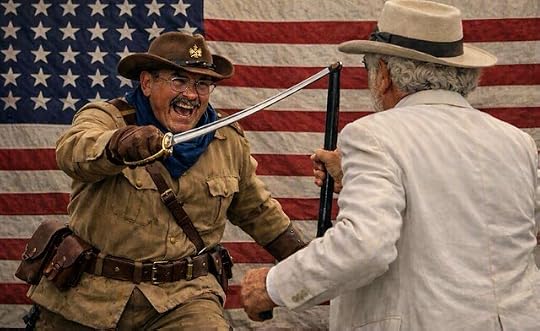
“We have hoisted our flag, and it is not fashioned of the stuff which can be quickly hauled down,” Theodore Roosevelt insisted. “There must be control! There must be mastery!”
The elections of 1898 marked the first attempts by large corporations to buy a majority stake in both the U.S. Congress and the U.S Executive Branch.
Why?
Because American corporations were producing more goods than they could sell in the U.S., that’s why. And many European countries had entered into a new wave of colonialism and had already gobbled up all the best third world areas in Africa, the Middle East, India, Southeast Asia, and the Indian Ocean. It just wasn’t fair.
Great Britain had even re-imagined itself as the world’s most reserved drug cartel and was selling opium to the Chinese and forcibly preventing the Chinese government from doing anything to stop the opium trade that was destroying the lives of many Chinese. The Brits were, with their stiff upper lip, making a fortune.
The U.S. obviously needed to get out there and burglarize … I mean liberate … some new colonies … I mean poor ignorant, naked native populations … before they were all gone.
It wasn’t just the corporations that wanted the U.S. to go forth and pillage. There were significant numbers of Americans who wanted the U.S. to get out and swing Excalibur wildly about and prove America had become a great world power like the big boys in Europe—planting the Stars and Stripes in some tropical paradise and sitting on the verandah on those Edenic shores and demanding that the heathen savages bring them mint juleps.
Some favored imperialism because of the rampant racism of the era and some to prove how patriotic and macho they were. (Macho being an American term for men who faithfully mainline their testosterone supplements.)
“As we age, testosterone levels often naturally drop… addressing these health markers early keeps you on the leading edge of lethality.”—Pete Hegseth, U.S. Secretary of War, in an address announcing his new 2026 testosterone screening policy for men in the military.
One of the people most responsible for the growth of imperialism in the United States was President McKinley.
President Trump has repeatedly said that William McKinley is his favorite U.S. president (other than himself) because he sees McKinley as a model for extremely high tariffs, economic nationalism, and territorial expansion. Trump sees the McKinley era as a “golden age” of American prosperity (for the rich, anyway) and identifies with McKinley’s protectionist philosophy. What better recommendation can you get. One of McKinley’s favorite themes in his speeches was about subduing foreign lands and then forbidding the residents to trade with anyone except Americans.
The U.S. annexed Hawaii as an American territory in 1898 because it was essential to our strategic reserve of sugarcane, pineapple, and pretty Hula Dancers, and we couldn’t let those resources fall into the hands of our enemies. [Or was that Greenland I’m thinking of?] Anyway, the islands were annexed against the will of the people who inhabited them.
Pop Quiz: Before it became an American territory, Hawaii was known as the Sandwich Islands. Is the rumor true that President Trump is going to rename Hawaii the Big Mac Islands to honor President McKinley?
This was the impetus for the growth of an Anti-Imperialist movement that was led by such diverse notables as former presidents Grover Cleveland and Benjamin Harrison, the wealthy industrialist Andrew Carnegie, the humorist Mark Twain, and the head of the Democratic Party, William Jennings Bryan.
A major talking point of the Anti-Imperialists was that the Imperialists were essentially repealing The Declaration of Independence by usurping a foreign people without the consent of those people.
The Imperialist response was that Americans had done this to the Native Americans. They had taken over California from Mexico without asking the consent of the Mexicans who were living there. Americans had taken slaves without their consent. The Northern Union had taken the slaves away from their Confederate owners without the owner's consent. Therefore, we can legally take over any damn people we want.
This dispute between the Imperialist and Anti-Imperialists came to a head when Americans learned that the Spanish authorities who controlled Cuba were committing atrocities in Cuba and that the U.S. battleship Maine had mysteriously blown up and sank while setting in Havana harbor. The Imperialists said that the U.S. needed to free the Cubans from the Spanish for strictly humanitarian reasons, a sentiment with which even the Anti-Imperialist agreed. However, as this book makes clear, the Imperialist elements—which included Theodore Roosevelt and Henry Cabot Lodge—always planned on the U.S. permanently taking control of Cuba and, while they are at it, Spain’s colonies of Puerto Rico, Guam, and the Philippines. They never intended to actually free those lands; they just wanted to mug the Spanish and run off with their possessions.
The Imperialist’s excuse for not allowing the people of the Philippines, Hawaii, and Guam to choose their own government was quite simple—the residents of those territories, the Imperialists claimed, were heathen, naked savages and needed to be taught to be civilized before they could become independent, no matter how many centuries it might take.
After spending 400 years under the Spanish yoke, the Filipinos were not in favor of becoming the property of yet another imperial power, and they revolted. The American response was worthy of Nazi SS troopers. Filipinos were massacred and tortured, and their crops, homes, and farm animals intentionally destroyed. In one notorious case, General Jacob H. Smith. ordered the troopers under his command to take no prisoners and if they discovered even a single insurrectionist being sheltered in any village, everyone in the village—every man, every woman, and every child older than 9 years old—was to be executed. These orders were savagely carried out.
After news of Smith's butcheries outraged your average American, Smith was court-martialed. He admitted to ordering all of the atrocities he was accused of, and he said he would do it again if given a chance. And yes, he was found guilty, but curiously, General Jacob H. Smith’s punishment was an oral admonishment delivered by the President—after all, everyone is entitled to murder a few hundred women and children, especially if you are murdering those the women and children for their own good.
An estimated 200,000 civilians died as a result of the war, as were another 20,000 armed Filipino troops.
Imperialism was being sold as a blessing, but its true flag was stitched from greed, racism, and the blood of people who never asked for American usurpation.
🌟🌟🌟🌟 Stars
This is a period of U.S. history that all Americans should learn about. I had never even heard of the Filipino-American war until I was in college. I suspect because it was such a shameful episode in U.S. history.
The book does get rather didactic at times, and one of the author’s main points is that with the exception of Hoover, every U.S. President since McKinley has intervened in the internal affairs of third world countries. A significant portion of the book is made up of long direct quotes from both Imperialists and Anti-Imperialists. Those quotes do provide a first-hand point of view of the people who were prominent in the fiery imperialist/anti-imperialist debates, but those quotes get repetitive and could use some severe cropping, for their own good.
ADDENDUM
Below are actual quotes about the era discussed in the book. Can you figure out which are from Imperialists and which are from Anti-Imperialists? And yes, this information will be on the final test. Answers are given below the quotes.
Quote 1: “Take up the White Man’s burden— Send forth the best ye breed— Go bind your sons to exile To serve your captives’ need; To wait in heavy harness, On fluttered folk and wild— Your new-caught, sullen peoples, Half-devil and half-child.”
Quote 2: “Ye mis’rable, child-minded apes, we propose for to larn ye the uses of liberty.… We can’t give ye any votes, because we haven’t … enough to go round now; but we’ll treat ye the way a father shud treat his [misbehaving] children if we have to break every bone in y’er bodies.
Quote 3. “As Commander in Chief, President McKinley… heroically led our country to victory in the Spanish American War—advancing the blessings of freedom beyond our shores.”
Answers:
“We have hoisted our flag, and it is not fashioned of the stuff which can be quickly hauled down,” Theodore Roosevelt insisted. “There must be control! There must be mastery!”
The elections of 1898 marked the first attempts by large corporations to buy a majority stake in both the U.S. Congress and the U.S Executive Branch.
Why?
Because American corporations were producing more goods than they could sell in the U.S., that’s why. And many European countries had entered into a new wave of colonialism and had already gobbled up all the best third world areas in Africa, the Middle East, India, Southeast Asia, and the Indian Ocean. It just wasn’t fair.
Great Britain had even re-imagined itself as the world’s most reserved drug cartel and was selling opium to the Chinese and forcibly preventing the Chinese government from doing anything to stop the opium trade that was destroying the lives of many Chinese. The Brits were, with their stiff upper lip, making a fortune.
The U.S. obviously needed to get out there and burglarize … I mean liberate … some new colonies … I mean poor ignorant, naked native populations … before they were all gone.
It wasn’t just the corporations that wanted the U.S. to go forth and pillage. There were significant numbers of Americans who wanted the U.S. to get out and swing Excalibur wildly about and prove America had become a great world power like the big boys in Europe—planting the Stars and Stripes in some tropical paradise and sitting on the verandah on those Edenic shores and demanding that the heathen savages bring them mint juleps.
Some favored imperialism because of the rampant racism of the era and some to prove how patriotic and macho they were. (Macho being an American term for men who faithfully mainline their testosterone supplements.)
“As we age, testosterone levels often naturally drop… addressing these health markers early keeps you on the leading edge of lethality.”—Pete Hegseth, U.S. Secretary of War, in an address announcing his new 2026 testosterone screening policy for men in the military.
One of the people most responsible for the growth of imperialism in the United States was President McKinley.
President Trump has repeatedly said that William McKinley is his favorite U.S. president (other than himself) because he sees McKinley as a model for extremely high tariffs, economic nationalism, and territorial expansion. Trump sees the McKinley era as a “golden age” of American prosperity (for the rich, anyway) and identifies with McKinley’s protectionist philosophy. What better recommendation can you get. One of McKinley’s favorite themes in his speeches was about subduing foreign lands and then forbidding the residents to trade with anyone except Americans.
The U.S. annexed Hawaii as an American territory in 1898 because it was essential to our strategic reserve of sugarcane, pineapple, and pretty Hula Dancers, and we couldn’t let those resources fall into the hands of our enemies. [Or was that Greenland I’m thinking of?] Anyway, the islands were annexed against the will of the people who inhabited them.
Pop Quiz: Before it became an American territory, Hawaii was known as the Sandwich Islands. Is the rumor true that President Trump is going to rename Hawaii the Big Mac Islands to honor President McKinley?
This was the impetus for the growth of an Anti-Imperialist movement that was led by such diverse notables as former presidents Grover Cleveland and Benjamin Harrison, the wealthy industrialist Andrew Carnegie, the humorist Mark Twain, and the head of the Democratic Party, William Jennings Bryan.
A major talking point of the Anti-Imperialists was that the Imperialists were essentially repealing The Declaration of Independence by usurping a foreign people without the consent of those people.
The Imperialist response was that Americans had done this to the Native Americans. They had taken over California from Mexico without asking the consent of the Mexicans who were living there. Americans had taken slaves without their consent. The Northern Union had taken the slaves away from their Confederate owners without the owner's consent. Therefore, we can legally take over any damn people we want.
This dispute between the Imperialist and Anti-Imperialists came to a head when Americans learned that the Spanish authorities who controlled Cuba were committing atrocities in Cuba and that the U.S. battleship Maine had mysteriously blown up and sank while setting in Havana harbor. The Imperialists said that the U.S. needed to free the Cubans from the Spanish for strictly humanitarian reasons, a sentiment with which even the Anti-Imperialist agreed. However, as this book makes clear, the Imperialist elements—which included Theodore Roosevelt and Henry Cabot Lodge—always planned on the U.S. permanently taking control of Cuba and, while they are at it, Spain’s colonies of Puerto Rico, Guam, and the Philippines. They never intended to actually free those lands; they just wanted to mug the Spanish and run off with their possessions.
The Imperialist’s excuse for not allowing the people of the Philippines, Hawaii, and Guam to choose their own government was quite simple—the residents of those territories, the Imperialists claimed, were heathen, naked savages and needed to be taught to be civilized before they could become independent, no matter how many centuries it might take.
After spending 400 years under the Spanish yoke, the Filipinos were not in favor of becoming the property of yet another imperial power, and they revolted. The American response was worthy of Nazi SS troopers. Filipinos were massacred and tortured, and their crops, homes, and farm animals intentionally destroyed. In one notorious case, General Jacob H. Smith. ordered the troopers under his command to take no prisoners and if they discovered even a single insurrectionist being sheltered in any village, everyone in the village—every man, every woman, and every child older than 9 years old—was to be executed. These orders were savagely carried out.
After news of Smith's butcheries outraged your average American, Smith was court-martialed. He admitted to ordering all of the atrocities he was accused of, and he said he would do it again if given a chance. And yes, he was found guilty, but curiously, General Jacob H. Smith’s punishment was an oral admonishment delivered by the President—after all, everyone is entitled to murder a few hundred women and children, especially if you are murdering those the women and children for their own good.
An estimated 200,000 civilians died as a result of the war, as were another 20,000 armed Filipino troops.
Imperialism was being sold as a blessing, but its true flag was stitched from greed, racism, and the blood of people who never asked for American usurpation.
🌟🌟🌟🌟 Stars
This is a period of U.S. history that all Americans should learn about. I had never even heard of the Filipino-American war until I was in college. I suspect because it was such a shameful episode in U.S. history.
☠️☠️☠️☠️☠️☠️☠️☠️☠️☠️☠️☠️☠️☠️☠️☠️
I would love to get comments from my gentle American readers about when you first learned about the Filipino-American war—in high school, college, personal reading, or while reading this review.
☠️☠️☠️☠️☠️☠️☠️☠️☠️☠️☠️☠️☠️☠️☠️☠️
The book does get rather didactic at times, and one of the author’s main points is that with the exception of Hoover, every U.S. President since McKinley has intervened in the internal affairs of third world countries. A significant portion of the book is made up of long direct quotes from both Imperialists and Anti-Imperialists. Those quotes do provide a first-hand point of view of the people who were prominent in the fiery imperialist/anti-imperialist debates, but those quotes get repetitive and could use some severe cropping, for their own good.
ADDENDUM
Below are actual quotes about the era discussed in the book. Can you figure out which are from Imperialists and which are from Anti-Imperialists? And yes, this information will be on the final test. Answers are given below the quotes.
Quote 1: “Take up the White Man’s burden— Send forth the best ye breed— Go bind your sons to exile To serve your captives’ need; To wait in heavy harness, On fluttered folk and wild— Your new-caught, sullen peoples, Half-devil and half-child.”
Quote 2: “Ye mis’rable, child-minded apes, we propose for to larn ye the uses of liberty.… We can’t give ye any votes, because we haven’t … enough to go round now; but we’ll treat ye the way a father shud treat his [misbehaving] children if we have to break every bone in y’er bodies.
Quote 3. “As Commander in Chief, President McKinley… heroically led our country to victory in the Spanish American War—advancing the blessings of freedom beyond our shores.”
Answers:

February 18, 2020
Kinzer details the beginning of America’s global expansionism. It starts with the annexation of Hawaii and the Spanish American War in 1898. Kinzer attributes much of the impetus to influential Massachusetts Senator Henry Cabot Lodge and his eager accomplice Theodore Roosevelt. The country was ready to receive their message. Perhaps overseas expansion was just a continuation of Manifest Destiny now that America spanned the continent and the frontier was gone. But it also played into the racial meme that the superior Anglo-Saxon “race” was meant to civilize the “savage races”. And foreign expansion was seen as the next step for American business maturing from the industrial revolution, hurting from the depression of 1893 and in need of new markets. Foreign interference has frequently been used to support politically important business interests.
The annexation of Hawaii exemplified how all three arguments played out. White businessmen with U.S. military support overthrew the monarchy in Hawaii in 1893 and took control. The anti-imperialist President Grover Cleveland blocked Hawaii’s annexation. But with McKinley’s election in 1896, Hawaii’s president, Stanford Dole, saw his opportunity to expand the market for his fruit and sugar. Others saw extending American rule to Hawaii as a continuation of America’s history, its destiny. A significant justifying argument was to civilize the “savages”. After a quick victory in the Spanish American War in 1898 Lodge took advantage of the national mood to attach Hawaii annexation to the War Revenue Bill which passed both houses and McKinley signed.
Lodge, Roosevelt, and the expansionists had opposition, some of it powerful such as Andrew Carnegie, some of it popular such as Mark Twain, some of it influential such as William Dean Howells, and some of it political such as William Jennings Bryan. But the decider in chief was President William McKinley. The last president to have served in the Civil War, he noted that he had seen bodies piled high at Antietam and had no taste for war. But he was a politician who followed public opinion rather than lead it and once he sensed the American Public clamoring for war, he was all in. He wasn’t called “Wobbly Willie” for nothing. The yellow journalists led by Randolph Hearst seeing his opportunity for fortune beat the drum for war. Americans and in turn their president were ready to follow. Popular support for war with Spain quickly reached a fever pitch in the spring of 1898. McKinley was tuned into the needs of American business which was still suffering from the depression of 1893. The war was justified as saving the Cuban people from Spanish exploitation, but as McKinley had said in the election year 1896, “We want a foreign market for our surplus products”.
In Congress Lodge had become a powerful political insider. He launched Roosevelt’s political career getting McKinley to make him Assistant Secretary of the Navy. When war broke out, Roosevelt resigned and made his own name leading the Rough Riders up San Juan Hill. After a quick victory over Spain, the Paris Treaty of 1898 ceded the Spanish colonies (Puerto Rico, the Philippines, Guam) to the U.S. and allowed the U.S. to take control of Cuba. Americans backed off the idea of annexing Cuba when they realized how many Cubans were black. According to General Leonard Wood these black rebels were “…only partially civilized, in whom the old spirit of savagery has been more or less aroused by years of warfare...” Racism was used as justification by both the expansionists and some anti-imperialists such as labor leader Samuel Gompers who said, “If these new Islands are to become ours…can we hope to close the flood gates of immigration from the hordes of Chinese and the semi-savage races…” Henry Cabot Lodge already wanted to limit immigration because it would lead to “the lowering of a great race.” However, the idea of colonizing conquered territories remained popular. Roosevelt was crystal clear saying “All men of sane and wholesome thought must dismiss with impatient contempt the plea that these continents should be reserved for the use of scattered savage tribes whose life was but a few degrees less meaningless, squalid and ferocious than that of the wild beasts with whom they hold joint ownership.” This was Roosevelt’s logic for making the Philippines a far flung American colony.
When Admiral Dewey defeated the Spanish in the Philippines, McKinley readily admitted he had no idea where it was. Yet he too was more than ready to take control. Influential business and military interests who did know where it was saw its location as perfect for trade with China and extending American power to East Asia. Evangelistic religions savored the opportunity to save so many lost souls for Christ. McKinley said “I went down on my knees and prayed Almighty God for light and guidance.” “I don’t know how it was, but it came.” Given that the American public was besotted with visions of empire, the answer to Wobbly Willy’s entreaty was rather predictable. God and the voters were in synch. As McKinley noted, Filipinos “were unfit for self-government,” “there was nothing left for us to do but to take them all, and to educate the Filipinos, and uplift and civilize and Christianize them and by God’s grace do the very best we could by them, as our fellow men for whom Christ also died.” As Kinzer notes “God sounded remarkably like Theodore Roosevelt and Henry Cabot Lodge.” So began one of the darkest episodes in America’s history.
McKinley’s words about America’s intentions in the Philippines, “We come not as invaders, but as friends, to protect the natives in their homes, in their employments, and in their personal and religious rights…The mission of the United States is one of benevolent assimilation...” belied what would transpire. Notably McKinley did not mention self-rule which is what the rebel leader, Emilio Aguinaldo, had been promised. Dewey had brought Aguinaldo back from exile to the Philippines to help the Americans against the Spanish. After the Spanish were vanquished, Aguinaldo soon realized the Americans had double crossed him. Now he led his men in insurgency against his new American overseers. Roosevelt in 1899, now Governor of New York, in one of his most famous speeches, caught the prevailing American mood, claiming Filipinos: “are utterly unfit for self-government and show no signs of becoming fit.” Roosevelt went on castigating his opponents: “…I have even scanter patience for those who make a pretense of humanitarianism to hide and cover their timidity, and who cant about ‘liberty’ and ‘consent of the governed’ in order to excuse themselves for their unwillingness to play the part of men.” “Resistance must be stamped out! The first and all-important work to be done is to establish the supremacy of our flag.” This speech propelled Roosevelt into the limelight paving the way for Lodge and the NY party boss who wanted rid of Roosevelt as governor to get him in as McKinley’s VP in the 1900 election. Mark Hanna, McKinley’s handler, was beside himself realizing that this “madman” would be a heartbeat away from the presidency.
At the same time the U.S. was sending troops to the Philippines, Britain sent Lord Kitchener to South Africa to lead troops in a scorched earth campaign against the Boers, King Leopold’s Force Publique was cruelly exploiting native people of the Congo, and the Boxers in China were rebelling against the many foreign nations occupying Chinese territory. McKinley diverted 5,000 U.S. soldiers from the Philippines to China to join with other colonialist nations to subdue the Boxers. This was the first instance of what we call today “Presidential War Power”. It was the first time the U.S. sent a significant military contingent to a foreign country with which we were at peace to battle a force that had the support of the legal government. Even more important, McKinley did this on his own with no discussion with Congress, setting a precedent for executive behavior that has led to endless war today. The anti-imperialist always outspoken Mark Twain offered his take which was printed on turn of the century New Year’s cards: “I bring you the stately matron named Christendom, returning bedraggled, besmirched, and dishonored from pirate raids in Kiaochow, Manchuria, South Africa and the Philippines, with her soul full of meanness, her pocket full of boodle, and her mouth full of pious hypocrisies.” “Give her soap and towel, but hide the looking glass.”
In 1904 delegates to Cuba’s “constitutional convention” ratified the constitution handed them by General Wood, the American military governor of Cuba. Cuba would now be subject to severe restrictions under the Platt Amendment passed with only Republican votes. It protected U.S. business interests. American fruit and sugar companies had large landholdings in Cuba. As Wood pointed out, “There is, of course, little or no independence left Cuba under the Platt amendment.” With Cuba under control, attention turned to the Philippines. General Arthur MacArthur had been appointed military governor. He faced tens of thousands of rebels led by Aguinaldo. MacArthur instructed his officers that prisoners “are not entitled to the privileges of prisoners of war.” And “Whatever action is necessary, the more drastic the application, the better.” The American “liberators” outdid the Spanish they replaced, emulating the Inquisition. The Spanish had used some waterboarding, the Americans used it wholesale. For the first time U.S. forces were used to systematically torture and kill civilians overseas. Many civilians died in camps into which they were impounded. Food and supplies were interdicted to keep them from reaching the population. Villages were burnt down and the wounded shot. The campaign worked. Aguinaldo was captured and gave in. McKinley appointed William Howard Taft to be the Philippines governor. Taft noted that he would work with our “little brown brothers”, although American troops maintained order under martial law with a clearly different ethic. Filipinos had no rights. Due process did not apply nor did the right of free speech. Cruel and unusual punishment was the norm.
In 1900 McKinley was reelected with Roosevelt his VP. In September 1901 McKinley was assassinated by an anarchist, something that was happening frequently in Europe. McKinley had shrugged off the risk. Roosevelt, who had started studying law to help him get his next job in the days when the VP job led nowhere, was now President. Mark Hanna proclaimed “Now that damned cowboy is President of the United States.” Lodge and Roosevelt would remain close. Lodge had a private rear entrance to his house built just for Roosevelt and they conferred frequently. Also in September 1901 the “Balangiga Massacre” on the island of Samar made the headlines. Filipinos reeling from the U.S. Army’s scorched earth policy had snuck up and killed forty U.S. soldiers. Most Americans had been under the impression the war was winding down. Despite the strict censorship the military had imposed on the Philippines, information now came out shocking many Americans when they found out that torture and killing of civilians in the Philippines was standard practice.
Congress set up an investigating committee but Lodge got himself named chairman. He only invited favorable witnesses. Taft testified admitting to isolated instances of misconduct, but perhaps this question by Senator Patterson of Colorado best exemplifies the tone of the hearing. “When war is conducted by a superior race against those whom they consider inferior in the scale of civilization is it not the experience of the world that the superior race will almost involuntarily practice inhuman conduct.” Taft concurred. Conversely, the Filipinos were demonized. Secretary of War Elihu Root testified, “The war on part of the Filipinos has been conducted with the barbarous cruelty common among uncivilized races.” Yet many in the public and the Senate were not buying the whitewash. The anti-imperialists were outraged even involving a fistfight drawing blood between two senators on the Senate floor. One general did admit that burning Filipino villages was routine.
But the big story was the U.S. Army’s response to the 40 soldiers killed in Samar. Major Anthony Walker testified to orders received from General Jacob Smith, “I want no prisoners, I wish you to kill and burn. The more you kill and burn, the better you will please me. I want all persons killed who are capable of bearing arms in actual hostilities against the United States.” When Walker asked what age the order applied to, Smith replied “ten years”. Walker asked “Persons ten years and over are those designated to bear arms?” Smith, “Yes.” Smith then said he wanted the island “made a howling wilderness.” Subsequently every village found on Samar was burned down and civilians found routinely killed. Most Americans could not accept this. Smith was christened “Howling Wilderness” Smith by the press. Roosevelt found himself compelled to order General Smith’s court-martial, but Secretary Root let him off with a reprimand saying “cruel and barbarous savages” were responsible for his conduct.
An exceptionally brutal campaign with tens of thousands more civilians killed brought the end to organized resistance in the Philippines in 1902. Roosevelt declared the war over. 120,000 U.S. troops saw service there. 4,200 Americans died in the war. 20,000 Filipino insurgents and more than 200,000 Filipino civilians died as a result of the war, many from disease and starvation. Ninety per cent of the country’s water buffalo were slaughtered, denying a critical resource to rural Filipinos. Kinzer notes that more Filipinos were killed in the 41 months of the war than in the prior 350 years the Spanish controlled the islands. From then on Roosevelt ignored many available opportunities around the globe for expansion, save the Panama Canal. In an abrupt about face, he focused primarily on domestic issues attacking the trusts and promoting conservation. Roosevelt at his inaugural in 1905 said “Our fathers faced certain perils, which we have outgrown.” “We now face other perils.” Most Americans were also ready to turn a new page. Roosevelt handed the presidency over to Taft in 1909 who once again projected US power abroad for American business interests overthrowing governments in Nicaragua and Honduras. Interventionist policies, frequently in Latin America, would continue in the Wilson and Coolidge administrations. The Eisenhower administration added a new element deploying the CIA to secretly overthrow foreign governments. The interventionism that began in 1898 continues.
The annexation of Hawaii exemplified how all three arguments played out. White businessmen with U.S. military support overthrew the monarchy in Hawaii in 1893 and took control. The anti-imperialist President Grover Cleveland blocked Hawaii’s annexation. But with McKinley’s election in 1896, Hawaii’s president, Stanford Dole, saw his opportunity to expand the market for his fruit and sugar. Others saw extending American rule to Hawaii as a continuation of America’s history, its destiny. A significant justifying argument was to civilize the “savages”. After a quick victory in the Spanish American War in 1898 Lodge took advantage of the national mood to attach Hawaii annexation to the War Revenue Bill which passed both houses and McKinley signed.
Lodge, Roosevelt, and the expansionists had opposition, some of it powerful such as Andrew Carnegie, some of it popular such as Mark Twain, some of it influential such as William Dean Howells, and some of it political such as William Jennings Bryan. But the decider in chief was President William McKinley. The last president to have served in the Civil War, he noted that he had seen bodies piled high at Antietam and had no taste for war. But he was a politician who followed public opinion rather than lead it and once he sensed the American Public clamoring for war, he was all in. He wasn’t called “Wobbly Willie” for nothing. The yellow journalists led by Randolph Hearst seeing his opportunity for fortune beat the drum for war. Americans and in turn their president were ready to follow. Popular support for war with Spain quickly reached a fever pitch in the spring of 1898. McKinley was tuned into the needs of American business which was still suffering from the depression of 1893. The war was justified as saving the Cuban people from Spanish exploitation, but as McKinley had said in the election year 1896, “We want a foreign market for our surplus products”.
In Congress Lodge had become a powerful political insider. He launched Roosevelt’s political career getting McKinley to make him Assistant Secretary of the Navy. When war broke out, Roosevelt resigned and made his own name leading the Rough Riders up San Juan Hill. After a quick victory over Spain, the Paris Treaty of 1898 ceded the Spanish colonies (Puerto Rico, the Philippines, Guam) to the U.S. and allowed the U.S. to take control of Cuba. Americans backed off the idea of annexing Cuba when they realized how many Cubans were black. According to General Leonard Wood these black rebels were “…only partially civilized, in whom the old spirit of savagery has been more or less aroused by years of warfare...” Racism was used as justification by both the expansionists and some anti-imperialists such as labor leader Samuel Gompers who said, “If these new Islands are to become ours…can we hope to close the flood gates of immigration from the hordes of Chinese and the semi-savage races…” Henry Cabot Lodge already wanted to limit immigration because it would lead to “the lowering of a great race.” However, the idea of colonizing conquered territories remained popular. Roosevelt was crystal clear saying “All men of sane and wholesome thought must dismiss with impatient contempt the plea that these continents should be reserved for the use of scattered savage tribes whose life was but a few degrees less meaningless, squalid and ferocious than that of the wild beasts with whom they hold joint ownership.” This was Roosevelt’s logic for making the Philippines a far flung American colony.
When Admiral Dewey defeated the Spanish in the Philippines, McKinley readily admitted he had no idea where it was. Yet he too was more than ready to take control. Influential business and military interests who did know where it was saw its location as perfect for trade with China and extending American power to East Asia. Evangelistic religions savored the opportunity to save so many lost souls for Christ. McKinley said “I went down on my knees and prayed Almighty God for light and guidance.” “I don’t know how it was, but it came.” Given that the American public was besotted with visions of empire, the answer to Wobbly Willy’s entreaty was rather predictable. God and the voters were in synch. As McKinley noted, Filipinos “were unfit for self-government,” “there was nothing left for us to do but to take them all, and to educate the Filipinos, and uplift and civilize and Christianize them and by God’s grace do the very best we could by them, as our fellow men for whom Christ also died.” As Kinzer notes “God sounded remarkably like Theodore Roosevelt and Henry Cabot Lodge.” So began one of the darkest episodes in America’s history.
McKinley’s words about America’s intentions in the Philippines, “We come not as invaders, but as friends, to protect the natives in their homes, in their employments, and in their personal and religious rights…The mission of the United States is one of benevolent assimilation...” belied what would transpire. Notably McKinley did not mention self-rule which is what the rebel leader, Emilio Aguinaldo, had been promised. Dewey had brought Aguinaldo back from exile to the Philippines to help the Americans against the Spanish. After the Spanish were vanquished, Aguinaldo soon realized the Americans had double crossed him. Now he led his men in insurgency against his new American overseers. Roosevelt in 1899, now Governor of New York, in one of his most famous speeches, caught the prevailing American mood, claiming Filipinos: “are utterly unfit for self-government and show no signs of becoming fit.” Roosevelt went on castigating his opponents: “…I have even scanter patience for those who make a pretense of humanitarianism to hide and cover their timidity, and who cant about ‘liberty’ and ‘consent of the governed’ in order to excuse themselves for their unwillingness to play the part of men.” “Resistance must be stamped out! The first and all-important work to be done is to establish the supremacy of our flag.” This speech propelled Roosevelt into the limelight paving the way for Lodge and the NY party boss who wanted rid of Roosevelt as governor to get him in as McKinley’s VP in the 1900 election. Mark Hanna, McKinley’s handler, was beside himself realizing that this “madman” would be a heartbeat away from the presidency.
At the same time the U.S. was sending troops to the Philippines, Britain sent Lord Kitchener to South Africa to lead troops in a scorched earth campaign against the Boers, King Leopold’s Force Publique was cruelly exploiting native people of the Congo, and the Boxers in China were rebelling against the many foreign nations occupying Chinese territory. McKinley diverted 5,000 U.S. soldiers from the Philippines to China to join with other colonialist nations to subdue the Boxers. This was the first instance of what we call today “Presidential War Power”. It was the first time the U.S. sent a significant military contingent to a foreign country with which we were at peace to battle a force that had the support of the legal government. Even more important, McKinley did this on his own with no discussion with Congress, setting a precedent for executive behavior that has led to endless war today. The anti-imperialist always outspoken Mark Twain offered his take which was printed on turn of the century New Year’s cards: “I bring you the stately matron named Christendom, returning bedraggled, besmirched, and dishonored from pirate raids in Kiaochow, Manchuria, South Africa and the Philippines, with her soul full of meanness, her pocket full of boodle, and her mouth full of pious hypocrisies.” “Give her soap and towel, but hide the looking glass.”
In 1904 delegates to Cuba’s “constitutional convention” ratified the constitution handed them by General Wood, the American military governor of Cuba. Cuba would now be subject to severe restrictions under the Platt Amendment passed with only Republican votes. It protected U.S. business interests. American fruit and sugar companies had large landholdings in Cuba. As Wood pointed out, “There is, of course, little or no independence left Cuba under the Platt amendment.” With Cuba under control, attention turned to the Philippines. General Arthur MacArthur had been appointed military governor. He faced tens of thousands of rebels led by Aguinaldo. MacArthur instructed his officers that prisoners “are not entitled to the privileges of prisoners of war.” And “Whatever action is necessary, the more drastic the application, the better.” The American “liberators” outdid the Spanish they replaced, emulating the Inquisition. The Spanish had used some waterboarding, the Americans used it wholesale. For the first time U.S. forces were used to systematically torture and kill civilians overseas. Many civilians died in camps into which they were impounded. Food and supplies were interdicted to keep them from reaching the population. Villages were burnt down and the wounded shot. The campaign worked. Aguinaldo was captured and gave in. McKinley appointed William Howard Taft to be the Philippines governor. Taft noted that he would work with our “little brown brothers”, although American troops maintained order under martial law with a clearly different ethic. Filipinos had no rights. Due process did not apply nor did the right of free speech. Cruel and unusual punishment was the norm.
In 1900 McKinley was reelected with Roosevelt his VP. In September 1901 McKinley was assassinated by an anarchist, something that was happening frequently in Europe. McKinley had shrugged off the risk. Roosevelt, who had started studying law to help him get his next job in the days when the VP job led nowhere, was now President. Mark Hanna proclaimed “Now that damned cowboy is President of the United States.” Lodge and Roosevelt would remain close. Lodge had a private rear entrance to his house built just for Roosevelt and they conferred frequently. Also in September 1901 the “Balangiga Massacre” on the island of Samar made the headlines. Filipinos reeling from the U.S. Army’s scorched earth policy had snuck up and killed forty U.S. soldiers. Most Americans had been under the impression the war was winding down. Despite the strict censorship the military had imposed on the Philippines, information now came out shocking many Americans when they found out that torture and killing of civilians in the Philippines was standard practice.
Congress set up an investigating committee but Lodge got himself named chairman. He only invited favorable witnesses. Taft testified admitting to isolated instances of misconduct, but perhaps this question by Senator Patterson of Colorado best exemplifies the tone of the hearing. “When war is conducted by a superior race against those whom they consider inferior in the scale of civilization is it not the experience of the world that the superior race will almost involuntarily practice inhuman conduct.” Taft concurred. Conversely, the Filipinos were demonized. Secretary of War Elihu Root testified, “The war on part of the Filipinos has been conducted with the barbarous cruelty common among uncivilized races.” Yet many in the public and the Senate were not buying the whitewash. The anti-imperialists were outraged even involving a fistfight drawing blood between two senators on the Senate floor. One general did admit that burning Filipino villages was routine.
But the big story was the U.S. Army’s response to the 40 soldiers killed in Samar. Major Anthony Walker testified to orders received from General Jacob Smith, “I want no prisoners, I wish you to kill and burn. The more you kill and burn, the better you will please me. I want all persons killed who are capable of bearing arms in actual hostilities against the United States.” When Walker asked what age the order applied to, Smith replied “ten years”. Walker asked “Persons ten years and over are those designated to bear arms?” Smith, “Yes.” Smith then said he wanted the island “made a howling wilderness.” Subsequently every village found on Samar was burned down and civilians found routinely killed. Most Americans could not accept this. Smith was christened “Howling Wilderness” Smith by the press. Roosevelt found himself compelled to order General Smith’s court-martial, but Secretary Root let him off with a reprimand saying “cruel and barbarous savages” were responsible for his conduct.
An exceptionally brutal campaign with tens of thousands more civilians killed brought the end to organized resistance in the Philippines in 1902. Roosevelt declared the war over. 120,000 U.S. troops saw service there. 4,200 Americans died in the war. 20,000 Filipino insurgents and more than 200,000 Filipino civilians died as a result of the war, many from disease and starvation. Ninety per cent of the country’s water buffalo were slaughtered, denying a critical resource to rural Filipinos. Kinzer notes that more Filipinos were killed in the 41 months of the war than in the prior 350 years the Spanish controlled the islands. From then on Roosevelt ignored many available opportunities around the globe for expansion, save the Panama Canal. In an abrupt about face, he focused primarily on domestic issues attacking the trusts and promoting conservation. Roosevelt at his inaugural in 1905 said “Our fathers faced certain perils, which we have outgrown.” “We now face other perils.” Most Americans were also ready to turn a new page. Roosevelt handed the presidency over to Taft in 1909 who once again projected US power abroad for American business interests overthrowing governments in Nicaragua and Honduras. Interventionist policies, frequently in Latin America, would continue in the Wilson and Coolidge administrations. The Eisenhower administration added a new element deploying the CIA to secretly overthrow foreign governments. The interventionism that began in 1898 continues.

July 10, 2021
"Hurrah for Hawaii! Did I tell you I killed a Spaniard with my own hand when I led the storm [of San Juan Hill]?" - Letter from Theodore Roosevelt to his friend Senator Henry Cabot Lodge during the invasion of Cuba, 1898
"And as for a flag for the Philippine province, it is easily managed. We can just have our usual flag, with the white stripes painted black and the stars replaced by a skull and crossbones." Mark Twain essay, 1901
************
Teddy Roosevelt is ranked in the top five US presidents, with Washington, Jefferson, Lincoln and FDR, mainly for his roles in anti-trust, anti-corruption, regulation and conservation. This 2017 book by Stephen Kinzer looks at the darker side of his foreign policy beliefs and actions. The great debate of 1898 was if the US should follow a course of expansionism or remain true to ideals of liberty and rights to self governance. The argument against expansion was the US came from a colony that had won it's freedom. The argument made for expansion was that colonialism founded the country.
In 1893 a group of American business men had toppled the Hawaiian monarchy and the islands were annexed by the US in 1898. The same year McKinley sent the USS Maine to Havana harbor to defend American business interests in the Cuban war for freedom from Spain. When the ship exploded the Spanish-American War was declared. Anti-imperialists gave support for a fight against colonialism. Expansionists sought to annex Cuba and Puerto Rico. McKinley steamed off to seize the Philippines and Guam from Spain. Within four months the US had acquired further Pacific territories.
In 1899 the US fought Filipinos who had been ruled by Spain for over three hundred years. Roosevelt became president in 1901 and the war ended in 1902 with a quarter million native deaths from fighting and disease. Roosevelt advocated for American expansion and war, whether with undeveloped nations or European powers. Mark Twain was an outspoken anti-imperialist who had circled the globe writing about the evils of colonialism. Their opposing opinions are used to frame the issues of the day. They did not directly debate but addressed each other’s views through writing and speech.
Roosevelt was allied with Henry Cabot Lodge, a US Senator and nationalist who argued for projection of American naval power throughout the globe. William Randolph Hearst, the wealthy owner of yellow journalism publications, lobbied for an interventionist role in world affairs. The practical aspect behind the push was the desire to open new markets for American industries producing surplus goods. The race to grab colonies had gone on for centuries and the US was late to the game. An economic depression in 1893 contributed to a rush towards global trade and chauvinist rallying cries.
Twain was abroad in the late 1890's when jingoism broke out. He criticized treatment of Pacific Islanders, Australians, Asians and Africans. Actions in the Philippines and Cuba were portrayed as wars to liberate oppressed natives and Twain was in favor. When it was apparent the US would take possession he became a leader of the opposition, Andrew Carnegie and William Jennings Bryan joining in. Teddy quit office to fight and Cuba became a US dependency until the 1959 revolution. The Philippines lingered on as a US colony until 1946 when Truman recognized their independence.
Stephen Kinzer has written an interesting and entertaining account of American history. Kinzer was a long time New York Times journalist who published ten books about US foreign intervention. He seems politically centrist, although criticized by Noam Chomsky for 'Manufacturing Consent' in Reagan's anti-Sandinista folly. In the last chapter he surveys later foreign wars seen as imperialistic. Most weren't waged for territorial or economic gains and a poor fit, but the list is long and reveals a litany of ideological interventions. The book is best read as a study of turn of the century politics.
"And as for a flag for the Philippine province, it is easily managed. We can just have our usual flag, with the white stripes painted black and the stars replaced by a skull and crossbones." Mark Twain essay, 1901
************
Teddy Roosevelt is ranked in the top five US presidents, with Washington, Jefferson, Lincoln and FDR, mainly for his roles in anti-trust, anti-corruption, regulation and conservation. This 2017 book by Stephen Kinzer looks at the darker side of his foreign policy beliefs and actions. The great debate of 1898 was if the US should follow a course of expansionism or remain true to ideals of liberty and rights to self governance. The argument against expansion was the US came from a colony that had won it's freedom. The argument made for expansion was that colonialism founded the country.
In 1893 a group of American business men had toppled the Hawaiian monarchy and the islands were annexed by the US in 1898. The same year McKinley sent the USS Maine to Havana harbor to defend American business interests in the Cuban war for freedom from Spain. When the ship exploded the Spanish-American War was declared. Anti-imperialists gave support for a fight against colonialism. Expansionists sought to annex Cuba and Puerto Rico. McKinley steamed off to seize the Philippines and Guam from Spain. Within four months the US had acquired further Pacific territories.
In 1899 the US fought Filipinos who had been ruled by Spain for over three hundred years. Roosevelt became president in 1901 and the war ended in 1902 with a quarter million native deaths from fighting and disease. Roosevelt advocated for American expansion and war, whether with undeveloped nations or European powers. Mark Twain was an outspoken anti-imperialist who had circled the globe writing about the evils of colonialism. Their opposing opinions are used to frame the issues of the day. They did not directly debate but addressed each other’s views through writing and speech.
Roosevelt was allied with Henry Cabot Lodge, a US Senator and nationalist who argued for projection of American naval power throughout the globe. William Randolph Hearst, the wealthy owner of yellow journalism publications, lobbied for an interventionist role in world affairs. The practical aspect behind the push was the desire to open new markets for American industries producing surplus goods. The race to grab colonies had gone on for centuries and the US was late to the game. An economic depression in 1893 contributed to a rush towards global trade and chauvinist rallying cries.
Twain was abroad in the late 1890's when jingoism broke out. He criticized treatment of Pacific Islanders, Australians, Asians and Africans. Actions in the Philippines and Cuba were portrayed as wars to liberate oppressed natives and Twain was in favor. When it was apparent the US would take possession he became a leader of the opposition, Andrew Carnegie and William Jennings Bryan joining in. Teddy quit office to fight and Cuba became a US dependency until the 1959 revolution. The Philippines lingered on as a US colony until 1946 when Truman recognized their independence.
Stephen Kinzer has written an interesting and entertaining account of American history. Kinzer was a long time New York Times journalist who published ten books about US foreign intervention. He seems politically centrist, although criticized by Noam Chomsky for 'Manufacturing Consent' in Reagan's anti-Sandinista folly. In the last chapter he surveys later foreign wars seen as imperialistic. Most weren't waged for territorial or economic gains and a poor fit, but the list is long and reveals a litany of ideological interventions. The book is best read as a study of turn of the century politics.

January 8, 2022
This is about the period from 1898 to 1902 in which the United States extended its reach to global proportions.
Page 66 (my book)
In a ravenous fifty-five-day spasm during the summer of 1898, the United States asserted control over five far-flung lands with a total of 11 million inhabitants: Guam, Hawaii, Cuba, the Philippines, and Puerto Rico. Never in history has a nation leaped so suddenly to overseas empire.
It had accomplished its continental aspirations – and was now in the process of empire building – much like its European rivals.
The book presents us with the colourful personalities involved who were pro-imperialist – Theodore Roosevelt (who comes off as bumptious and ego-centric), Senator Henry Cabot Lodge, and President McKinley – who to some extent was on the fence. And the anti-imperialist forces – Carl Schurz, Andrew Carnegie (who provided money for the cause), Willian Jennings Bryan (who vacillated) and Mark Twain who joined the fray later and added his sardonic wit to the debates.
The book explains very well how these two forces combatted each other along with their arguments. The author does favour the anti-imperialist forces. Racism was a factor on both sides. The pro-imperialist forces wanted to civilize – and dominate – the “darker skinned natives” seeing it as a noble cause. Some on the anti-imperialist side wanted nothing to do with people whose skin complexion was different than their own and feared that there would be an influx of non-white immigrants into the United States.
Religious arguments were also used by the imperialists – missionaries saw opportunities for the spread of Christianity – and the proximity of the Philippines to China was seen as a vast market for both Christian proselytizers and business entrepreneurs. The American army and navy saw opportunities to expand their reach into the Pacific, creating bases across this vast ocean - which still exist to this day.
The United States encountered armed resistance in the Philippines which escalated to the point of more and more troops being sent in. It became a vicious and brutal subjugation.
Page 225
The Philippine War lasted forty-one months. A total of 120,000 American soldiers participated… it is estimated they killed twenty thousand Filipino insurgents. Hundreds of thousands of civilians also perished. The population of water buffalo, the essential article of rural life in the Philippines fell by 90 percent.
This resembles what occurred much later in Vietnam. Some Americans were repulsed by the sadism of American troops, ignoring what had just recently occurred in their country in the genocidal expropriation of Indian land in the West. And, of course, there was the ongoing oppressiveness and brutality toward Black people.
There are many wonderful personalities presented in this book like Mark Twain. One, whom I had never heard of, was General Smedley Butler. He was a military hero who, when on a speaking tour, went totally off script – telling how the Marines made many countries safe for “big business” and Wall Street” – acting as the strong arm for them. He stated: “Looking back on it, I might have given Al Capone a few hints. The best he could do was to operate his racket in three districts. I operated on three continents.” (Page 236)
The author convincingly argues that the conquests of 1898 were a turning point in United States history – making it now legitimate for future expansion and incursions across the globe.
Page 229
It is the dichotomy that torments our national psyche… Does intervention in other countries serve our national interest and contribute to global stability, or does it undermine both?
Page 67 in 1898
Pious pledges that the United States was intervening abroad only to liberate oppressed peoples turned out to have been part of a giant deception, or self-deception. America’s war began in June as a drive to liberate colonies. By August it had become a campaign to capture them.
This book is a gripping depiction of the time period. Perhaps the last chapter that attempts to summarize America’s global reach since then is somewhat simplistic; still the author is very impressive on the four years beginning in 1898.
Page 66 (my book)
In a ravenous fifty-five-day spasm during the summer of 1898, the United States asserted control over five far-flung lands with a total of 11 million inhabitants: Guam, Hawaii, Cuba, the Philippines, and Puerto Rico. Never in history has a nation leaped so suddenly to overseas empire.
It had accomplished its continental aspirations – and was now in the process of empire building – much like its European rivals.
The book presents us with the colourful personalities involved who were pro-imperialist – Theodore Roosevelt (who comes off as bumptious and ego-centric), Senator Henry Cabot Lodge, and President McKinley – who to some extent was on the fence. And the anti-imperialist forces – Carl Schurz, Andrew Carnegie (who provided money for the cause), Willian Jennings Bryan (who vacillated) and Mark Twain who joined the fray later and added his sardonic wit to the debates.
The book explains very well how these two forces combatted each other along with their arguments. The author does favour the anti-imperialist forces. Racism was a factor on both sides. The pro-imperialist forces wanted to civilize – and dominate – the “darker skinned natives” seeing it as a noble cause. Some on the anti-imperialist side wanted nothing to do with people whose skin complexion was different than their own and feared that there would be an influx of non-white immigrants into the United States.
Religious arguments were also used by the imperialists – missionaries saw opportunities for the spread of Christianity – and the proximity of the Philippines to China was seen as a vast market for both Christian proselytizers and business entrepreneurs. The American army and navy saw opportunities to expand their reach into the Pacific, creating bases across this vast ocean - which still exist to this day.
The United States encountered armed resistance in the Philippines which escalated to the point of more and more troops being sent in. It became a vicious and brutal subjugation.
Page 225
The Philippine War lasted forty-one months. A total of 120,000 American soldiers participated… it is estimated they killed twenty thousand Filipino insurgents. Hundreds of thousands of civilians also perished. The population of water buffalo, the essential article of rural life in the Philippines fell by 90 percent.
This resembles what occurred much later in Vietnam. Some Americans were repulsed by the sadism of American troops, ignoring what had just recently occurred in their country in the genocidal expropriation of Indian land in the West. And, of course, there was the ongoing oppressiveness and brutality toward Black people.
There are many wonderful personalities presented in this book like Mark Twain. One, whom I had never heard of, was General Smedley Butler. He was a military hero who, when on a speaking tour, went totally off script – telling how the Marines made many countries safe for “big business” and Wall Street” – acting as the strong arm for them. He stated: “Looking back on it, I might have given Al Capone a few hints. The best he could do was to operate his racket in three districts. I operated on three continents.” (Page 236)
The author convincingly argues that the conquests of 1898 were a turning point in United States history – making it now legitimate for future expansion and incursions across the globe.
Page 229
It is the dichotomy that torments our national psyche… Does intervention in other countries serve our national interest and contribute to global stability, or does it undermine both?
Page 67 in 1898
Pious pledges that the United States was intervening abroad only to liberate oppressed peoples turned out to have been part of a giant deception, or self-deception. America’s war began in June as a drive to liberate colonies. By August it had become a campaign to capture them.
This book is a gripping depiction of the time period. Perhaps the last chapter that attempts to summarize America’s global reach since then is somewhat simplistic; still the author is very impressive on the four years beginning in 1898.

May 24, 2021
Stephen Kinzer's excellent book, The True Flag: Theodore Roosevelt, Mark Twain & the birth of American Empire seeks to point out the country's great & persistent ambivalence with regard to dealing with countries beyond its shorelines. He indicates that its inability to choose between interventionism & isolationism "shapes its conflicted approach to the world."

In Stephen Kinzer's view, America seems unable to decide whether to defend its freedom abroad, or to turn inward & ignore growing threats. Or, stated differently, "should the U.S. charge violently into faraway lands, or allow others to work out their own destinies."

According to Stephen Kinzer,

Much of the controversy regarding America's interest in lands well beyond its existing borders began with President McKinley, who Roosevelt succeeded after McKinley was assassinated by a dissident who the author indicates was, among other things, an anti-imperialist. For the first time in its history, the U.S. had voted to seize a foreign territory not contiguous with its existing land, Hawaii in June 1898. McKinley had on his side dominant forces like Republican senate leader Henry Cabot Lodge, newspaperman & opinion maker Wm. Randolph Hearst and others who felt that the United States should attempt to emulate Great Britain, a small island that became great only through expansion & empire.
Meanwhile, Mark Twain & the forces of anti-imperialism included Wm. Jennings Brian (head of the Democratic Party), industrialist Andrew Carnegie & Karl Schurz. Political cartoonists took to vilifying those who opposed expansion by portraying them in women's clothing, while others made reference to the Kipling poem that spoke of "white man's burden". Race was often a factor, with Filipinos referred to as "a concatenation of hues & colors, people who not in 1,000 years could ever be called civilized." It was reckoned by some to be America's "Christian obligation to bring happiness & human rights to the inhabitants of the Philippines."

One of the more interesting aspects of The True Flag is the author's portrayal of each American president's stance on imperialism, empire-building, "manifest destiny" or merely an attitude embracing American expansionism, often called by names like "protectionism" or "pacification", as in the case of the Philippines.
For example, Kinzer points out that former Republican Benjamin Harrison opposed Republican President McKinley's policy on empire & refused to endorse him. Meanwhile, Republican president Herbert Hoover quickly removed American troops from Nicaragua soon after his election & turned down appeals to intervene on behalf of American companies in Mexico, Cuba, Honduras, El Salvador, Panama & Peru.
Additionally, the author points out that while FDR is often credited with proclaiming the "good neighbor" policy toward Latin America, both the idea & the phrase originated with his predecessor, Herbert Hoover, a sterling exemplar of the Republican Party's rich anti-imperial tradition. Hoover "represented the high-water mark of American restraint in foreign affairs." Calvin Coolidge, Hoover's predecessor meanwhile had sought to "impose stability" on Cuba, Haiti, the Dominican Republic & Nicaragua by sending troops to those lands and his defense of American oil interests in Mexico almost led to war.
Stephen Kinzer has taught at Northwestern University and presently teaches at Brown. He has served as the bureau chief for the New York Times in Turkey, Germany & Nicaragua; contributed columns to the Boston Globe & is a senior fellow at the Watson Institute at Brown University. I had the pleasure of introducing him in March 2021 to the Zoom gathering of a local congregation at which Mr. Kinzer spoke about the shift in American foreign policy from the administration of Donald Trump to that of Joseph Biden.
While I did not find this book quite as enjoyable as All the Shah's Men by Stephen Kinzer, I found The True Flag very engaging. In spite of some criticism, I felt that the author attempted to demonstrate that various presidents & politicians of both American political parties often failed to agree with others within their own party on the issue of American expansionism. I've also read Kinzer's The Brothers, dealing with the policies of the Dulles brothers within the Eisenhower administration & a book on President Joseph Kigame of Rwanda. I recommend his books very highly to those interested in any of the topics addressed in the author's various books.
In Stephen Kinzer's view, America seems unable to decide whether to defend its freedom abroad, or to turn inward & ignore growing threats. Or, stated differently, "should the U.S. charge violently into faraway lands, or allow others to work out their own destinies."
Our enthusiasm for foreign intervention seems to ebb & flow like the tides, or to swing back & forth like a pendulum. At some moments America is aflame with righteous anger. Confident in its power, it launches wars & deposes governments. Then, chastened, it retreats--until the cycle begins again.There seems some controversy about pitting Theodore Roosevelt against Mark Twain in the book's subtitle. In my view, the two are juxtaposed because their views were at polar extremes. However, Teddy Roosevelt & Mark Twain did not engage in frequent public debates, like Lincoln & Douglas did over the issue of slavery. However, Roosevelt & Twain did frequently square off in opposing each other, both in print & via public speeches, sometimes quite passionately.
America's interventionist urge is not truly cyclical. When it loves the idea of intervening abroad & then hates it, it is not simply changing its mind. Both instincts coexist, with America being both imperialist & isolationist. For more than a century America has debated this issue with itself & still can't even agree on the question.
According to Stephen Kinzer,
Roosevelt & Twain moved in overlapping circles & knew each other, but geography separated them for years. Twain traveled & lived abroad for much of the 1890s. He had been appalled by the way white rulers treated people of color in places like Fiji, Australia, India & South Africa.Interestingly, the author points out that Roosevelt & Twain were in some respects "remarkably similar", both being fervent patriots who believed that the United States had a sacred mission on earth, though they defined that mission quite differently. Roosevelt stated that he "would like to skin Mark Twain alive" & Twain considered Roosevelt "clearly insane" and "the most formidable disaster that has befallen the country since the Civil War."
Twain's frame of historical & cultural reference was far broader than Roosevelt's, seeing mobility in many peoples and found much to admire abroad--quite unlike Roosevelt, who believed that "the man who admires other countries as much as his own is quite as noxious as a man who loves other women as much as his own wife."
Mark Twain meanwhile saw his own country rushing to repeat the follies he believed had corrupted Britain, France, Belgium, Germany, Spain, Portugal, Russia and the Ottoman & Austro-Hungarian Empires. That way, Twain warned, led to war, oligarchy, militarism & the suppression of freedom at home & abroad.
Much of the controversy regarding America's interest in lands well beyond its existing borders began with President McKinley, who Roosevelt succeeded after McKinley was assassinated by a dissident who the author indicates was, among other things, an anti-imperialist. For the first time in its history, the U.S. had voted to seize a foreign territory not contiguous with its existing land, Hawaii in June 1898. McKinley had on his side dominant forces like Republican senate leader Henry Cabot Lodge, newspaperman & opinion maker Wm. Randolph Hearst and others who felt that the United States should attempt to emulate Great Britain, a small island that became great only through expansion & empire.
Meanwhile, Mark Twain & the forces of anti-imperialism included Wm. Jennings Brian (head of the Democratic Party), industrialist Andrew Carnegie & Karl Schurz. Political cartoonists took to vilifying those who opposed expansion by portraying them in women's clothing, while others made reference to the Kipling poem that spoke of "white man's burden". Race was often a factor, with Filipinos referred to as "a concatenation of hues & colors, people who not in 1,000 years could ever be called civilized." It was reckoned by some to be America's "Christian obligation to bring happiness & human rights to the inhabitants of the Philippines."
One of the more interesting aspects of The True Flag is the author's portrayal of each American president's stance on imperialism, empire-building, "manifest destiny" or merely an attitude embracing American expansionism, often called by names like "protectionism" or "pacification", as in the case of the Philippines.
For example, Kinzer points out that former Republican Benjamin Harrison opposed Republican President McKinley's policy on empire & refused to endorse him. Meanwhile, Republican president Herbert Hoover quickly removed American troops from Nicaragua soon after his election & turned down appeals to intervene on behalf of American companies in Mexico, Cuba, Honduras, El Salvador, Panama & Peru.
Additionally, the author points out that while FDR is often credited with proclaiming the "good neighbor" policy toward Latin America, both the idea & the phrase originated with his predecessor, Herbert Hoover, a sterling exemplar of the Republican Party's rich anti-imperial tradition. Hoover "represented the high-water mark of American restraint in foreign affairs." Calvin Coolidge, Hoover's predecessor meanwhile had sought to "impose stability" on Cuba, Haiti, the Dominican Republic & Nicaragua by sending troops to those lands and his defense of American oil interests in Mexico almost led to war.
Stephen Kinzer has taught at Northwestern University and presently teaches at Brown. He has served as the bureau chief for the New York Times in Turkey, Germany & Nicaragua; contributed columns to the Boston Globe & is a senior fellow at the Watson Institute at Brown University. I had the pleasure of introducing him in March 2021 to the Zoom gathering of a local congregation at which Mr. Kinzer spoke about the shift in American foreign policy from the administration of Donald Trump to that of Joseph Biden.
While I did not find this book quite as enjoyable as All the Shah's Men by Stephen Kinzer, I found The True Flag very engaging. In spite of some criticism, I felt that the author attempted to demonstrate that various presidents & politicians of both American political parties often failed to agree with others within their own party on the issue of American expansionism. I've also read Kinzer's The Brothers, dealing with the policies of the Dulles brothers within the Eisenhower administration & a book on President Joseph Kigame of Rwanda. I recommend his books very highly to those interested in any of the topics addressed in the author's various books.

February 21, 2017
Stephen Kinzer is a prolific writer and historian among whose books include ALL THE SHAH’S MEN an excellent study that explains the 1979 Iranian Islamic Revolution and the origins of our conflict with that country. Other books; THE BROTHERS, a fascinating dual biography of Allen W. and John Foster Dulles, men who significantly impacted American intelligence gathering and foreign policy throughout the 1950s; and OVERTHROW, a study that explains how Washington conducted a series of coups from Hawaii to Iraq to install governments that it could control. If there is a theme to Kinzer’s books it is that the United States has conducted a series of forays into foreign countries that reek of imperialism and have not turned out well. His latest effort, THE TRUE FLAG: THEODORE ROOSEVELT, MARK TWAIN, AND THE BIRTH OF THE AMERICAN EMPIRE follows the same theme and tries to bring about an understanding of why and how the United States began its journey towards empire.
From the outset Kinzer describes a conflicted American approach toward foreign policy. It appears that Americans cannot make up their minds on which course to follow: Should we pursue imperialism or isolationism? Do we want to guide the world or let every nation guide itself? This inability to decide has played itself out from the end of the nineteenth century until today as we try and figure out what avenue to take following the disastrous invasion of Iraq in 2003 and its ramifications. Kinzer argues that “for generations every debate over foreign intervention has been repetition,” however, “all are pale shadows of the first one” that began in 1898 is developed in THE TRUE FLAG. Kinzer zeroes in on one of the most far reaching debates in American history that was fostered by the Spanish American War, not the Second World War as most believe; should the United States intervene in foreign lands, a debate that is ever prescient today.
Following the results of the war against Spain, the United States found itself in possession of Cuba, the Philippines, Puerto Rico, and was about to annex the Hawaiian islands, leading to a fever of empire among many Americans in and out of government. Kinzer traces the political machinations that resulted in the new American Empire. He also takes the reader behind the scenes that resulted in decisions that led to what President McKinley termed “benevolent assimilation” for the Philippines, or a more accurate description, a race war to subdue Filipino guerillas led by Emilio Aguinaldo. Kinzer has full command of the history of the period politically, militarily, and economically. He has extensive knowledge of the secondary and primary materials, and writes with a clear and snappy prose that maintains reader interest.
What separates Kinzer’s narrative and analysis from other studies dealing with this topic is his focus on the debate over American expansionism that created the Anti-Imperialist League to offset the arguments of the imperialists in and out of Congress. He provides a blend of both arguments integrating a great many heated speeches and articles that the protagonists engaged in and produced, even describing a fist fight in the Senate between the senators from South Carolina over a vote that ratified the Treaty of Paris. Kinzer focuses on a number of important historical characters that include; Theodore Roosevelt who used the Spanish-American War as a vehicle to advance politically; Henry Cabot Lodge, a strong believer in the “large policy” of imperialism as the Senator from Massachusetts; William Randolph Hearst whose newspaper helped incite the war, and would later turn against imperialism as he sought a political career; President William McKinley who supposedly received divine guidance to pursue his expansionist agenda; Mark Twain, writer and satirist who initially favored expansion, then became the “eviscerating bard” against empire; William Jennings Bryan, the “free silver” commoner from the Midwest who was defeated three times for the presidency; Andrew Carnegie, the richest man in America, but opposition to imperialism for him was almost a religious cause; and Carl Schurz, a German immigrant who fought in the Civil War and served as Secretary of the Interior among many important positions during his career.
Perhaps the strongest aspect of Kinzer’s narrative discusses the two opportunities that Bryan had to stem the imperialist tide. Bryan was an avid opponent of expansion from the moral perspective, but he would cave to political ambition on two occasions. The first, during the debate in Congress over the Treaty of Paris which would cap America’s territorial aggrandizement from the war. At the last minute Bryan decided to support the treaty and America’s possession of the Philippines. Second, as the Democratic candidate for president in 1900 he refused to leave out his “free silver” plank from the convention platform and concentrate on the anti-imperialist message. By not doing so he scared away eastern business opponents of expansion and a number of allies in the Democratic Party. The result was the passage of the treaty and the reelection of McKinley.
Another fascinating aspect of the book is Kinzer’s treatment of Mark Twain. Kinzer offers a detailed discussion of Twain’s arrival from Europe on October 15, 1900 in the midst of the imperialism debate and his transition to his anti-imperialism stance. A number of Twain’s writings and comments are presented and analyzed and compared with those of Theodore Roosevelt, whose ascendancy to the presidency after McKinley is assassinated, effectively kills the Anti-Imperialism League. Twain’s writings detail his disgust for events in the Philippines and the disaster that ensued. Twain is presented along with other famous writers and poets whose anger at expansion and its results knew no bounds. However, the work of Finley Peter Dunne and his Mr. Dooley character, written with an Irish workman’s accent is probably more important in that it reached the illiterate masses, while others appealed to the social and political elite.
Kinzer’s narrative packs a great deal into 250 pages and it is a fast read. However, do not evaluate this book by its length because it presents an excellent synthesis and analysis of the important events, personalities, and policies of the 1898-1902 period as America debated if it should become an empire, the type of debate that was missing in the United States as we contemplated invading Iraq in 2003. A war that we are still paying for today. In the end many of the predictions set forth by the anti-imperialists have come to pass, just examine American foreign policy since the end of World War II. We as Americans must answer the question: “Does intervention in other countries serve our national interest and constitute global stability, or does it undermine both?” (229)
From the outset Kinzer describes a conflicted American approach toward foreign policy. It appears that Americans cannot make up their minds on which course to follow: Should we pursue imperialism or isolationism? Do we want to guide the world or let every nation guide itself? This inability to decide has played itself out from the end of the nineteenth century until today as we try and figure out what avenue to take following the disastrous invasion of Iraq in 2003 and its ramifications. Kinzer argues that “for generations every debate over foreign intervention has been repetition,” however, “all are pale shadows of the first one” that began in 1898 is developed in THE TRUE FLAG. Kinzer zeroes in on one of the most far reaching debates in American history that was fostered by the Spanish American War, not the Second World War as most believe; should the United States intervene in foreign lands, a debate that is ever prescient today.
Following the results of the war against Spain, the United States found itself in possession of Cuba, the Philippines, Puerto Rico, and was about to annex the Hawaiian islands, leading to a fever of empire among many Americans in and out of government. Kinzer traces the political machinations that resulted in the new American Empire. He also takes the reader behind the scenes that resulted in decisions that led to what President McKinley termed “benevolent assimilation” for the Philippines, or a more accurate description, a race war to subdue Filipino guerillas led by Emilio Aguinaldo. Kinzer has full command of the history of the period politically, militarily, and economically. He has extensive knowledge of the secondary and primary materials, and writes with a clear and snappy prose that maintains reader interest.
What separates Kinzer’s narrative and analysis from other studies dealing with this topic is his focus on the debate over American expansionism that created the Anti-Imperialist League to offset the arguments of the imperialists in and out of Congress. He provides a blend of both arguments integrating a great many heated speeches and articles that the protagonists engaged in and produced, even describing a fist fight in the Senate between the senators from South Carolina over a vote that ratified the Treaty of Paris. Kinzer focuses on a number of important historical characters that include; Theodore Roosevelt who used the Spanish-American War as a vehicle to advance politically; Henry Cabot Lodge, a strong believer in the “large policy” of imperialism as the Senator from Massachusetts; William Randolph Hearst whose newspaper helped incite the war, and would later turn against imperialism as he sought a political career; President William McKinley who supposedly received divine guidance to pursue his expansionist agenda; Mark Twain, writer and satirist who initially favored expansion, then became the “eviscerating bard” against empire; William Jennings Bryan, the “free silver” commoner from the Midwest who was defeated three times for the presidency; Andrew Carnegie, the richest man in America, but opposition to imperialism for him was almost a religious cause; and Carl Schurz, a German immigrant who fought in the Civil War and served as Secretary of the Interior among many important positions during his career.
Perhaps the strongest aspect of Kinzer’s narrative discusses the two opportunities that Bryan had to stem the imperialist tide. Bryan was an avid opponent of expansion from the moral perspective, but he would cave to political ambition on two occasions. The first, during the debate in Congress over the Treaty of Paris which would cap America’s territorial aggrandizement from the war. At the last minute Bryan decided to support the treaty and America’s possession of the Philippines. Second, as the Democratic candidate for president in 1900 he refused to leave out his “free silver” plank from the convention platform and concentrate on the anti-imperialist message. By not doing so he scared away eastern business opponents of expansion and a number of allies in the Democratic Party. The result was the passage of the treaty and the reelection of McKinley.
Another fascinating aspect of the book is Kinzer’s treatment of Mark Twain. Kinzer offers a detailed discussion of Twain’s arrival from Europe on October 15, 1900 in the midst of the imperialism debate and his transition to his anti-imperialism stance. A number of Twain’s writings and comments are presented and analyzed and compared with those of Theodore Roosevelt, whose ascendancy to the presidency after McKinley is assassinated, effectively kills the Anti-Imperialism League. Twain’s writings detail his disgust for events in the Philippines and the disaster that ensued. Twain is presented along with other famous writers and poets whose anger at expansion and its results knew no bounds. However, the work of Finley Peter Dunne and his Mr. Dooley character, written with an Irish workman’s accent is probably more important in that it reached the illiterate masses, while others appealed to the social and political elite.
Kinzer’s narrative packs a great deal into 250 pages and it is a fast read. However, do not evaluate this book by its length because it presents an excellent synthesis and analysis of the important events, personalities, and policies of the 1898-1902 period as America debated if it should become an empire, the type of debate that was missing in the United States as we contemplated invading Iraq in 2003. A war that we are still paying for today. In the end many of the predictions set forth by the anti-imperialists have come to pass, just examine American foreign policy since the end of World War II. We as Americans must answer the question: “Does intervention in other countries serve our national interest and constitute global stability, or does it undermine both?” (229)

September 8, 2016
Kinzer's work turned me on to this important period of time years ago in Overthrow: America's Century of Regime Change from Hawaii to Iraq, so it was fitting to return to him for further analysis in his newest book, The True Flag.
1898 began the shift of consciousness towards imperialism/neo-colonialism, and expansionist philosophies. We look back over a century later, and the US - and the rest of the world - still seeing the reprecussions of the choices made in this era.
While the book briefly touches on annexation of Hawaii and invasion of Cuba, the Philippines is the central focus. So few people know about the US occupation, and the war crimes that occurred in the Philippine islands today - it's truly a forgetten era of history - at least according to US history books. True Flag does detail some of these battles, but it is largely a book about the politics and philosophy of war, zeroing in on some key figures on both sides of the imperial/anti- debate: Theodore Roosevelt (surprise!), Henry Cabot Lodge, William Randolph Hearst, Andrew Carnegie, Jane Adams (briefly... wanted more here), and Mark Twain. Supporting cast are other US congressman, military figures, and public intellectuals of the 19th century.
TR is a larger-than-life character in American history, and all of these years later, he has become a legend. Kinzer breaks through this hagiography and folklore, showing Roosevelt as a man of his time, faults and all. (He comes off arrogant, silver spoon, and a showboat actually - some of the primary source descriptions reminded me of another modern-day president... however, I still think that TR was better qualified for his post than said leader ever was/will be).
This was my third book by Kinzer, and I admire his work and focus on this larger subject of American interventionism/colonialism around the globe (All the Shah's Men: An American Coup and the Roots of Middle East Terror, Bitter Fruit: The Story of the American Coup in Guatemala - see the theme?) His style can be a bit dry, relying heavily on primary sources and quotations, which is great for research, but can be tedious when reading/listening. However, the quality of scholarship is undeniable.
--
Read for Book Riot's 2017 Read Harder Challenge 'A book about war'
1898 began the shift of consciousness towards imperialism/neo-colonialism, and expansionist philosophies. We look back over a century later, and the US - and the rest of the world - still seeing the reprecussions of the choices made in this era.
While the book briefly touches on annexation of Hawaii and invasion of Cuba, the Philippines is the central focus. So few people know about the US occupation, and the war crimes that occurred in the Philippine islands today - it's truly a forgetten era of history - at least according to US history books. True Flag does detail some of these battles, but it is largely a book about the politics and philosophy of war, zeroing in on some key figures on both sides of the imperial/anti- debate: Theodore Roosevelt (surprise!), Henry Cabot Lodge, William Randolph Hearst, Andrew Carnegie, Jane Adams (briefly... wanted more here), and Mark Twain. Supporting cast are other US congressman, military figures, and public intellectuals of the 19th century.
TR is a larger-than-life character in American history, and all of these years later, he has become a legend. Kinzer breaks through this hagiography and folklore, showing Roosevelt as a man of his time, faults and all. (He comes off arrogant, silver spoon, and a showboat actually - some of the primary source descriptions reminded me of another modern-day president... however, I still think that TR was better qualified for his post than said leader ever was/will be).
This was my third book by Kinzer, and I admire his work and focus on this larger subject of American interventionism/colonialism around the globe (All the Shah's Men: An American Coup and the Roots of Middle East Terror, Bitter Fruit: The Story of the American Coup in Guatemala - see the theme?) His style can be a bit dry, relying heavily on primary sources and quotations, which is great for research, but can be tedious when reading/listening. However, the quality of scholarship is undeniable.
--
Read for Book Riot's 2017 Read Harder Challenge 'A book about war'
Read
September 1, 2026I just realized that I have a 2016 book (True Flag is 2017) by Mark Zwonitzer called The Statesman and the Soryteller: John Hay, Mark Twain & the Rise of American Imperialism.
Very similar takes, Kinzer mentions Hay as cheating with Henry Cabot Lodges wife, though both were on ihe imperialist side. Zwonitzer carries the story a little longer in time it seems. Mentions Twain having to soften his stance against imperialism because of money problems
I am liking this book True Flag at over the halfway point. It is really only 250 pages, there are lots of notes in the back.
It is like a history book of this Spanish American War of 1898 era. I didn’t get enough of that in school, partly my own fault. I didn't develop my reading skills until college either, and then I was an Economics major, similar to a General Management/Business degree. Coasted through school with a minor in both hedonism and heathenism.
Teddy shot and killed a Spaniard with his pistol on the charge up San Juan Hill. Some say he stumbled into a trap, Ted said he had it planned out.
During this War Ted worked with another hard-core imperialist in William Randolph Hearst, and also with Henry Cabot Lodge.
Ted was a shameless self promoter, made sure to show that pistol to reporters. Hearst was a showboat too. Hearst a Democrat and Ted a
Republican, not boding well for their future together.
The starting lineup for the anti-imperialist side was respected foreign born former Union General and US Senator Carl Schurz.
Also the great orator and soon to be three time losing Democrat presidential candidate William Jennings Bryan (who said in 1896 you ain't crucifying us on no cross of gold, gimme free silver for the little man), and two time Democrat President (non-consecutive) Grover Cleveland who had nixed the annexation of Hawaii as President. Rounding out the starting lineup in the pivot, was the formidably wealthy Andrew Carnegie. Carnegie offered to buy The Phillipines for $20 million so he could set them free and help keep America true to it's founding principles. Carnegie and Bryan met secretly to try to bridge differences between them on gold standard vs free silver.
They had a difference maker entering the fray on their side, one who was living large in Vienna, Samuel Beauregard Clemens, also known as Mark Twain. The same guy who fought a small skirmish or two for the Confederacy in Missouri then decided his heart wasn't in it and skeedaddled west to work in his brother Orion's silver mining business in Nevada. It is Chapter 4 though, and he has not yet appeared.
The last chapter covers in a few sentences the administrations of Teddy Roosevelt and going forward.
TR in office became much lest jingoistic.
Kinzers favorite President seems to be Herbert Hoover. He went on a 7 week tour of Latin America, and his wife was fluent in Spanish. He ended up withdrawing Marines from Nicaragua and a few other 'wise' policies.
Woody Wilson gets shellaced pretty good and rightfully so.
I read All The Kings Men about Huey Long and enjoyed it. I have heard alot about General Smedley Butler the former self-proclaimed gangster of capitalism in other books and movies. If I knew that Long had agreed to select Butler as his VP for a 1936 run against FDR I forgot about it. Long was assassinated in 1935 though.
I think Kinzer is too sympathetic to ultra leftist Henry Wallace who was dumped under pressure as VP by FDR in 1940. If Truman didn't get the gig then FDRs death could have really become a 'thing'.
The thumnail sketches end with Obama, who Kinzer says started to become less imperialistic with experience, in the vein of Teddy Roosevelt.
Very similar takes, Kinzer mentions Hay as cheating with Henry Cabot Lodges wife, though both were on ihe imperialist side. Zwonitzer carries the story a little longer in time it seems. Mentions Twain having to soften his stance against imperialism because of money problems
I am liking this book True Flag at over the halfway point. It is really only 250 pages, there are lots of notes in the back.
It is like a history book of this Spanish American War of 1898 era. I didn’t get enough of that in school, partly my own fault. I didn't develop my reading skills until college either, and then I was an Economics major, similar to a General Management/Business degree. Coasted through school with a minor in both hedonism and heathenism.
Teddy shot and killed a Spaniard with his pistol on the charge up San Juan Hill. Some say he stumbled into a trap, Ted said he had it planned out.
During this War Ted worked with another hard-core imperialist in William Randolph Hearst, and also with Henry Cabot Lodge.
Ted was a shameless self promoter, made sure to show that pistol to reporters. Hearst was a showboat too. Hearst a Democrat and Ted a
Republican, not boding well for their future together.
The starting lineup for the anti-imperialist side was respected foreign born former Union General and US Senator Carl Schurz.
Also the great orator and soon to be three time losing Democrat presidential candidate William Jennings Bryan (who said in 1896 you ain't crucifying us on no cross of gold, gimme free silver for the little man), and two time Democrat President (non-consecutive) Grover Cleveland who had nixed the annexation of Hawaii as President. Rounding out the starting lineup in the pivot, was the formidably wealthy Andrew Carnegie. Carnegie offered to buy The Phillipines for $20 million so he could set them free and help keep America true to it's founding principles. Carnegie and Bryan met secretly to try to bridge differences between them on gold standard vs free silver.
They had a difference maker entering the fray on their side, one who was living large in Vienna, Samuel Beauregard Clemens, also known as Mark Twain. The same guy who fought a small skirmish or two for the Confederacy in Missouri then decided his heart wasn't in it and skeedaddled west to work in his brother Orion's silver mining business in Nevada. It is Chapter 4 though, and he has not yet appeared.
The last chapter covers in a few sentences the administrations of Teddy Roosevelt and going forward.
TR in office became much lest jingoistic.
Kinzers favorite President seems to be Herbert Hoover. He went on a 7 week tour of Latin America, and his wife was fluent in Spanish. He ended up withdrawing Marines from Nicaragua and a few other 'wise' policies.
Woody Wilson gets shellaced pretty good and rightfully so.
I read All The Kings Men about Huey Long and enjoyed it. I have heard alot about General Smedley Butler the former self-proclaimed gangster of capitalism in other books and movies. If I knew that Long had agreed to select Butler as his VP for a 1936 run against FDR I forgot about it. Long was assassinated in 1935 though.
I think Kinzer is too sympathetic to ultra leftist Henry Wallace who was dumped under pressure as VP by FDR in 1940. If Truman didn't get the gig then FDRs death could have really become a 'thing'.
The thumnail sketches end with Obama, who Kinzer says started to become less imperialistic with experience, in the vein of Teddy Roosevelt.

September 1, 2018
Belongs on the shelf with Dark Money; read it and weep. The current corruption, racism, international bullying, and general crassness are nothing new. Kinzer describes the debate over America’s emergence as an imperial state in the late 1890s and early 1900s. He’s hardly impartial, and the final chapter’s jeremiad against the claims of proponents of interventionism cites all of the bad consequences of US action abroad without considering anything of what might have happened had we done nothing. But in general, the maneuverings, lies, and direction of foreign policy by big business is beyond depressing. But a useful background to understanding how we entered the arena, and how long the internal debate over whether America should ever interfere in other countries affairs has been going on.
Next books to be read to learn more: a biography of anti-imperialist Carl Schurz, who has also come up a few times in the coincidentally contemporaneous installment of the Oxford history of the United States I’m reading (And the Republic for Which it Stands), and a biography of the vehemently anti-imperialist Andrew Carnegie, who will turn out to be a much more mixed bag that the apparently heroic Schurz.
Next books to be read to learn more: a biography of anti-imperialist Carl Schurz, who has also come up a few times in the coincidentally contemporaneous installment of the Oxford history of the United States I’m reading (And the Republic for Which it Stands), and a biography of the vehemently anti-imperialist Andrew Carnegie, who will turn out to be a much more mixed bag that the apparently heroic Schurz.

January 5, 2018
This book covers the debates and political maneuvers that preceded the US emergence as an aggressive world player. The takeover of Hawaii was a single move but it represented the tenor of the time. Within the same year in the Spanish American War (now known to be provoked) the US took Guam, Cuba and the Philippines. Stephen Kinzer portrays Theodore Roosevelt as the embodiment of the imperialist spirit and shows that while the fate of the Philippines dominated the debate what was really at stake was the US role in the world.
The first take-over, Hawaii, is told from the Washington side. Living in Hawaii, I’m pretty well informed on this, but Kinzer had new elements. He wrote of how the US got Guam, an episode I had known nothing of. There is material on Cuba, but the larger issue is the Philippines.
MA Sen. Henry Cabot Lodge is portrayed as a behind the scenes strategist, steadfast and cagey in his imperialist defense. McKinley comes off as benign and convincible, not really belonging where he is - in the Lodge camp. William Jennings Bryan is shown as an opportunist and not as clever as he thinks he is. Mark Twain appears at the end, vociferously and eloquently defending the county’s original intent laid out in George Washington’s Farewell Address, but the time he returns from his European tour the damage had been done.
Andrew Carnegie and Booker T. Washington get cameos for the anti-imperialist cause as well as lesser-knowns such as the fascinating Carl Schurz and the eloquent George Frisbie Hoar. While the fate of other countries is held in the balance, only one visible leader appears, that of the Philippine patriot Emilio Aquinaldo.
The Spanish American War and the history of the Philippines, are sketched, but they provide a framework that holds together what I’ve read elsewhere together.
The analysis at the end is good but points to total success of the imperialists. I challenge this, the imperialists did not strike a total win. Unlike the toppling of Liliuokalani in Hawaii, and absorption of Guam and Puerto Rico as territories, after World War II, there was no talk of colonizing (or otherwise keeping) Japan or Germany. For subsequent incursions (i.e. Iran, Nicaragua, Vietnam or Iraq) there was no plan for making them states or territories. Operations in these countries had to be either kept quiet or sold on high principles.
Kinzer brings to order a lot of material in this short, easy to read book.
The first take-over, Hawaii, is told from the Washington side. Living in Hawaii, I’m pretty well informed on this, but Kinzer had new elements. He wrote of how the US got Guam, an episode I had known nothing of. There is material on Cuba, but the larger issue is the Philippines.
MA Sen. Henry Cabot Lodge is portrayed as a behind the scenes strategist, steadfast and cagey in his imperialist defense. McKinley comes off as benign and convincible, not really belonging where he is - in the Lodge camp. William Jennings Bryan is shown as an opportunist and not as clever as he thinks he is. Mark Twain appears at the end, vociferously and eloquently defending the county’s original intent laid out in George Washington’s Farewell Address, but the time he returns from his European tour the damage had been done.
Andrew Carnegie and Booker T. Washington get cameos for the anti-imperialist cause as well as lesser-knowns such as the fascinating Carl Schurz and the eloquent George Frisbie Hoar. While the fate of other countries is held in the balance, only one visible leader appears, that of the Philippine patriot Emilio Aquinaldo.
The Spanish American War and the history of the Philippines, are sketched, but they provide a framework that holds together what I’ve read elsewhere together.
The analysis at the end is good but points to total success of the imperialists. I challenge this, the imperialists did not strike a total win. Unlike the toppling of Liliuokalani in Hawaii, and absorption of Guam and Puerto Rico as territories, after World War II, there was no talk of colonizing (or otherwise keeping) Japan or Germany. For subsequent incursions (i.e. Iran, Nicaragua, Vietnam or Iraq) there was no plan for making them states or territories. Operations in these countries had to be either kept quiet or sold on high principles.
Kinzer brings to order a lot of material in this short, easy to read book.

March 11, 2018
There must have been a moment.
There must have been a moment when things could have turned out better. There could have been a time when people, for once, listened to the better angels of their natures, and the world was a better place for it. People could have changed the whole world for the better, or at least their own small part of it.
The yearning to know and think about these moments have in part fueled the avalanche of time-travel fictions in various paper, celluloid, and video forms, as well as books like this one, in which the author says: “[The Democratic Party convention of 1900] marked a decisive point in American history, one of those fork-in-the-road moments that determine the fate of nations” (page 168).
It's easy to declare that things could have been better. You don't even have to explicitly enumerate the many shortcomings of the world we live in. Even poorly-informed people are well aware of them. Furthermore, it's a great high ground to occupy because people who come along and say, “Well, things could have been worse, too”, seem a little shallow in their argumentation.
However, I'm here to say: “Things could have been worse.”
This book is a fun and easy history to read. I often enjoyed it and read bits I particularly liked to the loved ones who are condemned to listen (or pretend to). I didn't agree with the conclusion with my whole heart, but it was certain worth making and worth continuing to think about.
Here comes the sorehead carping.
Theodore Roosevelt and Mark Twain appear in the subtitle of this book, but the book could have just as easily been subtitled “Henry Cabot Lodge, George Frisbie Hoar, and the Birth of American Empire”. Lodge and Hoar were both Senators from Massachusetts and in 1898 very prominent on the opposite sides of the question of the expansion of US power outside its borders, and in this book. TR and Mark Twain, of course, appear in this book, but they take up less space than at least half-a-dozen or so less-instantly-recognizable names. I imagine that the marketing department of Simon & Schuster may have felt that TR and Twain will attract the attention of a certain type of History reader/geek, of which I must be an example, since I stopped in my tracks at the library and then took this book home. But when TR and Twain fail to appear for long periods (Twain especially is absent in Europe for much of the book, appearing only to write sardonic articles or letters), disappointment, and a sense of having received a misrepresented product, results.
The weakest part of the book, in my sight, was its ending, where the author rushed through the balance of the 20th century and up to the present day, cherry-picking facts to fit his thesis. The only time I actually laughed out loud when I read this book is when the author, using tortured grammar, implied that US occupation of the Philippines was responsible for Pearl Harbor (p. 246). Similarly, if you run through a list of 20th century US politicians who stood up to the dubious conventional wisdom that led to massive and unnecessary death and suffering in ill-thought-out foreign adventures, and (in that list) you end up prominently featuring Warren Harding, Henry Wallace, Pat Buchanan, and Ron Paul, you may wish to think about whether you are presenting your argument in its most attractive light. I know that correct ideas can be held by unadmirable people, but when you get this rogue's galley of personalities together, who (taken as a group) ranged from ridiculous to loathsome in character, each in his (never her) own way, it gives you new-found respect for the tired conventional wisdom you find in the opinion pages of the daily newspaper.
There must have been a moment when things could have turned out better. There could have been a time when people, for once, listened to the better angels of their natures, and the world was a better place for it. People could have changed the whole world for the better, or at least their own small part of it.
The yearning to know and think about these moments have in part fueled the avalanche of time-travel fictions in various paper, celluloid, and video forms, as well as books like this one, in which the author says: “[The Democratic Party convention of 1900] marked a decisive point in American history, one of those fork-in-the-road moments that determine the fate of nations” (page 168).
It's easy to declare that things could have been better. You don't even have to explicitly enumerate the many shortcomings of the world we live in. Even poorly-informed people are well aware of them. Furthermore, it's a great high ground to occupy because people who come along and say, “Well, things could have been worse, too”, seem a little shallow in their argumentation.
However, I'm here to say: “Things could have been worse.”
This book is a fun and easy history to read. I often enjoyed it and read bits I particularly liked to the loved ones who are condemned to listen (or pretend to). I didn't agree with the conclusion with my whole heart, but it was certain worth making and worth continuing to think about.
Here comes the sorehead carping.
Theodore Roosevelt and Mark Twain appear in the subtitle of this book, but the book could have just as easily been subtitled “Henry Cabot Lodge, George Frisbie Hoar, and the Birth of American Empire”. Lodge and Hoar were both Senators from Massachusetts and in 1898 very prominent on the opposite sides of the question of the expansion of US power outside its borders, and in this book. TR and Mark Twain, of course, appear in this book, but they take up less space than at least half-a-dozen or so less-instantly-recognizable names. I imagine that the marketing department of Simon & Schuster may have felt that TR and Twain will attract the attention of a certain type of History reader/geek, of which I must be an example, since I stopped in my tracks at the library and then took this book home. But when TR and Twain fail to appear for long periods (Twain especially is absent in Europe for much of the book, appearing only to write sardonic articles or letters), disappointment, and a sense of having received a misrepresented product, results.
The weakest part of the book, in my sight, was its ending, where the author rushed through the balance of the 20th century and up to the present day, cherry-picking facts to fit his thesis. The only time I actually laughed out loud when I read this book is when the author, using tortured grammar, implied that US occupation of the Philippines was responsible for Pearl Harbor (p. 246). Similarly, if you run through a list of 20th century US politicians who stood up to the dubious conventional wisdom that led to massive and unnecessary death and suffering in ill-thought-out foreign adventures, and (in that list) you end up prominently featuring Warren Harding, Henry Wallace, Pat Buchanan, and Ron Paul, you may wish to think about whether you are presenting your argument in its most attractive light. I know that correct ideas can be held by unadmirable people, but when you get this rogue's galley of personalities together, who (taken as a group) ranged from ridiculous to loathsome in character, each in his (never her) own way, it gives you new-found respect for the tired conventional wisdom you find in the opinion pages of the daily newspaper.

February 8, 2017
In The True Flag: Theodore Roosevelt, Mark Twain, and the Birth of the American Empire, award-winning journalist and author Stephen Kinzer recalls the four-year period 1898-1902, when the United States made its debut as a world power. The central event in this story was the U.S. seizure of Cuba, Guam, Puerto Rico, and the Philippines and the annexation of Hawaii, all in 1898.
The central question in U.S. foreign policy
Drawing on the newspapers and magazines of the times and on historical archives, Kinzer recalls the debates surrounding these events in colorful detail. His stated aim is to examine the central question of U.S. foreign policy: “Should we defend our freedom, or turn inward and ignore growing threats? Put differently: Should we charge violently into faraway lands, or allow others to work out their own destinies?” Kinzer’s thesis is that American entry into war with Spain in 1898 marked the crucial turning point in this debate. That brief, inglorious conflict represented the advent of the U.S. as a world power.
Mark Twain vs. Teddy Roosevelt?
To bring focus to his story, the author casts a spotlight on the debate between President Theodore Roosevelt and Mark Twain. The book’s subtitle frames this picture. As Kinzer writes, the two were “deliciously matched. Their views on life, freedom, duty, and the nature of human happiness could not have been further apart . . . Roosevelt considered colonialism a form of ‘Christian charity.’ Twain pictured Christendom as ‘a majestic matron in flowing robes drenched with blood.’” Unfortunately, the emphasis on these two men is misleading. Others played much larger roles in the crucial years of 1898-1900 than Twain did. He came into the picture later, as Kinzer himself clearly explains.
The two sides of the debate
Kinzer draws our attention to the principal figures in the two factions that lined up before the Spanish-American War. What might be termed the imperialist faction was led by Senator Henry Cabot Lodge, then New York Governor Theodore Roosevelt, and publisher William Randolph Hearst. These three men were largely responsible for pushing the United States into war with Spain. Former U.S. Senator and Union Army general Carl Schurz, William Jennings Bryan, former President Grover Cleveland, and later Andrew Carnegie led the opposition. Mark Twain came to the debate belatedly, becoming the most recognizable voice of the anti-imperialist movement once Roosevelt was in the White House.
Kinzer depicts Teddy Roosevelt as bloodthirsty and racist to the core. In the 1890s, “Roosevelt racked his brain to find a possible enemy. ‘I should welcome almost any war, for I think this country needs one.’ he wrote in 1895.” Henry Cabot Lodge and William Randolph Hearst gave him the war he craved, Lodge from his seat in the U.S. Senate and Hearst by manipulating public opinion through his influential newspaper chain. As Kinzer makes clear, Lodge was the driving force in Roosevelt’s career. It was he who persuaded President McKinley to name the young New Yorker assistant secretary of the Navy, then gained him the nomination as Governor of New York, and later maneuvered him into the Vice Presidency. From there, of course, Roosevelt succeeded to the Presidency upon McKinley’s assassination in 1901. Lodge viewed Roosevelt as his agent to lead the nation onto the world stage. The two men were in touch on a daily basis throughout these crucial years.
The Anti-Imperialist League
Superficial histories of the years just before and after the turn of the 20th century give the impression that America’s drive to war with Spain and the seizure of its overseas colonies was irresistible and inevitable. Undoubtedly, “[t]his was the most popular war in American history . . . Americans had their first taste of overseas conquest, and they loved it.” But the sentiment was hardly universal. An Anti-Imperialist League spread nationwide from its base in New England, led by Carl Schurz, William Jennings Bryan, and Grover Cleveland. As Kinzer shows, the force these men represented was powerful. Debate erupted nationwide and greatly intensified as the U.S. grabbed the Philippines and went to war with its independence movement. In the U.S. Senate, the treaty to approve the acquisition of the Philippines was debated furiously for months and was only approved by the narrowest of margins—and then only because William Jennings Bryan changed sides at the last minute, swaying several Senators to switch and robbing the opponents of the treaty of a likely victory.
When did the U.S. become an imperialist nation?
Most Americans date the beginning of what has come to be called the American empire to the Spanish-American War of 1898, as Kinzer does in his book. At any rate, that’s the story we’re taught as children. Truth to tell, however, the United States has been an imperialist nation (in the contemporary sense of the term) since the origins of our republic. Thomas Jefferson famously purchased the Louisiana Territory in 1803, doubling the size of the young nation. Then-General Andrew Jackson ousted the Spanish from Florida in 1818. James K. Polk led the U.S. into war with Mexico in 1846, adding an additional one-third to our territory and extending our reach to the Pacific Ocean. And none of this acknowledges our country’s genocidal wars against the Native American peoples who had lived on this land for at least 12,000 years before Europeans arrived. If these actions don’t constitute imperialism, the term means little. From time to time Kinzer quotes individuals who acknowledged this during those crucial years, so he doesn’t entirely overlook this history. But he fails to emphasize what surely is the most significant evidence that the foreign policy debate he writes about did not emerge whole in 1898.
The central question in U.S. foreign policy
Drawing on the newspapers and magazines of the times and on historical archives, Kinzer recalls the debates surrounding these events in colorful detail. His stated aim is to examine the central question of U.S. foreign policy: “Should we defend our freedom, or turn inward and ignore growing threats? Put differently: Should we charge violently into faraway lands, or allow others to work out their own destinies?” Kinzer’s thesis is that American entry into war with Spain in 1898 marked the crucial turning point in this debate. That brief, inglorious conflict represented the advent of the U.S. as a world power.
Mark Twain vs. Teddy Roosevelt?
To bring focus to his story, the author casts a spotlight on the debate between President Theodore Roosevelt and Mark Twain. The book’s subtitle frames this picture. As Kinzer writes, the two were “deliciously matched. Their views on life, freedom, duty, and the nature of human happiness could not have been further apart . . . Roosevelt considered colonialism a form of ‘Christian charity.’ Twain pictured Christendom as ‘a majestic matron in flowing robes drenched with blood.’” Unfortunately, the emphasis on these two men is misleading. Others played much larger roles in the crucial years of 1898-1900 than Twain did. He came into the picture later, as Kinzer himself clearly explains.
The two sides of the debate
Kinzer draws our attention to the principal figures in the two factions that lined up before the Spanish-American War. What might be termed the imperialist faction was led by Senator Henry Cabot Lodge, then New York Governor Theodore Roosevelt, and publisher William Randolph Hearst. These three men were largely responsible for pushing the United States into war with Spain. Former U.S. Senator and Union Army general Carl Schurz, William Jennings Bryan, former President Grover Cleveland, and later Andrew Carnegie led the opposition. Mark Twain came to the debate belatedly, becoming the most recognizable voice of the anti-imperialist movement once Roosevelt was in the White House.
Kinzer depicts Teddy Roosevelt as bloodthirsty and racist to the core. In the 1890s, “Roosevelt racked his brain to find a possible enemy. ‘I should welcome almost any war, for I think this country needs one.’ he wrote in 1895.” Henry Cabot Lodge and William Randolph Hearst gave him the war he craved, Lodge from his seat in the U.S. Senate and Hearst by manipulating public opinion through his influential newspaper chain. As Kinzer makes clear, Lodge was the driving force in Roosevelt’s career. It was he who persuaded President McKinley to name the young New Yorker assistant secretary of the Navy, then gained him the nomination as Governor of New York, and later maneuvered him into the Vice Presidency. From there, of course, Roosevelt succeeded to the Presidency upon McKinley’s assassination in 1901. Lodge viewed Roosevelt as his agent to lead the nation onto the world stage. The two men were in touch on a daily basis throughout these crucial years.
The Anti-Imperialist League
Superficial histories of the years just before and after the turn of the 20th century give the impression that America’s drive to war with Spain and the seizure of its overseas colonies was irresistible and inevitable. Undoubtedly, “[t]his was the most popular war in American history . . . Americans had their first taste of overseas conquest, and they loved it.” But the sentiment was hardly universal. An Anti-Imperialist League spread nationwide from its base in New England, led by Carl Schurz, William Jennings Bryan, and Grover Cleveland. As Kinzer shows, the force these men represented was powerful. Debate erupted nationwide and greatly intensified as the U.S. grabbed the Philippines and went to war with its independence movement. In the U.S. Senate, the treaty to approve the acquisition of the Philippines was debated furiously for months and was only approved by the narrowest of margins—and then only because William Jennings Bryan changed sides at the last minute, swaying several Senators to switch and robbing the opponents of the treaty of a likely victory.
When did the U.S. become an imperialist nation?
Most Americans date the beginning of what has come to be called the American empire to the Spanish-American War of 1898, as Kinzer does in his book. At any rate, that’s the story we’re taught as children. Truth to tell, however, the United States has been an imperialist nation (in the contemporary sense of the term) since the origins of our republic. Thomas Jefferson famously purchased the Louisiana Territory in 1803, doubling the size of the young nation. Then-General Andrew Jackson ousted the Spanish from Florida in 1818. James K. Polk led the U.S. into war with Mexico in 1846, adding an additional one-third to our territory and extending our reach to the Pacific Ocean. And none of this acknowledges our country’s genocidal wars against the Native American peoples who had lived on this land for at least 12,000 years before Europeans arrived. If these actions don’t constitute imperialism, the term means little. From time to time Kinzer quotes individuals who acknowledged this during those crucial years, so he doesn’t entirely overlook this history. But he fails to emphasize what surely is the most significant evidence that the foreign policy debate he writes about did not emerge whole in 1898.

May 4, 2018
Author Stephen Kinzer has produced a very readable dose of important (and largely forgotten) American History. How did we as a nation get to the point of being the world's policeman? This book presents an excellent argument that it started at the dawn of the twentieth century with the Spanish American War, the annexation of Hawaii and Guam, and the growing might of our military.
Kinzer has the background and chops to produce this short but powerful history lesson. He was an award winning foreign correspondent for the 'NY Times' and is a professor and columnist on foreign affairs. In short, he has global perspective. His research and writing are excellent. His insight into the important characters in this drama make for page-turning reader interest. (Character such as Henry Cabot Lodge, William McKinley, William Jennings Bryan, Andrew Carnegie, William Randolph Hearst, and of course Theodore Roosevelt and Mark Twain.)
History brought to life - I recommend this enjoyable book.
Kinzer has the background and chops to produce this short but powerful history lesson. He was an award winning foreign correspondent for the 'NY Times' and is a professor and columnist on foreign affairs. In short, he has global perspective. His research and writing are excellent. His insight into the important characters in this drama make for page-turning reader interest. (Character such as Henry Cabot Lodge, William McKinley, William Jennings Bryan, Andrew Carnegie, William Randolph Hearst, and of course Theodore Roosevelt and Mark Twain.)
History brought to life - I recommend this enjoyable book.

March 5, 2026
“Violent intervention always leaves a trail of “collateral damage” in the form of families killed, towns destroyed, and lives ruined. Usually these consequences are called mistaken or unavoidable. That does nothing to reduce the damage - or the anger that survivors pass down through generations.”
There are 11 chapters in this book. The first 10 deal with intricate details of what is historically considered the largest acquisition of new territory since the Louisiana Purchase or the annexation of large parts of Mexico during the Polk administration.
“In a ravenous fifty-five day spasm during the summer of 1898, the United States asserted control over five far-flung lands with a total of 11 million inhabitants: Guam, Hawaii, Cuba, the Philippines, and Puerto Rico. Never in history has a nation leaped so suddenly to overseas empire.”
(For comparison's sake the US census put the 1890 population at nearly 63 million people.)
Not that this era of expansionism was without detractors. Public opinion was almost evenly split between those who quested for “new markets” for goods produced in the US, and those that thought, in keeping with our own humble beginnings, we should not seek control over any people who desired independence from colonial power. Among those who thought it was our duty to capture new territory was the common belief that dark skinned people were not equipped for self-governance, a thought clearly articulated with no embarrassment whatsoever. Such folks were pitted against such luminaries as Mark Twain who considered our imperial adventures such an anathema we should repaint the white stripes on our flag black and replace the stars with a skull and crossbones. Feelings were quite heated.
Mark Twain, speaking of Teddy again, said:
“We have never had a President before who was so destitute of self-respect and of respect for his high office. We have had no President before who was not a gentleman; we have had no President before who was intended for a butcher, a dive-keeper, or a bully.”
I hazard to imagine what choice words Twain might have for the current President.
But here is the bad news: the war mongers won out. The predictions of the anti-imperialists often came true, but this did not matter to history as the final, eleventh, chapter details. In sharp contrast to the near tedious details of the previous chapters, the final chapter applies the lens of history so carefully crafted earlier in the book to every single administration since Teddy Roosevelt, elected by a landslide in the election of 1904. Party affiliation did not matter in the least as whether presidential aspirants toed the imperial line or the anti-imperial line, as in fact they mixed and matched their rhetoric to appeal to the prevailing winds, though almost all erred on the side of continued expansionism since then regardless of the rhetoric employed.
But after achieving office for his first full term (having assumed office initially when his predecessor McKinley was assassinated), even Roosevelt softened his belligerence:
“Slowly but palpably he lost enthusiasm for the idea of conquest. Soon after taking office he engineered a bogus revolution in Panama to secure a strip of land for his interoceanic canal, but that was his only major intervention. He even came to recognize presciently, though not presciently enough- that annexing the Philippines might have been a mistake . . .”
Even Teddy’s predecessor recognized that the struggle for independence among the “liberated” inhabitants of the Philippines were a bad look for the occupiers. McKinley smartly waited until after his re-election in 1900 to start on a vicious campaign of submission in the islands. Then his Secretary of War sent a stark order to “start a vigorous campaign at once . . . “ This was reportedly the first time American soldiers had systematically brutalized a civilian population overseas. A reporter later wrote:
“Our men have been relentless, have killed to exterminate men, women, children, prisoners and captives, active insurgents and suspected people, from lads of ten and up, the idea prevailing that the Filipino, as such, was little better than a dog, a noisome reptile in a rubbish heap. It is not civilized warfare, but we are not dealing with civilized people. The only thing they know and fear is force, violence, and brutality, and we give it to them.”
These last two points are to illustrate that even if the anti-imperialist lost the battle, even the most belligerent of the expansionists presidents may still desire to heed the cautions articulated by the critics.
The book concludes with some wise words that we might imagine could be useful in the present day, if only more of us were to read history:
“Most Americans agree that the United States should act in its own interests. We cannot agree, however, what foreign policies are truly in our interest. Eager for quick results, we take rash steps to solve immediate problems. That often creates larger ones. History’s great counsel to the United States is that it should more carefully weigh the long-term effects of its foreign interventions.”
Now if you please, put down today’s newspaper and make of this history what you will.

November 11, 2022
A great history of the age of expansionism and the debate that was raging in the country at the time. Mr. Kinzer paints a great picture of the two sides of the battle, and it shows that politics do make strange bedfellows sometimes. However, what is preventing this from being 5 stars is the lack of Mark Twain in this book. While Mr. Kinzer includes him in the title, Mr. Twain is absent in most of the book, save for a note or article written here and there. Honestly, this should have been called something like "Roosevelt vs. the World" or something like that because that is what he seemed to be going up against and won. A great book with interesting tidbits of the age of expansionism and the far-reaching consequences of the policy, but I wasn't sold what was completely advertised.

November 19, 2016
The internal debate within the United States about how the country should act around the world, to either avoid or intervene in foreign entanglements, has been going on for over a century. However, neither the arguments nor the situations that bring them on have changed over that time. Stephen Kinzer in his book The True Flag looks at when this debate began back at the turn of the 20th Century when the United States looked beyond the Americas in the “Age of Imperialism”.
The political and military history before, during, and after the Spanish-American War both inside and outside the United States was Kinzer’s focus throughout the book. Within this framework, Kinzer introduced organizations and individuals that opposed the actions and outcomes promoted by those more familiar to history, namely Theodore Roosevelt, as the United States was transformed into a “colonial” power. Yet, while this book is about the beginning of a century long debate it is more the story of those who through 1898 and 1901 argued against and tried to prevent the decisions and actions that today we read as history.
Although the names of Roosevelt and Mark Twain catch the eye on the cover, in reality Kinzer’s focus was on other important figures on either side of the debate. The biggest promoter of “expansionist” policy was Henry Cabot Lodge, Roosevelt’s long-time friend, who gladly let his friend become figure that history would remember. However, Lodge’s fellow senator from Massachusetts, George Frisbie Hoar was one of the fiercest opponents and critics of the “expansionist” policy that Lodge and Roosevelt promoted. One of the enigmatic figures of the time was newspaper tycoon William Randolph Hearst, who openly advocated and supported war in Cuba but then turned against the expansion when the United States fought the insurrection in the Philippines. Businessman Andrew Carnegie was one of many prominent individuals who founded the American Anti-Imperialist League to work against the United States ruling foreign territory. Amongst those working with Carnegie were former President Grover Cleveland and imminent labor leader, Samuel Gompers, but the strangest bedfellow was William Jennings Bryan. In Bryan, many believed they had the person in the political sphere that could stem the tide against the “expansionist” agenda but were twice stunned by the decisions he made when it was time to make a stand.
Kinzer throughout the book would follow the exploits and opinions of both Roosevelt and Twain during the period covered, however there was is a stark difference amount of coverage each has in which Roosevelt is in the clear majority. It wasn’t that Kinzer chose not to invest page space to Twain, it was that he did not have the material to do so. Throughout most of the period covered, 1898-1901, Twain was in Europe and out of the social and political landscape of the United States. However, once Twain stepped back onto U.S. soil his pen became a weapon in the cause against imperialism that Kinzer documents very well. Unfortunately for both the reader and Kinzer, Twain only becomes prominent in the last third of the book whereas Roosevelt’s presence is throughout. This imbalance of page space between the books’ two important figures was created because of marketing, but do not let it create a false impression of favoritism by Kinzer on one side or another.
History records that those opposed to the United States’ overseas expansion lost, however ever since the arguments they used have been a part of the foreign policy debate that has influenced history ever since. The True Flag gives the reader a look into events and arguments that have shaped the debate around the question “How should the United States act in the world?” since it began almost 120 years ago. This book is a fantastic general history of an era and political atmosphere that impacts us still today, and is a quick easy read for those interested in the topic.
I received this book for free though LibraryThing’s Early Reviewers program in exchange for an honest review.
The political and military history before, during, and after the Spanish-American War both inside and outside the United States was Kinzer’s focus throughout the book. Within this framework, Kinzer introduced organizations and individuals that opposed the actions and outcomes promoted by those more familiar to history, namely Theodore Roosevelt, as the United States was transformed into a “colonial” power. Yet, while this book is about the beginning of a century long debate it is more the story of those who through 1898 and 1901 argued against and tried to prevent the decisions and actions that today we read as history.
Although the names of Roosevelt and Mark Twain catch the eye on the cover, in reality Kinzer’s focus was on other important figures on either side of the debate. The biggest promoter of “expansionist” policy was Henry Cabot Lodge, Roosevelt’s long-time friend, who gladly let his friend become figure that history would remember. However, Lodge’s fellow senator from Massachusetts, George Frisbie Hoar was one of the fiercest opponents and critics of the “expansionist” policy that Lodge and Roosevelt promoted. One of the enigmatic figures of the time was newspaper tycoon William Randolph Hearst, who openly advocated and supported war in Cuba but then turned against the expansion when the United States fought the insurrection in the Philippines. Businessman Andrew Carnegie was one of many prominent individuals who founded the American Anti-Imperialist League to work against the United States ruling foreign territory. Amongst those working with Carnegie were former President Grover Cleveland and imminent labor leader, Samuel Gompers, but the strangest bedfellow was William Jennings Bryan. In Bryan, many believed they had the person in the political sphere that could stem the tide against the “expansionist” agenda but were twice stunned by the decisions he made when it was time to make a stand.
Kinzer throughout the book would follow the exploits and opinions of both Roosevelt and Twain during the period covered, however there was is a stark difference amount of coverage each has in which Roosevelt is in the clear majority. It wasn’t that Kinzer chose not to invest page space to Twain, it was that he did not have the material to do so. Throughout most of the period covered, 1898-1901, Twain was in Europe and out of the social and political landscape of the United States. However, once Twain stepped back onto U.S. soil his pen became a weapon in the cause against imperialism that Kinzer documents very well. Unfortunately for both the reader and Kinzer, Twain only becomes prominent in the last third of the book whereas Roosevelt’s presence is throughout. This imbalance of page space between the books’ two important figures was created because of marketing, but do not let it create a false impression of favoritism by Kinzer on one side or another.
History records that those opposed to the United States’ overseas expansion lost, however ever since the arguments they used have been a part of the foreign policy debate that has influenced history ever since. The True Flag gives the reader a look into events and arguments that have shaped the debate around the question “How should the United States act in the world?” since it began almost 120 years ago. This book is a fantastic general history of an era and political atmosphere that impacts us still today, and is a quick easy read for those interested in the topic.
I received this book for free though LibraryThing’s Early Reviewers program in exchange for an honest review.

May 6, 2018
The True Flag focuses on the domestic debate over imperialism that followed the U.S.'s intervention in Cuba and seizure of Hawaii, the Philippines, and Puerto Rico. The narrative revolves around the major speeches and articles proffered by each side. While this book may make a useful primer, the rehashing of these arguments offers little of interest to anyone even moderately educated in American history.

December 23, 2017
Subtitle: Theodore Roosevelt, Mark Twain, and the Birth of American Empire
--which is pretty much what it's about. Beginning in 1898, America became, yes, imperial, with the taking (detailed herein) of Cuba, Guam, Puerto Rico, and the Philippines from Spain, and Hawai'i into the bargain, almost as a side note. 119 years later, three of those places are still American "Territories," one a state, and one was our bitter enemy for most of the last 70 years. But it nearly didn't happen that way.
The "Expansionists" were faced with a powerful "Anti-Imperialist" movement. Kinzer somewhat personifies the two movements with the two prominent figures of the subtitle, though he is careful to detail the part played by many other Americans on both sides - indeed, Twain was not even in America when the annexations took place, though on his return he quickly took a leadership role in the Anti-Imperialist League; and Roosevelt was not so much the leader of the Expansionists as a tool in the hands of his very good friend Henry Cabot Lodge.
The conflict is summed up neatly on page 245:
"Early promoters of American intervention were zealous patriots. They loudly proclaimed their love for the United States, fidelity to its flag, and willingness to defend its sovereignty to the death. Yet they could not imagine that people in non-white countries might feel just as patriotic. To them, love of country was a mark of civilization, meaning that lesser peoples could not grasp it.
"Anti-imperialists felt a different kind of patriotism. They believed that all power, even American power, is inherently limited - and that this is a good thing because limits keep countries from launching self-defeating wars. Expansionists of 1898 were visionary radicals who wanted to pull the United States into a new age. Anti-imperialists were conservatives who looked back to old virtues, not forward to global power.
"Both sides in this debate saw their country as being in grave danger and wanted to rescue it. The threats they perceived, however, were quite different..."
Just how closely matched the two sides were is clear when you realize that one key vote in the Senate was won (by the expansionists) by a single vote; while another key battle was won in the Supreme Court on a 4-5 split.
The point of this book, however, is not just the events of 1898 and the subsequent years; it is that the two urges that showed forth in the Expansionists and Anti-Imperialists has remained, if not _the_, then certainly _a_ central issue in American politics and the American conscience ever since: on the one hand, there is the American feeling which says, "we must bring the blessings of democracy to other nations" (but never quite seems to do so); on the other, that which says "stick with Washington's Farewell Address, don't meddle in foreign affairs" (and which might well have let Japan take all of Asia, and Hitler have his way with Europe, if the Japnese hadn't bombed Pearl Harbor).
The final chapter skims over the history of American expansionism/interventionism/imperialism and anti-imperialism/isolationism from 1900 to the near-present (the book was published in 2014).
Kinzer writes with clarity and occasional wit, keeping his own feelings on the subject well in the background until the final pages. (Spoiler: He pretty clearly sides with the anti-imperialists.) Both sides are portrayed with humanity, as people who sought an ideal and not mere villains.
I come away with a changed, and hopefully better, sense of where my country is at, and how it got there, and what is going on today. And isn't that what a good history book should so?
--which is pretty much what it's about. Beginning in 1898, America became, yes, imperial, with the taking (detailed herein) of Cuba, Guam, Puerto Rico, and the Philippines from Spain, and Hawai'i into the bargain, almost as a side note. 119 years later, three of those places are still American "Territories," one a state, and one was our bitter enemy for most of the last 70 years. But it nearly didn't happen that way.
The "Expansionists" were faced with a powerful "Anti-Imperialist" movement. Kinzer somewhat personifies the two movements with the two prominent figures of the subtitle, though he is careful to detail the part played by many other Americans on both sides - indeed, Twain was not even in America when the annexations took place, though on his return he quickly took a leadership role in the Anti-Imperialist League; and Roosevelt was not so much the leader of the Expansionists as a tool in the hands of his very good friend Henry Cabot Lodge.
The conflict is summed up neatly on page 245:
"Early promoters of American intervention were zealous patriots. They loudly proclaimed their love for the United States, fidelity to its flag, and willingness to defend its sovereignty to the death. Yet they could not imagine that people in non-white countries might feel just as patriotic. To them, love of country was a mark of civilization, meaning that lesser peoples could not grasp it.
"Anti-imperialists felt a different kind of patriotism. They believed that all power, even American power, is inherently limited - and that this is a good thing because limits keep countries from launching self-defeating wars. Expansionists of 1898 were visionary radicals who wanted to pull the United States into a new age. Anti-imperialists were conservatives who looked back to old virtues, not forward to global power.
"Both sides in this debate saw their country as being in grave danger and wanted to rescue it. The threats they perceived, however, were quite different..."
Just how closely matched the two sides were is clear when you realize that one key vote in the Senate was won (by the expansionists) by a single vote; while another key battle was won in the Supreme Court on a 4-5 split.
The point of this book, however, is not just the events of 1898 and the subsequent years; it is that the two urges that showed forth in the Expansionists and Anti-Imperialists has remained, if not _the_, then certainly _a_ central issue in American politics and the American conscience ever since: on the one hand, there is the American feeling which says, "we must bring the blessings of democracy to other nations" (but never quite seems to do so); on the other, that which says "stick with Washington's Farewell Address, don't meddle in foreign affairs" (and which might well have let Japan take all of Asia, and Hitler have his way with Europe, if the Japnese hadn't bombed Pearl Harbor).
The final chapter skims over the history of American expansionism/interventionism/imperialism and anti-imperialism/isolationism from 1900 to the near-present (the book was published in 2014).
Kinzer writes with clarity and occasional wit, keeping his own feelings on the subject well in the background until the final pages. (Spoiler: He pretty clearly sides with the anti-imperialists.) Both sides are portrayed with humanity, as people who sought an ideal and not mere villains.
I come away with a changed, and hopefully better, sense of where my country is at, and how it got there, and what is going on today. And isn't that what a good history book should so?

October 1, 2020
Did not finish. I thought this would be an interesting look back at history. Instead it quickly turned into a bore-a-rama of recited speeches and author opinions. He subtly makes his point that the way America went regarding expansion is wrong. WRONG. W.R.O.N.G!!!!
Not for me. Author puts a shit-spin on the "Gilded Age" of America. If I want this point of view I'll tune in Rachel Maddow and MSNBC. So many authors feel that if they want to attract young readers then they need to trash US history and American institutions. That's exactly what this turd breath does- but in a nice way. I guess if you like a guy who tries to re-spin history to his liking- then this is your book.
Yes. I didn't like the tone or the spin of this authors slanted opinion. He presents both sides but uses his sly "Yellow journalism" to taint the story to "seeing it his way". I hate that. If you're presenting history stick to the f-ing facts. I really don't care for authors who use their literary skills to rip apart and attempt to shame our history.
Not for me. Author puts a shit-spin on the "Gilded Age" of America. If I want this point of view I'll tune in Rachel Maddow and MSNBC. So many authors feel that if they want to attract young readers then they need to trash US history and American institutions. That's exactly what this turd breath does- but in a nice way. I guess if you like a guy who tries to re-spin history to his liking- then this is your book.
Yes. I didn't like the tone or the spin of this authors slanted opinion. He presents both sides but uses his sly "Yellow journalism" to taint the story to "seeing it his way". I hate that. If you're presenting history stick to the f-ing facts. I really don't care for authors who use their literary skills to rip apart and attempt to shame our history.

August 4, 2026
Every American should read this book. Sometimes we can best understand our current situation by reading history. The errors, delusions, and outrages committed by this nation during and following the Spanish-American War set a terrible precedent. I knew some of this history, but on almost every page I learned something new.
For example, did you know what an immature, headstrong warmonger Teddy Roosevelt was? He became a hero in the popular imagination, but he and others supporting an imperialist policy for the US led us terribly astray.
Did you know that President Herbert Hoover was the most anti-imperialist president we have had?
Did you know how bitterly Mark Twain attacked those expansionist policies? He published many pieces during that time (and spoke out frequently), but he chose to keep his bitterest writings unpublished until decades after his death.
Did you know that Booker T. Washington spoke against US imperialism, reminding Americans that they needed to get their own house in order rather than rushing out to save other people?
Did you know that Andrew Carnegie, a pretty ruthless business mogul, joined the anti-imperialist movement, helped fund it, and spoke forcefully against US militarism and our savage attacks on innocent people in Cuba and especially The Philippines?
Kinzer has done his research and writes engagingly, quoting many primary sources from those years.
For example, did you know what an immature, headstrong warmonger Teddy Roosevelt was? He became a hero in the popular imagination, but he and others supporting an imperialist policy for the US led us terribly astray.
Did you know that President Herbert Hoover was the most anti-imperialist president we have had?
Did you know how bitterly Mark Twain attacked those expansionist policies? He published many pieces during that time (and spoke out frequently), but he chose to keep his bitterest writings unpublished until decades after his death.
Did you know that Booker T. Washington spoke against US imperialism, reminding Americans that they needed to get their own house in order rather than rushing out to save other people?
Did you know that Andrew Carnegie, a pretty ruthless business mogul, joined the anti-imperialist movement, helped fund it, and spoke forcefully against US militarism and our savage attacks on innocent people in Cuba and especially The Philippines?
Kinzer has done his research and writes engagingly, quoting many primary sources from those years.

March 18, 2019
An interesting book but I thought, in places, a little long.
I looked at some of the other reviews to see if anyone else had my issues but I couldn’t find any. Admittedly, I didn’t look that long. Most of the ones who gave this less than a 4 or 5-star review had issues with the author’s conclusions, particularly at the end. I had no problem with them. I thought he was bang on and that was the best part of the book because it was short. The account of Spanish-American war and its aftermath, even the debate about expansionism, could’ve been a lot shorter and still covered this very important piece of history. I just had issues with all the endless arguments and speeches and debates and political maneuvering and more arguing and more speeches and more debates. Henry Cabot Lodge may have been a lot of things but, at least to me, interesting wasn’t one of them.
Theodore Roosevelt doesn’t come out of this book looking like he deserved to have his face carved on a mountain. Young Teddy Roosevelt, aside from being a thoroughgoing racist, (normal for a white guy at the time) was also an absolutely rabid warmonger for the most infantile possible reasons. Even the things he did to protect natural wonders and the environment, which were very admirable, were often done for the silliest of motives: so that highly evolved Anglo-Saxon manly men would have more wilderness to sally forth and be manly in and so they have more animals to shoot. Oh well, at least those natural wonders are still there instead of having been degraded to pad out some Gilded Age bank accounts.
Sam Clemens comes out of the story still looking like the Mark Twain we all know and love.
I wonder how many people today remember how horrible that war in the Philippines was.
Anyway, it’s not a bad book and this is important stuff to know if we’re going to understand how we got to where we are today. I recommended it for that reason.
I looked at some of the other reviews to see if anyone else had my issues but I couldn’t find any. Admittedly, I didn’t look that long. Most of the ones who gave this less than a 4 or 5-star review had issues with the author’s conclusions, particularly at the end. I had no problem with them. I thought he was bang on and that was the best part of the book because it was short. The account of Spanish-American war and its aftermath, even the debate about expansionism, could’ve been a lot shorter and still covered this very important piece of history. I just had issues with all the endless arguments and speeches and debates and political maneuvering and more arguing and more speeches and more debates. Henry Cabot Lodge may have been a lot of things but, at least to me, interesting wasn’t one of them.
Theodore Roosevelt doesn’t come out of this book looking like he deserved to have his face carved on a mountain. Young Teddy Roosevelt, aside from being a thoroughgoing racist, (normal for a white guy at the time) was also an absolutely rabid warmonger for the most infantile possible reasons. Even the things he did to protect natural wonders and the environment, which were very admirable, were often done for the silliest of motives: so that highly evolved Anglo-Saxon manly men would have more wilderness to sally forth and be manly in and so they have more animals to shoot. Oh well, at least those natural wonders are still there instead of having been degraded to pad out some Gilded Age bank accounts.
Sam Clemens comes out of the story still looking like the Mark Twain we all know and love.
I wonder how many people today remember how horrible that war in the Philippines was.
Anyway, it’s not a bad book and this is important stuff to know if we’re going to understand how we got to where we are today. I recommended it for that reason.

March 31, 2017
Inspired by having read his outstanding book "The Brothers" and by the author's talk at the Chicago Council on Global Affairs about this book, I decided to read "The True Flag." I must admit that I was disappointed, eventually skimming the last chapter in which Kinzer tries to cover every disastrous intervention by every U.S. President from the early 20th Century through the Obama administration. As I previously noted, despite his prominent place in the subtitle, Mark Twain plays a relatively minor role in the book. Much more important was Henry Cabot Lodge, whose machinations and lust for sending others on overseas adventures led the U.S. down the ill-fated path to empire.

November 14, 2017
I think there's a lot of overlap between this book and
The War Lovers
, but The War Lovers takes a more measured approach. In both books, Teddy Roosevelt comes out looking like the complete sociopath that he undoubtedly was.
I think this book failed a bit when it started drawing drawing conclusions about imperialism outside of this early age of the imperial US. For the most part, I think there is something of a difference in kind between early efforts at straight-up land grabs vs. the somewhat more modern approach of proxy states and puppet governments.
I think this book failed a bit when it started drawing drawing conclusions about imperialism outside of this early age of the imperial US. For the most part, I think there is something of a difference in kind between early efforts at straight-up land grabs vs. the somewhat more modern approach of proxy states and puppet governments.

January 30, 2019
This was a great read. It happened to be that for me it was slightly out of order with my own journey of American history. I started this just after I'd just wrapped up "American Empire - The rise of a global power" which explored American foreign policy and domestic politics from the 1940s to 2000. The True Flag would have better prepared me for that book as it provided a lot of context for America's position as a 'world power'.
The book closely documents the debate in America between 1898 and 1905 about America's imperial pursuits. Kinzer ties the movement to a very small group of powerful men, primarily McKinley, Roosevelt, Lodge and (at the start only) Hearst. The author creates the convincing case that Roosevelt is a war monger. Where American Empire had ruined my image of Kennedy & Reagan, The True Flag definitely changed my opinion of Roosevelt. The comparison between Roosevelt and Twain is consistent throughout the book but, by no means is it the core subject.
Once Kinzer has established the platforms of the Imperial and Anti-Imperial groups, the book dwells on the bloody American invasion and occupation of the Philippines. I'll share that I was emotionally affected the horrific recounting of the tactics used by US forces against Filipinos. Perhaps as much as anything, I was depressed at how little I knew about this before reading this book - which was nothing. As I read, I recounted all the times I'd seen and never questioned the references to "American Territories" on website drop-down menus or elsewhere. My poor children - they've been caught off guard by my ranting history lessons over the past week.
The last chapter of this book was a complete surprise to me. Where the majority of the book focused on the dates in the 1890's and early 1900's - the last chapter took a sprint through the long-range impact of Imperial policies clear up to President Barack Obama. In many ways, this last chapter would be a FANTASTIC read independent of the rest of the book though the context gained from Roosevelt's story makes it more meaningful.
This has been a poor effort at expressing my fondness for this book. I'll leave off by saying, if you are like me - unaware of America's role in Cuba, Philippines, Guam, Hawaii (before it was annexed), etc - you owe it to yourself to read this book.
The book closely documents the debate in America between 1898 and 1905 about America's imperial pursuits. Kinzer ties the movement to a very small group of powerful men, primarily McKinley, Roosevelt, Lodge and (at the start only) Hearst. The author creates the convincing case that Roosevelt is a war monger. Where American Empire had ruined my image of Kennedy & Reagan, The True Flag definitely changed my opinion of Roosevelt. The comparison between Roosevelt and Twain is consistent throughout the book but, by no means is it the core subject.
Once Kinzer has established the platforms of the Imperial and Anti-Imperial groups, the book dwells on the bloody American invasion and occupation of the Philippines. I'll share that I was emotionally affected the horrific recounting of the tactics used by US forces against Filipinos. Perhaps as much as anything, I was depressed at how little I knew about this before reading this book - which was nothing. As I read, I recounted all the times I'd seen and never questioned the references to "American Territories" on website drop-down menus or elsewhere. My poor children - they've been caught off guard by my ranting history lessons over the past week.
The last chapter of this book was a complete surprise to me. Where the majority of the book focused on the dates in the 1890's and early 1900's - the last chapter took a sprint through the long-range impact of Imperial policies clear up to President Barack Obama. In many ways, this last chapter would be a FANTASTIC read independent of the rest of the book though the context gained from Roosevelt's story makes it more meaningful.
This has been a poor effort at expressing my fondness for this book. I'll leave off by saying, if you are like me - unaware of America's role in Cuba, Philippines, Guam, Hawaii (before it was annexed), etc - you owe it to yourself to read this book.

June 26, 2022
This book mostly covers the time immediately after the Spanish-American war when we were deciding what to do with the Philippines. Kinzer does a great job of examining the national debate over imperialism and the major players behind it. Despite the book's title, Twain doesn't play the biggest anti-imperialist role, but he is the most famous.
"These adversairies -- Roosevelt and Twain -- were deliciously matched. Their views of life, feedom, duty and the nature of human happiness could not have been further apart....Roosevelt considered colonialism a form of "Christian charity." Twain pictured Christendom as "a majestic matron in flowing robes drenched with blood." " p13
Roosevelt's experience in Cuba in 1898 and Twain's experience travelling all over the world in peace gave them very different perspectives. Much of the national debate centered around commercialism. American manufacturers needed new markets. Ultimately, that and civilizing our "little brown brothers" were the final straw in the Philippine debate. We took it over despite promising not to and that set off so much death and destruction. From these opposing views: "the United States should intervene to help other people, but should not oppress them...springs the question we have never managed to answer: Does intervention in other countries serve our national interest and contribute to global stability or does it undermine both?" p 229
The last chapter is speed round American Imperialism and it's effects. "Violent intervention in other countries always produces unintend consequences." Cuba in 1901 turned to anti-american sentiment in 1950, Philippines set off nationalism that led to the rise of communist China in 1949....and on and on and on. p 246.
A great book to read for a fair view of both sides, but ultimately coming back to George Washington telling young America to let other countries be.
"These adversairies -- Roosevelt and Twain -- were deliciously matched. Their views of life, feedom, duty and the nature of human happiness could not have been further apart....Roosevelt considered colonialism a form of "Christian charity." Twain pictured Christendom as "a majestic matron in flowing robes drenched with blood." " p13
Roosevelt's experience in Cuba in 1898 and Twain's experience travelling all over the world in peace gave them very different perspectives. Much of the national debate centered around commercialism. American manufacturers needed new markets. Ultimately, that and civilizing our "little brown brothers" were the final straw in the Philippine debate. We took it over despite promising not to and that set off so much death and destruction. From these opposing views: "the United States should intervene to help other people, but should not oppress them...springs the question we have never managed to answer: Does intervention in other countries serve our national interest and contribute to global stability or does it undermine both?" p 229
The last chapter is speed round American Imperialism and it's effects. "Violent intervention in other countries always produces unintend consequences." Cuba in 1901 turned to anti-american sentiment in 1950, Philippines set off nationalism that led to the rise of communist China in 1949....and on and on and on. p 246.
A great book to read for a fair view of both sides, but ultimately coming back to George Washington telling young America to let other countries be.

September 30, 2017
There is quite a bit to enjoy about this book. Kinzer is a good writer, and he breaks down the basic arguments of each side with clarity, concision, and enough depth to leave you feeling comfortable with the subject, which itself is fascinating and relevant today. This is not a social history, and mainly focuses on the major players in Washington, but it convinced me that relatively few people pushed a major policy change that altered U.S. history. That said, its treatment of the anti-imperialist movement is enlightening. If you're interested in how the U.S. Became a world power and almost didn't, I suggest reading this book. And though Kinzer is clearly not sympathetic to the "large policy" -- the imperialists, such as Roosevelt -- he presents their arguments straightforwardly and thoroughly.
"The True Flag" suffers from a few flaws. First, Mark Twain's use as a foil to Roosevelt is a stretch. Twain has a place in the narrative, but I would not be surprised to learn an editor pushed getting him in the subtitle to sell more books. Second, issues with Cuba and Puerto Rico are minimized without explanation. Why did the anti-imperialists seem to focus so much more on the Philippines? There may be a good reason, but Kinzer doesn't explain it. On this score, one is left wondering, which seems avoidable. Third, the concluding chapter might have been written on a bumpy flight with a few mini-bottles of gin and a movie in the background. It's not good, which is rather frustrating.
"The True Flag" suffers from a few flaws. First, Mark Twain's use as a foil to Roosevelt is a stretch. Twain has a place in the narrative, but I would not be surprised to learn an editor pushed getting him in the subtitle to sell more books. Second, issues with Cuba and Puerto Rico are minimized without explanation. Why did the anti-imperialists seem to focus so much more on the Philippines? There may be a good reason, but Kinzer doesn't explain it. On this score, one is left wondering, which seems avoidable. Third, the concluding chapter might have been written on a bumpy flight with a few mini-bottles of gin and a movie in the background. It's not good, which is rather frustrating.
May 22, 2017
I was at a party recently, where someone I had just met said they were planning a trip to see Mount Rushmore. I responded I'd like to blow Teddy Roosevelt's face right off the mountain. Great first impression.
Kinzer portrays Roosevelt and his benefactor Henry Cabot Lodge as responsible for leading the United States towards a policy of colonialism and imperialism in the late 1890's, particularly using the vehicle of the Spanish-American War.
This is an important, neglected chapter in U.S. history, and I recommend the book.
Kinzer does a good job of detailing the savage, racist war that the U.S. conducted against rebel forces in the Philippines who has already begun fighting against the Spanish and who expected that the U.S. would support their cause. Instead, the U.S. military used torture, the killing of civilians, and a practice of take no prisoners to subdue the independence movement.
There are a number of weaknesses in the book. He states several times that the majority of Americans were in favor of imperialism and uses election results, the passage of treaties and a Supreme Court decision as evidence. Never does he mention this took place before women got the vote, and when voting by African Americans in the South was effectively suppressed. Further, although American racism is seen throughout, Kinzer does not follow that thread of the story back and show how racism infects every aspect of American politics and culture.
Kinzer portrays Roosevelt and his benefactor Henry Cabot Lodge as responsible for leading the United States towards a policy of colonialism and imperialism in the late 1890's, particularly using the vehicle of the Spanish-American War.
This is an important, neglected chapter in U.S. history, and I recommend the book.
Kinzer does a good job of detailing the savage, racist war that the U.S. conducted against rebel forces in the Philippines who has already begun fighting against the Spanish and who expected that the U.S. would support their cause. Instead, the U.S. military used torture, the killing of civilians, and a practice of take no prisoners to subdue the independence movement.
There are a number of weaknesses in the book. He states several times that the majority of Americans were in favor of imperialism and uses election results, the passage of treaties and a Supreme Court decision as evidence. Never does he mention this took place before women got the vote, and when voting by African Americans in the South was effectively suppressed. Further, although American racism is seen throughout, Kinzer does not follow that thread of the story back and show how racism infects every aspect of American politics and culture.
November 12, 2017
I cannot recommend this book highly enough. Kinzer proposes that every debate over foreign policy we have had in this country over the last hundred or so years is merely a reiteration of the debate we had at the dawn of the 20th century over our role in the Philippines. He is absolutely correct. I have heard the echoes of the speeches and essays from that time in debates over Somalia, Bosnia, Iraq War I, Rwanda, Iraq War II, Afghanistan, Syria, etc. It also amazed me how much broader and nuanced our foreign policy debates used to be. Well known and widely respected leaders of the business community & the political establishment, social activists, preeminent writers and intellectuals of the age framed their anti-imperialist rhetoric in ways that, today, I rarely encounter WELL outside the mainstream. The types of speeches and essays circulating at that time would, in our day and age, usually be dismissed with the stamp of "anti-American" and not seriously engaged. The spectrum of acceptable political discussion in our country has narrowed considerably since we debated our decision to go to war in the Philippines and I don't think we're better off for it.
My only quibble with this book, and it is SO minor, is that Mark Twain's role in the whole debate is rather oversold. But, that's my fault for failing to heed the age old advice about books and their covers.
My only quibble with this book, and it is SO minor, is that Mark Twain's role in the whole debate is rather oversold. But, that's my fault for failing to heed the age old advice about books and their covers.

December 10, 2024
This was very good, and very well-written.
In 1898, America went to war with Spain in the name of "liberating" Spain's last colonial possessions—Cuba, Puerto Rico, Guam, and the Philippines. Lots of debate was had over whether America should assert itself as a colonial power by taking over stewardship of these islands. Some (like Theodore Roosevelt) thought very much yes. Many other voices thought doing so would betray America's most basic principles of liberty. In the end, the temptation to colonialism was too powerful and America asserted rule over the Philippines, and less directly, but still practically, over Cuba. America's crushing of Philippine independence was pretty plainly unjust, even brutal, and set America on a strongly interventionist trajectory into the 20th century, and still today.
Despite the cover and subtitle, Mark Twain only features sporadically in this narrative. The focus is more heavily on the aggressively interventionist Roosevelt, and a cast of other characters on both sides of the debate (Senator Henry Cabot Lodge of Massachusetts, populist presidential candidate William Jennings Bryrant, President McKinley, and others). Fascinating account of the years 1898-1902 and the long-range effect of decisions and policies made by those in high places that have helped shape our national character, not always in as flattering a light as we like to believe.
In 1898, America went to war with Spain in the name of "liberating" Spain's last colonial possessions—Cuba, Puerto Rico, Guam, and the Philippines. Lots of debate was had over whether America should assert itself as a colonial power by taking over stewardship of these islands. Some (like Theodore Roosevelt) thought very much yes. Many other voices thought doing so would betray America's most basic principles of liberty. In the end, the temptation to colonialism was too powerful and America asserted rule over the Philippines, and less directly, but still practically, over Cuba. America's crushing of Philippine independence was pretty plainly unjust, even brutal, and set America on a strongly interventionist trajectory into the 20th century, and still today.
Despite the cover and subtitle, Mark Twain only features sporadically in this narrative. The focus is more heavily on the aggressively interventionist Roosevelt, and a cast of other characters on both sides of the debate (Senator Henry Cabot Lodge of Massachusetts, populist presidential candidate William Jennings Bryrant, President McKinley, and others). Fascinating account of the years 1898-1902 and the long-range effect of decisions and policies made by those in high places that have helped shape our national character, not always in as flattering a light as we like to believe.
Displaying 1 - 30 of 254 reviews