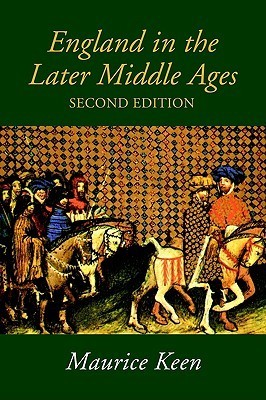
First published to wide critical acclaim in 1973, England in the Later Middle Ages has become a seminal text for students studying this diverse, constantly changing period. The second edition of this book, while maintaining the character of the
Maurice Hugh Keen OBE (30 October 1933 – 11 September 2012) was a British historian specializing in the Middle Ages. His father had been the Oxford University head of finance ('Keeper of the University Chest') and a Fellow of Balliol College, Oxford, and after schooling at Winchester College, Maurice became an undergraduate there in 1954. He was a contemporary and lifelong friend of Tom Bingham, later the Senior Law Lord, as well as of the military historian, Sir John Keegan, whose sister Mary he married.
Keen's first success came with the writing of The Outlaws of Medieval Legend while still a Junior Research Fellow at The Queen's College, Oxford, 1957–1961. He was elected a tutorial Fellow of Balliol in 1961, retaining his fellowship until his retirement in 2000, when he was elected a Fellow Emeritus. He also served as Junior Dean (1963–68), Tutor for Admissions (1974–1978), and Vice-Master (1980–83).
In 1984, Keen won the Wolfson History Prize for his book Chivalry. The book redefined in several ways the concept of chivalry, underlining the military aspect of it.
Keen was elected a Fellow of the British Academy, a Fellow of the Royal Historical Society, and a Fellow of the Society of Antiquaries of London.
Covering the tumultuous period from Edward I through to Richard III, Keen manages to keep the story flowing elegantly while also breaking down the mechanics of society—from the serfs right through to the monarchy itself—in a very comprehensive manner. Maurice Keen’s writing style is very engaging, but if I had to make a knock against this book, it would be that it (inevitably) misses out a lot of important details, and I noticed that the Queens of England barely got a passing mention, most of the time. Still, I would definitely recommend this book to anyone!
An interesting and well-researched guide of English political history from the last days of the reign of Edward 1 until the Wars of the Roses. Covering such a long period it has a tendency to gloss over major events and readers will be drawn to subsequent research into the Hundred Years War and other notable events. Furthermore, the rather narrow focus on political history means a lot is left out. As an introduction, however, it's well-written and engaging.