Ett fartyg färdas nerför Hudsonfloden. Ombord finns Juliet och hennes lilla son på väg mot Sicilien. Det är läkaren hemma i Amerika som ordinerat vila i solen och trots att Juliet inte tror på dess helande kraft, låter hon sig övertalas. Resan för henne bort från den såriga relationen till maken Maurice och det gråa hemlandet. Här finns fullt av citronlundar och sakta omfamnar hon värmen och med den livslusten.
Men kan solen lysa på henne för all framtid eller finns det ett slut? Hon brukade gnida in huden med lite olivolja, ströva en stund i citronernas mörka, underjordiska värld, balansera en citronblomma i naveln och skratta för sig själv. Det fanns en liten risk att någon bonde skulle få syn på henne. Men gjorde han det så skulle han vara mer rädd för henne än hon var för honom. Hon kände till den vita kärnan av rädsla i mäns påklädda kroppar.
Sol är ett poetiskt porträtt av en kvinna som sakta förändras och hittar tillbaka till sina känslor, sig själv och slutligen till fullständig frigörelse. D.H. Lawrence suggestiva skildring av en människas inre publicerades första gången 1926.
Två år senare skapade författarens mest berömda roman, Lady Chatterleys älskare, stor skandal med sitt erotiska innehåll och skildringarna av kvinnlig sexualitet.
Novellen återfinns här i nyöversättning av Erik MacQueen.
Sol är Novellix nr 81. Novellix ger ut noveller i fickformat; nyskrivet och klassiker, en novell per bok. Läs mer på novellix.se
David Herbert Richards Lawrence was an English writer of the 20th century, whose prolific and diverse output included novels, short stories, poems, plays, essays, travel books, paintings, translations, literary criticism, and personal letters. His collected works represent an extended reflection upon the dehumanizing effects of modernity and industrialisation. In them, Lawrence confronts issues relating to emotional health and vitality, spontaneity, human sexuality and instinct.
Lawrence's opinions earned him many enemies and he endured official persecution, censorship, and misrepresentation of his creative work throughout the second half of his life, much of which he spent in a voluntary exile he called his "savage pilgrimage." At the time of his death, his public reputation was that of a pornographer who had wasted his considerable talents. E. M. Forster, in an obituary notice, challenged this widely held view, describing him as "the greatest imaginative novelist of our generation." Later, the influential Cambridge critic F. R. Leavis championed both his artistic integrity and his moral seriousness, placing much of Lawrence's fiction within the canonical "great tradition" of the English novel. He is now generally valued as a visionary thinker and a significant representative of modernism in English literature. http://en.wikipedia.org/wiki/D.H._Law...
This was a short story from D.H. Lawrence that certainly wasn't his best, but the beautifully evocative language made it quite delightful to read. A woman is prescribed open space and plenty of laying out in the sun by her doctor, possibly in a hope to improve her mental health state.
It is written from her perspective, which I enjoyed, and we learn her lusts and desires, which probably raised a few eyebrows when this was first published, but thankfully now it is common knowledge that women enjoy sex, too. This story wasn't as erotic as I'd hoped, though.
While the language is typical D.H. Lawrence, I failed to really love the story itself. I feel like it had problems developing, and quite honestly, it was too short for my tastes.
An interesting story of a New York wife and mother whose doctor prescribes nude sun-bathing. Mother and infant son depart for Sicily, leaving father and husband behind in New York. As her body responds to the healing rays of the sun, she experiences unexpected emotions.
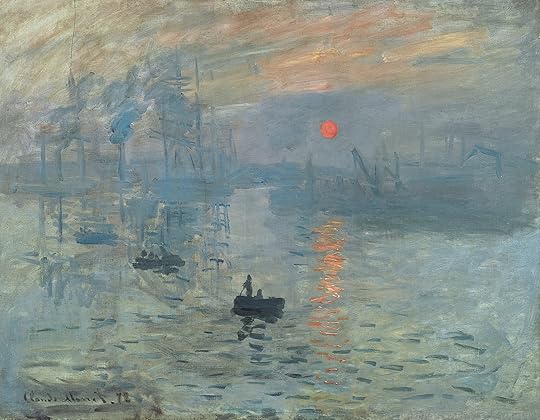
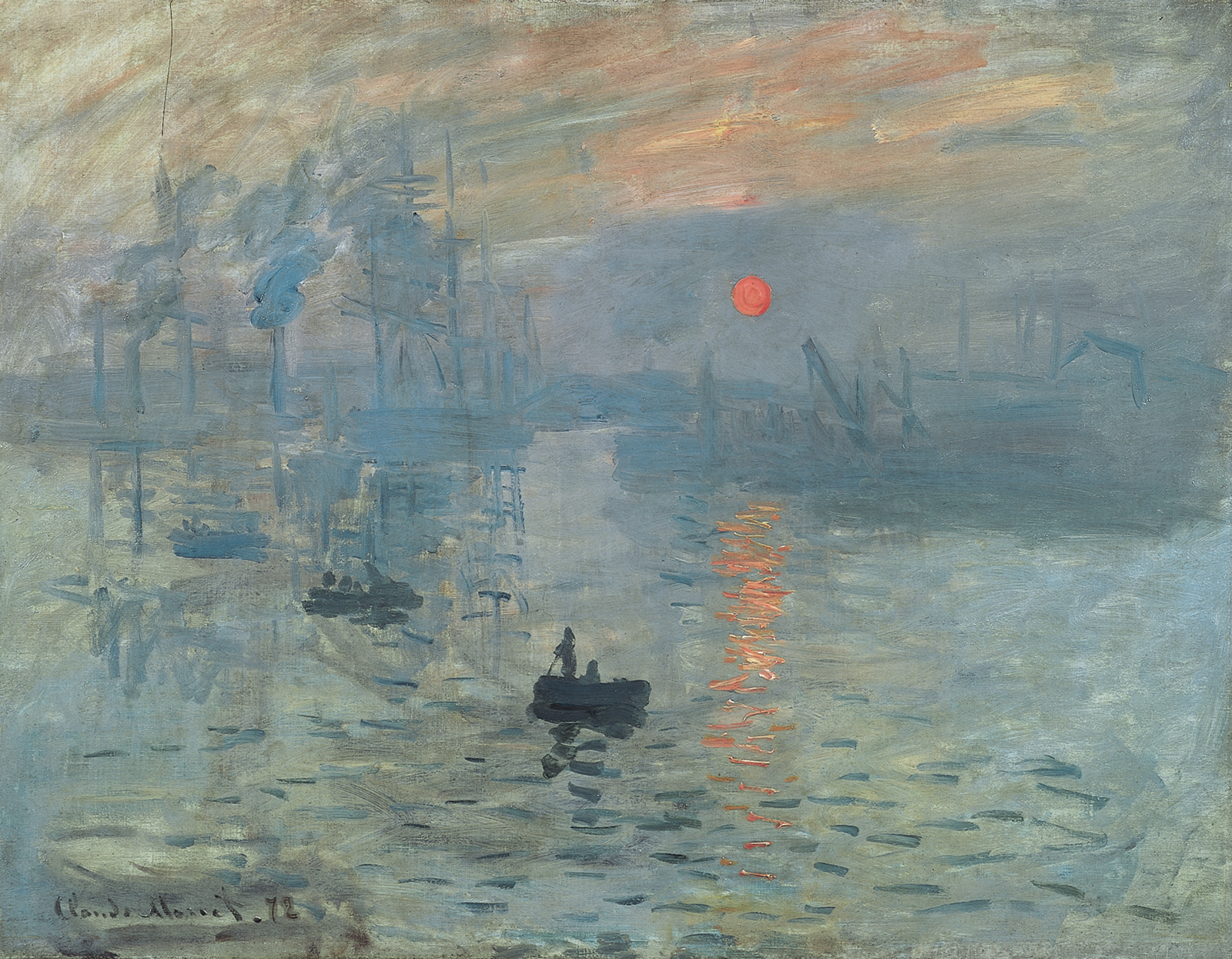
Monet’s “Impression, Sunrise” gave the title to a movement. But the dominant colours are not red, yellow and gold, but blue.
This short story conjures a powerful impression of carnal awakening from intimate communing with the sun. The significant colour is blue, not just of eyes, the sea, and the sky, but of the sun itself, and especially the flames that stream from it. The flames that alight on Juliet, light her, warm her, melt her, mould her, penetrate her innermost self. Resistance is futile. Resistance is rejected. She acknowledges her needs and desires, even as she realises how they are constrained by temperament and society.
Once again, I willingly, eagerly, submitted to the naturalistic but elliptically fiery passion of Lawrence’s words.
As I read this, the sun was shining, but the wind was bitter. I’ve become more sensitive to cold in recent months. I yearn for the sun, not just its cheering light, but its deep, penetrating warmth. The words on the page were an uplifting simulacrum for Juliet’s rebirth.
Story by Quotes
On arriving at this beautiful place: "She saw it all, and in a measure it was soothing. But it was all external... She herself was just the same... her incapacity to feel anything real."
Things change from the first sunrise she sees there, as if it's the first sunrise she's ever seen: "The sun lifted himself molten and sparkling, naked over the sea's rim... shaking the night off himself, like wetness. And he was full and naked. And she wanted to come to him."
She keeps seeing blue in the sun: “He rose all molten in his nakedness, and threw off the blue-white fire, into the tender heaven.” "his blue pulsing roundness, whose outer edges streamed brilliance."
Over several days or weeks, she develops an intense connection with the sun: "She could feel the sun penetrating into her bones; nay, further, even into her emotions and thoughts." "Her weary, chilled heart was melting." (Her womb also gradually ceases resistance, and begins to unfold like a lily.)
Sharing: "She knew the sun in every thread of her body... And though he shone on all the world, when she lay unclothed he focussed on her" so she had “a feeling of detachment from people”.
Acceptance: "Beautiful or not, she felt that by the sun she was appreciated. Which is the same." "Something deep inside her unfolded and relaxed... her conscious self was secondary. The true Juliet lived in the dark flow of the sun within her deep body."
Notes on the Story
Juliet is despatched to Italy for "sun baths" - naked sunbathing. She seems to be suffering from post-natal depression, and she and her husband were “Like two engines running at variance, they shattered one another”. So “She permitted herself to be carried away.”
For me, this was all about the sun. But there is Biblical imagery if you want it. in this Paradisiacal garden, Juliet leaps “quick as a serpent” and later, there is a literal snake. No apples, but there are pears. And an attractive peasant with an ass that may also be attractive - though the word choice may not have been purely Biblical. ;)
I didn’t like the ending, because it’s sadly plausible for the time - perhaps even, for now.
Notes on the Picture
Impressionists often put specks of contrasting colours next to each other to create the impression of another. Radical then, though less so to those of us familiar with pixels and screens.
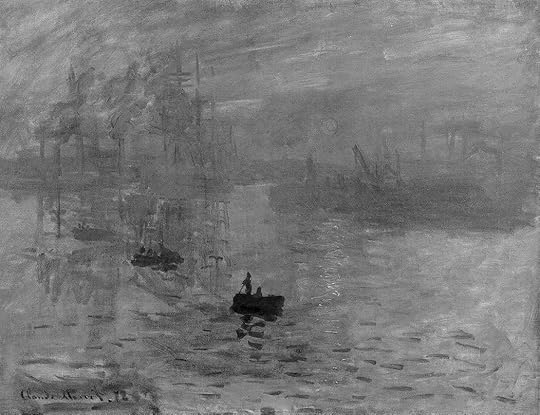
With “Impression, Sunrise”, if you measure the brightness of different areas of the canvas with a photometer, or just look at it in black and white, the sun is barely visible, because it is no brighter than the rest of the painting. See Luminance.
PG / R Alternative
For a less sexual version of the awakening power of Italian sun on body and soul, see Elizabeth von Arnim’s Enchanted April, reviewed HERE.
This is a strange story of the conflict between a woman's desire and her sense of responsibility and willingness to accept fate. It plays out almost entirely within her soul, without any outward expression of the conflict. Very interesting and again, astonishing how much can be said (or written) in so few pages.
Compliments to Erik MacQueen for this brilliant translation into Swedish!
About how some solitary time with the sun changes a woman's self perception and the people in her life. I read this in college and it made a huge impact on me.
En av de bättre novellerna publicerade av Novellix.
Lawrence har ett intressant sätt att arbeta med gränser på i Sol. Dels finns där en väldigt tydlig skildring av konflikten mellan själ och kropp. Dock är det inte fullständigt klart vad som utgör kroppens medium och vad som utgör själens. Skillnader mellan kvinna och man, barn och vuxen, natur och civilisation är också tydligt presenterade. Trots att den mest uppenbara tolkningen av denna novell är om kvinnans uppgörelse med sin biologiska givenhet, dvs att vara förmögen att bära avkomma, finns det där en annan tolkning att göra enligt mig. Man kan läsa solen som ett slags kontakt med det andliga, det högre. Jag ser det absolut som ett försök att skriva sig fram till ursprunget som idé. Hur kommer man i kontakt med det som är människan innan hon sugs upp av civilisationen? Hur förhåller sig individen mellan det kultiverade och det biologiska? Kan hon utan kompromiss välja båda? Vilka konsekvenser uppstår då hon faktiskt väljer det ena över det andra? Lawrence använder sig av kvinnans starka koppling till fortplantningen, inte som ett sexuellt begär, utan som den nödvändiga driften att låta "lotusblomman" öppna sig på ett intressant sätt. Juliet drivs mellan att vilja låta sig befruktas och föda ett nytt barn och att känna sig tyngd inför det ansvar som läggs på modern (betänk även hur det ansvaret måste sett ut då novellen publicerades). Detta slutar i en modern, men också ytterst antik (Lawrence refererar t.o.m. till Perseus i sista meningen), tanke om att det inte går att bryta sig loss från ödets makt. En nog så sann insikt vilken vi, enligt mig, allt för sällan vill kännas vid i den tid vi själva lever i idag.
This entire review has been hidden because of spoilers.
I had no idea what I was about to read going in. It's a woman who's horny about the sun. Also the next door peasant, but most of all the sun. I think if you make a drinking game out of how many times the words "breasts" and "womb" are written you can kill someone. They're characters of their own, when she turns towards the sun it's very often talked about as if the breasts standed for her entire being. Her womb kept being mentionned as something opening up? I don't really get the praise on the writing style of this one, it's extremelly repetitive and unimaginative. Someone said it was cool that the point of view was that of a woman - is it really?? Like, yeah, the narrator is a woman, but you can feel the man behind every single word that describes her. We don't know how her face is, what she likes besides the sun, but we know that her breasts are pointy. Alright. I get that there's themes throughout, about the nature of humans and to rekindle with the world around us and whatnot, a woman's desire versus her obligations as a woman in society tm. All of that could've been achieved without mentionning her breasts and womb every two line is all that I'm saying.
Novellen är väldigt sensuella & sexuellt laddad då man får följa en kvinnliga huvudkaraktär tankar kring lust & sex & åtrå.
Huvudkaraktären ordinerad av läkare att vitsas i solen för att bli friskare & gladare förmodligen mot mental hälsa.
Det som är unikt med novellen är att skrivit ur en kvinnas perspektiv att hon brottas med sina inte tankar & känsloliv kring sin åtrå & sexualitet på ett icke normgivande sätt. Jag förstår varför novellen ansågs under sin tidsepok att vara kontroversiell & normbrytande & annorlunda. Nu är det snarare mer normaliserat att kvinnan är en aktiv sexuell varelse precis som mannen.
Det som är bra med novellen är att tempot är lagom. Dock lyckas jag inte få någon vidare känsla för huvudkaraktär då hen är avtrubbad i sitt moderskap till en början (säkerligen förlossningsdepression). Novellen tar liksom aldrig riktigt fart & avslutet blir vad som förväntas av kvinnans roll & ställning. Jag hade önskat ett oväntat slut. Därför ger jag novellen betyget tre av fem.
För mer info om mig & mina bokrecension följ FruLuleHamilton på instagram för en kreativ bild till bokrecension.
This is like when a turbo-normie white woman goes to Bali and thinks herself as spiritual and shit cause she paid for some overpriced, overwashed, over-gentrified Yoga sessions set up by some Ruskies who have been welcomed by buck-broken Balinese who calls for Total Jawa Death because of that one bombing done by a Malaysian despite letting themselves be anally gapes by those damned foreigners.
Vet ej vad jag tycker. Jag har lite svårt att komma i stämning när jag läser så korta verk. Jag behöver lite mer tid på mig för att komma in i historien och karaktärerna. Jag får läsa om dom en gång till så får jag nog en annan uppfattning om dom.
A story about man-woman relationship, both bound by circumstances of born to riches, woman finding freedom through sunbathing in the nude. She knows she will not find her freedom with a peasant
D.H. Lawrence’s short story Sun explores the sensual awakening of a woman through her connection with nature, particularly the sun. The story follows Juliet, a woman prescribed sunbathing to restore her vitality, both physical and emotional. As she spends her days under the sun's rays, she experiences a profound transformation, feeling liberated and connected to her deepest desires. Her bond with the sun becomes almost spiritual, as it penetrates her mind and body, reviving parts of herself long repressed by societal expectations and her marriage.
The story is rich with Lawrence’s evocative language, vividly describing Juliet’s communion with the sun and her gradual release from her emotional numbness. The recurring imagery of blue, from the sky and the sea to the fiery core of the sun, reflects Juliet’s personal journey. She is drawn to the sun’s powerful energy, which melts her internal resistance and stirs her sensual desires.
The plot itself feels somewhat underdeveloped, and the brevity of the story leaves certain elements unexplored. Readers are introduced to Juliet’s inner world and desires, which may have been quite provocative when the story was first published, but today feel more familiar in their themes of female sexuality and self-discovery. The story, while suggestive, doesn’t fully embrace the erotic potential that it hints at, leaving some readers wanting more.
The ending brings Juliet back to reality with the arrival of her husband, symbolizing a return to the constraints of respectability and societal norms. It’s a plausible conclusion, reflecting the time period’s limitations on women’s autonomy, but it also feels like a retreat from the freedom Juliet had begun to taste.
I wasn't really prepared what was about to happen because I did't read the text on the back and I was little bit shocked. There is not a lot happening and I thought it was a little bit boring to be honest.