

What do you think?

The Gospel-Centered Life: Study Guide with Leader's Notes
The Gospel-Centered Life by World Harvest Missions Bob Thune and Will Walker is a nine-lesson small group study to help participants understand how the gospel shapes every aspect of life. The Gospel-Centered Life will challenge you to develop authentic relationships as the gospel moves you to love and serve others. Each lesson is self-contained, featuring clear teaching from scripture and requires no extra work outside of the group setting. Developed by experienced church-planting pastors, the material is designed to promote transformational conversations among groups of mature Christians, new Christians, and even non-Christians. The self-explanatory The Gospel-Centered Life Leader's Guide contains directions and added material to help small group and discipleship leaders clearly explain and apply the material.
118 pages, Paperback
First published October 31, 2011
About the author
Robert H. Thune
21 books10 followersRobert H. Thune, MA (Reformed Theological Seminary), is the lead pastor of Coram Deo, a gospel-centered church he planted in 2005 in Omaha, Nebraska. He is the coauthor of The Gospel-Centered Community, another Christ-centered small group study. Bob and his wife Leigh have four children.
Ratings & Reviews
Friends & Following
Create a free account to discover what your friends think of this book!
Community Reviews
Displaying 1 - 22 of 22 reviews

May 19, 2015
This was an excellent book for my small group and led to a lot of small group discussion. My reason for the 3 stars is because I found the wording of the book to be problematic. It is titled "The Gospel-Centered Life", and it seems that the author uses the word Gospel as much as possible even to the point of disagreeing with the Bible.
The author attributes things to the Gospel that the Bible attributes to grace and to the work of the Holy Spirit. I read this book in a group of believers who are solid in their knowledge about the Bible, and that allowed us to dismiss these things and discuss them as the results of grace and the Holy Spirit (rather than the result of “The Gospel”.)
My concern is that someone who is not well grounded in their Bible knowledge will read this book and be misled. Some of the book comes across as stating that simply because of the Gospel our lives should be radically different from non-believers. While technically true, it is the work of the Holy Spirt that effects that change. The book mentions the work of the Holy Spirit in some chapters, but others seem to indicate that we should be able to live the Christian life on our own apart from the work of the Spirit simply because of “The Gospel.”
The author attributes things to the Gospel that the Bible attributes to grace and to the work of the Holy Spirit. I read this book in a group of believers who are solid in their knowledge about the Bible, and that allowed us to dismiss these things and discuss them as the results of grace and the Holy Spirit (rather than the result of “The Gospel”.)
My concern is that someone who is not well grounded in their Bible knowledge will read this book and be misled. Some of the book comes across as stating that simply because of the Gospel our lives should be radically different from non-believers. While technically true, it is the work of the Holy Spirt that effects that change. The book mentions the work of the Holy Spirit in some chapters, but others seem to indicate that we should be able to live the Christian life on our own apart from the work of the Spirit simply because of “The Gospel.”

February 17, 2018
Buenisimo para leer en equipo

May 19, 2017
While it does at times feel repetitive, this book is a fantastic explanation and guide in how to practically walk out living a Gospel centered life. Highly recommended for small groups, though you will struggle to fit the content of each lesson into a single 1 hr meeting - we often took 2 weeks to go through a lesson. The last chapter on conflict resolution really helped me understand a right way to engage with others in resolving conflict and approaching life in general.

January 13, 2019
I led a study based on this book about two years ago and it was a major success in terms of bringing spiritual depth based on the Gospel to teenagers. It's simple, but not simplistic. It's deep but not too difficult to grasp. In short, if you can get a hold of this book for an in-depth study about the implications of the Gospel in the day-to-day life, by all means, please do so.

November 15, 2017
A helpful small-group study on the practical implications of the Gospel.

December 13, 2017
I had high expectations based on what friends said about the book, which taints my rating. Useful bit not “life changing” as it was described to me.

March 6, 2018
Went through this study with Christ Church Conway. It was very helpful in almost every chapter. An exception has to be made of chapter 7 due to a poor misapplication of Galatians 5.

July 25, 2018
This study is well suited for a church group or leadership setting. I did not enjoy it in my small Mom Bible study setting and didn't feel it pertained to where I'm at in life

August 7, 2019
Helpful. Good group study resource.
March 25, 2020
I've read this just about 4 times now, very good read! The creators of this book do a good job of taking complicated christian principles and simplifying them.

May 30, 2023
Excellent book. Highly recommend.

June 8, 2023
Encouragement for the joruney to being more gospel-focused

March 27, 2024
Great reminder of the basics for my faith. It would be a great book for the new believer
November 21, 2015
This series of books is intentionally very entry-level (as far as explaining the Gospel goes), but that does not mean that it is fluff or unbiblical. The theology is very solid. The books are intended for group-discussion. I would recommend group leaders not be too tied to the “lesson plan” (get your nose out of the book and don’t read the plan out loud to people while you are leading them… prepare beforehand and just use the lesson plan as a basic guide for the discussion… feel freedom to skip questions or pick the 3-5 questions that you think would be most beneficial for your group). If you lead a group through Gospel-centered Life followed by Gospel-centered Community and it goes well, then consider following that up with the Gospel Trilogy by World Harvest Mission (Book 1: Gospel Identity, Book 2: Gospel Growth, and Book 3: Gospel Love).

August 7, 2013
We did this as a small-group home Bible study. The readings are short but impactful. It lead to good discussion. If you do the homework/answer the questions, you'll really have to dig deep within yourself and be more honest about yourself and your sin than anyone probably wants to be (I know that was the case with me). But it's really good to take a hard look at yourself and see how your life lines up with what God wants from us.

March 27, 2012
Used for young adults fellowship group. Nine lessons on seeing the relevance of the Gospel for life, with Bible discussion, helpful articles and discussion questions. Doctrinally solid and relevant. Recommended.

February 23, 2012
This study was excellent. It was not complicated, yet it was not simplistic. It provided thought-provoking questions, and I would highly recommend, especially for new Christians.
November 16, 2014
Great book for a small group and to elicit discussion.

June 26, 2025
Applicable, simple to read, thought provoking
Good for individuals to read or groups to discuss
Good for individuals to read or groups to discuss

January 23, 2016
Excellent!

March 27, 2017
This study had some thought-provoking and convicting lessons. Obviously, the point is to get more "meat" from the group discussions, but I would have like more in the lessons themselves.

May 22, 2017
This is a packed little book. It is rightly marketed as a study guide but its more than that. The format of the 9 chapter book is that each lesson has a Big Idea, an article, a supplemental article, and then an exercise. There is also a leader's guide with additional discussion questions for each chapter.
But what I was most interested in were the articles for each chapter. These 5-7 page articles are absolutely packed. Bob Thune has been marinating on these ideas for year and in my judgment, this is the best biblical treatment of "Gospel Centered Living" that I know of. The content itself is good, but I was especially impressed with the organization and structure of how he builds the case for Gospel-Centered Living.
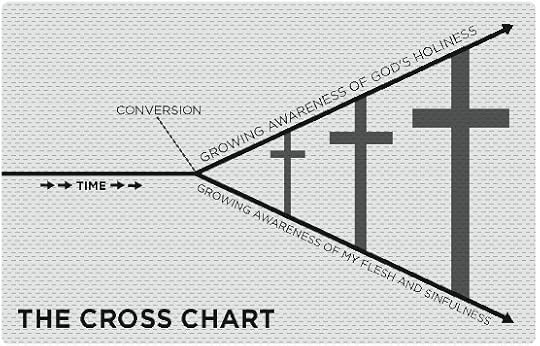
A central tool from this book is the well known Cross Chart (or Gospel Grid) which is the most helpful diagram I've ever used in my ministry. I have expounded upon it in my ministry in numerous ways to illustrate many other abstract ideas. If you aren't familiar with it, it alone is worth the price of the book.
Part of me wishes that Thune would publish a fuller treatment on the subject, but I love how article force authors to get to the point. For now, this is the standard book to expound on what is meant by "Gospel Centered Living."
But what I was most interested in were the articles for each chapter. These 5-7 page articles are absolutely packed. Bob Thune has been marinating on these ideas for year and in my judgment, this is the best biblical treatment of "Gospel Centered Living" that I know of. The content itself is good, but I was especially impressed with the organization and structure of how he builds the case for Gospel-Centered Living.
A central tool from this book is the well known Cross Chart (or Gospel Grid) which is the most helpful diagram I've ever used in my ministry. I have expounded upon it in my ministry in numerous ways to illustrate many other abstract ideas. If you aren't familiar with it, it alone is worth the price of the book.
Part of me wishes that Thune would publish a fuller treatment on the subject, but I love how article force authors to get to the point. For now, this is the standard book to expound on what is meant by "Gospel Centered Living."
Displaying 1 - 22 of 22 reviews