Four years ago, Kosaku pulled off an astounding upset in his pro test by KO'ing a big-time boxer. More than simply sending his opponent down for the count, Kosaku also managed to mangle this pretty-boy fighter's teeth in the process. Now this toothless tyrant is ready for a rematch, but can Kosaku drop down an entire weight class to qualify for the bout? It is said that the weight of a fighter's punch comes down to how hard he grips his fist, but will Kosaku ever get a grip on his pre-fight snacking?
Rumiko Takahashi (高橋留美子) was born in Niigata, Japan. She is not only one of the richest women in Japan but also one of the top paid manga artists. She is also the most successful female comic artist in history. She has been writing manga non-stop for 31 years.
Rumiko Takahashi is one of the wealthiest women in Japan. The manga she creates (and its anime adaptations) are very popular in the United States and Europe where they have been released as both manga and anime in English translation. Her works are relatively famous worldwide, and many of her series were some of the forerunners of early English language manga to be released in the nineties. Takahashi is also the best selling female comics artist in history; well over 100 million copies of her various works have been sold.
Though she was said to occasionally doodle in the margins of her papers while attending Niigata Chūō High School, Takahashi's interest in manga did not come until later. During her college years, she enrolled in Gekiga Sonjuku, a manga school founded by Kazuo Koike, mangaka of Crying Freeman and Lone Wolf and Cub. Under his guidance Rumiko Takahashi began to publish her first doujinshi creations in 1975, such as Bye-Bye Road and Star of Futile Dust. Kozue Koike often urged his students to create well-thought out, interesting characters, and this influence would greatly impact Rumiko Takahashi's works throughout her career.
Career and major works:
Takahashi's professional career began in 1978. Her first published story was Those Selfish Aliens, a comedic science fiction story. During the same year, she published Time Warp Trouble, Shake Your Buddha, and the Golden Gods of Poverty in Shōnen Sunday, which would remain the home to most of her major works for the next twenty years. Later that year, Rumiko attempted her first full-length series, Urusei Yatsura. Though it had a rocky start due to publishing difficulties, Urusei Yatsura would become one of the most beloved anime and manga comedies in Japan.
In 1980, Rumiko Takahashi found her niche and began to publish with regularity. At this time she started her second major series, Maison Ikkoku, in Big Comic Spirits. Written for an older audience, Maison Ikkoku is often considered to be one of the all-time best romance manga. Takahashi managed to work on Maison Ikkoku on and off simultaneously with Urusei Yatsura. She concluded both series in 1987, with Urusei Yatsura ending at 34 volumes, and Maison Ikkoku being 15.
During the 1980s, Takahashi became a prolific writer of short story manga, which is surprising considering the massive lengths of most of her works. Her stories The Laughing Target, Maris the Chojo, and Fire Tripper all were adapted into original video animations (OVAs). In 1984, after the end of Urusei Yatsura and Maison Ikkoku, Takahashi took a different approach to storytelling and began the dark, macabre Mermaid Saga. This series of short segments was published sporadically until 1994, with the final story being Mermaid's Mask. Many fans contend that this work remains unfinished by Takahashi, since the final story does not end on a conclusive note.
Another short work left untouched is One-Pound Gospel, which, like Mermaid Saga, was published erratically. The last story to be drawn was published in 2001, however just recently she wrote one final chapter concluding the series
Later in 1987, Takahashi began her third major series, Ranma ½. Following the late 80s and early 90s trend of shōnen martial arts manga, Ranma ½ features a gender-bending twist. The series continued for nearly a decade until 1996, when it ended at 38 volumes. Ranma ½ is one of Rumiko Takahashi's most popular series with the Western world.
During the later half of the 1990s, Rumiko Takahashi continued with short stories and her installments of Mermaid Saga and One-Pound Gospel until beginning her fourth major work, InuYasha. While Ran
Secondo volume di One Pound Gospel, e poco si muove sotto la superfice stagnante del rapporto tra questi due simpatici stupidotti. Lui rimane un inconcludente babbeo anche se comincia ad avere dei momenti di orgoglio, lei comincia a domandarsi se dietro tutto questo incoraggiamento da parte sua non ci sia forse un sentimento di amore che sta nascendo nel suo cuoricino. Questi sentimenti ci vengono fatti notare non solo dalla madre superiora, che sembra dotata dell’incredibile capacità di notare le ovvietà (“c’è un ragazzo che viene sempre a trovarti e ti guarda con gli occhioni che brillano, provolando sfacciatamente con te in piscina, secondo me ci sono piccole possibilià che tu gli piaccia”), ma anche dal fatto che se nel primo volume costei veniva spesso ritratta intenta a parlare al crocefisso gigante della chiesa modello Don Camillo, in questo secondo volume sì, parla con dio e lo prega come sempre di aiutare Kosaku nei momenti di crisi, ma latitano le chiacchierate con la sua emanazione fisica e corporea. Segno che ha qualcosa da nascondere al suo futuro sposo divino.
In questo secondo numero cominciamo a capire che Angela non è una suora solitaria che gestisce da sola la chiesa ma, sembrerebbe, fa parte di un gruppo di simpatiche suore-yakuza, armate di ramazze di paglia con le quali fanno spezzatino degli uomini che osino insidiare le loro novizie, le quali vivono nel suddetto convento. Per la prima volta vediamo suor Angela interagire con altre suore che le rammentano quali sono i suoi doveri come suora, e le fanno capire che il comportamento che tiene Kosaku nei suoi confronti è a dir poco inopportuno. Rimangono da spiegare misteri che presumo rimarranno irrisolti quali: come fanno in una vignetta di questo volume a celebrare una messa se non si vede ombra di un prete da nessuna parte? Le suore in Giappone possono andare in piscina in costume da bagno (espediente che permette a Kosaku di guardare per la prima Suor angela senza scafandro divino)? Ma che minchia di dieta è una che non ti permette nemmeno di bere dell’acqua dopo che ti sei sudato l’anima per ore tra corsa, pugni e incontri di allenamento sul ring (cioè lo so che disidratarsi serve a perdere peso più in fretta, ma questi stanno male nel cervello)?
Wow this series has really turned around for me in this volume. I am loving it! I am curious where the series is heading. Either way I think this series will have something interesting to say. I recommend it if you're a fan of Takahashi!
Classic Takahashi art with a quirky storyline. All this sports action gets my heart racing! More exciting boxing matches than volume one. Oh Kosaku, will you ever give up your gluttonous ways and end up the champion with Sister Angela at your side?
Ever since finishing Maison Ikkoku, which I love, I've been itching to read more of Takahashi's work; alas, she's mostly known for the impossibly long Inu-Yasha and the equally impossibly long Ranma 1/2. I just can't commit to that sort of unending series, so the decades-in-the-making conclusion to the four-volume One Pound Gospel series seemed the perfect chance to read more of her work.
I kind of see why it took so long to finish - it probably didn't hold her attention very well. Kosaku's a young boxer who loves eating and has trouble maintaining his training regimen. Sister Angela's a young nun-in-training. They like one another, but she's a nun; Kosaku has a fight, but keeps sneaking away to eat food. Repeat for two books with little variation except for opponents for Kosaku who are more interesting than either he or Angela.
By volume three, Takahashi starts to finally explore Sister Angela, and Kosaku starts to develop a little depth beyond his typical food/training dichotomy. The characters are likable enough, and by the end of vol. 4, you're happy to see them achieve what they hope for - but it could've been stronger. Takahashi never explores Angela's faith - outside of occasional prayers for strength for herself or Kosaku, we NEVER see any indication that her faith is central to her life, nor does she EVER speak of God/Jesus - so the ending is obvious from the get-go. You never feel that unseen, unfelt, barely mentioned God is any competition for Angela's heart.
Still, it has some moments - though half or more of those belong to Kosaku's rival boxers! - and the art's nice.
between One-Pound Gospel, the film BLUE, and the television drama 10 Count to the Future, I've discovered this year that I love boxing media.
man. rumiko takahashi was on the most insane hot-streak through the late 80s into 2000s. from the conclusion of Maison Ikkoku and all through Inuyasha, nobody was doing it like her. so much output out of just one skilled storyteller, how generous she was to give every guy like me such an impressive backlog of work to enjoy. I've been reading her work since I was eleven years old, and I've still got so much left to experience!
Bakat saja tidak cukup menjadikan seseorang berhasil dalam hal yang dia tekuni. Butuh sedikit kemujuran juga. Setidaknya itulah yang dialami oleh Hatanaka ketika ia harus kembali turun ke ring. Masih tetap dengan gaya khasnya, Rumiko Takahashi kembali menghibur lewat kocaknya dunia olahraga tinju di Jepang.
Weird premise (rom-com about a novice nun and a boxer who struggles to stay in his weight class) tempered by Takahashi's charming art style and perfect comedic timing. Worth a look if you like her other titles but not one I'd rush to recommend.
actually is 4.5 of 5. HATANAKA-KUN, THANKS FOR MADE KURUSU STAND FOR HIMSELF! YOU ALSO MADE IT!!! I KNOW YOU COULD! YOU LOVED BOXING SO MUCH! But, you could stop for binge eating when you sad after rejected and kind of wanted food so much, Hatanaka-kun XDDDD
Kosaku is still stuck in his binge-eating cycle while fawning over Sister Angela and failing his boxing matches. This volume was better than the first one. It was entertaining.
I like this manga a lot, but not so much to become a fan, so it is actually 3.5 stars. At least, when I am reading it, I don't get distracted with other stuffs, so it means that it is very entertaining.
Kosaku is a very likeable character, and his struggle with the food is understandable. Poor guy! And he is in love with a nun. At least he enjoys fighting a lot.
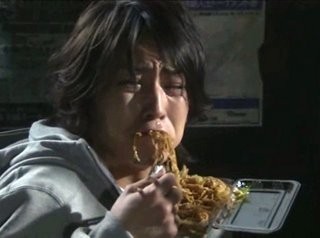
Funny and creepy when he was dealing with Sister Angela's rejection, eating and crying. I remembered this image from the dorama, although I did not watch it yet.
And seeing how cute he is 'in real life', I cannot help to like him even more. I mean, just look at this face, It shouts 'kawaii'.
Okay officially in love with this story and characters and art !! Basically everything!! I am appreciating every page of this manga since it's only four volumes!
1. Who knew steak was the think that powered up Kosaku!!
2. If they used food as an incentive he will a champion!
3. Matsuzaka is the best! HE HAS A WORK FACE AND HIS EVERY DAY FACE! I wish I had that too!
4. Also I liked matsuzaka's hair at work, all gel-ed up!
5. The next arc is Kosaku VS Kusuru! Followed by a new development between Kosaku and Angela!
6. I legitimately thought that Kosaku would win the fight against Kusuru so finally Angela and him can start dating but he lost he fight.. because he crossed himself 🤣
7. Angela's short hair is goals tbh.
This volume made me want to read Rumiko sensei's other work Maison Ikkoku😻
lately this manga is what gets me through the day, glad that i bought this one, the art is flexible the story is funny and balanced plot; something i will rarely ever find. god bless Rumiko sensei*^*