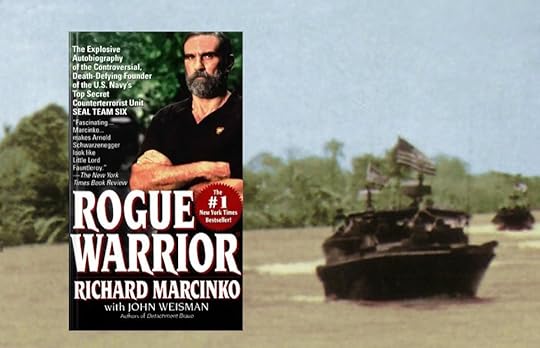
A brilliant virtuoso of violence, Richard Marcinko rose through Navy ranks to create and command one of this country's most elite and classified counterterrorist units, SEAL TEAM SIX. Now this thirty-year veteran recounts the secret missions and Special Warfare madness of his worldwide military career - and the riveting truth about the top-secret Navy SEALs.
Marcinko was almost inhumanly tough, and proved it on hair-raising missions across Vietnam and a war-torn world: blowing up supply junks, charging through minefields, jumping at 19,000 feet with a chute that wouldn't open, fighting hand-to-hand in a hellhole jungle. For the Pentagon, he organized the Navy's first counterterrorist unit: the legendary SEAL TEAM SIX, which went on classified missions from Central America to the Middle East, the North Sea, Africa and beyond.
Then Marcinko was tapped to create Red Cell, a dirty-dozen team of the military's most accomplished and decorated counterterrorists. Their unbelievable job was to test the defenses of the Navy's most secure facilities and installations. The result was predictable: all hell broke loose.
Here is the hero who saw beyond the blood to ultimate justice - and the decorated warrior who became such a maverick that the Navy brass wanted his head on a pole, and for a time, got it.
Richard Marcinko is the author of the Rogue Warrior thrillers and is a living, breathing hero honored with the silver star and four bronze stars for valor, along with two Navy Commendation medals and other honors. After serving in Vietnam, he went on to start and command SEAL Team 6, the Navy's anti-terrorist group, and Red Cell, a high-level anti-terrorist unit. Marcinko keeps his hand in the field as the president of a private international security company and now lives in Warrington, Virginia.
I’ve wanted to read “Rogue Warrior” by Marcinko for a couple of years. The man has a larger than life reputation, and I’ve read a little of his fictional collaborations that have been described as “the Marcinko style”, which appeared sarcastic and hard-edged at the same time. I also knew a thing or two about “Demo Dick” (forming SEAL Team Six, running Red Cell, etc.), but that was about it. So as a final venture into the realm of nonfiction military memoirs (following up on a couple of Gary Linderer’s books), “Rogue Warrior” seemed a logical place to go.
SUMMARY Richard Marcinko describes his life, from his youth, his decision to join the Navy, training for and joining the Underwater Demolitions Teams (UDTs), volunteering for SEALs once he heard they were going to Vietnam, his two six-month tours in Vietnam (very briefly described), his assignments afterwards (including as commander of SEAL Team Two), the genesis of SEAL Team Six and his command of it (an “elite of the elite” counter-terrorism force), his formation of “Red Cell”, an American “terrorist” opposing force that tested vulnerabilities in America (including our nuclear submarines and Air Force One), and finally being sent to prison after a witch hunt run by the various enemies he made in the Navy over the years.
OVERALL: 3.8 out of 5 I read this book in two and a half days and loved every page of it.
For one thing, it was a refreshing look at the military for me. Most of the stuff I’ve read are Army accounts, and this is a Navy man who covers Vietnam, counterterrorism of the 1970s, and his own “terrorist” team in the 1980s. It’s a panoramic of American Special Operations in the latter half of the 20th century.
I’ve heard Marcinko described as boastful (I don’t know if there are any special operations people who aren’t, isn’t it kind of a requirement when you’re asking to do impossible and unthinkable things?), difficult, bombastic, and a host of other things, but I have yet to hear or read a single good argument to refute the claims he makes in this book.
For one thing, for a boastful man who seems full of himself (as I’ve heard another reviewer describe him), he spends very little time extolling his own exploits. On his first six months in Vietnam, he reports a kill score for his squad (not himself) of 26 or something. That isn’t some wild “We killed 500 VC!” Rambo claim.
He freely admits that though he founded SEAL Team Six, he did not participate in one hostile action with them. The closest they came was an advisory operation to the American embassy in Beirut, and he never shot a single person.
In short, while the man was BUSY, he actually doesn’t make outrageous claims. And no one refutes that he founded SEAL Team Six or the Red Cell. This man did it all, and if he loves talking about drinking hard, partying, and cheating on his life, well it’s his book. You can always put it down if you want.
Personally, I loved the perspective of this guy. Is he hard to like sometimes? Absolutely. I think I would like him more now that he’s an older man and has probably mellowed out a little... but like the things SEALs are tasked to do, it doesn’t actually matter if you like him. You just need to appreciate what this man did for his country... and the fact that he did it all with a gigantic grin on his face nearly the entire time.
RATINGS BY CATEGORY CHARACTERS: 3 out of 5 Being nonfiction, characters aren’t judged as much on how “good” they are, but on how well real people carry to the page. Marcinko mentions names (most appear to be aliases to protect identities), but no one is really developed except for him. About halfway through the book, the reader does begin to see a “core” of individuals that he keeps using in his operations, and his pure love for these troops really does begin to shine through. You understand that they’re all capable killing machines who love to party hard and train harder. I wouldn’t say they become fully fleshed out “characters”, but you understand where they are and how they are real. It’s an interesting look into people that the author obviously knows very well.
PACE: 5 out of 5 This book is brief. Due to the length, Marcinko can’t spend a ton of time talking about every detail of his life, his kids, the training, the jokes, etc. It is a very busy life of forty or fifty years encapsulated down to 416 pages, and those pages are easy to turn. Marcinko never bores the reader with the boring parts of his life, and you know he’s only giving you some of the best, juiciest stuff (at least that he was allowed to talk about).
I read this book in two and a half days.
STORY: 5 out of 5 Dick Marcinko is basically the type of person that all of the tough guy, Hollywood muscle men who blew up communists in 1980s action movies is based upon. He served in Vietnam, founded SEAL Team Six and Red cell, and is one of the founding fathers of counterterrorism operations in the United States. Even if you don’t believe his stories (and you should, in my opinion), this is an entertaining and informative book that I will read again.
DIALOGUE: 3 out of 5 Marcinko doesn’t devote a lot of time to “modern equivalents of what was said”, but does provide important conversations in his life. Many people have complained about the profanity, but the guy is a sailor! I don’t think it’s there for shock value, I think it’s there as an example of how people in the Navy (namely crusty master chiefs) actually talk.
STYLE/TECHNICAL: 3 out of 5 There were a lot of typos in the copy of the book I read, but that doesn’t seem uncommon to Kindle editions. I never had a problem understanding what he was saying, and I was never confused about what was going on.
Is there a “Marcinko style”? Maybe in his later books, but this one is actually pretty straight forward. The layout (beginning with a training operation for SEAL Team Six, going back to his youth and then catching up to the beginning, and then continuing on from then) is also fresh and interesting way of approaching things.
There are some points where information is relayed twice (and not necessarily on purpose), but it never gave me a headache.
A poorly written self-aggrandising autobiography by an egocentric man.
I am all for the stand by one's principles and gung-ho ideology in a dog-eat-dog world, but there is also a time for circumspection and bona fide humility.
Full throttle in one direction, laced with expletives and chest banging does not a good book make.
While this novel has options I like reading, such as revenge and bad guys getting theirs, it runs short on excitement due to few characters to care about. Since the Rogue Warrior is the only character to get to know, this causes a shortfall. 6 of 10 stars
Often imitated, never emulated, the ROGUE WARRIOR brooks no BS. Marcinko is the real deal. UDT Frogman, Navy SEAL, Vietnam Vet, creator of SEAL Team 6--none of those ex-Navy librarian, museum curator or hidden awards and accolades shenanigans. From the Mekong Delta to SEAL Team 6, Beirut, and Red Cell, testing the vulnerabilities of base installations, command and control facilities, operations centers and naval assets, 'Demo Dick' Marcinko is not mudsucking readers, he's Mark 1, Mod 0--the Original, unimproved, unedited, real. ROGUE WARRIOR is a full misson profile, until it isn't; a book of surprising ingenuity, passionate enthusiasm, and considerable diligence. Go rogue and head into adventure, espionage and action with the trail blazing Navy SEAL who cleared the way for all others in the MIL-Thriller world. Informative and entertaining to the max, roll along with Marcinko and his trusty friend, who's name is Murphy and his word was law. ROGUE WARRIOR, the one and only.
3.25 Stars - Took me some getting into, especially once out down, I found it tough to get back into due to the slightly elongated opening. Feels like one if I re read now, I’d perhaps enjoy much more!
There’s no doubting the solid & visceral content here. The insights given not just into the Navy and life in shoes of the elite of the elite in military ops, but the highlight of the book comes in the consistent growth chapter to chapter. Each page is built expertly on the previous & exhilarating highs come at a rapid pace throughout the latter third of the novel.
A definite must-read for anyone interested in the Navy & special forces & a near must for anyone with a passing interest in combat & exactly what mental fortitude looks like at the highest level in the most stressful test conditions one could even begin to fathom.
In his own words, the tale of Marcinko's rise from enlisted Navy UDT to founder and Commander of Seal Team Six is extremely through and engaging. The book is written extremely well, and his first person perspective narration is excellent in bringing to life his stories.
His experience as a SEAL in Vietnam might be referred to today as 'war crimes', but he doesn't pretend he was seeking moral high ground during the war, but that his only priority was keeping his men alive regardless of what rules he broke to ensure that. It's a noble and positive motivation that could be used to excuse shooting unarmed VC, but I imagine other, less professional individuals did the same because they could, not because they needed to. Slippery slope and all that. It's a bit staggering to read, mostly because Marcinko was one of the few to realize that the SEALs had to fight the VC like the VC to win, a mentality that modern pundits would call bloodthirsty and violent. Back then however, it made him and his team feared throughout Vietnam by the VC, even to the point of their offering an enormous reward for his head specifically.
Once Marcinko leaves Vietnam and becomes immersed in the Navy's administrative machine the book hit its high mark for me. As a high school dropout who earned his GED and went on to a B.A with the Navy's help he achieved a commission, but began the start of angering the political apparatus of Academy graduated officers that would lead to the 100 man years and $60 million dollars of the Navy's money to crucify him for overcharging on a shipment of grenades, allegedly. Only by the grace of certain impressed Admirals was he protected for 15 years, but once they were gone, he was nailed to the wall.
The descriptions of the Navy officers as essentially aristocracy to the enlisted grunts, and the ensuing friction between Academy Grads and all other officers is staggering. Marcinko paints a picture of a Armed services that is commanded by mostly political hungry bureaucrats, eager to nominate each other for medals and climb to higher ranks over the backs of the more deserving.
Personally for me the most important part, above all, is that Marcinko fully admits his serious flaws as a person. He was a horrible husband to his wife, his children grew up mostly without him, and he always put his men and the Navy above his family. He refused to toe the line and play the political game to make changes, and would aggressively challenge higher ranked officers when they gave him trouble. By the end of the book, which he wrote while he was serving his prison sentence, he reflects on his attitudes and treatment of those 'pus-nuts' and comments that he overstepped his bounds far to often and was protected by certain superiors to whom he'll always be grateful.
Great read, probably offensive to anyone of delicate sensibilities, but a must for anyone wanting to get a much better understanding of the military SpecWar operations.
Cross Charles Bukowski with Popeye the Sailor and you're still nowhere close to the colorful character of this brilliant scallywag. This is one of the greatest books you'll ever read. Period. It hits on so many levels - action, humor, history, drama, bitterness, and ends on a soaring, rebellious "I'll be back" survivor's note (Marcinko wrote the book from prison, more on that later). His writing style is infectious and you'll laugh at many points (how many guys signed up to do covert ops in Vietnam to get away from their wives?). You will not find tons of battle stories here because Marcinko is almost clinically careful in combat. He regards Purple Hearts as "Enemy Marksmanship Awards" and is proud to have never gotten one (how refreshing is this to read after months of John Kerry?). His philosophy of "hit the enemy where they least expect it, when they least expect it" is a SEAL maxim today. Therefore, what little combat there is in the book consists mostly of ambushes - find a Vietcong encampment whose inhabitants are out on patrol, quietly take position and wait until they return and set their guns down to relax, then unload with everything you've got and kill them as quickly as possible. You WANT to be in a squad led by a guy who disdains the obsession with martial arts and knives that was in vogue during Vietnam, preferring instead to never be caught without a gun. Marcinko is the ultimate realist.
Like Beckwith's Inside Delta Force, Marcinko's book mainly comes from the perspective of a commander and unit-creator, so you're in the cloakrooms of the Pentagon often. Where Marcinko's book differs markedly though is when he begins to upset his superiors and vice versa. Beckwith might grumble to himself, but Marcinko goes for the throat. His irreverence is refreshing and his disdain with the career apparatchiks wearing the uniform is in keeping with other great SpecOps bios, but nowhere is that impatience exhibited with more vengeance than here. This is a man who had zero patience for BS. It upsets him.
Favorite moments: The cobra feast, using condoms to wrap explosives in `Nam, SEALs breaking into a morgue to steal the corpse of a former teammate, the infamous black box...let me go into that one, it has relevance in this day and age of the war on terror: During our involvement in Lebanon Marcinko was tasked with finding security weaknesses at the American Embassy. He found several but one in particular bothered him most - the ease with which a truck bomb could drive right up to the front door and detonate, leveling the place. Knowing that most truck bombs come with a backup radio detonator in the event the driver got cold feet at the moment of truth, Marcinko's team made specs for a "black box" that could transmit a spectrum of radio frequencies simultaneously. Some whiz kids at the Navy built it but now Marcinko had to test it. Disguised as journalists, Marcinko and his team drove to the area in Beirut where the PLO was headquartered under the pretense of covering the Israeli-Palestinian conflict. The area was well-known as a bomb-makers's hideout so if they were lucky they might pass one with a radio detonator; so they cruised around with the black box in the car, silently broadcasting radio signals until BOOOOMMMM!!!!!! A tremendous explosion destroyed the side of a building two blocks away. It worked. When they advised the American Ambassador to install it on the roof of the embassy, to Marcinko's incredulousness he declined, citing that if it set off a truck bomb down the street that might kill innocent Lebanese civilians. Sure enough, the embassy was leveled by a truck bomb weeks later, killing scores of Americans. A similar bombing destroyed the UN Headquarters in Baghdad after the UN predictably turned down an American security team.
Marcinko's best chapters deal with his devilishly fun creation, Red Cell, the unit tasked with doing mock kidnappings and raids of Navy bases to find their weaknesses. These takedowns are hilariously chronicled and you get the sense that he was having more fun than he had ever had. What better job for a maverick who despises opportunistic, pedantic commanders than waging mock war on them! As quickly as he ascended though he was brought down via criminal charges from the Navy. The details are sketchy, but Marcinko was apparently involved in the production of a mini-hand grenade meant to take out a single terrorist in a crowded area with minimal collateral damage. Some people made some money on the side, probably illegally, and Marcinko was brought up on charges. His take is that it was politically motivated payback for years of thumbing his nose at the system. It could be a bit of both. Either way, he went to jail, got into terrific shape (he writes he could bench press 300 lbs in jail), and wrote this terrific book to pay his legal bills, and we got "Rogue Warrior" out of the whole affair. Its sense of humor is unmatched. It is sweeping in scope: From the sands of UDT training to Cambodia, to the Middle East, to the halls of the Pentagon, to kidnapping admirals and taking down bases, to reading letters from friends in a jail cell. It's a remarkable book from a survivor's survivor and you'll re-read it again and again.
Badass. That's about the only way to describe Richard Marcinko a retired Navy Seal and founder of the most elite team of Seal, 6. Well, badass, reckless, and full of himself. However, I can forgive him his insanely high opinion of himself considering some of the stuff he accomplished during his long, but often troubled, military career.
When I was in the Army I really, really, wanted to join the Special Forces which is sort of like the Army's version of Seals. However, I didn't and that alone is a big difference between myself and Marcinko. When he wanted to do something in he went after it full bore and nothing would get in his way; including regulations and/or his chain of command. In fact, his utter disregard for his chain of command turned out to be his downfall.
This book was full of hoorah stories that really pumped me up and, quite honestly, inspired me to be a bit more kickass myself. Mr. Marcinko really does have something postive to teach everyone even if his approach to doing it may turn off many readers. He writes much as he talks; like a sailor so if rough language is a problem for you get over it. He worked in a world where death was a constant possibility; a few fucks scattered around really isn't too bad in comparision. No matter your background you should read this book simply to experience the raw power of a personality as strong as Marcinkos.
As bad ass as he came across he is also extremely selfish and, at times, deluded into thinking everything that happened to him, or his troops, was someone else's fault. First and foremost he was a horrendous husband. He sort of admits to it but at the same time he also doesn't seem to have any remorse for his overall neglect of his family. In fact, he seems proud of it. He also tended to act with his own sense of glory in mind rather than the welfare of his troops. Now, it may be that this is just a part of the SEAL psyche I can't understand; but, when his decisions as a leader led to his troops being in unnecessary and extreme harms way he just blames others for not supporting him. He never seems to realize it was his decision that put his boys up against 100 north Vietnamese on the night of the Tet Offensive for example. Instead he blames an incompetent and drunk Special Forces commander.
Marcinko does give good credit where it is due however and he frequently cites soldiers he served with who helped him or made him a better soldier. However, no matter how much those other guys tried to teach him there were some things, like tact, that Marcinko never learned; and it was this lack of tact; along with his disregard for the chain of command, that ultimately killed his career.
A prime example of his lack of tact comes late in the book when he is leading the super secret, bad ass team called Red Cell. These guys have what, to me, seems like the greatest job on earth. They are tasked with testing and breaking the security of naval installations around the world so that those bases can learn and improve. However, in his reports to the base commander's Marcinko doesn't care how he tells the commander that his post is screwed. Instead he just slams the guy regardless of the ego he is dealing with. I would think that in 30 years of naval service he would have learned he wasn't the only proud sailor around. I'm not saying that he should have softened his message but he certainly could have delivered them in a much more convincing manner. Instead he was an ass.
The ends may justify the means; but by delivering his message like a jerk he hurt not only himself but he undermined Red Cell's mission. Sure, the base's security flaws were illuminated but they certainly weren't addressed because the post commander had his feathers ruffled and he would turtle up and attack Marcinko instead of accepting the evaluation as a critique of the post and not of the commander. I don't know if I could have handled it any better but, considering the job he had, I certainly would have tried.
In the end Marcinko was still an excellent soldier who did his job, taking out the enemy, well and I'm going to try to take away some of his strengths from reading it. From now on, when I'm faced with a difficult obstacle that I think is too great to overcome, I might even ask myself, "What would Marcinko Do" - then I'll run through the damn thing and kick it's ass.
Even with all his failings and the books often awkward writing I enjoyed it and give it a 3.5 out of 5 star review.
I'm glad Marcinko was on our side. But wow, this book is so full of machismo and foul language that my eyes are still blistered. I barely made it through.
A book rattled with explosions, guns, fast cars, cursing, sounds like a book for me. If you're offended by fouling which, gore, blood, or manhood this book isn't for you. However if this appeals to you this is going to be one of the best books you'll ever read.
The book rogue warrior, by Richard Marcinko follows a Navy seal through a special operation in which an Irish terrorist organization takes a preschool captive. When something goes horribly wrong Marcinko, the main character, loses one of his operatives, and friend. He almost loses his job and freedom due to political mumbo-jumbo that he does not understand, as he explains it. throughout the story Marcinko is conflicted with the political correctness of his superiors. Whilst trying to avenge his friend and stop the leading terrorist organization he is forced to go rogue, meaning he doesn't abide by the Navy SEALs political and ethnic regulations.the author uses many literary devices as well as stylistic devices but a few stand out more than the others, diction, flashbacks, and a fast-paced narrative style. Through these the author conveys the themes of vengeance and rebelism ( Hope that's a word). Marcinko knows sometimes it's necessary to break the rules in order to get what you're looking for.
In the story we follow a Navy seal named Marcinko. The character is a hardheaded, big talking, badass.he is cocky but still finds it necessary to call everyone too sure of themselves. Some parts of the story I even find myself disliking the main character, however this only adds to the awesomeness of the book. Marcinko is about 6'2'' and 250 pounds of pure muscle. He is the guy when walking down the street you want to be on the opposite side of the sidewalk. We understand by the end that he decides his looks is quite intelligent. However this is not the impression you get with his choice of language.
The author uses a few literary devices frequently which really added to the story. Most noticeable being diction. This book needs to be rated PG-13, it was littered with foul, horrible language. I'm not going to recite the words for you because your ears will burn. My friends curse at school, but nothing like this. However this makes you feel like you're really there with a Navy seal. Another device the author used is flashbacks. Marcinko used to flashbacks expertly. Often times and bucks you'll get a flashback that creates confusion where you don't know where the flashback begins and where reality ends. But in this book that is not the case in fact the author has in bold words flashback which I really enjoyed. The less more noticeable of the stylistic devices was the fast-paced narrative style. In other words there is no down time for the reader to take a break and reflect on what he just read. This created a more interesting story to read. In addition it also made me feel like you are there with the Navy SEALs, one minute you're in the UK next you are in France and now you're in Argentina.
Marcinko used these devices and many more expertly. I'll have to say above all my favorite part of the book was the ending. I'll not spoil anything but let's just say it's a must read just because the ending. My least favorite part of the book was the lacking attention to detail. I feel like this book could've been so much better if the author used vivid description of the situations. however the author did teach me not to abide by the rules all the time if the rules are getting in my way of success. That's why this book review I did without the template. I remember in the template we are supposed to say how the themes connect with real life. However I feel like if we all broke the rules society would be chaotic. Only a select few in the right circumstances, and the right intentions can do this, Rogue Warriors
In the past year or so I have been seeking out books written from a political perspective that is different from my own, but that may nonetheless contain an element of interest that can capture my attention long enough to actually finish reading them. Rouge Warrior is an example of such a book, for while there is almost no explicit discussion of politics or political themes, there is a fairly strong undercurrent of attitudes and perhaps even worldview that tracked somewhat closely to the Republican party in the 90s. In general, these days, military topics are widely frowned upon by my fellow left-leaning readers, so I almost feel that the act of reading books on such topics courts opprobrium, and as a result, they have become a type of guilty pleasure.
I was able to finish Rogue Warrior, which in itself is largely because it is not terribly written. It is a kind of military autobiography reminiscent of About Face, a very substantial (and thoughtful) memoir that I read in the latter half of 2018, however Rogue Warrior has neither the clear objective feel or searching quality of About Face, nor the sometimes subtle aspect that indicates long reflection on past lived events. The story of Rogue Warrior concerns Richard Marcinko, an abrasive, brash, highly confident Frogman made SEAL who founded the well-known SEAL team 6. It is difficult to determine how much of the narrative voice is due to the co-author John Weisman, but the first person narrator comes off as intelligent and perceptive. The narrator, ostensibly Richard Marcinko himself, describes himself as having had a reputation as "a renegade, a maverick, a loner" (p. 123), and over the course of the tale of his entire Naval career it becomes quite obvious why this is the case. Marcinko appears to have had to have great moral flexibility, which may in part be related to his eventual imprisonment, despite his characterization of having been targeted unfairly by certain Naval superiors who objected to his methods and approach.
Like all of us, Marcinko appears to have a personality composed of both laudable and deplorable traits, for while he seems totally and irrevocably committed to his various commands and the men in them, he frequently comes off as a very big and extremely dangerous frat boy, whose idea of a good time is to go to a bar, drink a keg full of beer, get in a fight, and bring home a random woman home with him. Surely this fits a stereotypical view of a testosterone fueled warrior, but I found myself becoming bored by the one-dimensional and superficial attitudes that he seemed to have not moved beyond even by the time of the writing of Rogue Warrior itself.
I couldn't help but compare Rogue Warrior to About Face, an autobiographical account of David Hackworth, an Army soldier who fought in Korea and Vietnam, who in many ways seemed similar in attitude to Marcinko, and yet who displayed true human growth throughout the course of his story. Unlike Hackworth, who actually seemed to have very similar attitudes about the operational deficiencies of conventional military doctrine, bureaucracy, and organization, Marcinko seems much less open to the possibility that he could ever be wrong. Both Hackworth and Marcinko made enemies with their more administratively minded superiors, but while Hackworth appeared able to take a philosophical view in which he made decisions that he knew had consequences he was willing to face, Marcinko seems to have been unable to see beyond his own point of view, and appears to have viewed the censure he eventually received as having been more the result of others scheming against him than the result of his own actions. In short, Marcinko does not seem to take his own responsibility anywhere near as seriously as Hackworth does. They are both bitter at having been wronged by a military organization that at times seems more concerned about paperwork, rules, and top-down bureaucratic policy than about becoming an effective fighting force that can meet the demands of a changing threat environment. They both genuinely appear to have had innovative and ultimately effective approaches to solving military problems that were sometimes criticized by commanders who thought more in terms of wars and battles fought 50 years earlier than in terms required by new and fluid conflict environments.
For me, the most interesting aspect of Rogue Warrior was the very brief glimpse into the modes of operation of counter-insurgent and counter-terror training. During his time in Vietnam, Marcinko learned lessons by observing and imitating his enemy; he appeared to have found a method of effectively combating him using relatively small groups of operators. Rather than using force on force, or charging the strong-points of enemy positions, Marcinko learned the old lesson to do what your enemy does not expect you to do, to find a path he does not expect you to take, and to strike his weakest point using your strongest methods of attack. This approach comes directly out of even a cursory reading of Sun Tzu, but oddly appears to not have always been learned by many military organizations, or at least by the higher levels of commanders within them. But then again, perhaps that only seems to be the case judging from the point of view of Marcinko. In any case, the lessons Marcinko learned during two tours in Vietnam were applied to seemingly great effect while he commanded SEAL team two, and when he founded SEAL team 6 and Red Cell. While his attitudes toward casualties can appear heartless at times, I often felt I could understand his point of view that when one is engaged in combat, one side against the other, one should be prepared to do everything and anything it takes to defeat the enemy and win - to ensure the men of the other side die rather than the men (and occasionally, women) of one's own side. Surely this kind of attitude enters moral grey areas, but it strikes me as a practical and professional mindset for a soldier.
In the end, Rogue Warrior is recommended to those who want to peek into the story of the man who founded the well-known SEAL team 6, or to those who have a particular predilection for military memoirs, but it is perhaps not of great interest to others. It is a competently written narrative account, but it does not surprise one with creativity or deep insight. It is a tale of an effective soldier with very rough edges. In my opinion, the substantial tome that is David Hackworth's About Face is a much better military memoir for many reasons, the first of which being the more authentic feel and the greater contemplative focus. David Hackworth feels more like a human with both clear flaws and obvious merits than the sometimes caricature-like portrayal of Marcinko. I would have enjoyed a conversation with Hackworth, and while I may not have always agreed with him on all points, I think I could have learned interesting lessons from him. I'm not so sure the same would be true of Marcinko. Marcinko seems fearsome in Rogue Warrior, but beyond his views on military topics I'm not sure I was able to perceive a man who is anything other than a beer drinking, party and fighting machine.
I wanted to read what Marcinko would say about his history. I assumed that he would display "enough" integrity to get a semi-genuine feel for the middle ground reality. I think Marcinko did a decent work given what my expectations were. I did not miss the SEAL stories of killing, nor the gory details that you might think would be in this book. The book was true to form - Marcinko talking about Marcinko and his experience with the Navy, the SEALS, Team 6 and Red Cell. I would have liked to hear a little more about his wife, and her perspective on his career choices, as well as her thoughts in general about the topics he touches on. I would have also liked Marcinko to delve a little deeper into his general philosophy on choosing to be UDT/SEAL, what changed after becoming one, what changed after Vietnam, what changed after Red Cell...etc
I am not sure that I gained a totally accurate perspective on Marcinko, at times it felt like I was reading a bullet point resume with brief details/descriptions. I think this short-changed Marcinko. I came to understand that Marcinko was best with his team/men and little else mattered to him, right or wrong, there has to be so much more to the Man whom become UDT, then SEAL... creates Team 6... creates Red Cell then what is written about here.
In short, I got the fact that he was obviously great at being a bad ass, but I wanted to better understand why he was so good at being a warrior, like when you learn that Michael Jordan shot x amount of free throws AFTER practice...etc more details on what mad Marcinko great at being a Rogue Warrior and why he chose the choices he did.
Worth the read, but there are better Warrior books out there that met my standard reading criteria. I am grateful what Marcinko's accomplishments and the right things he did for our country.
This surprisingly held up as entertaining, even though I know of Marcinko's poor reputation amongst SOF and my having changed, socially and politically.
Better than I had expected. Marcinko is not popular within the modern Navy, ironically for having written the first popular book about being a SEAL, they all write a book now. I only gave it three because he isn't as bad as they have made him out but I often found myself puzzled as to why he went out of his way to make enemies. He did write this in prison so he probably wrote it to offend the people that put him there.
This is the story of the guy that thought out and founded Seal Team Six.
Having had a rough youth 'Dick' Marcinko decided to change his life and make the US Navy his world. He became a special forces warrior in more ways than one and was determined to make Special Warfare his world. Gaining experience in Vietnam, and seeing how bureaucracy was a danger to the men in the field, he got even more determined to do it right and put the operators on the first place.
The whole experience is a trainride at high speed and nothing can stop him. You as the reader are taken along on this rough and tough journey. Be aware that he does not shy away from using swear words and such.
I liked it and think the guy deserved far better than he received. Yes, he did break some rules but always with the safety and wellfare of his men in mind. And I think that you have to be hard in counterterrorism ops.
One of my all-time favorite books in any genre, and a book and author whom I used as a role model source of inspiration for my military career, from my enlisted basic training (I first read this book a few months before I shipped off to boot camp in 1999) to enlisted tech school, to my first active-duty assignment, to Officer Training School, and beyond. I frequently quoted Demo Dick's leadership principles with my colleagues, superiors, and subordinates alike throughout my military career, and encouraged as many of my friends and acquaintances as possible (military and civilian alike) to read it. Action-packed, funny, insightful, and at times, frustrating (when reading about the ridiculous closed-minded bureaucracy that Dick had to deal with over and over again). A book taht I refer to over and over again, 14 years after having first read it. Bravo Zulu, Demo Dick Marcinko, HOOYAH!
UPDATED REVIEW BASED ON APRIL 2015 RE-READING:
p. 140: "Drinking was an important element of the fusion process. It was more than just aimless, macho-bullshit partying, or frat-house chugalugging. I've always been a believer in the phrase 'in vino veritas.' Five or six hours of hard partying after a 12-hour day of rough training allowed me to see how my guys would act when they were wrecked, almost out of control and weird--and how well they'd do the next morning, when they were nursing throbbing heads and bloodshot eyes--but still had to swim six or seven miles, run ten, or shoot to qualify. Fact is, you can tell a lot about a man by the way he handles his alcohol." Hooyah. Suck that, teetotaler assholes.
p. 156: Who was making stainless 1911s back in 1968?? Certainly not Colt! Maybe it was custom chromed?
pp. 220-221: "In rock-and-roll terms, if we from SEAL Team Two were the Rolling Stones, the SEALs from California were the Monkees."
pp. 228-229: uh, staff action officer work.
p. 230: "I found it reassuring when he called me 'asshole' and came to realize I was making progress when that sobriquet changed to 'shit-head.'"
p. 260: "That was one of the best things about Six--there would be no caste system in my unit. If a man was good enough to die with, he was good enough to eat, drink, and get laid with." Hooyah!
p. 294: Simunitions are Canadian-made, eh?
p.312: "Even with all the destruction, the view was spectacular--this must have been an incredible city before the Lebanese decided to commit national suicide" Sounds like my Dad's (RIP) sentiments on Beirut.
p. 336: Oops! Demo Dick refers to Grenada as "Operation Just Cause" (the Panama op) instead of Operation Urgent Fury.
Rich, Demo Dick, Sharkma- I mean, Richard, has a lot of good stuff in this biography, but I also found just as much to frown upon. Maybe this one just wasn't written in a style I enjoyed, but he consistently tried to ride the line between historical biography and military thriller which put the pacing all over the place. I really, really enjoyed reading about his training, the creation of Seal Six, and Red Cell. I did not enjoy reading hundreds of pages about information that really had nothing to do with anything.
Also, as determined and motivated as Richard was for the Navy, the dude was also unapologetically a scumbag to his family.
Came for the history, stayed for the information, lost out on the person. Honest 2.5/5 rounded up to 3. RIP Marcinko, glad I never had to cross paths with you in the jungle.
No matter how many times I picked up this book to read, I just couldn't force myself to push through. It really has nothing to do with my lack of interest in his military exploits. I thought a lot of what he did and experienced was really incredible and the stuff great movies are made of! However, his approach was way too self-aggrandizing for my taste.
If you're into hearing bro-talk of military ops, then this book is for you. I barely care enough to listen to the exploits of the off-going crew at shift change at the firehouse and reading this seemed like exactly that; stories of exploits that have no impact or involvement in my own life.
Only up to page 109, seldom read non fiction while this is not a "can't put down" category it still intrigues me enough to keep reading it. Can't find the other book (Fiction)I am reading so will stick to this one until I do. OK, I finished and now want to get others in the series, It started slow then got interesting, then slowed down again and picked up the last 100 pages. I don't know how much is true but if it is predominantly true I know he really pissed of a lot of superior officers who would love to wring his neck. I will search out other Rogue Warrior books by Marcinko.
I’ve read a ton of Navy SEAL books and was intrigued and excited to read this one for two reasons. First was because everything I’d read occurred in the last 25-30 years where as this was long before that. Second was because of Marcinko’s reputation. I’d heard of him several times in other books, typically in a pretty negative light. After reading this I’m still not 100% sure what the negativity is about. Obviously this is Marcinko’s side of the story so it’s skewed. I do look forward to reading a few of his other books however though my understanding is they are more fiction than fact.
For pure entertainment value, this book still gets 5 stars. Commander Marcinko wrote it long ago, pre-911. Today, JSOC is a whole different animal. Even if this book was total fiction, it would be fascinating and entertaining. The fact is, once upon a time, this was a very relevant account of events from one man's perspective. It comes at you hard, in your face, and I think its great. Love him or hate him, it is entertaining to hear Demo Dick Marcinko let off steam.
Calling this one early. Read about a thirds and didn't feel like finishing it. Marcinko has a cool story of childhood to UDT teams to SEAL teams, but his ego is enormous and was too much for me to enjoy reading the rest of the book. It's cool if you want the "fuck you I'm a tough guy" talk and personality every page, but isn't for me. I much prefer the ego-in-check style of Jocko/Goggins/other SEALs.
I thought this book wasn't that interesting. I thought it was more of a let's tell everyone how cool we are, and badass we are, and less of a book on leadership and the making of SEAL team 6. I thought Haney's book on Delta Force was much much better.
All in all, i think i would have been fine with never reading this book.
Demo Dick practically dares his superiors to fire him, and then seems surprised by the rear-guard attack from the establishment he's spent the entire book antagonizing. That said, the Special Warfare stuff is fantastic, and he's to be congratulated on an amazing run of defending the United States of America.
Rogue Warrior is a true story written by Richard Marcinko, a former U.S. Navy SEAL. In this book, Marcinko talks about his life in the military and what it was like serving in one of the toughest special forces units in the world. The book is serious, intense, and sometimes shocking, but it also feels very real and honest.
One thing I noticed right away is that Marcinko does not try to make himself look perfect. He talks about mistakes he made and the problems he ran into, especially when dealing with other officers. This makes the story feel more real, like he is actually telling his own life story instead of trying to impress the reader. Marcinko's style of writing is very straightforward and rough, which fits the life he lived.
The book follows Marcinko from the beginning of his Navy career to his role in helping create SEAL Team Six. He explains why the military needed special teams that could move fast and handle dangerous threats. He also talks a lot about training and how hard it was. These parts helped me understand how much work and discipline it takes to be a Navy SEAL, not just physical strength, but mental toughness, too.
Leadership is a big part of Rouge Warrior. Marcinko believes that leaders should lead by example and not just give orders. He talks about punishing his teammates hard, but also having their backs when things got dangerous. At the same time, he had many disagreements with high-ranking officers. These moments show that being a leader is not always easy and that doing what you believe is right can cause problems.
The action scenes are one of the best parts of the book. Marcinko describes dangerous training missions and real combat situations that kept me interested. It feels like the author wants you to understand how serious the risks were and how quickly things could go wrong. These scenes made the book exciting without feeling fake.
There are a few things that I was against. Marcinko can sound very confident and sometimes comes off as blaming others. He often talks about what he did right and what others did wrong. Also, the book includes strong language and mature topics, which I didn't mind, but some people might not agree with it.
Even with those flaws, Rouge Warrior is a book that sticks with you. It shows how hard military life can be and how important teamwork, focus, and discipline are. It also shows that leadership means making hard choices, even when not everyone agrees.
In the end, Rouge Warrior is a strong and memorable book that feels honest and real. It is not just about action, but about responsibility and pushing yourself in difficult situations. I would recommend this book to people who like true stories, military history, and books that show real challenges.
This entire review has been hidden because of spoilers.
I first read this book in the 90's as a young man in my early 30's, totally impressed with Dick Marcinko's accomplishments and his rise from a blue collar hard-working Pa Kid to a Vietnam hero and founder of Seal Team Six. Later in life I moved to Va Beach and through a friend, had my book autographed by Dick Marcinko. After his death in 2021 I decided I would re-read Rogue Warrior and maybe look for some of his fictional books that I enjoyed years ago. The second time reading this book in my 50's, I was glued to the pages involving Dick's prep for Vietnam and his two tours in Vietnam and time as naval attache in Cambodia. He and his team put their lives at risk in numerous missions that put the enemy on the defensive. He devised detailed plans that outwitted the Viet Cong. He always put his team, the Navy and our country above all, and that will always set him apart. I was also riveted by the sections of Dick's inside view of the Pentagon and the bureaucracy that led to failures during the Iran rescue mission and Lebanon failures to prevent terror attacks on our embassy. Finally and sadly, the same bureaucracy that helped Dick Marcinko create Seal Team Six, later put him in Federal Prison for what appear to be minor financial crimes. This is a stark warning of how government can be finicky about its choice of winners and losers. In Dick's case, he embarassed too many Admirals and was destined to be a loser. In the end, will anyone remember these nameless bureaucrats, probably not, but Dick Marcinko will be talked about for decades, maybe longer. Warning - If you have a low tolerance for strong male leaders, than you should probably not read this book. If you're like me, you'll not only enjoy the book, but you'll enjoy Dick Marcinko's worldview and life spent defending it.