

What do you think?

Open All Night: New Poems
These 189 posthumously published new poems take us deeper into the raw, wild vein of Bukowski's that extends from the early 1980s up to the time of his death in 1994.
361 pages, Hardcover
First published January 1, 2000
About the author
Charles Bukowski
892 books30.6k followersHenry Charles Bukowski (born as Heinrich Karl Bukowski) was a German-born American poet, novelist and short story writer. His writing was influenced by the social, cultural and economic ambience of his home city of Los Angeles.It is marked by an emphasis on the ordinary lives of poor Americans, the act of writing, alcohol, relationships with women and the drudgery of work. Bukowski wrote thousands of poems, hundreds of short stories and six novels, eventually publishing over sixty books
Charles Bukowski was the only child of an American soldier and a German mother. At the age of three, he came with his family to the United States and grew up in Los Angeles. He attended Los Angeles City College from 1939 to 1941, then left school and moved to New York City to become a writer. His lack of publishing success at this time caused him to give up writing in 1946 and spurred a ten-year stint of heavy drinking. After he developed a bleeding ulcer, he decided to take up writing again. He worked a wide range of jobs to support his writing, including dishwasher, truck driver and loader, mail carrier, guard, gas station attendant, stock boy, warehouse worker, shipping clerk, post office clerk, parking lot attendant, Red Cross orderly, and elevator operator. He also worked in a dog biscuit factory, a slaughterhouse, a cake and cookie factory, and he hung posters in New York City subways.
Bukowski published his first story when he was twenty-four and began writing poetry at the age of thirty-five. His first book of poetry was published in 1959; he went on to publish more than forty-five books of poetry and prose, including Pulp (1994), Screams from the Balcony (1993), and The Last Night of the Earth Poems (1992).
He died of leukemia in San Pedro on March 9, 1994.
Charles Bukowski was the only child of an American soldier and a German mother. At the age of three, he came with his family to the United States and grew up in Los Angeles. He attended Los Angeles City College from 1939 to 1941, then left school and moved to New York City to become a writer. His lack of publishing success at this time caused him to give up writing in 1946 and spurred a ten-year stint of heavy drinking. After he developed a bleeding ulcer, he decided to take up writing again. He worked a wide range of jobs to support his writing, including dishwasher, truck driver and loader, mail carrier, guard, gas station attendant, stock boy, warehouse worker, shipping clerk, post office clerk, parking lot attendant, Red Cross orderly, and elevator operator. He also worked in a dog biscuit factory, a slaughterhouse, a cake and cookie factory, and he hung posters in New York City subways.
Bukowski published his first story when he was twenty-four and began writing poetry at the age of thirty-five. His first book of poetry was published in 1959; he went on to publish more than forty-five books of poetry and prose, including Pulp (1994), Screams from the Balcony (1993), and The Last Night of the Earth Poems (1992).
He died of leukemia in San Pedro on March 9, 1994.
Ratings & Reviews
Friends & Following
Create a free account to discover what your friends think of this book!
Community Reviews
Displaying 1 - 30 of 43 reviews
May 12, 2021
"my poems are raw like the guts of a catfish cut open...words are all right as words but never let them get in the way"
A collection of poems written between 1970 and 1990 and part of an archive Bukowski left to be published posthumously after his death. As a result, their authenticity is intensified.
His usual themes loiter: alcoholism, womanising, horseracing and piercing cynicism, yet as always rings true with Bukowski's work - there are cracks through which slip moments of overwhelming tender beauty and the uncanny, raw imagery of everyday life through which we can all find solace.
Recommend: a day so flat you could roll marbles on it, raw, broken
A collection of poems written between 1970 and 1990 and part of an archive Bukowski left to be published posthumously after his death. As a result, their authenticity is intensified.
His usual themes loiter: alcoholism, womanising, horseracing and piercing cynicism, yet as always rings true with Bukowski's work - there are cracks through which slip moments of overwhelming tender beauty and the uncanny, raw imagery of everyday life through which we can all find solace.
Recommend: a day so flat you could roll marbles on it, raw, broken

November 18, 2017
sometimes we are given
something extra by the
gods and we don't know it
at the time.
I look back now,
I look back at that kid
and I'm glad it was
me,
the gods up there
laughing and urging me
on,
having such a god-damned
good time about it
all,
me in the small room,
running that pen across the paper,
no automobile, no woman,
no job, no food,
just wine and ink and
paper,
the door closed,
my mind running along the
edge of the ceiling,
along the edge of the
night sky,
I just didn't know any
better and I
did.
something extra by the
gods and we don't know it
at the time.
I look back now,
I look back at that kid
and I'm glad it was
me,
the gods up there
laughing and urging me
on,
having such a god-damned
good time about it
all,
me in the small room,
running that pen across the paper,
no automobile, no woman,
no job, no food,
just wine and ink and
paper,
the door closed,
my mind running along the
edge of the ceiling,
along the edge of the
night sky,
I just didn't know any
better and I
did.

April 23, 2017
This collection of Bukowski’s poetry is part of a collection of work that he left behind to be published after his death, which actually opens it up to a whole new possibility. Regardless of how much he never gave a shit about what people thought about him, I’m pretty sure that every human being has some level of self-preservation. There’s a natural instinct not to share certain things because you know that it could change the way people look at you. But if you’re leaving poems behind to be published after you’ve died, does it really matter?
That’s why I feel like this book – and some of his other posthumous work – is somehow more honest than most of his other stuff. And that’s in no way a criticism of Bukowski’s work – it’s just the way that these things work. And you also get to see inside his mind as his death approached, when he was in his late sixties and early seventies. A little morbid, perhaps, but one of the interesting things about reading Bukowski is that you get to experience his life with him.
As for the poetry itself, you can expect to see Bukowski’s typical subjects here, including women, drinking and horse racing. But there’s something more than that, although it’s hard to quantify it in a review. It’s like the collection has a soul of its own, a wizened old soul but a soul nonetheless. The poems somehow seem to go together to create a new cohesive whole that’s bigger than its parts, which gives it an edge over some of the other collections.
Overall, it’s a pretty good collection, and a good place to start whether you’re new to Bukowski’s work or not. You can really feel his passion as it flows from the page, even if it is applied in cynical, misogynist ways. The interesting thing about Bukowski is that he was honest – he always told it like it was, or at least how it was for him. He was uncompromising in his beliefs, and that’s what makes him a good writer.
That’s why I feel like this book – and some of his other posthumous work – is somehow more honest than most of his other stuff. And that’s in no way a criticism of Bukowski’s work – it’s just the way that these things work. And you also get to see inside his mind as his death approached, when he was in his late sixties and early seventies. A little morbid, perhaps, but one of the interesting things about reading Bukowski is that you get to experience his life with him.
As for the poetry itself, you can expect to see Bukowski’s typical subjects here, including women, drinking and horse racing. But there’s something more than that, although it’s hard to quantify it in a review. It’s like the collection has a soul of its own, a wizened old soul but a soul nonetheless. The poems somehow seem to go together to create a new cohesive whole that’s bigger than its parts, which gives it an edge over some of the other collections.
Overall, it’s a pretty good collection, and a good place to start whether you’re new to Bukowski’s work or not. You can really feel his passion as it flows from the page, even if it is applied in cynical, misogynist ways. The interesting thing about Bukowski is that he was honest – he always told it like it was, or at least how it was for him. He was uncompromising in his beliefs, and that’s what makes him a good writer.

May 7, 2024
damn he sure is a misogynist isn’t he

July 23, 2022
There is no way of more surely avoiding the world than by art, and it is by art that you form the surest link with it.
-Johann Wolfgang Von Goethe
I have been feeling kind of blue lately and I picked up this poem collection to, well not exactly cheer me up but perhaps uplift my spirit. I’m a simple woman, these poems seem simple enough, kind of raw, which is how I am feeling and so it seemed like a good idea. And it was. I have quite a few favourites from this collection, there’s the one about going to a play(little theatre in Hollywood) one about changing locks(locks), love(broken, yes I am), keeping poor company(this is a fact), bigotry(terrorists), bad nights(royal standard, night sweats), on writing and cats and drinking and women and Hollywood and fan mail and anything else he cared to write about. There’s one about buying a mac computer that eerily mirrors what I feel about mine. Since I can’t review poems, let me just share a random one.
BRUCKNER(2)
Bruckner wasn’t bad
even though he got down
on his knees
and proclaimed Wagner
the master.
It saddens me, I guess,
in a small way
because while Wagner was
hitting all those homers
Bruckner was sacrificing
the runners to second
and he knew it.
and I know that
mixing baseball metaphors with classical
music
will not please the purists
either.
I prefer Ruth to most of his teammates
but I appreciate those who did
the best they could
and kept on doing it
even when they knew they
were second best.
this is your club fighter
your back-up quarterback
the unknown jock who sometimes
brings one in
at 40-to-one.
this was Bruckner.
there are times when we should
remember
the strange courage
of the second-rate
who refuse to quit
when the nights
are black and long and sleepless
and the days are without
end.
-Johann Wolfgang Von Goethe
I have been feeling kind of blue lately and I picked up this poem collection to, well not exactly cheer me up but perhaps uplift my spirit. I’m a simple woman, these poems seem simple enough, kind of raw, which is how I am feeling and so it seemed like a good idea. And it was. I have quite a few favourites from this collection, there’s the one about going to a play(little theatre in Hollywood) one about changing locks(locks), love(broken, yes I am), keeping poor company(this is a fact), bigotry(terrorists), bad nights(royal standard, night sweats), on writing and cats and drinking and women and Hollywood and fan mail and anything else he cared to write about. There’s one about buying a mac computer that eerily mirrors what I feel about mine. Since I can’t review poems, let me just share a random one.
BRUCKNER(2)
Bruckner wasn’t bad
even though he got down
on his knees
and proclaimed Wagner
the master.
It saddens me, I guess,
in a small way
because while Wagner was
hitting all those homers
Bruckner was sacrificing
the runners to second
and he knew it.
and I know that
mixing baseball metaphors with classical
music
will not please the purists
either.
I prefer Ruth to most of his teammates
but I appreciate those who did
the best they could
and kept on doing it
even when they knew they
were second best.
this is your club fighter
your back-up quarterback
the unknown jock who sometimes
brings one in
at 40-to-one.
this was Bruckner.
there are times when we should
remember
the strange courage
of the second-rate
who refuse to quit
when the nights
are black and long and sleepless
and the days are without
end.

February 26, 2025
"it took me 15 years to humanize poetry
but it’s going to take more than me
to humanize humanity."
but it’s going to take more than me
to humanize humanity."

February 16, 2022
“ the lair of the hunted is
hidden in the last place
you’d ever look
and even if you find it
you won’t believe
it’s really there
in much the same way
as the average person
will not believe a great painting. “
hidden in the last place
you’d ever look
and even if you find it
you won’t believe
it’s really there
in much the same way
as the average person
will not believe a great painting. “

February 17, 2018
I didn't really expect to like these poems because, I dunno, womanizing and horse-racing and ampersands aren't really my jam. I also lived in LA for a while and it was gross.
And yet, these poems are amazing.
And yet, these poems are amazing.

February 8, 2019
Masterful. Bukowski wields the pen like no other and his words fall in peculiar fashion on the page: slowly at first, then all at once. Reading this collection will not only immerse you in pure poetry - it will make you drown in it.

October 13, 2010
Another Bukowski anthology. His work gets me everytime, there is hardly a collection that doesn't have a ton of poems I can identify with.

April 2, 2015
Great! Stupendous! Mind-blowing! Do I need to say anything else? Oh yeah. If you haven't read Bukowski you are not fully alive.

October 20, 2016
This is more of a 4.9 than a 5 star book, but still worthwhile stuff from the much missed Charles Bukowski. For those of you new to Buk, here he is:

Think of him as uncomfortably numb to the point where he has to share this with the world -- or at least with his typewriter.
I have to be honest here -- this is not Bukowski's best poetry collection. This one gets repetitive and yet scatterbrained at times. This is one of the many poetry collections that came out after Buk died. I would love to know how these collections came about and why certain poems were published earlier than others.
I bought my copy from somewhere on Amazon selling used books. My copy came with a bonus -- a smell of aftershave, cigarette smoke and (I think) sandalwood. It's quite a masculine blend. I can't help but wonder where this book had been and what hands it had touched before arriving at my door. The smell is fading now, which is a shame. It's a smoky smell for smoky poems of living on the fringes of live, being baffled by fame and looking forward to death.
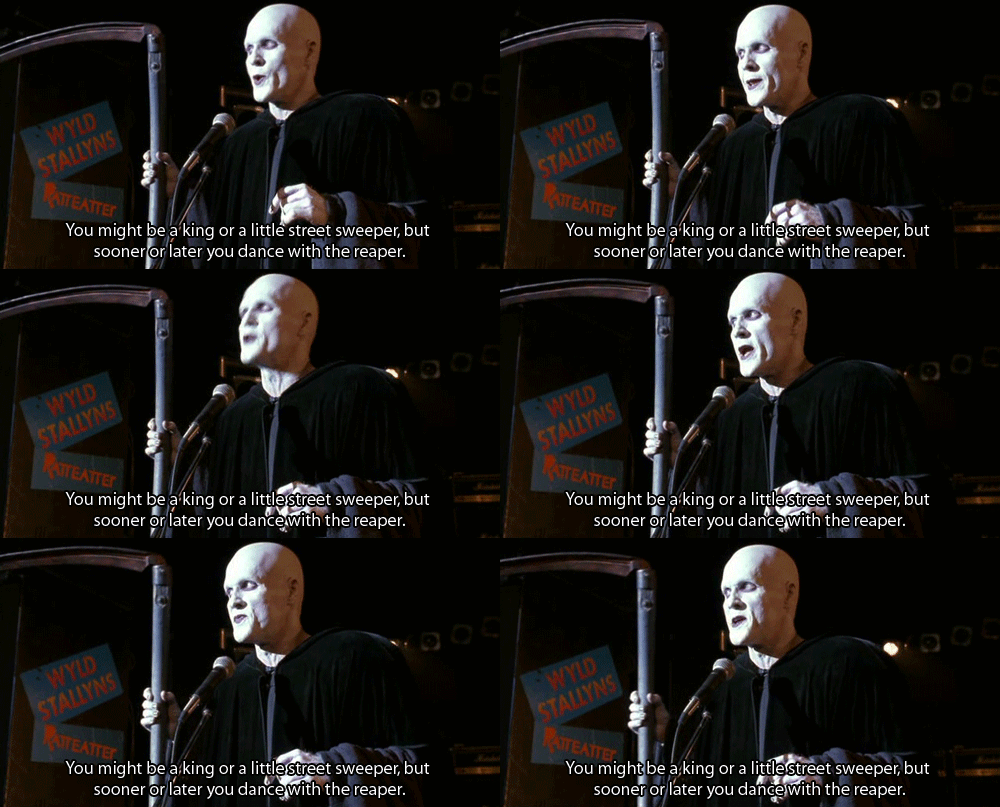
Think of him as uncomfortably numb to the point where he has to share this with the world -- or at least with his typewriter.
I have to be honest here -- this is not Bukowski's best poetry collection. This one gets repetitive and yet scatterbrained at times. This is one of the many poetry collections that came out after Buk died. I would love to know how these collections came about and why certain poems were published earlier than others.
I bought my copy from somewhere on Amazon selling used books. My copy came with a bonus -- a smell of aftershave, cigarette smoke and (I think) sandalwood. It's quite a masculine blend. I can't help but wonder where this book had been and what hands it had touched before arriving at my door. The smell is fading now, which is a shame. It's a smoky smell for smoky poems of living on the fringes of live, being baffled by fame and looking forward to death.

December 8, 2023
A bulky posthumous collection of Bukowski poems written from 1970 to 1990, "Open All Night" is a testament to the poet's ability to produce, even if the product is inconsistent. In the beginning, I was struck by Bukowski's uplifting talent for using simple language and simple situations to conjure up not-so-simple epiphanies. Nothing I'd post on the refrigerator door for re-reading perhaps but consistently enthralling enough to not feel put off by this book's length: 350+ pages. (For most poets, that's the collected works!) What was the secret to his magic, I wondered. How did he manage to deliver these flashes of quiet insight and enlightenment in poem after poem... And why did that magic leave for the last third of this tome? Was it that Bukowski was writing disposable verse? And by disposable I don't mean useless! Consider the match, a tissue, the cheap umbrella bought when it suddenly starts to rain. Was Bukowski -- at least here -- simply recording that night's thought or memory or reflection, then, once he'd put it down on paper, moving on. And when the muse had left the building, was he putting whatever down on paper, too? Do we imitate ourselves at the end?

September 2, 2021
Before the review know this book was actually more of a 4.8. Though a fan of Bukowski, I began reading this book with trepidation. It was published posthumously. This usually means with was an assortment of works that were not chosen for publication during his lifetime. This is usually a bad sign. This work however was bits and pieces that Bukowski chose himself.
As I began to read the words leapt off the page filled with a vibrancy and rhythm lacking from some of his later works. The majority of the poems are devoid of maudlin reflection that can be found in some of his later publications. A hopeful cynicism accompanies many of these pieces. Yes, some old topics like the racetrack are revisited, but all in all the works do carry a life.
In summary this is a solid tome that should be considered for exploration.
As I began to read the words leapt off the page filled with a vibrancy and rhythm lacking from some of his later works. The majority of the poems are devoid of maudlin reflection that can be found in some of his later publications. A hopeful cynicism accompanies many of these pieces. Yes, some old topics like the racetrack are revisited, but all in all the works do carry a life.
In summary this is a solid tome that should be considered for exploration.

April 7, 2020
Published after his death, so always the question of whether inclusion and editing were done with or with out his approval...but no worries, all is quality stuff from the master. And surprisingly, after his usual literary flame-throwing, Bukowski seems slightly uplifting in some of these, which were written around the time of his imminent death from leukemia.
February 25, 2024
„the angels pissed themselves in fear.
I am a beautiful person.
and you are.
and she is.
as is the yellow thumping of the sun and the glory of the world.“
Hymn from the hurricane was a great one. Other than that, this didn‘t exactly blow my mind. I have a love-hate-relationship with Bukowski and I would place this collection on a sort of indifferent middle ground.
I am a beautiful person.
and you are.
and she is.
as is the yellow thumping of the sun and the glory of the world.“
Hymn from the hurricane was a great one. Other than that, this didn‘t exactly blow my mind. I have a love-hate-relationship with Bukowski and I would place this collection on a sort of indifferent middle ground.
February 11, 2019
I laughed through most of this. Bukowski is a dark, hilarious genius.

August 10, 2019
Bukowski ile tanışamadım, ama Avi Pardo ile tanışma umuduyla :)

December 30, 2019
Felt like the poems were lukewarm. Not a favorite.

July 21, 2020
Covering hookers horses and boozing
August 30, 2021
last faves (check out my previous updates for the others)
Schubert
As much as I hate to use the "f" word
Schubert
As much as I hate to use the "f" word

January 19, 2023
I need a beer.

September 24, 2024
You either hate him or love him, for me it is the latter. He was so Raw...My journey with reading his material is far from over......

March 7, 2017
I remembered almost 3 years ago, a friend asked why I liked Bukowski so much, while he couldn't even finish reading one Buk's poem. I told him I liked Buk because he presented the world around him as it is. All is not sunny in this reality and that's okay. Most of the times, reality is dirty (just like his genre: dirty realism) but that's totally fine. With a lil bit of humor, we will pass it gracefully. That's how I see his poems.
My favourite poem in this collection is Yes, I am. He could be romantic every once in a while.
"I like sleeping up against a body that I know well.
I take much pleasure in being alone, but there is also a strange warm grace in not being alone."
My favourite poem in this collection is Yes, I am. He could be romantic every once in a while.
"I like sleeping up against a body that I know well.
I take much pleasure in being alone, but there is also a strange warm grace in not being alone."
October 24, 2017
Some people don't read poetry . . . not a poetry book on their Goodreads review page. But then we can also consider this: on my last review, a poetry book, The Collected Longer Poems of Kenneth Rexroth . . . my review was the third (3rd) review of that book on Goodreads, published far before Bukowski's, while the Bukowski has 21 reviews . . .
Is Bukowski more accessible? Followed by . . . whatever that means. I was always a little skeptical of the Bukowski cult, though I have come to appreciate him (see my other reviews of his novels). His life story, the story of his career as a writer is noteworthy. He is an original, if an aberrant original, if rubbing-you-the-wrong-way kind of original, but he does well unapologetically encapsulating his dissipation in extremely readable prose.
The guy paid his dues . . . it is my understanding that he wrote for years and years, submitting to various magazines and was rejected over and over, gave up writing prose, wrote poetry for years and years, was accepted and acknowledged in the small poetry magazine world and was then offered a contract with Black Sparrow, which REALLY got his career as a writer going.
Bukowski doesn't, on the surface, appear like he would be dedicated to poetry, but he amassed this collection for posthumous publication. The poems are typical for his themes; it's to be expected that in one poem he declares that he has a photograph of Celine hanging above his typewriter. Many of the poems express his fidelity to his typewriter, the one thing he can return to over and over, a refuge . . . but then . . . . the poem fill in his dreaded interludes with writer's block.
The poems are engaging for a spell, full of bitterness for the work-a-day world, in fact down right misanthropic, even disparaging of his "fans" . . . I got through three quarters of this volume in a matter of days, impressed, and then began to think, "OK, Chinaski, enough with the self-pity . . . "
Is Bukowski more accessible? Followed by . . . whatever that means. I was always a little skeptical of the Bukowski cult, though I have come to appreciate him (see my other reviews of his novels). His life story, the story of his career as a writer is noteworthy. He is an original, if an aberrant original, if rubbing-you-the-wrong-way kind of original, but he does well unapologetically encapsulating his dissipation in extremely readable prose.
The guy paid his dues . . . it is my understanding that he wrote for years and years, submitting to various magazines and was rejected over and over, gave up writing prose, wrote poetry for years and years, was accepted and acknowledged in the small poetry magazine world and was then offered a contract with Black Sparrow, which REALLY got his career as a writer going.
Bukowski doesn't, on the surface, appear like he would be dedicated to poetry, but he amassed this collection for posthumous publication. The poems are typical for his themes; it's to be expected that in one poem he declares that he has a photograph of Celine hanging above his typewriter. Many of the poems express his fidelity to his typewriter, the one thing he can return to over and over, a refuge . . . but then . . . . the poem fill in his dreaded interludes with writer's block.
The poems are engaging for a spell, full of bitterness for the work-a-day world, in fact down right misanthropic, even disparaging of his "fans" . . . I got through three quarters of this volume in a matter of days, impressed, and then began to think, "OK, Chinaski, enough with the self-pity . . . "
May 26, 2007
some of my favorite poems from this fine collection.
"this is a fact"
in the company of fools
we relax upon
ordinary embankments,
enjoy bad food, cheap
drink,
mingle with the men and
ladies from
hell.
in the company of fools
we throw days away like
paper napkins.
in this company
our music is loud and our
laughter
untrue.
we have nothing to lose
but our selves.
join us.
we are now
almost
the entire
world.
God bless
us.
"stark dead"
pretentious pap smeared on sanctified
walls
again and again
until almost everybody believes it is
viable.
affectations of the centuries accepted
as Art.
beware the textbooks, beware the libraries,
beware the galleries,
beware the father and the teacher.
beware the mother.
we are born into a civilization which is stunned
by overwhelming mediocrity.
what is placed before us is artifice, an
illusion, a lie.
the womb has spilled us into a sewer.
new gods are needed.
new doors must be opened.
we have waited so long for so little.
we must rip the enclosures open.
the dark stinks of us,
here.
"we can't"
we can't win
it
we know we can't win
it
do right and win
it
do wrong and win
it
somebody else is going to win
it
it will happen
but to accept it is
impossible
like a cat I once saw killed and
skinned before my
eyes.
and the human
faces
watching.
"this is a fact"
in the company of fools
we relax upon
ordinary embankments,
enjoy bad food, cheap
drink,
mingle with the men and
ladies from
hell.
in the company of fools
we throw days away like
paper napkins.
in this company
our music is loud and our
laughter
untrue.
we have nothing to lose
but our selves.
join us.
we are now
almost
the entire
world.
God bless
us.
"stark dead"
pretentious pap smeared on sanctified
walls
again and again
until almost everybody believes it is
viable.
affectations of the centuries accepted
as Art.
beware the textbooks, beware the libraries,
beware the galleries,
beware the father and the teacher.
beware the mother.
we are born into a civilization which is stunned
by overwhelming mediocrity.
what is placed before us is artifice, an
illusion, a lie.
the womb has spilled us into a sewer.
new gods are needed.
new doors must be opened.
we have waited so long for so little.
we must rip the enclosures open.
the dark stinks of us,
here.
"we can't"
we can't win
it
we know we can't win
it
do right and win
it
do wrong and win
it
somebody else is going to win
it
it will happen
but to accept it is
impossible
like a cat I once saw killed and
skinned before my
eyes.
and the human
faces
watching.
April 24, 2019
It's always difficult with a posthumous collection (especially poetry) to know how close to the author's original intent the published work actually is. I've read something to the effect that Black Sparrow changed things quite a bit from the originals when publishing these works, but what I'd say is that this collection could have been so much more by just being a little bit less - there are easily 50 pages of straight up "filler" here, pieces that read like a journal entry with line breaks more than a "poem" (in anyone's definition). There's no way he could have intended for all of these pieces to be published.
However, there are also some gems, and a lot of lines which occasion a chuckle, a shake of the head, and a "Well, that's Buk". For me, the most important pages of this book come towards the end, when we see a write very much aware of his impending demise, reflecting on what that means to him and to the world. (Bukowski wrote like a 70-year old when he was 35, but actually hearing him reflect on being 70 is a different thing)
However, there are also some gems, and a lot of lines which occasion a chuckle, a shake of the head, and a "Well, that's Buk". For me, the most important pages of this book come towards the end, when we see a write very much aware of his impending demise, reflecting on what that means to him and to the world. (Bukowski wrote like a 70-year old when he was 35, but actually hearing him reflect on being 70 is a different thing)
February 19, 2014
"stark dead"
pretentious pap smeared on sanctified
walls
again and again
until almost everybody believes it is
viable.
affectations of the centuries accepted
as Art.
beware the textbooks, beware the libraries,
beware the galleries,
beware the father and the teacher.
beware the mother.
we are born into a civilization which is stunned
by overwhelming mediocrity.
what is placed before us is artifice, an
illusion, a lie.
the womb has spilled us into a sewer.
new gods are needed.
new doors must be opened.
we have waited so long for so little.
we must rip the enclosures open.
the dark stinks of us,
here.
Quite possibly one of greatest collections of his poems. Every song is filled with such brutality, honest and raw truth, maybe a bit more than in his other collections.
pretentious pap smeared on sanctified
walls
again and again
until almost everybody believes it is
viable.
affectations of the centuries accepted
as Art.
beware the textbooks, beware the libraries,
beware the galleries,
beware the father and the teacher.
beware the mother.
we are born into a civilization which is stunned
by overwhelming mediocrity.
what is placed before us is artifice, an
illusion, a lie.
the womb has spilled us into a sewer.
new gods are needed.
new doors must be opened.
we have waited so long for so little.
we must rip the enclosures open.
the dark stinks of us,
here.
Quite possibly one of greatest collections of his poems. Every song is filled with such brutality, honest and raw truth, maybe a bit more than in his other collections.
June 21, 2008
Bukowski's raw and raunchy poetic ramblings about his drunken, prostitute-filled life on skid row LA is the opposite of what I thought I'd ever like. He tells it like it is and does not candy coat. His repulsive life style is redeemed with his many ode's to his one true love, Jane. For me, one who will hopefully never live the life that Bukowski writes about, I actually enjoy taking a mental romp down those harrowing streets and living for a few poems that dirty life, relishing the feeling that I'm doing something forbidden.
A favorite poem from this selection is "Swivel Chair," I couldn't help myself from laughing out loud.
A favorite poem from this selection is "Swivel Chair," I couldn't help myself from laughing out loud.
Displaying 1 - 30 of 43 reviews