Steven Zaloga is an author and defense analyst known worldwide for his articles and publications on military technology. He has written over a hundred books on military technology and military history, including “Armored Thunderbolt: The US Army Sherman in World War II”, one of the most highly regarded histories of the Sherman Tank. His books have been translated into Japanese, German, Polish, Czech, Romanian, and Russian. He was a special correspondent for Jane’s Intelligence Review and is on the executive board of the Journal of Slavic Military Studies and the New York Military Affairs Symposium. From 1987 through 1992, he was the writer/producer for Video Ordnance Inc., preparing their TV series Firepower. He holds a BA in history from Union College and an MA in history from Columbia University.
Mr. Zaloga is also a noted scale armor modeler and is a host/moderator of the World War II Allied Discussion group at Missing-Lynx.com, a modelling website. He is a frequent contributor to the UK-based modeling magazine Military Modelling. He is a member of the Armor Modeling and Preservation Society.
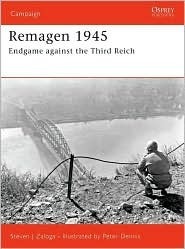
"Remagen 1945" is one of the numerous Osprey titles about the European war front in 1945 by author Steven J. Zaloga. I think he is one of the best Osprey Publishing-related authors and I thoroughly enjoyed this book. Zaloga clearly lays out the way that events occurred in March and April of that year, culminating in the defeat of Germany. Excellently detailed theater-wide maps are provided on pages 6 and 66, showing where the various armies of the Allies and Germans were operating at this critical time, supplemented by closer-scaled operation-sized maps and "birds-eye" view maps of important battles. Osprey "Campaign" titles are somewhat thin volumes for the money spent, but they are best read very deliberately, allowing the reader to match the text with the maps, unit by unit as desired. The accompanying photographs and very nice original art, in this case by artist Peter Dennis, are always relevant to the story-line.
The opening map shows the situation in the war at the beginning of March. The Allies were pushing hard, Eastward, toward the Rhine River after recovering from the Germans' Ardennes Offensive. There were three powerful Allied army groups ranging from North to South just west of the Rhine: Field Marshall Bernard Montgomery's British 21st Army Group, in Holland, was bordered on its south end by General Omar Bradley's 12h U.S. Army Group. South of the 12th Army Group was the U.S. Sixth Army Group under General Jacob Devers.
Bradley's Army Group consisted of the Ninth Army, situated in Holland and led by General William Simpson; the First Army, situated in Belgium, under General Courtney Hodges; and the Third Army, situated in Luxembourg under General George Patton. Although the three armies of the Group were immediately adjacent to each other, North to South, Bradley only had command of two of them at the present time, because the Ninth Army was temporarily on loan to Montgomery in order to beef up his forces for his upcoming planned attempt to cross the Rhine. The bulk of this book is devoted to the actions involving the Ninth, First and Third Armies.
Much more was going on during the month of March regarding the Allied drive to the Rhine. Numerous major actions had taken place in February, and would also occur during March, after the actual capture of the only intact remaining bridge across the Rhine at Remagen. These events are thoroughly covered in the excellent Osprey title "The Rhineland: 1945" by author Ken Ford.
It's interesting to see the different interpretations of the operation of the Allied armies from British and American authors. Montgomery was preparing to launch a large set-piece invasion across the Rhine at Wesel in late March called Operation "Plunder." His never ending request for more American divisions to add to his force concerned General Omar Bradley greatly, since any Americans sent to reinforce the British army group would go at his expense.
Bradley's need to preserve his forces under his command became more urgent when the Americans found an intact bridge crossing the Rhine at Remagen on March 7th. The American capture and use of this bridge is one of the great stories from World War II and Zaloga does a superb job of objectively recounting how American and German forces reacted to this Allied windfall. The First Army started pushing divisions across the bridge, and Army engineer-built bridges adjacent to it, although it was not in an area geographically well-suited to large scale armored division movements. As a result, the Remagen bridgehead seems to have been given a status of being a curiosity, but not ultimately critical to winning the war in the British viewpoint. This view may have been reinforced by the initial American need to decide exactly how to exploit the windfall, and the ultimate collapse of the bridge after ten days of being subjected to heavy American usage while the Germans threw everything in the arsenal against the position, including ballistic missiles and jet aircraft. Zaloga shows how this breakthrough became the foundation for American operations across the Rhine which became as critical to success as those conducted by Montgomery.
However, it would be several weeks before any of the Allies would be able to cross the Rhine in large enough numbers to accomplish their objectives eastward. There were still many German forces west of the Rhine, south of Remagen, because their higher headquarters were still pressing for counterattacks against the Americans. Toward the aim of neutralizing the German forces which were concentrated heavily in the Saar Palatinate, an area straddling the Third Army of the 12th Army Group and the Seventh Army of the 6th Army Group, Bradley implemented Operation "Undertone". Sticking to the plan, Patton's Army "bounced" across the Moselle River on its southeastern flank, and raced to envelop the German Army Group G while General Patch's Seventh Army broke through the German Saar Westwall fortifications. In two weeks in March, the remnants of the German units were sent scurrying back across the Rhine in the wake of the loss of 90,000 of its force captured and many thousands killed; the German Seventh Army was almost completely destroyed.
This German collapse in the face of rapid, aggressive American armored strength provided the evidence Bradley needed to convince Supreme Commander Dwight Eisenhower to stop allowing Montgomery to detach American divisions for his use, and to devise a strategy for the maximum use of American units under the command of American generals for the purpose of fighting across the Rhine. Operation "Undertone" therefore gave way to Operation "Voyage". Toward this end, Patton's forces were able to start crossing the Rhine on March 22nd at Oppenheim between Mainz and Worms. As predicted, German units were too weak and disorganized to mount a counter assault.
The British-led "elephantine extravaganza" (p. 89), as Zaloga would describe Operation "Plunder" was let loose by Montgomery on the 24th. By the 26th, Patton's forces had consolidated their bridgehead and the American Third Army was on its way to link up with the American First Army at Giessen where access to the Autobahn would be possible. By the 28th, the U.S. Ninth Army was across the Rhine at Vesel and on its way toward Kassel to envelop the Ruhr Industrial Region via a link-up with the First Army. Toward that objective, the First Army was directed to neutralize the area around the village of Paderborn. The Germans were able to muster together armored units, including some supplied with Kingtiger heavy tanks and "let the Devil loose" (p. 80) against the Americans, causing heavy damage during March 30.
The First and Ninth Armies would envelop the Ruhr Pocket completely by Easter Sunday, and the entire area would be the site of battles until April 18. Field Marshal Walter Model's Army Group B would be destroyed, with 317,000 German soldiers surrendering to the Allies. As Zaloga has shown, Remagen started the momentum for the U.S. Army to show that the war would be brought to a quicker end by adapting to crises caused by the rapid disintegration of the Wehrmacht at this time. As the book reveals, it was the 12th Army Group and not the 21st that conducted the Ruhr encirclement.
A detailed account of the capture during the waning years of WWII of the strategic bridge at Remagen, German which spanned the Rhine River. The book includes great detail of the location and movement of the various US and Germany forces, artillery and strategy behind the taking of the bridge and the Allied campaign thereafter into Germany. An excellent account for WWII buffs.