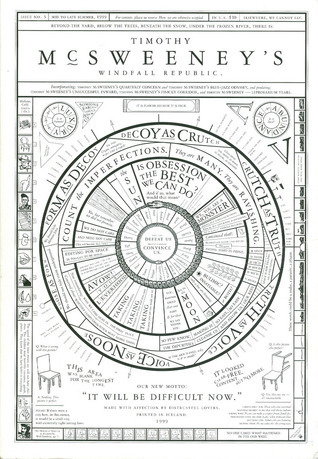
Yes, there's a use of the word "grimace" in this volume, and a use of the illiterate expression "honing in" (though it's in a direct quote, which can be justification), but still I encourage you to find a copy and explore the thing.
This was my first subscription copy of McSweeney's Quarterly Concern, after I found the second volume on a bookstore rack. I read bits of it the month it came, and it was influential, but distractions pulled me away. Older and wiser now, I am systematically reading all the issues, cover to cover.
This issue, like the previous one, has the manic squeezing of text into nooks and crannies everywhere, making the reading an adventure. There's a David Foster Wallace flash fiction on the spine, for crying out loud. This is cleverness-as-virtue, and imagination as an inside joke. It works for me.
Let me start with the article "Banvard's Folly. (Or, How Do You Lose a Three-Mile Painting?)". In the bio of this issue we are told that Paul Collins is working on a book entitled Loser: A Brief History of Noble Failures, and that this article is a chapter in it. Two years later, when the book actually came out, it was entitled Banvard's Folly: Thirteen Tales of Renowned Obscurity, Famous Anonymity, and Rotten Luck. It's about one of those huge paintings that were popular long ago, which were displayed in huge barns or specially built structures. If you've seen the Cyclorama at Gettysburg, you've seen one.
Because I knew a couple of these huge works of art, I paid special attention to this story, which is labeled, in tiny print, a "true story" but which reads like fiction the whole time. Not too long ago I was reading another article that was also in a McSweeney's and bought the book, because it, too, was fascinating. So, go ye and find this issue of McSweeney's and find Collins's book, too.
The front matter of this early volume is three pages of tiny print, and ridiculous as all get out. It makes the masthead, subscription information and submission guidelines a stitch to read. Submission margins are to be one inch all around "unless your piece is about animals who do funny things, in which case the margins should be one-half inch on all sides except the bottom, the margin for which should be two inches." The Letters section includes such correspondents as David Shields, Jonathan Lethem, Sarah Vowell and Camden Joy; and I realized as I read it that this was an artform all its own.
I also read Chris Sorrentino's "The Organ Grinder" back in 1999, when I first possessed this volume, and I think the combined amusement and distraction overwhelmed me at that point. I put #3 on the shelf, and didn't get back to it until recently. The remainder of this madcap volume did not disappoint. There are serialized stories (serialized within the volume), there's a "Note about the Type" at the end that turns into a short story that has to be continued into earlier pages. There are two blank pages just before the Note labeled Complaints. (And yes, it immediately reminded me of Laurence Sterne.) There are fake advertisements. There's an interview about physics. There's a discussion of growing spider silk in goats. There's the fraught tale of Santa Claus's son, and the mistake he made going back home for a visit.
There is one of my favorite story titles: Lucy Thomas's "This Story Is Small Because I Am Not Sure It Is Good" which is particularly effective when printed, as it is here, in something like 9pt type, with the story text at half that size.
In sum, this early volume typifies the phenomenon of McSweeney's As Adventure.
I vote yes.